
I just finished reading Tolkien’s epic The Silmarillion. I’m proud of that because it took me a few tries to get rolling. But once it started becoming clearer to me what was happening, who was who, and the overall point of everything, I found it to be a stunning work of genius that is unmatched in scope, attention to detail, and craftmanship.
If you’re into the Peter Jackson movies or love The Hobbit or Lord of the Rings books but have been side-eyeing The Silmarillion like I was, I think I can help with that. If you don’t really know what this insanely impressive book even is, I can help with that as well, and explain why you might want to consider taking the plunge and reading it. (There are spoilers here, but I wouldn’t even recommend reading this book without knowing a few things first if you expect to follow the big picture).
My point with this two-part set of articles is to give you a few tips that can make the going easier in reading it. Then I’ll land on what Tolkien was actually planning for a sequel and which direction he might have taken that should he have actually determined to press ahead.
Cool?
What is The Silmarillion?

J. R. R. Tolkien was one of the finest writers to ever work in the English language. He was one of the first true detailed worldbuilders, and in large part may have invented that craft itself. His main interest in the beginning was inventing fictional languages, and the worlds at the heart of the Lord of the Rings and related works were just places to house them. In The Hobbit, Fellowship of the Ring, The Two Towers, and Return of the King, we get glimpses and casual mentions of incredible events and the long, rich history of Eä, a fictional universe which contains Middle Earth (among other places). The Silmarillion is an opus of the mythology from creation of these worlds up to the end of their ages leading to our own.
What’s good about it?
Oh, man, are you in for some of the most incredible imagery and ideas, fiery wars on a mythological scale that altered the very shape of the earth, fascinating characters fleshed out like real people but strutting larger-than-life on a stage of unimaginable fireworks! They might seem disconnected as you read them, but it all has a point. Practically everything you might love about the more famous books, every place you remember from them, has a history and reason for being. The giant spider that captures Frodo, the fiery balrog that killed Gandalf, why there are wizards at all, who built Minas Tirith, who was Sauron and what he really wanted (he wasn’t the first dark lord), why there is evil in this world, where elves and men came from & why they don’t like each other, why elves are fading, where they’re all going in the west, and on and on. It’s all made clear and hangs together tightly like a masterpiece tapestry while it tells an incredible story. In fact, the events of the more famous books are like footnotes here. There’s so much of a bigger picture going on than the rings and Sauron!
It’s genius, man. That’s what I’m saying. Genius.
Summarize it a bit, then. And give some tips on what’s important.
A creator god invites his supernatural beings to begin singing, though one among them strays into his own musical themes to suit himself rather than following the creator god’s lead (Melkor, one of the most important through-lines of the entire book and eventually the original dark lord). It turns out, their very music is creating Tolkien’s fictional universe, and all its long history, everything that ever will happen in it, is just that original music playing out. The creator god offers for them to enter into this new universe, and some take the invitation.
This new world is waking up with life and light, and the beings that entered it build a magical place called Valinor. Very much of what happens in The Silmarillion, and what is going on behind the scenes in the later books relates to this magical land to the west. Pay attention to everything that happens in Valinor and any time somebody enters there or leaves there.
Elves are the first newly created beings to appear in this world (in a place outside Valinor called Middle Earth), and most of action of the book is telling their early history. Most of the characters are in fact various types of elves, split up by various events and decisions and so with different tribal names. But elves nevertheless. Humans come into the picture, though a bit later and ultimately are the point of the music and everything else.
And the jewels?
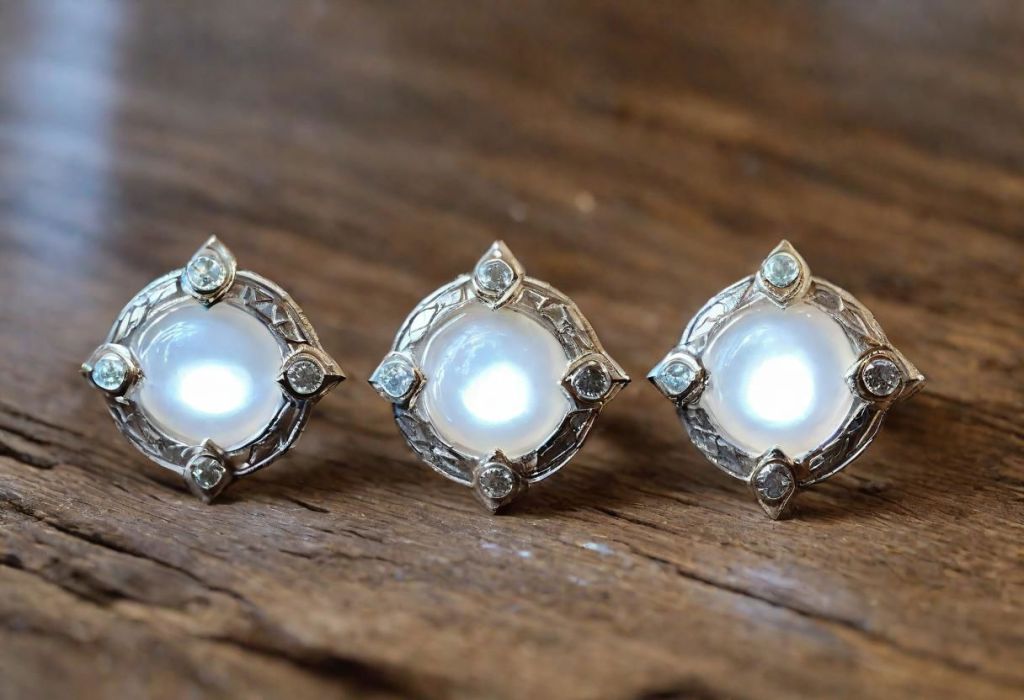
Three magical jewels (called the silmarils) are created by a craftsman elf (Feonor), and that drives an incredible chain of events that serve as the backbone of practically everything that happens. Pay close attention to Feanor, why the jewels glow like that (light from the trees of Valinor), what happened to those trees (Melkor’s dark deeds), and the terrible oath sworn regarding who will own these jewels. That’s the engine of the story, these jewels. That’s why the book is called what it is.
One family tree is really core to the book. This one:
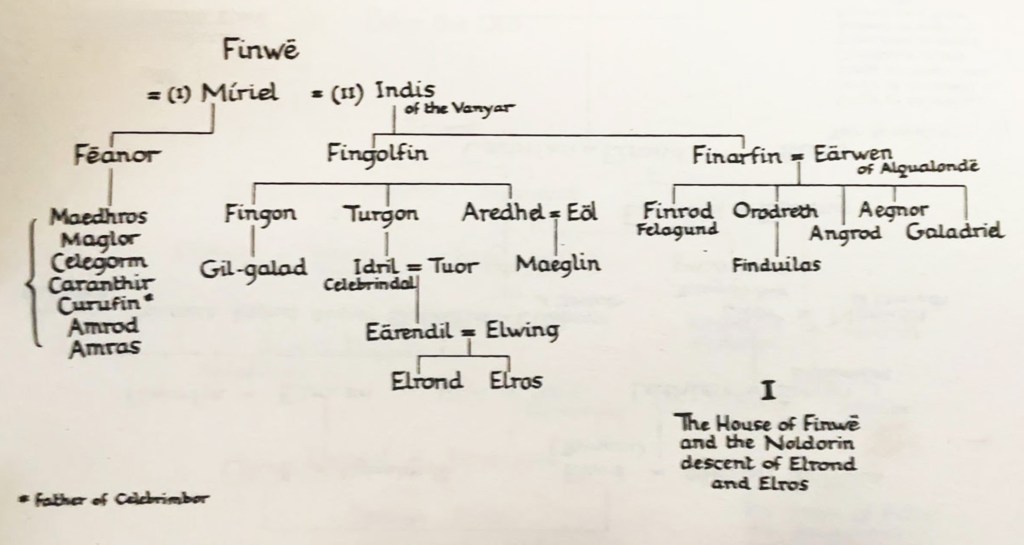
Feanor made the jewels – he and his sons swear the oath, which carries supernatural weight and leads to the dooms of many. For anybody that chases those jewels, there are problems. In this family tree, there’s a connection eventually to the rings of power (Celebrimbor), Elrond and Galadriel (who you know from the movies), and a lot of the main events that happen in The Silmarillion. Aragorn traces his ancestry back to here as well. A lot of people are turned off by the firehose blast of names in this book (and I get that), so ticking off a few important names for yourself (and a few important places) is key in enjoying the book. Feanor and his sons matter a lot.
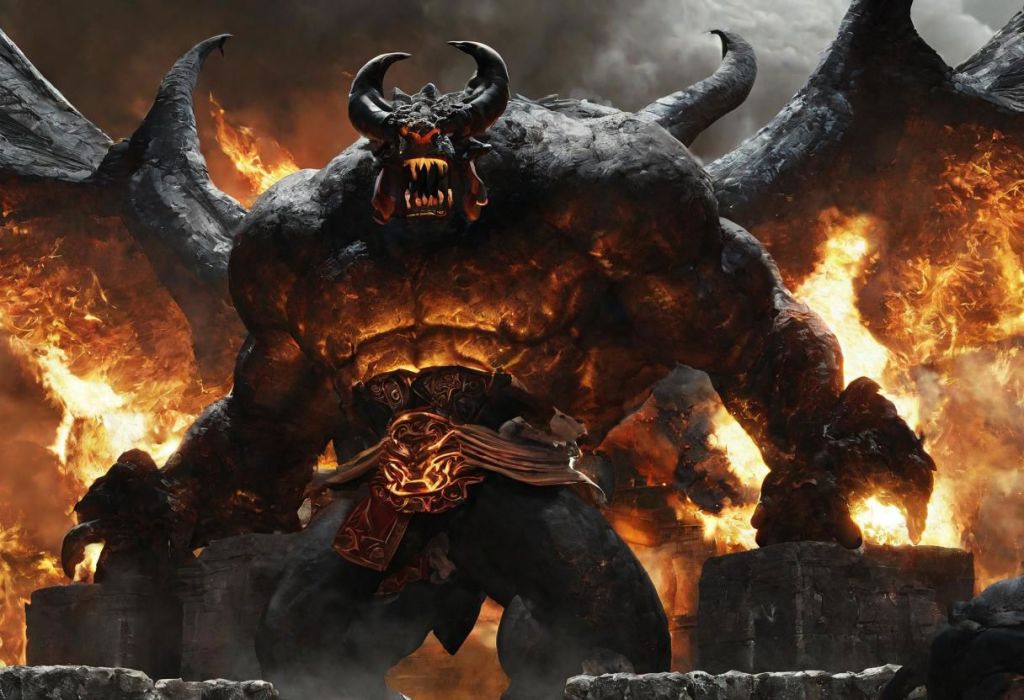
Over a biblical scale of time, long-lived elves (occasionally with supernatural help) fight Melkor and his dark armies of beasts. Here, you get orcs, balrogs, and the first dragon (who you get to watch grow up), werewolves, and giant spiders. Earthshaking battles and incredible conflicts rage, often to deal with Melkor’s evil or to struggle for those jewels.
Wait. Werewolves?
There are werewolves in Tolkien, yes. They’re mainly in the story of Beren and Luthien which is one of the most central parts of the entire tapestry. It’s a story that is gorgeous and mythical. Let me blow your mind a bit, if you didn’t know this:
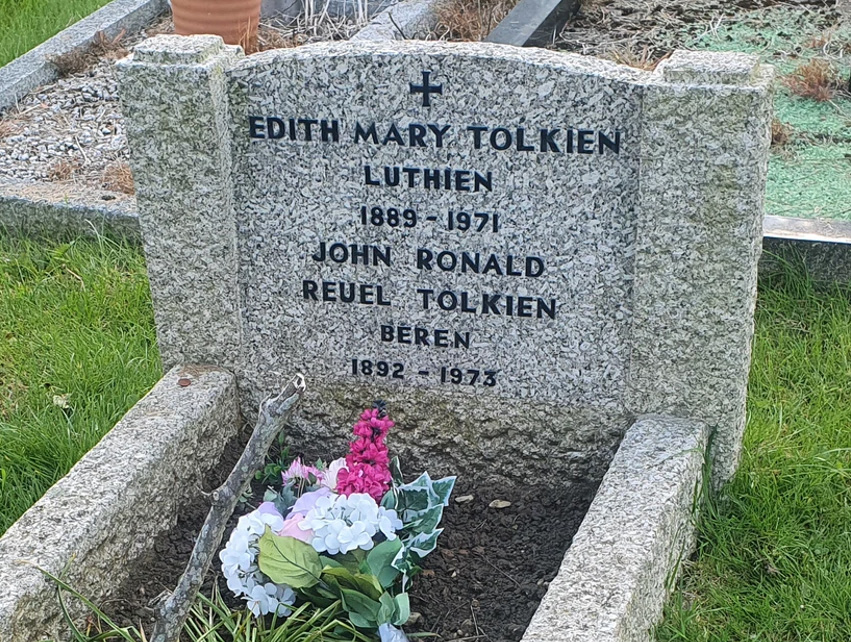
That’s the gravestone for Tolkein and his wife. Here’s a quote from the Tolkien society:
“…the story has a personal significance to Tolkien. In 1917, a young Ronald (as Tolkien was known) saw his wife Edith dancing in a glade near Roos, Yorkshire; this scene was the germ of the story as Beren also first espies Lúthien whilst dancing in Doriath.”
[Beren And Luthien is available as a standalone book itself, which I’ve also read, and it’s worth your time as well. This is even more of a composite study done by Tolkien’s son than The Silmarillion, and is a bit more like piecing the tale together through notes than a somewhat polished work.]
Beren is human, Luthien, elf, and her father challenges Beren to bring him a silmaril for her hand. Unfortunately, the dark lord himself has all three of them by this point embedded in his crown where he sits on a throne in a dark and impregnable fortress protected by every manner of vile beast you can imagine and endless armies of orcs. This part of the story is key, so key in fact that Aragorn tells it to Frodo, as they are his ancestors.
Wrap this up, then. How does The Silmarillion end?
This book is a world, so it isn’t really that simple. There are several threads going on tangential to the big picture, like the Atlantis city of Numenor and its upheaval, the hidden city of Gondolin and its fall, and the tragedy of Hurin and his children (also available as a standalone work and also worth your time). I name these threads for a reason – pay attention to Numenor’s role and why it was destroyed, how and why Gondolin was destroyed, and Hurin’s son, Turin and his adventures. Still, they’re like side quests.
However, The Silmarillion tells at last of the fall of Melkor and the eventual fate of the silmarils. If you just keep your eye on Melkor (also named Morgoth) and the silmarils, you’ll get the main flow of everything going on with this incredible book. Towards its end, there is a concise summary of events leading up to the world we know from the more famous books.
Okay, so what was that you said about a sequel to Lord of the Rings that Tolkien was planning?
Ahhh, that’s interesting. It will be the point of the second part of this set of articles. A year and a half ago, I found out Tolkien had begun writing a sequel to be called The New Shadow. The scrap of it that exists is chapter 16 in a compilation called The Peoples of Middle Earth.
That’s honestly why I went deep on Tolkien in the first place. I rewatched the six movies (extended editions) and read all these books I’ve mentioned here, originally because I wanted to solve the mystery for myself of what was going to happen in that sequel should the professor have gone on to continue the story as he at one point planned. He explained clearly why he stopped, so I’ll briefly recap that for you in the second part of this series.
But what’s more interesting for me is where he would have taken the tale if he’d really decided he would press on with it. I believe he would have returned to the background of The Silmarillion, the big picture of that music from the very beginning and how it decided everything that was to happen, and point of humanity’s coming into this world in the first place.
*
I hope this whetted your apetite should you have interest in this amazing book. If it helped, let me know. If you love the book already, let me know that too. It was a transformative experience for me, going this deep into such a rich world.
Till next time,

 Grailrunner Publishing
Pingback: Uncovering The Plot Of Tolkien’s Unwritten Sequel To “Lord Of The Rings” | Grailrunner Publishing
Pingback: A creator of souls and the original literary universe | Grailrunner Publishing