
One of my first obsessions was Larry Niven‘s science fiction. Back in the day, we had a pool table in a big living room where the air conditioning was a box unit embedded in the wall. That AC made the most comforting white noise you could imagine, and to lay on my belly under that pool table reading A HOLE IN SPACE, NEUTRON STAR, CONVERGENT SERIES, RINGWORLD, and PROTECTOR (still on my shelf, so I can read off the names for you) was amazing.
I knew he was extrapolating from hard science. Some of what he was describing was just beyond my reach, but I could make out enough at 10 or 12 years old to know this was fascinating stuff. The naughty bits were cool too, and he seemed to revel in those things. I was his target audience.
Then in probably 1983 or 1984, I talked my mom into buying me his latest: a book called INTEGRAL TREES.
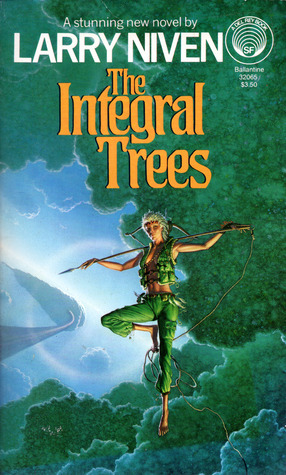
The text on the back hooked me entirely: “Critics long thought Niven would find it difficult to surpass his Hugo-winning novel RINGWORLD – the story of an artificial world, a ribbon of unreasonably strong material 1 million miles wide and 600 million miles long. They were right. Until now, that is. In THE INTEGRAL TREES Niven presents a fully fleshed culture of evolved humans who live without real gravity in the gas torus that rotates about a neutron star. This is the novel his fans have been awaiting!”
I remember flattening the hardback so I could make out the entire cover image to try and understand better what I was reading, and it’s a real dazzler by the great Michael Whelan:
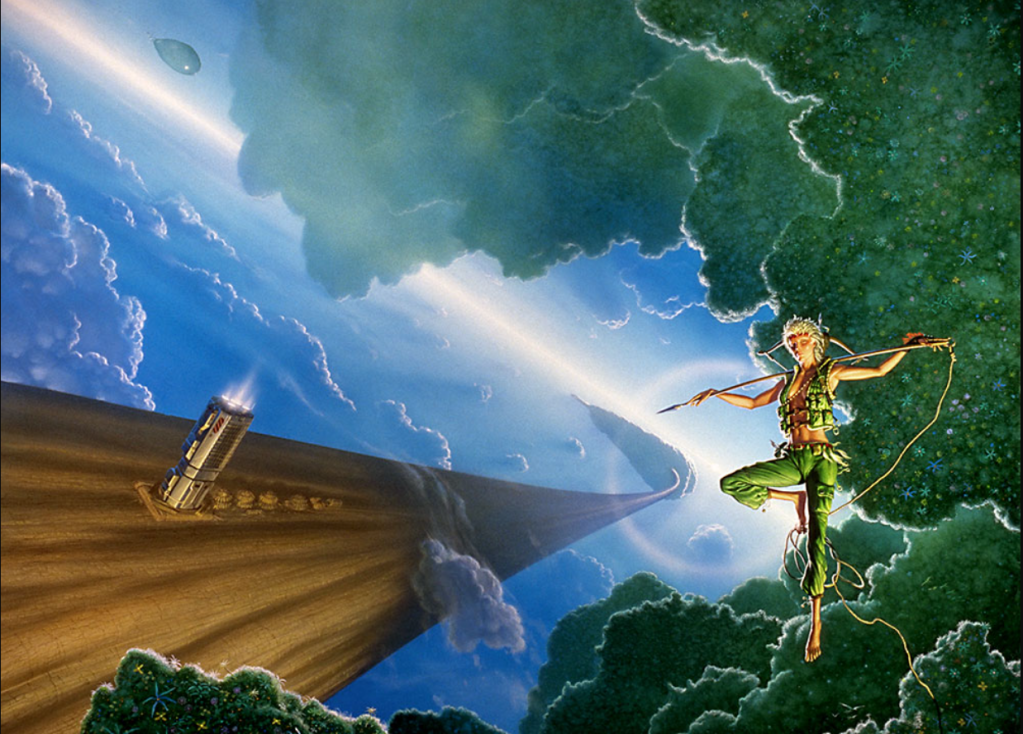
Unfortunately, I didn’t know what an integral sign was shaped like. I didn’t know what a “torus” or a “tuft” was, and even when I looked these things up in the dictionary (dictionary?!), I couldn’t visualize anything in what I was reading beyond people could float weightlessly. Honestly, it seemed this would be awesome if I knew even half of what these sciencey words meant, but I was 10. So I bailed.
I hated that book for years because of that. On a side note, I went on and earned a Physics degree and worked in nuclear engineering for a while, and now I’ve packed in another 40 years beyond when I first laid beneath that pool table to try and visit Niven’s fascinating setting.
For no other reason than I came across its title on Youtube randomly, a couple of weeks ago, it was time to try again.
I’ve finished THE INTEGRAL TREES as well as its unfortunate sequel, THE SMOKE RING, and I believe I’m prepared to describe the visuals and dynamics to you so you can have an easier time than my early self (and from what I understand from reviews and people on-line, many, many others!). I’m a big fan of environmental science fiction like RENDEZVOUS WITH RAMA, RINGWORLD, RIVERWORLD, SCAVENGER’S REIGN, and others, so if that’s you at all – hang on, here. There’s good and bad, my friend. Good and bad.
Let’s head to a faraway binary star system where a neutron star (Voy) and a Sun-like star play gravity tug-of-war with each other, locking in a dead planet (Gold). The planet had a thick atmosphere once, but that’s being stripped away by the tidal forces making a stable doughnut-shaped gas torus that, believe it or not, is breathable and inhabitable within a specific zone.
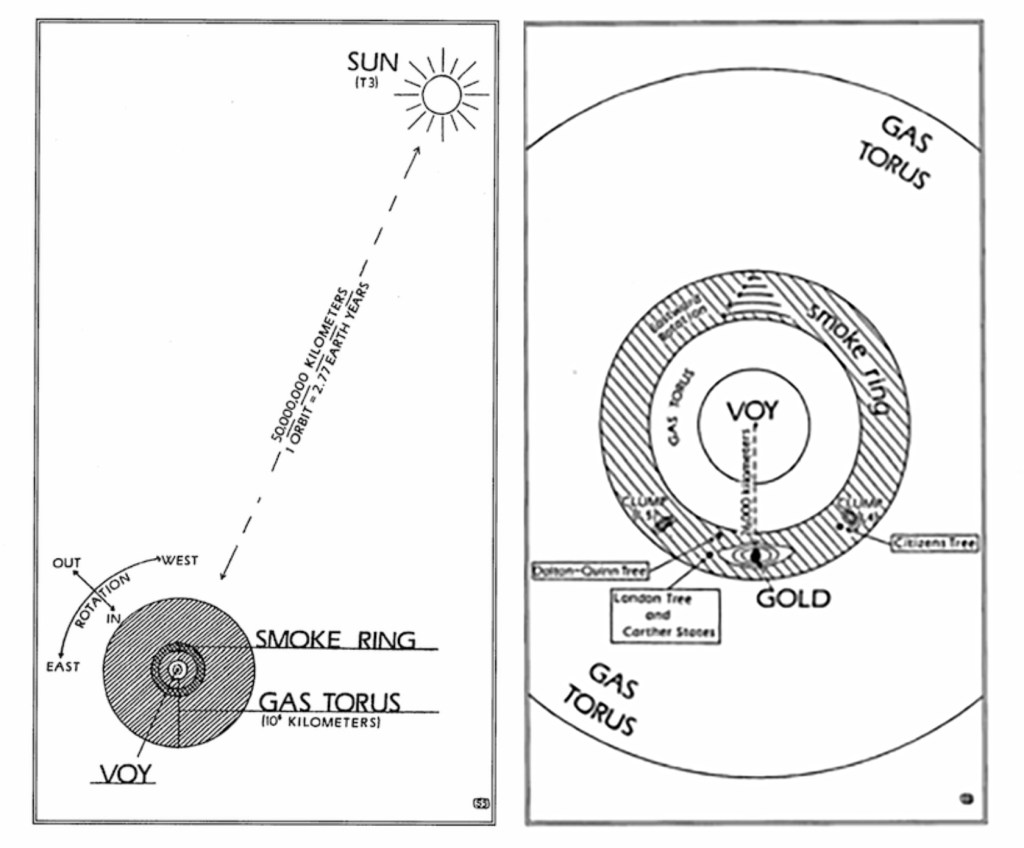
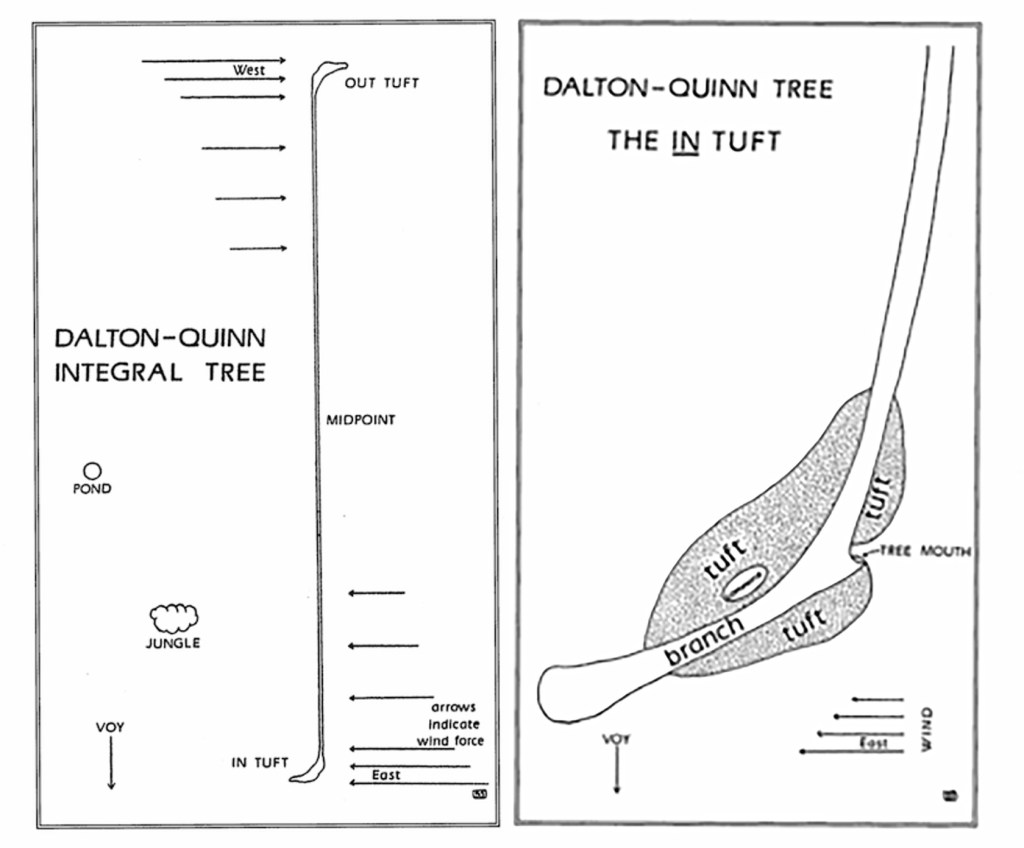
Picture yourself climbing up a thick tree canopy, in fact so thick that people have established tunnels through it and built huts inside. It’s easy for you, as gravity seems to be much lighter than you’re accustomed to here on Earth. You come up on an enormous tree limb and realize this is no normal tree. In fact, as you make your way along its length to the trunk, you find the trunk itself is so incredibly large it appears to be a flat wooden wall. It must be 60 miles long to have a trunk this size.
You press on, climbing upwards to find the top of the canopy and hopefully understand better where you are. There’s light up there, sparkling through the leaves. Bright clouds. Maybe a strong wind – you start to feel a stiff breeze against your skin. A wet mist, like that near a big waterfall, tickles the skin of your forearms as you approach the light. You poke your head up through the canopy and:

Indeed, the tree is bigger than you imagined, stretching into the distance above you as far as you can see, with a yellow sun way up there making a halo around its fuzzy far end. You squint and can just make out against the glare that the massive tree is bare along the bulk of its trunk above your canopy here though it appears to have a similar clump of foliage on the opposite side of the trunk from yours though that’s just a thin hair-like black silhouette to you this far away. The entire tree is shaped like a planetoid-sized elongated “S” with you clinging to the bottom left-hand curve of it. Your tree limb juts off the main trunk, though it’s so large a hundred others like you could just live here.
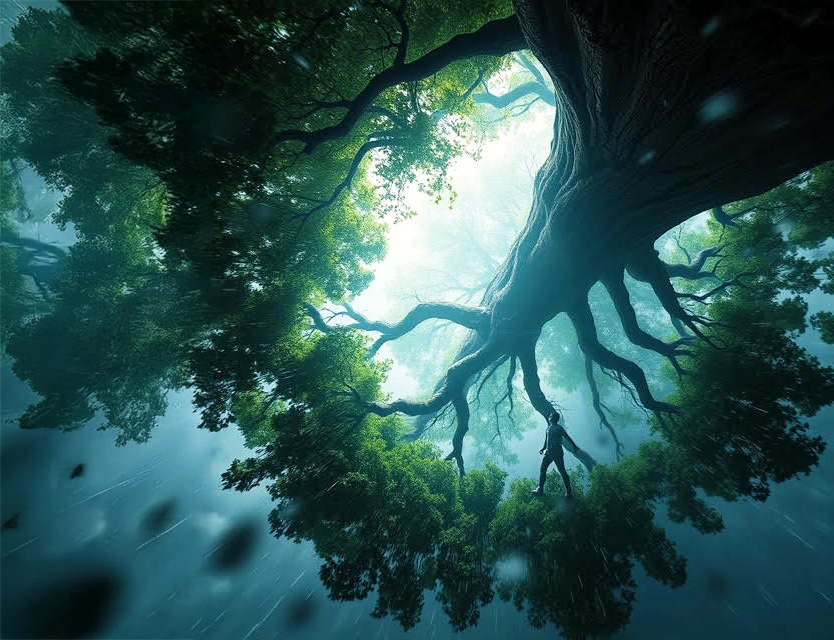
The wind against your face is strong and constant. You can squint against it, but honestly, it’s easier to just look in the opposite direction. That’s when you notice that the very sky here, blue and hazy and beautiful, is full of life and trees just like this one. In fact, perhaps thousands of such trees drift like spokes inside this gas ring and all around you, all oriented radially so they point down at the neutron star far below your feet.
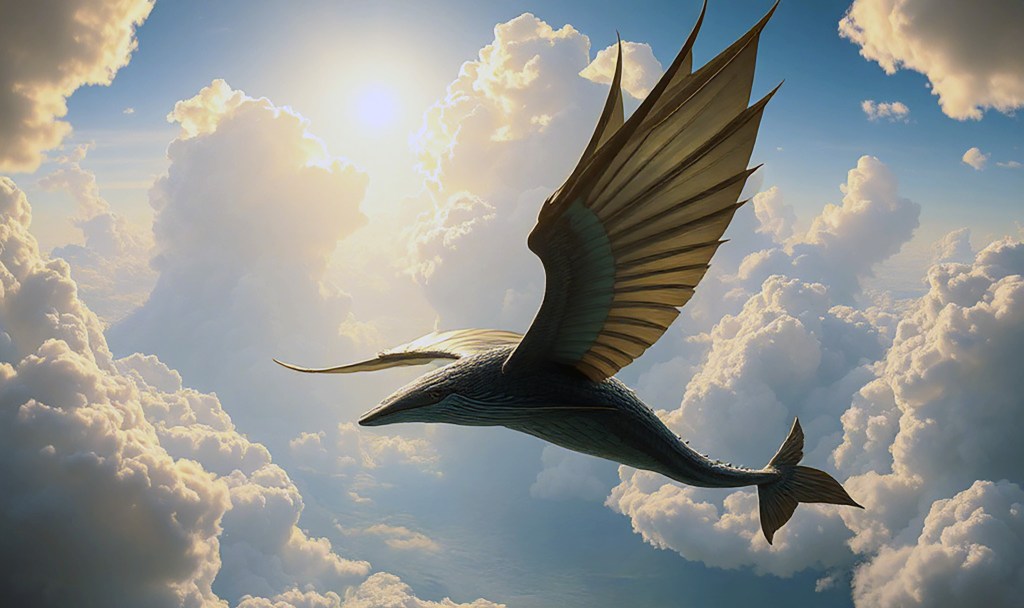
Whale-looking beasts and birds with sharp blades for beaks soar past like airplanes. It’s a bountiful frontier, seemingly ready for hunters. A ball-shaped jungle appears:

In the hazy blue-gray, you see the silhouettes of tall, thin people tied to lines and floating in the sky weightlessly, aiming harpoons at something among the trees of the jungle. It dawns on you that you can stand here atop this mighty tree limb and gaze upwards at them, but were you to climb this trunk, the pull of gravity would fade to nothing.
So you start climbing, because that sounds awesome.
It takes no time at all before you’re having to hold on to knurls and warps in the trunk to avoid drifting into the sky. High above you, people are swimming in a raindrop as big as a sky scraper. It’s a lake, pulled into an elongated sphere by surface tension. And they’re swimming inside!
This place is perhaps the most beautiful thing you’ve ever seen. That’s what you’re thinking as you make it far enough to at least glimpse the far end of the tree, the end closest to the yellow sun. And you realize as other settlements come into view that they’re upside-down to you! The pull of the yellow sun is their down. The pull of the neutron star below was yours.
Now, here in the center, there is no such thing as down.
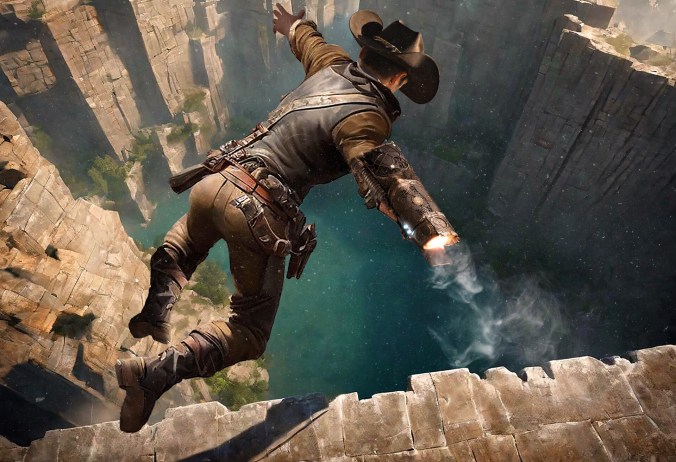
The thought of jumping into the sky is too much for you. It’s terrifying, but thrilling. You wave at one of the folks in the distance, and a hazy-gray silhouette waves back. You think you can make it to them. At the very least, they might toss you a rope and pull you in.
What the heck! Maybe that big old whale-thing will take you on its back. Whatever! You jump and don’t look back.
*
Anyway, that’s how I saw it. The setting for these two books is amazing, and it gets better as the main characters start exploring and also as you can better visualize where they’re going and what it would look and feel like.
The issue is the writing. The plot of the first book is great until it isn’t. Way too much time is spent in a location and with a plot point that is just annoying and a terrible decision. I believe if you’re going to make the environment the lead, it’s just wrong-headed to add a host of extraneous sideways quests and traps that don’t really add to the feeling many of us were drawn to in the first place. (I’m taking that advice, by the way, in the book I’m writing now based on this very experience!).
The characterization is nonsense too. Everyone speaks the same, and that’s like Larry Niven. An orbital mechanics textbook would have more interesting dialogue. I especially cringe when people obsess over “mating” and “making babies” in Niven’s effort to head off questions about gene pool viability. Ladies in these books are cartoon-like in their willingness to pleasure or be impregnated by pretty much any male. Again, I was the target audience for that sort of thing back in the day. Now, it’s just embarrassing and silly.
Please avoid the sequel, THE SMOKE RING. No reason to read that. You’re not going to get any more great exploration or insight into the ecosystem. Just the idea of growing a round tree. Everything else is silly and very, very difficult to plod through.
So if the writing is so bad, why am I heartily recommending you read THE INTEGRAL TREES?
You know the answer! This setting is incredible and unforgettable. It would make a compelling anime setting, or a video game background. I just wish a stronger story with better characters inhabited it.
Anyway, that’s what I wanted to bring you today. Let me know what you think if you take the plunge too.
Till next time,


 Grailrunner Publishing