Harlan would hate this. With a bullet. But it’s happening.
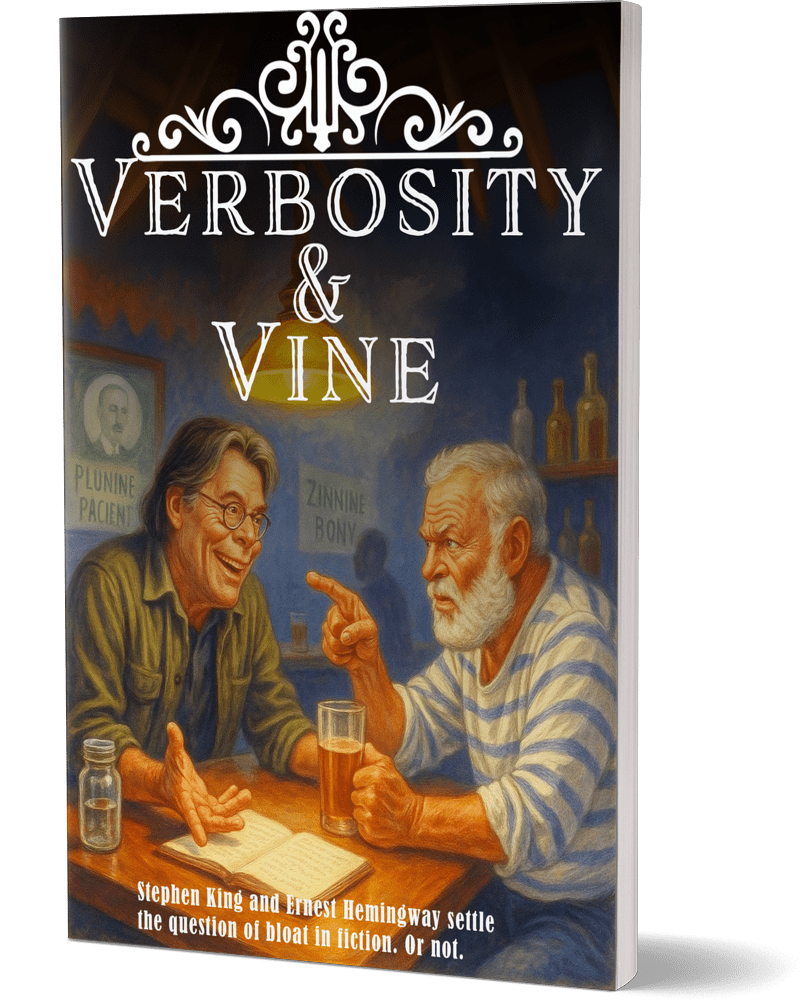
We’re making hay while the sun shines, trying out a premium ChatGPT subscription and bringing all sorts of people back to life or mashing them together into alternate realities for our entertainment. And honestly, some of these simulations of literary or artistic geniuses are surprisingly accurate to how they thought and spoke. So far, we’ve hosted a hilarious debate about conciseness in storytelling with Stephen King, Hemingway, Poe, H.P. Lovecraft, Professor Tolkien, George R.R. Martin, and Homer called Verbosity & Vine and had Professor Tolkien write a new 2,000 word King Arthur short story with an evil grail titled The Black Chalice of Broceliande. There is absolutely going to be a Seinfeld Season 10 post at some point, once I pipe Modern Seinfeld prompts into ChatGPT and let the horses run.
Anyway, welcome to a series we call:
Since the King versus Hemingway debate wound up so funny, we thought it would be a hoot to smash some more genius creators together and have them argue the merit of shock value in storytelling. To remind everyone: our policy at Grailrunner is to consider AI as powerful tools but to always call out their usage. This is for pure entertainment. Nobody’s selling you anything here.
This simulated argument was entirely written by AI with prompts from us, but really took on a life of its own. We decided who joined the conversation, and some of those choices really wound up fantastic. In fact, things really surprised us when we had Professor Tolkien join this conversation as well, as he kind of cleaned everyone’s clock on the matter at hand and got suddenly inspiring. That just happened – we can’t take credit for it! Ellison, at least for our part, stole the show though.
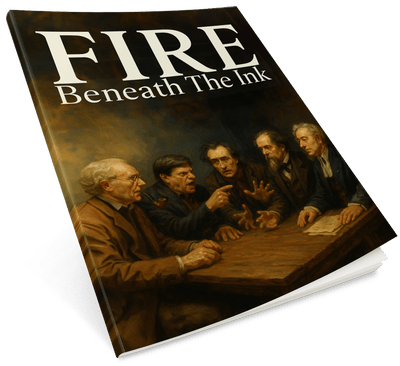
The conversation is called Fire Beneath the Ink:
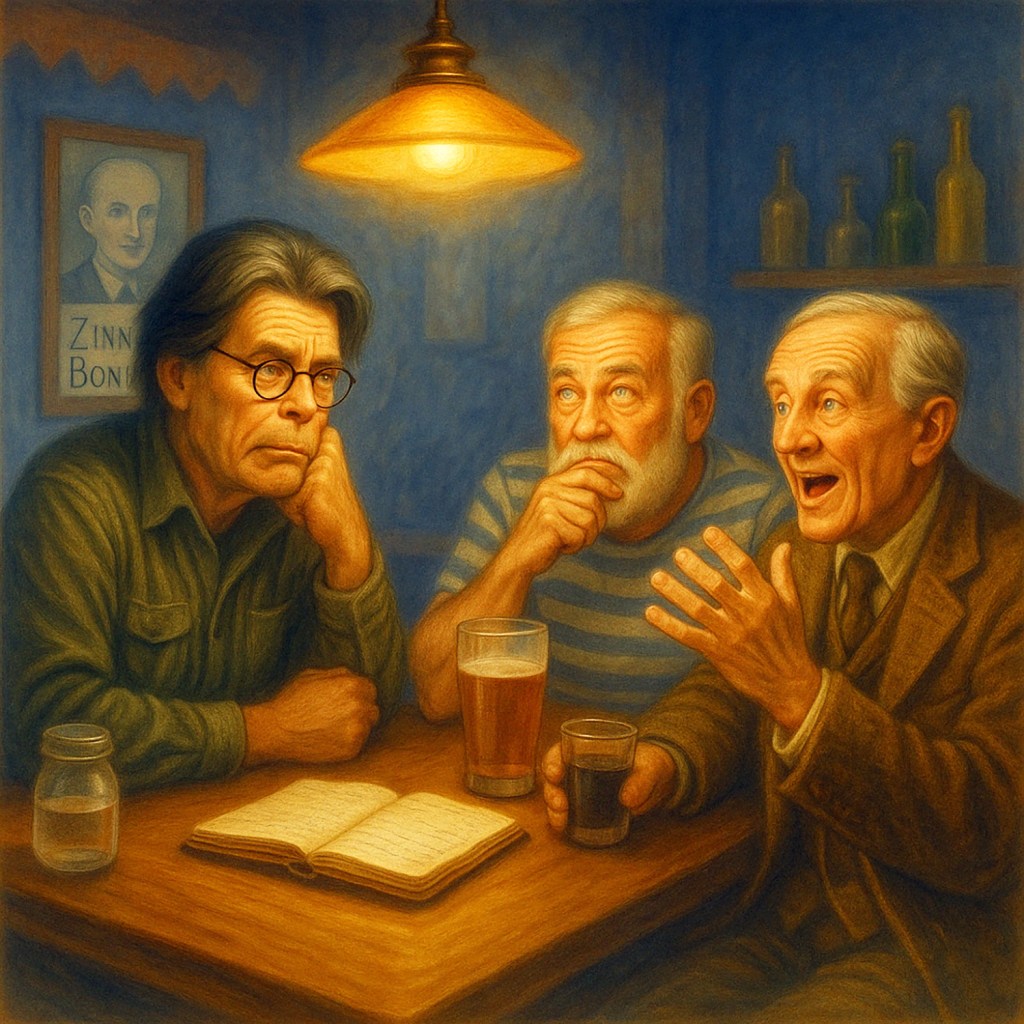
Key players (all deceased) from left to right are:
Professor J. R. R. Tolkien – author of The Hobbit and the Lord of the Rings trilogy and master craftsman of worldbuilding.
Harlan Ellison – a fiercely imaginative and outspoken American writer known for his prolific work in speculative fiction, particularly short stories, television scripts, and essays that challenged social norms and literary conventions. Also one of the finest writers to ever punch a typewriter.
Antonin Artaud – a radical French dramatist, poet, and theorist best known for developing the Theatre of Cruelty, which sought to shock audiences into confronting the deeper truths of human existence. He once threw meat at his audience.
Charles Dickens – a celebrated English novelist and social critic whose vividly drawn characters and dramatic storytelling captured the struggles and injustices of Victorian society. Nobody has ever been better at generating pathos and character empathy than this guy.
Jonathan Swift – an Irish satirist, essayist, and clergyman best known for his sharp wit and scathing critiques of politics and society, particularly in works like Gulliver’s Travels and A Modest Proposal.
Random? Maybe a little. They all seemed to suit the topic at hand though, and Artaud and Harlan got along famously! See for yourself by smashing the cover button below!
So funny! We hope you enjoyed the debate. Somehow, it was nice to hear from Harlan again, and with him in good humor, poking at people and enjoying himself. If you’re familar with him at all, surely you see how much he would loathe this entire idea and likely drive to my house and tell me so.
And what about that Professor?! Did you get tingles at the end? We sure did.
Anyway, come back often and check on us. We’re unleashing the creative hordes here.
So I was killing time at the airport last week, waiting on my flight. Grabbed lunch and sat down to start doom scrolling my phone since I had a couple of hours to kill. Then I thought…”Wait, I’m trying out the ChatGPT+ premium membership this month.”
I really….really need to share with you what this AI built for me with some simple prompting, all on my iPhone while I had lunch. Even the pdf I’m going to share, with the front and back covers. All of it.
On. My. Phone. During lunch.
Anyway, our policy is to consider AI as powerful tools but to always call out their usage. This is for pure entertainment. Nobody’s selling you anything here.
So I always read back in the 70’s and 80’s that “computers can’t create”, and imagination is the skill of the future. I hear it a lot now, actually, that AI is blobbing existing works together and creating nothing new, and that’s technically true. But that’s also what our brains do.
“All you need to invent is an imagination and a pile of junk.”Thomas Edison
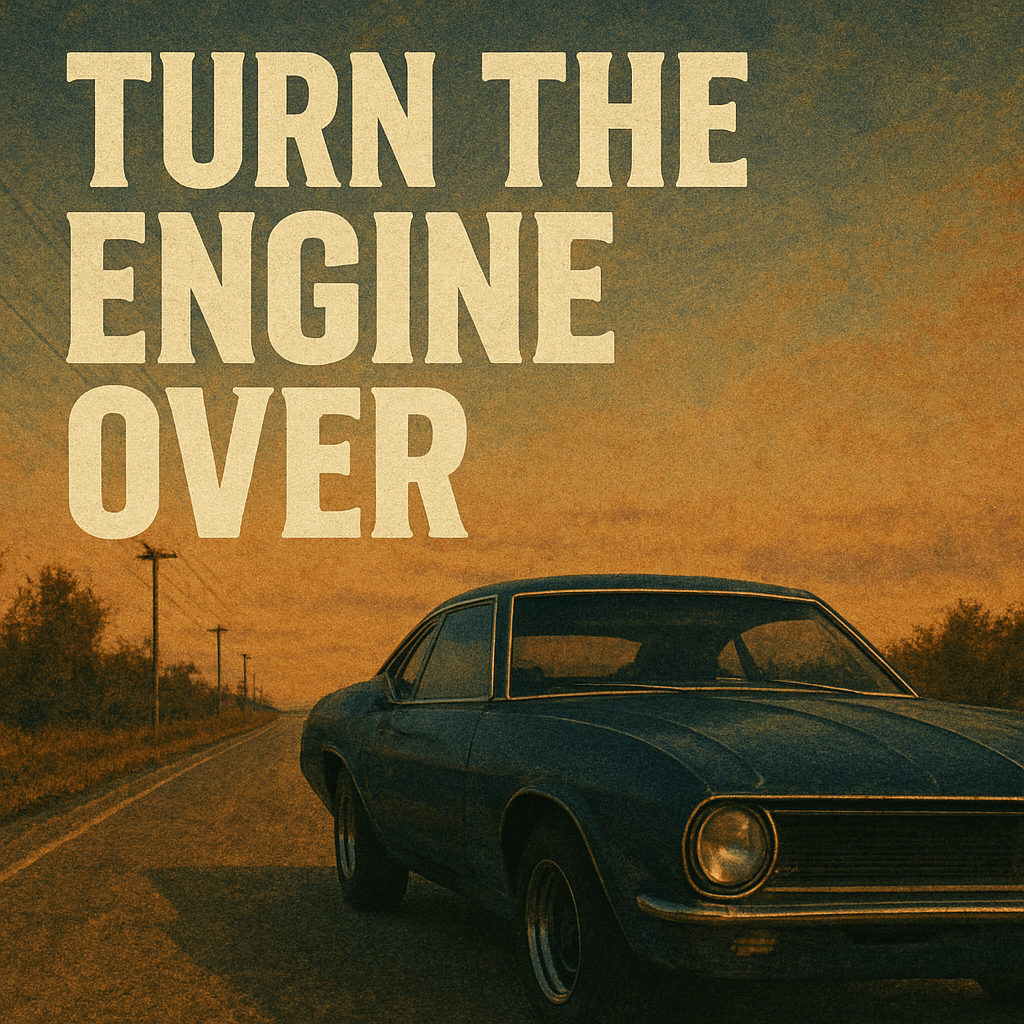
It’s one thing to see the lyrics of an imaginary Bruce Springsteen song, like “Turn The Engine Over”:
I was born on the edge of a steel town flame, Where the smokestacks whisper your daddy’s name. Mama lit candles, prayed hard through the storm, While the foreman shouted, “Son, that’s just how you’re born.” The rail yard’s rusted, the bar lights dim, But I still see her dancin’ like a seraphim. [Chorus] Turn the engine over, feel the rattle in your bones, Roll past the ghosts that call these back roads home. Love don’t die, it just hides out in the dust, So turn the engine over, babe— Drive it like you still believe in us. [Verse 2] Jenny worked nights down at Jackson’s Grill, Saved up dimes in a jar on the windowsill. She said, “Someday, I’ll see the ocean tide,” But dreams like that don’t get no free ride. I was too scared to run, too proud to beg, Now her name’s a tattoo on my right leg. [Chorus] Turn the engine over, feel the thunder in your chest, Every mile a mercy, every town a test. The past don’t sleep, it rides in the rearview dust— So turn the engine over, babe— Drive it like you still believe in us. [Bridge] We were kings of the lot, gods of the drag, Laughin’ through summers in American rags. Now I punch clocks just to quiet my mind, But some nights I hear her, singin’ soft through the pines… [Verse 3] Now my hands are blistered, my boots are worn, I’ve buried too much to mourn like I’m torn. But this old Ford’s got one more ride, And maybe redemption waits on the other side. [Final Chorus] So turn the engine over, let it roar like it’s alive, This heart’s still beatin’ like it’s twenty-five. Hope ain’t gone, it’s just buried in the dust— So turn the engine over, babe— Drive it like you still believe in us. [Outro] Yeah, turn the engine over, babe… Drive it like you still believe in us.
I had Suno (different AI application) gen up a version you can listen to, which wound up a country song and nothing like the Boss, but honestly still pretty awesome. Listen to that here.
The lyrics are eerily appropriate to something the Boss might write. Not mind-blowing, I agree. But it definitely reads like him. Certainly better than anything I could do trying to emulate him.
In my case over lunch, I really felt like reading a King Arthur short story since:
I love King Arthur and grail stories, in all their forms
I only had a sandwich and didn’t want to deal with anything very long anyway
If it sucked, it really didn’t matter. It’s just replacing futile news scrolls and will serve as a place to put my eyeballs and attention for a little while.
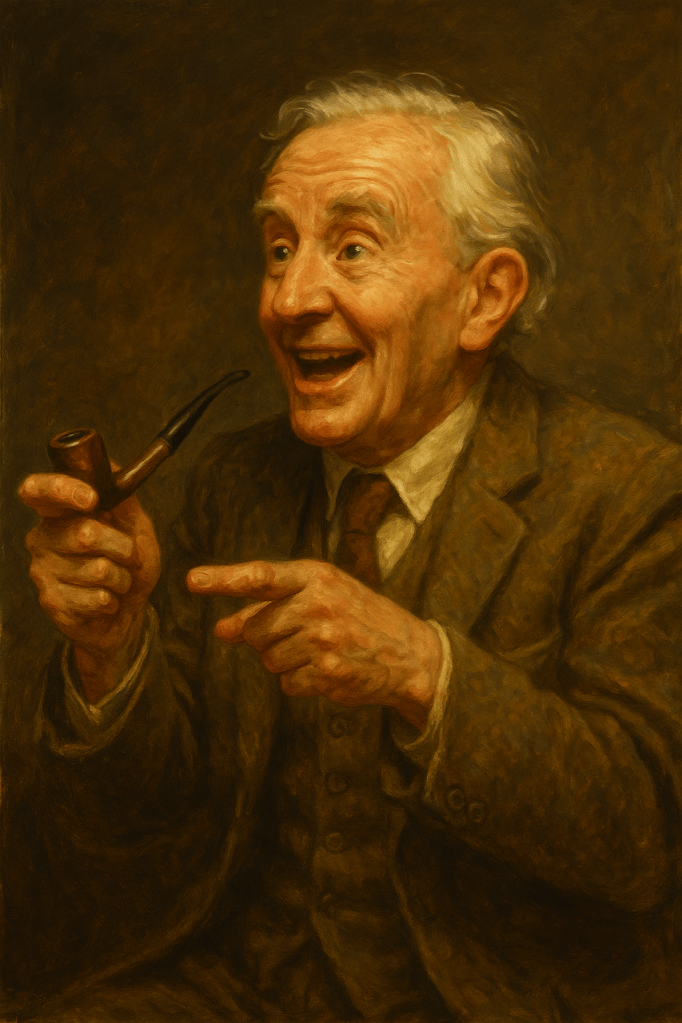
I think very highly of Professor Tolkien’s writing style and lament that he didn’t generate a bigger bibliography of fully formed fiction in his unmatchable voice and sense of scale, his ability to summon majestic backdrops and twinkling cities in the distance. So I added to the prompt to make the story roughly 2,000 words and in the style of Tolkien.
What I got was – honestly, not bad at all. First try. Shorter than I had asked, but still interesting. I gave it a couple of ideas to squeeze in to some new attempts, specifically about the Green Knight, and then asked for a cover image. I wanted to test if I could generate an entire pdf ebook (really a packaged short story) without needing Photoshop or other desktop tools.
Just my phone, waiting on a plane.
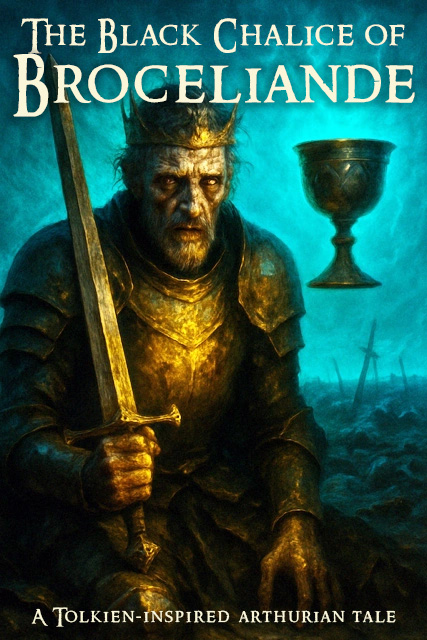
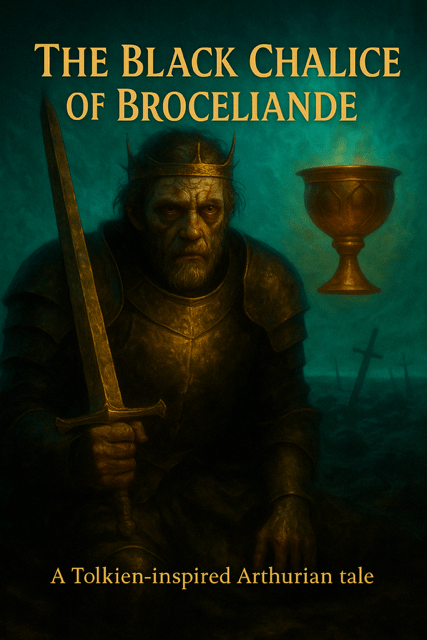
The cover kind of gave me fits and needed a lot of coaxing, though I didn’t use Photoshop at all for this. I mean, it also named the story for me, generated variations of fonts and layouts, and created the entire front cover just based on prompts (the one in the header, I did in Photoshop, so that’s cheating):
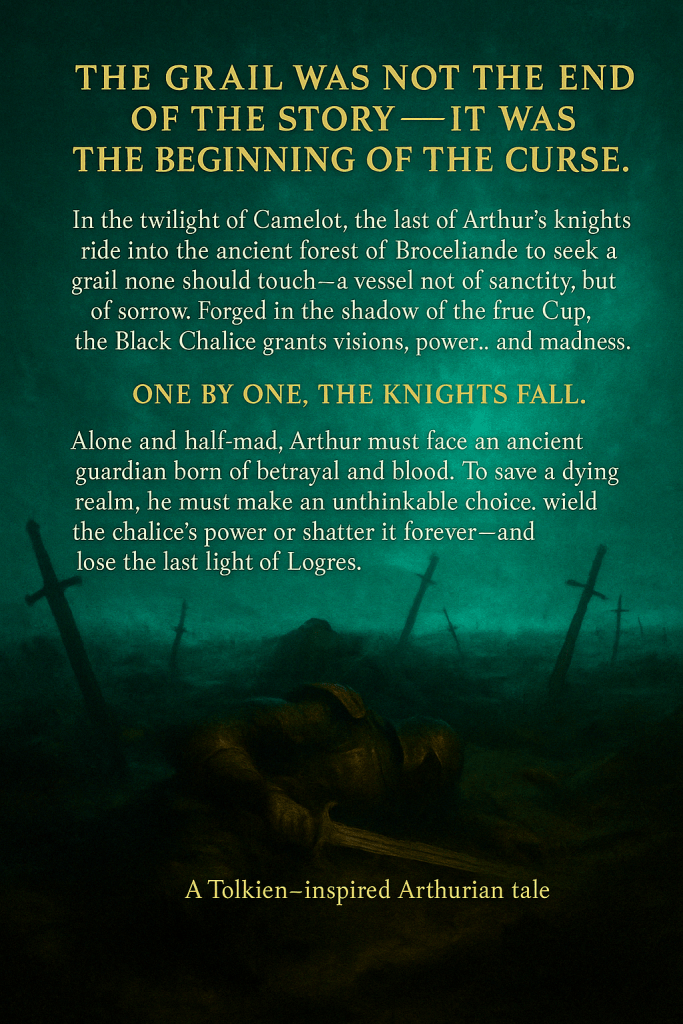
Here’s the back cover it generated for me, based on text it wrote and some prompts to stick to the theme of the story and the front cover:
And finally, having no idea if it was possible, I asked it to include all of this generated content into a pdf. And here that is.
Please keep in mind – I didn’t sit down with Indesign or Photoshop or Word. I didn’t write any of it. I didn’t paint anything. This is me waiting on a plane and punching things into my iPhone to entertain myself.
Crazy world we live in, isn’t it? I think we need to be careful with all this, for sure. Training databases should be combinations of properly licensed images and works or things in public domain. Original creators need to be paid for their work. People using AI ought to say so and be clear how.
Still, crazy world. And a wonderful way to pass some time if you’re itching for a new Tolkien story.
We’re including this post in a new ongoing series where AI is resurrecting interesting people for us to chat with, or dropping them into alternate realities to entertain us (for free). It’s called:
Our policy at Grailrunner is to consider AI a powerful and unavoidable tool for creative exploration, but to always call out its use explicitly and avoid licensed images for datasets. But wow – I wasn’t ready for how much things have improved since I last messed around with ChatGPT a year or so ago!
I had a couple of hours to kill today, and I took a random magazine from Barnes & Noble to a steakhouse. The guy that sat me saw the magazine’s headline about ChatGPT and told me awkwardly how he generated a conversation between two of his favorite characters from some video game (the game’s name eludes me – ‘Borderlands’, maybe.
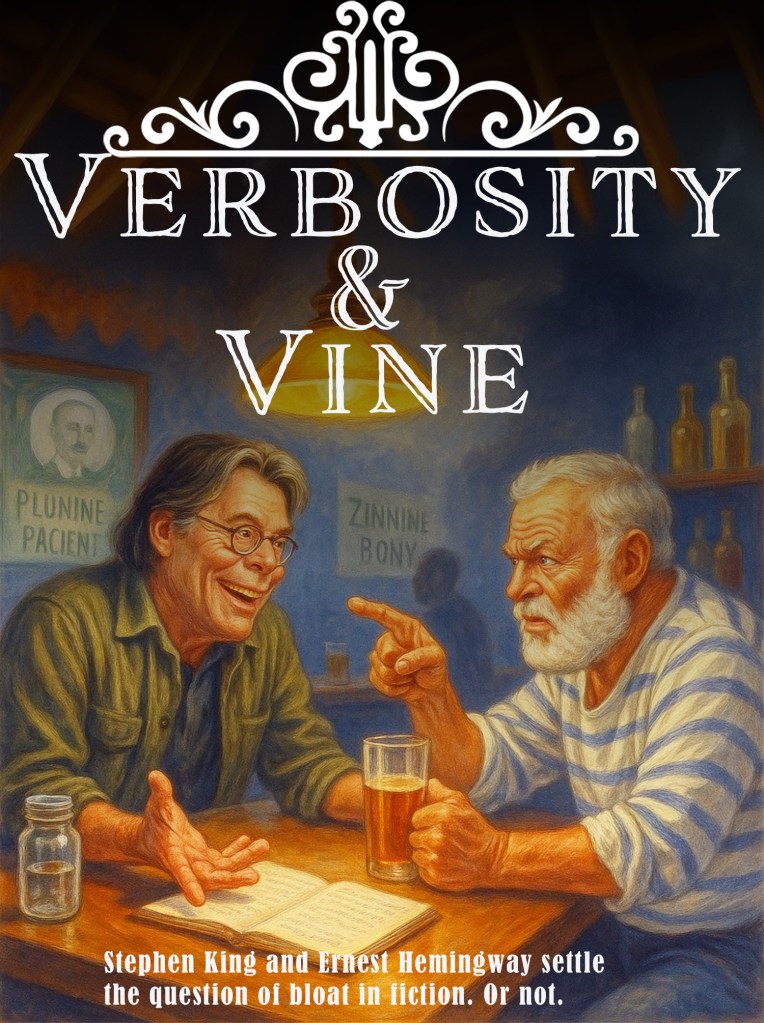
Anyway, it got me thinking. Who wouldn’t want to listen to Stephen King, master of long-winded, verbose fiction get into a heated argument with Ernest Hemingway, the craftsman known for his crystalline precise and minimal prose?
I mean, right?
So I signed up for ChatGPT+ to avoid a bunch of annoying limits and played around with some prompts to get things going. They were coming to a resolution too quickly, so I juiced the scene by adding Tolkien. Then Edgar Allan Poe and H.P. Lovecraft and George R. R. Martin. Then Virginia Woolf showed up uninvited. That’s on her – I didn’t prompt that one! Then I had Homer rise up from the bar floor to give his thoughts and quiet everyone since he’s the original boss.
As a twist, I had King step up and propose a means of settling the entire debate. Not maybe what anyone would expect, but satisfying from my perspective at least.
Then I asked Shakespeare to come in with an after-credits scene. He even wrote some poetry for the occasion.
I used ChatGPT to illustrate the conversations too, which was a bit of a pain. It’s kind of random with safety content filters, but it seems if you end the chat and start a new one, filters that have kicked in and start shutting down everything seem to go away. I cleaned them up a little in Photoshop, but honestly – not that much.
The cover was a quick gen-up in Photoshop too, then I made the pdf in Microsoft Word because I didn’t have the energy to do it right in Indesign. Was just amusing myself, anyway. Nobody’s selling anything here.
Take a look by smashing the button here.
Isn’t that just hilarious? Surprisingly hilarious? I remember a couple of years ago asking this same software to write a new adventure with King Arthur and a dark, evil grail to see if it would be amusing and I was incredibly irritated how generic and nonsensical it was. That wasn’t that long ago – crazy how much better this content is.
Anyway, I just wanted to offer you something amusing today. Let me know what you think.
We’re going to make this another ongoing series, just to bring some folks back from the dead or drop them into alternate realities where some fascinating chats can take place. Come back and check that out!
It’s been a month since we published SALT MYSTIC: BOOK OF LOTS, a solo roleplaying game based on our multi-media Salt Mystic setting. There are some bright spots, some hopeful notes, and a world of pain. Overall, we’re still incredibly proud of the product and seeing and hearing people appreciate it in the wild is an experience like nothing else!
We thought it would be helpful for anybody thinking of putting your own book out to see what we tried: what worked, and what didn’t…and what still might. Care to come along?
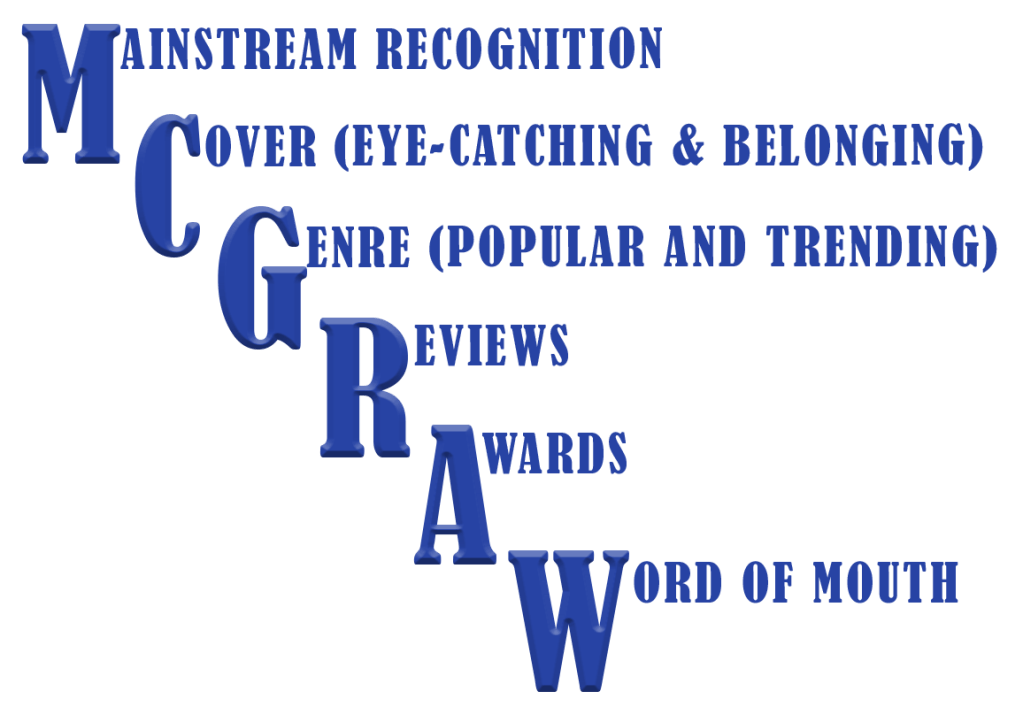
Way back in 2016, I wrote a short article defining some indie publishing principles based on lessons from the launch of my first book: TEARING DOWN THE STATUES. The principles were consolidated into the acronym “MCGRAW”, suggesting the key elements necessary for publishing success (Mainstream recognition, an eye-catching Cover that looks like it belongs with books like it, a popular Genre, as many Reviews on major listing sites as possible, Awards to add validation that the book merits attention, and Word of Mouth.) We kept these in mind this launch and tried to incorporate what we could, although the genre of tabletop roleplaying is so saturated and so dominated by Dungeons & Dragons that we were working uphill and digging holes from the beginning.
Still, hope springs eternal, and this is a product we believe in mightily, knowing from its ideation that nobody else was doing anything like it.
What was the pre-launch like?
February was a hot mess, finalizing the proofs and shaking trees to try and get attention from bloggers and gaming news sites. Short of providing free pizza delivered by cosplayers who do magic tricks, I’m not sure what else we could have done to get mentions from some of these guys – we reached out to 20 and got one “No, Thanks” and absolute crickets otherwise. That’s offering a free physical copy for review, by the way. Local gaming store wasn’t interested, and I didn’t have the heart to cold call others. My ego can only take so much bruising!
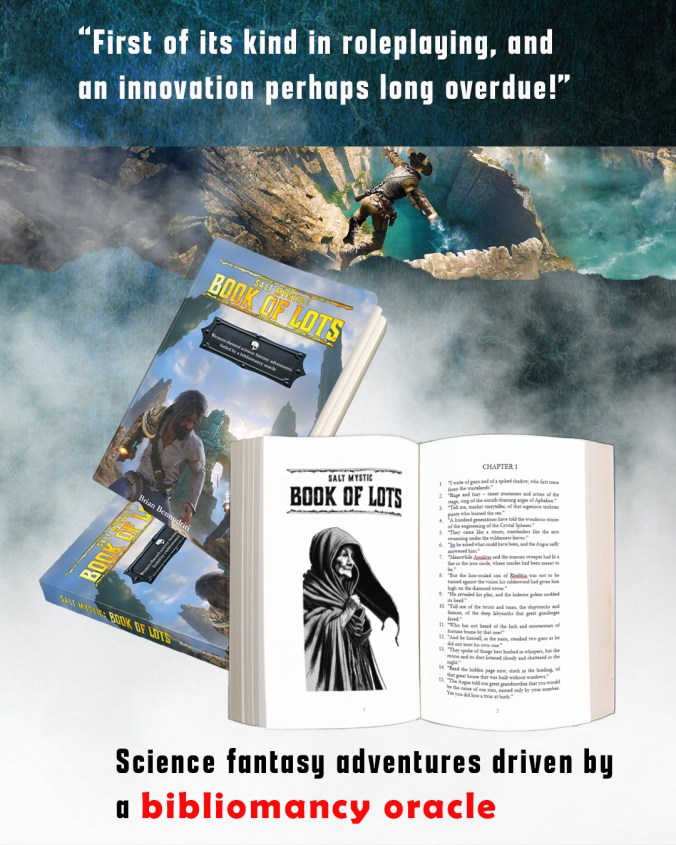
I pushed my Photoshop skills to the breaking point generating ad assets to use in social media and ad campaigns, stirring up some images that I think really popped! Here’s my favorite, though we had to switch it out to juice the click rate after things got rolling.
I’m a big fan of Absolute’s 3d cover generator and Envato’s PlaceIt – both to generate mock up’s of the cover in various places. We generated this one below for banners through RPG Geek and some other sites:
We came SOOOO close to hiring an artist we’ve been targeting for years now, and he might yet come on board for a promotional poster, so I won’t jinx anything by saying more. That would be amazing, so wish us luck! Anyway, he was swamped with other things, so the heavy lifting on graphics was still in-house.
How did you handle distribution setup?
The book is available at booksellers globally through Ingram Spark, and also on Amazon thru Kindle Direct Publishing, as well as the pdf on Drivethru RPG. We got the barcode direct from Bowker to retain full distribution rights – there are strings attached to the freebies. Honestly, setup was fairly painless for Kindle Direct, but I thought at one point Ingram was going to leave me with facial tics!
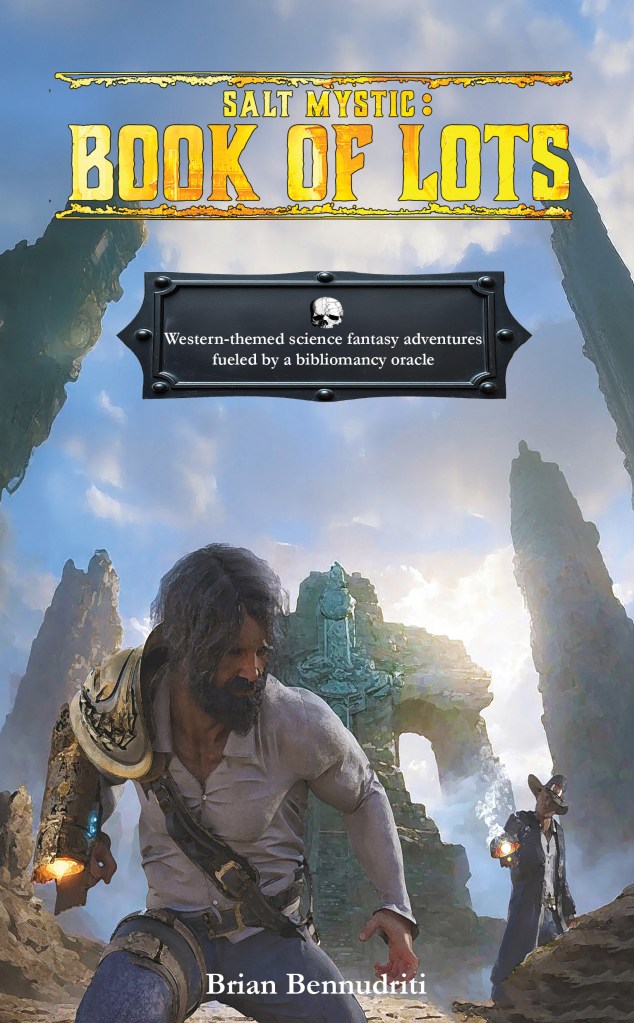
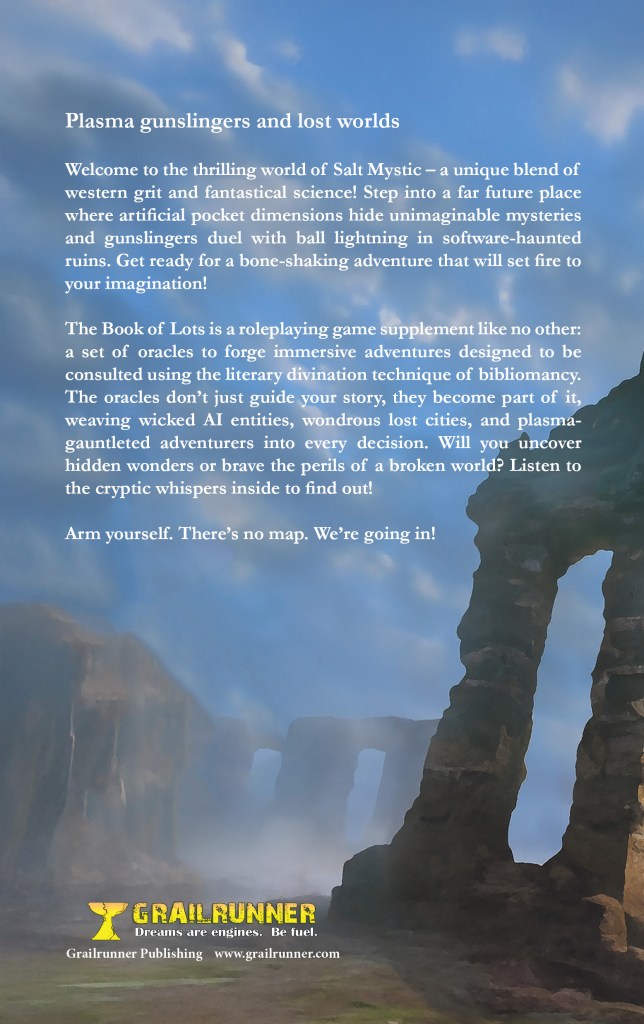
The cover file was a high res jpg I’d built in Adobe Illustrator, and it included some transparent png images (the title and the Grailrunner logo). The art was done with Daz Studio for the figures, some Blender and Photoshop filters for the forearm weapons, and some AI help for the background, everything composited and color graded in Photoshop then dropped into Illustrator for the text and placements. This is what that looks like, front and back:
Weird white outlines were appearing in the digital proof around anything that was a png in the image. Maddening! Nobody at Ingram Customer Service was responding, and internet advice was kind of all over the place. I tried various export presets and never resolved it, at last approving the digital proof even with the outlines in hopes that it was in fact a screen artifact only (as some advice suggested). Thankfully, the issue didn’t show up in the physical version.
As for offering a physical version through Drivethru RPG, I basically gave up. They seem to be saying they use the same print house as Ingram, though a different division or something? I dunno. Anyway, much worse issues with anything that was a png, including the interior art! A true disaster! I’m sure they would say it’s my fault, but I bailed entirely and just offer the digital version through them. My blood pressure thanked me immediately!
How did you advertise?
We ran campaigns on Facebook, through Google, Amazon, and on RPG Geek. The book is also listed this month on Ingram’s home page and in the World Reader, iCurate Connection, and Indiewire newsletters, all via Ingram (~28,000 circulation for the newsletters). Through the Independent Book Publishers Association, the book will be represented at the American Library Association conference in Philadelphia this June. We’ll see how all that works out, but here are some initial experiences:
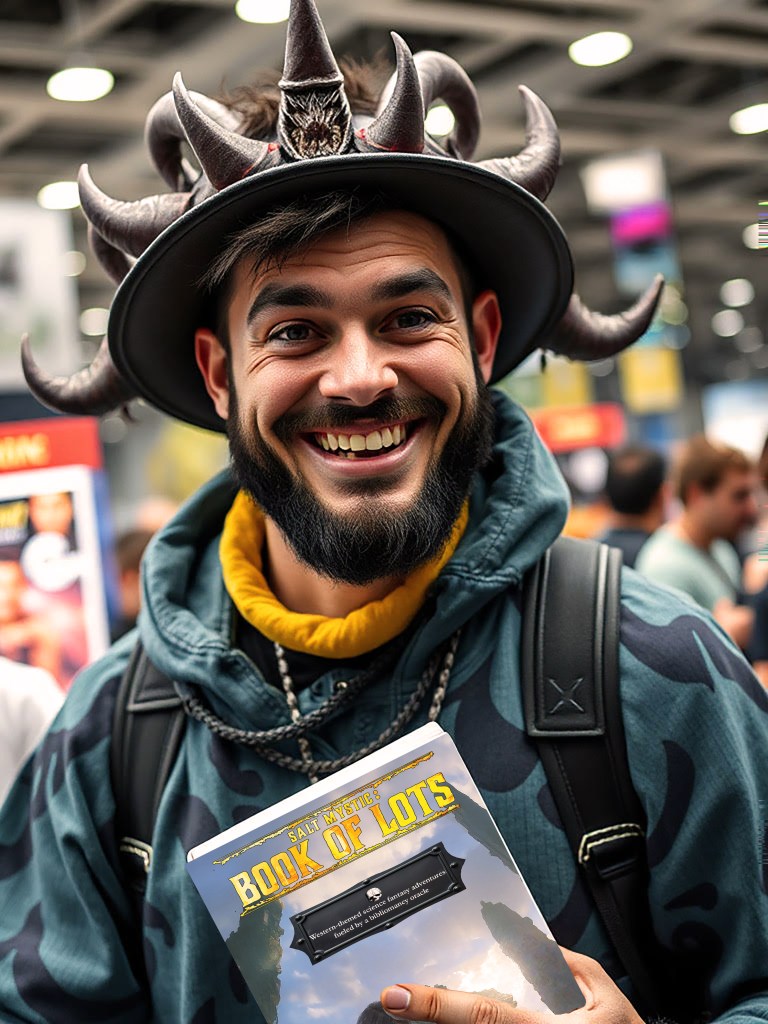
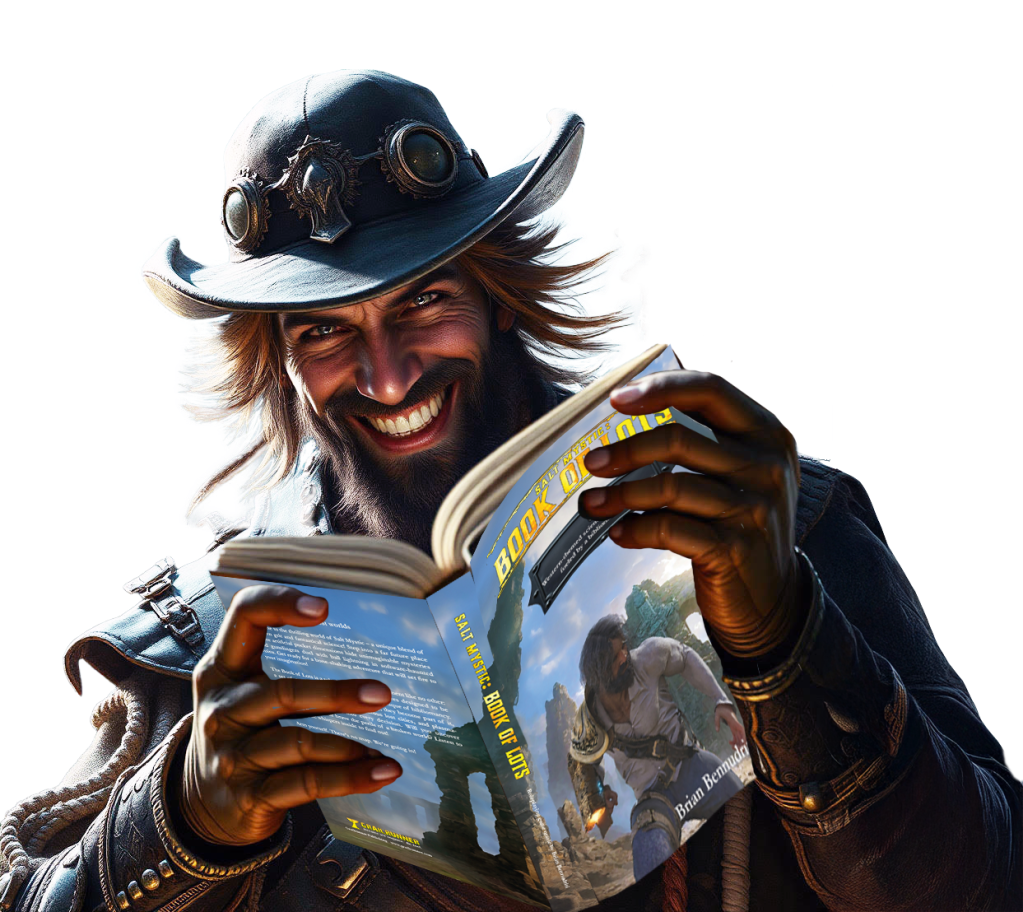
Meta (Facebook) started at 2.1% click rates with tens of thousands of impressions as well as loads of shares and likes and bookmarks. It all felt great until we saw that precious little of that was converting to sales. Internet research was suggesting a good click rate was 2% for search ads and 0.1% for display ads like banners, but for us it was just a lot of activity with poor conversions. By changing the graphics out to a grinning gunslinger and tweaking the copy a bit, we doubled the click rate to 4.2%. We’ll see if all those bookmarks and shares pay off down the line!
GoogleAds was impressive, as their algorithm learns as you go, tweaking things to improve the reach. We wound up with a 5.1% click rate by the campaign’s end, which we view as solid. We even had one day peak at the end at 8.1%! All campaigns led to the same Amazon listing, so we can’t separate sales by campaign but I thought a lot of this experience overall.
RPG Geek was a little disappointing. Multiple banner and display ads dominated the site for a month. The thinking here was that this site entirely specializes in roleplaying games, so you couldn’t find a more on-the-nose target audience! Still, click rates flatlined at 0.1% for two weeks, till the same changes as above doubled that to a paltry 0.18% by campaign end.
Amazon: We only launched the Amazon ads in the last week or so – it’s a little early to report any results. I’d also never added any A+ content to a listing before, so that was new. Of course, I added that gunslinger since he seems to catch eyeballs, along with a very short description of the book.
So, was it a good launch?
Could have done more on pre-launch to get some mentions, honestly. We need to work on a solid email list and social media following though the new content required for that is a bit threatening when everyone has day jobs. Reviews remain super difficult to get, though some favorables have popped up that we didn’t arrange. Overall, sales are ramping up very slowly. Glacially, you might say.
What’s next?
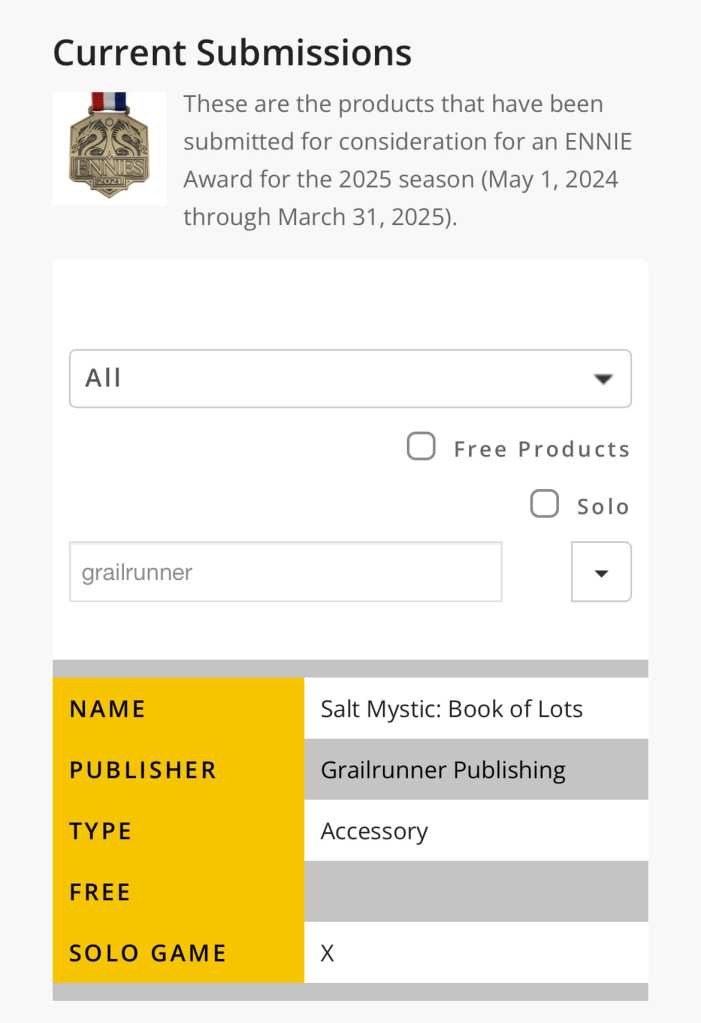
I submitted SALT MYSTIC: BOOK OF LOTS for consideration in the 2025 Ennie Awards, which is the Super Bowl of RPG’s! Any mentions at all would be high octane fuel for me. That’s a long shot, of course, just because of the ridiculous amount of talent in the field these days. Still, you never know…
*
I hope some of this was helpful or at least entertaining. Warts and all, this is how things have gone so far and the plan going forward. I’m sure the outside observer can find all manner of beasties and stinking swamps herein, but from the inside, it’s a wild, crazy bucking bronco we’re just happy to hold onto!



 Grailrunner Publishing