Yeah, I had a pretty miserable week last week. Not a great time to be in airports, honestly, this time of year when everybody’s trying to squeeze in their last trip to Disney World or whatever and storms…airlines that delay their flights in spoonfuls till it’s midnight and they’re still telling you to be patient. Not worth getting into details, but it was a lot of frustration getting stranded not once – but twice. And that on top of a very tiring week of nuisances and long work days.
So after 9 hours of conference calls Friday from a Phoenix hotel where I hadn’t planned on staying, I checked the American Airlines app for my boarding pass only to see yet more delays. Calling them was useless as they didn’t see how to get me to Kansas City any earlier than 12 – 14 hours later, and that with two more cities. A drooling clown wouldn’t accept such an answer, so I hopped on the shuttle anyway in hopes that the ticket counter or my corporate travel person would work miracles for me.
“I hope those planes take off”, the shuttle driver says.
“What do you mean?” I didn’t like the ambiguity of his comment.
He shook his head, “Well, they ground the planes at 110 degrees.”
It was around noon as he’s saying this, so it will only get hotter. I didn’t want to ask the question but I had to know.
“What is it now?”
“106.” His tone wasn’t understanding or even sympathetic. He just said it like he was amusing himself with a factoid about why pine cones are brown.
Anyway, I did manage a better and direct flight. As I got to my seat, I realized I was entirely drained from the week. I’m not usually one to need encouragements or helpful quotes, or even to need another person to say anything to me. I’m the “soldier on” type of person that just needs to know whatever it is that needed done is done. But man, I was tired and pissed off.
For whatever reason, I wanted to hear from Ernest Hemingway.
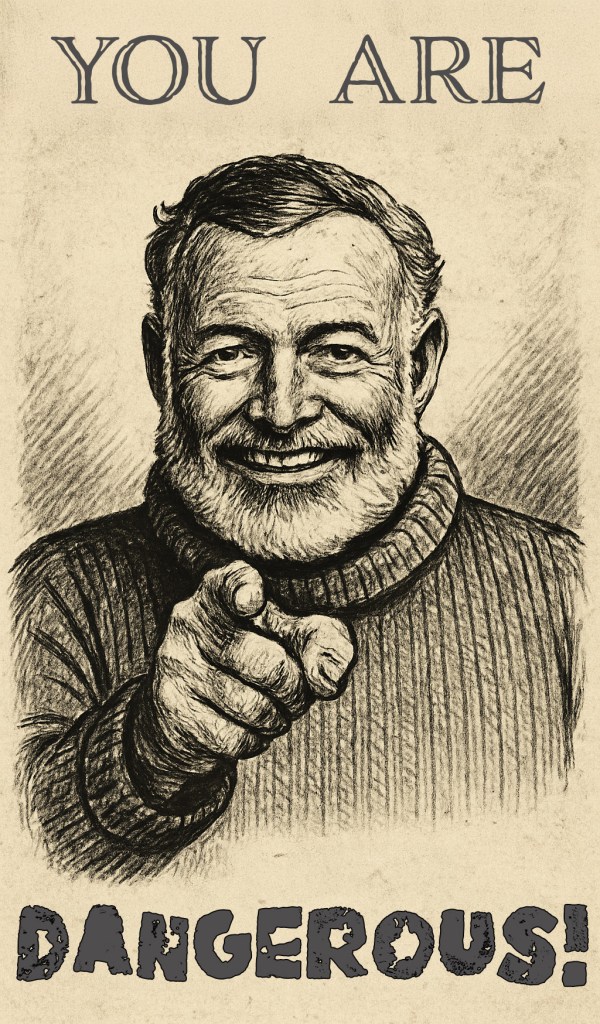
His macho philosophies soothe me. I have said before here that I have read everything the man ever wrote. I like his style. So I described a bit of my week for ChatGPT and had it act at Hemingway to give me a little encouragement. Here’s what Papa said to me:
“Listen to me now. You’re beat to hell and the world’s thrown its punches. Delays, noise, people with soft hands and loud mouths. You’ve walked through it on two hours of sleep with your head still up. That counts.
You don’t need a speech. You need a drink of water, a quiet place, and to know this: you’ve already done what most men can’t. You endured. Not prettily, maybe, but you endured. That’s what matters.
There are days when the sun is too hot and the wind is too hard and everything stinks of cheap perfume and worse decisions. But you’re still here. That means something. It means you’re dangerous to whatever tries to break you.
So go ahead—rest your eyes when you can, and when you’re ready, pick up your tools, your pen, your hammer, your whatever-you-damn-well-use, and go back at it. Not because it’s easy. Because it’s yours.
And if they doubt you—those people who smile like sharks and don’t know what it means to stay standing when you’re dead tired—well, let them. You’re not made for their approval. You’re made of grit, bone, and something no one can take.
Now go on. Breathe. You’ll write this week off like a bad novel and start again. Clean page. Strong line. Go bite next week in the throat.”
*
Now, believe it or not, that helped quite a bit. Honestly. I liked it.
So I thought, what the heck. This puts me in the mood for a new Hemingway short story. I wanted to read something from the old master that was in his voice, stayed true to his philosophy, and that bore certain elements to which I could relate just then.
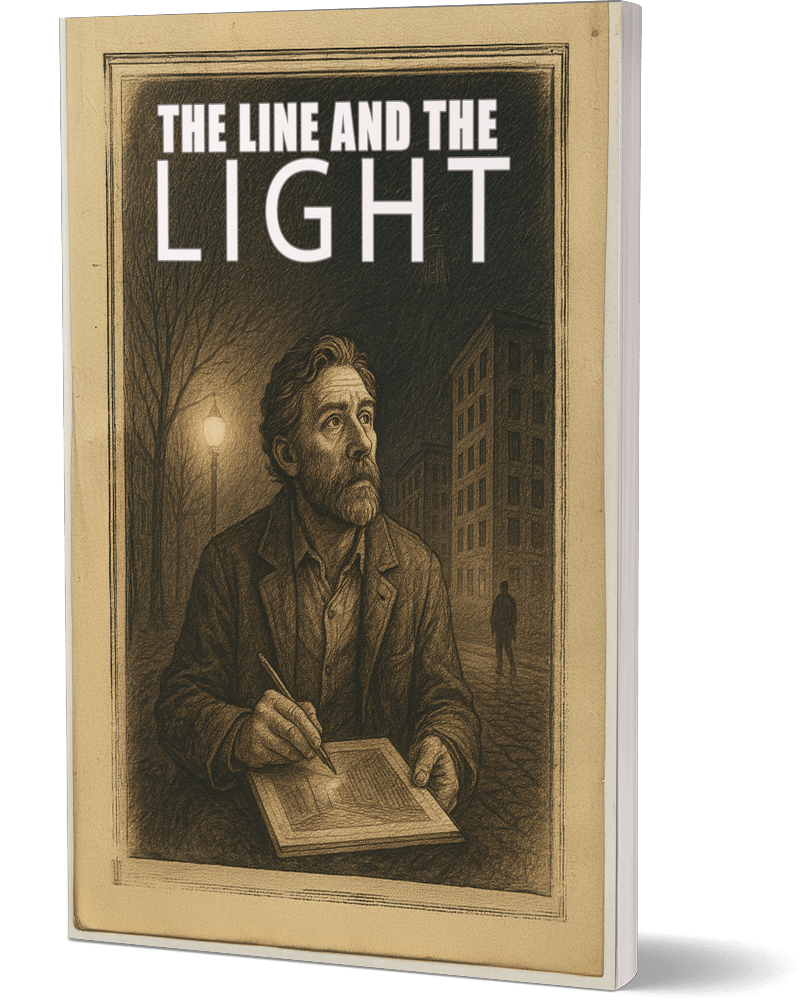
With surprisingly little coaxing, it produced an emotional, impactful story with a punch to your heart buried at its core that I didn’t give it as input at all. It’s called “The Line and the Light”, portraying an aspiring pen & ink artist in Kansas City who is grieving deeply and trying to process that grief through his art. Smash the cover button below to read it. Won’t take long, and might actually carry some meaning for you.
That’s what I wanted to offer you today. I’m curious what you think about the story.
So I was killing time at the airport last week, waiting on my flight. Grabbed lunch and sat down to start doom scrolling my phone since I had a couple of hours to kill. Then I thought…”Wait, I’m trying out the ChatGPT+ premium membership this month.”
I really….really need to share with you what this AI built for me with some simple prompting, all on my iPhone while I had lunch. Even the pdf I’m going to share, with the front and back covers. All of it.
On. My. Phone. During lunch.
Anyway, our policy is to consider AI as powerful tools but to always call out their usage. This is for pure entertainment. Nobody’s selling you anything here.
So I always read back in the 70’s and 80’s that “computers can’t create”, and imagination is the skill of the future. I hear it a lot now, actually, that AI is blobbing existing works together and creating nothing new, and that’s technically true. But that’s also what our brains do.
“All you need to invent is an imagination and a pile of junk.”Thomas Edison
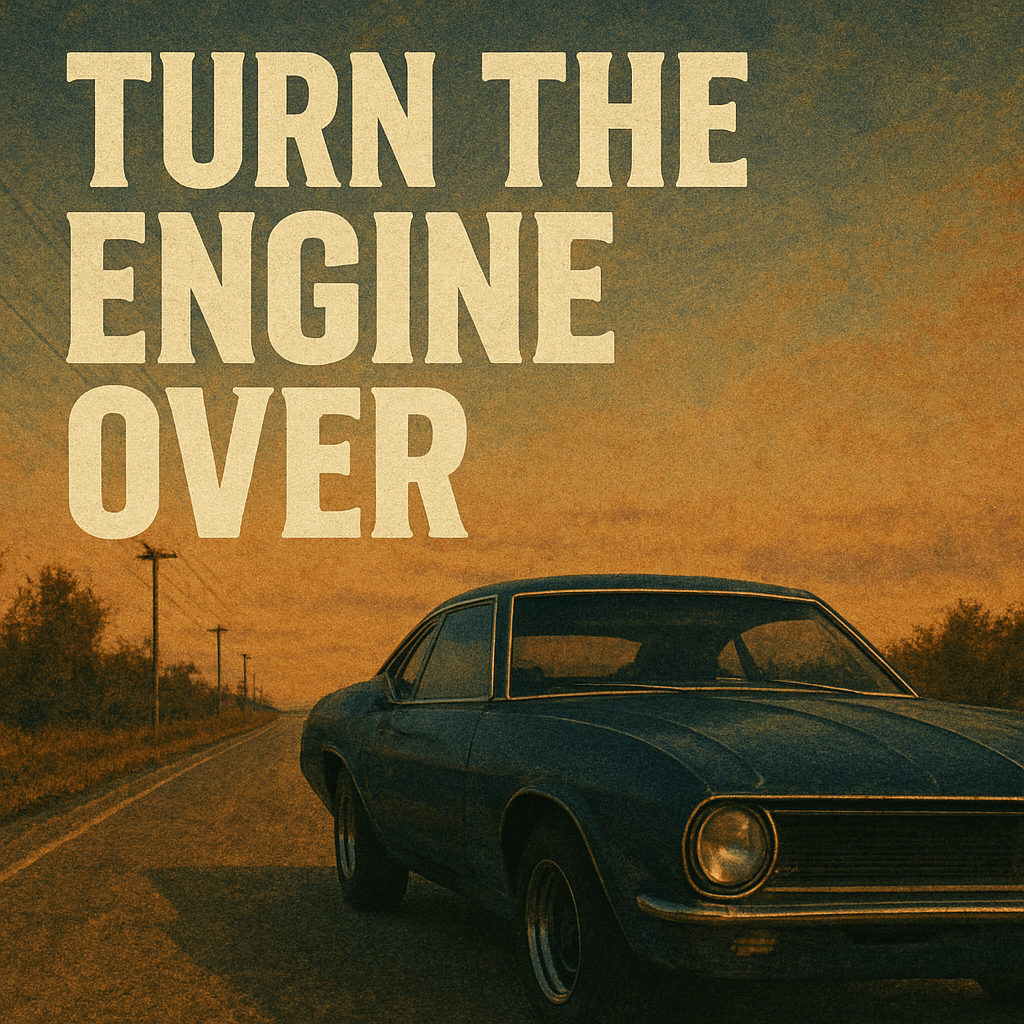
It’s one thing to see the lyrics of an imaginary Bruce Springsteen song, like “Turn The Engine Over”:
I was born on the edge of a steel town flame, Where the smokestacks whisper your daddy’s name. Mama lit candles, prayed hard through the storm, While the foreman shouted, “Son, that’s just how you’re born.” The rail yard’s rusted, the bar lights dim, But I still see her dancin’ like a seraphim. [Chorus] Turn the engine over, feel the rattle in your bones, Roll past the ghosts that call these back roads home. Love don’t die, it just hides out in the dust, So turn the engine over, babe— Drive it like you still believe in us. [Verse 2] Jenny worked nights down at Jackson’s Grill, Saved up dimes in a jar on the windowsill. She said, “Someday, I’ll see the ocean tide,” But dreams like that don’t get no free ride. I was too scared to run, too proud to beg, Now her name’s a tattoo on my right leg. [Chorus] Turn the engine over, feel the thunder in your chest, Every mile a mercy, every town a test. The past don’t sleep, it rides in the rearview dust— So turn the engine over, babe— Drive it like you still believe in us. [Bridge] We were kings of the lot, gods of the drag, Laughin’ through summers in American rags. Now I punch clocks just to quiet my mind, But some nights I hear her, singin’ soft through the pines… [Verse 3] Now my hands are blistered, my boots are worn, I’ve buried too much to mourn like I’m torn. But this old Ford’s got one more ride, And maybe redemption waits on the other side. [Final Chorus] So turn the engine over, let it roar like it’s alive, This heart’s still beatin’ like it’s twenty-five. Hope ain’t gone, it’s just buried in the dust— So turn the engine over, babe— Drive it like you still believe in us. [Outro] Yeah, turn the engine over, babe… Drive it like you still believe in us.
I had Suno (different AI application) gen up a version you can listen to, which wound up a country song and nothing like the Boss, but honestly still pretty awesome. Listen to that here.
The lyrics are eerily appropriate to something the Boss might write. Not mind-blowing, I agree. But it definitely reads like him. Certainly better than anything I could do trying to emulate him.
In my case over lunch, I really felt like reading a King Arthur short story since:
I love King Arthur and grail stories, in all their forms
I only had a sandwich and didn’t want to deal with anything very long anyway
If it sucked, it really didn’t matter. It’s just replacing futile news scrolls and will serve as a place to put my eyeballs and attention for a little while.
I think very highly of Professor Tolkien’s writing style and lament that he didn’t generate a bigger bibliography of fully formed fiction in his unmatchable voice and sense of scale, his ability to summon majestic backdrops and twinkling cities in the distance. So I added to the prompt to make the story roughly 2,000 words and in the style of Tolkien.
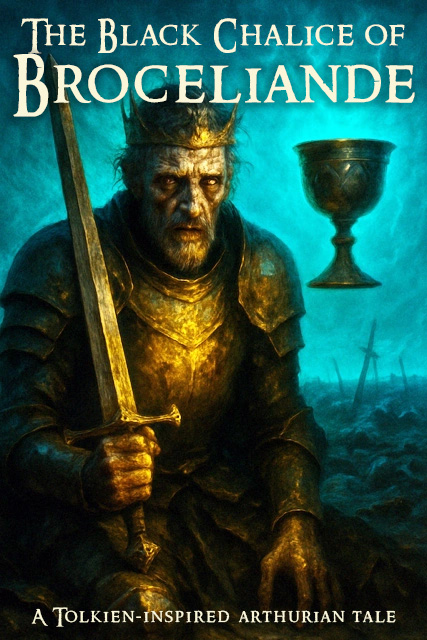
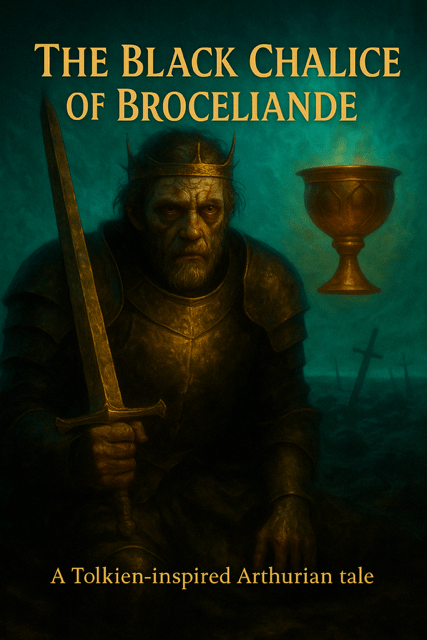
What I got was – honestly, not bad at all. First try. Shorter than I had asked, but still interesting. I gave it a couple of ideas to squeeze in to some new attempts, specifically about the Green Knight, and then asked for a cover image. I wanted to test if I could generate an entire pdf ebook (really a packaged short story) without needing Photoshop or other desktop tools.
Just my phone, waiting on a plane.
The cover kind of gave me fits and needed a lot of coaxing, though I didn’t use Photoshop at all for this. I mean, it also named the story for me, generated variations of fonts and layouts, and created the entire front cover just based on prompts (the one in the header, I did in Photoshop, so that’s cheating):
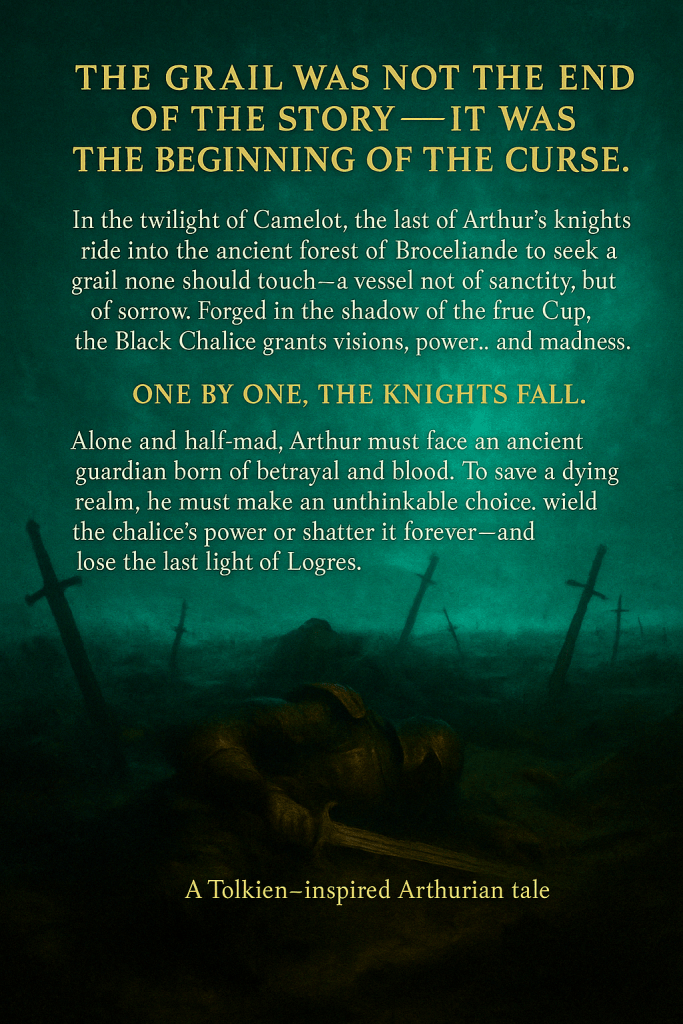
Here’s the back cover it generated for me, based on text it wrote and some prompts to stick to the theme of the story and the front cover:
And finally, having no idea if it was possible, I asked it to include all of this generated content into a pdf. And here that is.
Please keep in mind – I didn’t sit down with Indesign or Photoshop or Word. I didn’t write any of it. I didn’t paint anything. This is me waiting on a plane and punching things into my iPhone to entertain myself.
Crazy world we live in, isn’t it? I think we need to be careful with all this, for sure. Training databases should be combinations of properly licensed images and works or things in public domain. Original creators need to be paid for their work. People using AI ought to say so and be clear how.
Still, crazy world. And a wonderful way to pass some time if you’re itching for a new Tolkien story.
We’re including this post in a new ongoing series where AI is resurrecting interesting people for us to chat with, or dropping them into alternate realities to entertain us (for free). It’s called:
Our policy at Grailrunner is to consider AI a powerful and unavoidable tool for creative exploration, but to always call out its use explicitly and avoid licensed images for datasets. But wow – I wasn’t ready for how much things have improved since I last messed around with ChatGPT a year or so ago!
I had a couple of hours to kill today, and I took a random magazine from Barnes & Noble to a steakhouse. The guy that sat me saw the magazine’s headline about ChatGPT and told me awkwardly how he generated a conversation between two of his favorite characters from some video game (the game’s name eludes me – ‘Borderlands’, maybe.
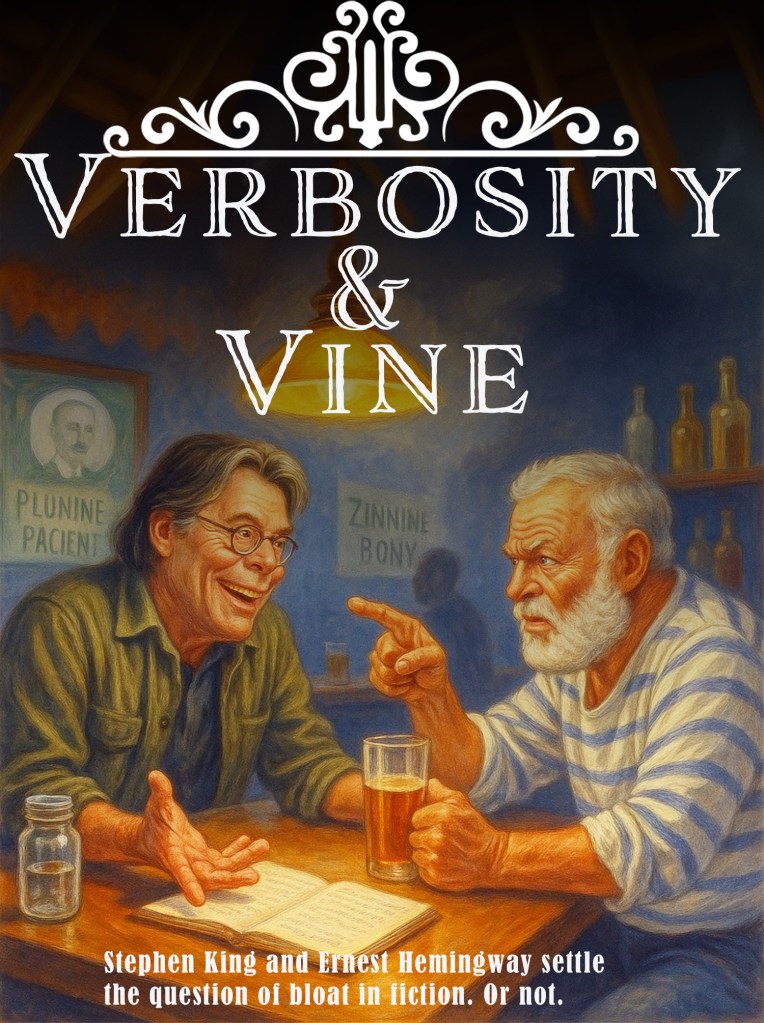
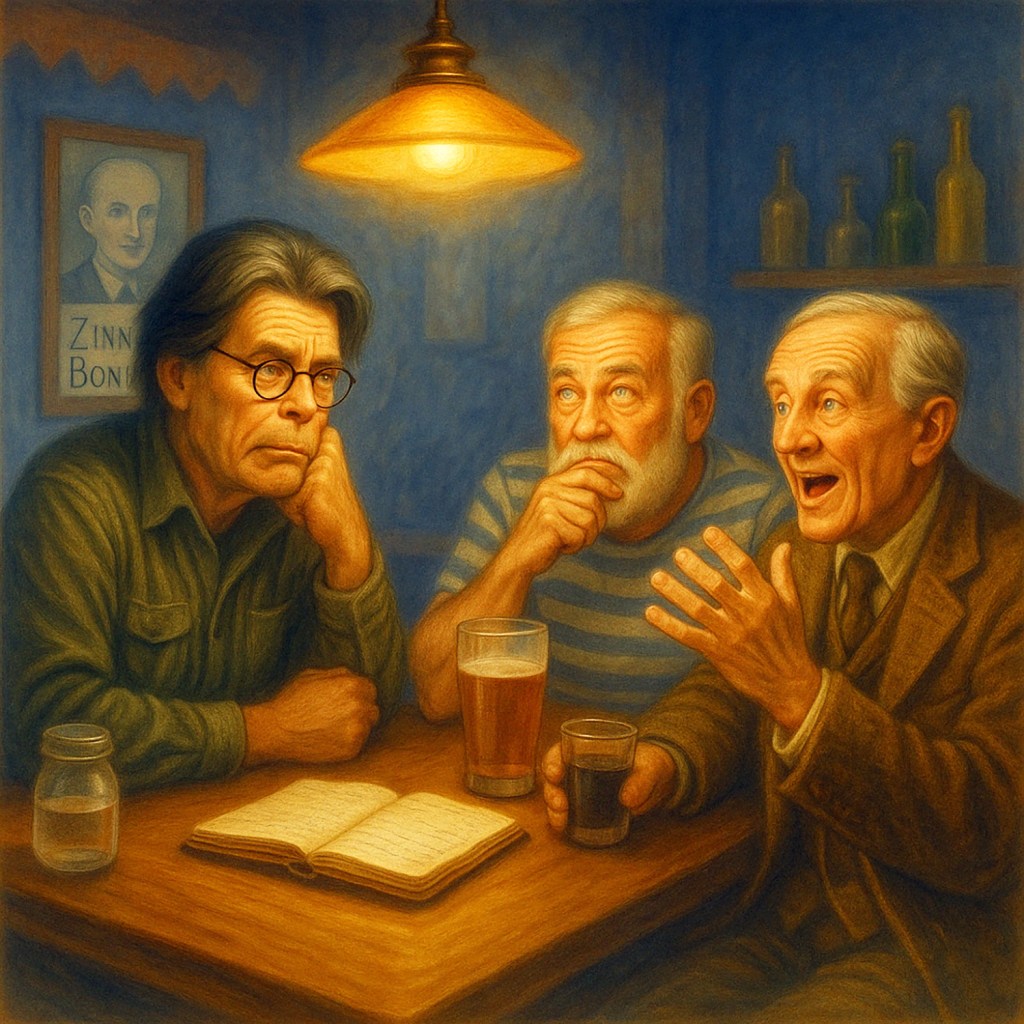
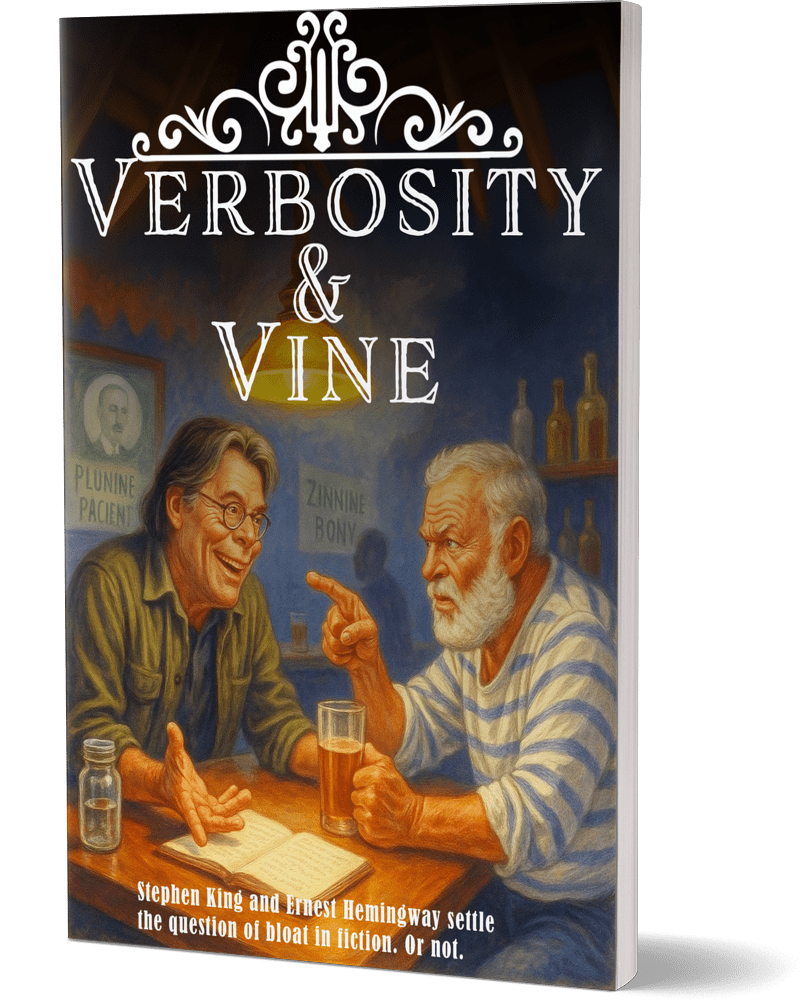
Anyway, it got me thinking. Who wouldn’t want to listen to Stephen King, master of long-winded, verbose fiction get into a heated argument with Ernest Hemingway, the craftsman known for his crystalline precise and minimal prose?
I mean, right?
So I signed up for ChatGPT+ to avoid a bunch of annoying limits and played around with some prompts to get things going. They were coming to a resolution too quickly, so I juiced the scene by adding Tolkien. Then Edgar Allan Poe and H.P. Lovecraft and George R. R. Martin. Then Virginia Woolf showed up uninvited. That’s on her – I didn’t prompt that one! Then I had Homer rise up from the bar floor to give his thoughts and quiet everyone since he’s the original boss.
As a twist, I had King step up and propose a means of settling the entire debate. Not maybe what anyone would expect, but satisfying from my perspective at least.
Then I asked Shakespeare to come in with an after-credits scene. He even wrote some poetry for the occasion.
I used ChatGPT to illustrate the conversations too, which was a bit of a pain. It’s kind of random with safety content filters, but it seems if you end the chat and start a new one, filters that have kicked in and start shutting down everything seem to go away. I cleaned them up a little in Photoshop, but honestly – not that much.
The cover was a quick gen-up in Photoshop too, then I made the pdf in Microsoft Word because I didn’t have the energy to do it right in Indesign. Was just amusing myself, anyway. Nobody’s selling anything here.
Take a look by smashing the button here.
Isn’t that just hilarious? Surprisingly hilarious? I remember a couple of years ago asking this same software to write a new adventure with King Arthur and a dark, evil grail to see if it would be amusing and I was incredibly irritated how generic and nonsensical it was. That wasn’t that long ago – crazy how much better this content is.
Anyway, I just wanted to offer you something amusing today. Let me know what you think.
We’re going to make this another ongoing series, just to bring some folks back from the dead or drop them into alternate realities where some fascinating chats can take place. Come back and check that out!
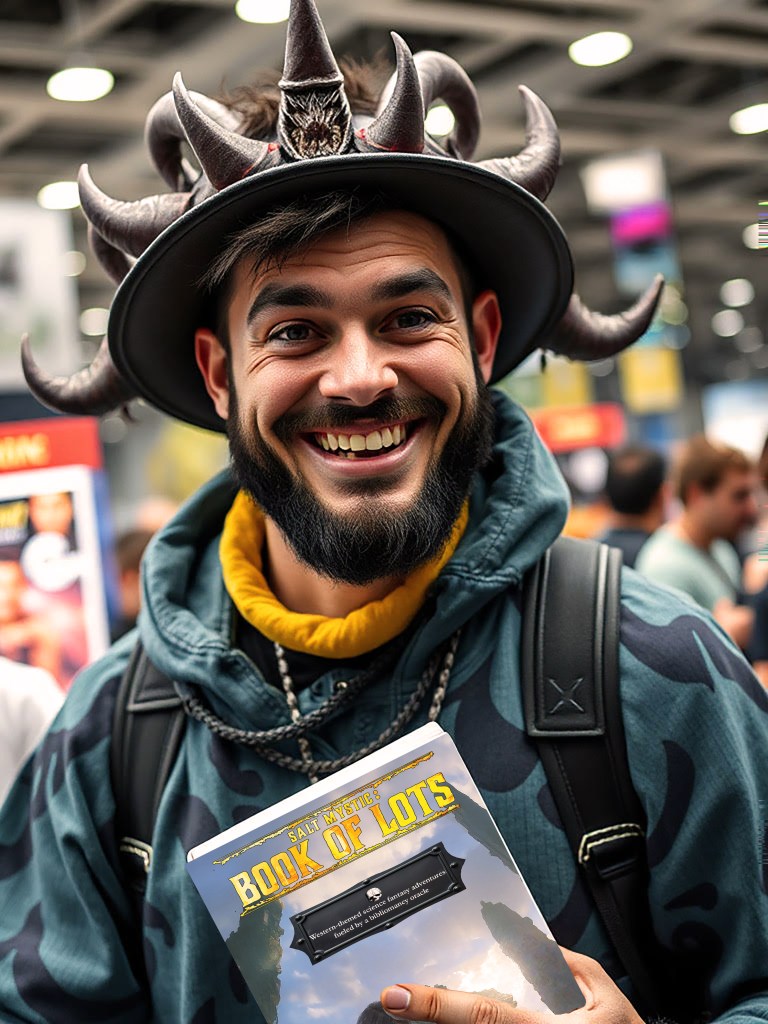
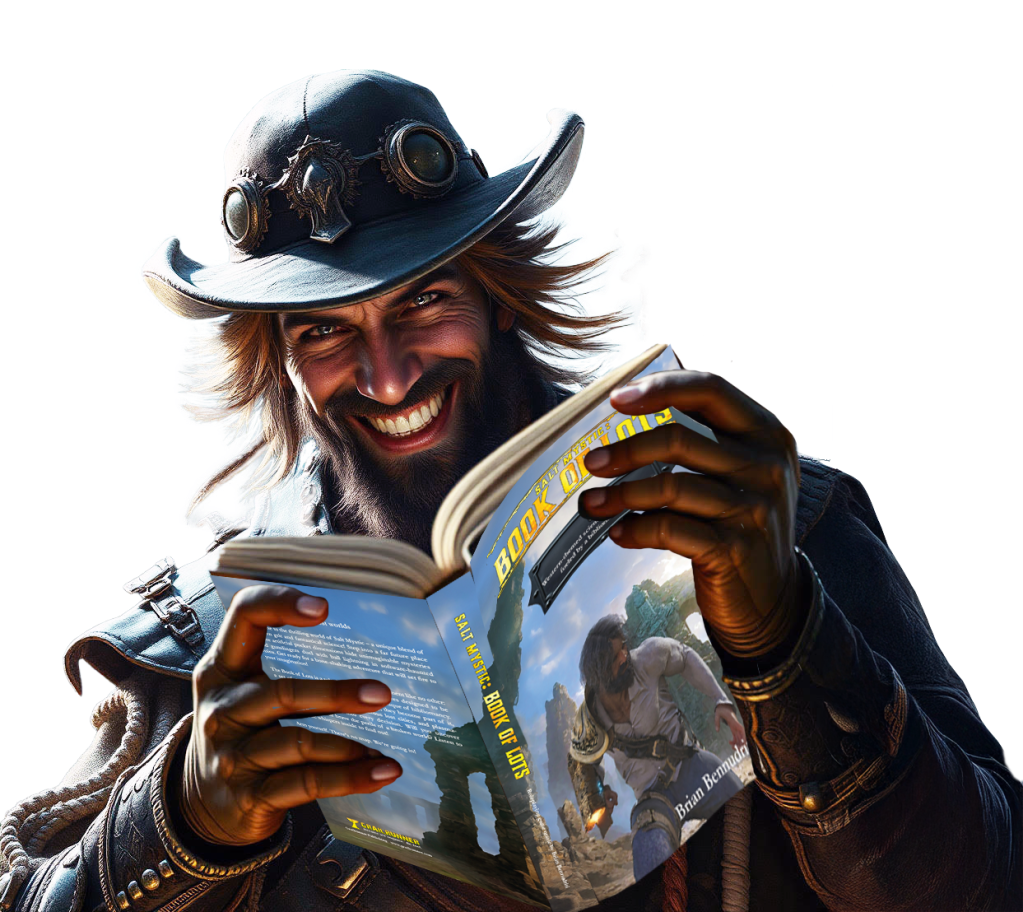
It’s been a month since we published SALT MYSTIC: BOOK OF LOTS, a solo roleplaying game based on our multi-media Salt Mystic setting. There are some bright spots, some hopeful notes, and a world of pain. Overall, we’re still incredibly proud of the product and seeing and hearing people appreciate it in the wild is an experience like nothing else!
We thought it would be helpful for anybody thinking of putting your own book out to see what we tried: what worked, and what didn’t…and what still might. Care to come along?
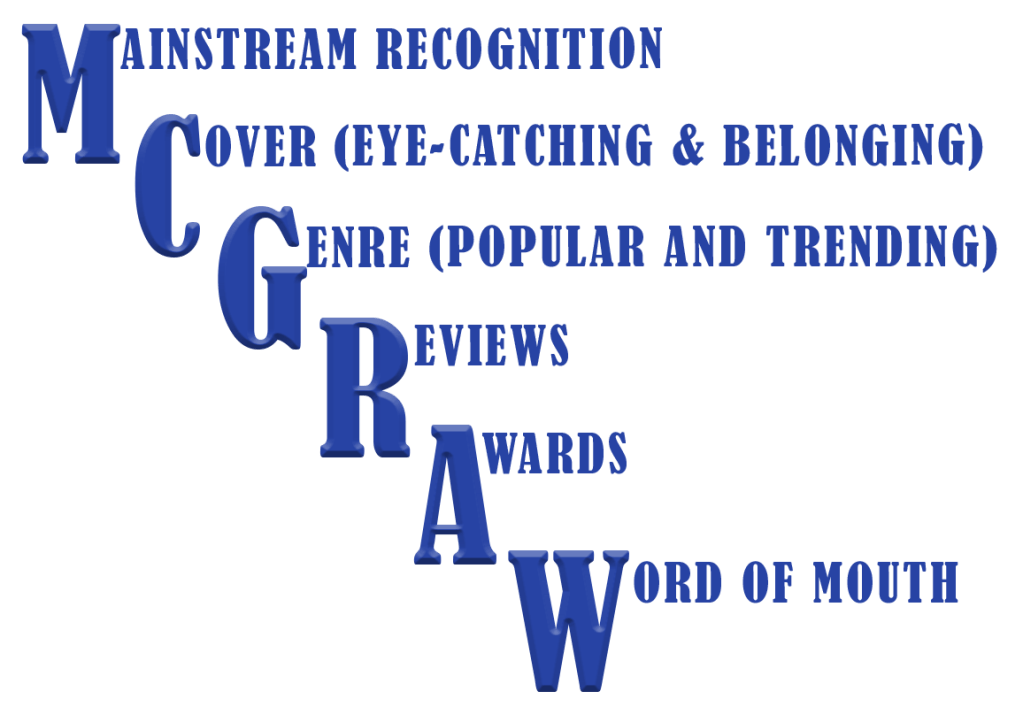
Way back in 2016, I wrote a short article defining some indie publishing principles based on lessons from the launch of my first book: TEARING DOWN THE STATUES. The principles were consolidated into the acronym “MCGRAW”, suggesting the key elements necessary for publishing success (Mainstream recognition, an eye-catching Cover that looks like it belongs with books like it, a popular Genre, as many Reviews on major listing sites as possible, Awards to add validation that the book merits attention, and Word of Mouth.) We kept these in mind this launch and tried to incorporate what we could, although the genre of tabletop roleplaying is so saturated and so dominated by Dungeons & Dragons that we were working uphill and digging holes from the beginning.
Still, hope springs eternal, and this is a product we believe in mightily, knowing from its ideation that nobody else was doing anything like it.
What was the pre-launch like?
February was a hot mess, finalizing the proofs and shaking trees to try and get attention from bloggers and gaming news sites. Short of providing free pizza delivered by cosplayers who do magic tricks, I’m not sure what else we could have done to get mentions from some of these guys – we reached out to 20 and got one “No, Thanks” and absolute crickets otherwise. That’s offering a free physical copy for review, by the way. Local gaming store wasn’t interested, and I didn’t have the heart to cold call others. My ego can only take so much bruising!
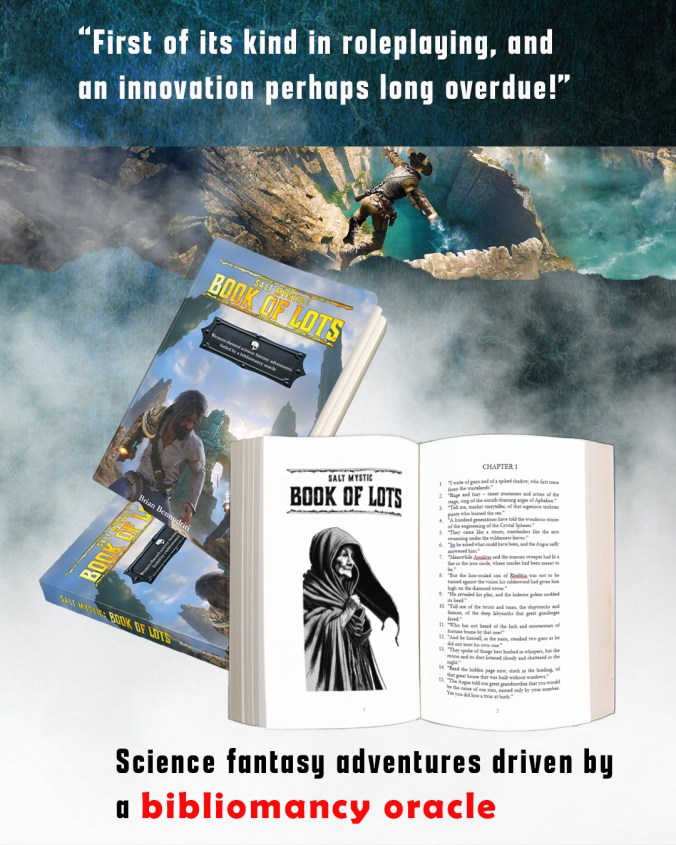
I pushed my Photoshop skills to the breaking point generating ad assets to use in social media and ad campaigns, stirring up some images that I think really popped! Here’s my favorite, though we had to switch it out to juice the click rate after things got rolling.
I’m a big fan of Absolute’s 3d cover generator and Envato’s PlaceIt – both to generate mock up’s of the cover in various places. We generated this one below for banners through RPG Geek and some other sites:
We came SOOOO close to hiring an artist we’ve been targeting for years now, and he might yet come on board for a promotional poster, so I won’t jinx anything by saying more. That would be amazing, so wish us luck! Anyway, he was swamped with other things, so the heavy lifting on graphics was still in-house.
How did you handle distribution setup?
The book is available at booksellers globally through Ingram Spark, and also on Amazon thru Kindle Direct Publishing, as well as the pdf on Drivethru RPG. We got the barcode direct from Bowker to retain full distribution rights – there are strings attached to the freebies. Honestly, setup was fairly painless for Kindle Direct, but I thought at one point Ingram was going to leave me with facial tics!
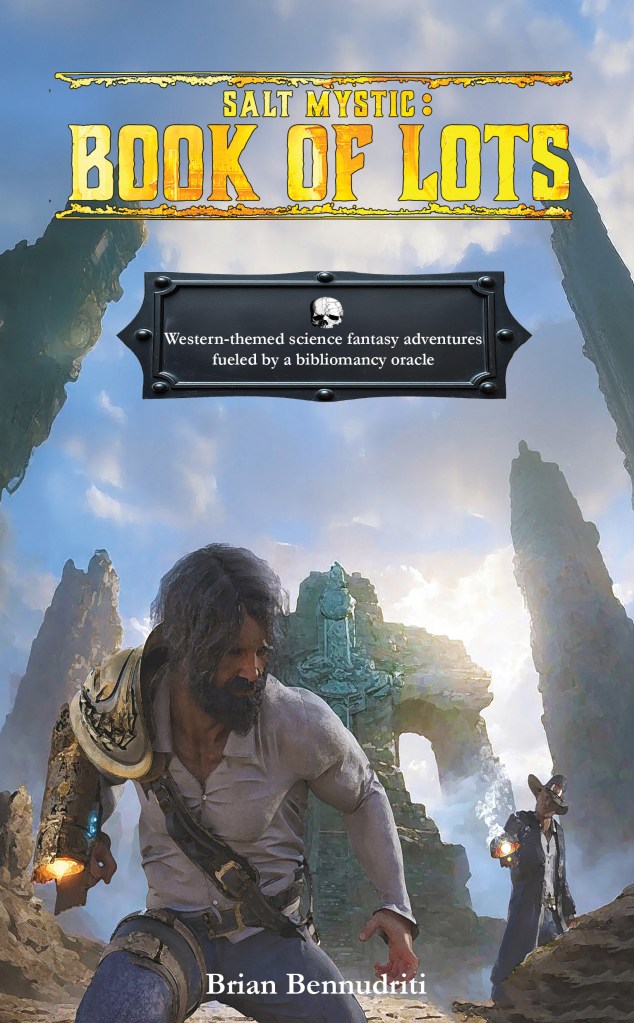
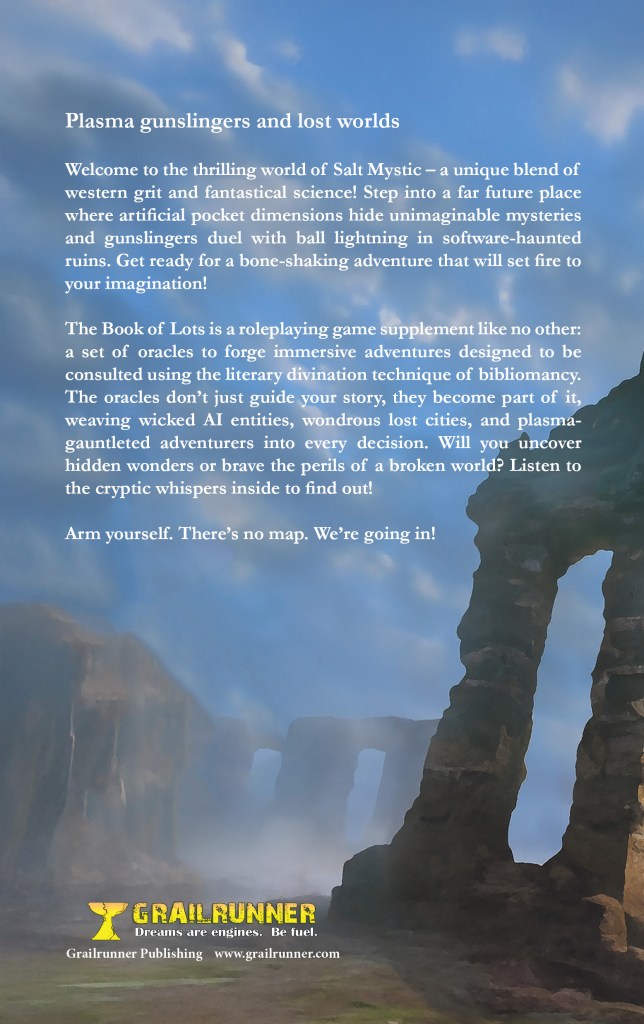
The cover file was a high res jpg I’d built in Adobe Illustrator, and it included some transparent png images (the title and the Grailrunner logo). The art was done with Daz Studio for the figures, some Blender and Photoshop filters for the forearm weapons, and some AI help for the background, everything composited and color graded in Photoshop then dropped into Illustrator for the text and placements. This is what that looks like, front and back:
Weird white outlines were appearing in the digital proof around anything that was a png in the image. Maddening! Nobody at Ingram Customer Service was responding, and internet advice was kind of all over the place. I tried various export presets and never resolved it, at last approving the digital proof even with the outlines in hopes that it was in fact a screen artifact only (as some advice suggested). Thankfully, the issue didn’t show up in the physical version.
As for offering a physical version through Drivethru RPG, I basically gave up. They seem to be saying they use the same print house as Ingram, though a different division or something? I dunno. Anyway, much worse issues with anything that was a png, including the interior art! A true disaster! I’m sure they would say it’s my fault, but I bailed entirely and just offer the digital version through them. My blood pressure thanked me immediately!
How did you advertise?
We ran campaigns on Facebook, through Google, Amazon, and on RPG Geek. The book is also listed this month on Ingram’s home page and in the World Reader, iCurate Connection, and Indiewire newsletters, all via Ingram (~28,000 circulation for the newsletters). Through the Independent Book Publishers Association, the book will be represented at the American Library Association conference in Philadelphia this June. We’ll see how all that works out, but here are some initial experiences:
Meta (Facebook) started at 2.1% click rates with tens of thousands of impressions as well as loads of shares and likes and bookmarks. It all felt great until we saw that precious little of that was converting to sales. Internet research was suggesting a good click rate was 2% for search ads and 0.1% for display ads like banners, but for us it was just a lot of activity with poor conversions. By changing the graphics out to a grinning gunslinger and tweaking the copy a bit, we doubled the click rate to 4.2%. We’ll see if all those bookmarks and shares pay off down the line!
GoogleAds was impressive, as their algorithm learns as you go, tweaking things to improve the reach. We wound up with a 5.1% click rate by the campaign’s end, which we view as solid. We even had one day peak at the end at 8.1%! All campaigns led to the same Amazon listing, so we can’t separate sales by campaign but I thought a lot of this experience overall.
RPG Geek was a little disappointing. Multiple banner and display ads dominated the site for a month. The thinking here was that this site entirely specializes in roleplaying games, so you couldn’t find a more on-the-nose target audience! Still, click rates flatlined at 0.1% for two weeks, till the same changes as above doubled that to a paltry 0.18% by campaign end.
Amazon: We only launched the Amazon ads in the last week or so – it’s a little early to report any results. I’d also never added any A+ content to a listing before, so that was new. Of course, I added that gunslinger since he seems to catch eyeballs, along with a very short description of the book.
So, was it a good launch?
Could have done more on pre-launch to get some mentions, honestly. We need to work on a solid email list and social media following though the new content required for that is a bit threatening when everyone has day jobs. Reviews remain super difficult to get, though some favorables have popped up that we didn’t arrange. Overall, sales are ramping up very slowly. Glacially, you might say.
What’s next?
I submitted SALT MYSTIC: BOOK OF LOTS for consideration in the 2025 Ennie Awards, which is the Super Bowl of RPG’s! Any mentions at all would be high octane fuel for me. That’s a long shot, of course, just because of the ridiculous amount of talent in the field these days. Still, you never know…
*
I hope some of this was helpful or at least entertaining. Warts and all, this is how things have gone so far and the plan going forward. I’m sure the outside observer can find all manner of beasties and stinking swamps herein, but from the inside, it’s a wild, crazy bucking bronco we’re just happy to hold onto!
I’ve had a couple of weeks worth of a pause in a very hectic year so far and managed to dig back in to a novel in progress. This week, I had some mind-expanding epiphanies that set the whole novel on fire for me again: the exhilaration and thrill to see this story play out on paper burning with the same heat it did when they were all just ideas.
When they were all just ideas, that is, before words went to paper to ruin my dreams.
Thought I’d share that with you in case writer’s block or a blank canvas is staring back at you, or if the plot that made so much sense suddenly crumbled like burnt toast in your hands.
Mazewater: Master of Airships is a standalone story set in the Salt Mystic universe, existing at around 38k words of a planned 70-80k. The original notion was to introduce a new war marshal with the novel, which would lead the introduction of new playing cards in the Salt Mystic wargame for his faction. “Read the book, love the guy, go buy his cards.” Right?
But it grew to be a lot more than that. A whole world more!
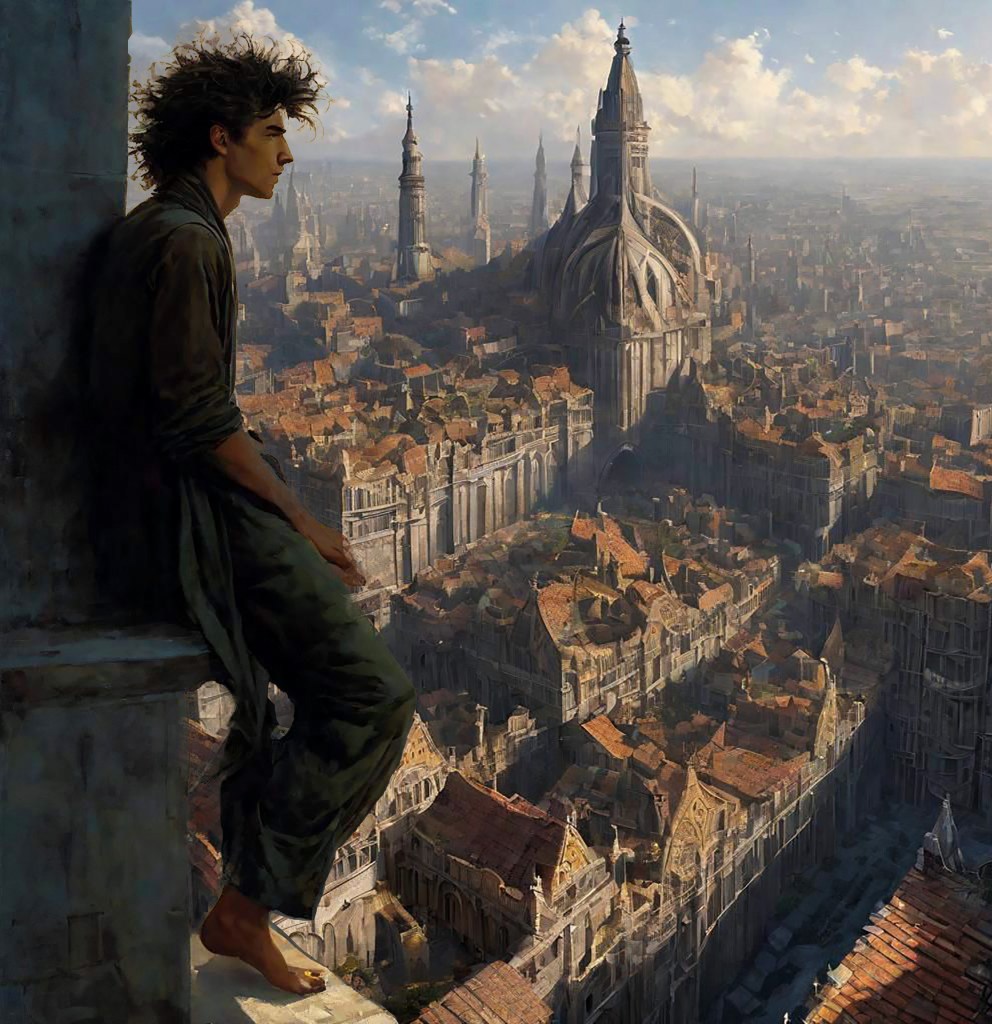
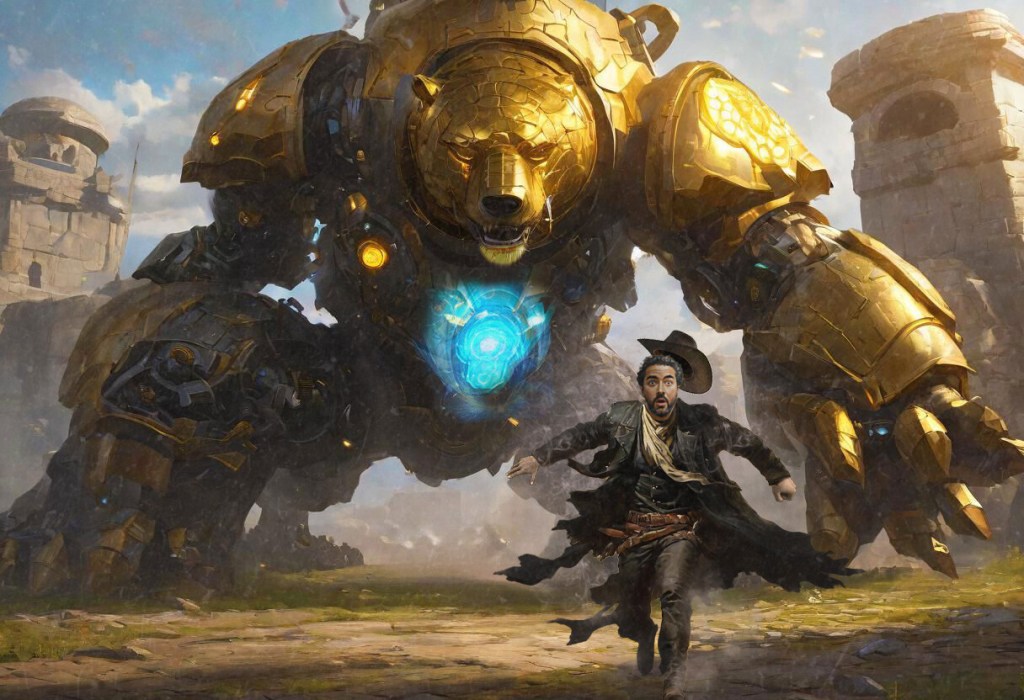
Taking place in a wild, unruly city called the Jagganatheum, it’s the story of a sickly, asthmatic young dreamer from a doomed family and the abandoned sentient weapon he steals. When a wheezing, sickly giant is unleashed at the city’s heart, it reveals intrigues that carry him into adrenalin-fueled adventures in a shattered world and, ultimately, to the heights of legend.
Here, there are lore cards to learn more if you’re interested, all relating to elements that will appear in the novel:
Anyway, I pretty much stopped writing on this back in February. Yes, I was busy with my day job, but the plot I had in mind just kind of fell apart for me. It stopped making sense. I really got the impression back in the dead of winter that all the dazzling imagery I had in mind, those flashes of plot points that made the book worth writing for me, they were just getting strung together with a discount plot that would obviously stall and get contrived in places.
I’m the first guy to complain about poorly written soap opera nonsense like Star Wars: The Acolyte and Amazon’s Rings of Power. Juvenile and inept attempts at high school level drama frustrate me: having lead characters just go be heroes because that’s who they are, people being angry with each other just for the dialogue the writer wanted to include, or sizzle reels glued awkwardly together with coincidences or by having characters do things they just wouldn’t normally do but need to for the plot happen, for a few examples. I truly don’t want to be associated with anything that even smells like that.
No offense if you’re into either of these, but craftmanship in plotting is an aspiration of mine. These two mainstream offerings are stinkers in my opinion.
I read three things over the years that have been screaming at me recently (only one of which I can cite so I’ll paraphrase):
“The only thing worth writing about is people.” – Harlan Ellison
“Villains are interesting because they are often the driver of the plot – they DO things.” -unknown
“Marvel’s Magneto (major villain in the X-Men comics and movies) has one of the most interesting motivations in all of comics.” -unknown, but it was a writer for Wizard Magazine
What I take from all that is:
Stick to realistic motivations and interesting, fleshed-out people who all have their own agendas and desires (not just plot supporters who don’t exist when not in the chapter)
Have protagonists DRIVE the plot (versus villains) by their actions, which have consequences
Make the motivations of villains make sense and be understandable and relatable, almost justified
It’s these principles that set the wrecking ball to the ideas I was holding on to. I’ll give you a few examples of what I’m talking about:
1. A train trip through the wild, jumbled Jagganatheum
Right after I started writing the novel, I caught the flu – it was a nasty one with a fever that wouldn’t go away. One night I had one of the most vivid dreams I’ve ever had. I had been trying to envision what a city two thousand years old and comprised of a single enormous building strapped to a mountainside would look like from the inside (and getting nowhere).
Then the dream – I saw Mazewater’s entire day play out. I watched him get beaten up by a guy who posed as his bully so his mom would stop trying to toughen him up. I saw him in a complex series of barter exchanges and understood how the social networks functioned. I remember being in a subway-style train station with ancient broken marble statues and skylights, hissing through massive corridors like airport concourses. It was a genius picture and made the city make so much more sense for me.
I was enamored with those images for months before I came to realize the whole series of exchanges and even the trip across the city just burned the clock and didn’t move anything. They could be trimmed without cost to the plot, and that hurt tremendously to let them go.
But I had to. And I knew it. Finally.
2. Ilianore, the loose cannon brunette
Oh, I hated to let this one go! No fever dream this time, but still she showed up in my head fully formed such that I could almost hear her voice. She had jet black hair she kept in a pony tail and worked part time for a troll-looking lady chef right out of a Studio Ghibli movie. When the lead character (who had crushed on her since they were in school together) would accidentially get her fired, Ilianore would barge into his apartment in a storm of anger, light a match and drop it to the floor, and sit to demand of him what was he thinking while his carpet burned. Just to make her point.
I found myself cramming in a romantic subplot with awkward flirting, weird secrets she would bring to the story, and a terrible confrontation after you were made to like her where she would die to drive him forward.
All nonsense and didn’t fit at all. It just wasn’t the story the core ideas needed. By keeping her, it forced certain things to happen with her or risk distractions and clutter. Unfortunately, and I breaks my heart to say this, we will not meet Ilianore in this book. We’ll likely never meet her, and I miss her already.
3. An old conspiracy uncovered
I turned this one loose just this past week. Still hurts.
Again, almost fully formed, I saw Mazewater on a stylite pillar doing a vision quest, trying to commune with the sentient weapon he’d stolen for 3 days in the rain. I knew why the pillar was there and what that had to do with the founding of the city. I knew what the weapon would say when it finally spoke, and how that would unlock an old conspiracy that turned the whole story on its head. I could have told you what that had to do with the giant’s attack on the city, what was really going on, and what happened next. I mean, this part of the story was core to the whole remainder of the novel. I really….can’t stress this enough….really didn’t see even the NEED to let this go.
So I was taking a long walk in the woods this past Tuesday, pleased that I had rewritten the work done so far into a tighter, coherent narrative with dynamic characters and that, so far, this story matched what was needed. However, some things about the bigger picture still didn’t make sense for me and felt cluttered. I was really worried heading out on that walk, fearing things might crumble again as I thought them through looking for holes. My plan was to let this walk take as long as it took to iron things out.
At one point, almost audibly, I told myself nothing was sacred. Nothing at all. What would the story look like if I just stopped holding on to cool pictures or imagined moments and let the motivations and personalities decide the course? What was it, exactly, that made me want to write this thing at all?
It turned out, the old conspiracy didn’t add anything useful at all. The weapon needs to say something else entirely. Even the vision quest was just a sizzle-reel for me that I thought was interesting, to add flavor to the history of the city but was useless in the end.
Gone! All of it. I am fascinated with where this wound up though. It’s tight and hangs together like brickwork.
Anyway, what I wanted to offer you today is the wisdom of outtakes. I have entire an entire chapter of Ilianore that I’m keeping for my own files. I’ve got pages of notes about the old conspiracy and what I saw in that fever dream of the city, that will likely never see the light of day – but which I’ll keep.
I’m not going to delete or discard any of that, much like directors struggle to cut scenes from their movies to which they’d become attached. In their case, they might add them to Director’s Cut versions of the movie just to feel good about sharing them with the world. Whether scenes wind up in the world or not though, it was the cutting that made the difference. That’s what tightened the story and made it resonate enough with an audience that anyone would even want a Director’s Cut of it in the first place.
Turn them loose, then. Nothing is sacred. Move on, even if they’re gorgeous.
I had writer’s block for a reason, and it was because I was holding on to nonsense that felt like gold.
Let me know what you think about that. Till next time,

I just finished reading Tolkien’s epic TheSilmarillion. I’m proud of that because it took me a few tries to get rolling. But once it started becoming clearer to me what was happening, who was who, and the overall point of everything, I found it to be a stunning work of genius that is unmatched in scope, attention to detail, and craftmanship.
If you’re into the Peter Jackson movies or love The Hobbit or Lord of the Rings books but have been side-eyeing The Silmarillion like I was, I think I can help with that. If you don’t really know what this insanely impressive book even is, I can help with that as well, and explain why you might want to consider taking the plunge and reading it. (There are spoilers here, but I wouldn’t even recommend reading this book without knowing a few things first if you expect to follow the big picture).
My point with this two-part set of articles is to give you a few tips that can make the going easier in reading it. Then I’ll land on what Tolkien was actually planning for a sequel and which direction he might have taken that should he have actually determined to press ahead.
J. R. R. Tolkien was one of the finest writers to ever work in the English language. He was one of the first true detailed worldbuilders, and in large part may have invented that craft itself. His main interest in the beginning was inventing fictional languages, and the worlds at the heart of the Lord of the Rings and related works were just places to house them. In The Hobbit, Fellowship of the Ring, The Two Towers, and Return of the King, we get glimpses and casual mentions of incredible events and the long, rich history of Eä, a fictional universe which contains Middle Earth (among other places). The Silmarillion is an opus of the mythology from creation of these worlds up to the end of their ages leading to our own.
What’s good about it?
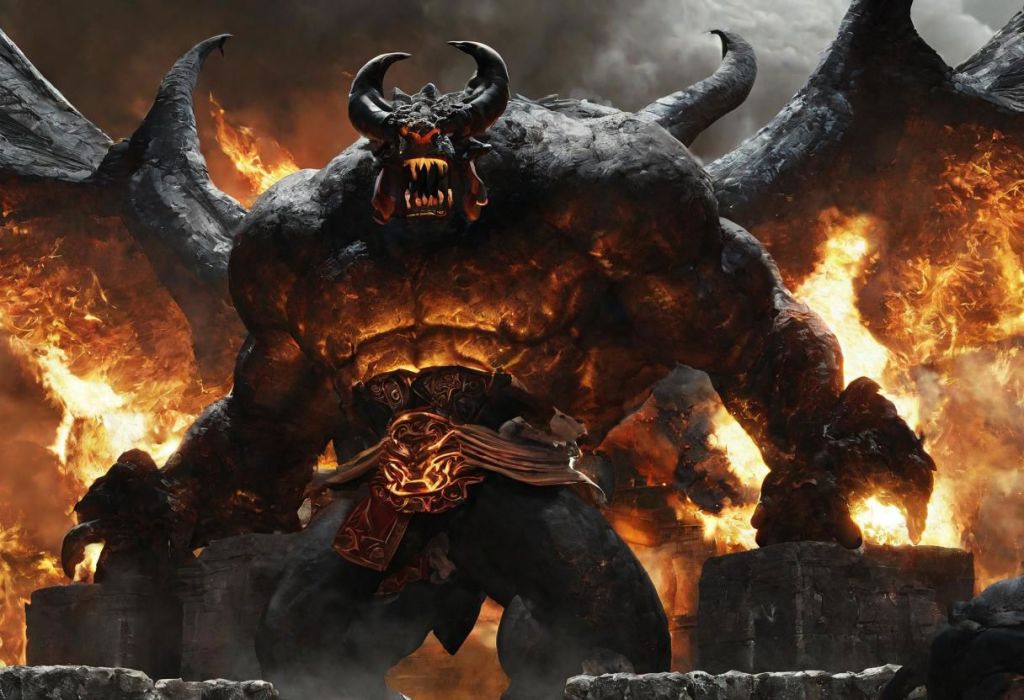
Oh, man, are you in for some of the most incredible imagery and ideas, fiery wars on a mythological scale that altered the very shape of the earth, fascinating characters fleshed out like real people but strutting larger-than-life on a stage of unimaginable fireworks! They might seem disconnected as you read them, but it all has a point. Practically everything you might love about the more famous books, every place you remember from them, has a history and reason for being. The giant spider that captures Frodo, the fiery balrog that killed Gandalf, why there are wizards at all, who built Minas Tirith, who was Sauron and what he really wanted (he wasn’t the first dark lord), why there is evil in this world, where elves and men came from & why they don’t like each other, why elves are fading, where they’re all going in the west, and on and on. It’s all made clear and hangs together tightly like a masterpiece tapestry while it tells an incredible story. In fact, the events of the more famous books are like footnotes here. There’s so much of a bigger picture going on than the rings and Sauron!
It’s genius, man. That’s what I’m saying. Genius.
Summarize it a bit, then. And give some tips on what’s important.
A creator god invites his supernatural beings to begin singing, though one among them strays into his own musical themes to suit himself rather than following the creator god’s lead (Melkor, one of the most important through-lines of the entire book and eventually the original dark lord). It turns out, their very music is creating Tolkien’s fictional universe, and all its long history, everything that ever will happen in it, is just that original music playing out. The creator god offers for them to enter into this new universe, and some take the invitation.
This new world is waking up with life and light, and the beings that entered it build a magical place called Valinor. Very much of what happens in The Silmarillion, and what is going on behind the scenes in the later books relates to this magical land to the west. Pay attention to everything that happens in Valinor and any time somebody enters there or leaves there.
Elves are the first newly created beings to appear in this world (in a place outside Valinor called Middle Earth), and most of action of the book is telling their early history. Most of the characters are in fact various types of elves, split up by various events and decisions and so with different tribal names. But elves nevertheless. Humans come into the picture, though a bit later and ultimately are the point of the music and everything else.
And the jewels?
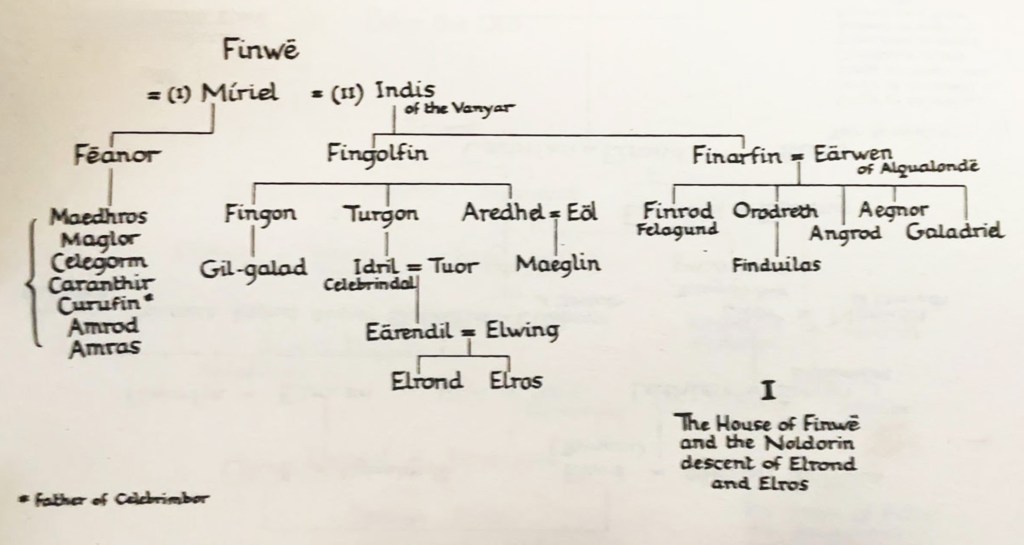
Three magical jewels (called the silmarils) are created by a craftsman elf (Feonor), and that drives an incredible chain of events that serve as the backbone of practically everything that happens. Pay close attention to Feanor, why the jewels glow like that (light from the trees of Valinor), what happened to those trees (Melkor’s dark deeds), and the terrible oath sworn regarding who will own these jewels. That’s the engine of the story, these jewels. That’s why the book is called what it is.
One family tree is really core to the book. This one:
Feanor made the jewels – he and his sons swear the oath, which carries supernatural weight and leads to the dooms of many. For anybody that chases those jewels, there are problems. In this family tree, there’s a connection eventually to the rings of power (Celebrimbor), Elrond and Galadriel (who you know from the movies), and a lot of the main events that happen in The Silmarillion. Aragorn traces his ancestry back to here as well. A lot of people are turned off by the firehose blast of names in this book (and I get that), so ticking off a few important names for yourself (and a few important places) is key in enjoying the book. Feanor and his sons matter a lot.
Over a biblical scale of time, long-lived elves (occasionally with supernatural help) fight Melkor and his dark armies of beasts. Here, you get orcs, balrogs, and the first dragon (who you get to watch grow up), werewolves, and giant spiders. Earthshaking battles and incredible conflicts rage, often to deal with Melkor’s evil or to struggle for those jewels.
Wait. Werewolves?
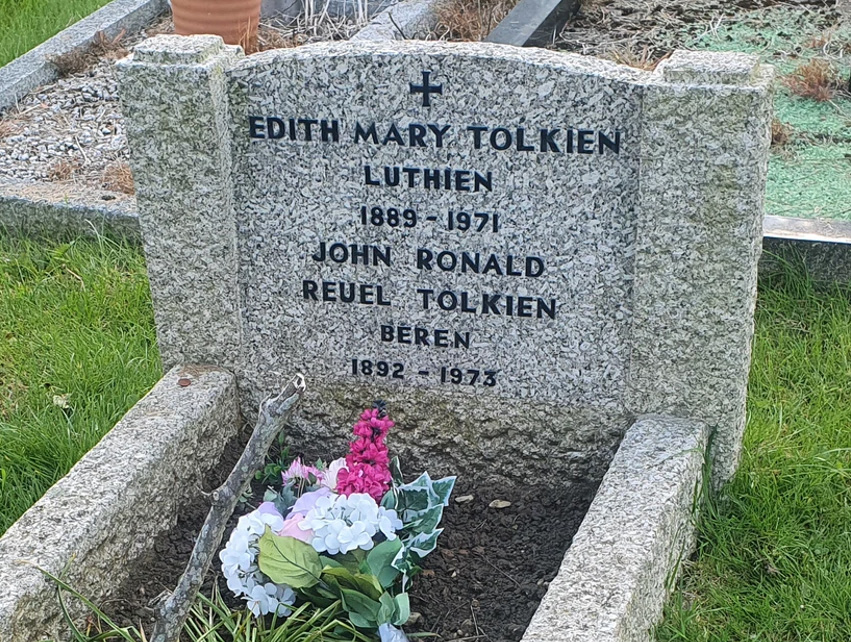
There are werewolves in Tolkien, yes. They’re mainly in the story of Beren and Luthien which is one of the most central parts of the entire tapestry. It’s a story that is gorgeous and mythical. Let me blow your mind a bit, if you didn’t know this:
That’s the gravestone for Tolkein and his wife. Here’s a quote from the Tolkien society:
“…the story has a personal significance to Tolkien. In 1917, a young Ronald (as Tolkien was known) saw his wife Edith dancing in a glade near Roos, Yorkshire; this scene was the germ of the story as Beren also first espies Lúthien whilst dancing in Doriath.”
[Beren And Luthien is available as a standalone book itself, which I’ve also read, and it’s worth your time as well. This is even more of a composite study done by Tolkien’s son than The Silmarillion, and is a bit more like piecing the tale together through notes than a somewhat polished work.]
Beren is human, Luthien, elf, and her father challenges Beren to bring him a silmaril for her hand. Unfortunately, the dark lord himself has all three of them by this point embedded in his crown where he sits on a throne in a dark and impregnable fortress protected by every manner of vile beast you can imagine and endless armies of orcs. This part of the story is key, so key in fact that Aragorn tells it to Frodo, as they are his ancestors.
Wrap this up, then. How does The Silmarillion end?
This book is a world, so it isn’t really that simple. There are several threads going on tangential to the big picture, like the Atlantis city of Numenor and its upheaval, the hidden city of Gondolin and its fall, and the tragedy of Hurin and his children (also available as a standalone work and also worth your time). I name these threads for a reason – pay attention to Numenor’s role and why it was destroyed, how and why Gondolin was destroyed, and Hurin’s son, Turin and his adventures. Still, they’re like side quests.
However, The Silmarillion tells at last of the fall of Melkor and the eventual fate of the silmarils. If you just keep your eye on Melkor (also named Morgoth) and the silmarils, you’ll get the main flow of everything going on with this incredible book. Towards its end, there is a concise summary of events leading up to the world we know from the more famous books.
Okay, so what was that you said about a sequel to Lord of the Rings that Tolkien was planning?
Ahhh, that’s interesting. It will be the point of the second part of this set of articles. A year and a half ago, I found out Tolkien had begun writing a sequel to be called The New Shadow. The scrap of it that exists is chapter 16 in a compilation called The Peoples of Middle Earth.
That’s honestly why I went deep on Tolkien in the first place. I rewatched the six movies (extended editions) and read all these books I’ve mentioned here, originally because I wanted to solve the mystery for myself of what was going to happen in that sequel should the professor have gone on to continue the story as he at one point planned. He explained clearly why he stopped, so I’ll briefly recap that for you in the second part of this series.
But what’s more interesting for me is where he would have taken the tale if he’d really decided he would press on with it. I believe he would have returned to the background of The Silmarillion, the big picture of that music from the very beginning and how it decided everything that was to happen, and point of humanity’s coming into this world in the first place.
*
I hope this whetted your apetite should you have interest in this amazing book. If it helped, let me know. If you love the book already, let me know that too. It was a transformative experience for me, going this deep into such a rich world.
Look, I try and keep it positive and optimistic around here. I do. Mostly, as anyone who stops by to visit any of the Grailrunner waystations on the internet or social media will tell you, I focus on things that inspire us. I especially (and incessantly) harp on inspirational engines within speculative fiction. It’s my jam.
But sometimes I need to vent. And I need to warn you away from some potentially very irritating literary experiences. Since this is all subjective, you probably love at least one of these books and think I’m a Neanderthal for feeling otherwise. That’s cool, man. That’s cool. But these suck. Really.
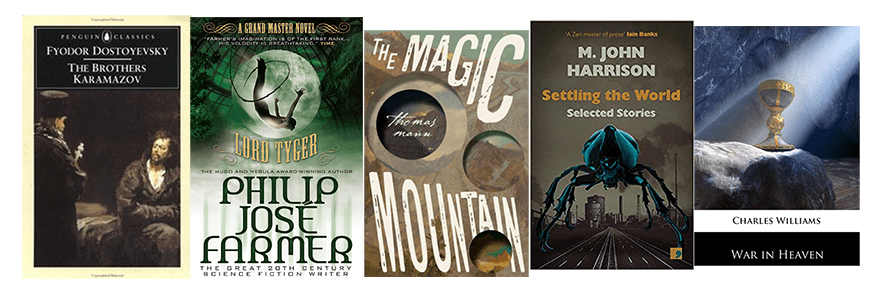
Let me tell you how the highlighted suck gallery went for me, in reverse order of my irritation level.
5. Brothers Karamazov by Dostoevsky.
I periodically dip into heavier literature (and outside of science fiction or fantasy, my usual haunts) to sharpen my writing, to expose myself to the towering figures of literature and scientifically dissect what makes those books tick. It’s a great exercise, as it has been with Moby Dick, with Hemingway (all of it, man…I’ve read all of it), Dickens and Faulkner. I picked Dostoevsky as an experiment because of how highly Harlan Ellison spoke of him. This one, I went with because it seemed to offer me some nuanced character studies, piledriving into a supposedly blowout climactic event (patricide by four brothers) that resulted from those character traits, and the fallout of that event. Now, it strikes me that this setup, should that be the case as I’ve outlined in the preceding description, then I could learn quite a bit about crafting plots driven by character flaws or quirks, and possibly about how to foreshadow and set ominous thundercloud mood to lead to the blowout.
That was the thought, at least. But what a cheese fart this one was! Sorry if you’re a professor who’s dedicated your life to it or whatever. But this book is super tedious, flat and uninspiring.
I admired the early chapters, with alternating introductions of the individuals and clear characterization. But it went on and on. It just went on and on and on, with nothing seeming to have any consequence. The big event wasn’t clearly foreshadowed (at least for me). There was no ominous mood as I’d expected. Not even the supposed angelic and innocent brother meant a thing in the world to me. I hated all of them. It was a chore to keep going, till I eventually wondered if they’d ever get around to knocking the old man off. So I bailed.
4. Lord Tyger by Philip Jose Farmer
If I told you there’s a book, written by the guy who dreamed up the masterwork Riverworld series, that conducts a thought experiment speculating what would actually happen should someone be raised by gorillas like Tarzan in the jungle….would you think that sounds awesome?
The idea is a British millionaire hires a couple of dwarves to raise a British aristocratic boy in the jungle like Tarzan, simulating some of the key events of Burroughs’ Tarzan books because of his love for them. And things go differently than he’d planned.
It struck me as a fascinating idea for a book, and I had some wild ideas of what might play out like the books and what would obviously go south. More curiosity than anything, I tried it. To be honest, I didn’t bail and actually finished the book. It was painful, but I made it through. What kept me going was the same curiosity of what would be done with the idea, and definitely NOT any skilled storytelling or characterization.
The lead character is overly obsessed with his penis, and it gets really monotonous and cartoon-like how many times we have to see that play out. I get it, monkeys touch themselves and maybe sleep around. I get it. But can’t we move on to something else?! It drives the plot sometimes. It’s entirely ridiculous sometimes. And it keeps coming up (no pun intended). Nobody is interesting, nothing makes sense, and I yawned through the climax. Avoid this one.
3. Magic Mountain by Thomas Mann
Not sure why, but I have a deep fascination with the psychology that led up to World War One, that kept it escalating and stagnating, and that resulted from its fallout in the couple of decades afterwards. It’s incredibly rich, picking all that apart – at large scales, understanding trends and behaviors of large groups, and also at small scales reading the biographies and journals of key figures that fought in the war. Magic Mountain by Thomas Mann struck me as a great option because it’s so highly praised, and supposedly was going to offer me a hotbed of the different moods and psychologies of people of that time, but in the setting of a health salon high in the mountains.
Reading this book feels very much like talking to a sickly aunt who won’t stop going on about the parts of her that hurt. And her cough, do I think that’s serious. And her swollen toe, should she get that looked at. And she’s so tired…
The lead figure isn’t sickly, but visits his cousin who is recuperating at a sanitarium in the Alps. And he meets people and stays, and he has breakfast and he has lunch. And he has dinner. And he tells you in detail what he ate. And no one is interesting, at least in the first fourth of the book I managed to read. You can see how little patience I have for stories that lead nowhere, for characterizations without some sizzle, and for aimlessness. This book seemed to go absolutely nowhere, and at the very point I threw it physically to the floor was at least the fifth time he was explaining what they were serving for the next meal. Avoid this one.
2. Settling The World by M. John Harrison
Nobody loves Harrison’s Viriconium series like I do! His mother wouldn’t love it like I do. It’s genius. Read that one. Please, God, read that one instead of Settling The World. In Viriconium, you get a true masterwork of mood-setting, of fascinating ideas to inspire, of interesting people, of a world you’d care to visit, and of the most maddeningly genius wording and phrasing you’ll encounter. Anybody who writes should treat Viriconium like nitroglycerine. A true brilliant white-hot piece of literature.
Much of everything else he’s written comes off as comparatively weak and confusing to me. Light is an exception, but its sequels are muddled streams of consciousness. Settling The World is a set of speculative fiction short stories. I don’t even know how to summarize it, because I can’t tell at all what’s happening in some of these tales. It’s seriously bad. Pages in, I had to ask myself if there was anything at all that was clear to me. I read a summary of a story I’d finished on the internet to see what it was about. Isn’t that funny? There are people in this world that can read jumbles of words like some of the tales in this collection and tell you what happened, even though you read the same story and saw none of that. And I saw none of the brilliant word-slinging which draws me so much to Viriconium and Light. With those books, there are moments when I’ve had to set the book down and just marvel and ponder at what I’d just read…descriptions and phrasing that pop with a life of their own and send your mind reeling.
I honestly have enough grief in my life than to read stories that I have to research afterwards to understand what happened and come off as bland as these. I set it as number two because I know what Harrison can accomplish and he fell short here.
1. War In Heaven by Charles Williams
This one made the top of the list because it presented itself as a story about the Holy Grail. I’m literally ALWAYS in for a story about the grail. I mean, this is “grailrunner”. That’s kind of…for a reason, you know? Here, we have the description from Amazon:
“Williams gives a contemporary setting to the traditional story of the Search for the Holy Grail. Examining the distinction between magic and religion, War in Heaven is an eerily disturbing book, one that graphically portrays a metaphysical journey through the shadowy crevices of the human mind.”
Williams was one of the Inklings, that little Oxford literary club that gave us J.R.R. Tolkien (Lord Of The Rings) and C.S. Lewis (Chronicles Of Narnia). If this guy hung around with those two, who could produce towering mythic works such as those, then he would potentially speak and think along the same mythic lines. I’ve written here about the power of mythic storytelling. That can change your life! And here, I’m told he’s going to potentially apply such mythic storytelling techniques to the eternal grail myth, in a contemporary setting. What on earth is NOT to like about that?!
Unfortunately, this reads like a boring, slice-of-life trip to the general store to buy a pound of flour. Even a dead body found in the opening pages is portrayed with the weight and significance of a paperweight. I got possibly a fourth of the way in before bailing. Where was my updating of mythic figures like Arthur or Merlin? Where was my ominous doomsaying warning of consequences? Where was that curious, inspirational sense of questing and seeking perfection in body and spirit that I get from classic Eschenbach or De Troyes? Where was the mystery from those original grail tales, that leave you breathlessly marveling over what the bleeding lance means, and who the maidens are in the processional carrying the mystical platter?
Nope. Just nope. Maybe it got better. I’ll never know. Pass on this one.
*
And that’s the roundup for this little venting session. I hope it wasn’t overly negative. I finished Gene Wolfe’s Book Of The New Sun, all four parts, for those who’d asked what I thought. Definitely worth the experience, though not one of my favorites. There’s a distinct sense of importance as you read those books, like the early seasons of Game Of Thrones, wherein every word people speak seems to have weight and grant some vague insights. Events here make far more sense after the fact, in reflection, and often what you thought happened actually played out differently than you’d thought. Yeah, there’s a place to spend your money.
Anyway, let me know what you think. And if I poo-poo’ed on one of your faves, maybe drop me a note on what you liked about these books I consider stinkers. Maybe I could feel differently and try again if you make sense.