Yeah, I had a pretty miserable week last week. Not a great time to be in airports, honestly, this time of year when everybody’s trying to squeeze in their last trip to Disney World or whatever and storms…airlines that delay their flights in spoonfuls till it’s midnight and they’re still telling you to be patient. Not worth getting into details, but it was a lot of frustration getting stranded not once – but twice. And that on top of a very tiring week of nuisances and long work days.
So after 9 hours of conference calls Friday from a Phoenix hotel where I hadn’t planned on staying, I checked the American Airlines app for my boarding pass only to see yet more delays. Calling them was useless as they didn’t see how to get me to Kansas City any earlier than 12 – 14 hours later, and that with two more cities. A drooling clown wouldn’t accept such an answer, so I hopped on the shuttle anyway in hopes that the ticket counter or my corporate travel person would work miracles for me.
“I hope those planes take off”, the shuttle driver says.
“What do you mean?” I didn’t like the ambiguity of his comment.
He shook his head, “Well, they ground the planes at 110 degrees.”
It was around noon as he’s saying this, so it will only get hotter. I didn’t want to ask the question but I had to know.
“What is it now?”
“106.” His tone wasn’t understanding or even sympathetic. He just said it like he was amusing himself with a factoid about why pine cones are brown.
Anyway, I did manage a better and direct flight. As I got to my seat, I realized I was entirely drained from the week. I’m not usually one to need encouragements or helpful quotes, or even to need another person to say anything to me. I’m the “soldier on” type of person that just needs to know whatever it is that needed done is done. But man, I was tired and pissed off.
For whatever reason, I wanted to hear from Ernest Hemingway.
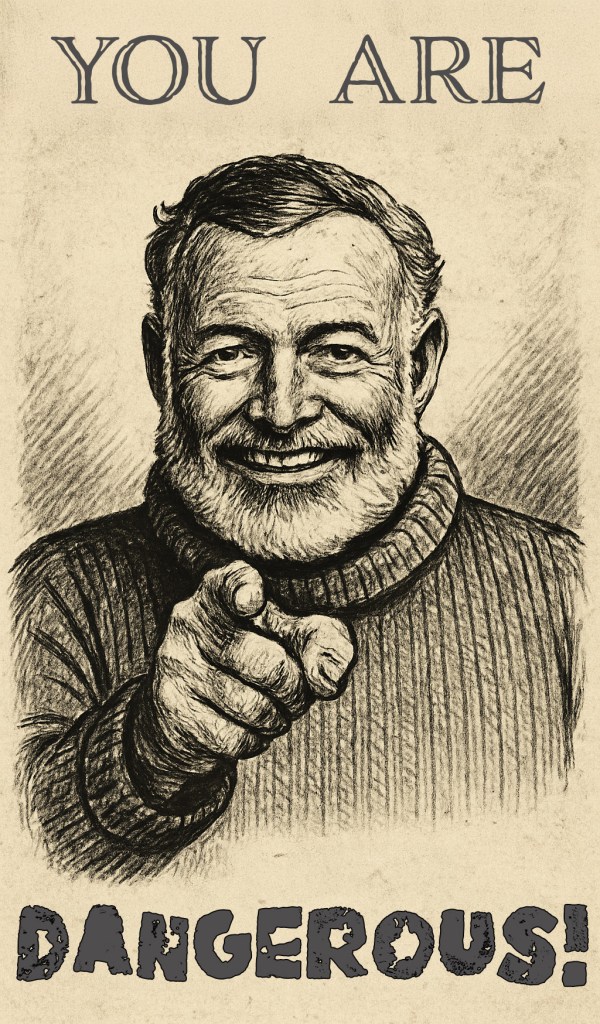
His macho philosophies soothe me. I have said before here that I have read everything the man ever wrote. I like his style. So I described a bit of my week for ChatGPT and had it act at Hemingway to give me a little encouragement. Here’s what Papa said to me:
“Listen to me now. You’re beat to hell and the world’s thrown its punches. Delays, noise, people with soft hands and loud mouths. You’ve walked through it on two hours of sleep with your head still up. That counts.
You don’t need a speech. You need a drink of water, a quiet place, and to know this: you’ve already done what most men can’t. You endured. Not prettily, maybe, but you endured. That’s what matters.
There are days when the sun is too hot and the wind is too hard and everything stinks of cheap perfume and worse decisions. But you’re still here. That means something. It means you’re dangerous to whatever tries to break you.
So go ahead—rest your eyes when you can, and when you’re ready, pick up your tools, your pen, your hammer, your whatever-you-damn-well-use, and go back at it. Not because it’s easy. Because it’s yours.
And if they doubt you—those people who smile like sharks and don’t know what it means to stay standing when you’re dead tired—well, let them. You’re not made for their approval. You’re made of grit, bone, and something no one can take.
Now go on. Breathe. You’ll write this week off like a bad novel and start again. Clean page. Strong line. Go bite next week in the throat.”
*
Now, believe it or not, that helped quite a bit. Honestly. I liked it.
So I thought, what the heck. This puts me in the mood for a new Hemingway short story. I wanted to read something from the old master that was in his voice, stayed true to his philosophy, and that bore certain elements to which I could relate just then.
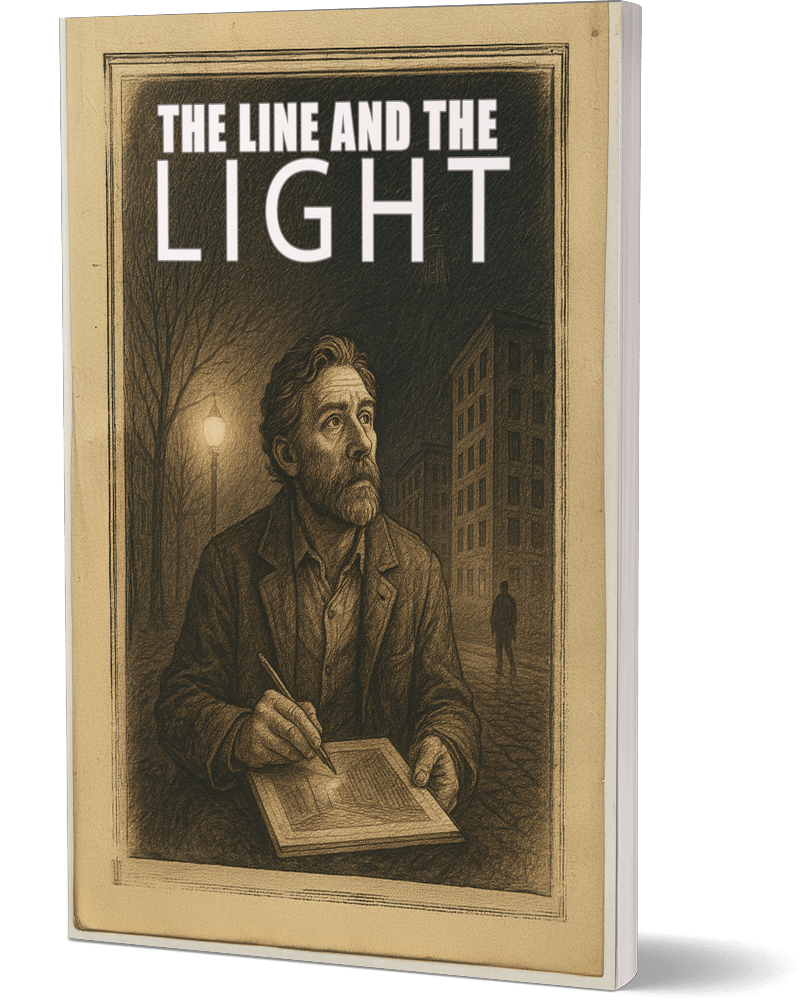
With surprisingly little coaxing, it produced an emotional, impactful story with a punch to your heart buried at its core that I didn’t give it as input at all. It’s called “The Line and the Light”, portraying an aspiring pen & ink artist in Kansas City who is grieving deeply and trying to process that grief through his art. Smash the cover button below to read it. Won’t take long, and might actually carry some meaning for you.
That’s what I wanted to offer you today. I’m curious what you think about the story.
Harlan would hate this. With a bullet. But it’s happening.
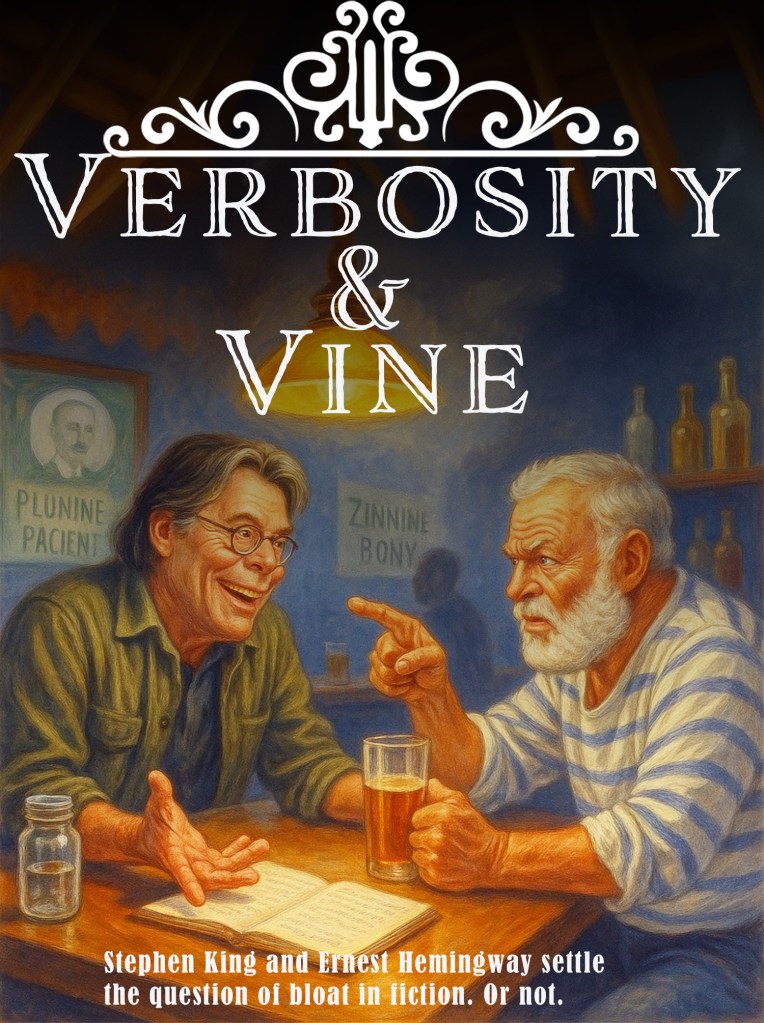
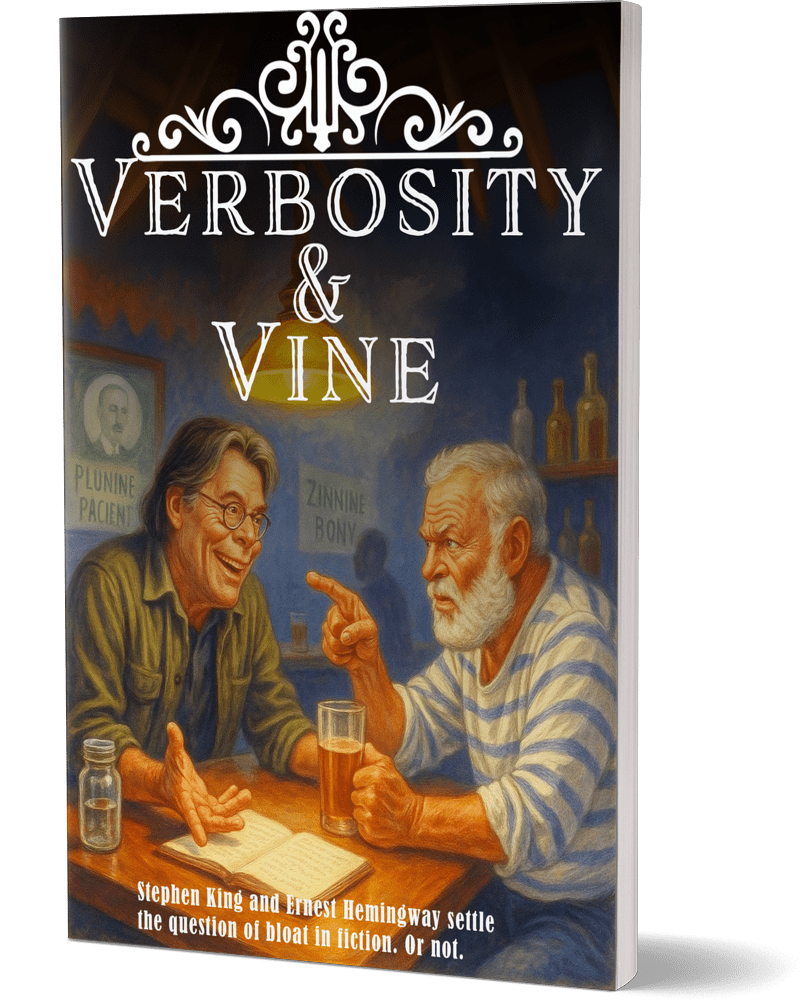
We’re making hay while the sun shines, trying out a premium ChatGPT subscription and bringing all sorts of people back to life or mashing them together into alternate realities for our entertainment. And honestly, some of these simulations of literary or artistic geniuses are surprisingly accurate to how they thought and spoke. So far, we’ve hosted a hilarious debate about conciseness in storytelling with Stephen King, Hemingway, Poe, H.P. Lovecraft, Professor Tolkien, George R.R. Martin, and Homer called Verbosity & Vine and had Professor Tolkien write a new 2,000 word King Arthur short story with an evil grail titled The Black Chalice of Broceliande. There is absolutely going to be a Seinfeld Season 10 post at some point, once I pipe Modern Seinfeld prompts into ChatGPT and let the horses run.
Anyway, welcome to a series we call:
Since the King versus Hemingway debate wound up so funny, we thought it would be a hoot to smash some more genius creators together and have them argue the merit of shock value in storytelling. To remind everyone: our policy at Grailrunner is to consider AI as powerful tools but to always call out their usage. This is for pure entertainment. Nobody’s selling you anything here.
This simulated argument was entirely written by AI with prompts from us, but really took on a life of its own. We decided who joined the conversation, and some of those choices really wound up fantastic. In fact, things really surprised us when we had Professor Tolkien join this conversation as well, as he kind of cleaned everyone’s clock on the matter at hand and got suddenly inspiring. That just happened – we can’t take credit for it! Ellison, at least for our part, stole the show though.
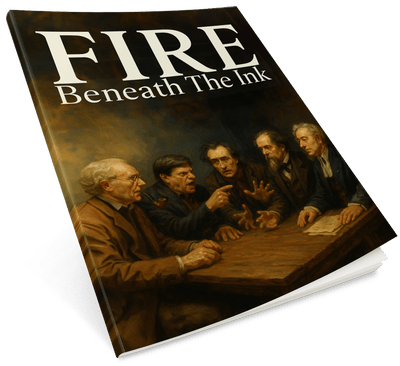
The conversation is called Fire Beneath the Ink:
Key players (all deceased) from left to right are:
Professor J. R. R. Tolkien – author of The Hobbit and the Lord of the Rings trilogy and master craftsman of worldbuilding.
Harlan Ellison – a fiercely imaginative and outspoken American writer known for his prolific work in speculative fiction, particularly short stories, television scripts, and essays that challenged social norms and literary conventions. Also one of the finest writers to ever punch a typewriter.
Antonin Artaud – a radical French dramatist, poet, and theorist best known for developing the Theatre of Cruelty, which sought to shock audiences into confronting the deeper truths of human existence. He once threw meat at his audience.
Charles Dickens – a celebrated English novelist and social critic whose vividly drawn characters and dramatic storytelling captured the struggles and injustices of Victorian society. Nobody has ever been better at generating pathos and character empathy than this guy.
Jonathan Swift – an Irish satirist, essayist, and clergyman best known for his sharp wit and scathing critiques of politics and society, particularly in works like Gulliver’s Travels and A Modest Proposal.
Random? Maybe a little. They all seemed to suit the topic at hand though, and Artaud and Harlan got along famously! See for yourself by smashing the cover button below!
So funny! We hope you enjoyed the debate. Somehow, it was nice to hear from Harlan again, and with him in good humor, poking at people and enjoying himself. If you’re familar with him at all, surely you see how much he would loathe this entire idea and likely drive to my house and tell me so.
And what about that Professor?! Did you get tingles at the end? We sure did.
Anyway, come back often and check on us. We’re unleashing the creative hordes here.
Our policy at Grailrunner is to consider AI a powerful and unavoidable tool for creative exploration, but to always call out its use explicitly and avoid licensed images for datasets. But wow – I wasn’t ready for how much things have improved since I last messed around with ChatGPT a year or so ago!
I had a couple of hours to kill today, and I took a random magazine from Barnes & Noble to a steakhouse. The guy that sat me saw the magazine’s headline about ChatGPT and told me awkwardly how he generated a conversation between two of his favorite characters from some video game (the game’s name eludes me – ‘Borderlands’, maybe.
Anyway, it got me thinking. Who wouldn’t want to listen to Stephen King, master of long-winded, verbose fiction get into a heated argument with Ernest Hemingway, the craftsman known for his crystalline precise and minimal prose?
I mean, right?
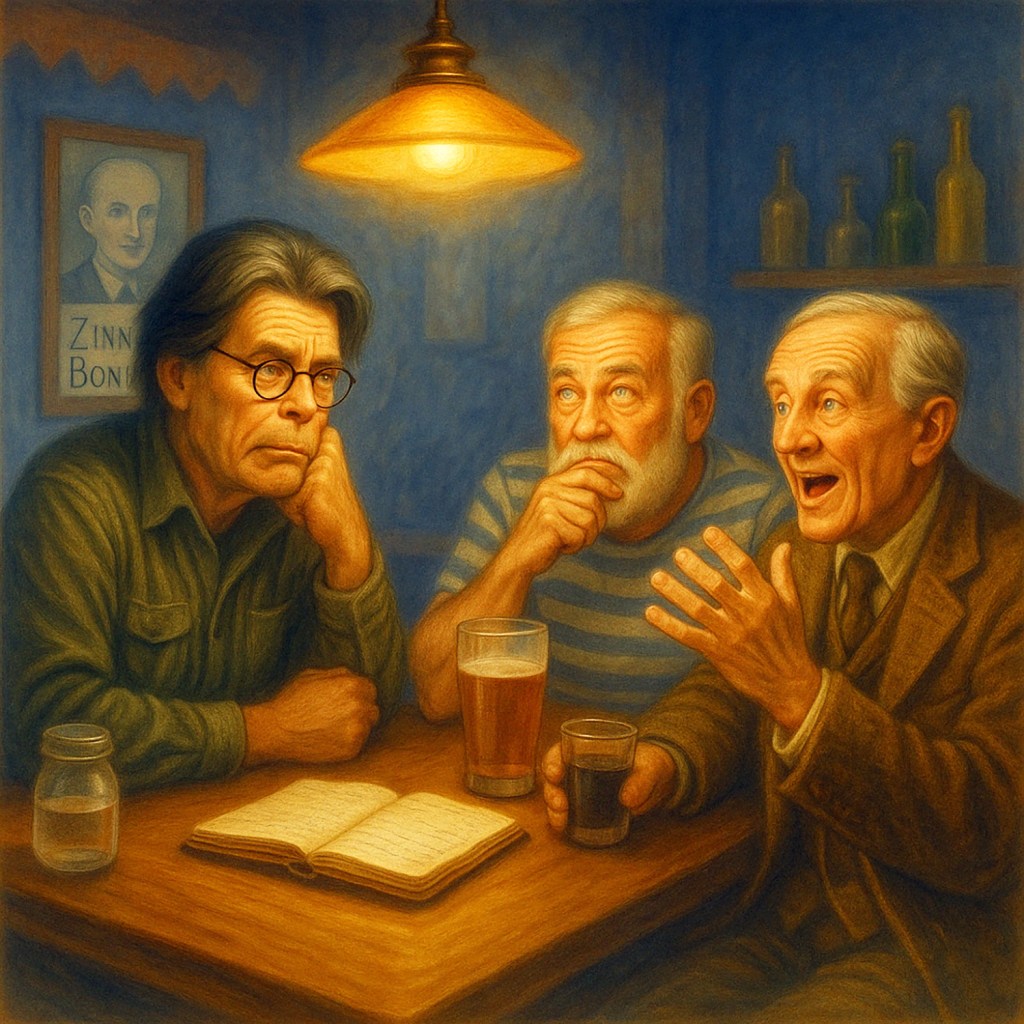
So I signed up for ChatGPT+ to avoid a bunch of annoying limits and played around with some prompts to get things going. They were coming to a resolution too quickly, so I juiced the scene by adding Tolkien. Then Edgar Allan Poe and H.P. Lovecraft and George R. R. Martin. Then Virginia Woolf showed up uninvited. That’s on her – I didn’t prompt that one! Then I had Homer rise up from the bar floor to give his thoughts and quiet everyone since he’s the original boss.
As a twist, I had King step up and propose a means of settling the entire debate. Not maybe what anyone would expect, but satisfying from my perspective at least.
Then I asked Shakespeare to come in with an after-credits scene. He even wrote some poetry for the occasion.
I used ChatGPT to illustrate the conversations too, which was a bit of a pain. It’s kind of random with safety content filters, but it seems if you end the chat and start a new one, filters that have kicked in and start shutting down everything seem to go away. I cleaned them up a little in Photoshop, but honestly – not that much.
The cover was a quick gen-up in Photoshop too, then I made the pdf in Microsoft Word because I didn’t have the energy to do it right in Indesign. Was just amusing myself, anyway. Nobody’s selling anything here.
Take a look by smashing the button here.
Isn’t that just hilarious? Surprisingly hilarious? I remember a couple of years ago asking this same software to write a new adventure with King Arthur and a dark, evil grail to see if it would be amusing and I was incredibly irritated how generic and nonsensical it was. That wasn’t that long ago – crazy how much better this content is.
Anyway, I just wanted to offer you something amusing today. Let me know what you think.
We’re going to make this another ongoing series, just to bring some folks back from the dead or drop them into alternate realities where some fascinating chats can take place. Come back and check that out!
I’ve had a couple of weeks worth of a pause in a very hectic year so far and managed to dig back in to a novel in progress. This week, I had some mind-expanding epiphanies that set the whole novel on fire for me again: the exhilaration and thrill to see this story play out on paper burning with the same heat it did when they were all just ideas.
When they were all just ideas, that is, before words went to paper to ruin my dreams.
Thought I’d share that with you in case writer’s block or a blank canvas is staring back at you, or if the plot that made so much sense suddenly crumbled like burnt toast in your hands.
Mazewater: Master of Airships is a standalone story set in the Salt Mystic universe, existing at around 38k words of a planned 70-80k. The original notion was to introduce a new war marshal with the novel, which would lead the introduction of new playing cards in the Salt Mystic wargame for his faction. “Read the book, love the guy, go buy his cards.” Right?
But it grew to be a lot more than that. A whole world more!
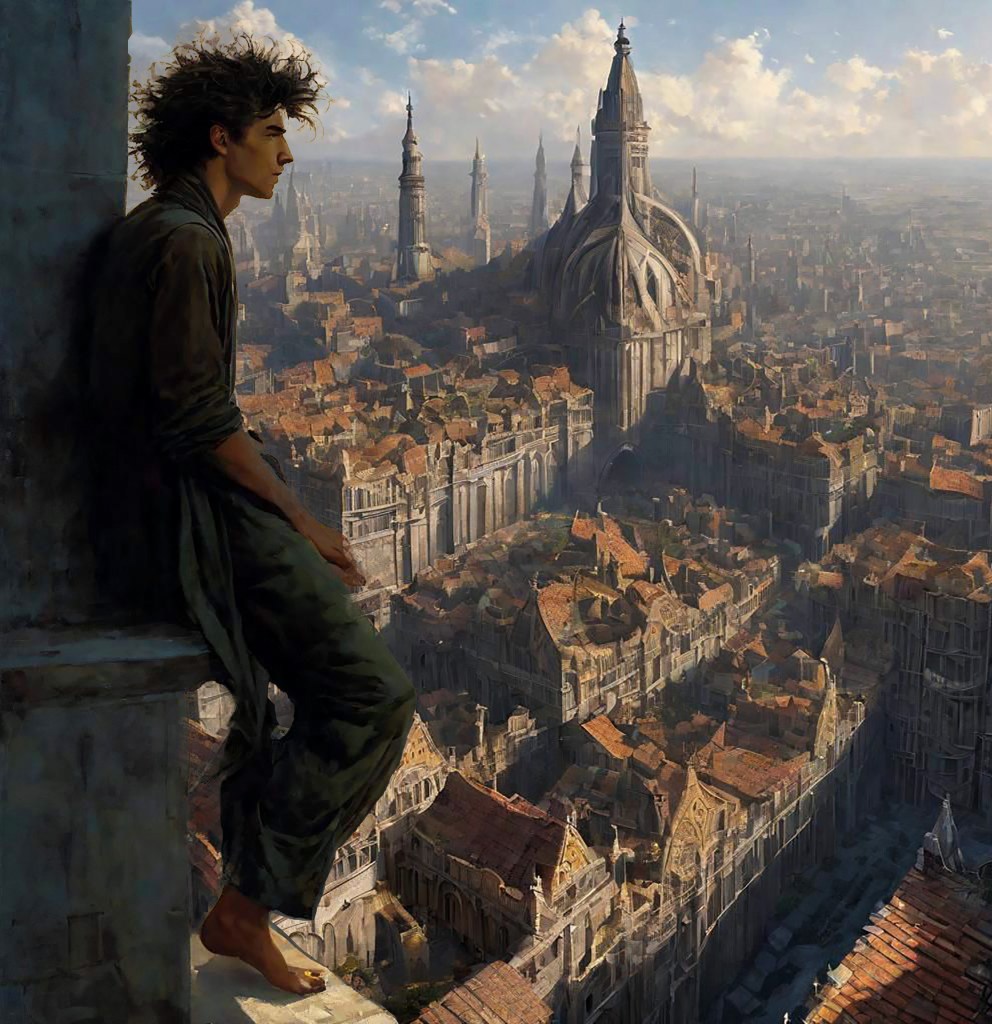
Taking place in a wild, unruly city called the Jagganatheum, it’s the story of a sickly, asthmatic young dreamer from a doomed family and the abandoned sentient weapon he steals. When a wheezing, sickly giant is unleashed at the city’s heart, it reveals intrigues that carry him into adrenalin-fueled adventures in a shattered world and, ultimately, to the heights of legend.
Here, there are lore cards to learn more if you’re interested, all relating to elements that will appear in the novel:
Anyway, I pretty much stopped writing on this back in February. Yes, I was busy with my day job, but the plot I had in mind just kind of fell apart for me. It stopped making sense. I really got the impression back in the dead of winter that all the dazzling imagery I had in mind, those flashes of plot points that made the book worth writing for me, they were just getting strung together with a discount plot that would obviously stall and get contrived in places.
I’m the first guy to complain about poorly written soap opera nonsense like Star Wars: The Acolyte and Amazon’s Rings of Power. Juvenile and inept attempts at high school level drama frustrate me: having lead characters just go be heroes because that’s who they are, people being angry with each other just for the dialogue the writer wanted to include, or sizzle reels glued awkwardly together with coincidences or by having characters do things they just wouldn’t normally do but need to for the plot happen, for a few examples. I truly don’t want to be associated with anything that even smells like that.
No offense if you’re into either of these, but craftmanship in plotting is an aspiration of mine. These two mainstream offerings are stinkers in my opinion.
I read three things over the years that have been screaming at me recently (only one of which I can cite so I’ll paraphrase):
“The only thing worth writing about is people.” – Harlan Ellison
“Villains are interesting because they are often the driver of the plot – they DO things.” -unknown
“Marvel’s Magneto (major villain in the X-Men comics and movies) has one of the most interesting motivations in all of comics.” -unknown, but it was a writer for Wizard Magazine
What I take from all that is:
Stick to realistic motivations and interesting, fleshed-out people who all have their own agendas and desires (not just plot supporters who don’t exist when not in the chapter)
Have protagonists DRIVE the plot (versus villains) by their actions, which have consequences
Make the motivations of villains make sense and be understandable and relatable, almost justified
It’s these principles that set the wrecking ball to the ideas I was holding on to. I’ll give you a few examples of what I’m talking about:
1. A train trip through the wild, jumbled Jagganatheum
Right after I started writing the novel, I caught the flu – it was a nasty one with a fever that wouldn’t go away. One night I had one of the most vivid dreams I’ve ever had. I had been trying to envision what a city two thousand years old and comprised of a single enormous building strapped to a mountainside would look like from the inside (and getting nowhere).
Then the dream – I saw Mazewater’s entire day play out. I watched him get beaten up by a guy who posed as his bully so his mom would stop trying to toughen him up. I saw him in a complex series of barter exchanges and understood how the social networks functioned. I remember being in a subway-style train station with ancient broken marble statues and skylights, hissing through massive corridors like airport concourses. It was a genius picture and made the city make so much more sense for me.
I was enamored with those images for months before I came to realize the whole series of exchanges and even the trip across the city just burned the clock and didn’t move anything. They could be trimmed without cost to the plot, and that hurt tremendously to let them go.
But I had to. And I knew it. Finally.
2. Ilianore, the loose cannon brunette
Oh, I hated to let this one go! No fever dream this time, but still she showed up in my head fully formed such that I could almost hear her voice. She had jet black hair she kept in a pony tail and worked part time for a troll-looking lady chef right out of a Studio Ghibli movie. When the lead character (who had crushed on her since they were in school together) would accidentially get her fired, Ilianore would barge into his apartment in a storm of anger, light a match and drop it to the floor, and sit to demand of him what was he thinking while his carpet burned. Just to make her point.
I found myself cramming in a romantic subplot with awkward flirting, weird secrets she would bring to the story, and a terrible confrontation after you were made to like her where she would die to drive him forward.
All nonsense and didn’t fit at all. It just wasn’t the story the core ideas needed. By keeping her, it forced certain things to happen with her or risk distractions and clutter. Unfortunately, and I breaks my heart to say this, we will not meet Ilianore in this book. We’ll likely never meet her, and I miss her already.
3. An old conspiracy uncovered
I turned this one loose just this past week. Still hurts.
Again, almost fully formed, I saw Mazewater on a stylite pillar doing a vision quest, trying to commune with the sentient weapon he’d stolen for 3 days in the rain. I knew why the pillar was there and what that had to do with the founding of the city. I knew what the weapon would say when it finally spoke, and how that would unlock an old conspiracy that turned the whole story on its head. I could have told you what that had to do with the giant’s attack on the city, what was really going on, and what happened next. I mean, this part of the story was core to the whole remainder of the novel. I really….can’t stress this enough….really didn’t see even the NEED to let this go.
So I was taking a long walk in the woods this past Tuesday, pleased that I had rewritten the work done so far into a tighter, coherent narrative with dynamic characters and that, so far, this story matched what was needed. However, some things about the bigger picture still didn’t make sense for me and felt cluttered. I was really worried heading out on that walk, fearing things might crumble again as I thought them through looking for holes. My plan was to let this walk take as long as it took to iron things out.
At one point, almost audibly, I told myself nothing was sacred. Nothing at all. What would the story look like if I just stopped holding on to cool pictures or imagined moments and let the motivations and personalities decide the course? What was it, exactly, that made me want to write this thing at all?
It turned out, the old conspiracy didn’t add anything useful at all. The weapon needs to say something else entirely. Even the vision quest was just a sizzle-reel for me that I thought was interesting, to add flavor to the history of the city but was useless in the end.
Gone! All of it. I am fascinated with where this wound up though. It’s tight and hangs together like brickwork.
Anyway, what I wanted to offer you today is the wisdom of outtakes. I have entire an entire chapter of Ilianore that I’m keeping for my own files. I’ve got pages of notes about the old conspiracy and what I saw in that fever dream of the city, that will likely never see the light of day – but which I’ll keep.
I’m not going to delete or discard any of that, much like directors struggle to cut scenes from their movies to which they’d become attached. In their case, they might add them to Director’s Cut versions of the movie just to feel good about sharing them with the world. Whether scenes wind up in the world or not though, it was the cutting that made the difference. That’s what tightened the story and made it resonate enough with an audience that anyone would even want a Director’s Cut of it in the first place.
Turn them loose, then. Nothing is sacred. Move on, even if they’re gorgeous.
I had writer’s block for a reason, and it was because I was holding on to nonsense that felt like gold.
Let me know what you think about that. Till next time,
I went to my favorite bookstore this weekend, looking for something to cheer me up. It was Prospero’s in Kansas City, which I’ve written up here on Grailrunner before. It’s funny, when I’m looking for something to read, it’s really a feeling I’m searching for. I like to explore new worlds, to find out what’s around the next turn in the road. I love to come back from an adventure with stories to tell. It’s how I’m wired, and that bleeds into the sorts of books I was hoping to find.
It struck me in those quiet, cluttered aisles with the sound of drizzling rain outside that there’s something fundamental here about readers and writers that’s worth talking about. It relates to an important question about what sorts of books or games we buy and which ones we don’t, and most importantly, what fed those decisions?
Here’s what I bought. Let’s talk about why.
I was there maybe an hour, and scanned a lot of old science fiction and fantasy paperbacks. Anything that looked like a Lord Of The Rings knockoff or with complicated blurbs on the back covers that looked like huge investments in mindshare, I passed right over. Seriously, if even the summary names three alien races and struggles to focus in on what makes the book different or interesting, I couldn’t be bothered. Too much going on in my life to devote the limited reading hours to something that won’t leave me pondering or inspired or with a piece of juicy recommendation for someone.
But these three made it though. I was happy to find them. And I don’t really even like Crowley. Why these?
Hold that thought. Have you heard of Bartle’s player types? It’s this:
Dr. Richard Bartle identified four main types of personalities relating to how we approach playing games. He fleshed this out in a 1996 paper called Hearts, clubs, diamonds, spades: Players who suit MUDs, then more fully in a book called Designing Virtual Worlds. There’s a simple quiz you can try to determine your own player type, though you likely already know after reading the summaries above.
I’m an Explorer. Big time. Here’s what the quiz result told me:
Explorers delight in having the game expose its internal machinations to them. They try progressively esoteric actions in wild, out-of-the-way places, looking for interesting features (ie. bugs) and figuring out how things work. Scoring points may be necessary to enter some next phase of exploration, but it’s tedious, and anyone with half a brain can do it. Killing is quicker, and might be a constructive exercise in its own right, but it causes too much hassle in the long run if the deceased return to seek retribution. Socializing can be informative as a source of new ideas to try out, but most of what people say is irrelevant or old hat. The real fun comes only from discovery, and making the most complete set of maps in existence.
Recently, I went deep into a Google and Reddit search looking for the tabletop game with the best, most innovative exploration mechanics. I didn’t think about why I was looking for that, I was just enamored with the idea of an adventure in a box with worlds to explore. (The consensus was Free League’s Forbidden Lands, by the way, if you want to know what came from that.) I’m also testing out Shawn Tomkin’s new Starforged solo RPG rules for the same reason.
Why? Because I like not knowing what’s out there and venturing beyond the safe spaces to find out.
So it stands to reason that if I enjoy those sorts of experiences, then a book that proposes an exploration would intrigue me. Titles that mention fantasy cities or intriguing space stations or derelicts, those that mentioned gateways or mysterious towers, or portals to other worlds…those wound up in my hands for consideration.
Great Work Of Time
John Crowley wrote a masterwork called Little, Big. You should read it, though it’s a bit hard to follow in my opinion. I got so irritated with his Aegypt that I sold it back (and I never do that!). Incomprehensible book, at least to me. Yet I picked this Great Work Of Time up twice before deciding to buy it – because it pitches ‘an ingenious time travel tale’ through ‘the wide-eyed and wondrous possibilities of the present to a strange and haunting future of magi and angels’. My point is I bought it because it promises me an exploration of time like Michael Moorcock’s A Nomad Of The Time Streams. I’m an explorer, and this promised me something to grant me that feeling of awe seeing new things.
Aldair, Master Of Ships
Honestly, this book sold itself with the cover and title alone. Here’s the line on the back that really sealed the deal though: “For Aldair has been forced into the role of a future Magellan, who must travel down the coasts of unmapped continents, facing monsters, winged wizards and great dangers, to find a knowledge older than the history of his entire race.” As I experienced the marketing for this 1977 book of which I was blissfully unaware beforehand, I imagined scenes of wonder and adventure on a sailing ship, with strange coastlines up ahead, and this Aldair person (whoever he was) squinting his eyes in the sea wind at something on the horizon…
The Stainless Steel Rat Wants You!
I’ve tried reading these Stainless Steel Rat books before and felt the whole thing was too dated and silly. It’s a con man going on space adventures, apparently. I generally don’t like heist stories or conmen characters who cheat and lie. My preference for a protagonist is somebody decent, imperfect, scared in the face of terrible things, but doing what they need to do anyway. So why pick up this one? Truthfully, what sealed the deal for me was the cover art’s slick spaceship and a blurb on the back with comparisons to James Bond and Flash Gordon. I was intrigued with the idea of a recurring adventurer character with his own spaceship touring the wonders of the galaxy, free of bureaucracy and politics and financial burdens. Pure escapist adventure on a spaceship. If this one was selling that, then I’d try again.
*
So that’s what I wanted to talk about today. If you’re writing or designing games or art, it’s worth giving this a thought. There are a lot more Socializers out there than the other types, but maybe your creations can offer something for all four types. At least recognize your own type, and make sure you leverage that to the fullest in whatever you create.
Gotta go now. It’s sunny outside, and I’m taking the kayak to a different part of the lake under a little footbridge to a cove I’ve not been into before. Who knows what sorts of things I’ll find over there…
Many moons ago, when I had a vision of traipsing across Europe with only a baguette in my satchel and no idea what I was doing, I had the good fortune to be in Barcelona. Don’t think I’m entitled, my mom actually surrendered a chunk of inheritance money to give me the chance when she couldn’t afford to do that. That’s another tale; and yes – she’s awesome. My point here is how cool the Sagrada Familia was.
Of course, I’d never heard of the place or Antoni Gaudi, the mad architect who designed this melting crackpot of a building until then. It was a skeleton at the time; but the experience sugared my cookies that he was so unlike anyone else. Seriously, look it up. This guy had no boundaries. It struck me even then when my thoughts didn’t … ummm…run all that deep, that the way this guy went after stone was how I wanted to live my life. Whatever other people are successful with is just a floor, but let’s climb to the roof and see what’s there! That sort of thing. Didn’t work out that way, because life. Still, I was thinking today when I was complaining to my brother about how bad the TV show, The Walking Dead has gotten, that I’ve missed something along the way.
I really used to love The Walking Dead. Seriously, it was my jam. I’m sorry if you’re still into it and are insulted; but it’s growing disturbingly unwatchable for me. My overall feeling is they’re not pursuing the story’s possibilities like they should – that there is amazing potential in the world they’ve set up, but it’s not being turned up to the audacious, wild levels it’s begging for. For example, how can this tiny group of people still be drama-dragging (in their second state, by the way!) on back roads with nary a freaking Applebee’s, Best Buy, Home Depot, or Wal-Mart? I can’t throw a dead cat without hitting one of those. How amazing would it be to have a big post-apoc blowout with zombies and raiders in an abandoned amusement park! When you’re popping down the street tomorrow to go to work or shopping or whatever, look around whatever you pass and see if you don’t think it would be more interesting after the end of the world than featureless roads where you occasionally run into a single gas station and a couple of mean people with rifles. Untapped potential, man. Go bigger!
So I started doing flash fiction a while back, posted on Tumblr and Facebook, to drum up some interested parties willing to do reviews or who might enjoy my writing. In doing so, I’ve learned a lot about honing down my wordiness and trying to make words pop. Less fat, more meat. Sharp razor endings designed to make you think or dream your own story to what I’ve begun. That’s the idea; and it’s fun. It’s changing me; and it’s bleeding over into the novel I’m writing.
Now, I can hear all this in my head as I cling to the original inspiration for the book, because that’s what excited me to begin with. It’s hard to kill anybody off or fundamentally change them because I want to be safe and make you feel what I did when I first dreamed the idea or the people up. That’s all balls, of course. I know that; and I need to take my own medicine. The people who read those shorts on Tumblr or reddit or whatever aren’t always kind; but they have a point. Go bigger!
So I’ve scheduled a date with Armageddon. In a couple of weeks, I’m going deep with some actual, honest-to-God free time to sit down and write to push that book closer to the finish line. I have wild plans, that make so much sense given the characters and what they want. They’re finally – after all this time – speaking up for themselves; and I couldn’t be happier about that.
So why don’t you go do the same thing, over the holidays? Whatever you’re wordsmithing, ask yourself if you’re going big enough. Dream up different twists, and secret agendas your folks might have. People are layered, and don’t always do what you expect them to. Engineer that.
Here’s another architect to round home for us:
“Make no little plans. They have no magic to stir men’s blood.” -Daniel Burnham
“You don’t have to burn books to destroy a culture. Just get people to stop reading them.” -Ray Bradbury
I travel a lot for work; and it’s easy to get the impression that nobody freaking reads anything anymore. It’s disheartening, man. I want to tell stories – there have to be people out there who want to unplug and hear them! This Thanksgiving, I got into a fairly cerebral chat with some family folks (I didn’t start it, honestly, was just munching chocolate pecan pie and it sort of happened!). It got me thinking, so I’ll hit you with the thought to see where you stand.
I don’t run into many people from day to day who get far beyond Youtube tutorials and whatever management book is in flavor rotation, so when this chat started, I thought it was going to go my way. Wife’s uncle leans over like he’s telling a secret and says,
“I understand you’ve published a book.”
Okay, cool. We can talk about that. And we did. He got a copy, says he’ll read it. I’m in. But somehow the whole conversation veered into the nonfiction he typically reads. Also cool, I read plenty myself. But I got the gist he never reads fiction at all. I’m back where I started. He’s not going to like the book, I know that already. But guys, I just can’t sit down and write a biography about Lyndon Baines Johnson. It’s never going to happen. We covered LBJ in more detail in that conversation than I’d have guessed you could. Apparently the man was complicated.
I enjoyed the conversation, actually. Yet it sent me off on this idea that if most folks do sit down to read, I’m not running into the type that want to get totally lost in an imagined world with gargantuan ideas, flash-bang battles and clashing intrigue. That’s my thing, man. I can’t get enough of getting lost in a great book where sometimes I have to look up and ponder something I read. That’s my baseline for when I’m writing – I want to engineer that. Every time.
Jump ahead a few days. Christmas shopping on-line. To be honest, I was actually looking for cool stuff to put on my own Christmas list so my wife doesn’t just get me more Doctor Who merchandise. Was reading reviews of the Kindle Paperwhite to see if I should go back to e-ink screen readers. Page after page of folks who are apparently of my tribe – talking about the lake, the beach, camping, trains, in bed at night, by fireplaces, in hotel lobbies. Awesome people who love a great book. I was feeling better.
Then I found a guy who put a Cheshire Cat grin on my face. He’s your kind of guy too. Check this out.
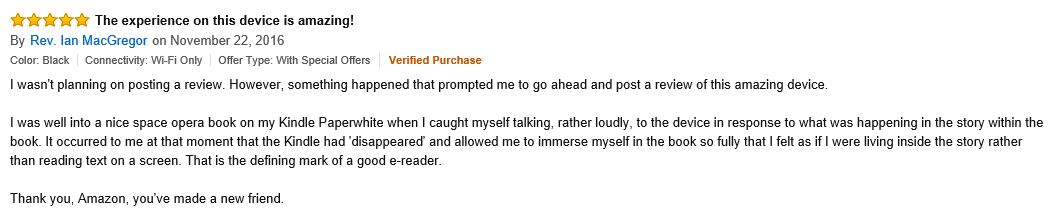
If you can’t read the image, here’s the text:
“I wasn’t planning on posting a review. However, something happened that prompted me to go ahead and post a review of this amazing device.
“I was well into a nice space opera book on my Kindle Paperwhite when I caught myself talking, rather loudly, to the device in response to what was happening in the story within the book. It occurred to me at that moment that the Kindle had disappeared and allowed me to immerse myself in the book so fully that I felt as if I were living inside the story rather than reading text on a screen.” -Rev. Ian MacGregor
Let’s dissect this guy for a second. He was ‘well into a nice space opera book’. Wow. Already my buddy. The man was actually talking to his Kindle. I can’t say I relate to that; but this guy is one of my favorite people on the planet now. He was talking loudly to his Kindle. And he got totally lost in the story. Whatever the crap this dude was reading, I’d like to know. The Reverend MacGregor is not only in my tribe, he’s the goll-darn shaman!
So what do you think about the future of fiction? Interesting, ground-breaking fiction that pushes cool intellectual or narrative boundaries, I mean…not gobbledygook thrillers that software will eventually write, optimized through the bestseller list algorithms. Try this quote on for size:
“The reading of all good books is like a conversation with the finest minds of past centuries” Rene Descartes
I hear you, Rene. But who are we going to have these conversations with?
Let’s talk about being stuck in paradigms and not even knowing it. The reason you should care – if you’re an aspiring writer or somebody interested in the craft of storytelling, then you probably want to break some kind of new ground. At least for me, I like to think I’m an original, coming up with cool stuff that inspires other people. When somebody tells me I wrote something that really made them think or that gave them the shivers…or best of all, that made them want to know more…that’s fireworks to me! So paradigms are cancer. Off with their head – if you know what I mean!
Here’s an example, for the science fiction nerds out there like myself. Maybe it was Star Trek that started this, not sure; but have you noticed when you’re watching basically any show or movie set on a spaceship that the doors swish open and closed automatically? That would require motion sensors and motors. The doors always look like heavy industrial steel. In fact, everything looks like industrial steel and huge! Just huge. But stop and think about it for just a second – space has precious little resources; and every bit of mass you take along with you takes up more energy to move the ship at all. Massive freaking spaceships made of heavy steel with silly, unnecessary things like automatic doors are a bit unlikely. “Hold on, genius”, you might say. “These aren’t science text books. Energy is free in my story. If I want doors to swish shut automatically, maybe I’m thinking about emergency containment!” Blah blah. Maybe – and you have to ask yourself this – maybe you’re just coasting on paradigms Gene Roddenberry set up decades ago.
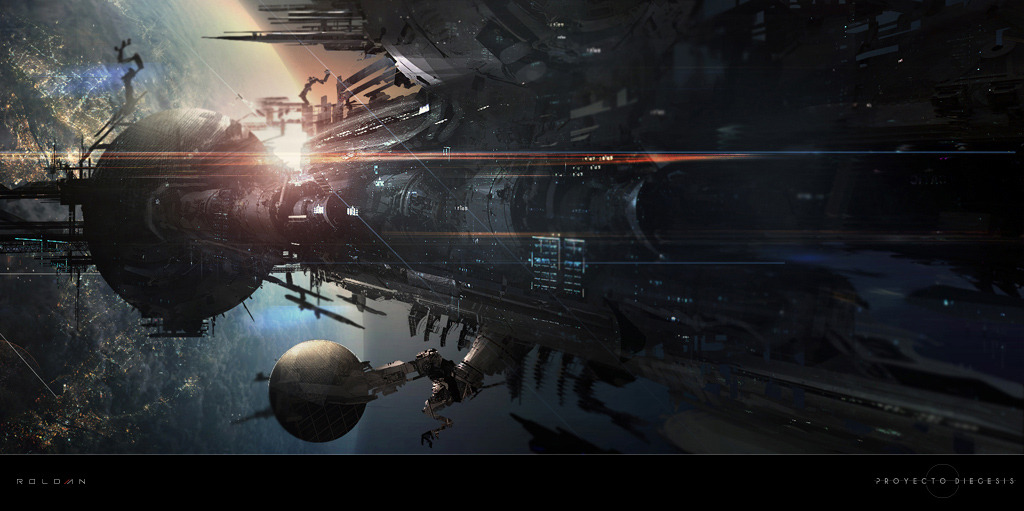
Why are spaceships always gray metal? Is it because that’s most likely, or because Navy ships have been battleship gray; and that was the paradigm folks like George Lucas just carried on from the trailblazing pulp cover artists of the 1930s? When you’re at the airport, are the planes gray? You can disagree; but my guess is the economics of space travel either in our future or in whatever alternative universe you’re dreaming up, say commercial enterprises will be building ships for space travel. They won’t have to worry about obscuring visibility in ocean environments like the Navy does. I’m saying spaceships probably won’t be battleship gray with all sorts of squiggly machinery and useless lights blinking all over their hulls. Think about it. Isn’t it more likely they’ll be smaller, probably modular vessels with logos and smooth shielded hulls, light on mass and with relatively small hallways and workspaces, maybe capable of linking up into larger structures?
Gravity? Every show you’ll watch has their folks walking around and nothing floating. That means you’re assuming the ship spins or you should at least hand-wave something about ‘gravity generators’ or something. Why not just make it spin? How hard is that?
Don’t get me started on robots. The pulps set the stage for human-looking robotics; and we’re still living with that. We’ll probably get there, no doubt. But what’s the point of all that design if the job you’re giving it is to clean the floor or pilot the ship or load cargo or to repair things? Why make it look human with all the expense and complications and liabilities, to do mundane things like that? Form will follow function, right? That’s actually how the world really works when manufacturing plants have to actually spend money on R&D and machinery and raw materials and labor to make something real. Those slick little Roomba vacuum cleaners are a fantastic example of this. They look nothing like C3PO; but they can suck up dog hair like nobody’s business.
I’m going to end with my least favorite paradigm of all because your argument should build to a climax, shouldn’t it? I mean, this one really…really needs to go. If you’re guilty of it, please stop and question yourself. I purposely avoid the heck out of this one because it’s so tired and lazy and ridiculous by now. Yet it’s hard to stay away from it. I’ve veered very close and hated myself afterwards, like when you eat the whole bag of those little chocolate doughnuts. Stop. Stay away. Go back.
‘The chosen one’. Oh my God, how many times have you heard somebody say this? Look, I understand that to set up a mythology, some sort of over-arching roller coaster you want your characters to get swept up in, this is a handy little trick. Just make the main guy the chosen one; and all sorts of mysterious things can happen. Then you can show all the whiz-bang stuff they can do and didn’t know, so replicate the ‘coming of age’ motif which everybody loves so much. Me too. But isn’t it getting old? We’re pretty sophisticated in our appreciation of narrative structure and themes by now, so isn’t it time to put this one to bed? It almost never makes sense anyway, when you poke on who chose them and why.
Anyway, I should really practice what I’m preaching here. When you agree to move beyond some of these deeply entrenched themes or backdrop devices, it gets challenging. There’s maybe even an argument to be made that things like I’m talking about here are the common vocabulary now, so to change them up too much makes the reader confused or uncomfortable and distracts from what you’re really trying to say. Honestly, if we’ve thought about it that much, then we probably did our due diligence and should have the big, freaking steel doors swish open and closed if we feel like it.
If you haven’t watched Dead Of Summer yet, I don’t really care either way. It’s meh, mostly. Yet I was in a binge this weekend to get caught up and noticed something that was particularly relevant for me right now. I’m writing a horror novel – about 40k words in to a targeted 90k, and so I’m particularly concerned with how to get someone on the edge of their butt, chomping their tongue in anticipation and as nervous as I can make them. While this show is fun, it’s not scary in even the smallest sense, though I think it tries to be. Maybe we should have a look at why it fails to see how I can succeed. It’s what I thought, at least.
Go read reviews from the second Avengers movie. One thing you’ll find is a lot of people annoyed with the weird dream sequences. Should you peruse what the masses had to say overall about Batman Versus Superman, you’ll find similar irritation with dream sequences. Let’s not get into whether you dug those movies, okay? I get how divisive that is right now – it’s been Marvel Versus DC since the seventies, nothing to see here. The point I’m making is about the overuse of this narrative technique and how it practically forces an audience to disengage. In movies, it’s probably an excuse to just show some cool visuals. In execution though, it’s a signal to me I’m good to go get a refill on my Coke Icee. Know what I mean?
Anyway, back to Dead Of Summer. Here’s the marketing blurb:
“Set in 1989, school is out for the summer, and a sun-drenched season of firsts beckons the counselors at Camp Stillwater, a seemingly idyllic Midwestern summer camp, including first loves, first kisses—and first kills. Stillwater’s dark, ancient mythology awakens, and what was supposed to be a summer of fun soon turns into one of unforgettable scares and evil at every turn.”
If you read that, you agree they want to be scary, right? Their narrative structure follows the same style asLost, involving individual character flashbacks to flesh out each main player. Honestly, that part works for me, though the flashbacks they showed had little to do with decisions characters were making in the storyline. It came off cheaper than it did in Lost for that reason. However – and this is my overall point here – about a gajillion times, we are shown visions of a dark, mysterious man from the 19th century who’s supposedly tied in with the mysterious goings-on at the camp. I mean over and over and over, we see this guy and some blood streaming off something, or eclipses or bugs or murders or whatever…and EVERY SINGLE TIME you know it’s going to be a vision with no consequences. You can’t possibly get scared because even though somebody gets pushed into a grave or dunked underwater or whatever – I can’t even remember because I checked out during so many of those – that they’re just going to wake up and be okay. It’s foreboding but not much more.
Let’s set aside movies like Inception, which broke ground with this concept and the Freddy Krueger films (the good ones, let’s not discuss the Dream Warriors, shall we?) which staked their premises on the dream sequence. The difference with stories like those is they established consequences – you could die in those dreams. How boring would The Matrixhave been if you couldn’t die while inside?
I run into this problem of consequences a lot, actually. If you’re a science fiction guy, you might think a lot about the vast distances in space and how slow moving any real-life story would be…months to get anywhere and hours to talk to each other. You might go the road of setting up avatars or virtual reality-style storylines to account for that; but honestly, you’re still looking at ridiculous lag times for the signals. If you hand-wave all of that and just say ‘tachyons’ or ‘entanglement’ to get the science-snobs off your back, you’ll be looking at this problem of consequences just like I am. If your guy is actually laying in a booth in Utah or wherever directing the action, how are there any stakes for him?
Right. So there have to be consequences and some kind of danger that’s entirely relatable. If you watch Game Of Thrones or The Walking Dead enough, you start to think at any moment this freaking show is going to kill off one of your favorite characters. Mercilessly. Back in the nineties, Joe Quesada who was then Editor-In-Chief at Marvel Comics (pre-Disney) established a “dead is dead” rule for killing off characters to restore some kind of drama given the prevalence of resurrections. Fantastic concept, actually, though he drifted wide off the mark over his tenure.
That’s what I wanted to say, guys. Dream sequences and visions are tired and boring and are basically tickets for your audience to disconnect. Don’t do that. Avoid resurrections too, while you’re at it. Kill a major character early on just for giggles, to challenge yourself, and to set the bar for your reader that YOU AREN’T PLAYING AROUND…THIS IS SERIOUS!.
Every previous generation in human history, it’s been more difficult to move around and certainly more difficult to be exposed to the different stories people tell around the world than it is right now. In fact, you can go back less than a century and see a world where people largely stay where they were born. A guy’s library and his best storytellers were the primary means of being exposed to new stories. There’s been a sea change caused by the internet, electronics, and our own leisure time & mobility. So here you are…knowing stuff. Good for you. Now what does that mean?
I went into my thinking corner about that very question; and I baked up something for you that I believe you’ll like. It’s free – go read it. I also kept it short. Printed, it’d be less than 30 pages. Shouldn’t take you long at all. I stirred in some stories you’ve heard of, and one or two maybe you haven’t.
Would be great to hear from you on what you think. Let me know!