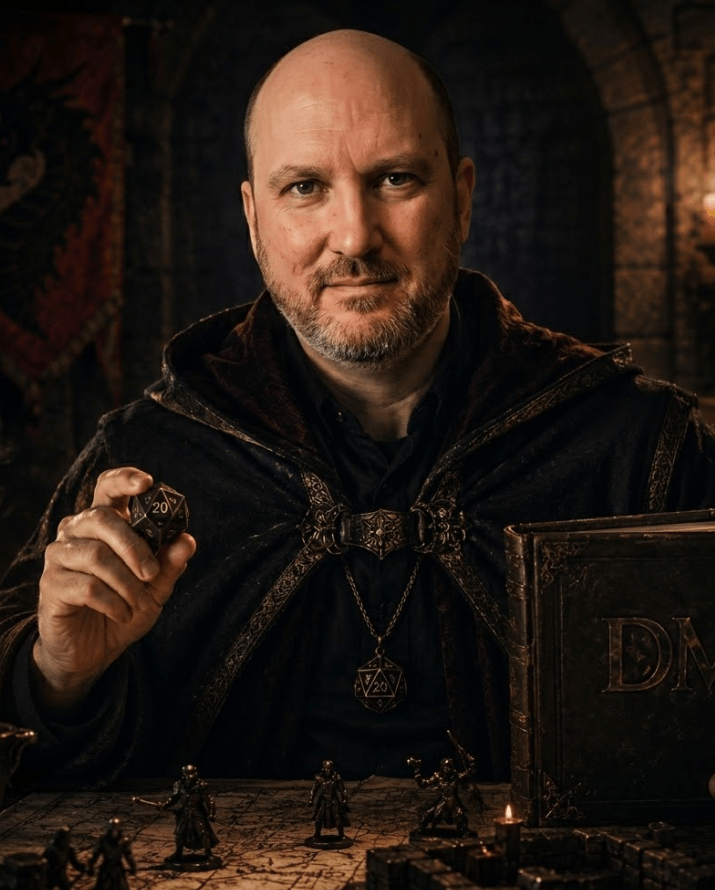
Michael Weems is a lifelong Dungeon Master and entrepreneur, longtime Chief Digital Officer of Heritage Auctions, and creator of ZapGM: an AI-powered tool looking to explode how tabletop worlds are built and experienced. We’re going to dig in with him today and talk about tabletop roleplaying, the potential and the risks of AI tools, and what it takes to build a mind-bending evening in a game.
Welcome back to our ongoing series of interviews with innovative creators in science fiction & fantasy storytelling, art, and gameplay! We call it the Inspiration Creator Series.
Michael, thanks very much for spending some time with us! Dungeon Masters are one of the great unappreciated treasures of the world. If no one ever said so, let me just thank you for the long nights googling folklore, drawing maps, printing off cool handouts, and practicing your weird voices. That’s awesome, and we all appreciate it.
That’s a great intro. Glad to be here.
Q. Let’s get your nerd credentials out of the way so we have everyone’s attention. How far do you go back with D&D or other RPG’s and which ruleset do you prefer?
I’ll explain by way of a trek down memory lane for us, um, more seasoned gamers. I was first introduced to OD&D by my friend’s older brother, I think around 1980-82. That would make me maybe 13 at the time. That friend started running for us soon after, and he got the Basic set with the dice you had to color in yourself with the provided wax pencil. I became a Dungeon Master in high school around ‘83, and a Game Master in college in ‘92 when I got hooked on Gurps and Champions for their one system, infinite worlds approach. Champions turned into Hero Games and I ran that and 3.5/Pathfinder mostly for a few decades. However, some of my favorite experiences have been with the Conan official D20 RPG, Warhammer Wrath and Glory and Eclipse Phase game systems. Those provide nuance that is hard to replicate from an “everything” system, and I highly recommend.
Q. What were your biggest creative inspirations growing up?
This may be cliché since everyone around this time was heavily influenced by them, but my influences came from shows like Star Blazers, Battle of the Planets (Gotchaman), Conan, & Star Wars. Literarily, books like the Stainless Steel Rat by Harry Harrison (I have a very dry sense of humor) and later by Snow Crash by Neal Stephenson and The Neutronium Alchemist by Petter F. Hamilton (I love hard sci-fi). It’s almost embarrassing how normal that is.
Q. In the prep for this chat, I saw that you mentioned having created several RPG’s, even selling 50 copies back at a convention in 1990. Let’s pause on that – pitch that game to me now. What made it different?
I’ll get the boring one out of the way first. I made a game adaptation of the movie “TAG: The Assassination Game”, from 1982. In this game, called Slayer, the players really hunted each other to the death for sport and profit, while the cynical public spurned them on through prizes and ad revenue. With that out of the way, here’s the sale pitch:
You’re a high school junior, your girlfriend Julia just broke up with you, and you are drowning your tears with your buddies down behind the bleachers late one Friday night. As the third beer is just starting to hit, your friend starts telling ghost stories about the local hermit that’s been hanging around campus lately. It’s absurd gossip, and it gets more fanciful as he spins the tale, but you’re loving it. Suddenly, you hear your name screamed from the woods. Not called, but screamed. It’s Julia, you’re positive, and you don’t know what to make of this. A cruel prank. Real trouble? Doesn’t matter, you have the disadvantage “must investigate strange occurrences alone”, so you tell your friends to wait there while you see what’s what.
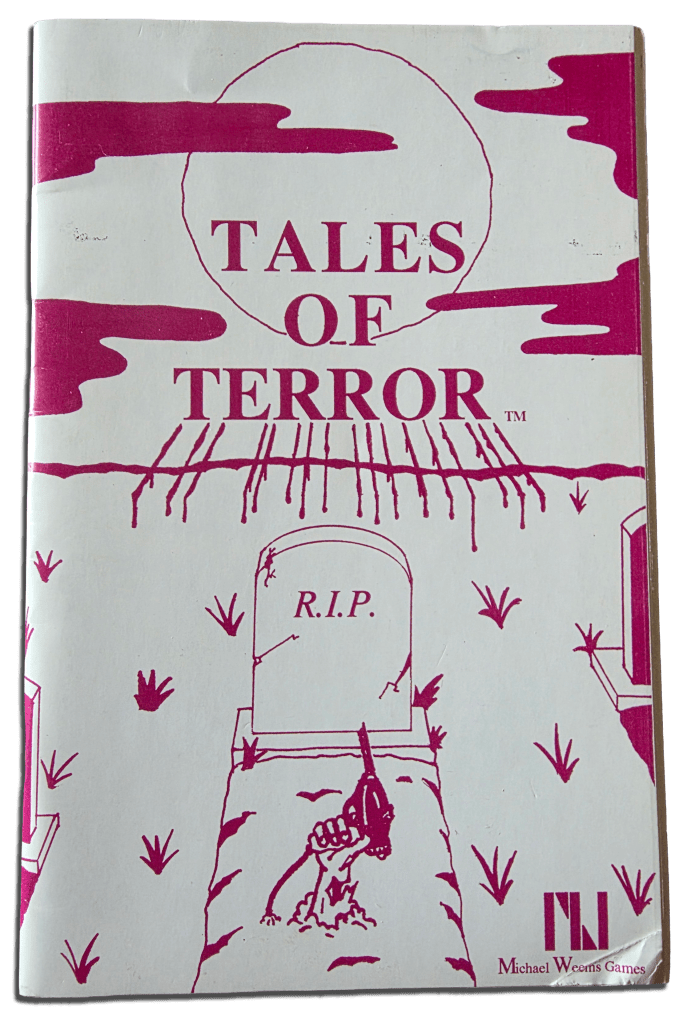
The game is called Tales of Terror. It is a very simple game meant for the rules to take a back seat to the role playing. You play a character in a horror movie, which could be a victim aspiring to be a hero, a monster or a villain. You build your character with advantages and disadvantages that that were all about flavor. For example, a victim might have an advantage of “scream that can be heard a mile away through solid rock” (Julia), but a disadvantage like “must split from group when in danger” (Julia again) or “car won’t start when in danger” (let’s hope that’s not you, because you feel that urgency to investigate). A villain might have “surprise appearance”, but also “must lecture victims for X rounds”, etc.. The game works great with both seasoned role players, and total novices equally well. Thanks for asking, as now I have a strong desire to break it out again.
This was 1991, and I was inspired by “It Came From the Late, Late, Late Show”, which is similarly themed but very different gameplay.
Q. My personal most memorable RPG moment was back in the 90’s playing Call of Cthulhu with my buddy, his semi-girlfriend (which I thought might have been better off as my girlfriend) and some folks I didn’t know. There was this book that drove you crazy if you read it, and my character tore off a page to carry it around and weaponize it. Anytime somebody gave me crap about something, I just showed them the page. Anyway, as I was descending into a basement researching weird noises, my buddy killed me with some floating whirling blades. She begged him to resurrect me. Yes, he won and I was dead. But she was impressed, and that’s what mattered more at the moment.
How about you? What’s your most memorable tabletop moment?
Not joking, I just laughed out loud. I didn’t think I would have to compete with the interviewer, but here goes. I love stories, as they are why we play, but I will limit myself to two and I hope you have room for both.
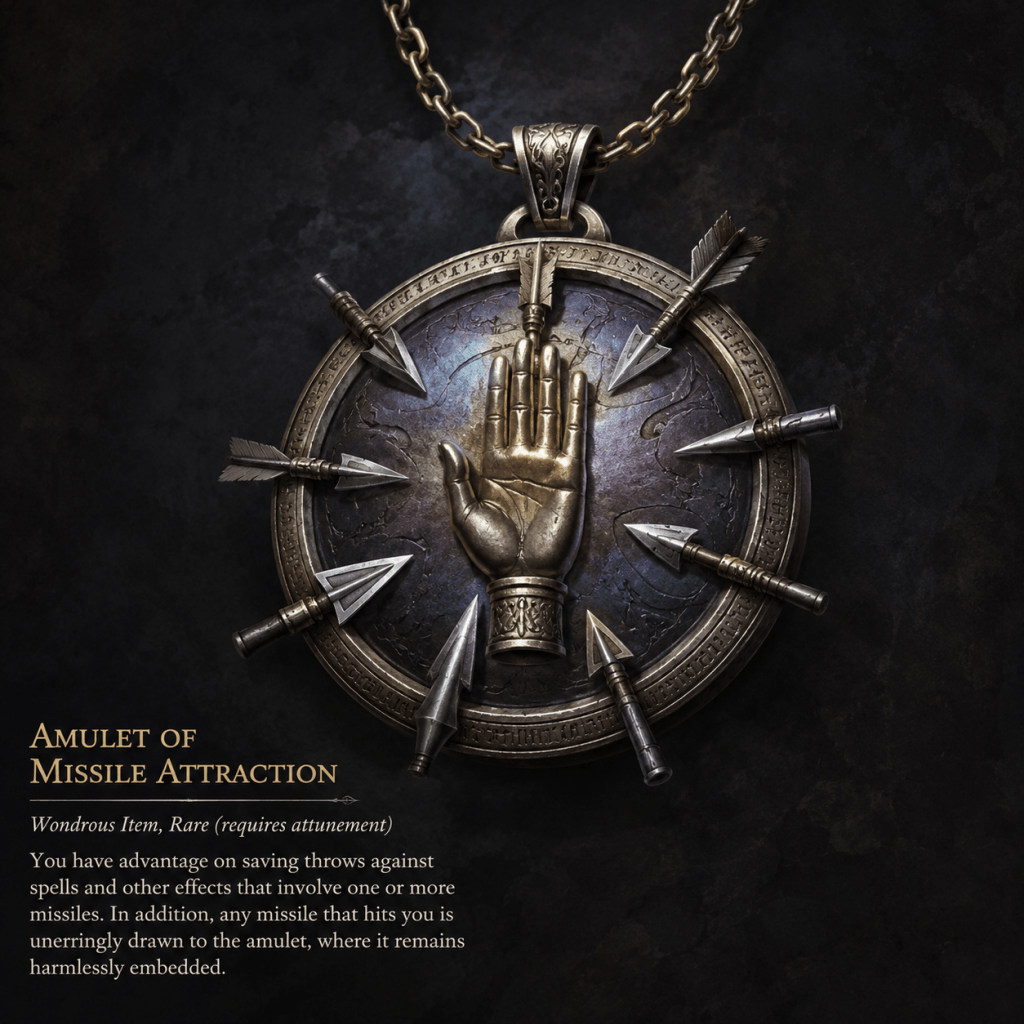
In the first, I was running D&D in college with people that are mostly still in my group today. One of them got an amulet of missile attraction in loot and thought it was missile deflection. The next fight was against a bunch of bugbears, many with bows. This player was a pin cushion by the end of the fight, and I was ready for him to lay it on me. But when the dust settled, I swear he said out loud to the rest of the group, not even remotely ironically, “just think how many times I would have been hit without this amulet!” I had no choice but to tell him the truth; it was too cruel at that point to continue. In his defense, to this day, he swears that I had previously stated that I never give out cursed items. I may have lied.
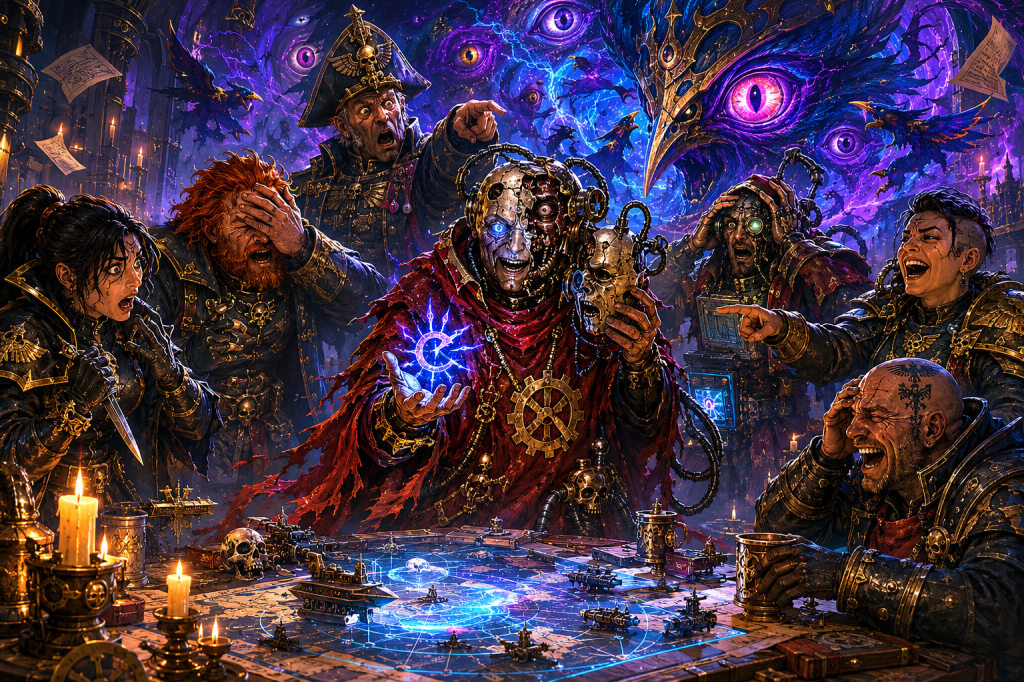
The second story is much more recent, same group. I was running Warhammer and the players were led by a rogue trader and solving a massive mystery involving all the gods of Chaos, with a universe shattering artifact. Throughout the story, the party would encounter subplots relating to one god or another, and discover how these disparate encounters were starting to weave into something larger. The one god that they had not had even an inkling of was Tzeentch, the god of plots and manipulation, among other things. Even though we have some real Warhammer fans in our group, they didn’t take notice of this, so they weren’t as suspicious as they should have been.
My master plot involved getting a Tzeentch spy onto their ship, and this spy was a servitor that they encountered named Solon. He still had some of his faculties and so could communicate better with the party, and they found him at an abandoned ancient research site for the Mechanicus Adeptus. I really hadn’t figured out how I was going to get him to weasel his way onto their ship, and so was going to have to just role-play it based on how they reacted to him. It turns out that their reaction should not have surprised me, because “party see likeable NPC, party adopt NPC”, which is what they promptly did. I was floored, but I knew that when the reveal happened many months later, nobody would believe that I had planned for him to be the spy all along. So I called another close friend, explained to him what happened, and let him know that I would one day call upon him to reveal my secret.
6 months passed, dozens of games where the party was harassed, outmaneuvered, and backstabbed to the point that they started questioning everyone and everything… but inexplicably, not Solon. And then on the final night when the time was right, I stopped and made a phone call without preamble. As the phone rang, I put it on speakerphone and the party started asking what I was doing interrupting the game like that. I just raised a finger and waited. The other friend answered the phone and I said, “I’m here with the group, and it’s time for you to tell them your secret”. When he explained that Solon was a Tzeentch spy and that Tzeentch had orchestrated the entire campaign, the groans and guffaws were like precious food for my soul, and we all laughed until we cried.
I should note here that I don’t think I could have orchestrated such a complex plot over such a long time and with such detail without ChatGPT. I was not a big Warhammer fan prior to running, and so ChatGPT would not only council me on the rules, but also the lore as I went. Together, we brainstormed and created the whole thing with way more detail and accuracy than I could have mustered alone.
Q. What is it about roleplaying games that inspires you? Yes, escapism is nice, but is there something more to it?
I play games for the fellowship and the memories that enrich my life. I lost a friend to a heart attack (sorry for the downer), and what I have left of him are those memories. Maybe they aren’t better memories than playing golf or going clubbing or whatever other people do together, but they feel more intimate to me. Role playing is the kind of shared experience that non-gamers are missing IMO.
Q. Why be the Dungeon Master, though? What made you gravitate to that role rather than just showing up to eat somebody else’s Dorito’s?
I run games for the creative outlet. I try to create universes, plots and NPCs, which lead to interactions that are immersive and fun. I like for the games to be mentally engaging. When I craft a story arc, I never figure out how the players will overcome it. I have realistic events and adversaries with their details and motivations, and the fun for me is seeing how the players solve the problems. Besides apparently lying about cursed items, I have built a level of trust with my players that I run realistic worlds with realistic NPCs, such that they can be creative in their problem solving.
A recent game in Eclipse Phase is a great example. The goal was to save a commune of people who refused digitization from being forcibly uploaded and made into indentured servants for a corporation that held a legal debt claim against them. To the system, it was debt repayment; to them, it was death. The players only had to delay the hired mercenaries long enough for the legal wrangling to work its way through the system.
Since there is no real death in this game when you have a backup of your ego, I thought the players might simply fight the mercenaries. Instead, they uncovered rumors that the commune’s youth were contemplating suicide to avoid being digitized (a throwaway comment I made during role playing off the cuff). The players latched onto that, decided to spread the rumor further, then fake the commune’s suicide pact by collapsing the tunnels they lived in on the moon. In reality, they hid the commune in a secure bunker and let the clock run out while their legal maneuvering took effect.
I adore that sort of outcome.
Q. Tell me about how prepping for games has changed over the years. I imagine the 90’s, the 2000’s, the 2010’s, and now. So we can see the contrast, what was all that like in those different periods?
In the 1990s, prepping for a game meant a pad of notebook paper, a pad of graph paper and a no. 2 pencil. I might occasionally have a printed module, some artwork or other collateral from a Dragon Magazine, or perhaps something I made with Mac Paint on my Plus, but the ideation was all me, and the props were severely limited by my art skills (see the Tales of Terror cover above as proof).
Later, Google helped with the collateral, although I was still limited to my own experience and creativity. I don’t know of many game masters that have a confidant that they can bounce ideas off of, nor artists volunteering their custom art. It’s usually us alone, doing our best. That said, Google Image Search at least gave me a way to visually show what was going on in the game.
More recently, we got AI for both brainstorming and artwork. As it’s gotten better, it’s become an expert on my games and my worlds and is a springboard to take my games to new heights. Not only has my game prep been cut dramatically, but at the same time the game materials have gone way up in quality.
Now, I use my own tool, ZapGM.
Q. And what will it look like in the 2050’s?
About 20 years ago, I saw Ray Kurzweil speak about the singularity and the future of society. Mind blowing stuff that is coming to fruition in the next 5ish years IMO. And more recently, Elon gave an interview where he said that once we hit ASI (Artificial Super Intelligence), that all bets are off, and I tend to take that approach. So 2050’s, tough to say.
But in the shorter term, I think we’ll get AI and robotics to the point where nobody has to work. And I think that, possibly after some turmoil during the transition, we’ll end up with universal high income, where it feels more like retirement than unemployment. As someone who would like to retire in the not-too-distant future, I like to think of it that way. When people tell me they’re retiring, not once have I thought to offer condolences. Instead, I congratulate them on being able to unshackle themselves from the work week just to survive, and on finally being able to thrive by doing whatever they find valuable.
Q. You’re building something exciting right now. Tell us about that.
As I optimized my processes for prepping my games, I started coding ZapGM just for myself. There are prompting techniques, as well as agent scaffolding that can be applied to get levels of consistency, accuracy and creativity that the chatbots can’t do on their own at this point. As I honed that system, my youngest son asked if I could add some features to help him run for his friends. None of them wanted to GM, and he didn’t feel confident enough in the rules, much less the creative side of making new campaigns… so I added more features. Eventually, my party encouraged me to finish out the feature set and launch it for public use, which I recently did. As a long-time entrepreneur, the experience isn’t that new to me, but the fear of failure and rejection is just as real the last time as the first. The site just left early access, so we’ll soon see.
Q. I see exports to Roll20, Foundry, supporting Pathfinder and D&D simultaneously – it seems you’re interested in integrating with what’s going on rather than replacing. Am I wrong about that?
Because I made this tool to be helpful to me, I never saw it as competition for what’s out there. In some respects, it supports whatever game masters are currently doing. One way it does this is with pre-made maps that can be exported to those other systems. I even wrote what I think are the best online guides for importing maps with vectors into Foundry and Roll20, better than their own documentation. Another is with map editing tools that have much easier to use vector creation/editing, square and hex grid support, plus AI inpainting for tweaking maps. I encourage my visitors to use those tools to improve what they’re already doing elsewhere.
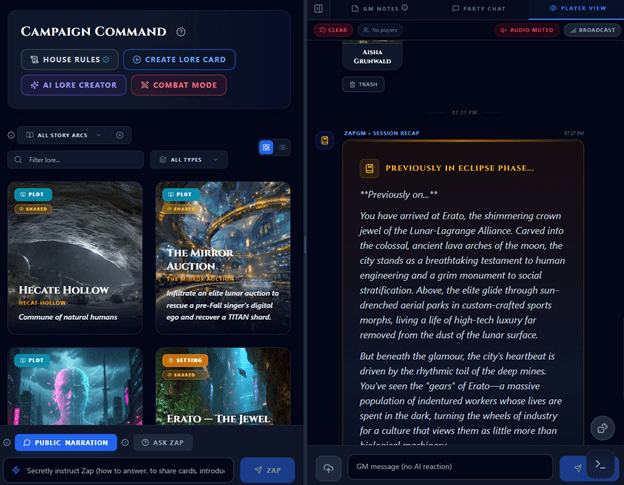
Additionally, ZapGM is a different way of viewing the world building, maintenance and hosting than other systems. It aligns with the way I create and run games, so time will tell if that appeals to a broader audience. You use it in three stages. The first is to brainstorm with Zap about the world and generate rich Lore Cards (Settings, Plots, NPCs, Adversaries, etc.). The second is to broadcast to your players with a shared canvas, where uniquely the players can come back and interact not just with their PCs, but also read the shared lore, create new PCs and Summons and more. And lastly, as the game master hosts the game, the AI can help generate unique narration with text to speech where each NPCs gets their own voice. And one of the coolest features IMO is that there is an AI overseer that watches the narration and automatically suggests and makes approved edits to the Lore Cards. So if the players anger an NPC, the Overseer will suggest noting in the NPCs Lore Card that disposition and that the players get disadvantage on future rolls. And if the game master decides to roll that back or regenerate the narration, the Overseer puts the lore cards back to the way they were before that encounter.
Maybe that sounds just technical, features in a website, but that is some of the most fun I’ve had creatively lately. Figuring out what features to add and then designing them is fun, and I even invented two new features (I have two patents pending). At some points in developing this site, I got so focused that I worked 20 hour days for several weeks straight… and promptly got sick. So I can’t say that I recommend that, but it does illustrate the level of creative energy I was pouring out.
Q. I sometimes see people pushing back on AI like a little guy with a sword wading into the waves swinging left and right and shouting to get off their beach. Yet there’s a lot of passion around this topic. I think AI slop is real but avoidable. Artists should be compensated for their work, but image generation tools are almost certainly going to be a tool in the workflow of future generations just like stock images, filters, 3D nodes, and asset libraries. My take, anyway.
What’s your position on AI in creative arts and particularly, roleplaying games? How do you address some of the valid concerns?
I agree that there are real issues around AI taking jobs, and as I said above, I think society will change in many ways we can’t predict, but we can act humanely and empathetically as we progress toward that new future.
As for game masters and players, I am thrilled with how AI can empower us all. No game master is going to commission artwork for their weekly game with 3 friends, or commission a writer to brainstorm or hone their plots and narration. AI filling this gap is enriching everyone involved IMO. For decades, this has been an unsolved need, and the improvements for me and my players are tangible.
PS. I have a friend that flirts with Grok. Let’s not go there.
Q. You’ve got a great take on Non-Player Characters in games, insisting that they be believable and not “quest dispensers”. Tell me about that.
I almost got a writing degree, and out of that came my passion for storytelling. Good stories are populated by real people, with real motives, that behave in realistic ways. I want my players to be so immersed in role playing their character, that they feel like the world they are inhabiting is real. When that happens, it’s magic. One of my players ended up so drunk in the Conan campaign that they woke up married to the daughter of a local merchant, dowry included (a goat). The wife and the goat stayed with them for the rest of their adventures and were the subject of many shenanigans. I live for that.
Q. All right – let’s wind it up with a banger, then. Tell me your absolute ideal experience you imagine in a roleplaying game. Get crazy.
The year is 2038, my brain is integrated with my AI assistant and my personal humanoid robot is integrated with that. Each of my players, my lifelong friends that have been with me for 50 years or more by now, have the same setup. As we cast a portion of our consciousness into our physical avatars, they step forth both in the real world and into an alternate reality with the aid of AR/VR. Although we are each in our various comfy spaces with our real bodies, me on the shore of Interlaken Switzerland, Brent in his mountain cabin, Matt in a permanent renaissance community, Bill sailing the deep blue and Duane in a Tokyo high-rise, our avatars step into the Conan universe yet again. Something about that world keeps drawing us back.
Your readers might think that I would be only a player now. But something I think many players don’t realize is that game masters do it because they love it, not because they have to. So, I imagine that as we step into the game again, I am both orchestrating the adventure with my AI assistant and also getting to be part of the adventure to boot.
Thank you for giving me this opportunity to share my story. I hope your readers will check out www.ZapGM.com and more importantly, find it useful.
*
Thanks again for your generous time today, Michael. It was a blast, and I’m looking forward to seeing more of what you’re up to as things take off for you.
Till next time,