Let’s trace 18th century sites for a shipwreck and a town’s founding!

Some glorious times when you troll around in old journals and historical accounts, you come across an adventurous soul of long ago that made the absolute best of truly magical opportunities, braved unbelieveable dangers, and came out on top.

I’ve got one for you today that became an obsessive research project ultimately leading to a road trip, locals in a town library gathering around the table with me, and a moment of awe (for me at least).

Welcome back to an ongoing series we call…

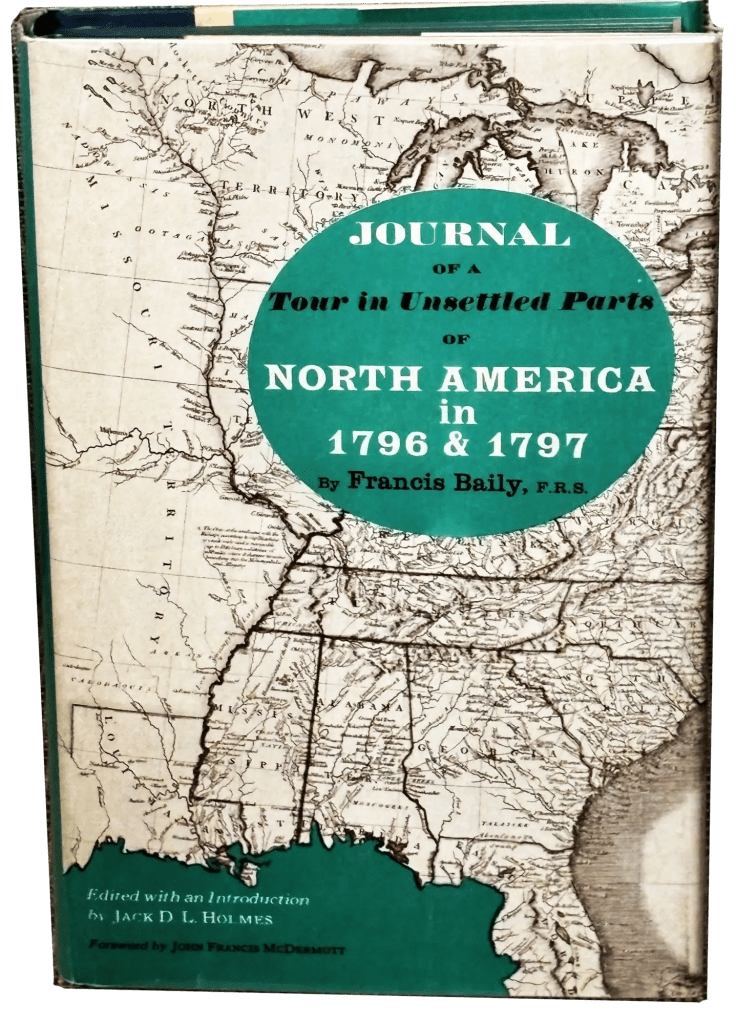
I went into my study a couple of weeks ago looking for something to read. It’s a lifetime of books collected in there, so there was no telling what I would pick up. I grabbed one titled Journal of a Tour in Unsettled Parts of North America in 1796 & 1797 by a guy named Francis Baily. Here’s a copy for free.
What’s interesting about that?

Baily was 21 years old, and for reasons he never gave, he came over from England for 2 years and visited an America that was brand new and wide open. What this guy was able to see and do in those 2 years was incandescent. It was an opportunity of a generation to go where he went, and Baily made it happen.

He landed in Norfolk, visited Baltimore and Philadelphia, describing them wonderfully such that you could all but see them in your mind’s eye. He described the road from Lancaster to Philadelphia as “paved with stone the whole way, and overlaid with gravel so that it is never obstructed during the most severe season”. Little nuances like that just popped for me – like the little museum in Philadelphia founded by a “Mr. Peale” which had just opened. I fell into the habit of leaving ChatGPT on voice mode so I could ask it as I read what became of some of the things Baily saw and people he met. (Peale’s collection got busted up later and distributed to places like the Philadelphia Academy of Natural Sciences.)

He visited “the new city of Washington” where his “first walk was to the President’s House”, which was to be the White House and was still under construction. Of Washington itself, he said “not much more than one-half the city is cleared; the rest is in woods; and most of the streets which are laid out are cut through these woods” Also, “The canal and the gardens, as well as bridges, which you see marked down in the plan, are not yet begun”. And finally, “Game is plenty in these parts, and what perhaps may appear to you remarkable, I saw some boys who were out a shooting, actually kill several brace of partridges in what will one of the most public streets of the city”.
He went to New York and said: “…it is an irregularly built place, consisting principally of little narrow streets, though some of those which are newly laid out are broad and handsome, particularly Broadway, extending nearly a mile in length.” You see something like (explaining why it’s called ‘Broadway’), then he says “The inhabitants of New York are very fond of music, dancing, and plays; an attainment to excellence in the former has been considerably promoted by the frequent musical societies”. I mean…Broadway….in 1796. Music already. Crazy!

Honestly, I marveled at every little inn or hut where he stayed as he described the meals, the ramshackle rooms, sleeping in a drafty barn with a smile on his face at what he was doing. I hadn’t read two chapters of this before I really, really liked this kid.

Okay, that does sound fun. But you mentioned a shipwreck site?

Right. Baily’s adventure really picked up once he left Pittsburgh on the Ohio River headed Northwest at first, before ultimately bending south. He’d booked passage with some people looking to found a new settlement, specifically a friend he’d made named Samuel Heighway who’d purchased some land in modern-day Ohio off the Little Miami River and was trying to get there with some agricultural equipment and a handful of settlers. Why was Baily accompanying them? Who knows! He just did, and it wound up awesome.

We need to keep in mind that American rivers in 1796 were crazy dangerous and nothing like the placid, dammed wonderlands they are now. At this point in the tale, it was a cold December with the Ohio half-frozen with ice blocks as big as houses sailing past at great speeds.

Dec 21, 1796: “We were awakened out of our sleep with a noise like thunder, and, jumping out of our beds, we found the river was rising, and the ice breaking up. All attempts would be feeble to describe the horrid crashing and tremendous destruction which this event occasioned on the river. Only conceive a river near 1,500 miles long, frozen to a prodigious depth (capable of bearing loaded wagons) from its source to its mouth, and this river by a sudden torrent of water breaking…Conceive this vast body of ice put in motion at the same instant, and carried along with an astonishing rapidity, grating with a most tremendous noise against the sides of the river and bearing down everything which opposed its progress – the tallest and the stoutest trees obliged to submit to its destructive fury!”

Should you decide to read this marvelous book, I won’t steal from you by describing all that happened to them at that spot in the river. I called it a shipwreck, though. Remember that much at least.

Dec 25, 1796: “Here am I in the wilds of America, away from the society of men, amidst the haunts of wild beasts and savages, just escaped from the perils of a wreck, in want not only of the comforts, but of the necessities of life, housed in a hovel that in my own country would not be good enough for a pigstye, at a time too when my father, my mother, my brothers, my sisters, my friends and acquaintance, in fact, the whole nation, were feasting upon the best the country could afford. I could not but picture to myself the fireside of my own home…”
Despite incredible danger from drowning, frostbite, starvation, and exposure, it was also on Christmas day that Baily wrote one of my favorite quotes of the entire book. Keep in mind the conditions he was under as he wrote this:

“…there is something so very attractive in a life spent in this manner, that were I disposed to become a hermit, and seclude myself from the world, the woods of America should be my retreat; there should I, with my dog and my gun, and the hollow of a rock for my habitation, enjoy undisturbed all that fancied bliss attendant on a state of nature.”

Ultimately, they constructed another boat and got underway again in February after an unforgettable winter at that lonely place on the Ohio.

You didn’t find the site of that shipwreck, did you?

It wasn’t easy, but yes – I absolutely did. The girl at the Barnes & Noble counter who sold me a map of West Virginia asked me if I was doing some traveling. When I told her what I was looking to do – collect and trace the little clues Baily noted in his journal and leverage ChatGPT and the map to find the exact spot – she only said with eyes widened, “That sounds amazing!”

We’re talking 228 years later, with few proper names provided – and the ones that ARE provided are rarely in use today. What this looked like for me, as I was on a business trip out of town doing this, was me in a Doubletree late at night leaned over the map poring over Baily’s account and tracing any likely touchpoints with my finger, asking ChatGPT as if in conversation things like “He mentions Capteen Riffle, south of Grave Creek – what would that likely be referencing?” To which I would receive answers such as “That likely refers to modern-day Captina Island, across from Powhatan Point, Ohio.” Knowing that AI is wrong as often as it is right, I fact-checked in Google along the way to confirm each touchpoint.
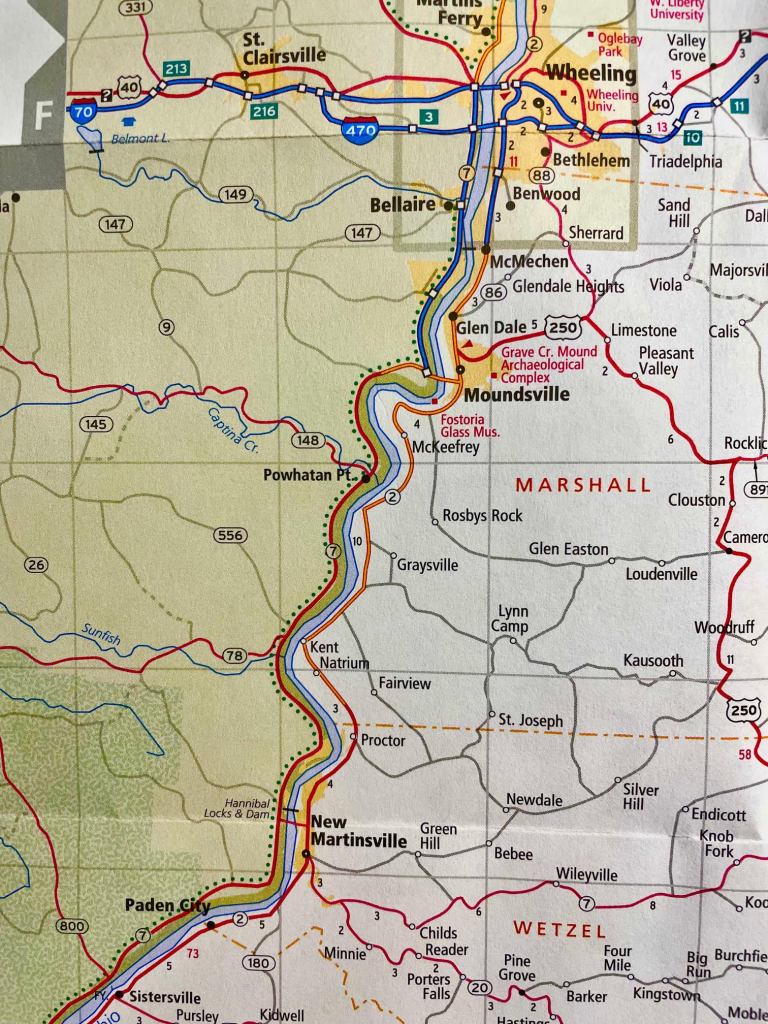
  • He “got fast upon a riffle near Brown’s Island” near modern Weirton, WV
  • He passed “Buffaloe Town”, which is modern Wellsburg, WV
  • He went aground 1/2 mile above Wheeling (still exists!)
  • He put ashore near Grave Creek (near modern-day Moundsville, WV)
  • He passed “Capteen Riffle” near Powhatan Point, OH and claimed he made 9 miles that day to “Fish Creek” near modern-day Martinsville, WV. That bad estimate of his pained me somewhat later.
  • He put ashore at a plantation recently built by an Irishman named Daily (no later records), and was told the river was entirely frozen.
  • Baily and Heighway walked “about 5 miles” down the banks of the river to Fish Creek, meaning Daily and their boat (at that time, though not the final shipwreck site) were 5 miles upstream of Fish Creek (and his 9 mile estimate was wrong). 5 miles upstream of Martinsville is modern-day Proctor, WV. That’s where Daily’s plantation was.
  • Baily and Heighway went back to Daily’s after seeing that indeed, the river was frozen solid at Fish Creek and took the boat downstream to a safer place the next day, saying it was “about a mile to a place which we had observed yesterday on our walk, and which we conceived more secure from the bodies drifting downriver from the one we were in”.

Whoa. We don’t need that kind of detail. Just say what you know and how you know it.

Look at that sharp bend in the river just south of Proctor, about a mile down in fact. Here it is on Google Earth:
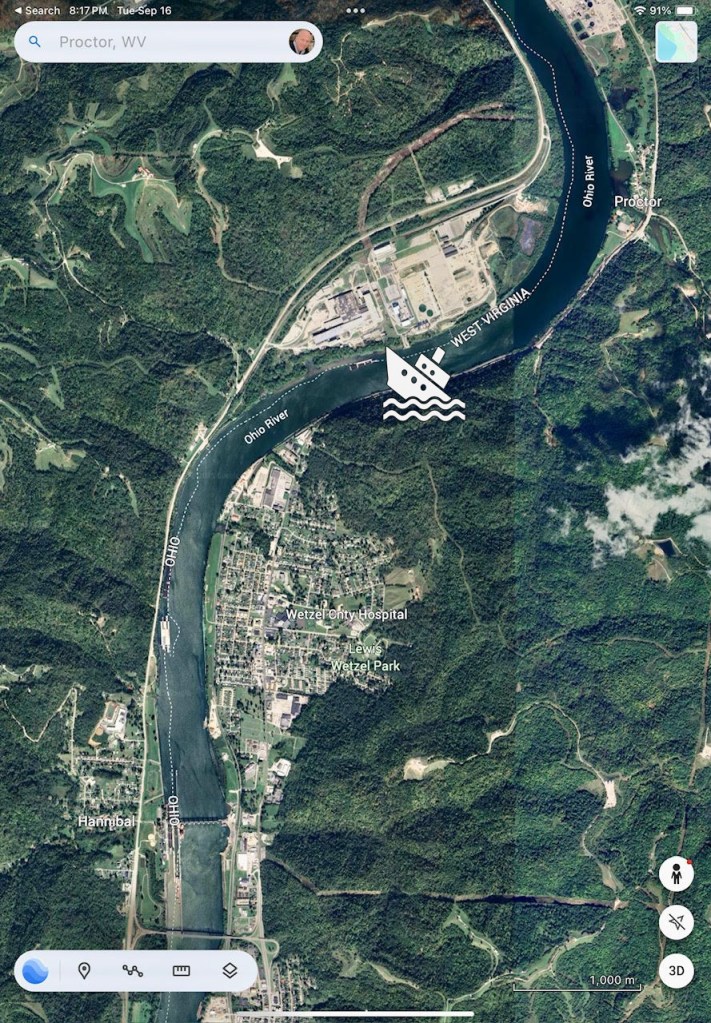
Remember how he described the ice blasting down the river. Imagine the eddies and more stationary water just past that bend, and using the trees and shoreline of the bend itself to weather the incoming debris and ice. It makes sense that they would see the area with trees now on the southern shore, northeast of the buildings you see in Proctor and across from the Long Ridge power station on the north as safer than staying at Daily’s plantation upstream where the river was straighter. Baily reported that Grave Creek (Moundsville) was ~9 miles upstream of where they were moored, so that aligns with the site being very close to Proctor.

No, this is the place. If I’d been close enough, I’d have driven there to take a look. I chuckled and called my dad I was so excited!

You mentioned a town’s founding?

At one point, they have to leave the river and hire wagons to make it “between forty and fifty miles off” where the land Heighway had purchased “lay for the most part amidst a desert wilderness, where no wagon had ever approached”. Baily described his time with Heighway:

Mar 7, 1797: “The town he had laid out at right angles, nearly on Penn’s plan, with a square in the middle, which he told me, with a degree of exulting pride, he intended for a courthouse, or for some public building for the meeting of the legislature; for he had already fallen into that flattering idea which every founder of a new settlement entertains that his town will at some future time be the seat of government. He also described to me, and walked over, the ground where he intended to make his gardens, his summerhouse, his fishpond, his orchard…” Continuing, “I believe he was as happy as if he saw them all before him. Whereas, for myself, I could behold nothing but a wild uncultivated country, full of lofty trees and prickly shrubs; and when he showed me fishponds and his serpentine walks, I could only discover a little standing water, and a few deertracks.”

That bit absolutely fascinated me: to see the very image of a town’s founder in the very first days, with only survey sticks in the ground, and the men who’d just climbed off the wagons with him taking axes to trees to build the first houses, and the founder laughing as he walks his imagined town.

I googled Samuel Heighway and found that his town became modern-day Waynesville, Ohio. Since I wasn’t too far from Cincinnati at the time, I checked Google Maps to see how far the drive would be.

And you drove there?

Yeah, I had to. I was getting too excited about all this. That Baily was inspiring me.

And?
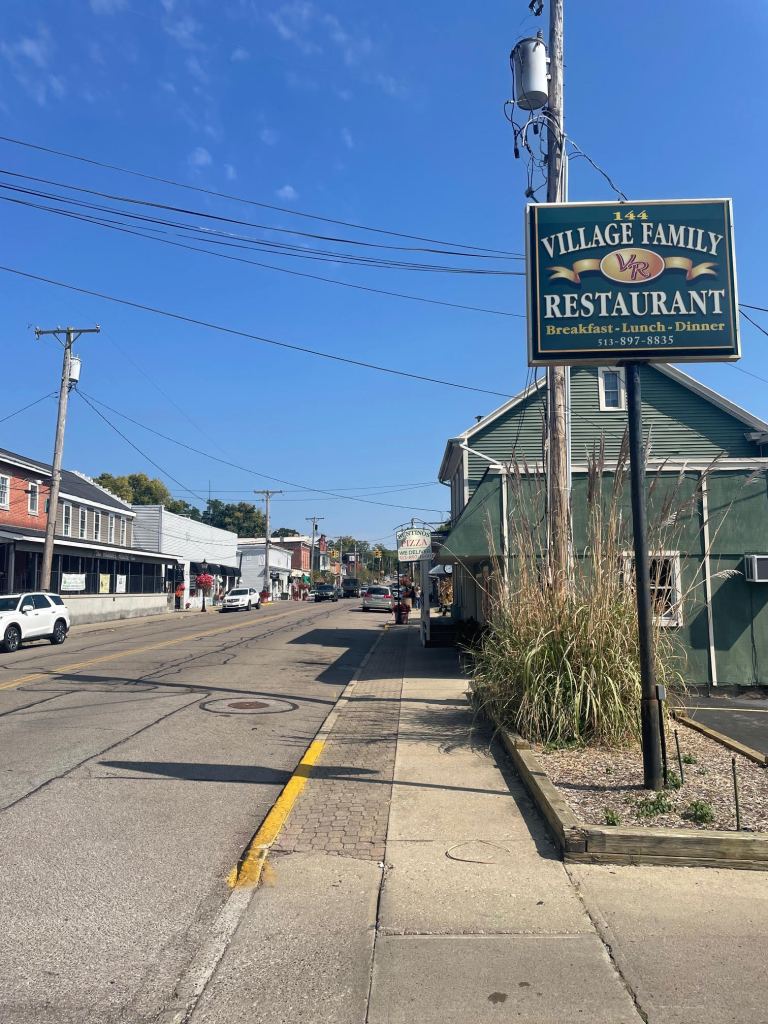
Just a little town. Nice, actually. I walked from one end to the other trying to get a feel for where these guys would have been walking…where they would have laid the first buildings. It looks like this on Google Earth (Waynesville):
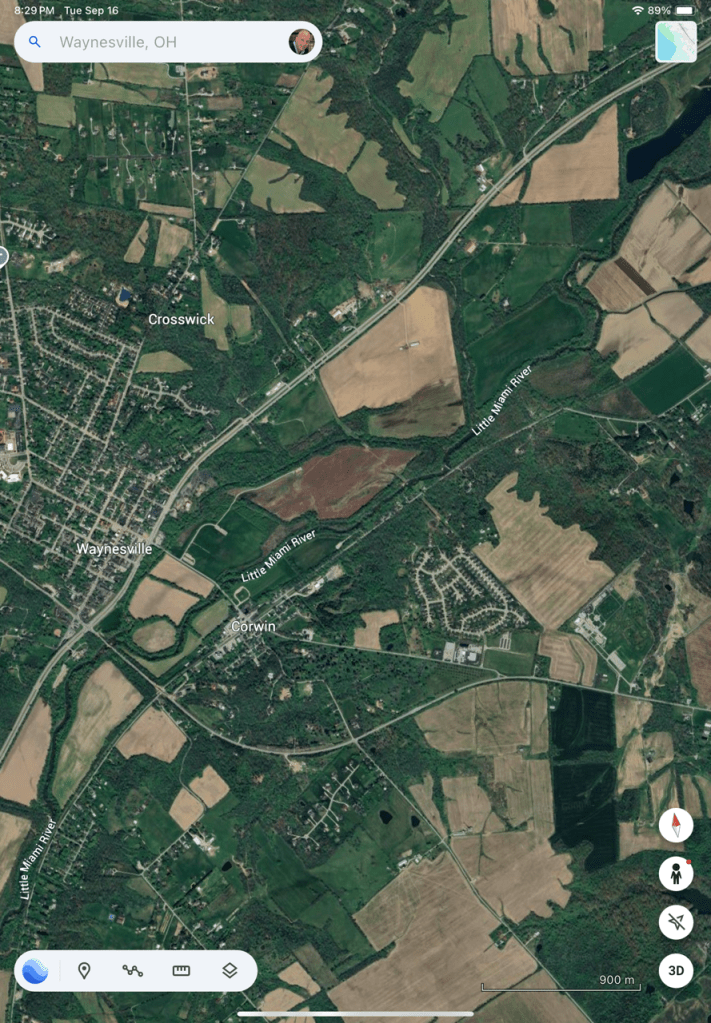
I tried the Chamber of Commerce to see who managed the historical markers, to see whether there was a town historian or something. They directed me to a town historical archive in the Waynesville library. The wonderful librarians there had a similar reaction to the girl at Barnes & Noble, and I gathered a bit of a crowd telling them the story I was researching. My objective, as I told them, was to find the very spot where these men stood as they first laid out the town.

One of them ran to the back computer promising to find something. Another gave me an exhaustive tour of the archives and started pulling various items off that might be helpful. Really, those ladies were fantastic.

I found this:
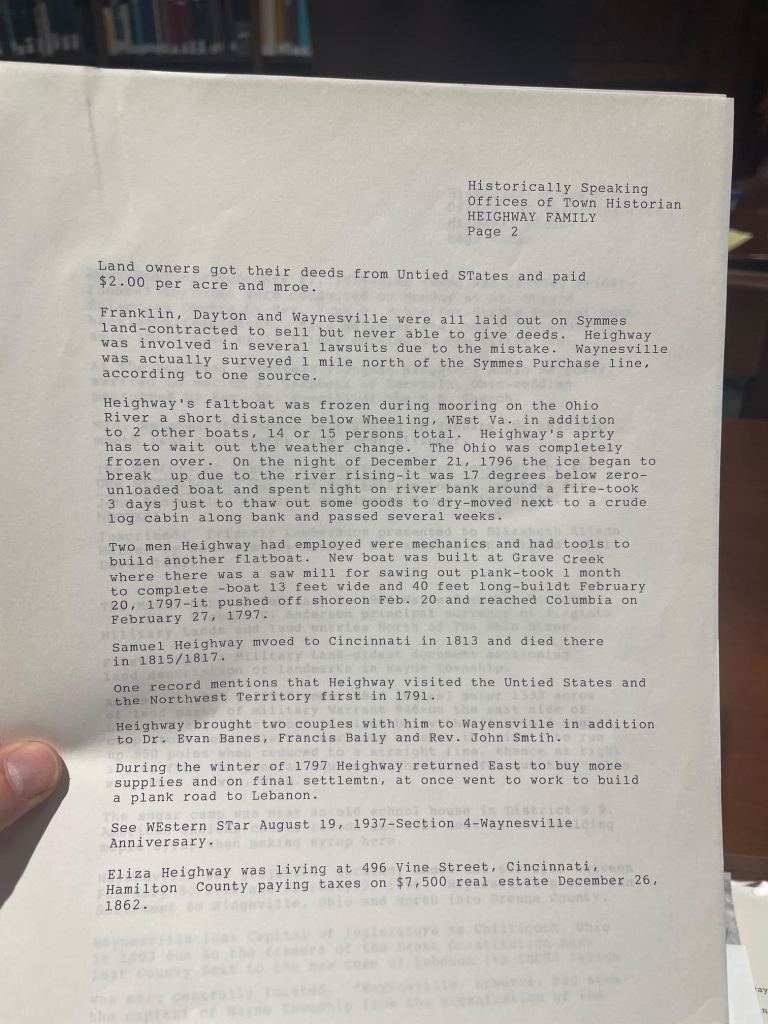
That broke my heart a little. Heighway didn’t stay, and in fact moved to Cincinnati in 1813 and died around 1815.

Also found this, an actual cabin Heighway built:
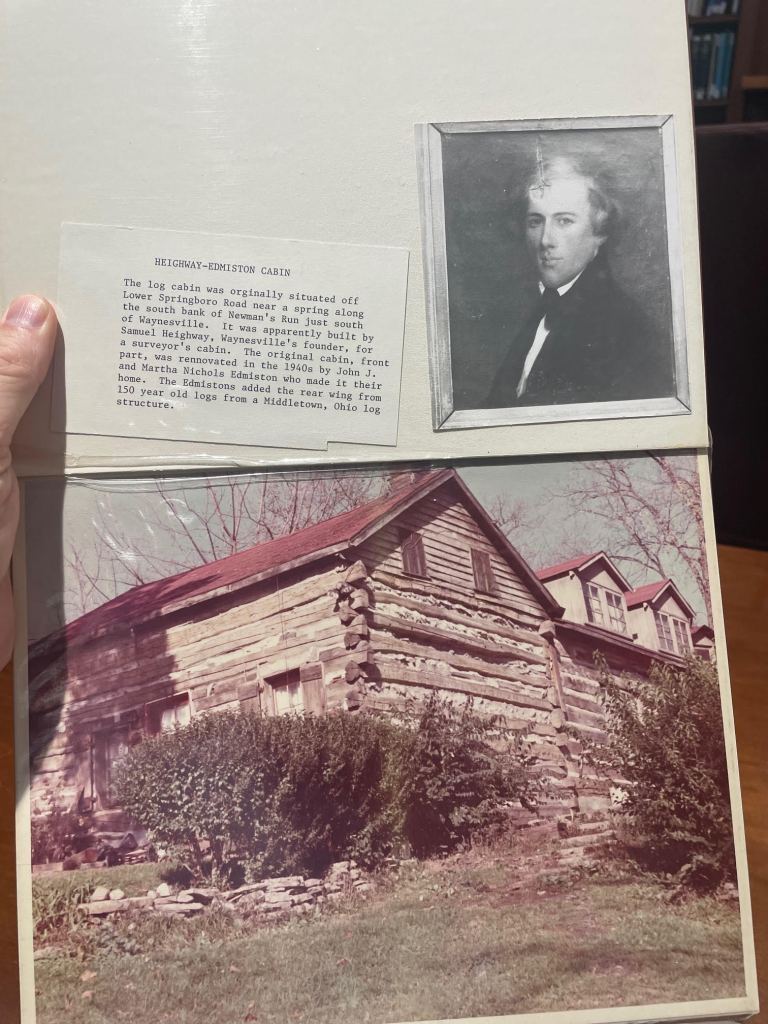
But what helped the most was this:
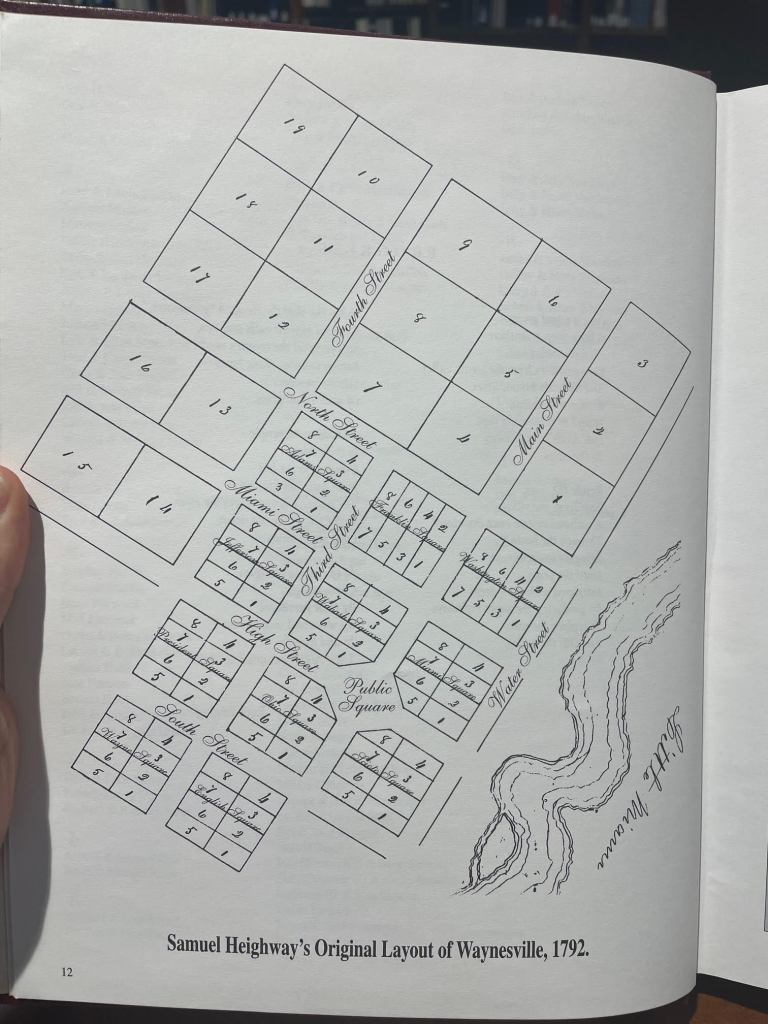
It’s a reproduction of Heighway’s original plan for the town: the one he showed Baily. Check how close the buildings are to the Little Miami River, and the fact that the first street was called “Water Street”. I saw Main Street on the map, and modern-day Waynesville is just up the hill from the river with a big old Main Street now. If that’s the same Main Street location, then where in the world was “Water Street”? I hadn’t seen it before I came to the library.

I took the plan back to the librarians and asked them what they knew about Water Street. An older lady who was sitting with them heard me and leaned back, thinking, “Water Street? We used to have a Water Street. That’s where the old mill was.”

The old mill? That sounded promising. “What happened to the mill?”

“Oh, they tore that down when they built the new highway.”

“You’re killing me. That’s what I’m looking for. I’m sure of it. Where would that have been?”

She pondered, scratching her chin maddeningly, “Oh, that’d be down in Corwin.”

I thanked everybody and blasted back to the car to drive down hill and across the river. I say “river”, but it looks like this now:
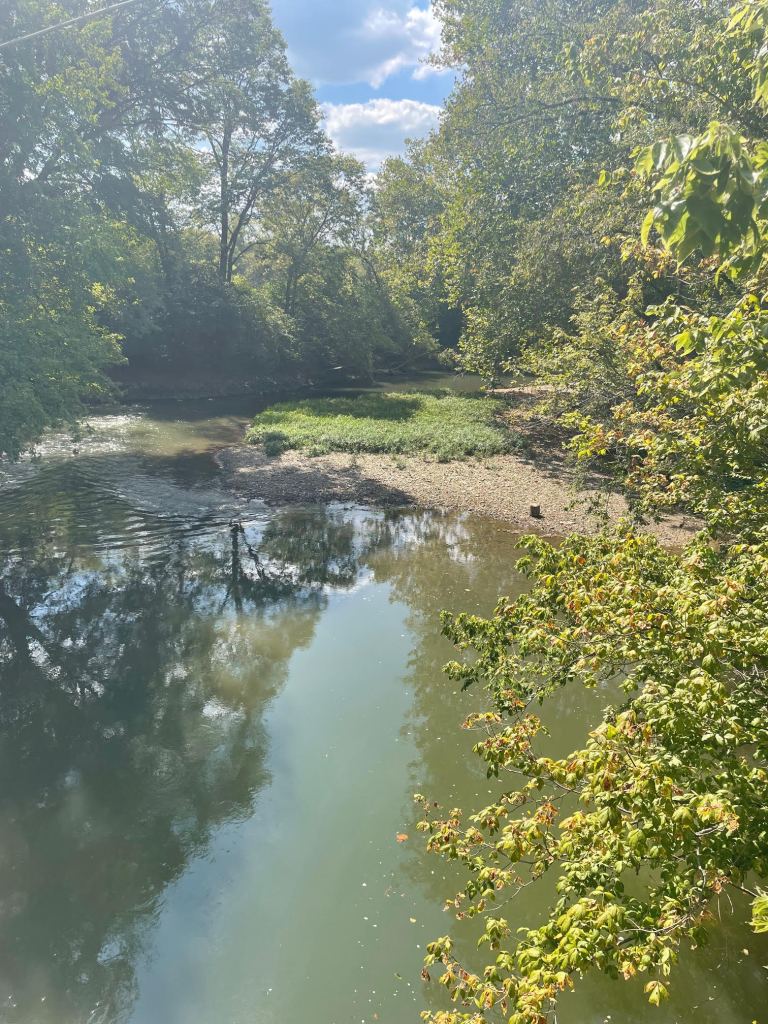
At one point, it clicked for me, stepping out of the car right across the Little Miami from Corwin and into a cornfield, why Waynesville is where it is up on the hill. The river would have flooded over the years, so they moved to higher ground. Main Street is just up the road. The plan showed Water Street and the first buildings right where I was standing.

Here:
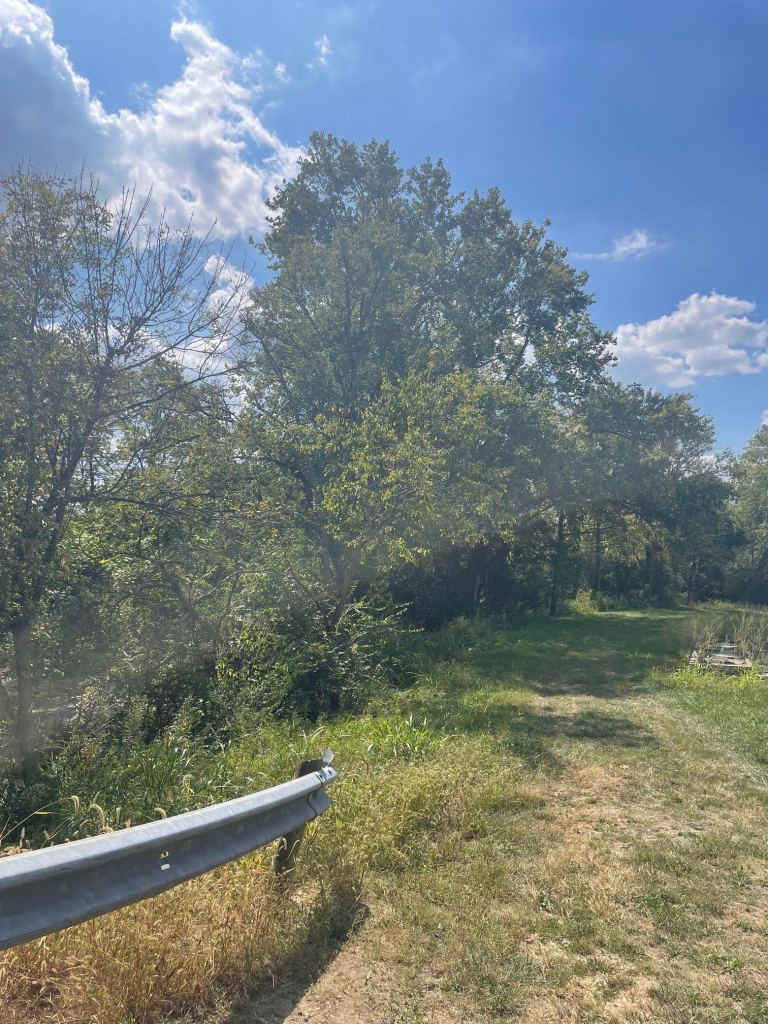
I can’t tell you that’s the precise spot where Baily chased behind Heighway as they laughed and joked what would become of the land, amid the hammering and axe chops.

But it sure felt like it to me.

Till next time,

Was A Booby Trap At The Heart Of One Of The Most Pivotal Battles In World History? (Part two)

If you haven’t read the first part of this double-header, click here for part one. This is the final wrap-up of a two-part deep dive into the ancient Battle of Milvian Bridge in 312 AD, to determine whether there was indeed a booby trap at the heart of the battle as some historical sources suggest.

Welcome back to our series called Inspirations From History!

The purpose of part one was to set the stage for why the battle happened and put its importance in context. We also met the key players: Constantine and Maxentius, and roughed out a psychological profile to probe the mystery at hand. If Maxentius really was a wily coward, superstitious and cautious, who relied on subterfuge and undermining enemy forces for victory, then yeah – he might have laid a booby trap. Instead, if Constantine was just lucky and bold and a good propagandist willing to use superstition and religion to advance his agenda and to inspire his men, then maybe no – the booby trap could have just been his insulting re-framing of the battle afterwards.

Well, which was it?

Pretty sure I have a good answer to that. There are 8 key historical sources to examine, all with solid claims to people who were there, spoke with those who were there, or otherwise had access to credible sources. I got my hands on all of them.

(1) Latin Panegyric 12, from an anonymous author and dating to 313 AD, only a year after the battle and representing the words of a speech made directly to Constantine

    The author describes Maxentius as growing gloomy and bitter at Constantine’s approach, rushing into a foolish formation, and panicking in his retreat. The narrowness of the bridge hindered the retreat, and the river “snatched up their leader himself in its whirlpool and devoured him when he attempted in vain to escape with his horse and distinctive armor by ascending the opposite bank“.

    No mention of a booby trap.

    (2) On the Deaths of the Persecutors by Lactantius, dating to 315 AD

    Chapter 44 describes Maxentius as staying behind in Rome at the games while his men fought the battle until he was shamed to ride out to fight and received what he thought was a favorable oracle. “Led by this response to the hopes of victory, he went to the field. The bridge in his rear was broken down. At sight of that, the battle grew hotter.” Then on seeing he was losing, Maxentius “fled towards the broken bridge; but the multitude pressed on him. He was driven headlong into the Tiber.”

    Still no mention of a booby trap, nor even Maxentius scheming by doing anything to the bridge.

      (3) Ecclesiastical History (between 312-324 AD) & Life of Constantine (337 AD), both by Eusebius and both would have been read by Constantine

      In the older work, Eusebius says Maxentius and his men drowned “when he fled” as he “passed through the river which lay in his way, over which he had formed a bridge with boats, and thus prepared the means of his own destruction“. Further, “Thus, then, the bridge over the river being broken…immediately the boats with the men disppeared in the depths“. No mention of a booby trap here either, but a casual reference that might be made more clear as we go here. Stick with me on this longer quote below.

      In his retelling of the story years later, the same author says of Maxentius, quoting more fully since it’s what inspired this entire quest):

      “…when in his flight before the…forces of Constantine, he essayed to cross the river which lay in his way, over which making a strong bridge of boats, he had framed an engine of destruction, really against himself, but in the hope of ensnaring thereby him who was beloved by God.” Later, “…one might say he had made a pit and fallen into the ditch which he had made. His mischief will return upon his own head..under divine direction, the machine erected on the bridge, with the ambuscade concealed therein, giving way unexpectedly before the appointed time, the bridge began to sink and the boats with the men in them went…to the bottom.”

      Constantine knew Eusebius well, and they would have definitely discussed this battle and its details, especially with Eusebius writing the guy’s biography. I can’t escape this account – the guy clearly says there was a booby trap.

      Is that the answer, then?

      Unclear so far. Let’s keep going. The other, equally old sources said nothing about it, in fact just the opposite.

      (4) Latin Panegyric 4, by Nazarius, dating to 321 AD

      Here, Maxentius is said to have arrayed his forces with disadvantage because he was “mad with fear“, in a “desperate state of mind and confused in counsel since he chose a location for the fight that would cut off escape and make dying a necessity.” The author’s first speech (now lost) would have covered more details, but he describes at least here the Tiber “filled with heaps of bodies” and an unbroken line of carnage “moving along with weakened effort among high-piled masses of cadavers, its waters barely forcing their way through“.

      No mention of a booby trap here, just a panicked retreat. Constantine wasn’t actually present when this speech was made, but he would have surely received the text and, I imagine, people who saw the battle would have been there to hear it and challenge anything said that was incorrect.

      (5) Origin of Constantine by an anonymous author, dating to 337 AD

      This account, though brief, sums up the battle as follows: “…when Constantine had arrived at the city, Maxentius, leaving the city, chose a plain above the Tiber in which to fight. There, defeated, with all his men put to flight, he perished amidst the straits of the people who were surrounding him, thrown from his horse into the river.” 

      No mention even of the bridge itself, nor in fact a collapse or breaking of the bridge. It just says he was thrown from his horse in a presumed retreat. Definitely no booby trap mentioned here.

      (6) The Caesars by Aurelius Victor, dating to 361 AD

      A short recount from this source describes the battle as follows:

      Maxentius, growing more ruthless by the day, finally advanced with great difficulty from the city to Saxa Rubra, about nine miles away. His battle line was cut to pieces and as he was retreating in flight back to Rome he was trapped in the very ambush he had laid for his enemy at the Milvian Bridge while crossing the Tiber in the sixth year of his tyranny.”

      Strangely, the recount of this senior bureaucrat in imperial service who possibly had access to good sources mentions an “ambush” but no booby trap. Eusebius had mentioned an ambush but said it was hidden by the booby trap.

      (7) Epitome of the Caesars by an anonymous author, dating to the 360’s AD

      This recount presents a very different twist to the story:

      Maxentius, while engaged against Constantine, hastening to enter from the side a bridge of boats constructed a little above the Milvian Bridge, was plunged into the depth when his horse slipped; his body, swallowed up by the weight of his armor, was barely recovered.

      No booby trap here either, though it’s thirty years later and this author is first to suggest Maxentius was possibly headed TO the battle, crossing the intact bridge, when his horse slipped. I can’t give any credence to this one due to its later date and its crucial variance from much older sources.

      (8) New History by Zosimus, dating to the 5th & early 6th century but with access to much older sources

        In part one of this series, I quoted the Zosimus passage describing the booby trap and its iron fastenings. The author continues describing the battle: “As long as the cavalry kept their ground, Maxentius retained some hopes, but when they gave way, he tied with the rest over the bridge into the city. The beams not being strong enough to bear so great a weight, they broke; and Maxentius, with the others, was carried with the stream down the river.

        So even though Zosimus had just described the booby trap as real, he doesn’t credit its triggering with killing Maxentius. Instead, it’s that the “beams” gave way.

        Okay, so what’s the answer? Was there a booby trap?

        No, it would seem there was not. Since most sources agree it was a rushed retreat and collapse of a temporary bridge, that’s likely what happened.

        Where did the booby trap story originate, then?

        This is something I learned as I researched this series: Constantine was a shrewd manipulator and propagandist. He had leveraged a supernatural vision before, and that wasn’t a Christian god. He leveraged a vision at Milvian. He painted himself as divine inevitability. This fellow knew Eusebius (a bishop) and the explosive new religion of Christianity as what they could do for him. It was very much to his benefit that he be the hero and liberator versus a wicked, scheming coward in Maxentius as this story was locked into history.

        Constantine made it up. That’s my conviction after poring through these sources. He just made it up. And I’m here two millenia later half-believing it.

        *

        Anyway, this has been intriguing for me and a long-time interest I enjoyed researching for you. Apologies for going long on it, but the background seemed important. Let me know what you think and if you believe the question is settled or not.

        Till next time,
        Was A Booby Trap At The Heart Of One Of The Most Pivotal Battles In World History? (Part one)

        It’s October 28, 312 AD. Beyond this bridge lies Rome. You won’t even have to fight inside its gates. Just enter, and the empire is yours…the entire known world as you see it. It isn’t even a real bridge; your enemy destroyed the permanent one. What’s there now is temporary: made of wooden pontoons. The only thing between you and rule over every part of the greatest empire ever known is one army, commanded by a devious, superstitious foe who wins battles by bribing and persuading his enemy’s forces in the dead of night and hiding behind seiged walls. He’s joining battle on this side of the river, with his back against the water to signal there will be no retreats. No running.

        This will be the end of the scheming and intrigue. Before the end of the day, one of you will ride into the city to be welcomed by the Senate. And they will welcome whoever comes to them. That’s how they are.

        You would remake the empire, granting freedom and re-defining who the people aspire to become. You would create an optimistic world and encourage new ways of thinking, ushering in a great and brave era of humanity. Your enemy is vile, the son of a liar and a coward. He offers the empire only more of the same internal wars and greed, persecutions and oppression that almost took Rome down a generation before.

        You’ve had a vision today. It isn’t your first omen, but it is the greatest: a mighty burning sign in the sky. “By this sign, conquer!” A voice in your head, promising your victory. You’ve had your soldiers paint it on their shields. They marvel at your confidence.

        It’s time. Waiting only empowers the enemy. Ride and fight! The Battle of Milvian Bridge begins!

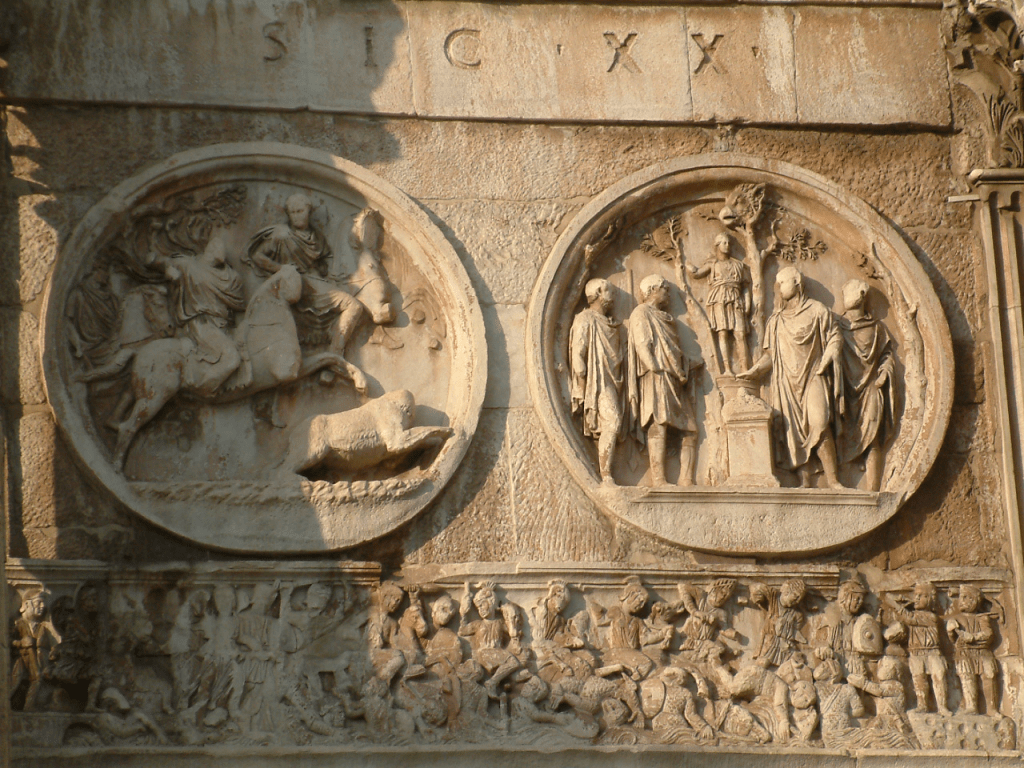
        The Arch of Constantine frieze showing the battle (at bottom)

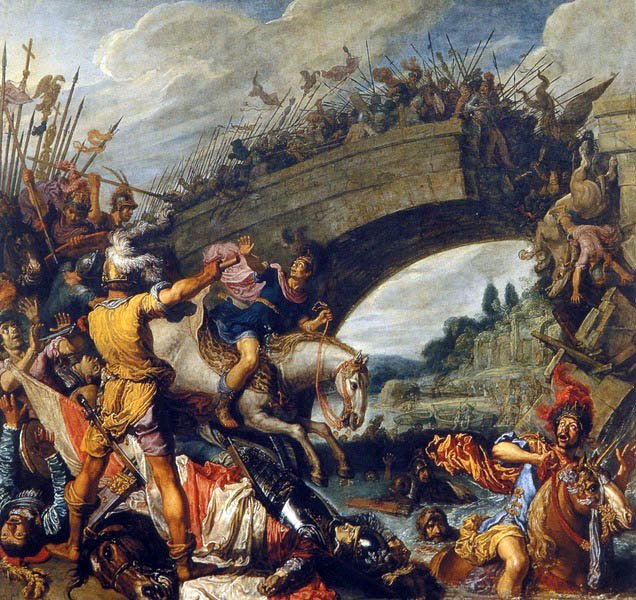
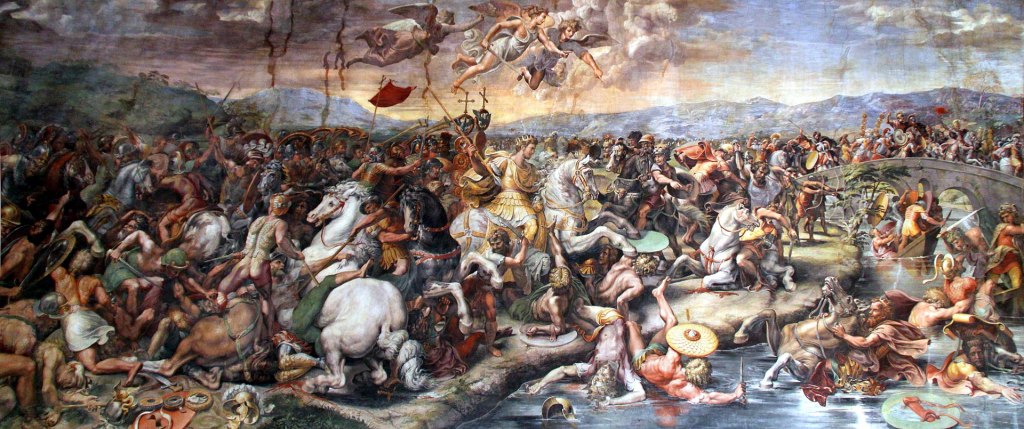
        That was the stage set on October 28 in the year 312, a battle that decided how world history would play out for the next two thousand years. It helped shape civilization as we know it, and even impacted how we think and see the world today. The story has everything you could want in a thriller: palace intrigue and power schemes, a superstitious emperor shamed by his people into abandoning his seiged city walls, a supernatural vision, and a brutal, violent conflict ending in the drowned screams of the defeated army.

        But some ancient sources such as church historian, Eusebius in Life of Constantine say there was a booby trapped bridge that decided the battle.

        Zosimumus, for example, an imperial bureaucrat writing quite some time later but drawing from older sources, said it clearly in his New History:

        “Maxentius threw a bridge over the Tiber, which was not of one entire piece, but divided into two parts, the center of the bridge being made to fasten with iron pins, which might be drawn out upon occasion. He gave orders to the engineers that as soon as they saw the army of Constantine upon the juncture of the bridge, they should draw out the iron fastenings that the enemy who stood upon it might fall into the river.”

        When I learned that, I just had to go deep to know the truth. I had to get inside the minds of some of the key players, especially the guy that lost that battle and would have set the trap (if there was one).

        How about I present the facts to you and we’ll see what you think. Welcome back to our series: Inspirations From History!

        A little background?

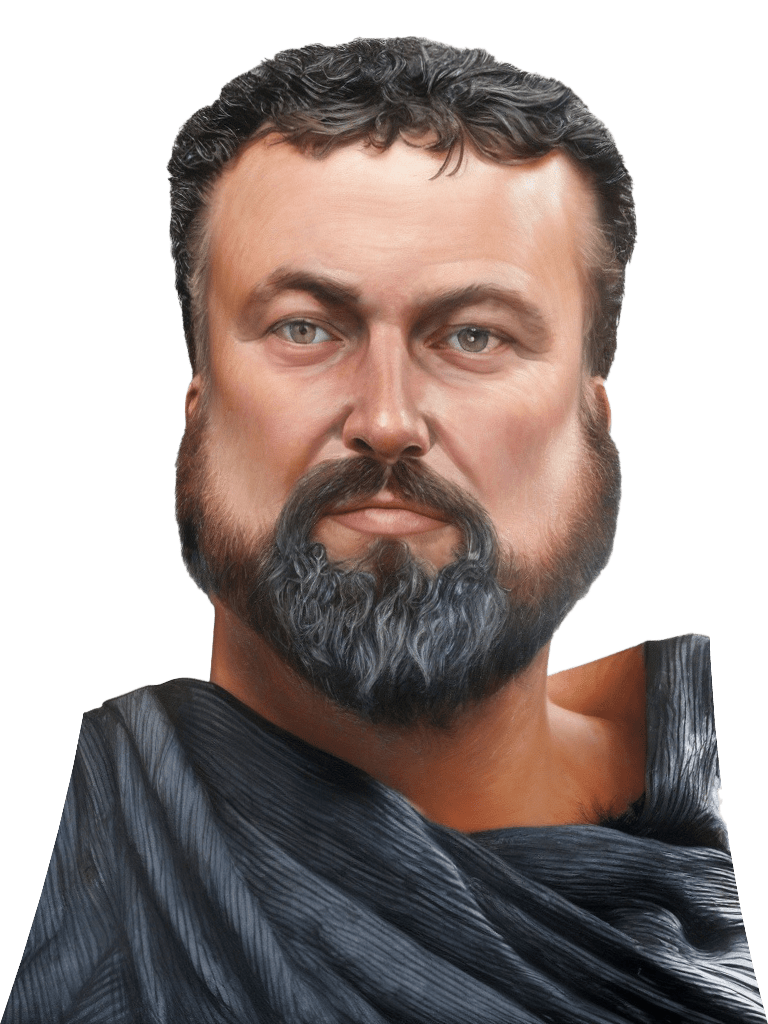
        Diocletian

        It all orbits around this guy here. His name was Diocletian, and in some ways he was the Abraham Lincoln of his day. On May 1st, in the year 305 AD on a parade ground in front of his army, he retired as emperor and was the very first to do so. He was ill and just wanted to tend to his vegetable gardens on the Adriatic shore. This was a shock to the system because he was the stabilizing force for the empire when it had all but shattered to its shakey core for 70 years before he came to power. In fact, during a 50-year period before Diocletian, there were no fewer than 60 claimants to the throne in a terrifying time of anarchy, intrigue, civil strife, plague, and foreign invasions.

        And now he wanted to tend vegetables.

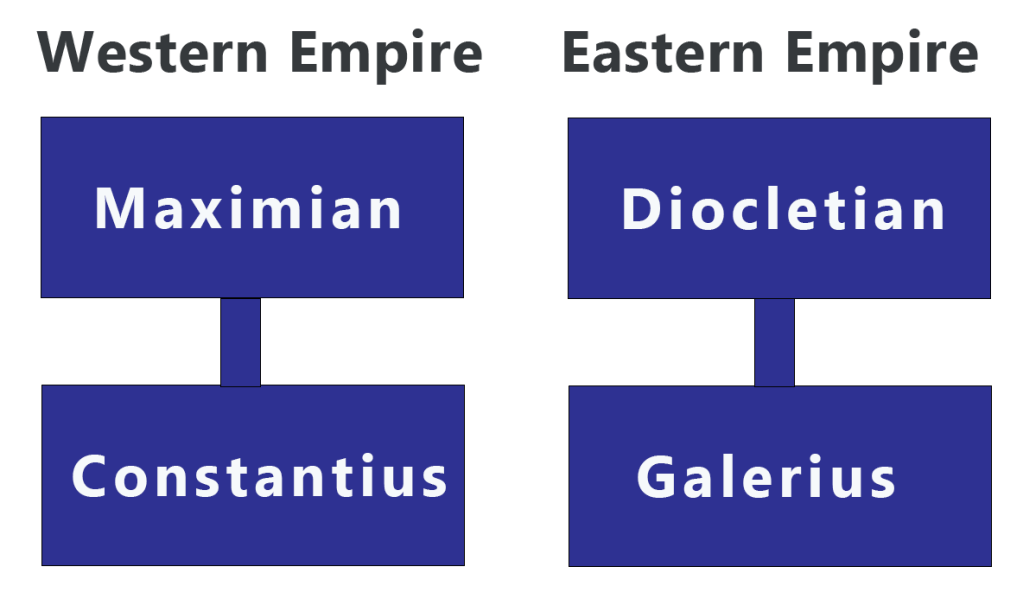
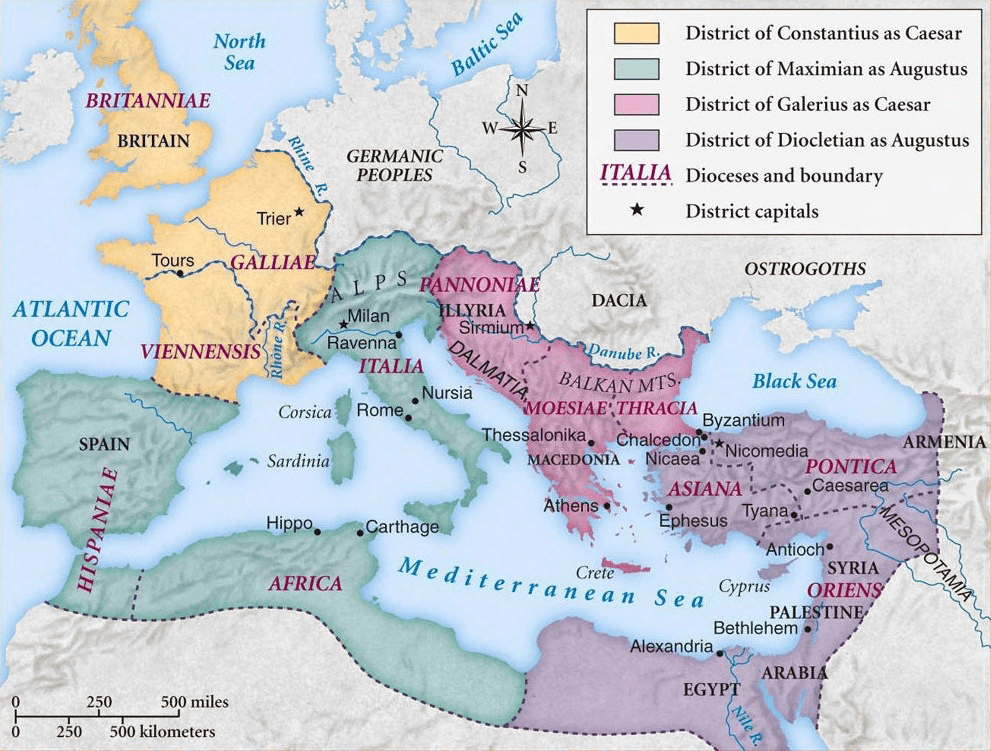
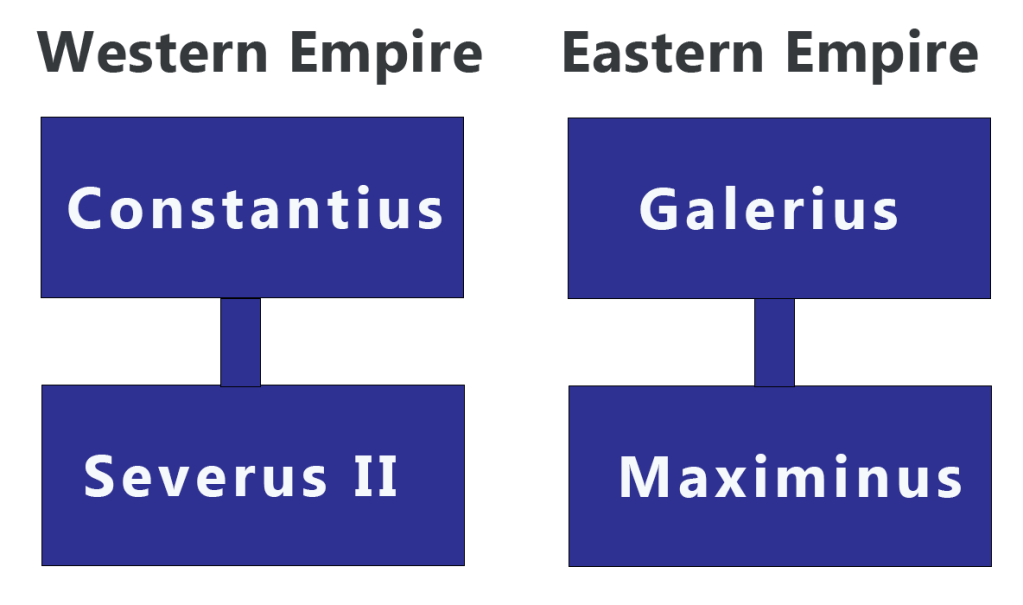
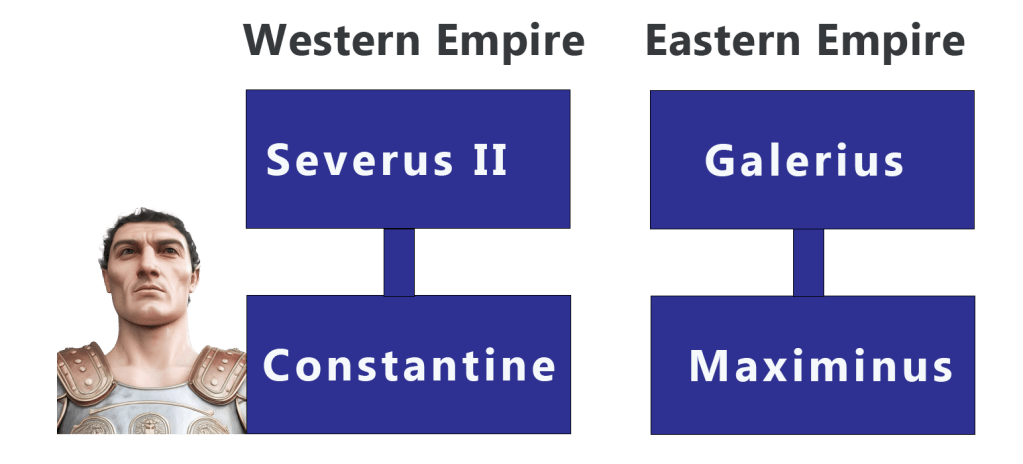
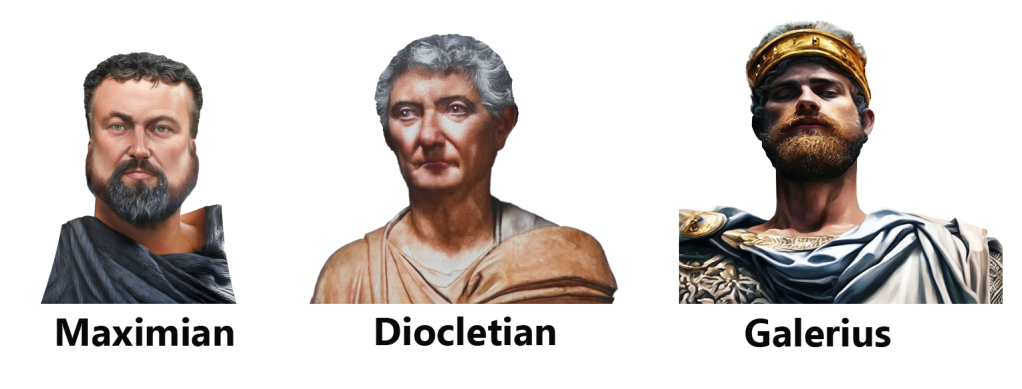
        One important way he had stabilized the empire was a shared-power framework called the Tetrarchy. Although Diocletian had remained the ultimate and senior honcho, he primarily governed the eastern portion of the empire with the senior title (Augustus), aided by a junior (a schemer named Galerius, titled Caesar). His counterpart in the western portion was a fellow named Maximian (also titled Augustus), aided by his own junior: Constantius (titled Caesar).

        Here’s what that all looked like:

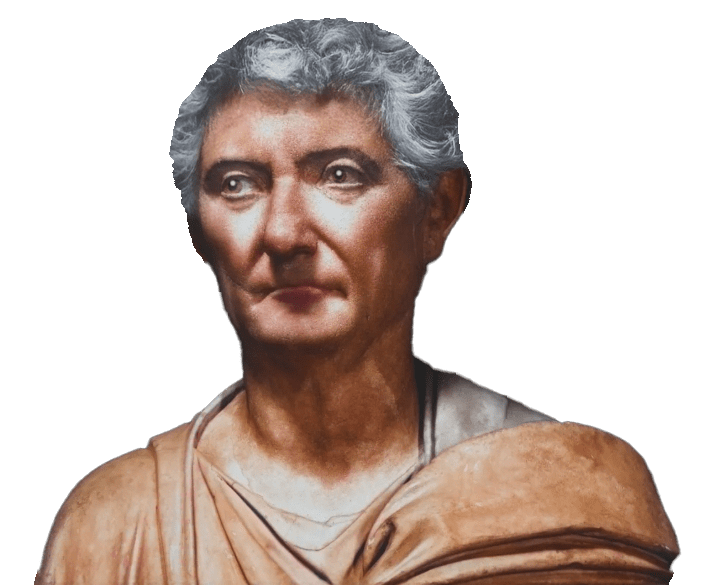
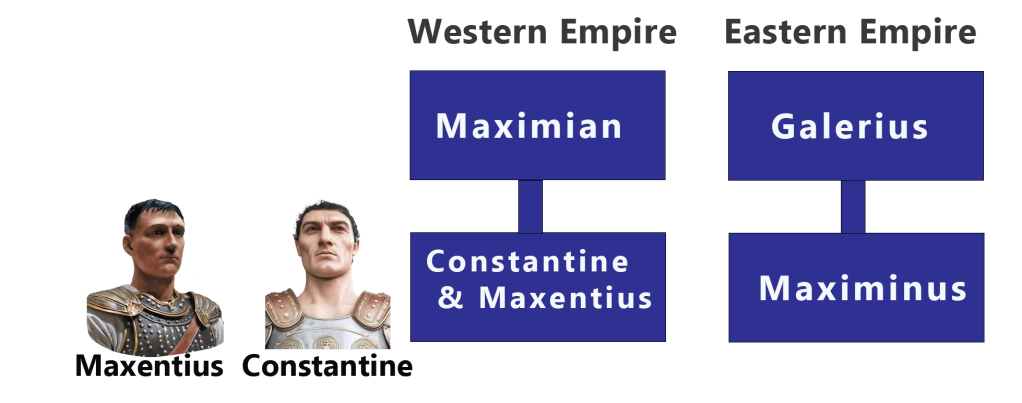
        Maximian

        And here’s Maximian. When Diocletian announced he was retiring, he forced this poor guy to retire too. And the surprises just kept coming…

        This was the new tetrarchy Diocletian announced on that parade ground. Constantius and Galerius got their promotions, but Constantine, the son of Constantius, was standing on the tribunal with these guys expecting to be named Caesar. That was the whole point of his previous 10 years, being groomed for this moment. He’d served under Galerius all but a captive to enable this promotion to happen. It was what he’d been told his whole life would happen.

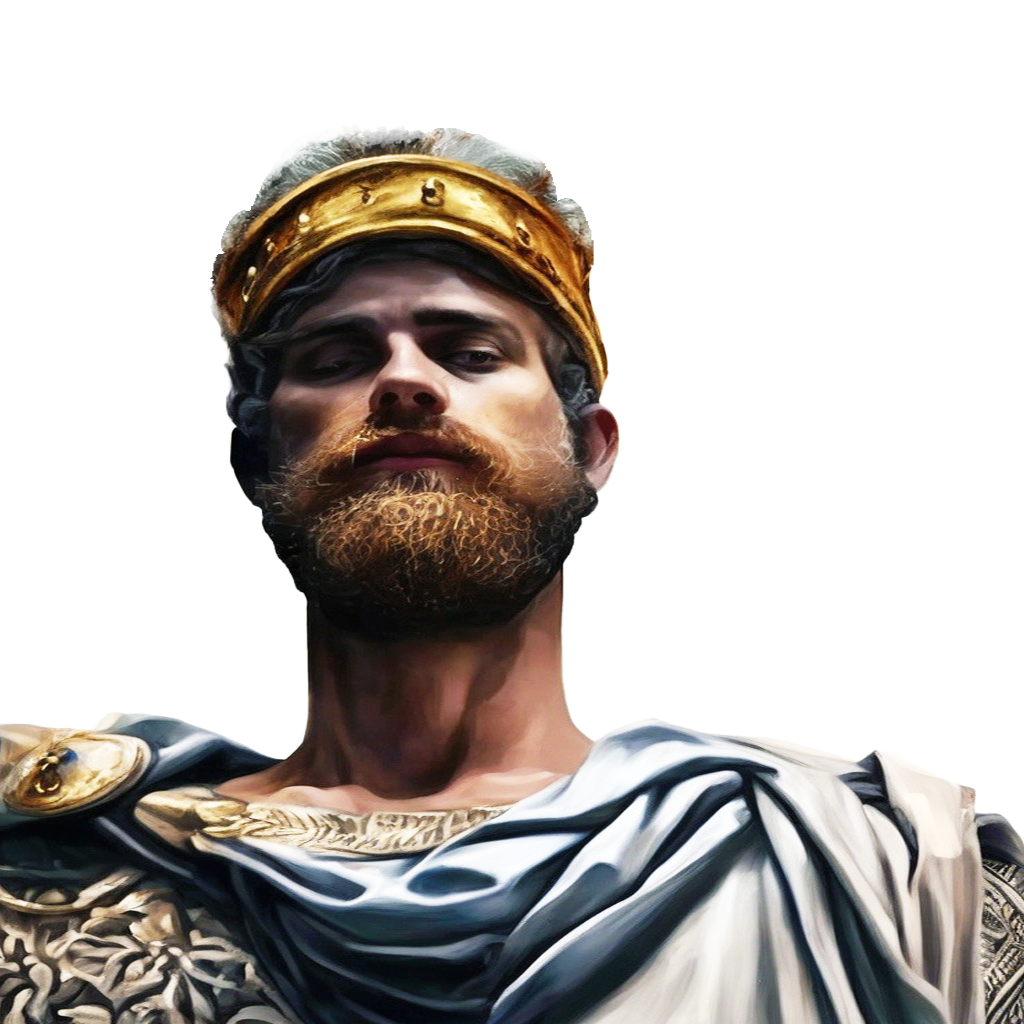
        Then it didn’t. Because of Galerius. This guy here:

        Galerius

        Galerius hated Constantine, and had convinced old Diocletian that the tall, handsome and well-liked young man was too ambitious and wouldn’t respect authority. So he got passed up. That fellow, Maximinus who got the Caesar job in the east was Galerius’s nephew: a puppet placeholder till Galerius’s young son was old enough to take the title. Constantine will be commanding one side at the Battle of Milvian Bridge; it’s with his perspective that I opened this article above.

        Constantine

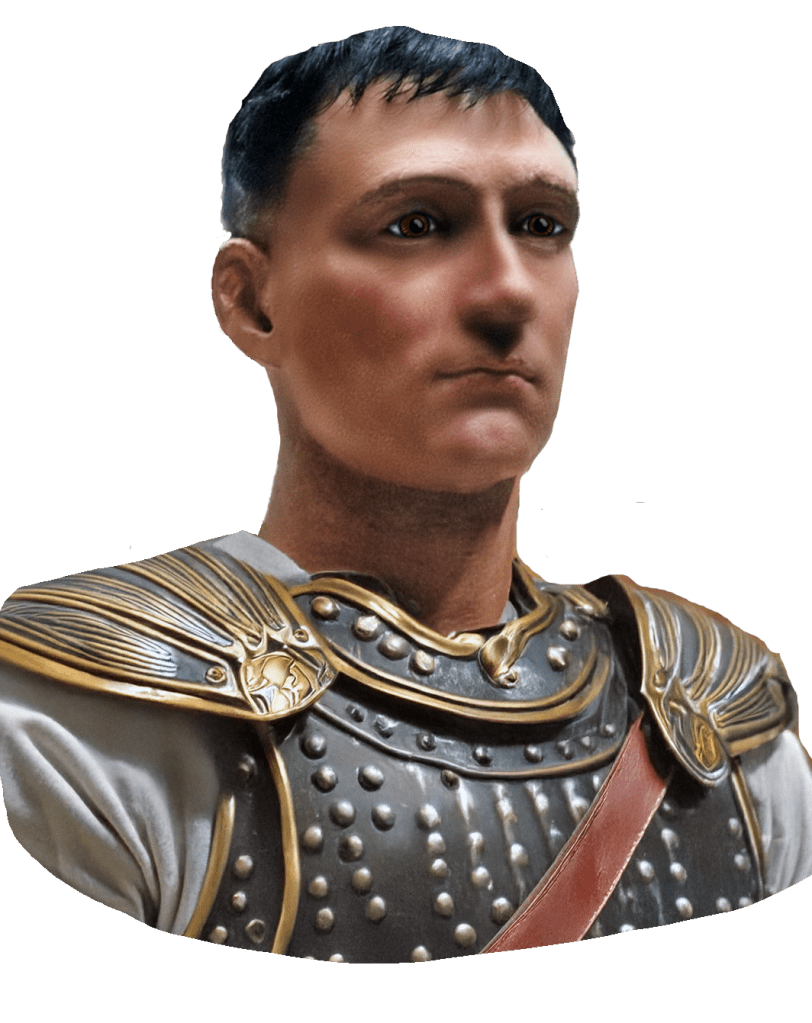
        Maximian had a son, too, a devious one who was also expecting to rise to the title of Caesar, a fellow named Maxentius. Not only was Maximian forced into retirement, but his son got passed over as well.

        Because of Galerius.

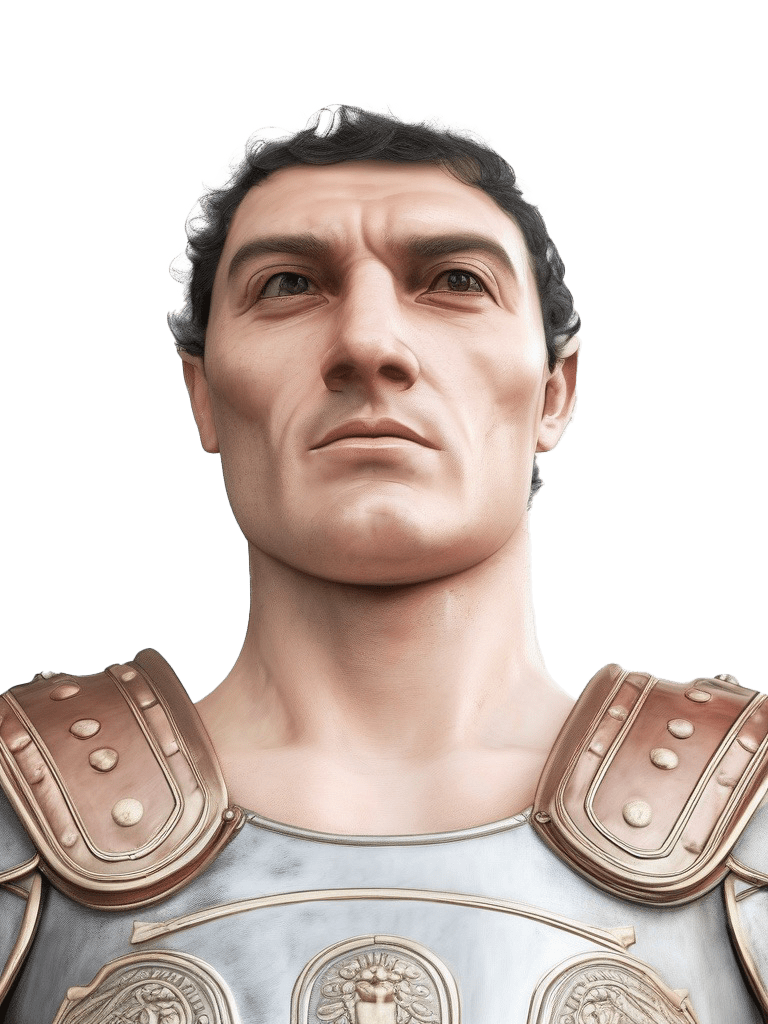
        Maxentius

        Galerius had convinced old Diocletian that Maxentius was insolent and unfit for rule, so he maneuvered his henchman, Severus into the Caesar job. And with all that intrigue, scheming Galerius wound up Augustus over the eastern empire with his nephew below him and a croney in waiting as Caesar in the west. Quite the layer cake, that Galerius! A true child of Rome.

        So everyone went along with that?

        Oh, no. Constantius was the only one not tied to Galerius here, and he did a thing.

        That Summer, Constantius summoned his son, Constantine to his service in a campaign against the Picts. When Constantius died of natural causes about a year afterwards, Constantine was presented to the army as Augustus. Not the junior title of Caesar, mind you. Augustus: Severus’s job. Galerius was furious with this, refusing to acknowledge that title but allowing him as Severus’s junior, Caesar.

        Constantine went along for the time being, pleased with his insertion into the Imperial College. But Constantine’s success here infuriated old Maximian’s son, Maxentius, who took advantage of some unrest in Rome due to new taxes and got himself an elevated title (“First Citizen”), an act that even moreso infuriated Galerius. Maxentius hated his father, but knew it would make his claim to some kind of authority legitimate if his dad came back from retirement as Augustus (yes, Severus’s title). The Roman senate went along with it despite the lack of Galerius’s backing.

        Galerius ordered Severus to suppress this uprising through force in early 307, and it was in this battle outside Rome that Maxentius did something very interesting, very effective, and highly relevant to the question of whether there was a booby trap on Milvian Bridge.

        He bribed and persuaded Severus’s soldiers to switch sides and just drop the seige of Rome. I imagine this as happening around campfires in the dead of night, with Severus waking up at sunrise to the bulk of his army gone. Severus was taken captive, forced to abdicate, and was dead by September.

        Maxentius was fast becoming a hero to the people of Rome. Crucially while Maximian was away negotiating with Constantine to keep him out of the conflicts (granting Constantine the cherished Augustus title), Maxentius faced Galerius himself who had crossed the Julian Alps to deal with this himself. Galerius was a fierce and renowned general with a glory-filled career in war, and was headed straight for Rome to settle all this and bring order back to his marvelous plans for the empire under his rule.

        And Maxentius did it again. His agents infiltrated Galerius’s camp at Interamna and worked the invading soldiers with promises of rewards and promotions, and insistence that Galerius was in the wrong attacking his own son-in-law. And it worked again, with so many of Galerius’s men defecting that he was forced to retreat and leave Italy entirely without even fighting a battle!

        When Maximian returned, he was dumbfounded to find his own son had declared himself Augustus and had made Maximian’s role obsolete. Maxentius ran his father out of town, driving him into the arms of Constantine for protection.

        Couldn’t the old guy that retired come back and fix all this?

        Galerius did, in fact, meet Diocletian in November 308 with Maximian in attendance as well to try and convince the old man to come out of retirement and use his prestige and reputation to fix the world they’d broken. But he wasn’t leaving his cabbages and proposed a revised tetrarchy that everyone should have known wouldn’t work. He named a loyal lieutenant of Galerius’s (Licinius) as Severus’s replacement Augustus, demoting Constantine to Licinius’s Caesar, and charging Licinius with putting down Maxentius. Maximian was told to retire again.

        It isn’t worth diagramming that, because both Constantine and Maxentius were forces of nature that couldn’t have cared less about Diocletian’s new framework.

        So we’re ready for the Battle of Milvian Bridge then?

        Yes, we are. By 310, Maximian, after trying to spread a false rumor that Constantine was dead to declare himself Augustus once again, had hung himself. Galerius and Diocletian both died in 311. Licinius wound up dying at Constantine’s hands a little more than a decade later and isn’t important to the story or its impact anyway. Maximinus died of natural causes a year later and isn’t important to the story either.

        In 312, Constantine struck like lightning in a raid through Italy bound straight for Rome to take out Maxentius for good. Whoever won that, honestly, got the empire with just some loose ends to clean up.

        What happened?

        Before the battle was done, Maxentius had left the city walls (though he’d won two previous seiges through guile), lost the fight, tried to retreat (in a panic?), and drowned in the Tiber along with much of his army. His pontoon bridge had collapsed. Take a look at that stone frieze above on the Arch of Constantine to see a contemporary visual for that. It’s Constantine driving men on horses into the river.

        Twenty years later, a man named Eusebius who knew Constantine personally reported that Milvian Bridge had a booby trap. That was what fascinated me about this whole story. Yet the sources don’t agree, and the oldest sources don’t mention a booby trap at all.

        Maxentius was devious and could very well have planned such a trap, even trying to lure Constantine’s forces into it. And Constantine was a master of propaganda, claiming kinship with gods, which could have persuaded Maxentius’s minion in charge of a booby trap to trigger it instead against his own master.

        I had to know. WAS there a booby trap at all?

        In part 2, I’ll try and get you an answer on that.

        Till next time,

        Why Does This 14th Century Book Have A Dial In The Cover?

        Oh, my…the bunny trails we do chase here at Grailrunner for your entertainment!

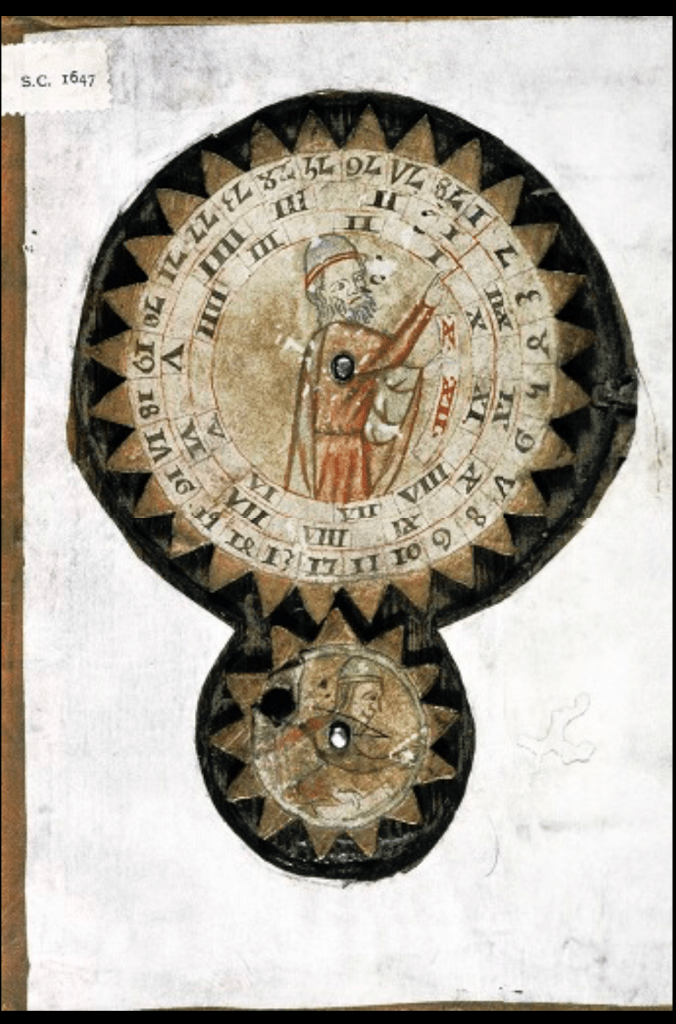
        I’ve got a crazy one for you today: a 14th century copy of an 11th century book called The Experimentarius by Bernardus Silvestris of Tours that he had virtually nothing to do with, that is nowhere titled like that, that played a desperate role in a terrifying city siege, and that has a funky set of cogged wheels embedded in its cover.

        Welcome to the Inspirations From History series!

        I’ll define my terms shortly and explain all this, and provide you some fascinating links, but let me tell you how I came across this intriguing bit of historical curiosity. I was writing this article here about a 13th century geomantic machine and saw something in the footnotes of a 2003 study by Emilie Savage-Smith and Marion B. Smith (follow the link for a download option). I’m a sucker for little nuggets in footnotes buried in dense books. If you’ve never read Jorge Luis Borges, he does that in some of his fiction.

        Anyway, here’s what I read:

        “The Oxford, Bodleian Library, Western Manuscripts, MS Digby 46, a fourteenth-century copy of The Experimentarius, has set into the inside front cover of the volume two interlocking wooden cogged wheels with twenty eight and thirteen teeth, by which one can find a random number, rather than by counting random points.”

        And I thought…huh? Why in the world would I need a random number reading a book? What’s it for? And how cool does it look? And can you play Dungeons & Dragons with it?

        Once I started chasing details on this little marvel, I realized quickly the scarcity of information available about it. I did however find a deep dive article written by Dr. Charles Burnett in 1977, who’s still teaching at the Warburg Institute in London (but who hasn’t unfortunately responded to an interview request). He specializes in the transmission of texts, techniques and artifacts from the Arab world to the West, especially in the Middle Ages.

        Here’s a link to the article I’m talking about, titled What Is The Experimentarius? It’s behind a paywall unless you have some connection to a recognized university, but it really offers a wealth of history and analysis on the book in question and is the source of much of what I say here.

        Who was Bernardus Silvestris?

        Bernardus Silvestris was a 12th century philosopher (and scientist, I guess, though that whole thing back then was a bit of a blur) who wrote an influential poem called Cosmographia that supposedly inspired people to feel good about exploring metaphysics and science with allegories. Anyway, Dr. Burnett effectively swats away any notion that Silvestris wrote any substantial portions of the book we’re discussing today, so let’s not dwell on him. We’ll have to find peace with the idea that the author is unknown.

        What’s this book about?

        We’ll also have to recognize that big portions of the book in question are a bit irrelevant for our purposes here today, as its varied copies in various museums around the world bear somewhat different content and don’t all matter for those weird wheels or their function. No, the main event here is a subset of the book that Dr. Burnett prefers to name Sortes Regis Amalrici, meaning “The Lots Of King Amalric”.

        Why that name?

        Sortes literature was a long-standing means of using various mechanisms to produce random numbers (like dice or random pokes in sand), forcing some pseudoscientific-looking ritual involving bouncing around tables, and ultimately selecting from a wide set of verses an oracle answer to whatever question a seeker was asking.

        It’s a tradition going all the way back to ancient Greece, and continued for well over a thousand years. You can find the full translated text of the most famous of these ancient sortes texts, titled The Oracles of Astrampsychus in the Anthology of Greek Popular Literature by William Hansen.

        So it’s a 14th century copy of a 12th century book for telling the future?

        Yes it is. And I became terribly interested in understanding what manner of questions and concerns these seekers would have to ask such a book, given their belief that this secret tome had unlocked a means of resonating with the very day and time of their consultation, and the crystal spheres inside which they lived, to reveal the secrets of the universe.

        So I used Google Translate to convert the functional tables from Latin in Burnett’s article to experience how this all worked. I included that and the instructions on the book’s usage in a spreadsheet, which I’m including at this link here.

        Where can I see the original parchment pages of this book?

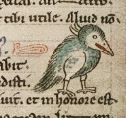
        You can go to the Bodleian Library site here or to the British Library site here to take a luxurious look if you (like me) see the joy of perusing high resolution images of super old parchment documents and the little doodling pics in the margins like these:

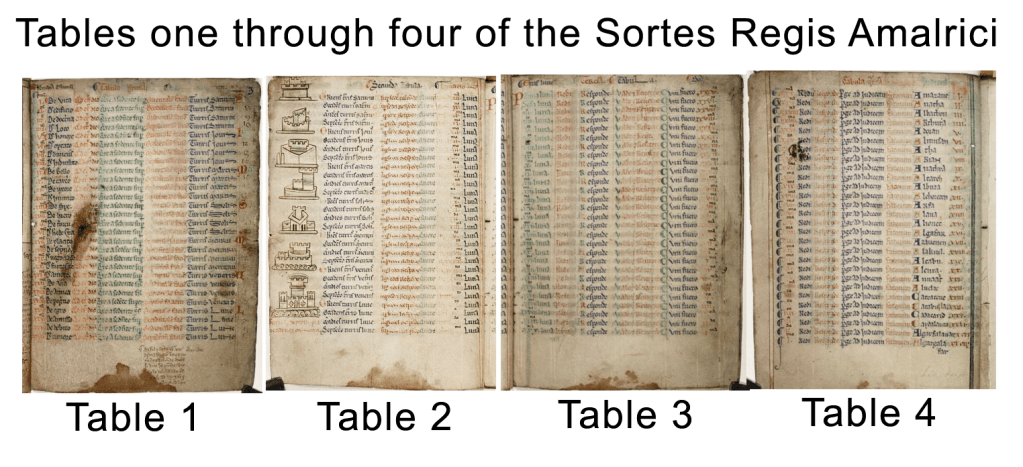
        Here is a reproduction of tables 1 through 4, which are the ones I translated in the Excel document linked above:

        Don’t make me read all that, how did this book work?

        Determine a random number, either through geomantic points or a dial like the one on our cover in question. Spin it or close your eyes and start turning, then peek to see what you got.

        If the random number exceeds 7 (say 10), find the theme of the question on table 1 (say “about war”) and count that as 7. Move up the table till you hit your number (in this case, move 3 up to “about wishes”). Then follow table 1 instructions (“western face of the tower of Jupiter”) -> table 2 instructions (“13th day of the Moon”) -> table 3 instructions (“18th moon”) -> table 4  Judge (“Alchozean”)

        Each Judge has verses, and you add 9 (a constant) to your random number to select the relevant verse which is your oracle. (So in this case, verse 19).

        If the random number is exactly seven, then follow the tables as above but begin directly from the theme of the question (“about war”). The oracle will be the verse for the respective Judge numbered 7 + 9 = 16.

        If the random number is less than 7 (say 5), then count the theme of the question as the random number (so 5 in this example) then go down the table till you reach 7 (“southern face of the tower of Mars”).

        Let’s keep in mind here that the point of all that jumping around and Middle Ages tech-speak is to make this seem like science. It’s possible seekers could only finish their consultations in many cases on the actual days listed in these tables, which would really make it all seem super serious.

        Where the heck are the Judge verses?! I wanted to play Dungeons & Dragons with this thing!

        I hear you, and that’s totally what I was going to do. I wanted to see if I could use an ancient fortune-telling book to act as dungeon master for a solo roleplaying game. Would have been awesome. However, Burnett didn’t include the Judge verses in his appendices, and the Latin font in the originals I could find was incomprehensible to me. I couldn’t even make out what letters they were. Was hoping Burnett would provide originals so I could translate them, but no luck.

        Well, what kinds of questions did people ask with this book?

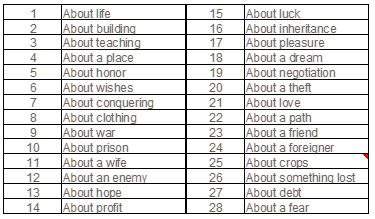
        Ahhh…that was super interesting to me. Take a look at Table 1 to see what issues concerned these folks. Some of these are very telling of the times (“about prison”, “about hope”, “about a dream”, “about a foreigner”) but practically all of them are common to all of us and incredibly easy to understand why they concerned the book’s users a thousand years ago.

        One curiosity here: number 25’s original Latin is clear on the parchment and reads “egro” which translates as “in the desert”. I strained to see why anybody had questions relating to the desert (though my imagination wandered) till I realized they probably slipped and meant “agro” which means “the field”, or crops probably. Yeah, that’s more likely by a mile.

        What was that bit you said earlier about a terrifying city siege?

        I’ll leave you with this story, this glimpse of what the Sortes Regis Amalrici and these weird little tables meant to some extremely frightened people in a terrible time. It’s an excerpt from a book written in the late 1200’s by Rolandino Patavino, a notary who worked in the Italian city of Padua.

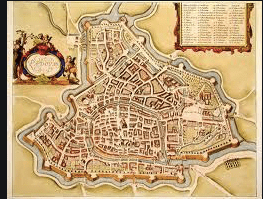
        The background is that Padua was on the rise and set to be as big a deal as Venice back in the day before Italy was a thing. Twenty years before, the Holy Roman Empire had taken and held Padua up until 1256 when some exiles (supported by the Pope) took it back. That lasted a year until the villain and tyrant of the story (named Ezzelino) laid siege to Padua to return it to the hands of the Holy Roman Empire.

        Here’s what Patavino recounted of those days trapped and surrounded by a returning conqueror and likely wondering whether they would all be slaughtered or would starve to death inside the city walls:

        “Some of the prisoners anxiously searched through the lots to find when the army was to arrive. And one of the points of a certain art…is to say that Padua could not be captured in these times. Another one of the prisoners favored this, saying, “Examine the book carefully.”

        That’s our book he’s talking about. They were desperately flipping through those very pages to find hope of salvation. And it was right.

        *

        That’s what I wanted to bring you this time. I hope you found it diverting like I did. Let me know what you think. And till next time,