Restoring Lord Dunsany’s Book of Wonder (and fixing a travesty while we’re at it!)

There was a writer of fantasy stories in the early 1900’s that helped lay the tracks for the books and films of imagination we enjoy today. Tolkien read him – supposedly gave a copy of the book we’re talking about today to Clyde Kilby in preparation for helping the Professor compile and develop The Silmarillion. H.P. Lovecraft wrote a poem about that same book. In fact the author, Lord Dunsany, inspired creators as far-ranging as Clark Ashton Smith, Guillermo del Toro, Neil Gaiman, Jorge Luis Borges, and Arthur Clarke.

He’s kind of a big deal.

But this particular book of 14 stories though, The Book of Wonder (available free here), was a real game-changer. Most, if not all, of the stories first appeared in a lifestyle magazine titled The Sketch from 1910 – 1911, then were compiled into the single volume for publication in 1912. Taken together, they read like a series of dream-visions, and feel comfortable and sleepy, like they’re being told in a warm voice by a crackling fireplace. It’s a collection of short fantasy tales about strange kings, cities, gods, and wanderers whose desires—for wealth, beauty, knowledge, or escape—lead them into eerie, dreamlike adventures. The tales often turn on irony or fate, showing how wonder and curiosity can just as easily bring enchantment as loss, transformation, or quiet doom

But there’s a real injustice that was done to this book, and Grailrunner is fixing it today with one of the coolest freebies we’ve ever given away. There will be a free download link at the end of this article, but first you have to know what injustice we mean and get as annoyed as we are about it!

Let’s talk about Sidney Sime for a second. He did this painting, which is how I first came across him.
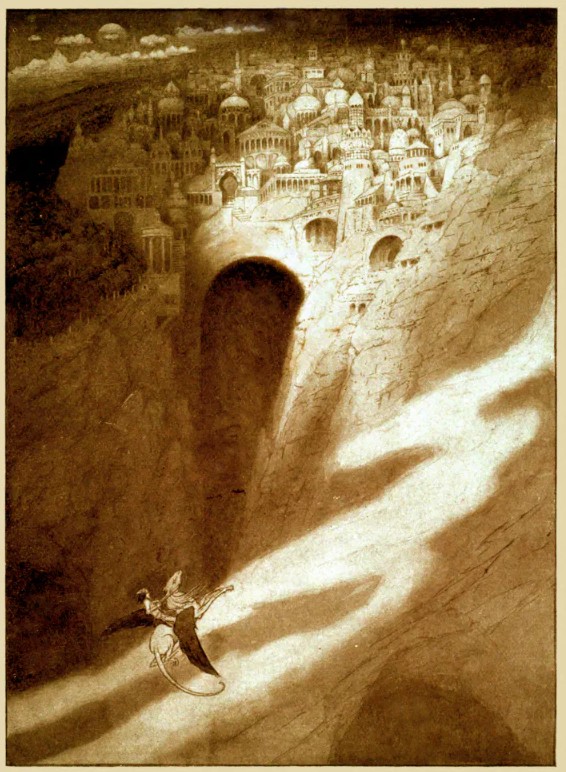
Isn’t that gorgeous?! Honestly, this is the kind of thing art is for! It’s called The City of Never, and it sends my mind wandering! I really love it.

Sime started his working life in a coal mine, almost dying in an accident, before working in various jobs ultimately winding up a sign painter. He managed to get some of his eerie, dreamlike art published in The Sketch Magazine as illustrations, and that’s where Dunsany first saw his work. When Dunsany contacted him to illlustrate his work, The Gods of Pegana, it began a long and incredible collaboration that lasted the rest of Sime’s life.

Then something with the feeling of destiny happened. We’ll let Dunsany tell you about that:

“I found Mr. Sime one day, in his strange house at Worplesdon, complaining that editors did not offer him very suitable subjects for illustration; so I said: ‘Why not do any pictures you like, and I will write stories explaining them, which may add a little to their mystery?’”

-Lord Dunsany

Wait a minute, what are you saying?

I’m saying that Dunsany hadn’t written The Book of Wonder or its component stories when he asked Sime to just paint something.
Anything! He just suggested that an artist with a wild imagination go wild and see where it led him. Then, Dunsany would make something of it.

That sounds cool. How did Sime decide what to paint, then?

He had a wonderful imagination. Still, Sime’s images often look as though they were found through the act of drawing and painting, not fully locked down in advance. You can see it in a few recurring traits:

Dream logic in the compositions: odd appendages, improbable towers, and strange silhouettes that feel less like academic illustration and more like an artist noticing possibilities inside the developing image and following them.

Forms that seem to emerge out of texture and shadow rather than being mechanically planned from the start.

Architecture and figures that feel invented midstream, as if one shape suggested the next.

Selective detail, where one area becomes highly specific while other parts stay loose and suggestive, which is often a sign of discovery rather than rigid predesign.

Examples?
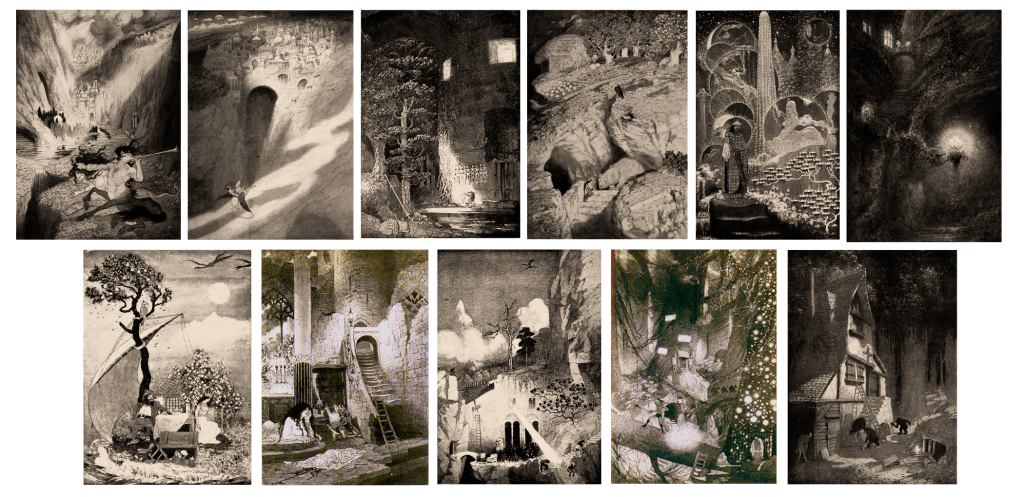
Yeah, I see the dreamy, moody thing you’re talking about. So what’s the travesty with this book?

In my mind, if Sime’s art came first and the stories were largely built from them, then this book is a composite work that should be inseparable. The art should be included in every reprint and copy. In fact, the images ought to come first before each story so the reader can follow the process for themself. You should be able to see the art cleanly, clearly, in good resolution, ideally in color, then proceed to the story to which it is attached.

But that’s just not the case.

I argue that in the far majority of cases where this incredibly influential and popular book is made available, it is without illustrations at all or is included with revised artwork. As if the Sime work was just some bumpkin’s outdated attempts at something a modern artist could exceed or modernize.

Worse, it’s a maddening trail of low-res scans and dead-ends to even find decent reproductions of Sime’s work at all! Even the dedicated Sime gallery in Surrey doesn’t contain the bulk of the images from The Book of Wonder. Dunsany’s castle supposedly houses the majority of Sime’s work that was meant for Dunsany’s writings, but you have to arrange a visit to see them!

That does seem annoying. And a shame. So what did you do about it?
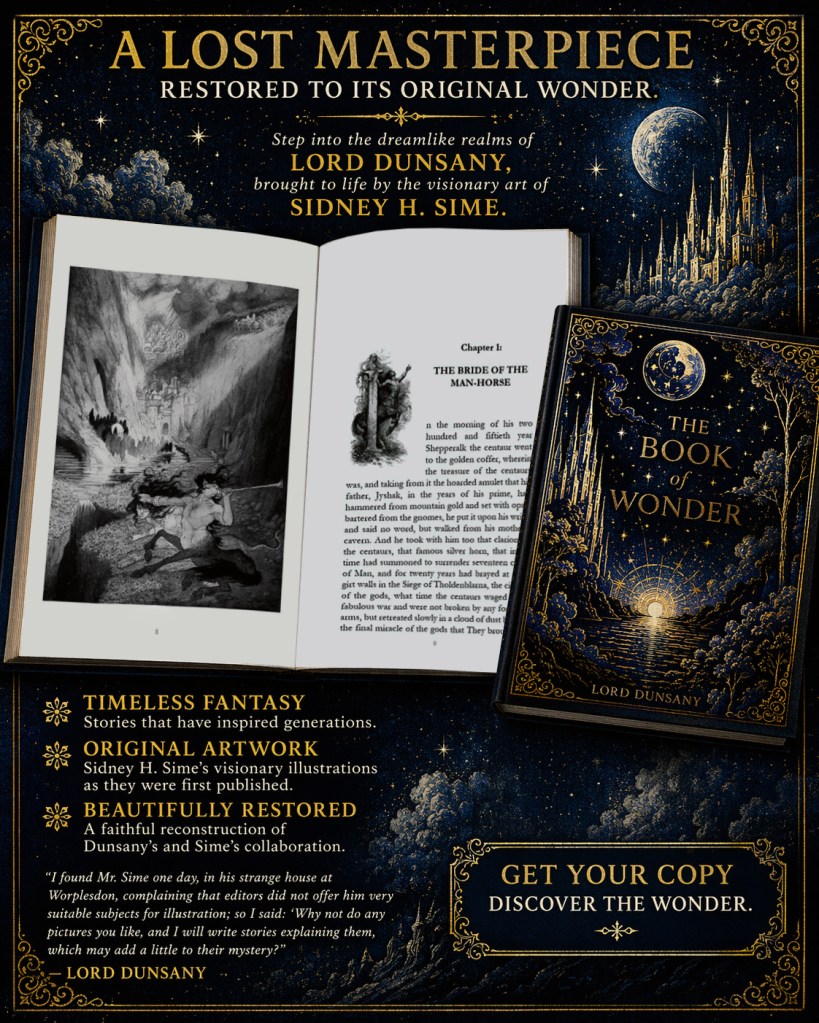
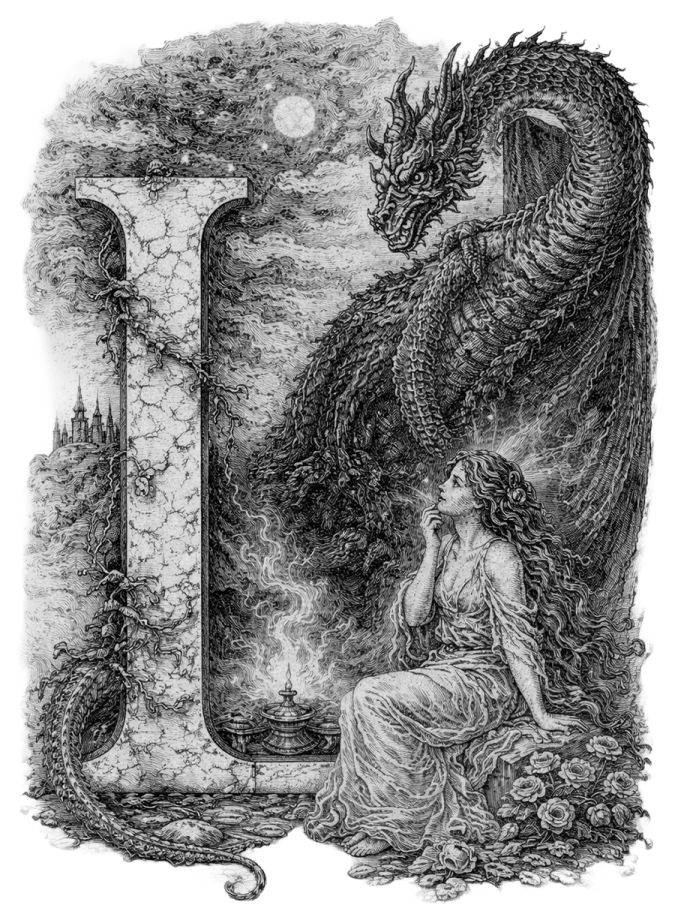
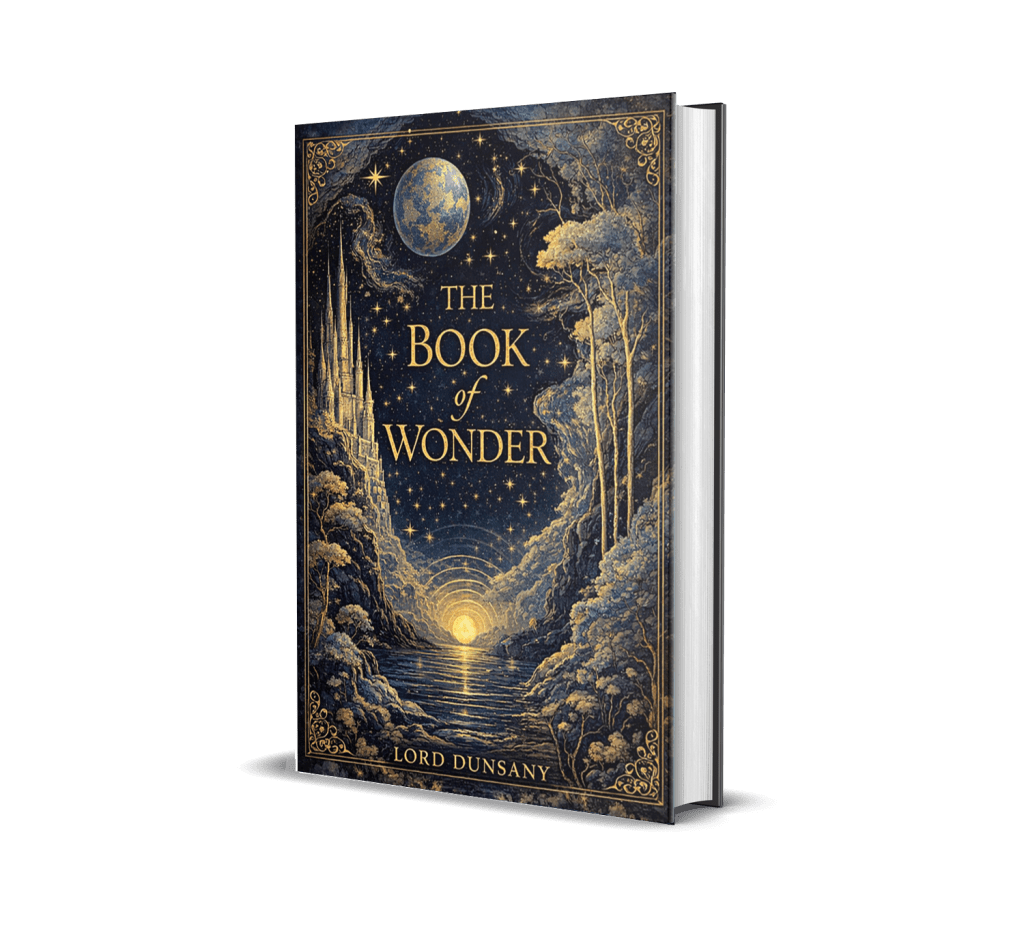
We produced a pdf version with a new front and back cover, collecting the best possible scans and most accurate text, and laid them all out in a beautiful spread with original “historiated intials” to begin each story.

Like this one:
Was it hard to find the art scans?

It was! Far harder than it should have been. We used the original 1912 version as the guiding light matching the images to the right stories. Everything needed cleanup in Photoshop. In one case, there was a lost artwork that didn’t actually appear in the 1912 version but DID appear in the Dec 1910 issue of The Sketch Magazine. Thanks to Douglas Anderson, original investigation result linked here for tracking down the lost image which likely inspired The Injudicious Prayers of Pombo the Idolater.

My main point with this labor of love is that Sime deserves co-credit for this incredibly influential work of fantasy. It’s a travesty that it was this hard to find half-way decent scans of his artwork that needed this kind of editing to even be presentable. If there was enough time in the day, we would contact Dunsany Castle and try and influence them for better scans and a new memorial edition, maybe including some correspondence between them to liven up the work. That would be amazing.

What do you hope to accomplish with this, then?

Just inspiration. Like everything else we do here at Grailrunner, we wanted to bring you the story of this fateful collaboration and give you the chance, as best we can, to gaze at the art for yourself, dream up something original for them if you like, before stepping into the wonderful mists of what Dunsany did with them.

Let’s have that download link!
*

That’s what I wanted to bring you today. I hope you enjoy the compilation and restored art. If you DO go inside The Book of Wonder to spend time with these two miracle-workers, it will be time well spent.

Deep Waters: A Case Study In Adding A Mythic Dimension


shicheng

When I read Stephen King’s Dark Tower series or Isaac Asimov’s Foundation, anytime I read Dune, I get the same vibe as I’m planning to chat with you about in this post…that there’s something ominous and huge going on – a belief system or set of myths or larger than life history affecting events. I dig that tremendously; and I look for it in things I enjoy reading. In fact, when I was growing up, you were either a Luke Skywalker guy or a Han Solo guy – meaning you wanted to be the space cowboy or the brooding, mythic hero. I was a Luke Skywalker guy. The literary take on this is it’s much more interesting in your fiction should you plan to include some sort of belief system if you don’t just recreate the Greek Gods or rip off the American Indians with a ‘Great Spirit’ thing-a-ma-bob.

So I’m going to go deep with this one. Stick with me. I finished an interesting study recently that went way farther that I’d expected. I was googling and flipping through the original materials madly, chasing a huge idea that kept getting bigger. It was like pulling up one of those weeds where the roots keep popping up out of the ground and you finally just cut it when you can’t tell how far it’s really going to go. For me, it started with a random book on my shelf from years ago that had an article about the I Ching in it.

Anyway, another article in that book that caught my attention was about the Kabbala’s  Sefirot. The idea of treating a deity like an engineered contraption, like a set of physics rules you just needed to respect to make jedi-mind-trick things happen tickled both the logic and artsy sides of my brain. So I went deep into the Kabbala – read several books and spent some time reading what its believers found attractive about it. No offense if that’s your thing; but I ultimately found it full of promise and marketing but a big fizzler when you try to pin it down to something useful. It did strike me as fascinating though, the nebulous descriptions of the highest realms of reality – a nameless and unapproachable perfect being so incredibly pregnant with the potential of creation it’s provoked by nothing more than a state of mind. The sefirot idea stuck with me, so I poked into where it came from.

Read the Sefer Yetzirah if you like; but it’s gibberish to me. That was where the sefirot were first described. I bought the Pritzker Edition of The Zohar though, because that’s the big daddy of Kabbala, the place where it really took off. Get far enough into The Zohar; and you’ll get the feeling that nobody’s saying what they really mean and you can stretch and pull to make anything mean what you want it to. Still though, the massive superstructure of the universe having a secret dimension to it, a direct line of sight to a divine machinery, kept things popping. So I went deeper to see what influenced Moses DeLeon (the 13th century Spanish author or the channeler, whichever you dig).

I’ll speed up to make my point, though this took a while to trace. What I found was a pattern of about every two or three hundred years, a very similar theoretical apparatus was showing up in some famous writings. The themes are these:

  • There’s an indescribable, unapproachable entity way up in some higher dimension ready to burst with creative potential
  • This entity is either intelligent or just a principle of the universe, depending on who you’re reading; but it can be influenced either way
  • Since this thing’s perfect, it can’t produce things that aren’t perfect, yet here we are with cancer and weeds and birth defects
  • So this thing has levels beneath it, where things get progressively farther from the top and so are less perfect till you get to us
  • That means there are perfect versions of things somewhere, like flawless templates from which all matter is descended

I had discovered what they call Neo-Platonism. If you already knew that, good for you. I didn’t. It made me think of Object Oriented Programming, because it’s exactly the same idea where you have ‘classes’ defined as templates, then make ‘instances’ of them to tweak for where you use them. Going successively back in time…

  • John Scottus Eriugena (800-877AD) said the entity at the top was God; and He was creating stuff so that He could understand Himself. He said the primary Forms I was talking about above were the patterns of all things located in God’s mind. Eriugena was probably influenced by…
  • Pseudo-Dionysius The Areopagite (late 5th, early 6th century AD) who shared the view of a procession of realms from God but said a rock or a worm was a window upon the entire universe if you only knew how to look at it. He was intrigued by finding his place within that procession and seeing himself inside it, focusing on the sacraments as a way to engage with the apparatus. This guy was probably influenced by…
  • Proclus (412-485AD)  who was head of the Athenian school and thought Plato was divinely inspired. This guy wasn’t Christian, so his view of the thing at the top was more of a nameless ‘One’ you could influence with magic rituals. He was influenced by…
  • Plotinus (205-270AD) who studied Plato religiously. This guy had an inherent distrust of material things because they were a poor image of something higher. He said the supreme dealie-o at the top was a transcendent ball of potentiality, without which nothing could exist. He also said because of its nature of perfection, it couldn’t have a will of its own and couldn’t engage in any activity without becoming imperfect. So he had a procession downwards as well, culminating in matter.
  • The Gnostics were around this same time period, thinking the same sort of thing about matter being wicked and only a pale reflection of the perfect templates up there somewhere.
    • You see how big this is getting, right? 
  • Plato (4th century BC) developed in The Phaedo and in The Republic what’s called his Theory Of Forms . He likened us to people who’ve spent their lives watching shadows on a cave wall, thinking the shadows were what’s real when in fact there’s something making the shadows. Plato extrapolated from this idea that the soul was also a Form, and therefore perfect and unchanging, so..you know…reincarnation. He may very well have been influenced by…
  • Parmenides (5th century BC) who revolted against the sciency philosophers by suggesting there was actually a difference between true, objective reality and the stuff we can see. I’m not sure he started all this though because of…
  • Heraclitus (535 – 475BC) which is where my story ends. I read Remembering Heraclitus by Richard Geldard. Here’s a deep well like you wouldn’t believe. Heraclitus may have written a book and just dropped it off in the famous temple at Ephesus, and soundly changed the world. He described ‘the logos’ as a fiery, invisible rational principle that embedded the universe (like the Force, surrounding us, binding the galaxy together). It’s the wisdom of all of creation. Entirely possible it’s this guy that kicked the whole thing off that led to the same theoretical apparatus inspiring people for millennia.

My point is that this nebulous, vague description of a cosmic apparatus appeals to the logical side of your brain because it sounds like machinery; and you want to figure out how to make it work. It appeals to the creative side of your brain because it leaves so much for you to interpret and add to it. In fact, ,that’s just the way the I Ching appeals as well, presenting itself as reflecting the universe in a little microcosm so you can leverage what it’s up to as it changes.

Since the I Ching has been around in some form for 3,000 years; and the ideas the Kabbala built its palace on for not much less than that, those systems have something to say about how to make your manufactured belief systems resonate with people. Appeal to both the right brain and the left. Show how it could make people’s lives better in some way.

I took a real stab at this myself in Tearing Down The Statues, focusing on the idea that history repeats itself at different scales.

Now you go try and let me know how it turns out for you!

“The cosmos was not made by immortal or mortal beings, but always was, is and will be an eternal fire, arising and subsiding in measure.” -Heraclitus