The Making Of A Mind-Bender

TheFallOfChronopolis.jpg

Standard warning – this is not a book review! I’m going to analyze how a science fiction author twists a story idea around like a diamond to craft a fascinating mind-bender of a book. Though I’ll likely spoil the crap out of it, we’ll hopefully pick up on best practices for anybody looking to squeeze novelty and freshness out of a concept they might have for a book or story.

“With a hollow booming sound the Third Time Fleet materialized on the windswept plain. Fifty ships of the line, the pride of the empire and every one built in the huge yards of Chronopolis, were suddenly arrayed on the dank savanna as if a small city had sprung abruptly into being in the wilderness”

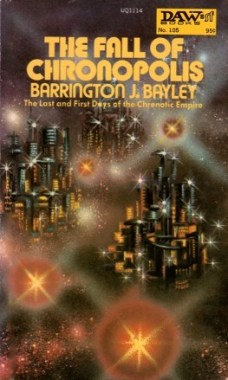
Because I’ve read it a jillion times and because you should too, I picked for this exercise a 1974 time travel novel by a guy capable of turning your brain into salt water taffy but still leave a smile on your face. Seriously, why are you not reading Barrington Bayley? Go get Knights Of The Limits if you want a sampler pack. The book we’re going to look at is The Fall Of Chronopolis.

The core idea:

There’s an empire that stretches across time instead of space

Time travel has been done to death; and it’s usually stupid and full of holes. Look, you’re probably nowhere near the Doctor Who fan I am – I adore that show in all its forms; but mostly they contradict themselves at will and skim over uncomfortable goofs. Admit that, so we can move on. Here, Bayley has an interesting twist on the galactic empire idea that’s been around since the 1930s. Already a good start. People go back to those 1930s pulps even now. They did a lot of things right; and so did he with this one.

But how to make that work?

Bayley built a theory of how time is structured to try and solve how his core idea could function, how the citizens would travel across the empire and how they’d be ruled. It’s a natural progression once you have an idea, right? Just answer the obvious questions about your idea. He tells us time is like a frothy ocean with our reality and perception of it like stable skim on the surface. Yet under special circumstances, you can go deeper into the potential realities lying below, a horrid and ghostly place where souls can be dissolved into nothingness. Nice – loads of chance for drama and action there.Giant freaking time barriers were set up at the rearward past and forward future like walls around the empire. Specially protected ‘achronal archives’ exist inside buffers which are compared to duplicate archives outside the buffers enabling them to become aware of any disruptions to the timestream…like people or cities disappearing from history. There’s your empire.

Which raises more questions…

There are obvious problems that are going to come up with all of this…you can imagine the debate that went on in his head at this point. Like a courtroom, putting his idea on trial, my guess is he knew right away he needed a way to smooth contradictions, and a way for them to have a conflict of some kind. So his theory of the ocean of time needed to expand a bit. If you can imagine standing ripples on the water, no different from you and I holding a rope at the two ends with me popping up and down quickly so my end goes up when yours goes down…that point between us where the direction switches is called a node. Bayley imagined us existing at a node in time – stable points that move forward one second per second. There are just several of these; and the empire stretches across seven of them. Since they’re all that’s stable though, wrecks in the hinterlands between nodes dissolves all souls onboard into the terrible sea of potentiality. Come on! Once you stretch out an idea like that, of course it’s going to happen in the story! It’s writing itself at this point!

…and implications…

I can also imagine in Bayley’s spitballing session on this idea just trolling over everyday things to bounce his time empire idea across them and see what comes out. Relationships, for example. He imagines a young narcissistic prince who seduces his future self into a romance at node 1. He constructed a religion around how his empire would view the sea of potential, and the special reverence attached to the sacred moment when a Physics lab assistant first discovered the principle which would enable time travel.

Add the conflict and stir…

Once the initial idea is set up, it just needs tension. I imagine Bayley still working his central idea, twisting and turning it to see what war would look inside this framework. Giggling maliciously, I’m sure, he gave us an enemy empire existing in the future beyond a long period of unpopulated nuclear wasteland, begun by dissident time travelers from the empire itself. Cool beans. Conflict was automatic with this one, wasn’t it? Suddenly, the archivists start reporting entire sprawling cities have vanished from history, which no one remembers. The automatic rule of science fiction is to keep pushing the idea – how far can this go? Bayley describes the ultimate goal of a time war as disrupting the founding of your enemy – basically, get behind them and muck it up. It’s really fascinating to read all this…just incredibly innovative.

I’ll wrap it up to leave at least a little mystery to it all. The overall point this time around is the ideas will come from mishearing something around you, from hammering differences into something you see in a movie or book or something somebody tells you, whatever. The job then is to twist it around in the light for:

  1. Your first-pass explanation of how things will work with this idea
  2. Answers to the obvious questions resulting from step 1
  3. Teasing out implications of all that on everyday things
  4. Finding conflict that leverages the idea, not something boring that didn’t need it

That’s my take on it, anyway. You can go read Bayley now.


‘Sun Of Suns’ by Karl Schroeder

sun-of-suns

What do you REALLY ask of a book, anyway? Isn’t it true that if you can just get lost in some cool world, check out of this one for a while, maybe run into some chin-scratching ideas along the way, meet some fictional folks who you care about one way or the other – love or hate or whatever, then it’s all cool? Me too. Here’s one.

So I tried a different Schroeder book a while back (‘Lady Of Mazes’) and saw enough potential to try him again, though his style was bugging me. Seemed to ramble a bit. Don’t point at me, I’m the one typing here. This one was worlds better though. I’ll prove it – see what you think. It’s called, ‘Sun Of Suns’, by Karl Schroeder, first in his, ‘Virga’ series.

Virga is a massive fullerene balloon three thousand kilometers in diameter but filled with air. There are spherical lakes and massive chunks of floating rock – all aimless. The people living in Virga form and ignite their own little fusion suns for light and heat; but that leaves huge swathes of the atmosphere left in winter where there are no towns. There isn’t a single government or even a single planetoid where these folks live either – they’re on individual floating towns made from huge wood and rope wheels, spun for centripetal gravity. You can jump from one to the other if they’re close enough. You can fly from one to the other on hover bikes. It takes a few pages to get used to what he’s painting for you; but I haven’t come across such memorable imagery for a while. Would be amazing to see maybe in anime if not live action.

The story centers on a guy named, Hayden whose tiny town was slaughtered by a larger town six years ago when they tried to set off their own sun to gain independence. Hayden’s looking for revenge, targeting the Admiral who he’s almost certain (but not entirely certain) led the attack. He of course gets in the fireworks and intrigue of something larger with everyone he’s mad at, but also with a mysterious lady who is impossibly not even from Virga at all. The Admiral’s wife is beautiful but conniving and nasty; and Hayden tags along with her for a sizeable chunk of the narrative. She’s also the subject of the second book in the series, ‘Queen Of Candesce’.

When I was a kid in summertime, I’d ride my bike down our long driveway and around the yard imagining I was on a hover bike, stopping in at a floating maintenance shop and spying for somebody preparing for the revolution or whatever. This book had every bit of that, which smoked my mind a little because how the heck could something so weird in my head show up in print now? Schroeder did an ‘Inception’ on me. That was fun to see.

One scene in the book made my Physics mini-me flinch a bit; but he redeemed himself and nailed something down that is incredibly unique and worth the price of admission on its own. I don’t think it’s a spoiler; but you may think so. If you’re worried about that, skip the next paragraph and join me at the end. I’ll wait for you there.

The key characters pay a visit to a small town that has inserted itself into a massive spherical ball of water. They used a water-repellent cone the size of a freaking town and wedged it into the sphere, carving out a place where they constructed their buildings and hide away from all the intrigue and conflict within Virga. Flinch, read it, stick with where he’s going…incredible idea, maybe could work…wouldn’t want to live there…hope they don’t fire any guns at the walls.

My point is this then: great book! I read a lot of pulp science fiction from the 1930’s and 1940’s like ‘Brigands Of The Moon’ by Ray Cummings or ‘The Metal Monster’  or ‘The Ship Of Ishtar’ by Abraham Merritt. ‘Sun Of Suns’ has that feel of fun and danger and outlandish technology. Don’t look for deep philosophical musings or ominous quests or galactic battles here, you won’t find them. Read my first paragraph again up there…if those things make it happen for you, then give this book a shot. Let me know what you think.

Why You Should Be Reading R. A. Lafferty: The Madman Of Oklahoma

lafferty-past-master

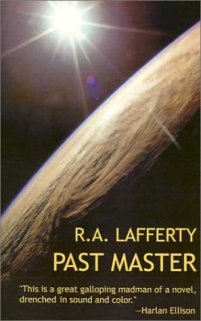
You’ve probably heard R.A. Lafferty quoted if you haven’t read him. I came across him first when Neil Gaiman said a particularly good line he’d used in his, ‘Sandman’ series was a Lafferty line. Maybe you recall it – the creepy witches called ‘The Kindly Ones’ said something like, ‘They can kill you; but we can kill you worse’. That’s actually a chapter title in Lafferty’s, ‘Fourth Mansions’. A rocking book, if you haven’t read it, about four secret societies vying to take control of the future of humanity. The reason you read it is not the plot, because you know…whatever…I can’t really say what’s going on; and I’ve read it twice. You read it because he drops these word-nuggets that sparkle. The title of the first chapter is, ‘I Think I Will Dismember The World With My Hands’. The ninth chapter is, ‘But I Eat Them Up, Federico, I Eat Them Up’. If you don’t love that kind of thing, then take a pass on the guy I guess; but you’re missing out. At least try, ‘Past Master’ because its plot is good too, there’s a great story, and there are more sparkling quotes for you.

Here are some quotes, see what you think:

  • ‘It looks like a good year for monsters’ – Fourth Mansions
  • ‘I’d like to be gentle to you with with a meat cleaver, Justin’ -The Emperor’s Shoestrings
  • ‘It is an awful and sickening thing to see a good man grow rich and respected.’ – The Underneath Man
  • ‘The first implement made by man was not a scraper or celt or stone knife, it was a crutch.’
  • ‘My magic can whip your magic; and my dog can whip your dog’ -All The Skies Are Full Of Fish
  • ‘Most of the trouble that comes to people in this world comes from reading the wrong books.’ -Try To Remember
  • ‘I have certain riddles to ask the woods and the mountain, and they do not speak when others are present’
  • ‘Which was first, you, or the belief in you?’ -Past Master

So back to what I view as his masterpiece, though everybody you talk to who digs this guy has a different view on that. For me, it’s, ‘Past Master’. A description from the interwebs:

‘Past Master is set in the year 2535 on the world of Astrobe, a utopian Earth colony that is hailed as Golden Astrobe, “mankind’s third chance”, after the decline of both the Old World and New World on Earth. Despite idealistic intentions, it is suffering moral and social decline that may be terminal for both Astrobe and the human race.

In an attempt to save their dying civilization, its leaders use time travel to fetch Sir Thomas More (chosen for his fine legal and moral sense) from shortly before his death in the year 1535 to be the president of Astrobe. More struggles with whether to approve of the Astrobian society, noting its possible connections to his own novel Utopia. His judgements soon lead him into conflict both with destructive cosmic forces on Astrobe and with its leaders who thought him a mere figurehead who could be manipulated.’

End quote. If you’ve ever read Harlan Ellison’s short story, ‘Repent, Harlequin Said The TickTock Man’, and loved it because the trickster guy in the story is thumbing his nose at the people who think they’re in charge, then this book may just work for you like it does me. Thomas More sticks it to the man, if you know what I mean. By the way, if you haven’t read Ellison’s story, what the crap, man!? Get that done, then come back. Sheesh, you’re lucky we found that out!

Lafferty, man. Go read this guy. He saved himself from alcohol through his writing; and he made the world a better place because of it. You owe him at least a look. Let me know what you think!