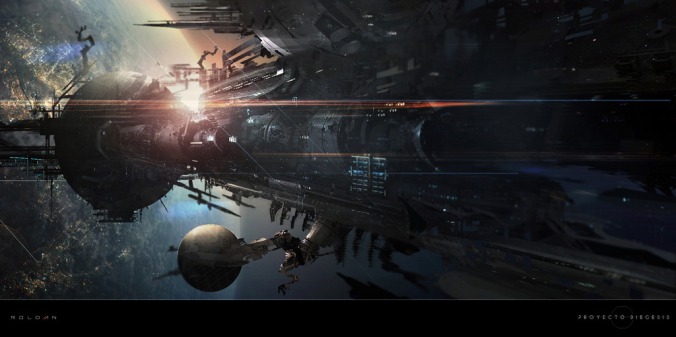
Art by Juan Pablo Rolda
Let’s talk about being stuck in paradigms and not even knowing it. The reason you should care – if you’re an aspiring writer or somebody interested in the craft of storytelling, then you probably want to break some kind of new ground. At least for me, I like to think I’m an original, coming up with cool stuff that inspires other people. When somebody tells me I wrote something that really made them think or that gave them the shivers…or best of all, that made them want to know more…that’s fireworks to me! So paradigms are cancer. Off with their head – if you know what I mean!
Here’s an example, for the science fiction nerds out there like myself. Maybe it was Star Trek that started this, not sure; but have you noticed when you’re watching basically any show or movie set on a spaceship that the doors swish open and closed automatically? That would require motion sensors and motors. The doors always look like heavy industrial steel. In fact, everything looks like industrial steel and huge! Just huge. But stop and think about it for just a second – space has precious little resources; and every bit of mass you take along with you takes up more energy to move the ship at all. Massive freaking spaceships made of heavy steel with silly, unnecessary things like automatic doors are a bit unlikely. “Hold on, genius”, you might say. “These aren’t science text books. Energy is free in my story. If I want doors to swish shut automatically, maybe I’m thinking about emergency containment!” Blah blah. Maybe – and you have to ask yourself this – maybe you’re just coasting on paradigms Gene Roddenberry set up decades ago.
Why are spaceships always gray metal? Is it because that’s most likely, or because Navy ships have been battleship gray; and that was the paradigm folks like George Lucas just carried on from the trailblazing pulp cover artists of the 1930s? When you’re at the airport, are the planes gray? You can disagree; but my guess is the economics of space travel either in our future or in whatever alternative universe you’re dreaming up, say commercial enterprises will be building ships for space travel. They won’t have to worry about obscuring visibility in ocean environments like the Navy does. I’m saying spaceships probably won’t be battleship gray with all sorts of squiggly machinery and useless lights blinking all over their hulls. Think about it. Isn’t it more likely they’ll be smaller, probably modular vessels with logos and smooth shielded hulls, light on mass and with relatively small hallways and workspaces, maybe capable of linking up into larger structures?
Gravity? Every show you’ll watch has their folks walking around and nothing floating. That means you’re assuming the ship spins or you should at least hand-wave something about ‘gravity generators’ or something. Why not just make it spin? How hard is that?
Don’t get me started on robots. The pulps set the stage for human-looking robotics; and we’re still living with that. We’ll probably get there, no doubt. But what’s the point of all that design if the job you’re giving it is to clean the floor or pilot the ship or load cargo or to repair things? Why make it look human with all the expense and complications and liabilities, to do mundane things like that? Form will follow function, right? That’s actually how the world really works when manufacturing plants have to actually spend money on R&D and machinery and raw materials and labor to make something real. Those slick little Roomba vacuum cleaners are a fantastic example of this. They look nothing like C3PO; but they can suck up dog hair like nobody’s business.
I’m going to end with my least favorite paradigm of all because your argument should build to a climax, shouldn’t it? I mean, this one really…really needs to go. If you’re guilty of it, please stop and question yourself. I purposely avoid the heck out of this one because it’s so tired and lazy and ridiculous by now. Yet it’s hard to stay away from it. I’ve veered very close and hated myself afterwards, like when you eat the whole bag of those little chocolate doughnuts. Stop. Stay away. Go back.
‘The chosen one’. Oh my God, how many times have you heard somebody say this? Look, I understand that to set up a mythology, some sort of over-arching roller coaster you want your characters to get swept up in, this is a handy little trick. Just make the main guy the chosen one; and all sorts of mysterious things can happen. Then you can show all the whiz-bang stuff they can do and didn’t know, so replicate the ‘coming of age’ motif which everybody loves so much. Me too. But isn’t it getting old? We’re pretty sophisticated in our appreciation of narrative structure and themes by now, so isn’t it time to put this one to bed? It almost never makes sense anyway, when you poke on who chose them and why.
Anyway, I should really practice what I’m preaching here. When you agree to move beyond some of these deeply entrenched themes or backdrop devices, it gets challenging. There’s maybe even an argument to be made that things like I’m talking about here are the common vocabulary now, so to change them up too much makes the reader confused or uncomfortable and distracts from what you’re really trying to say. Honestly, if we’ve thought about it that much, then we probably did our due diligence and should have the big, freaking steel doors swish open and closed if we feel like it.
All I’m saying is think about it first.
 Grailrunner Publishing