Innovations in Music and Mythmaking (and how to link them!)

I’m told my reading habits are a little out there. I get that. I do.

However, it intrigues me that in almost any field of human endeavor, there is a specific type of personality that thrives on breaking its rules and forging incandescent new ways of doing things. If you’re new here, that’s almost entirely what we do here – find, spotlight, analyze, and celebrate innovation in the creative process.

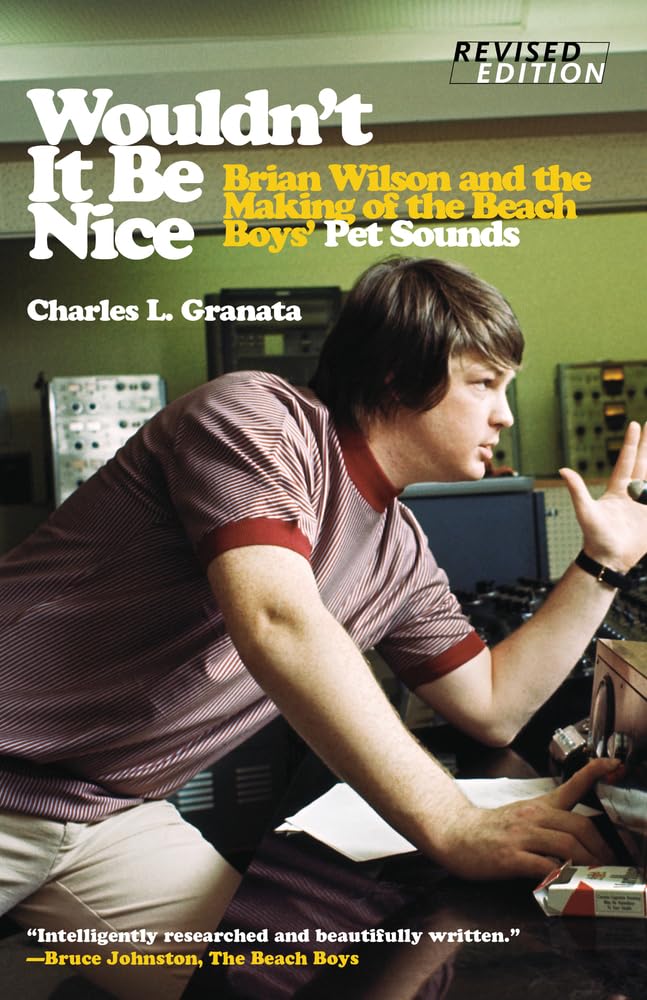
So I was reading this book about 1960’s beach music:

I don’t like that sort of music at all. I especially detest men singing falsetto and lyrics obsessing over the teenage emotional range. However, I had heard that the Beach Boys album, Pet Sounds, was considered the greatest and most influential album in music history. Knowledgeable people say that. I wanted to understand why in the world that would be, given its niche genre, its terrible album cover and name, and the fact that it isn’t chock full of top 10 hits.

What was so special? And once I knew that, I would of course ask: what inspired it?

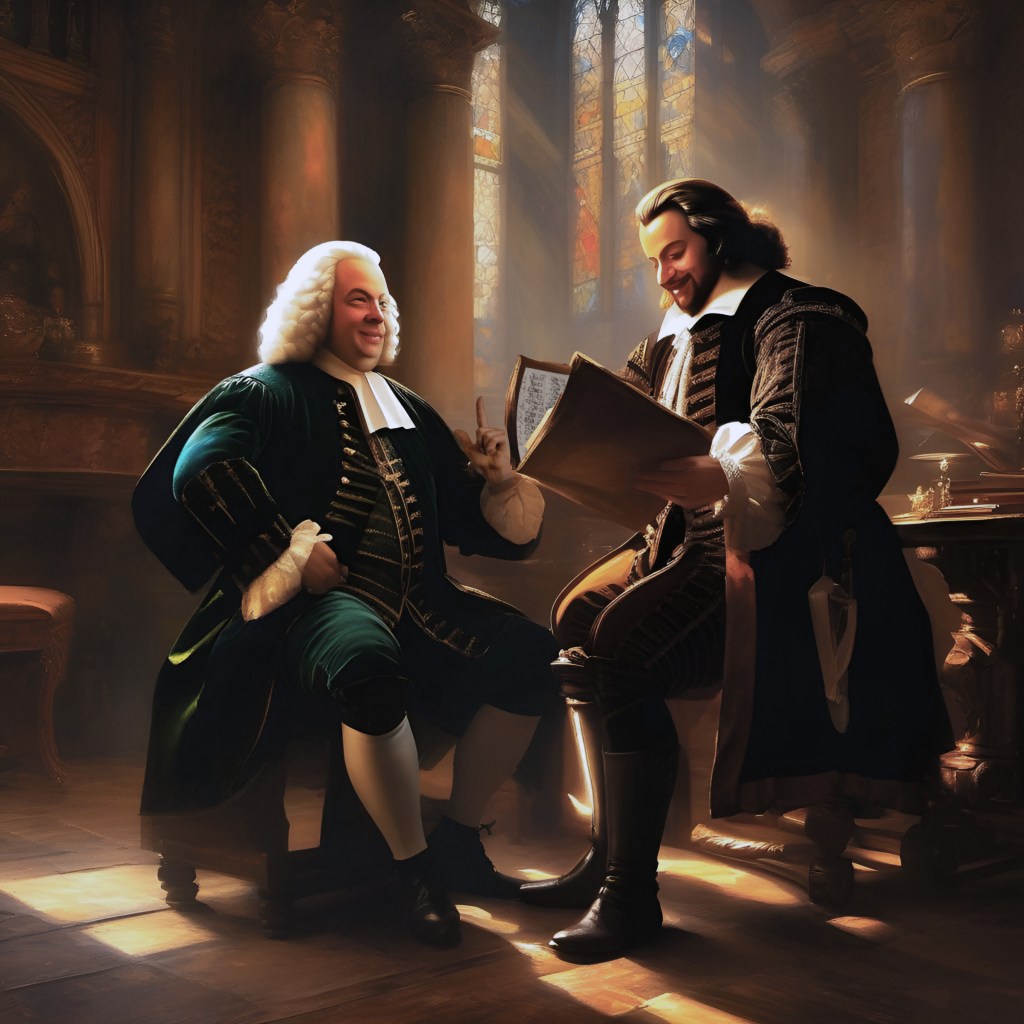
I’ll cut to the chase since the answers to those questions don’t actually comprise my point today. I want to extend some of these lessons over to mythmaking and storytelling since that’s my main jam. (If you’re into this crossover of music and storytelling, I wrote about this sort of thing in an article called “Aesthetic Puzzles: When Bach Met Shakespeare”, which you can go catch here.)

Why is Pet Sounds a big deal?

Brian Wilson was the main creative driver behind the 1960’s-era pop band, the Beach Boys, and took a break from touring in 1965 to focus on creating “the greatest rock album ever made”. Till then, their songs were bubble-gum melodies of no real sophistication and lyrics aimed like a piledriver at teenagers having fun, especially in and around the rapidly-growing fad of surfing. Wilson was enamored with the “wall of sound” production techniques of music producer, Phil Spector, which involved using echo chambers and physical studio arrangements augmenting studio manipulation of recorded tracks to generate robust, layered textures of sounds that would come across richly on a jukebox. Spector’s stated logic behind his own innovation was:

“I was looking for a sound, a sound so strong that if the material was not the greatest, the sound would carry the record.”

So it was mono (versus stereo) playback technology and the limited fidelity of speakers available at the time that prompted Spector to layer sounds together and experiment with ways of making the sounds more textured. Wilson felt the Beatles album, Rubber Soul contained some of the most mature lyrics yet for the band, and from these two launch points, he wanted to get more emotional with his lyrics and more experimental with his production techniques to surpass them all.

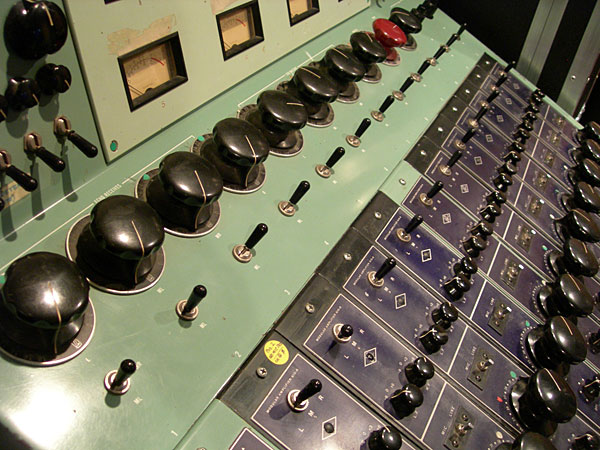
Wilson wound up innovating in all areas, and indeed developing intriguing ways of making the studio itself an instrument: combining, for example, multiple instruments simultaneously into a blended and new quality that sounded nothing like any of them. He introduced novel instruments like bicycle bells, a variation on the theremin, among others, in a rogue recording marathon of studio musicians while the actual band was out touring. Nobody had done that before, or even went off the trail of a small ensemble like that to make an album that couldn’t actually be played live. He also experimented with chord voicings, meaning how different chords are brought together (a little out of phase, for example, so there’s a slightly noticeable tremor) or avoiding a definitive key signature. By all accounts, Wilson’s efforts with the band surpassed anything Spector had done or would do. He took the inspiration and ran with it.

Studio musicians involved said of the time that they knew something very different was happening. Something important. It was interesting to me, reading what it felt like for the other guys there, the ones just hired to do a thing and realizing they were part of something.

So the idea to hold in your head then, for my point to land, is this: an approach towards recording music where all manner of frequencies and qualities of instruments and voices are layered over each other in a rich texture of sounds that you could listen to a multitude of times with headphones on and the volume turned up and still catch new things.

Texture. That’s the thing to remember. Innovating with texture.

What’s all this got to do with storytelling?

I’ve spent the last 3 years working on an approach to storytelling and tabletop roleplaying that I engineered to be as innovative as I could manage. I tried to rethink how narrative games like Dungeons & Dragons function and streamline everything down to core essentials.

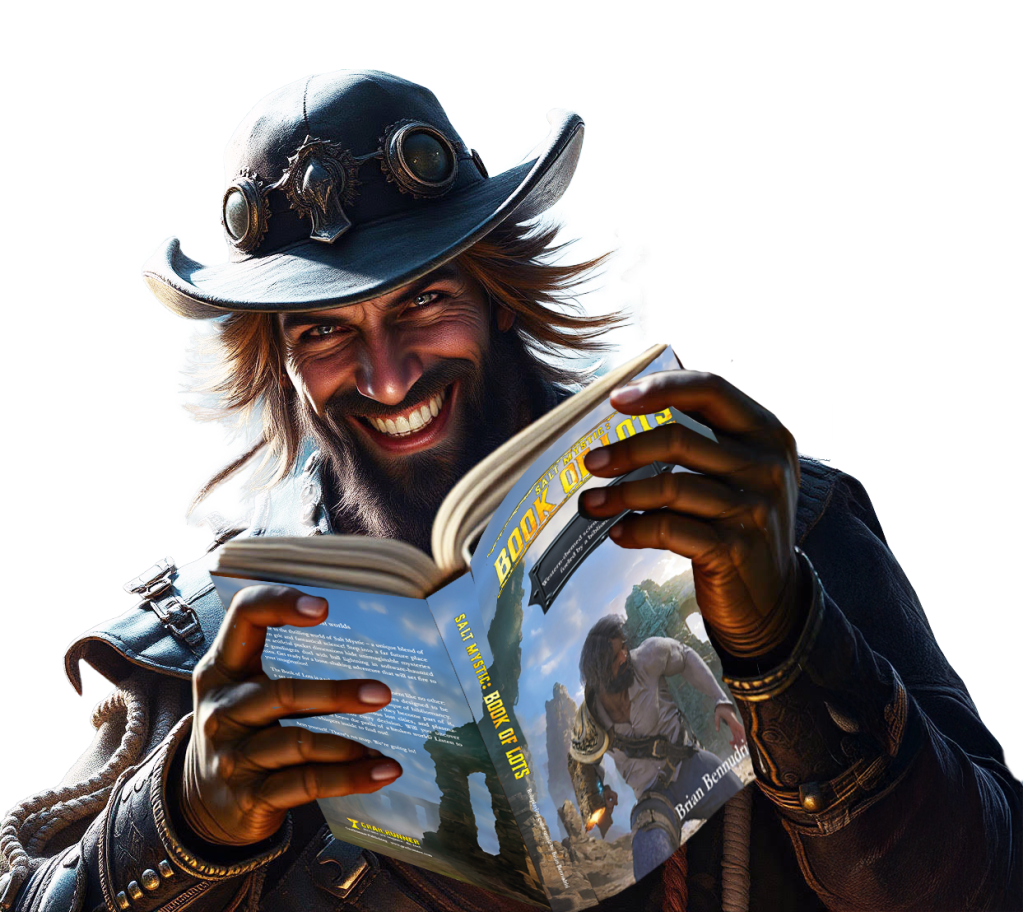
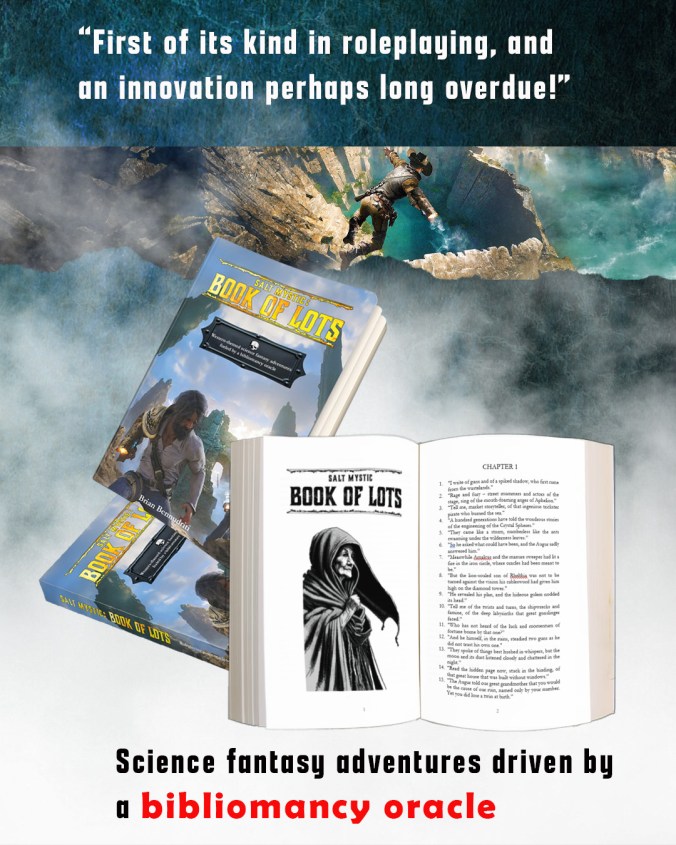
“The awe and danger of exploration inside the covers of a book.” That was my compass. It’s here, called SALT MYSTIC: BOOK OF LOTS. I’m not trying to sell you that right now, though. I want to talk about using it as a recording studio like Wilson did.

This idea now of texture and layered elements building a rich tapestry to transform a familiar art form into something different and new prodded a new question for me:

Can the elements of mythology and storytelling play the same role for the written word that musical notes, chords, and rhythms play? Instead of playing for the ear a rich tapestry like that, can archetypes and themes be arranged to play for the emotions?

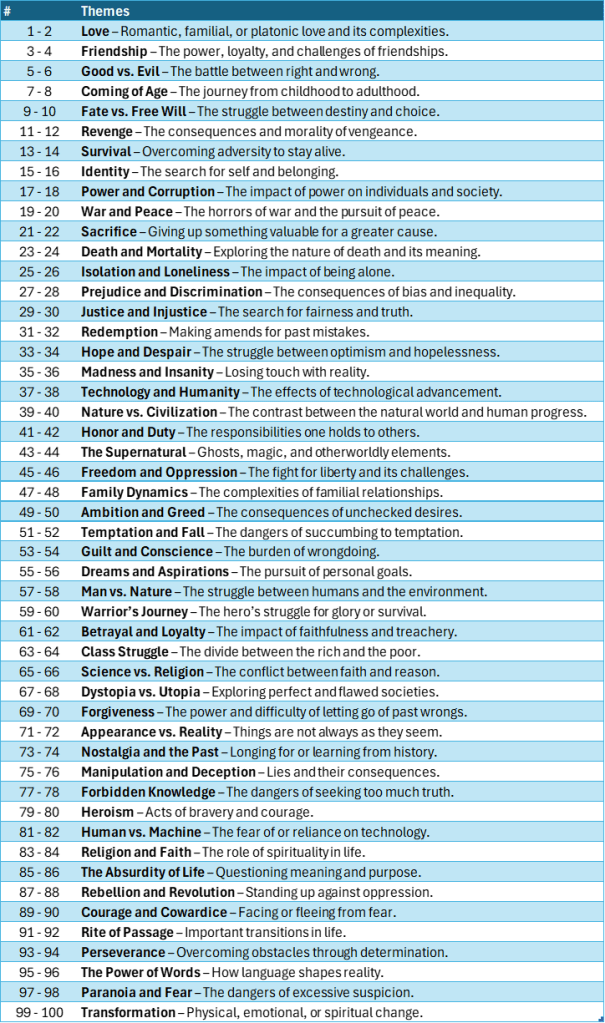
Here are the commonly accepted themes of mythology and folklore in a table, arranged into numbered entries appropriate for a roll of D100 dice:

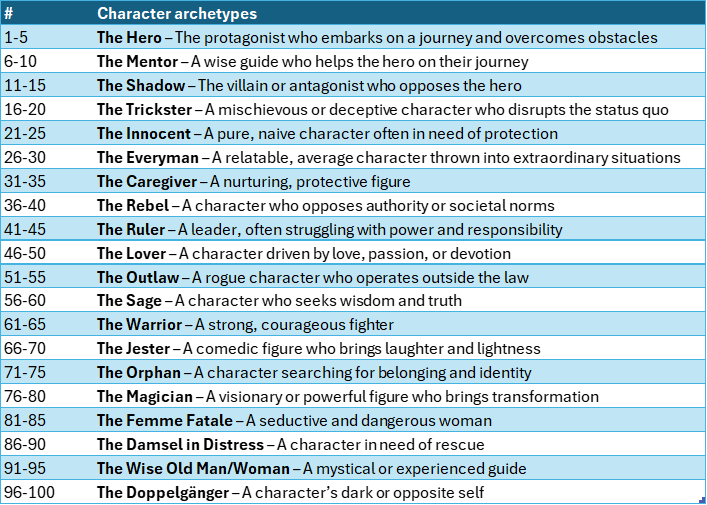
Here are the common character types of mythology, similarly arranged:

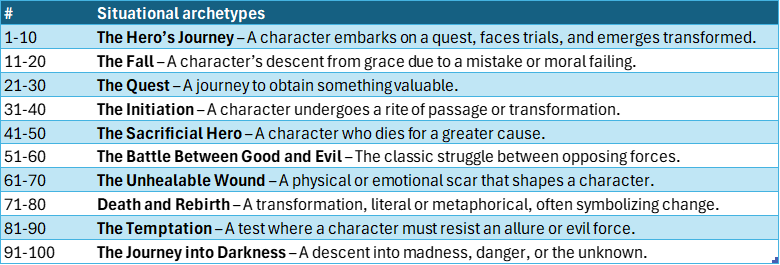
And finally, here are the common situational types of mythology:

SALT MYSTIC: BOOK OF LOTS is designed in a similar manner, with appendix tables for all manner of characters, encounters, and places arranged along the 100-scale like this, appropriate for idle shopping, dice rolls, or use of the bibliomancy mechanic core to the book’s function. The concept with the book is to forge a solo adventure and tell yourself an amazing, resonating story.

The analogy I’m drawing today is that themes and types of mythology have a power and resonance very much like the comforting, stable floor of bass in music. A deep, low melody on bass grounds a melody and makes it richer, makes it seem more important. That’s how myths work. I’m imagining incorporating elements from these tables into a solo tabletop adventure to make them play the same role…

…to summon them so they must work their magic.

I picture roleplaying game rulesets like the one in the BOOK OF LOTS as recording studios: an engine of creation that wasn’t available to previous generations that we can bend to dazzling new heights like Wilson did.

I see elements of oracle tables like those in BOOK OF LOTS or Ironsworn, Starforged, the Dungeon Dozen volumes 1 and 2, and other amazing sourcebooks as chords and notes.

And I see the solo player as a crazy artist, just messing with things to see what new comes out of it all. Telling new stories. Jamming new jams.

My head is swimming at the thought of this. I wonder if it’s too much coffee or if there’s something to be said, truly, about combinations of mythic elements arranged like music. Intriguing idea for me today, at least, to bring it to you today.

Till next time,
Outtakes: A Way Forward For Writers That Can’t Let It Go

I’ve had a couple of weeks worth of a pause in a very hectic year so far and managed to dig back in to a novel in progress. This week, I had some mind-expanding epiphanies that set the whole novel on fire for me again: the exhilaration and thrill to see this story play out on paper burning with the same heat it did when they were all just ideas.

When they were all just ideas, that is, before words went to paper to ruin my dreams.

Thought I’d share that with you in case writer’s block or a blank canvas is staring back at you, or if the plot that made so much sense suddenly crumbled like burnt toast in your hands.

Mazewater: Master of Airships is a standalone story set in the Salt Mystic universe, existing at around 38k words of a planned 70-80k. The original notion was to introduce a new war marshal with the novel, which would lead the introduction of new playing cards in the Salt Mystic wargame for his faction. “Read the book, love the guy, go buy his cards.” Right?

But it grew to be a lot more than that. A whole world more!

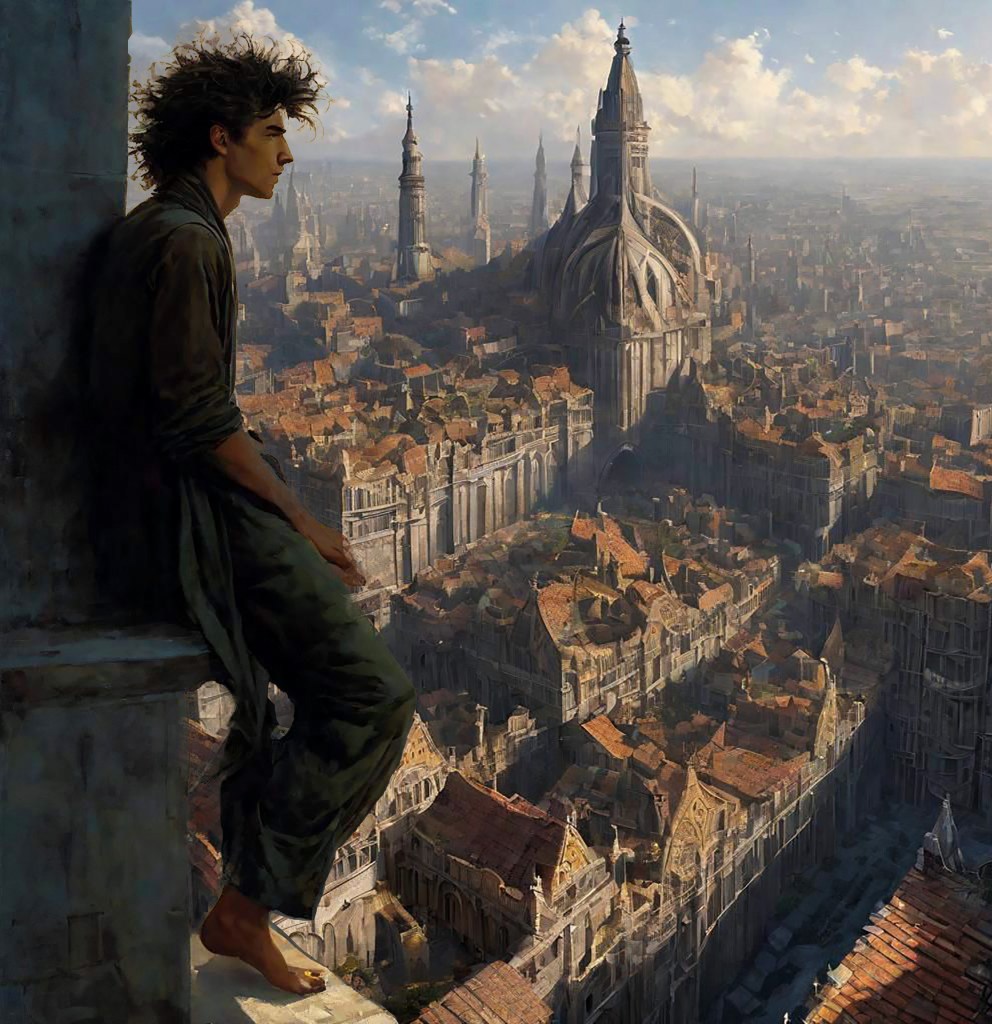
Taking place in a wild, unruly city called the Jagganatheum, it’s the story of a sickly, asthmatic young dreamer from a doomed family and the abandoned sentient weapon he steals. When a wheezing, sickly giant is unleashed at the city’s heart, it reveals intrigues that carry him into adrenalin-fueled adventures in a shattered world and, ultimately, to the heights of legend.

Here, there are lore cards to learn more if you’re interested, all relating to elements that will appear in the novel:

Anyway, I pretty much stopped writing on this back in February. Yes, I was busy with my day job, but the plot I had in mind just kind of fell apart for me. It stopped making sense. I really got the impression back in the dead of winter that all the dazzling imagery I had in mind, those flashes of plot points that made the book worth writing for me, they were just getting strung together with a discount plot that would obviously stall and get contrived in places.

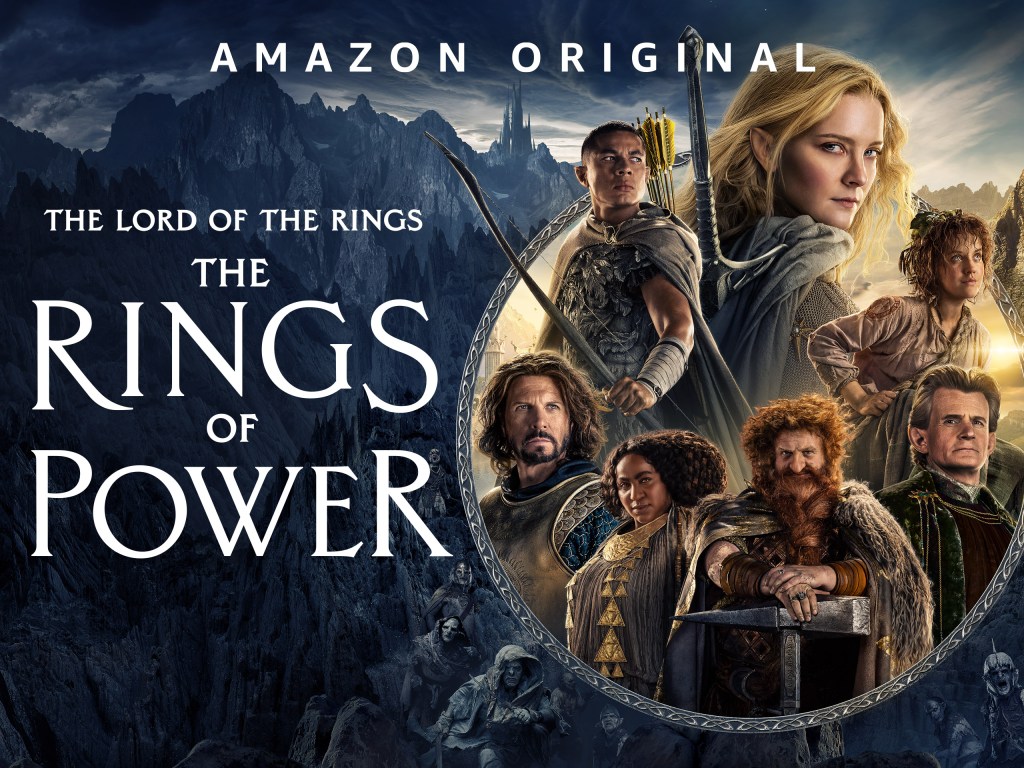
I’m the first guy to complain about poorly written soap opera nonsense like Star Wars: The Acolyte and Amazon’s Rings of Power. Juvenile and inept attempts at high school level drama frustrate me: having lead characters just go be heroes because that’s who they are, people being angry with each other just for the dialogue the writer wanted to include, or sizzle reels glued awkwardly together with coincidences or by having characters do things they just wouldn’t normally do but need to for the plot happen, for a few examples. I truly don’t want to be associated with anything that even smells like that.

No offense if you’re into either of these, but craftmanship in plotting is an aspiration of mine. These two mainstream offerings are stinkers in my opinion.

I read three things over the years that have been screaming at me recently (only one of which I can cite so I’ll paraphrase):

  1. “The only thing worth writing about is people.” – Harlan Ellison
  2. “Villains are interesting because they are often the driver of the plot – they DO things.” -unknown
  3. “Marvel’s Magneto (major villain in the X-Men comics and movies) has one of the most interesting motivations in all of comics.” -unknown, but it was a writer for Wizard Magazine

What I take from all that is:

  1. Stick to realistic motivations and interesting, fleshed-out people who all have their own agendas and desires (not just plot supporters who don’t exist when not in the chapter)
  2. Have protagonists DRIVE the plot (versus villains) by their actions, which have consequences
  3. Make the motivations of villains make sense and be understandable and relatable, almost justified

It’s these principles that set the wrecking ball to the ideas I was holding on to. I’ll give you a few examples of what I’m talking about:

1. A train trip through the wild, jumbled Jagganatheum

Right after I started writing the novel, I caught the flu – it was a nasty one with a fever that wouldn’t go away. One night I had one of the most vivid dreams I’ve ever had. I had been trying to envision what a city two thousand years old and comprised of a single enormous building strapped to a mountainside would look like from the inside (and getting nowhere).

Then the dream – I saw Mazewater’s entire day play out. I watched him get beaten up by a guy who posed as his bully so his mom would stop trying to toughen him up. I saw him in a complex series of barter exchanges and understood how the social networks functioned. I remember being in a subway-style train station with ancient broken marble statues and skylights, hissing through massive corridors like airport concourses. It was a genius picture and made the city make so much more sense for me.

I was enamored with those images for months before I came to realize the whole series of exchanges and even the trip across the city just burned the clock and didn’t move anything. They could be trimmed without cost to the plot, and that hurt tremendously to let them go.

But I had to. And I knew it. Finally.

2. Ilianore, the loose cannon brunette

Oh, I hated to let this one go! No fever dream this time, but still she showed up in my head fully formed such that I could almost hear her voice. She had jet black hair she kept in a pony tail and worked part time for a troll-looking lady chef right out of a Studio Ghibli movie. When the lead character (who had crushed on her since they were in school together) would accidentially get her fired, Ilianore would barge into his apartment in a storm of anger, light a match and drop it to the floor, and sit to demand of him what was he thinking while his carpet burned. Just to make her point.

I found myself cramming in a romantic subplot with awkward flirting, weird secrets she would bring to the story, and a terrible confrontation after you were made to like her where she would die to drive him forward.

All nonsense and didn’t fit at all. It just wasn’t the story the core ideas needed. By keeping her, it forced certain things to happen with her or risk distractions and clutter. Unfortunately, and I breaks my heart to say this, we will not meet Ilianore in this book. We’ll likely never meet her, and I miss her already.

3. An old conspiracy uncovered

I turned this one loose just this past week. Still hurts.

Again, almost fully formed, I saw Mazewater on a stylite pillar doing a vision quest, trying to commune with the sentient weapon he’d stolen for 3 days in the rain. I knew why the pillar was there and what that had to do with the founding of the city. I knew what the weapon would say when it finally spoke, and how that would unlock an old conspiracy that turned the whole story on its head. I could have told you what that had to do with the giant’s attack on the city, what was really going on, and what happened next. I mean, this part of the story was core to the whole remainder of the novel. I really….can’t stress this enough….really didn’t see even the NEED to let this go.

So I was taking a long walk in the woods this past Tuesday, pleased that I had rewritten the work done so far into a tighter, coherent narrative with dynamic characters and that, so far, this story matched what was needed. However, some things about the bigger picture still didn’t make sense for me and felt cluttered. I was really worried heading out on that walk, fearing things might crumble again as I thought them through looking for holes. My plan was to let this walk take as long as it took to iron things out.

At one point, almost audibly, I told myself nothing was sacred. Nothing at all. What would the story look like if I just stopped holding on to cool pictures or imagined moments and let the motivations and personalities decide the course? What was it, exactly, that made me want to write this thing at all?

It turned out, the old conspiracy didn’t add anything useful at all. The weapon needs to say something else entirely. Even the vision quest was just a sizzle-reel for me that I thought was interesting, to add flavor to the history of the city but was useless in the end.

Gone! All of it. I am fascinated with where this wound up though. It’s tight and hangs together like brickwork.

Anyway, what I wanted to offer you today is the wisdom of outtakes. I have entire an entire chapter of Ilianore that I’m keeping for my own files. I’ve got pages of notes about the old conspiracy and what I saw in that fever dream of the city, that will likely never see the light of day – but which I’ll keep.

I’m not going to delete or discard any of that, much like directors struggle to cut scenes from their movies to which they’d become attached. In their case, they might add them to Director’s Cut versions of the movie just to feel good about sharing them with the world. Whether scenes wind up in the world or not though, it was the cutting that made the difference. That’s what tightened the story and made it resonate enough with an audience that anyone would even want a Director’s Cut of it in the first place.

Turn them loose, then. Nothing is sacred. Move on, even if they’re gorgeous.

I had writer’s block for a reason, and it was because I was holding on to nonsense that felt like gold.

Let me know what you think about that. Till next time,
Aesthetic Puzzles: When Bach Met Shakespeare

Bach never met Shakespeare. Sorry about the clickbait title. Stick around though, because as always with this site we’re probing the creative process and what inspires it. In the past few weeks I’ve personally been going down a deep well with Johann Sebastian Bach, father of western music, and how his mind worked. I’m finding useful lessons there that I thought you might find helpful if you’re a creator yourself. Special focus here is on writing, hence the Shakespeare reference.

And you don’t have to know a thing in the world about music.

Join me?

(There are loads of Youtube videos about what makes Bach great, but two excellent books from which I’ve drawn heavily here are Bach: Music in the Castle of Heaven by John Eliot Gardiner and Why Bach? An Audiovisual Presentation by Daniel Brown.)

Bach composed music primarily for Sunday church services and often wrote the music for existing hymns or verses written by someone else. It was an aesthetic puzzle for him to solve, and sometimes a difficult one. Certain notes clash with one another and can sound harsh. We (somehow) almost universally feel kind of sad with certain notes and sequences and kind of happy with others. We (again, somehow) expect certain notes to show up after others or else it feels weird and lacking closure. For whatever reason, western ears generally agree on quite a bit about how musical notes should string together into music. Strange, but true.

Bach knew his craft well, understood these basic principles and expectations, and steered his listeners like a sailing ship by leveraging them in his works. He didn’t settle for just solving these aesthetic puzzles but broke every rule and went to places with his imagination that suited his own dazzling, soaring intellect in the process. That helped lay the foundations for western music as we know it today.

I noticed the more I read about Bach’s compositional tactics that those who were analyzing the music would very often say things along the lines of “you expect this, but he does that”. Once you get your head around these fundamental expectations I’m talking about above, it gets a bit clearer what Bach was doing, and what it can mean for a writer or creator in different fields than his.

Here’s an example: Jesu, Joy of Man’s Desiring. This (in my opinion) is one of the most beautiful pieces of music ever written. Bach fit this masterpiece on top of some stanzas written over 60 years earlier by a minister and musician named Martin Janus in 1661. It opens with Bach’s melody, followed by the first phrase of Janus’ chorale, then shortly thereafter the 2nd phrases of both works coincide flawlessly. The freedom with which he went gonzo with his own melody yet managed to fit without seams over the hymn is my point.

Bach was dancing.

Another example is particularly moving and gets to the heart of the spirituality and emotions that moved him when he was composing.

Sleepers Awake, a Voice Is Calling: An obscure 16th century pastor named Philipp Nicolai had just taken the job in the town of Unna when plague struck and killed half its people. His parsonage overlooked the cemetery. Suffering deeply, yet wishing to record his meditations to encourage the survivors, Nicolai wrote a collection he called “Mirror of Joy” which emphasized shining your own light in expectation of great things, not terrible ones. Bach built his own work on top of Nicolai’s hymn in a masterclass of weaving musical compositions.

In his piece, Bach presents his new melody entirely, then repeats the first three phrases (with 2nd and 3rd swapped) but with Nicolai’s melody in the choral part underneath. Again, separately they sound nothing alike, yet together they are flawless. At one point, Bach’s melody repeats its first phrase over Nicolai’s phrase that does not.

Did you catch that?

Bach wrote something that can repeat its melody and match perfectly in two different places on another melody. In this perfect weave, he was also weaving Nicolai’s times and his own – for Bach’s audience too was being encouraged to shine their own lights into a world that needed hope.

Last example, and another gorgeous one:

Air from the 2nd movement of Bach’s Orchestral Suite No. 3 in D Major. Click the link and listen to the incredibly talented Evangelina Mascardi (who has said she spent up to 6 months at a time learning Bach’s songs). You can stop after the first half when she pauses and moves on to ‘Gavotte’ to see my point here.

Listen closely for the melody – you’ll catch it right away. It’s really beautiful and poignant. People tend to describe this as, not sad…not happy…but something rather that reminds them of happy times, good memories, good friends. Keep listening though. You want him to repeat it. He doesn’t, not exactly. He adds all manner of embellishments and hesitations and dances around the melody he knows you want to hear again.

He gives you what you want, but embroiders it.

So what’s all this got to do with writing?

Recently, I came across a thorough article describing 49 effects possible in literature. At the time I first read it, I was just starting to examine Bach’s approach to composition and his freedom to innovate with tuning, different instruments, and other elements. I was seeing him play with his listener’s expectations, creating tension and dissonance and delaying resolution till it suited his dramatic purposes.

And I was seeing the same possibilities in this list of literary effects, such as pathos, irony, comedy, and others. Readers most certainly have common expectations and tropes, which can be similarly placed in opposition to each other. Bach mastered the elements of his craft and innovated wildly, though always staying in close view of what he knew were his listener’s expectations of resolution.

Maybe some principles apply here:

  1. Consider your characters and their dynamics. Anticipate the readers’ expectations and play with that. Don’t shortcut and focus on “subverting”, which is obnoxious and unpleasant.
  2. Innovate, but stay in view of the compelling engine driving the story…the central character dynamics. Don’t mess that up in your desire to make the plot happen.
  3. Break the attention barrier with something energetic and wild. Bach’s church audience was rude, reading papers, talking loudly, ogling women, endlessly walking in late and leaving early. He demanded their attention with his craft. We should do the same.
  4. Know the elements of your own craft. Be a professional – no obvious mistakes with grammar or plot holes, terrible dialogue or vague character motivations. It breaks the magic.
  5. Feel it. Bach felt it in his soul. He was talking to God. If we’re going to try and make something new for the world, at least we could try and feel it as we do so.

Anyway, I hoped you enjoyed a layman’s take on Bach. Impressive genius, even if you don’t really understand all the nuances of what he was doing.

Till next time,
Maps In Books And Other Things We Need

Tolkien’s Middle Earth

Boy, was I wrong!

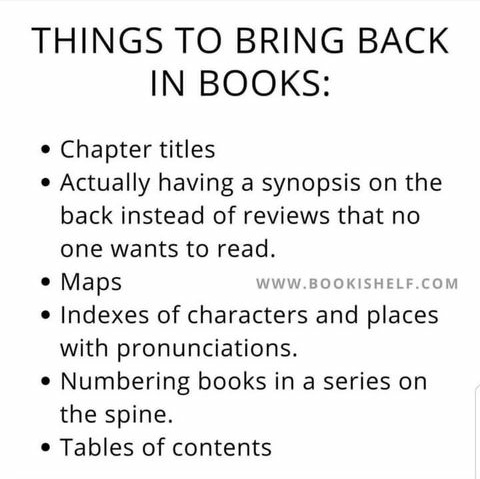
I need your opinion on something, so bear with me. I saw a post the other day that really got me thinking about supplemental materials in immersive storytelling, and now I’m happily hip-deep in Lord Of The Rings lore and can’t get enough. So I’ll want to ask you for your take, but let’s take a look at the post from The Bookish Elf:

I’ve spent a lot of time looking into what makes stories work, what great writers and myth-tellers did with their structure, their connections, how they introduce them, and immersive techniques. And I’m not sure how I missed this, or how I got the opinion that character lists at the front of a novel are for kids or Shakespeare but not for today’s ‘serious writers’. But I did.

I always had this nagging sense that as much as I hated books with too many characters that introduced them poorly, or with poor distinctiveness between them, that I still shouldn’t include character lists up front because no one does that. I’ve quoted George Lucas before with his intentional introductions of the cast in Episode 4: A New Hope because I think it’s genius:

I could not get out of my mind that poetically speaking I really wanted to have this clean line of the robots taking you to Luke, Luke taking you to Ben, Ben taking you to Han, Han taking you to Princess Leia. I wanted each character to take you to the next person.”Star Wars: The Annotated Screenplays

Outlandishly successful pulp author, Lester Dent relied on what he called ‘tags’ for character distinctiveness:

It means the character is equipped with something that the reader can readily recognize each time the actor appears on the scene. A simple example of an external tag for purposes of illustration might be the one-legged old rascal in Treasure Island. The wooden leg is the thing that is remembered…” -Lester Dent in 1940 essay, Wave Those Tags

Dent described tags as peculiarities of appearance, manner, voice, clothing, hobby, and so on. I thought about this when I read (or re-read) Dickens’ Pickwick Papers, where the gentlemen all have their own distinctive quirks. I saw it in the Dostoevsky’s Brothers Karamazkov as each brother was brought onto the stage. My point here is this sort of wordcraft of character introductions and distinctiveness was where my head’s been at forever on this point of supplemental materials.

Then I started reading Games Workshop’s Black Library and experienced The Horus Heresy (or at least seven books in the series, it’s a lot to get through!). I used those character lists constantly, flipping back and forth to see who someone was. I’m not saying their characters aren’t distinctive or introduced properly at all, just that life’s busy and there is a lot competing for my attention. If people read books straight through without interruptions, maybe I’d feel differently about the difficulty of keeping fictional paper-people separate in my head.

But I found those character lists up front to be tremendously helpful, like a guilty pleasure that I appreciated but maybe shouldn’t.

Then I stumbled across a few Lord Of The Rings nerds on Youtube who were spelling out all the connections and backstories in Tolkien’s towering intellectual achievement. Honestly, I’d always viewed those adventures the same way I might a random Dungeons & Dragons adventure – just beasties those hapless folks come across without patterns or histories and a winding, questy adventure tale. I’m into Tolkien’s, The Silmarillion now, and can now say definitively that nothing is random, that everything is connected flawlessly, and everything…absolutely everything…has a backstory.

And a map.

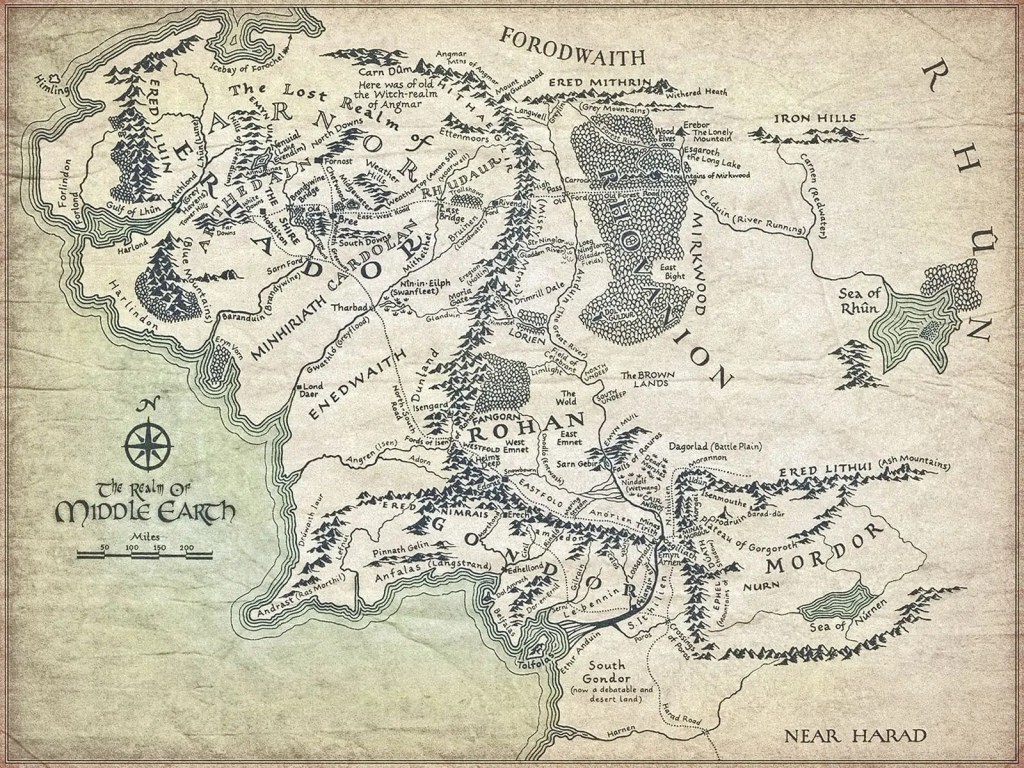
I wrote Tearing Down The Statues and the Salt Mystic Sourcebook and Core Rules without a defining map. I mean, I knew generally where these places were located, and major landmarks and visuals as I told the tales. But the definitive layout, the connections, who and what exactly were located adjacently and through what sort of lands….nada. Hadn’t seen the point of defining it that clearly. I liked the openness of it.

But the deeper I went into Tolkien and his miraculous achievements, laying the template for all worldbuilding to follow, it struck me how important all those connections are. When I sat down to stitch together all the histories and geographical references in the published tales and the game cards, in the character backstories on the art, it opened entirely new tales based on the geographies. Seriously, it feels like a Renaissance with huge new possibilities, just because I’ve defined the map itself. Amazing. That’s as a writer, I can imagine the utility for the reader even more so.

And that’s the question for you for today – what say you on the inclusion of maps, character lists, maybe even pronunciation guides for character or place names in books you’re reading?

I’m generally curious, and it would help set my direction. Just reply here or on the Facebook Page. You can email me directly if you like, as some of you do (brian at grailrunner.com).

Let me know what you think. Till next time…

Smashing Paradigms Like Halloween Pumpkins!

Juan_Pablo_Roldan_03

Art by Juan Pablo Rolda

Let’s talk about being stuck in paradigms and not even knowing it. The reason you should care – if you’re an aspiring writer or somebody interested in the craft of storytelling, then you probably want to break some kind of new ground. At least for me, I like to think I’m an original, coming up with cool stuff that inspires other people. When somebody tells me I wrote something that really made them think or that gave them the shivers…or best of all, that made them want to know more…that’s fireworks to me! So paradigms are cancer. Off with their head – if you know what I mean!

Here’s an example, for the science fiction nerds out there like myself. Maybe it was Star Trek that started this, not sure; but have you noticed when you’re watching basically any show or movie set on a spaceship that the doors swish open and closed automatically? That would require motion sensors and motors. The doors always look like heavy industrial steel. In fact, everything looks like industrial steel and huge! Just huge. But stop and think about it for just a second – space has precious little resources; and every bit of mass you take along with you takes up more energy to move the ship at all. Massive freaking spaceships made of heavy steel with silly, unnecessary things like automatic doors are a bit unlikely. “Hold on, genius”, you might say. “These aren’t science text books. Energy is free in my story. If I want doors to swish shut automatically, maybe I’m thinking about emergency containment!” Blah blah. Maybe – and you have to ask yourself this – maybe you’re just coasting on paradigms Gene Roddenberry set up decades ago.

Why are spaceships always gray metal? Is it because that’s most likely, or because Navy ships have been battleship gray; and that was the paradigm folks like George Lucas just carried on from the trailblazing pulp cover artists of the 1930s? When you’re at the airport, are the planes gray? You can disagree; but my guess is the economics of space travel either in our future or in whatever alternative universe you’re dreaming up, say commercial enterprises will be building ships for space travel. They won’t have to worry about obscuring visibility in ocean environments like the Navy does. I’m saying spaceships probably won’t be battleship gray with all sorts of squiggly machinery and useless lights blinking all over their hulls. Think about it. Isn’t it more likely they’ll be smaller, probably modular vessels with logos and smooth shielded hulls, light on mass and with relatively small hallways and workspaces, maybe capable of linking up into larger structures?

Gravity? Every show you’ll watch has their folks walking around and nothing floating. That means you’re assuming the ship spins or you should at least hand-wave something about ‘gravity generators’ or something. Why not just make it spin? How hard is that?

Don’t get me started on robots. The pulps set the stage for human-looking robotics; and we’re still living with that. We’ll probably get there, no doubt. But what’s the point of all that design if the job you’re giving it is to clean the floor or pilot the ship or load cargo or to repair things? Why make it look human with all the expense and complications and liabilities, to do mundane things like that? Form will follow function, right? That’s actually how the world really works when manufacturing plants have to actually spend money on R&D and machinery and raw materials and labor to make something real. Those slick little Roomba vacuum cleaners are a fantastic example of this. They look nothing like C3PO; but they can suck up dog hair like nobody’s business.

I’m going to end with my least favorite paradigm of all because your argument should build to a climax, shouldn’t it? I mean, this one really…really needs to go. If you’re guilty of it, please stop and question yourself. I purposely avoid the heck out of this one because it’s so tired and lazy and ridiculous by now. Yet it’s hard to stay away from it. I’ve veered very close and hated myself afterwards, like when you eat the whole bag of those little chocolate doughnuts. Stop. Stay away. Go back.

‘The chosen one’. Oh my God, how many times have you heard somebody say this? Look, I understand that to set up a mythology, some sort of over-arching roller coaster you want your characters to get swept up in, this is a handy little trick. Just make the main guy the chosen one; and all sorts of mysterious things can happen. Then you can show all the whiz-bang stuff they can do and didn’t know, so replicate the ‘coming of age’ motif which everybody loves so much. Me too. But isn’t it getting old? We’re pretty sophisticated in our appreciation of narrative structure and themes by now, so isn’t it time to put this one to bed? It almost never makes sense anyway, when you poke on who chose them and why.

Anyway, I should really practice what I’m preaching here. When you agree to move beyond some of these deeply entrenched themes or backdrop devices, it gets challenging. There’s maybe even an argument to be made that things like I’m talking about here are the common vocabulary now, so to change them up too much makes the reader confused or uncomfortable and distracts from what you’re really trying to say. Honestly, if we’ve thought about it that much, then we probably did our due diligence and should have the big, freaking steel doors swish open and closed if we feel like it.

All I’m saying is think about it first.

Kill The Dream Sequence. No, Seriously. Kill It.

dead of summer

If you haven’t watched Dead Of Summer yet, I don’t really care either way. It’s meh, mostly. Yet I was in a binge this weekend to get caught up and noticed something that was particularly relevant for me right now. I’m writing a horror novel – about 40k words in to a targeted 90k, and so I’m particularly concerned with how to get someone on the edge of their butt, chomping their tongue in anticipation and as nervous as I can make them. While this show is fun, it’s not scary in even the smallest sense, though I think it tries to be. Maybe we should have a look at why it fails to see how I can succeed. It’s what I thought, at least.

Go read reviews from the second Avengers movie. One thing you’ll find is a lot of people annoyed with the weird dream sequences. Should you peruse what the masses had to say overall about Batman Versus Superman, you’ll find similar irritation with dream sequences. Let’s not get into whether you dug those movies, okay? I get how divisive that is right now – it’s been Marvel Versus DC since the seventies, nothing to see here. The point I’m making is about the overuse of this narrative technique and how it practically forces an audience to disengage. In movies, it’s probably an excuse to just show some cool visuals. In execution though, it’s a signal to me I’m good to go get a refill on my Coke Icee. Know what I mean?

Anyway, back to Dead Of Summer. Here’s the marketing blurb:

“Set in 1989, school is out for the summer, and a sun-drenched season of firsts beckons the counselors at Camp Stillwater, a seemingly idyllic Midwestern summer camp, including first loves, first kisses—and first kills. Stillwater’s dark, ancient mythology awakens, and what was supposed to be a summer of fun soon turns into one of unforgettable scares and evil at every turn.”

If you read that, you agree they want to be scary, right? Their narrative structure follows the same style as Lost, involving individual character flashbacks to flesh out each main player. Honestly, that part works for me, though the flashbacks they showed had little to do with decisions characters were making in the storyline. It came off cheaper than it did in Lost for that reason. However – and this is my overall point here – about a gajillion times, we are shown visions of a dark, mysterious man from the 19th century who’s supposedly tied in with the mysterious goings-on at the camp. I mean over and over and over, we see this guy and some blood streaming off something, or eclipses or bugs or murders or whatever…and EVERY SINGLE TIME you know it’s going to be a vision with no consequences. You can’t possibly get scared because even though somebody gets pushed into a grave or dunked underwater or whatever – I can’t even remember because I checked out during so many of those – that they’re just going to wake up and be okay. It’s foreboding but not much more.

Let’s set aside movies like Inception, which broke ground with this concept and the Freddy Krueger films (the good ones, let’s not discuss the Dream Warriors, shall we?) which staked their premises on the dream sequence. The difference with stories like those is they established consequences – you could die in those dreams. How boring would The Matrix have been if you couldn’t die while inside?

I run into this problem of consequences a lot, actually. If you’re a science fiction guy, you might think a lot about the vast distances in space and how slow moving any real-life story would be…months to get anywhere and hours to talk to each other. You might go the road of setting up avatars or virtual reality-style storylines to account for that; but honestly, you’re still looking at ridiculous lag times for the signals. If you hand-wave all of that and just say ‘tachyons’ or ‘entanglement’ to get the science-snobs off your back, you’ll be looking at this problem of consequences just like I am. If your guy is actually laying in a booth in Utah or wherever directing the action, how are there any stakes for him?

Right. So there have to be consequences and some kind of danger that’s entirely relatable. If you watch Game Of Thrones or The Walking Dead enough, you start to think at any moment this freaking show is going to kill off one of your favorite characters. Mercilessly. Back in the nineties, Joe Quesada who was then Editor-In-Chief at Marvel Comics (pre-Disney) established a “dead is dead” rule for killing off characters to restore some kind of drama given the prevalence of resurrections. Fantastic concept, actually, though he drifted wide off the mark over his tenure.

That’s what I wanted to say, guys. Dream sequences and visions are tired and boring and are basically tickets for your audience to disconnect. Don’t do that. Avoid resurrections too, while you’re at it. Kill a major character early on just for giggles, to challenge yourself, and to set the bar for your reader that YOU AREN’T PLAYING AROUND…THIS IS SERIOUS!.

Have fun!


Less Whining. More Inspiring.

rendezvous-with-rama

I miss Arthur C. Clarke. When I was a kid, I wrote him a letter in pencil on notebook paper, asking him to explain to me what a ‘tesseract’ was, since I’d seen it in A Wrinkle In Time and was lost on what was going on. When my dad found out my desired pen pal lived in Sri Lanka, he told me he’d “look into it”, which of course meant exactly what you think it meant. So my letter went nowhere. Anyway, the reason I loved the guy so much is that his books inspired me. It got me thinking recently when I was trying to recreate that feeling with another book what it was he did right that Larry Niven did so wrong. Basically, what makes a book inspiring?

Rendezvous With Rama is an Arthur Clarke book, and an absolute classic. I won’t go into it because it isn’t the real point here; but the idea is a mysterious spacecraft comes flying in, gets boarded by some intrepid folks, and unfolds in the warmth of our sun internally as the most well-designed engineering marvel you could imagine. A sense of wonder infuses that book that feels like a crackling fire to me. I was thinking about it recently and looked into the sequels. An overwhelming tidal wave of reviews indicate I’d better avoid them  for various reasons. I found it interesting reading through the reviews that so many people appreciated the original for the same reasons I did. It made them either dream of joining those explorers on the spacecraft or of writing something as interesting as Sir Clarke had. Get that part – people like me are inspired by this book because of how it launches our imagination into ways we could engage with its ideas.

In my day job, I study and manipulate what engages people; and the overriding principle is always self-interest. We probably won’t stop to look over the charts on the wall the boss keeps posting unless there are pictures there of my friends up there or something showing me how close I might be to getting a bonus…that sort of thing. Self-interest. With our fiction, we want to relate to the characters in some way:

-For a horror novel or a thriller, you’re probably second-guessing every decision the characters make to decide what you’d do

-For a science fiction book like this one, you’re probably dreaming about how cool it would be to be doing those things

So I had a copy of Larry Niven’s Ringworld for some reason, and took it on a plane to try and recreate that sense of wonder and awe from Clarke’s book. Should have been a slam dunk: a massive ring-shaped partial dyson sphere constructed around an alien world gets explored in all its wonder. How can you screw that up? I’m sorry if you love this book, let’s keep in mind that fiction is subjective; but it’s just awful.

I groaned every time he used ‘tanj’ as fake profanity. There’s no way to tell which character is speaking without labels because everyone from furry warrior-aliens to 200yr old earthlings to multi-headed pacifist-aliens all speak exactly like Larry Niven does…like an old white physicist. They stand around philosophizing about the math behind how dense something must be or how the orbit would be affected…blah blah blah. Oh my God. I put it down multiple times, slugging to finish hoping something would redeem it. No idea how it ended because I just yielded. Whatever. It’s an award winner and always makes the big lists though. Somehow I’m missing it.

So here’s the point: if we’re writing something we really want to make inspiring….something for the ages that will stoke people’s imaginations or really change the way they look at the world (and what wordslinger doesn’t want that?!), then keep things simple and avoid whatever will distract from the feeling you’re trying to engender. In Niven’s case, he spent way too much time trying to make his cardboard lame characters interesting and introducing some ridiculous side-story about breeding luck, when the sales pitch for the book is an incredible sense of wonder and exploration of the Ringworld.

In whatever you’re writing now, or what you expect to write next, think about the feeling you want left behind when the reader is done…boil away everything that doesn’t produce that…and focus.

Einstein And Writer’s Block

einstein1_7

Yes, I’m definitely a nerd. It’s cool, I’m comfortable with that. What it means is I get interested in loads of things where most people might not see the attraction. Equally true,  if you ask me how the Royals are going to do this year, you’re probably going to get a change of subject from me. I’ll be polite; but I have no idea what to say to you when you ask me that. So I was studying Einstein’s Field Equations the other day…

I’m not trying to impress you here, just bear with me. There’s something about Einstein’s life that is of tremendous interest to an aspiring writer, especially one that’s seen the horror of a blank page blinking back and weedy plot points all twisted and ensnared, sudden contradictions that make the original idea nonsense…maybe even the whole premise that felt so much like warm, gooey chocolate sloshing around in your imagination in the beginning, suddenly frozen and hammered by an idle comment somebody made that trashes it entirely.

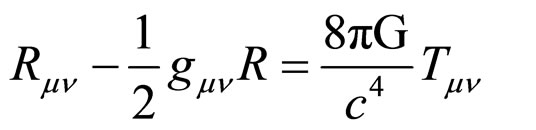
fieldHere they are: Einstein’s Field Equations defining gravity. Why things fall down.  All the jibber jabber on the left-hand side is just saying that spacetime curves. It doesn’t say why, just that it does. Einstein came up with all that on the left just to make the math work out, not because he was a prophet or anything. But he started with the doohickey on the right…the ‘T’. He knew he’d use that, and the idea that energy is conserved; and then he just started diddling around to see what he could do with it. Let’s say that was his original inspiration, the way a writer might suddenly string two things together to make a story idea. How pregnant with potential and thrilling, right! So what’s ‘T’, then?
Everything on the right-hand side except for the ‘T’ is just a bunch of numbers. If I gave you a calculator and a reference, you’d tell me the number. So forget those. Focus on the ‘T’. The Stress-Energy Tensor. It’s a thing. It was already a thing before he got started, that’s why he knew he’d use it. It describes energy and momentum. The big ah-hah for him, the thing that made General Relativity something you’ve heard of, is that it’s the energy and momentum, the ‘T’, that’s causing spacetime to curve. Great; but here’s what he said about it:

“But it (General Relativity) is similar to a building, one wing of which is made of fine marble but the other wing of which is built of low grade wood. The phenomenological representation of matter is, in fact, only a crude substitute for a representation which would do justice to all known properties of matter.” -from Physics And Reality.

He was bummed about ‘T’. It was crap to him. It didn’t explain any of the other whizz-bang stuff matter does. The guy that shook the world in 1905, starting entire branches of science from his work, and that explained why things fall down in 1916…the guy whose name became a nickname for geniuses, spent 40 years till his death trying to come up with a Grand Unified Theory that would settle this for him. No dice with that. He died frustrated. Sheesh.

I’m writing a horror novel right now; and one thing I struggle with is making the big baddies really scary without making the point of view characters useless. I can’t stand people in fiction that just stare like deer in the headlights and who don’t try something. Anything! The original idea I had for the book though, the thing that made me shiver and consider it worth a year of my life, brought that helplessness with the original spooky image. Okay, great; but if I’m not going to be like Einstein and just stay stuck with the original paradigm, then I’ve got to be willing to grow beyond the original idea. The point is, I can see I’m going to have to capture that first image and the feelings that went with it, but then let things grow to wherever they need to grow. Even if it’s not where I’d thought the narrative was headed.

In my first novel, I had a fantastic image I wanted in there so badly! I could hear Snow Patrol’s Chasing Cars as background music. I could see the camera pulling back from the scene. I could see my three main characters, young and scared out of their minds high on a rooftop spire looking down on the horrors they’d come through…freaking beautiful. I lost months trying to figure out how to get those guys into that circumstance. Finally gave up. Wasn’t going to happen. It stopped making sense for it to happen. That’s my point with all this, actually. To recognize when you’re there.

So if it happened to Einstein, it can happen to you, right? Recognize when your idea needs tweaking, and when it needs to be blown up. Be willing to turns things loose. Burn things down when you have to, so something else can grow in its place.


What A 19th Century Crazy Guy Taught Me About Writing Spooky Stuff

1984-movie-bb_a1

I want to talk about Guy De Maupassant; but I’ll come back to that in a minute. Stick with me here.

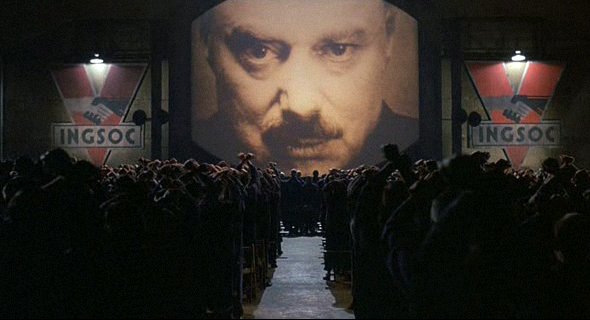
When someone asks me the scariest thing I’ve ever read, they usually expect me to say something from Stephen King. If they’re literary, they may want to hear Henry James. Whatever. Truthfully, 1984 by George Orwell scares the crap out of me more than anything; and I’m not sure how you could top it.

Especially during an American presidential election season, anybody can relate to that desolate feeling of trying to talk to someone so caught up in their beliefs and convictions that the eyes have glazed over, they’re not listening at all, and confirmation bias squeezes out any facts running contrary to what they want to believe. It’s horrifying how mobs of people can get caught up in the momentum of anything, and how quickly and viciously they’ll turn on dissenters. We should all just take a breath, right? When I read 1984, I think of how likely a world it describes, how people have behaved much like that. I can see how easily we’d slip into such a knot, and how impossible it would be to break from it once you’re inside. Shivers, man. Just shivers. That guy worked magic. It’s why we still quote that book so often.

You may have or heard the short story by Guy De Maupassant called The Necklace where a really poor lady borrows an expensive necklace and loses it, works her butt off and ruins her life trying to pay for a replacement, only to find after years and destroyed health that it was an imitation anyway. Not sure why that story hit the mainstream and gets taught in schools so much when the same author put out so much skull-slamming treasure! He went nuts, probably because of syphilis but kept writing while dipping into his madness.

“Every other time I come home, I see my double. I open my door, and I see him sitting in my armchair.”

Guy said that to his friend, Paul Bourget. It wasn’t fiction, though this exact thing happens in a story of his called He? Guy wound up slitting his own throat unsuccessfully and lived in an asylum for another 19 months. Here’s something he tossed out in a letter to his friend, Dr. Henry Cazalis:

“A saline fermentation has taken place in my brain, and every night my brain runs out through my nose and mouth in a sticky paste. This is imminent death and I am mad…”

Sheesh. Anyway, I consider one of his very short stories one of the most perfect scary pieces of fiction I’ve ever read. In the same manner as why 1984 spooks me so much, it is realistic and possible and shoots jolts of terror in ways you don’t normally see with no real strain on your suspension of disbelief. It could happen to you. That’s the basis of real horror, isn’t it? The story is called “Two Friends“. To read it yourself shouldn’t take more than fifteen minutes. Go ahead, I’m about to spoil it for you.

When my kids were very young, there was one particular July 4th night we were all sleeping; and I was awaken by a very loud CLAP sound downstairs. It sounded like two pieces of ceramic tile smacking together. Thinking something had fallen, but suspicious maybe of a break-in, I went groggily downstairs with my wife hovering at the top of the stairway with the ‘9’ and the ‘1’ already dialed, touching the ‘1’ again just in case she needed it.

I saw a massive spider-web in the dim light on the far wall, too massive to believe. It wasn’t there when we went to bed, right? Anyway, I was deep into the living room downstairs and exposed, gently extending a finger when I realized it wasn’t a web at all…it was the drywall cracking from a bullet hole. Someone outside had fired a gun into my home. Wasn’t that kind of neighborhood. This was the suburbs, for pete’s sake! Lawless teenage vandals, devil worshippers, whatever…I had to bolt for cover just not knowing who or what or where. The silence was maddening thereafter, with the thought of how a slightly different angle of the barrel, and I’d have awaken to a paralyzed or bleeding son or daughter!

The scariest things I’ve read fall into the same kind of chill:

  1. Mundane, maybe even pleasant events jarringly turn a different and terrible direction
  2. I can relate and sympathize with the character thrown into this surprise
  3. None of the decisions the character makes seem out of line with what I’d have done (nothing breaks my fright faster than an author breaking this rule)
  4. There’s a sudden realization that there isn’t a way out

In Two Friends, Maupassant presents two pleasant country guys who just love fishing. Even though there’s a war on in the countryside, they work through a military friend to get out of the village and to the shore of their favorite lake. Prussian troops show up, present the option of revealing the password back into the village or die, then shoot them dead where they stood when they won’t do it.

“The water spurted up, bubbled, swirled round, then grew calm again, with little waves rippling across to break against the bank. There was just a small amount of blood discoloring the surface.”

Guy broke the rules of literature, man! He killed off the point of view characters and shifted focus to people that had just been introduced. There’s a silly joke by the Prussian commander at the end about fish. It’s creepy and cold and absolutely believable. Honestly, the part of the story where the Prussians show up makes me feel exactly like I did tracing my finger on cracked drywall. That was a drunk neighbor barbecuing, by the way.

Anyway, go read more of Maupassant. The scary stories. They’re public domain and awesome. Let me know what you think!

Let The Trolls Speak: Principles Of 21st Century Storytelling

tweet-banner-trolls

Every previous generation in human history, it’s been more difficult to move around and certainly more difficult to be exposed to the different stories people tell around the world than it is right now. In fact, you can go back less than a century and see a world where people largely stay where they were born. A guy’s library and his best storytellers were the primary means of being exposed to new stories. There’s been a sea change caused by the internet, electronics, and our own leisure time & mobility. So here you are…knowing stuff. Good for you. Now what does that mean?

I went into my thinking corner about that very question; and I baked up something for you that I believe you’ll like. It’s free – go read it. I also kept it short. Printed, it’d be less than 30 pages. Shouldn’t take you long at all. I stirred in some stories you’ve heard of, and one or two maybe you haven’t.

Would be great to hear from you on what you think. Let me know!