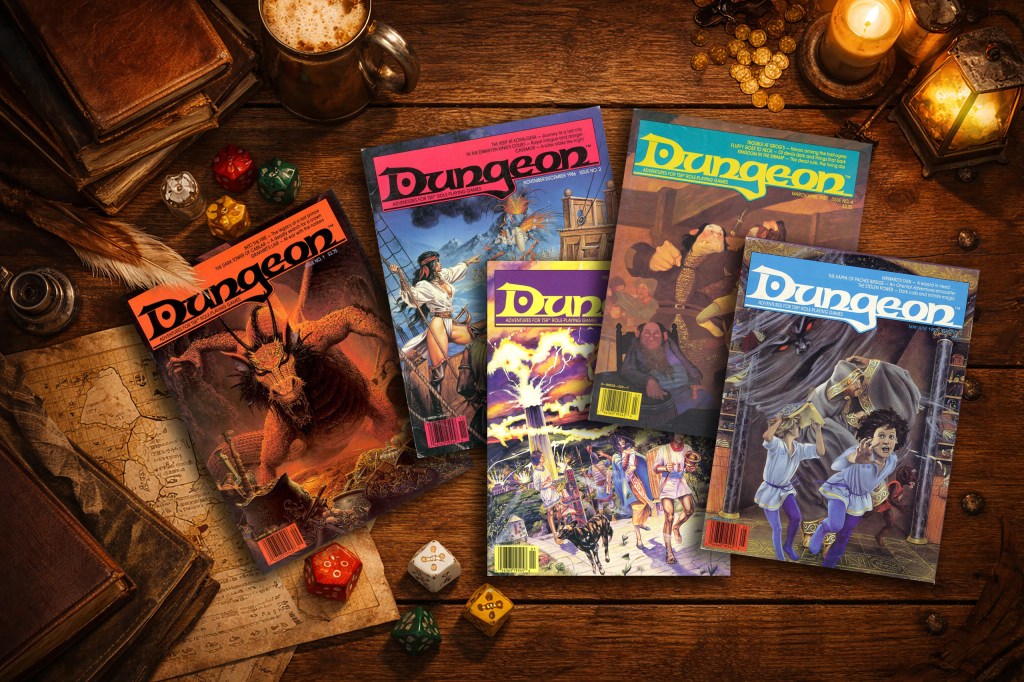
Classic D&D Adventures Revisited: Dungeon Magazine Experimental Podcast

Here at Grailrunner, we chase imagination as craft. Anything we can bring you that lights the fire of your creativity is fair game – with a special bend towards speculative fiction and fantasy. If you’ve got a willingness to tinker, you should find something here you can use, remix, or otherwise refine for whatever literary, roleplaying, or artistic wonders you’re cooking!

Today’s freebie is a really interesting one for the tabletop crowd—especially anyone who gets that nostalgic, electric feeling when you crack open old-school adventure content and your brain instantly starts building rooms, traps, villains, and bad decisions.

What’s the idea?

We wanted to turn classic modules from old Dungeon Magazine issues into a listen-able conversation

So, we generated a podcast-style episode using Google’s NotebookLM “Audio Overview” feature—one of those “wait…this is actually useful” tools that can transform your source material into an audio discussion format.

And the source material we fed it is a proper slice of RPG history (which you can download for free thanks to the folks at the Internet Archive – links below):

That’s the on-ramp period—Dungeon Magazine still finding its voice, still doing that early TSR-era thing where the tone can swing from earnest peril to delightfully oddball in the space of a page. It’s an incredible “creative compost pile” for modern GMs: hooks, maps, structures, pacing tricks, and that evergreen lesson that adventures are engines.

What is this (and what is it not)?

This is not a replacement for reading the magazines. It’s not “here are the adventures word-for-word.” Think of it as:

  • a guided audio tour of themes, adventure structures, and GM sparks
  • a way to re-encounter old material when you’re driving, cleaning, sketching, or prepping
  • a fast way to ask: What’s in here that I can steal, remix, and make new?

We like AI tools as levers—ways to turn raw source inspiration into momentum, while still being upfront that AI was used.

Why Dungeon #1–#5?

Because they’re early enough to feel like a time capsule, but polished enough to still be usable at the table. The first five issues show the magazine’s core promise: a buffet of adventures with different moods and play styles—exactly the kind of variety that keeps a campaign from turning into one long corridor.

Also, if you’re the kind of creator who likes grabbing one great detail—an encounter concept, a villain posture, a dungeon rhythm—and letting it domino into a whole scenario, these issues are loaded with that stuff.
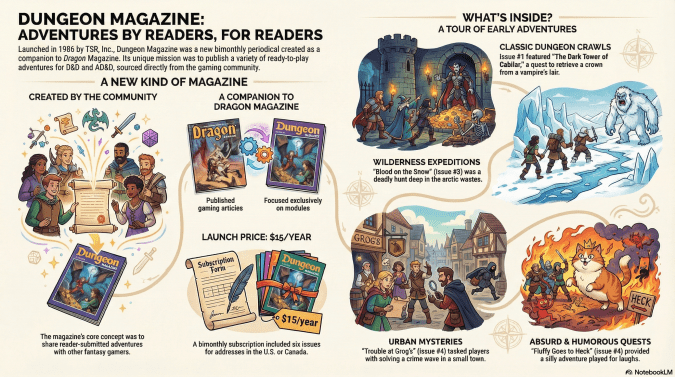
Why NotebookLM for this?

NotebookLM’s Audio Overview is basically a “make my sources talk back to me” button. Google describes it as turning documents and other materials into an “engaging discussion.” blog.google

And that’s the magic. The format doesn’t feel like a lecture. It feels like you’ve got two curious nerds in the room pulling interesting threads out of the stack. For RPG prep, that’s gold—because prep is often just asking better questions about material you already have.

What’s the Grailrunner angle?

If you’ve read our recent posts, you know the theme: build year by year, make interesting things, share freebies, keep the creative engine running.

This podcast episode is exactly that energy—another little proof-of-concept that says:

What if “reading old RPG material” became listening to it think out loud—and that sparked your next session?

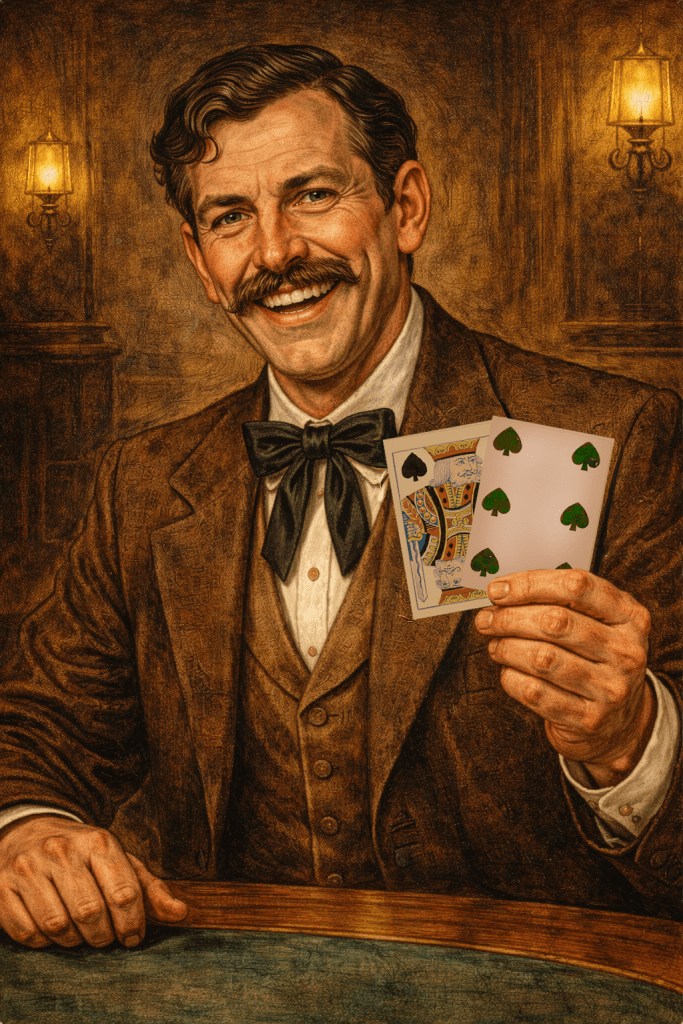
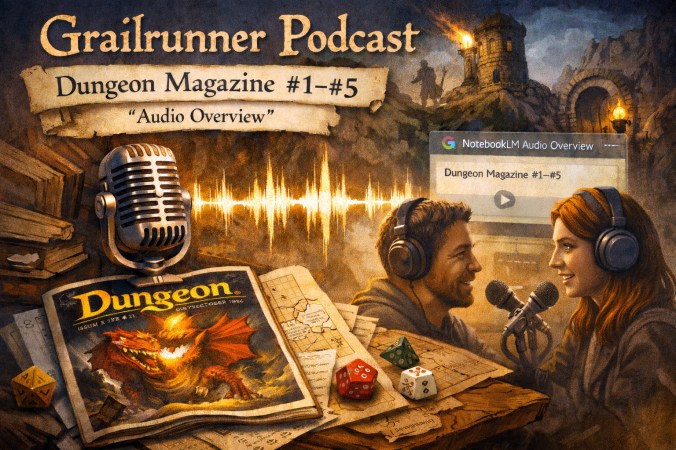
Smash the Podcast Announcement image below to give it a listen for free:
I’d love to know what hits you:

  • Which issue had the best “I’m stealing that” moment?
  • Did the audio format surface anything you’d normally skim past?
  • What should we feed NotebookLM next—old Dragon editorials? a run of White Dwarf? classic sci-fi pulp?

We’ve got a lot cooking for 2026, and if the last year taught us anything, it’s that the best stuff often starts as a weird little experiment you almost didn’t try.

Till next time,

A lost card game of the wild American west

A “bunny trail”is defined as a digression or tangent in a conversation, writing, or research that strays from the main point, often hopping from one related but different topic to another, like a rabbit darting through fields; it can be a useful, curiosity-driven exploration or a time-wasting distraction.

I sometimes feel like that describes me a little too well.

Anyway, happy new year! Let’s kick 2026 off with a new bunny trail and some freebies! This one’s for card game enthusiasts, folks interested in gaming history, and I’m adding a twist for game masters of RPG’s that would like to add some authentic wild west gambling into their next campaign.

Cool?

Before the holidays, I read a biography of legendary lawman, Wyatt Earp titled Wyatt Earp: The Life Behind the Legend by Casey Tefertiller. Great read, by the way, but not my point today. I catch odd things in between the lines sometimes when I’m supposed to be paying attention to the main storyline, and one thing that snatched my attention early was Earp’s passion for a card game I’d never heard of called Faro. It sounded awesome; I was surprised it wasn’t more popular now. They used to call it “Bucking the tiger” because some card decks had tigers on their backs. And of course that only makes it more awesome.

How do you play?

The main mechanic of the game is as follows:

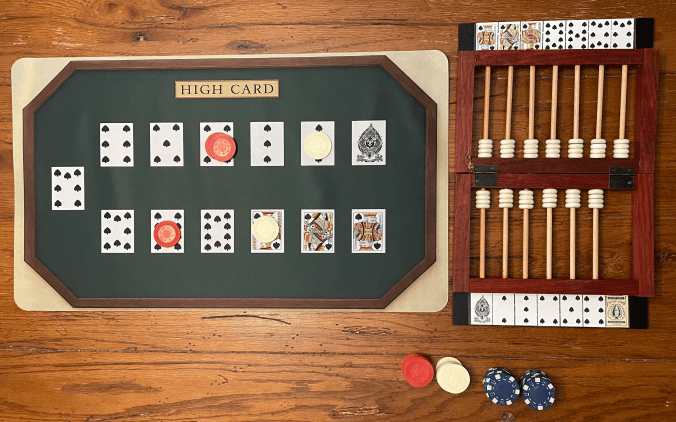
One dealer, multiple players. Standard 52 card deck with no Jokers. Before them on the table is a spread of cards on which they’ll place their bets representing one each of a suit (so Ace is 1, then 2-10 and the face cards). The particular suit on the table doesn’t matter – just what kind of card it is. This layout is just a spot for players to put their chips as they bet on which cards the dealer will draw next each round.

The dealer draws one card at first to “burn the card”, which means nothing other than there needs to be only 3 cards in the final hand so this makes the numbers work. Nobody bets on that one.

After that, the dealer draws two cards at a time, the first being the “losing card” and the second “the winning card”. If you’ve got chips on a “losing card”, the dealer takes them. If you’ve got chips on a “winning card”, the dealer pays you out that many chips. The dealer doesn’t place any bets.

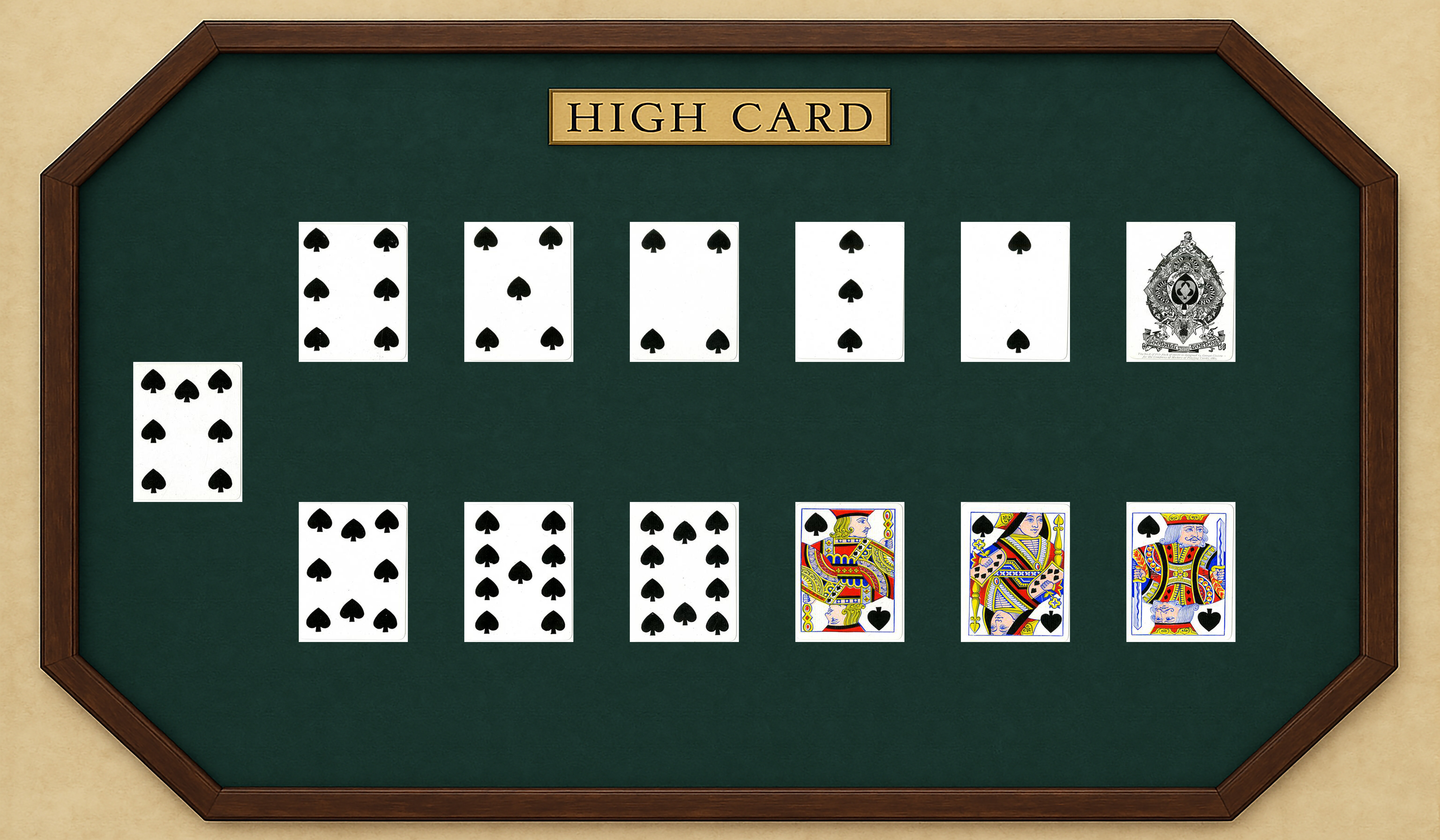
The plaque labeled “High Card” is a bet you can make that the second card will be numerically higher than the first card. Again, if you’re right, then the dealer pays you out however much you bet. Dealers can entice you to take advantage of that bet by upping the payout ratio (“High card’s paying out two to one next hand!”)

That abacus device was called a “case keeper”. You slide the beads to keep track of what cards have been drawn so players can know better what’s left in the deck to be drawn. It makes the game much more exciting towards the last few hands as you have better information.

The final hand of three cards is handled differently: players put a penny on the card they bet will be drawn first, then their chips on the card they’re betting will be drawn second (with the third and final card assumed).

Sounds fun. Why don’t people play this anymore?

It appears the house odds aren’t sufficiently in their favor to make this as profitable as poker or some other games. I’ve played it fairly many times now as dealer and can vouch for this – my family broke the bank more than once. Any ties where the dealer draws the same type of card twice go to the house, but that and the probabilities of the game just don’t pay enough, it seems.

And the cheating, which we’ll get to shortly.

So cowboys played this?

Oh yeah, big time! Anybody moving cattle to sell them in the bigger towns and with a little extra money in their pocket couldn’t wait to get as drunk as possible and play Faro. The house knew when to give out free drinks to shift the odds more in their favor, and when to send pretty ladies over as well for more distraction – offering rooms upstairs of course.

You mentioned cheating?

Oh, man was there cheating! Have a look at this book titled Faro Exposed: or The Gambler and His Prey by Alfred Trumble. It was published in 1882 and details the wildest machinations and sleights of hand that dealers would employ to make it all but impossible for players to win. And I heartily recommend this book if you’re at all interested in this game because it’s an incredible read.

The introduction of a mechanical means of dealing called a “dealing box” was supposed to give the gambler a sense that he was dealing with a fair game as it doled out cards one at a time through its apparatus. Supposedly, this took the sleight of hand and manipulations of the dealer out of play, but Trumble walks through multiple chapters worth of how that was also nonsense.

Here’s a funny quote from the book:

“But the reader will ask. Are there no honest gamblers? I answer no. Emphatically no. The sun shines not upon one honest gambler in all this broad land.”

Where did you get the stuff to play?

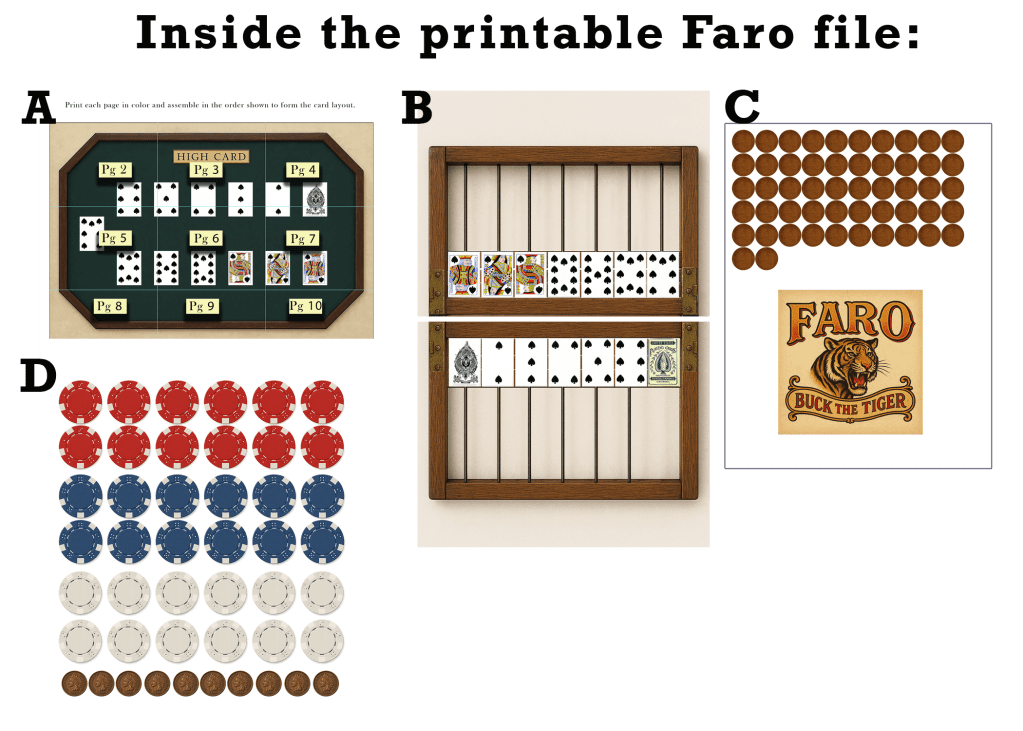
Here’s where today’s freebies come in! I made everything in Photoshop so it can be printed out on regular 8.5 x 11″ paper and assembled on the table. If you have a card deck, printer, scissors, and tape, you’re good to go. I included poker chips and pennies just for completeness but unless you have a Silhouette Cameo or a lot of patience, you’ll probably just use tokens or coins instead. That’s fine.

I wanted it to look cool and authentic though. The cards came from a Wiki Commons reproduction of 1880’s era cards. The coins too.

There are several pdf’s in the download:

  • A: The Faro card layout itself in several pages for accuracy on size – print and place per the instructions.
  • B: The Faro case keeper in 2 pages – just print and assemble per the picture. You’ll use pennies or tokens in place of the abacus beads and just slide them along the dowels in the image.
  • C: Some tokens to use (if you choose) on the Faro case keeper as well as the Tiger logo
  • D: Some poker chips and pennies (if you don’t have any handy yourself)

That looks great, thanks! Anything for roleplaying gamers?

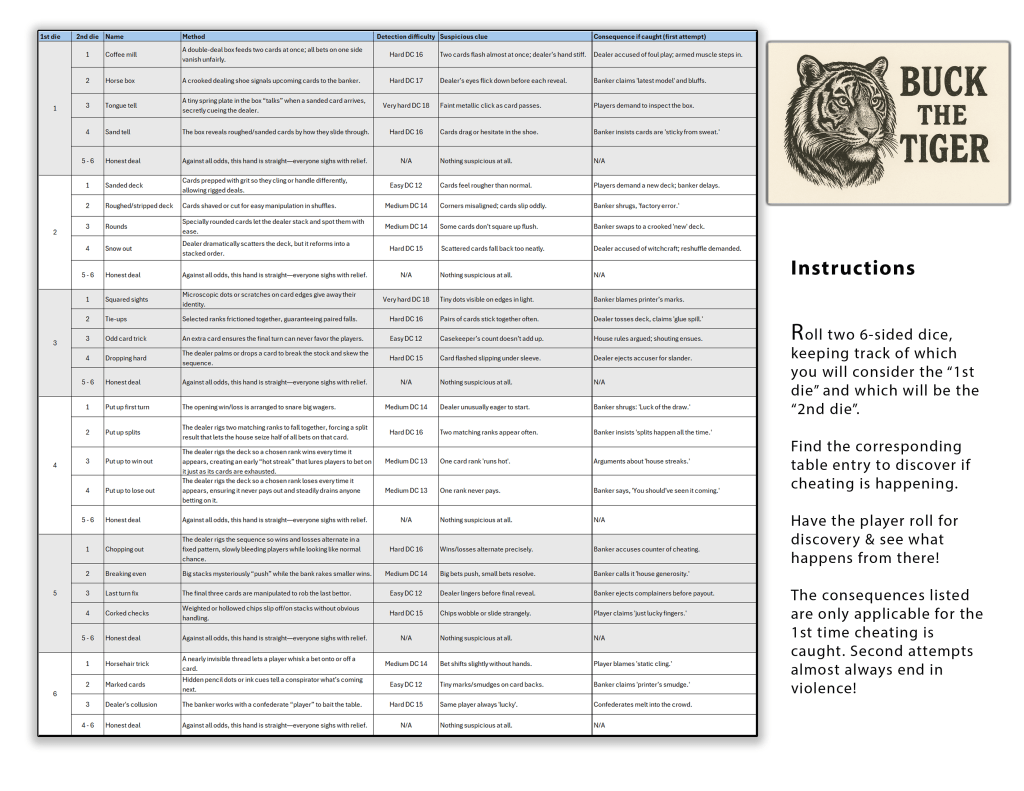
Trumble’s extensive descriptions of cheating methods made me wonder if this wouldn’t be a lot of fun in a roleplaying campaign – something quick to drop in to a wild west scenario in the ruleset or storyline of your choice where players could actually play the card game, gamble authentically, and be cheated. The game master could drop clues that cheating was happening, and dice rolls could decide how obvious that is and which authentic cheating methods were occurring.

Here’s what that wound up looking like:

Roll two D6’s to decide the situation from the table, then use Perception rolls (or whatever your ruleset uses for that) to decide whether it’s noticed or not. If it is noticed, then the table offers details on the clues to drop and also the consequences if the player decides to do something about it (first notice only – after that, guns come out!)

Here’s that table in a printable pdf as well if you think that sounds interesting:

If you’d like a high resolution 24″ x 14″ jpg of the Faro table to have a playmat printed (like I did), just click the image below for that. I used Frogigo (link here).

And that’s what I wanted to bring you today. I hope you’re as intrigued as I was – it really is a fun game, and the images of sly dealers and drunk gamblers, the ensuing gunplay, that all was just fuel for my imagination. We played this like crazy over Thanksgiving and Christmas. My dad especially loved it.

Anyway, till next time,