Getting Over Free And Rewiring Your Imagination

expansortext

Back in the day, pre-internet and when the only way to hit it big was to get signed by a big publishing house, you hounded magazines to sell short stories as much as you could. You got in print. All the names you’d recognize from those days offered that advice; and I sadly admit to listening to my dot matrix printer bweh-bweh-bweh in the corner of my desk while I bent those little metal clips on the manila envelope time and time again patiently sending off stories so I could make a name for myself to finally see the way clear before me. The only cool story I have from those days is a terribly cruel rejection letter from the guy who ran Asimov’s magazine accusing me of stealing the story idea (naming some obscure piece I’d never heard of and saying the other guy did it better). Now that I think about it – there was a guy named Vampire Dan who ran something called The Story Emporium at one point, who said nice things about what I sent him and always said I was ‘close’. He was awesome; but that’s beside my point.

Where I’m going with this is – you sold everything. Nothing was free. Guys like Harlan Ellison were brutal about it, chasing every dime for reprints and mentions and ripoffs. Basic economic common sense says you don’t give your hard work away because it has value. Giving it away means it’s crap and you couldn’t sell it. Right? Hold onto that for a minute.

My brain builds up steam. What I mean by that is my job can be technical; and if I’m not careful, I’ll be exclusively reading science journals and history books, learning statistical programming, building robotic arms, or whatever my left brain decides to chase with precious little stretching of my imagination. It can make my writing a little dodgy and stiff, and the ideas a little plain-Jane and cardboard because I’m not exercising that part that mishears things on purpose, that plugs and unplugs things I see around me to rewire them into something else. Everybody says you’re supposed to write every day; and they’re of course right about that. It matters. Our brains are neuroplastic, meaning you can rewire them yourself just by what you think about. It would be incredibly helpful for a writer to be able to dredge up an inspiring idea to stretch on like taffy any time he needs it. Confidentially, it helps me tremendously at work too because I’m always being presented something people are stuck on. Different ways of thinking break out of that kind of rut.

When I recently started in earnest to build a platform for future book launches, I finally got the light bulb to spark on – that old school thinking about not giving things away for free doesn’t hold true in the internet age. Nothing gets attention on-line like FREE. It’s amazing. Book giveaways are critical because of how you get reviews; and no book sells without reviews. Twitter, Facebook and Goodreads or whatever media you want to talk about, they’re all swamped and crowded with authors pumping books. Nonsense. Sales are about trust; and somebody who’s looking for an author needs to trust them. It is an incredibly intimate relationship between author and reader…a joining of the minds that must be honored and treated as precious. What this all means is it’s not only okay to give your work away for free, it’s important to do so. Setting up a place on Facebook where you can share a piece of flash fiction or a story idea you never intend to build a book around – that gives you a fantastic place for people to get to know your style, to trust you, and also forces you to sit down once a day and do it!

Go see what I mean here and let me know which ones you like best. I’ve come to notice already that people seem to appreciate most the ones with images attached. Give it a shot yourself and see if it doesn’t stretch you to look for slick story ideas around you more often.
The Making Of A Mind-Bender

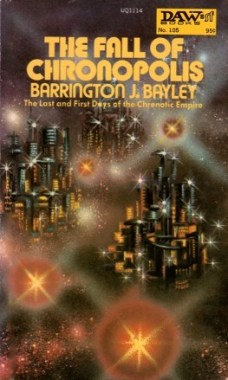
TheFallOfChronopolis.jpg

Standard warning – this is not a book review! I’m going to analyze how a science fiction author twists a story idea around like a diamond to craft a fascinating mind-bender of a book. Though I’ll likely spoil the crap out of it, we’ll hopefully pick up on best practices for anybody looking to squeeze novelty and freshness out of a concept they might have for a book or story.

“With a hollow booming sound the Third Time Fleet materialized on the windswept plain. Fifty ships of the line, the pride of the empire and every one built in the huge yards of Chronopolis, were suddenly arrayed on the dank savanna as if a small city had sprung abruptly into being in the wilderness”

Because I’ve read it a jillion times and because you should too, I picked for this exercise a 1974 time travel novel by a guy capable of turning your brain into salt water taffy but still leave a smile on your face. Seriously, why are you not reading Barrington Bayley? Go get Knights Of The Limits if you want a sampler pack. The book we’re going to look at is The Fall Of Chronopolis.

The core idea:

There’s an empire that stretches across time instead of space

Time travel has been done to death; and it’s usually stupid and full of holes. Look, you’re probably nowhere near the Doctor Who fan I am – I adore that show in all its forms; but mostly they contradict themselves at will and skim over uncomfortable goofs. Admit that, so we can move on. Here, Bayley has an interesting twist on the galactic empire idea that’s been around since the 1930s. Already a good start. People go back to those 1930s pulps even now. They did a lot of things right; and so did he with this one.

But how to make that work?

Bayley built a theory of how time is structured to try and solve how his core idea could function, how the citizens would travel across the empire and how they’d be ruled. It’s a natural progression once you have an idea, right? Just answer the obvious questions about your idea. He tells us time is like a frothy ocean with our reality and perception of it like stable skim on the surface. Yet under special circumstances, you can go deeper into the potential realities lying below, a horrid and ghostly place where souls can be dissolved into nothingness. Nice – loads of chance for drama and action there.Giant freaking time barriers were set up at the rearward past and forward future like walls around the empire. Specially protected ‘achronal archives’ exist inside buffers which are compared to duplicate archives outside the buffers enabling them to become aware of any disruptions to the timestream…like people or cities disappearing from history. There’s your empire.

Which raises more questions…

There are obvious problems that are going to come up with all of this…you can imagine the debate that went on in his head at this point. Like a courtroom, putting his idea on trial, my guess is he knew right away he needed a way to smooth contradictions, and a way for them to have a conflict of some kind. So his theory of the ocean of time needed to expand a bit. If you can imagine standing ripples on the water, no different from you and I holding a rope at the two ends with me popping up and down quickly so my end goes up when yours goes down…that point between us where the direction switches is called a node. Bayley imagined us existing at a node in time – stable points that move forward one second per second. There are just several of these; and the empire stretches across seven of them. Since they’re all that’s stable though, wrecks in the hinterlands between nodes dissolves all souls onboard into the terrible sea of potentiality. Come on! Once you stretch out an idea like that, of course it’s going to happen in the story! It’s writing itself at this point!

…and implications…

I can also imagine in Bayley’s spitballing session on this idea just trolling over everyday things to bounce his time empire idea across them and see what comes out. Relationships, for example. He imagines a young narcissistic prince who seduces his future self into a romance at node 1. He constructed a religion around how his empire would view the sea of potential, and the special reverence attached to the sacred moment when a Physics lab assistant first discovered the principle which would enable time travel.

Add the conflict and stir…

Once the initial idea is set up, it just needs tension. I imagine Bayley still working his central idea, twisting and turning it to see what war would look inside this framework. Giggling maliciously, I’m sure, he gave us an enemy empire existing in the future beyond a long period of unpopulated nuclear wasteland, begun by dissident time travelers from the empire itself. Cool beans. Conflict was automatic with this one, wasn’t it? Suddenly, the archivists start reporting entire sprawling cities have vanished from history, which no one remembers. The automatic rule of science fiction is to keep pushing the idea – how far can this go? Bayley describes the ultimate goal of a time war as disrupting the founding of your enemy – basically, get behind them and muck it up. It’s really fascinating to read all this…just incredibly innovative.

I’ll wrap it up to leave at least a little mystery to it all. The overall point this time around is the ideas will come from mishearing something around you, from hammering differences into something you see in a movie or book or something somebody tells you, whatever. The job then is to twist it around in the light for:

  1. Your first-pass explanation of how things will work with this idea
  2. Answers to the obvious questions resulting from step 1
  3. Teasing out implications of all that on everyday things
  4. Finding conflict that leverages the idea, not something boring that didn’t need it

That’s my take on it, anyway. You can go read Bayley now.


Load The Gun First: Indie Book Launching Like Grownups

nightingale

If there’s anything I regret most about all the screw-ups I made launching my first indie book, it’s that I didn’t do anything before the launch other than write the book. Is that weird to say? Anyway, I got an interesting case study sent to me recently by Goodreads that I thought did a nice job of outlining how the big press houses work the system for book launches now, that make a real joke of the approach I took (or the lack of an approach, which is a little more accurate).

I wrote recently about what I view as the key success factors for book marketing in the modern age, centering on:

  1. Mainstream name recognition
  2. The cover
  3. The genre
  4. Reviews
  5. Awards
  6. Word of mouth

Have a look at the case study using the link in my first paragraph to see these in action. The emphasis for St. Martins Press in this launch was predominantly up-front and prior to publication. Who knew that was when the real marketing work should have been done? I was busy just trying to get the plot points to tie off without seeming forced and trying to decide what a typical book length in word count should be.

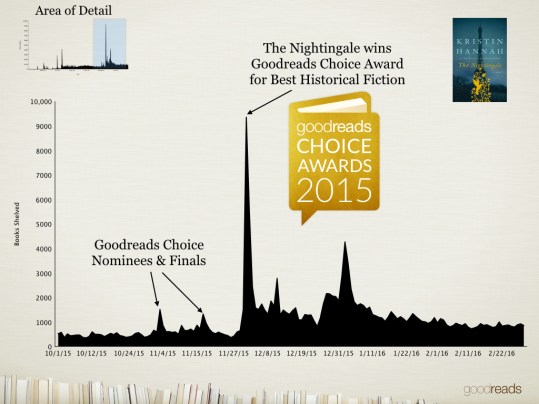
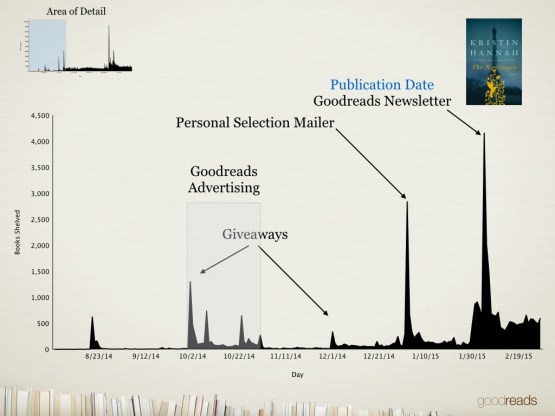
They strategically ran paperback giveaways, larger that normal (about 200 in this case) with good follow-through for reviews and word of mouth. Then they tied this in with focused advertising. I have been more impressed with Facebook’s approach to targeting ads versus anyone else, certainly more impressive than Twitter. Zuckerburg really seems to have done a nice job painting us all into neat little demographic corners. When St. Martins got the buzz building, nurturing it like a desperate fire on a desert island and watching the ‘to-read’ listings on goodreads as a measure of that, they launched a personalized mailer to readers who’d expressed an interest in the author.This was all prior to publication date.

nightingale2

When word of mouth and buzz built to the point that nominations happened for listings and awards, St. Martins Press doubled down again with giveaways and ads to further fan the flames. Very strategic, this approach. Not surprisingly, it was a momentum thing no different from a football game or a successful startup company. Maybe everything that’s good in life is a momentum thing. Who knows?

Indie Book Marketing With A Vengeance

MCGRAW

It’s funny how so many people that hear you published a book scratch their chin, smile a bit and tell you they’ve been thinking about putting one together too. “I’ve got a great idea…there’s this_____”. Fill in the blank. For me, writing them is the fun part. Blasting words into the laptop down at the lake or acting out the dialogue somewhere quiet to make sure it sounds like something people would actually say…that’s all adrenalin for me. It’s the terrible part that happens after it’s done where so many hold our noses and dive in anyway. It’s the marketing. Selling it. Making people aware that a piece of you has been captured in the narrative; and it’s available on Amazon and Barnes & Noble, waiting to change the world. I dove into that swamp in the Fall of 2015 knowing absolutely nothing about what to do next. It isn’t my intention here to tell anybody how to do it right because I’m no example to follow. It’s very likely, however that I can spare somebody from making the same sorts of mistakes. I’m actually really good at making mistakes.

When I typed the last sentence on a rainy beach in Maine, I was pretty pumped, of course. Who wouldn’t be? It’s huge to actually finish something that’d been stewing for that long. Look at that guy grinning…he has no clue what he’s in for. Anyway, I would have told you – should you have asked what’s next if you’re going independent – that you make the book as widely available as possible through Ingram Spark and Createspace, in electronic and paperback, set yourself up on social media, do a few giveaways, and start advertising. No problem. It’s a waiting game till the sales figures just start rolling in. Unfortunately, that wasn’t my experience; and I’ve made some boneheaded moves you need to know about. I won’t get into the decision whether to go indie or to find an agent or whatever. Pros and cons to either, so read up on it and choose wisely.

  1. I published the book before getting any reviews on it from anyone, before submitting to any contests or major review houses, and before setting any presence of substance up on social media. Ouch and double ouch.
  2. With a new Adobe Creative Cloud membership, I learned Photoshop and made myself a slick cover that I loved and everyone in my family loved. Neither they nor I have the first clue about cover design or the marketing principles behind them. It looked terrible in a lineup with other books online and drew no attention whatsoever. Ouch again.
  3. I ran a paperback giveaway on Goodreads but only made 20 books available, listed the contest for way too short a time period, and made too little emphasis on securing the reviews afterwards with zero follow-up. Almost all those copies wound up for sale on Amazon.
  4. I spent entirely too much valuable time screwing around on Twitter and Facebook, and even spent money on a social media marketer. Zero payback. A money pit that echoes.
  5.  I spent advertising money on Goodreads and Amazon though I had only two reviews. Anybody clicking through to the sell page just left because it looked so barren. I do the same thing when I’m on Amazon, should have thought of that. Didn’t.

Okay, that’s stressing me out so I’m going to stop right there. Anyway, through trial and error, deep research and conversations, and through reading up on what savvy marketing guys like Derek Murphy  and Dave Chesson have to say about this, I’ve distilled some principles of indie success that I believe hold true. There are probably exceptions and folks who caught lightning by chance; but this is what I wish I could have handed to myself there on that Maine beach. Would have saved a lot of effort and made the whole thing more fun. Let’s call it the MCGRAW principles:

M for mainstream name recognition: If the public has heard of you, favorably or unfavorably, talent or no talent, irrespective of the quality of your work, you’re far more likely to sell books without even trying. It’s hard to leverage this one unless you’re willing to put the time and effort into guerilla marketing or through interviews to force it.

C is for the cover: Think about how you pick books yourself, even online. This is a big deal. Murphy outlines seven principles of effective covers here. The cover should look professional and should look like it belongs on the shelf next to similar books, like it’s in the club. Spend money on this. It’s worth it; and there are thousands of talented folks who will do it inexpensively. If nothing else, get a pre-made cover customized.

G is for the genre: You can see this spelled out for you on Amazon book count listings by genre or in places like Bookbub where they show how many people have signed up for science fiction freebies versus general literature or romance freebies. Lesbian vampires will make sales happen for you. Mythic and philosophical musings on historical eras probably won’t. Just know going in what your audience looks like and where they feed.

R is for reviews: You need at least ten of these. They’re extremely difficult to get, even from people who read and loved your work. Probably the majority of the reviews online were paid for somehow or achieved through connections. Disheartening, but true. Giveaways done properly are the right way to make this happen; but it takes timing, good publicizing, and personal follow-through. Don’t waste any time or effort getting people to your sell page if there are no reviews there.

A is for awards: Awards by themselves are a bit unlikely to sell your work unless it’s one of the biggies. Snake oil salesmen are out in force trying to rape indie publishers with awards right now, so beware. However, awards will apparently push people who are on the fence over to the side where they spend money.

W is for word of mouth: Advertising can fall here, sure; but any way you can get people talking about you or the work will make it rain for you. Influential book blogs can help here. Being on even a local tv appearance can help. Generating buzz through charitable or newsworthy events can help. There are no end of strategies you can read about online of how to force this.  

So there you go. At least, that’s my take on it. Painful lessons. Good experience. Listen to people who screw up a lot. They know things.


Using A Wordcloud To Examine How You Write

Here’s a wordcloud on the full text of a book I wrote. I’ll tell you what it tells me in a minute. For now, just scan over that blob yourself and see if anything stands out for you. wordcloud

Anyway, a wordcloud (incase you’ve not run into one of these yet) counts how often words repeat in something and builds a picture like this – bigger words here repeat more often. The whole picture gives you a comparison of word choices.  You set a cutoff frequency count, so it isn’t every word in the document. Make sense?

In my day job, one thing I do is study and optimize how people communicate with each other. This sort of blob here calls me out on a few things I do that maybe I should be careful about, and maybe I should keep doing. Either way, there are insights into the word choices and emphases I made in the book. That’s a big deal if you’re a writer, to help you get better. Know what I mean yet? Let’s dig in, I’ll get to the meat of it.

Staring at me like the eye of Sauron (nerd reference!) is the word, ‘like’. I also know from my day job that the majority of us think and learn visually and that we absorb information quicker and more effectively when we can relate to it naturally. Parents get that point well without being told – tell a kid not to cross the street and they’ll bound away as fast as they can. Tell them a scary story about a kid named, Lulu who used to live down the street and looked just like them but crossed without waiting on the ‘walk’ sign and can’t get up from her chair anymore…no more problems with crossing the street. Is that wrong? Maybe. Effective? Try it yourself. When I’m building a scene as a writer, I probably use too much simile and metaphor, too much comparison, to burn my pictures into your head. It’s why that word is showing up as the biggest repeater. If I’m going to stick by my philosophy of emphasizing comparisons, I need to balance the word choice on that, not overuse it, and be careful not to mix one metaphor in the same paragraph with another. Good advice, right?

I notice in yellow the words, ‘just’ and ‘eyes’. Since I’m emphasizing the visuals, I do tend to describe facial expressions quite a bit. I want it to feel like a movie as you’re reading it. We process and can relate to human faces probably more than any other image. It’s why the words, ‘looked’ and ‘face’ are showing up in red as well. Because these are among my heavy hitters, I need to be careful not to overuse them. Honestly, I was shocked to see, ‘just’ there. I need to go digging on that one to see if it’s okay what I’m doing. My point here in this post isn’t that everything showing up as a high frequency word is a bad thing, just that it’s something to be aware of. Tells you where to go looking to see if it’s all right. Get me?

The two main characters are named, Misling and Ring. They’re showing up as heavy repeats as well, which makes sense. I would have thought Misling would have outpaced Ring, so that was a surprise to me. The storyline of the book is heavily influenced by events from a previous generation, so that’s possibly why you see, ‘old’ and ‘man’. When I saw the word, ‘back’ here, it made me curious. Apparently, in my zeal to make you see what I was writing, I spent some effort in describing ‘glances back’ and whatnot. Better watch that.

So that’s all I was going to suggest to you for this post, if you’re a guy that slings words for fun or cash. I would honestly never go back and edit something I’ve written because of something like this. It’s more like a personal growth thing for me to have yet another perspective on how I’m constructing things…to be aware of what I do so I can control it better.

I put this wordcloud together in R with the ‘tm’ and ‘wordcloud’ packages; but I believe you can do things like it easily with sites like, ‘wordle’. I’ve not used them myself. Give it a shot and see what your own cloud tells you. May surprise you!


Publishing Myths I Still Can’t Let Go

Yeah, I still have the dream of walking into a Barnes & Noble and seeing my name up on the shelf, with some of my sci-fi tribe standing around chatting it up. Awesome. Would be equally amazing to get an invite to Dragon-Con in Atlanta with a room full of cosplayers living out characters I dreamed up. My tribe again. Those guys are crazy. Anyway, that’s the sort of thing that prompts a guy like me to sit in his study or out on the lake and pound away on a keyboard, dreaming up outlandish tech-scapes and apocalyptic drama – or maybe more often chuckling at something I thought up for somebody in the story to say. The thing about reality though is it’s unforgiving and thrills at squashing the pictures you had in your head going into something like publishing. So here’s a few things I can’t turn loose, but probably need to:

3. Book reviews and big name author blurbs are reliable gauges of quality, and those guys are just out there waiting on you to publish so they can blanket bomb you with their verbiage. Book reviews and big name author blurbs are in fact, by majority, paid for or culled through big publishing house connections. They’re about as meaningful as the things people you didn’t like wrote in your high school yearbook. Trying to get real live people to log in to Amazon and enter a review is as fun and satisfying as passing a kidney stone. Yet you need them, so let the heavy work begin. Go to places like the following to send thoughtful, customized review requests of blogs in your genre. You should know though, if you’re one of those keyword and search engine geeks, the Amazon algorithms put a ton more weight on verified purchase reviews than they do other reviews.

http://www.allbooksreviewint.com/                                             http://melanierockett.com/directory-of-book-reviewers/ http://www.theindieview.com/indie-reviewers/

2. In order to get on the bookshelf at a big chain bookstore, you just have to have a great book and put the time in – pay your dues. It’s a process, open to everyone. Maybe that’s the case; but I’m not seeing it as worthwhile if you’re an indie publisher or self-publishing. Way too much effort and very low probably of success. Get yourself on Ingram if you like since so many of them order through that database. Get yourself a Kirkus or Midwest review, though you’ll pay through the nose for Kirkus (and may have to pay at Midwest). Look up the Barnes & Noble, Books A Million, and Hudson buyers online and submit if you like. The American Bookseller’s Association has an Indie Advance Access program where you can try and approach their small-store membership. Honestly, though, your time is better spent dropping this one for now, especially if it’s your first book or so, and churn up a decent on-line presence to drive people to your sales page on Amazon.

1. No reason I can’t just make the cover myself. I’m a smart guy. Give me a trial membership of Photoshop and get out of my way! Stop. Go back. Here be dragons. I spent days on this, learned the software, got my stock photography, even learned how to do lens flares J. J. Abrams would be proud of. I put that bad boy together and was overjoyed at how it looked. Family folks agreed at how amazing it was. A good time was had by all. Then I found out how hideous it looked as a thumbnail on ebook sites, how little impact it made when on the page with a bunch of other books, and just how many freaking rules of marketing and book cover best practices I broke with it. A savvy marketing guy named, Derek Murphy made a comment that stuck with me here – he said your book cover shouldn’t reflect a scene from the book because that’s worthless. It should just look like it belongs on the shelf next to books similar to it. That’s important.

So I’m done with this train of thought. Good luck to you if this is the road you’re headed down. Let me know if I can help!