A lost card game of the wild American west

A “bunny trail”is defined as a digression or tangent in a conversation, writing, or research that strays from the main point, often hopping from one related but different topic to another, like a rabbit darting through fields; it can be a useful, curiosity-driven exploration or a time-wasting distraction.

I sometimes feel like that describes me a little too well.

Anyway, happy new year! Let’s kick 2026 off with a new bunny trail and some freebies! This one’s for card game enthusiasts, folks interested in gaming history, and I’m adding a twist for game masters of RPG’s that would like to add some authentic wild west gambling into their next campaign.

Cool?

Before the holidays, I read a biography of legendary lawman, Wyatt Earp titled Wyatt Earp: The Life Behind the Legend by Casey Tefertiller. Great read, by the way, but not my point today. I catch odd things in between the lines sometimes when I’m supposed to be paying attention to the main storyline, and one thing that snatched my attention early was Earp’s passion for a card game I’d never heard of called Faro. It sounded awesome; I was surprised it wasn’t more popular now. They used to call it “Bucking the tiger” because some card decks had tigers on their backs. And of course that only makes it more awesome.

How do you play?

The main mechanic of the game is as follows:
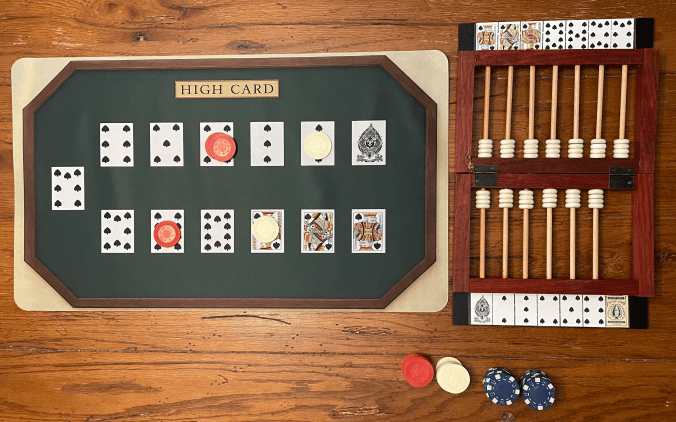
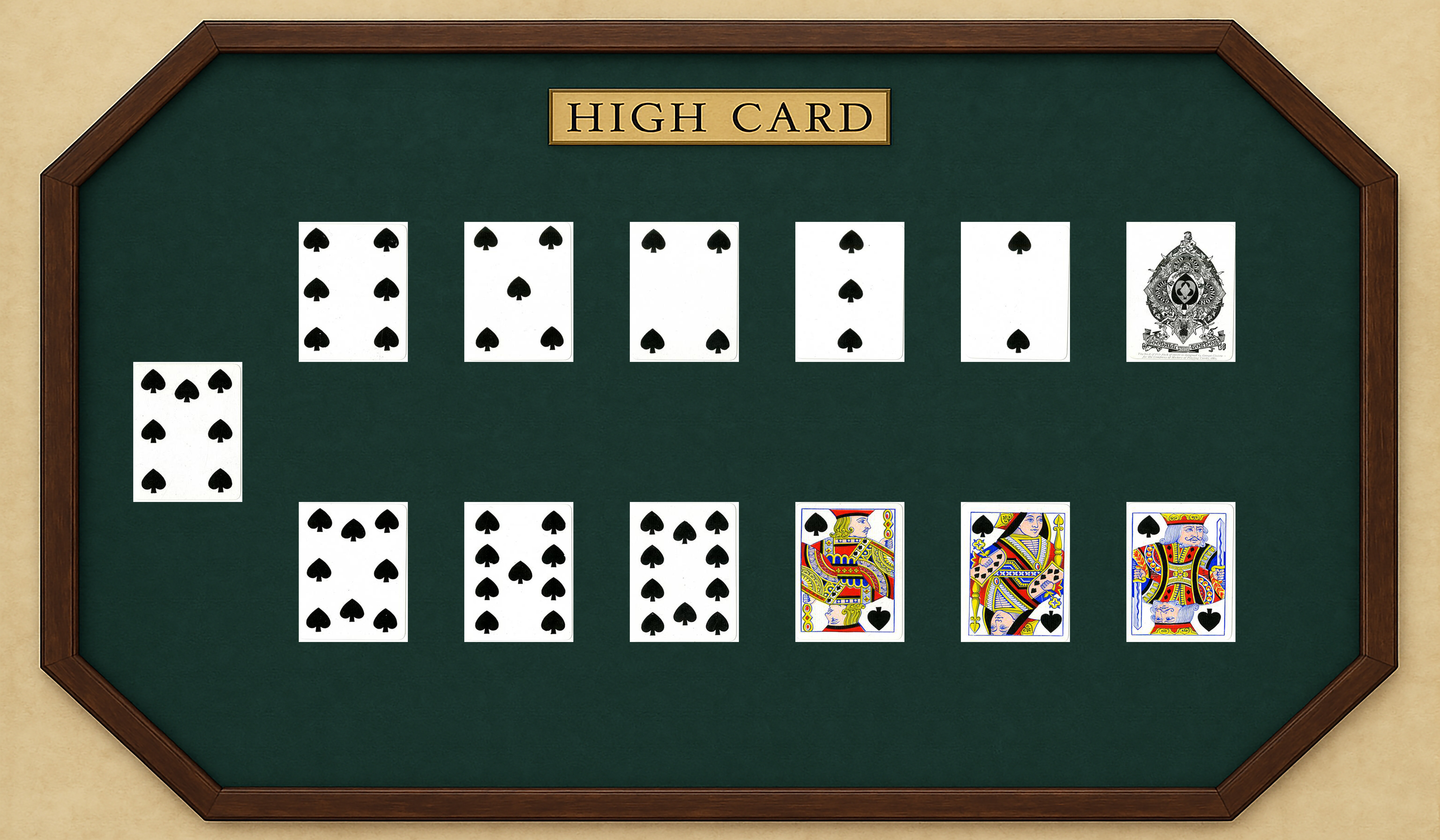
One dealer, multiple players. Standard 52 card deck with no Jokers. Before them on the table is a spread of cards on which they’ll place their bets representing one each of a suit (so Ace is 1, then 2-10 and the face cards). The particular suit on the table doesn’t matter – just what kind of card it is. This layout is just a spot for players to put their chips as they bet on which cards the dealer will draw next each round.

The dealer draws one card at first to “burn the card”, which means nothing other than there needs to be only 3 cards in the final hand so this makes the numbers work. Nobody bets on that one.

After that, the dealer draws two cards at a time, the first being the “losing card” and the second “the winning card”. If you’ve got chips on a “losing card”, the dealer takes them. If you’ve got chips on a “winning card”, the dealer pays you out that many chips. The dealer doesn’t place any bets.

The plaque labeled “High Card” is a bet you can make that the second card will be numerically higher than the first card. Again, if you’re right, then the dealer pays you out however much you bet. Dealers can entice you to take advantage of that bet by upping the payout ratio (“High card’s paying out two to one next hand!”)

That abacus device was called a “case keeper”. You slide the beads to keep track of what cards have been drawn so players can know better what’s left in the deck to be drawn. It makes the game much more exciting towards the last few hands as you have better information.

The final hand of three cards is handled differently: players put a penny on the card they bet will be drawn first, then their chips on the card they’re betting will be drawn second (with the third and final card assumed).

Sounds fun. Why don’t people play this anymore?

It appears the house odds aren’t sufficiently in their favor to make this as profitable as poker or some other games. I’ve played it fairly many times now as dealer and can vouch for this – my family broke the bank more than once. Any ties where the dealer draws the same type of card twice go to the house, but that and the probabilities of the game just don’t pay enough, it seems.

And the cheating, which we’ll get to shortly.

So cowboys played this?

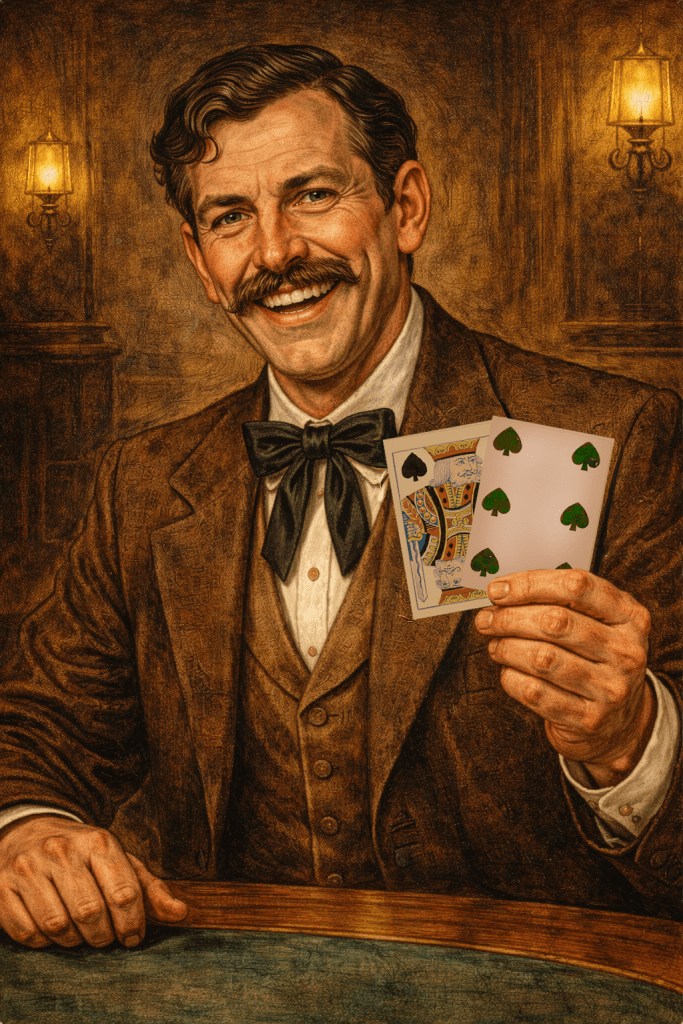
Oh yeah, big time! Anybody moving cattle to sell them in the bigger towns and with a little extra money in their pocket couldn’t wait to get as drunk as possible and play Faro. The house knew when to give out free drinks to shift the odds more in their favor, and when to send pretty ladies over as well for more distraction – offering rooms upstairs of course.

You mentioned cheating?

Oh, man was there cheating! Have a look at this book titled Faro Exposed: or The Gambler and His Prey by Alfred Trumble. It was published in 1882 and details the wildest machinations and sleights of hand that dealers would employ to make it all but impossible for players to win. And I heartily recommend this book if you’re at all interested in this game because it’s an incredible read.

The introduction of a mechanical means of dealing called a “dealing box” was supposed to give the gambler a sense that he was dealing with a fair game as it doled out cards one at a time through its apparatus. Supposedly, this took the sleight of hand and manipulations of the dealer out of play, but Trumble walks through multiple chapters worth of how that was also nonsense.

Here’s a funny quote from the book:

“But the reader will ask. Are there no honest gamblers? I answer no. Emphatically no. The sun shines not upon one honest gambler in all this broad land.”

Where did you get the stuff to play?

Here’s where today’s freebies come in! I made everything in Photoshop so it can be printed out on regular 8.5 x 11″ paper and assembled on the table. If you have a card deck, printer, scissors, and tape, you’re good to go. I included poker chips and pennies just for completeness but unless you have a Silhouette Cameo or a lot of patience, you’ll probably just use tokens or coins instead. That’s fine.

I wanted it to look cool and authentic though. The cards came from a Wiki Commons reproduction of 1880’s era cards. The coins too.
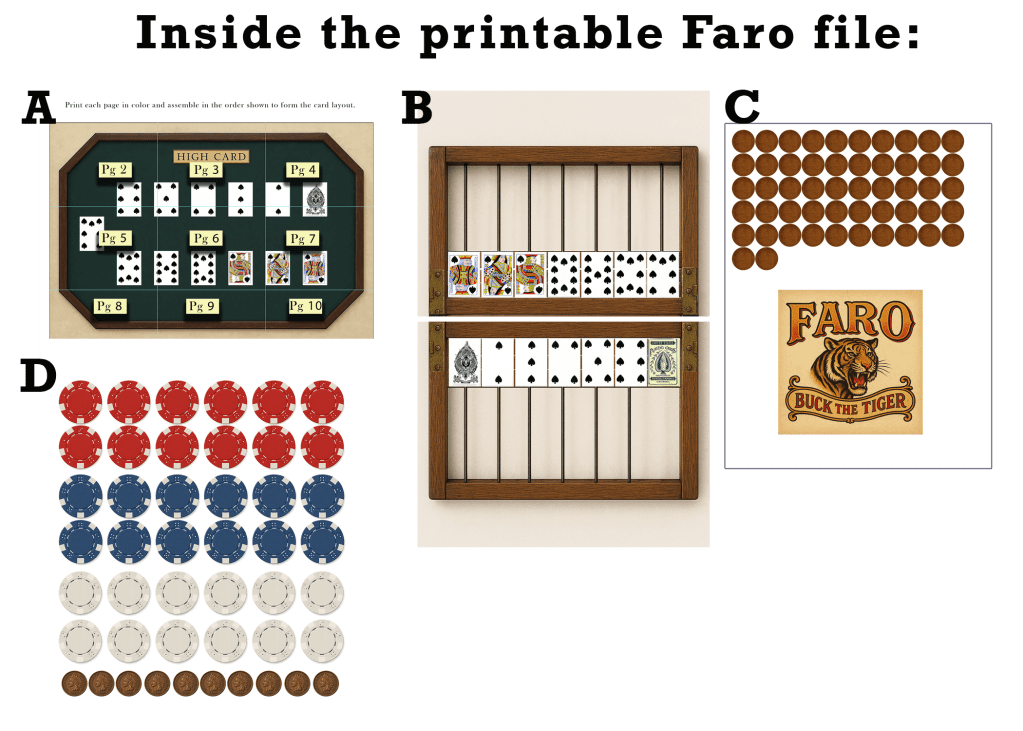
There are several pdf’s in the download:

  • A: The Faro card layout itself in several pages for accuracy on size – print and place per the instructions.
  • B: The Faro case keeper in 2 pages – just print and assemble per the picture. You’ll use pennies or tokens in place of the abacus beads and just slide them along the dowels in the image.
  • C: Some tokens to use (if you choose) on the Faro case keeper as well as the Tiger logo
  • D: Some poker chips and pennies (if you don’t have any handy yourself)

That looks great, thanks! Anything for roleplaying gamers?

Trumble’s extensive descriptions of cheating methods made me wonder if this wouldn’t be a lot of fun in a roleplaying campaign – something quick to drop in to a wild west scenario in the ruleset or storyline of your choice where players could actually play the card game, gamble authentically, and be cheated. The game master could drop clues that cheating was happening, and dice rolls could decide how obvious that is and which authentic cheating methods were occurring.

Here’s what that wound up looking like:
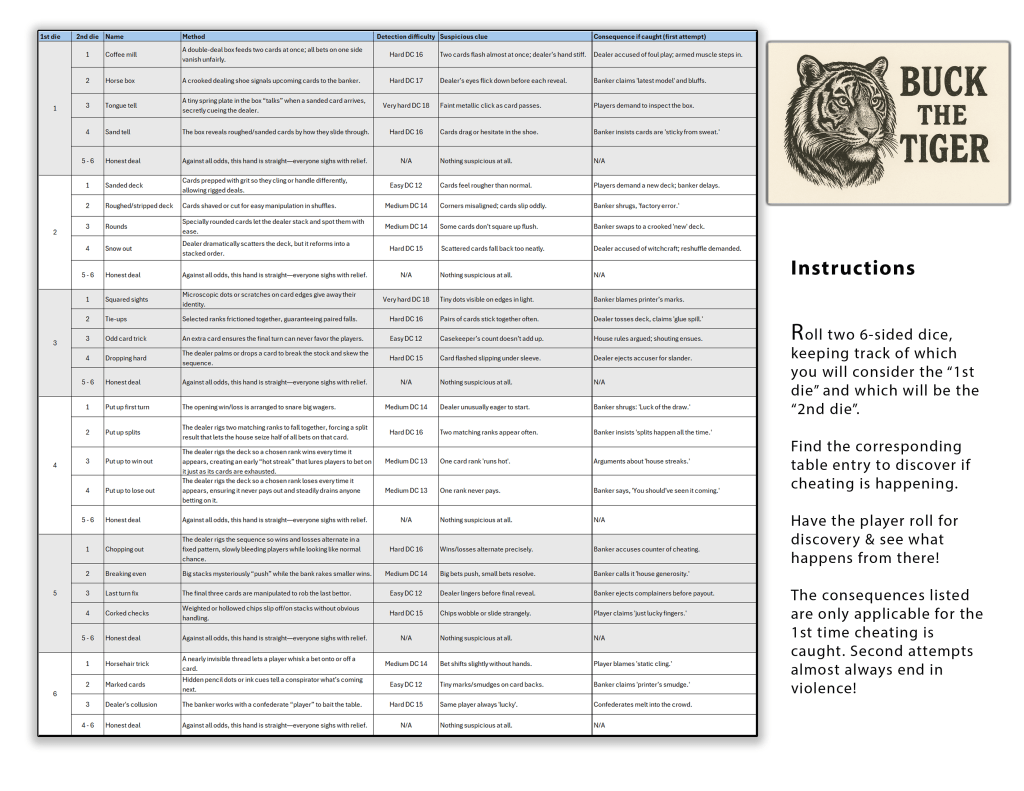
Roll two D6’s to decide the situation from the table, then use Perception rolls (or whatever your ruleset uses for that) to decide whether it’s noticed or not. If it is noticed, then the table offers details on the clues to drop and also the consequences if the player decides to do something about it (first notice only – after that, guns come out!)

Here’s that table in a printable pdf as well if you think that sounds interesting:

If you’d like a high resolution 24″ x 14″ jpg of the Faro table to have a playmat printed (like I did), just click the image below for that. I used Frogigo (link here).
And that’s what I wanted to bring you today. I hope you’re as intrigued as I was – it really is a fun game, and the images of sly dealers and drunk gamblers, the ensuing gunplay, that all was just fuel for my imagination. We played this like crazy over Thanksgiving and Christmas. My dad especially loved it.

Anyway, till next time,

One Month Into Book Launch: How’s That Going?

It’s been a month since we published SALT MYSTIC: BOOK OF LOTS, a solo roleplaying game based on our multi-media Salt Mystic setting. There are some bright spots, some hopeful notes, and a world of pain. Overall, we’re still incredibly proud of the product and seeing and hearing people appreciate it in the wild is an experience like nothing else!

We thought it would be helpful for anybody thinking of putting your own book out to see what we tried: what worked, and what didn’t…and what still might. Care to come along?

Way back in 2016, I wrote a short article defining some indie publishing principles based on lessons from the launch of my first book: TEARING DOWN THE STATUES. The principles were consolidated into the acronym “MCGRAW”, suggesting the key elements necessary for publishing success (Mainstream recognition, an eye-catching Cover that looks like it belongs with books like it, a popular Genre, as many Reviews on major listing sites as possible, Awards to add validation that the book merits attention, and Word of Mouth.) We kept these in mind this launch and tried to incorporate what we could, although the genre of tabletop roleplaying is so saturated and so dominated by Dungeons & Dragons that we were working uphill and digging holes from the beginning.

Still, hope springs eternal, and this is a product we believe in mightily, knowing from its ideation that nobody else was doing anything like it.

What was the pre-launch like?

February was a hot mess, finalizing the proofs and shaking trees to try and get attention from bloggers and gaming news sites. Short of providing free pizza delivered by cosplayers who do magic tricks, I’m not sure what else we could have done to get mentions from some of these guys – we reached out to 20 and got one “No, Thanks” and absolute crickets otherwise. That’s offering a free physical copy for review, by the way. Local gaming store wasn’t interested, and I didn’t have the heart to cold call others. My ego can only take so much bruising!

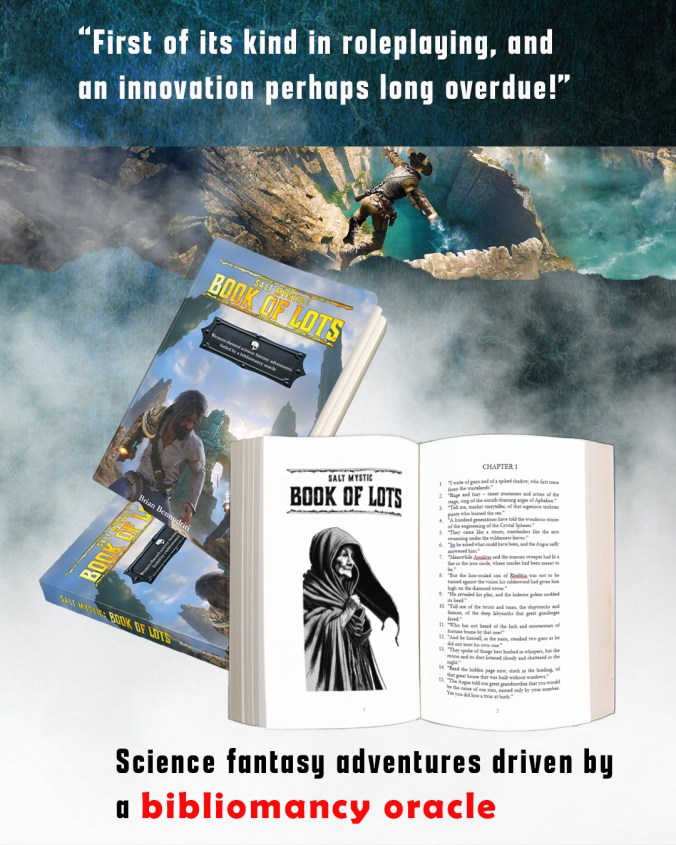
I pushed my Photoshop skills to the breaking point generating ad assets to use in social media and ad campaigns, stirring up some images that I think really popped! Here’s my favorite, though we had to switch it out to juice the click rate after things got rolling.

I’m a big fan of Absolute’s 3d cover generator and Envato’s PlaceIt – both to generate mock up’s of the cover in various places. We generated this one below for banners through RPG Geek and some other sites:

We came SOOOO close to hiring an artist we’ve been targeting for years now, and he might yet come on board for a promotional poster, so I won’t jinx anything by saying more. That would be amazing, so wish us luck! Anyway, he was swamped with other things, so the heavy lifting on graphics was still in-house.

How did you handle distribution setup?

The book is available at booksellers globally through Ingram Spark, and also on Amazon thru Kindle Direct Publishing, as well as the pdf on Drivethru RPG. We got the barcode direct from Bowker to retain full distribution rights – there are strings attached to the freebies. Honestly, setup was fairly painless for Kindle Direct, but I thought at one point Ingram was going to leave me with facial tics!

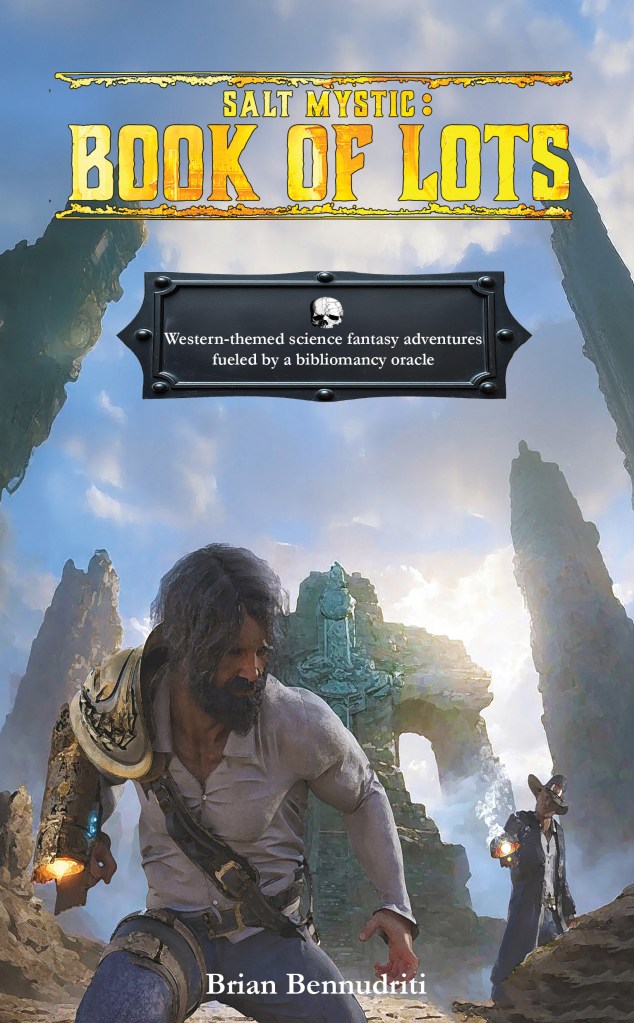
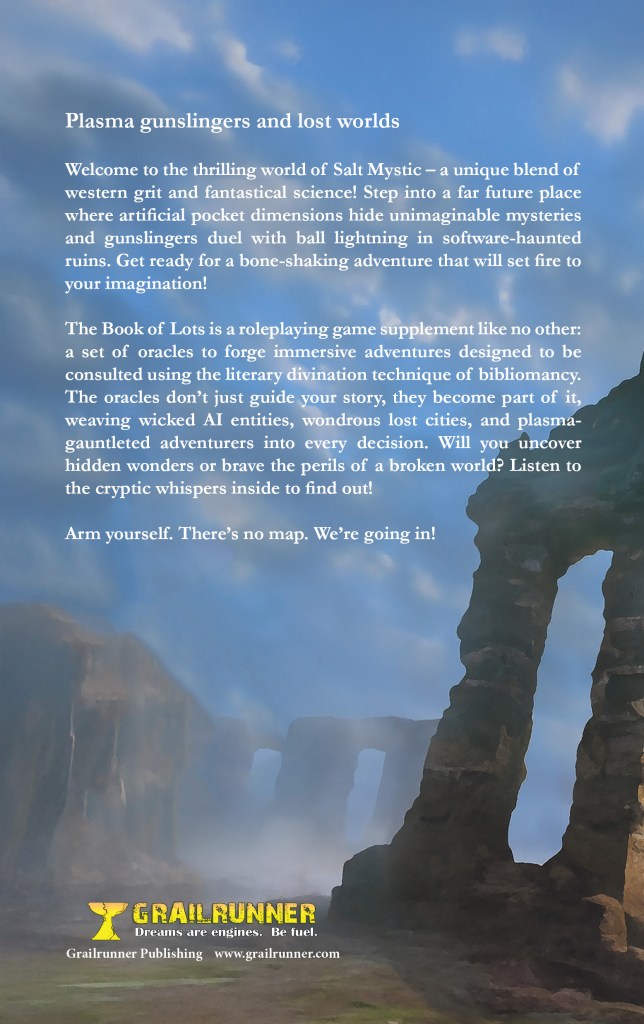
The cover file was a high res jpg I’d built in Adobe Illustrator, and it included some transparent png images (the title and the Grailrunner logo). The art was done with Daz Studio for the figures, some Blender and Photoshop filters for the forearm weapons, and some AI help for the background, everything composited and color graded in Photoshop then dropped into Illustrator for the text and placements. This is what that looks like, front and back:

Weird white outlines were appearing in the digital proof around anything that was a png in the image. Maddening! Nobody at Ingram Customer Service was responding, and internet advice was kind of all over the place. I tried various export presets and never resolved it, at last approving the digital proof even with the outlines in hopes that it was in fact a screen artifact only (as some advice suggested). Thankfully, the issue didn’t show up in the physical version.

As for offering a physical version through Drivethru RPG, I basically gave up. They seem to be saying they use the same print house as Ingram, though a different division or something? I dunno. Anyway, much worse issues with anything that was a png, including the interior art! A true disaster! I’m sure they would say it’s my fault, but I bailed entirely and just offer the digital version through them. My blood pressure thanked me immediately!

How did you advertise?

We ran campaigns on Facebook, through Google, Amazon, and on RPG Geek. The book is also listed this month on Ingram’s home page and in the World Reader, iCurate Connection, and Indiewire newsletters, all via Ingram (~28,000 circulation for the newsletters). Through the Independent Book Publishers Association, the book will be represented at the American Library Association conference in Philadelphia this June. We’ll see how all that works out, but here are some initial experiences:

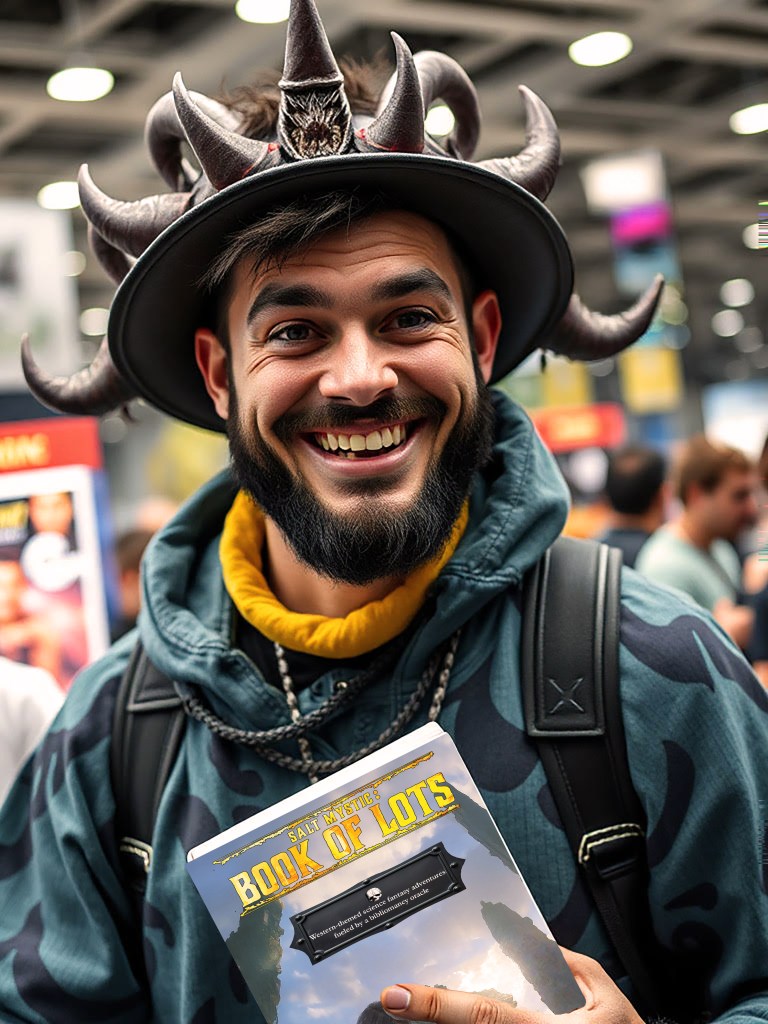
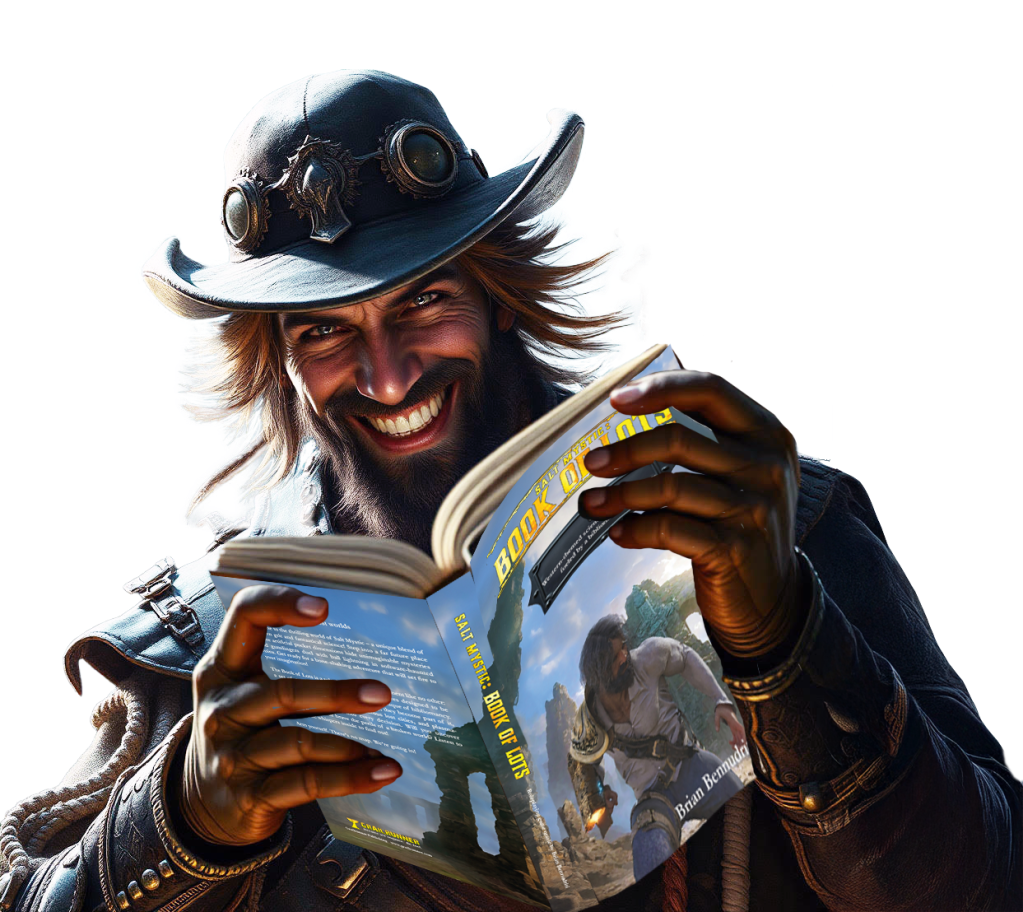
Meta (Facebook) started at 2.1% click rates with tens of thousands of impressions as well as loads of shares and likes and bookmarks. It all felt great until we saw that precious little of that was converting to sales. Internet research was suggesting a good click rate was 2% for search ads and 0.1% for display ads like banners, but for us it was just a lot of activity with poor conversions. By changing the graphics out to a grinning gunslinger and tweaking the copy a bit, we doubled the click rate to 4.2%. We’ll see if all those bookmarks and shares pay off down the line!

Google Ads was impressive, as their algorithm learns as you go, tweaking things to improve the reach. We wound up with a 5.1% click rate by the campaign’s end, which we view as solid. We even had one day peak at the end at 8.1%! All campaigns led to the same Amazon listing, so we can’t separate sales by campaign but I thought a lot of this experience overall.

RPG Geek was a little disappointing. Multiple banner and display ads dominated the site for a month. The thinking here was that this site entirely specializes in roleplaying games, so you couldn’t find a more on-the-nose target audience! Still, click rates flatlined at 0.1% for two weeks, till the same changes as above doubled that to a paltry 0.18% by campaign end.

Amazon: We only launched the Amazon ads in the last week or so – it’s a little early to report any results. I’d also never added any A+ content to a listing before, so that was new. Of course, I added that gunslinger since he seems to catch eyeballs, along with a very short description of the book.

So, was it a good launch?

Could have done more on pre-launch to get some mentions, honestly. We need to work on a solid email list and social media following though the new content required for that is a bit threatening when everyone has day jobs. Reviews remain super difficult to get, though some favorables have popped up that we didn’t arrange. Overall, sales are ramping up very slowly. Glacially, you might say.

What’s next?

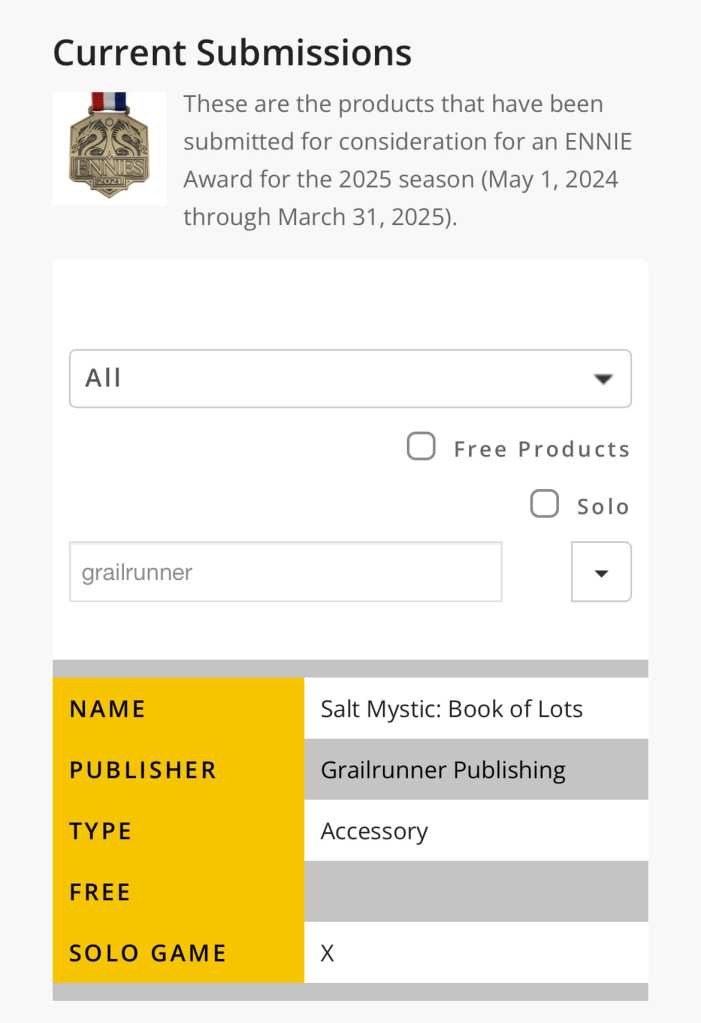
I submitted SALT MYSTIC: BOOK OF LOTS for consideration in the 2025 Ennie Awards, which is the Super Bowl of RPG’s! Any mentions at all would be high octane fuel for me. That’s a long shot, of course, just because of the ridiculous amount of talent in the field these days. Still, you never know…

*

I hope some of this was helpful or at least entertaining. Warts and all, this is how things have gone so far and the plan going forward. I’m sure the outside observer can find all manner of beasties and stinking swamps herein, but from the inside, it’s a wild, crazy bucking bronco we’re just happy to hold onto!

Till next time,