Oh, man have I got a great freebie for you today! I’ve been experimenting, pushing AI tools to their limits, these last 2 weeks to see just what’s possible in prototype gaming. I’ll tell you the story behind this, what all I did, then introduce a game which I’ll give you for free.
It has struck me recently that the future of entertainment is quite possibly on-demand, immediate & fully customizable media. I’m talking about having a random idea for a board game for example, and having the ability to describe it simply and have a color printer, 3D printer, music generation service, and AI tools spit out a polished, playable game with all its components ready for the table.
Is that what I did? Kinda sorta. That’s coming, but this was a lot more painful to bring to life than all that. AI tools are like a super creative and talented idiot whose attention wanders off while they generate random things, useless things, ripoff copies, and sometimes…some brilliant times…something magical.
Anyway, it started with me wondering what a naval boardgame would be like if it was designed by Hannibal of Carthage, Admiral Horatio Nelson, J. R. R. Tolkien, and the Monkey King of Chinese folklore.
Welcome back to our ongoing series titled:
Where in the world do you come up with strange ideas like that?
I don’t know. It happens. Then I have to see it. Then I lose two weeks of my free time. Then you guys get free stuff.
So, who were these people and why did you choose them?
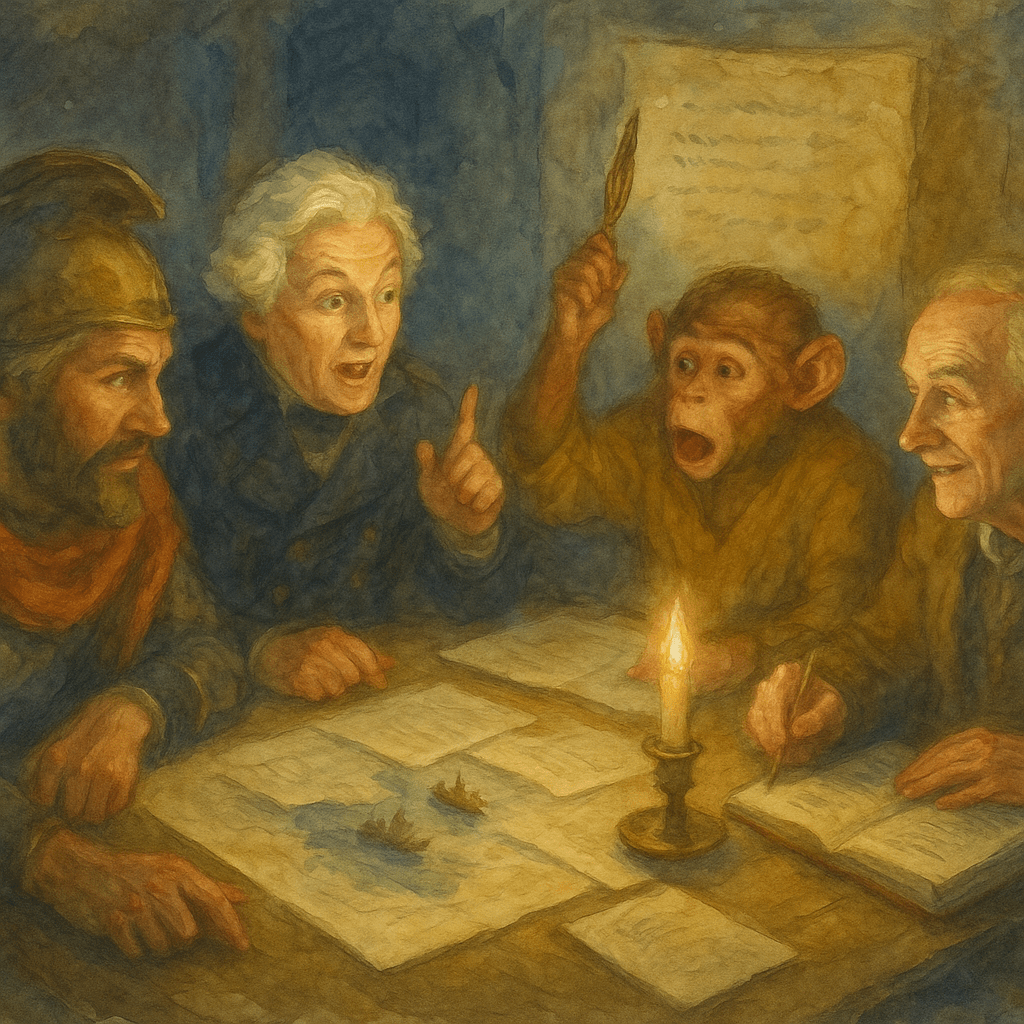
Hannibal of Carthage (c. 247–183 BC) was a brilliant Carthaginian military commander, best known for leading his forces — including war elephants — across the Alps during the Second Punic War against Rome.
I wanted the greatest, most innovative military mind in history. Arguable, I know, but I see Alexander the Great as a talented nepo-baby who inherited a lot of his advantages. I get there are others who could contend for that, but Romans used to put their babies to bed telling them to be good or Hannibal would come for them.
Horatio Nelson (1758–1805) was a British admiral and one of history’s most celebrated naval commanders. Famous for his bold tactics and inspirational leadership, he secured a string of decisive victories for Britain during the Napoleonic Wars.
This was going to be a sea warfare game set in Tolkien’s Lord of the Rings universe, so I wanted the greatest naval genius of history. His victory at Trafalgar was so resounding it established British naval superiority for a century.
J. R. R. Tolkien (1892–1973) was an English writer, philologist, and Oxford professor, best known as the author of The Hobbit and The Lord of the Rings.
This idea of sea battles in Middle Earth came to mind writing this article for Grailrunner speculating on the unfinished sequel to Lord of the Rings. It was the Professor’s setting, and he would bring unique insights to bring it to life.
The Monkey King is a Chinese folk hero from Journey to the West. A mischievous trickster with immense strength, magic, and a shape-shifting staff, he defied heaven before becoming a companion on a sacred pilgrimage — a lasting symbol of rebellion and wit.
I love trickster characters. Always have. This particular one is great for throwing the table over and over-the-top madness. I definitely wanted the rules of this hypothetical game to reflect that somehow.
And these three historical figures and a mythological simian were going to design this game then?
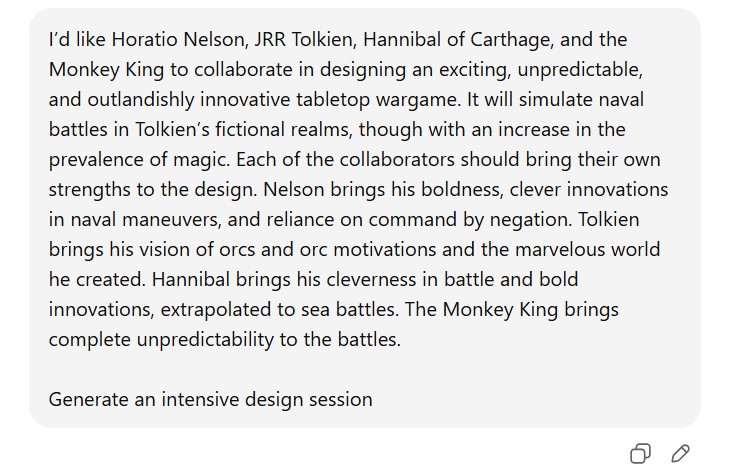
Right. This was the initial prompt. The design session was hilarious, and ChatGPT did an amazing job bringing these folks to life and crafting some basic game mechanics that applied their unique perspectives. Over the next few days in whatever free time I could manage (and during conference calls…sshh), I wound up having to exhaustively point out inconsistencies and vague points, iteratively asking for elaboration in the developing rules. Let’s say it was an ugly baking and the kitchen got messy, but the final ruleset honestly looks great and unique. Lesson here is be patient, don’t trust anything, don’t accept first outputs for anything, be super clear what you want, and give it feedback as you go.
I’m being honest in this experiment, by the way. I intentionally did NOT design or suggest any rules or game mechanics. The point was to explore what I was presented, not design it myself. All I did was ask questions and point out when the designer contradicted itself.
So you wound up with a ruleset. Nice. How about game components?
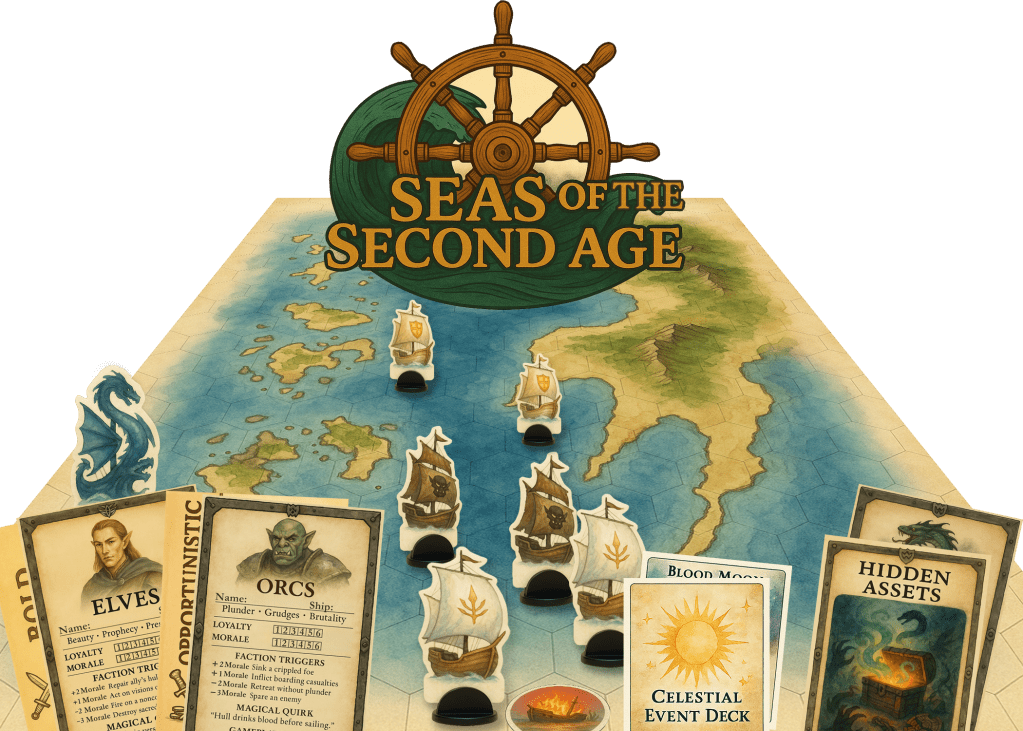
I was so fabulously surprised by the quality and consistency of the game components. I swear to you, no matter how cool these things look, I did absolutely NONE of the artwork, the graphic design, concept art, or logos. I used Photoshop like crazy, but that was only to clean these things up (like adding a “the” when ChatGPT refused to do or making a grid consistent across similar cards, that sort of thing).
I just scrutinized the rules, asking for elaboration when things didn’t make sense, and when I saw a component like a marker or a tracker of some kind get referenced, I would ask ChatGPT to design them one by one. Lessons learned here: never bother asking for a printable pdf – it’s useless at that, assume there are contradictions and inconsistencies you’ll need to fix, and only ask for designs one at a time. Once it had established a really attractive watercolor art style, I forced it to stay close to the same style for consistency in design. You be the judge on that, but these wound up some very attractive and playable components.
What is gameplay like?
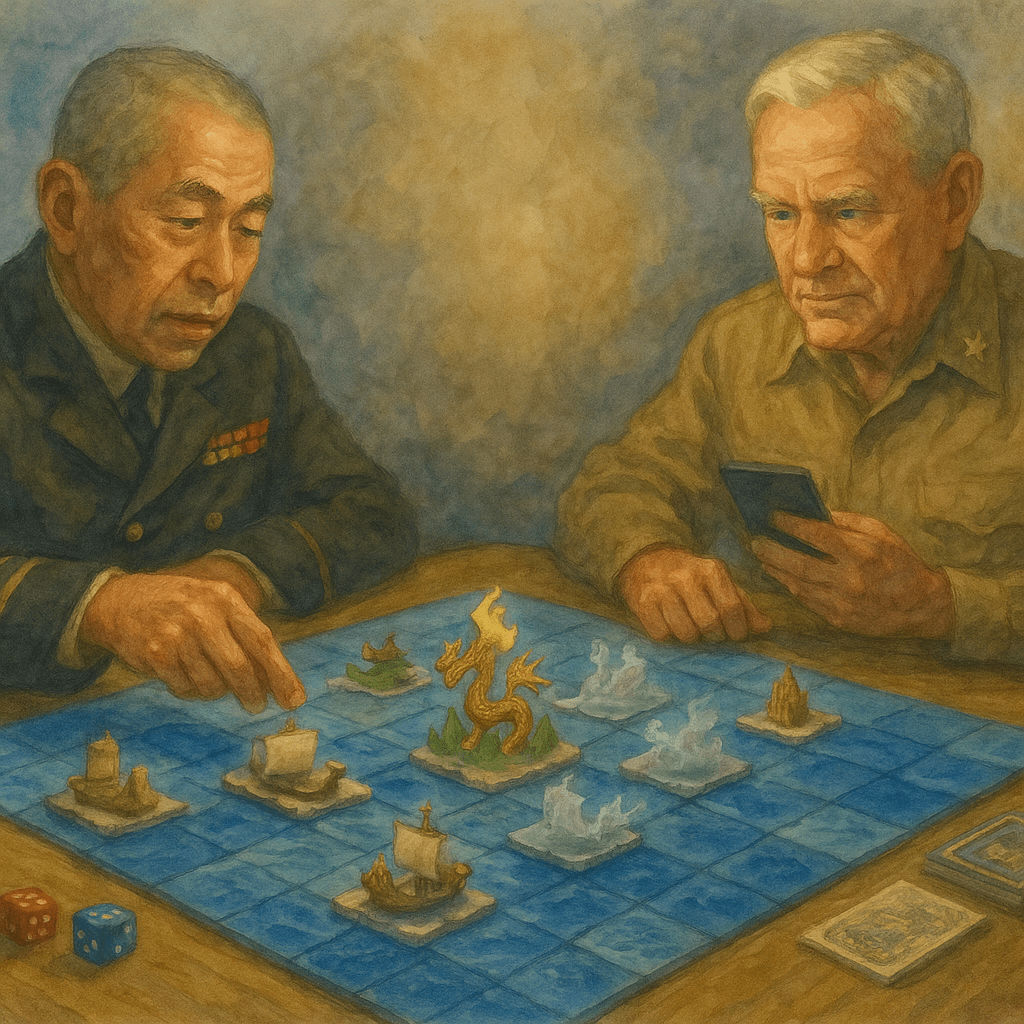
Funny, actually. I had Admiral Nimitz and Admiral Yamamoto, two more innovative geniuses of sea warfare, playtest in a simulation of the rules (just another simulation in ChatGPT, asking it to act as these two historical figures and play a game of the rules it had designed). Yamamoto chose the Elven fleet and built his game around precision strikes & ambushes. Nimitz chose Orcs and favored layered defense and overwhelming counter-punches.
Oh yeah? Who won?
Nimitz was pressing Yamamoto hard, but a Leviathan broke up his fleet and put him at a disadvantage. In the end, Yamamoto won by being more adaptable to the ever-changing conditions of the battlefield.
So how exactly are the personalities of these 4 designers reflected in the rules?
- Admiral Horatio Nelson
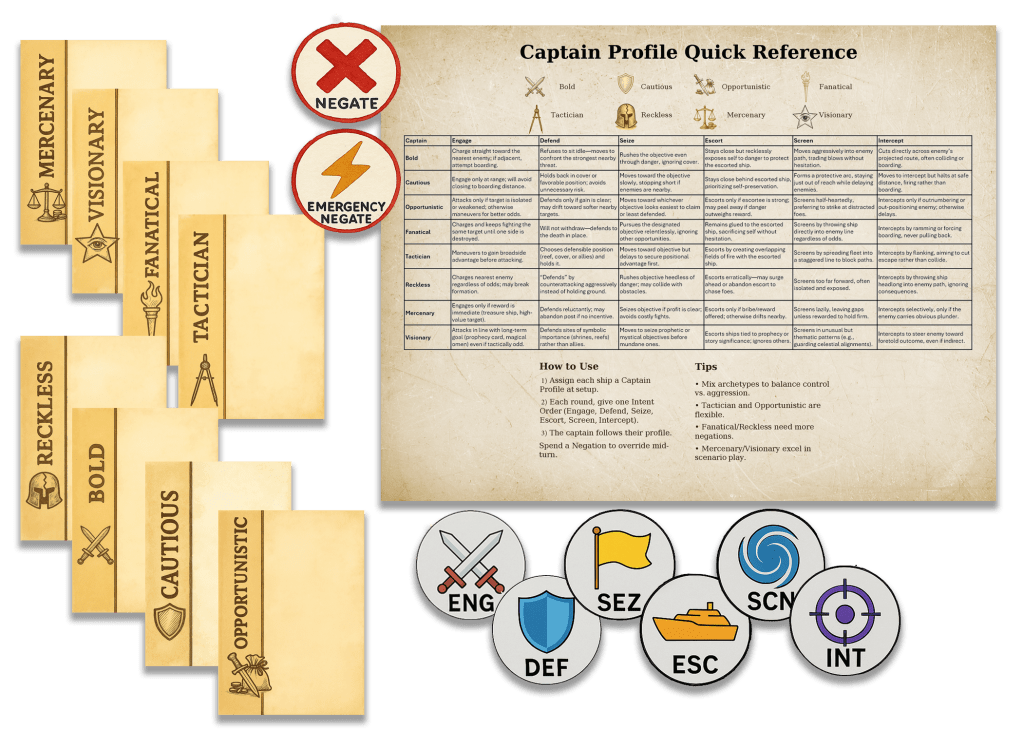
Nelson’s mechanic is command by negation, which requires the player to choose a personality profile for each ship captain and issue broad commands for each ship at the beginning of each turn. During each ship’s activation, that captain may or may not carry out the order as desired, and that is determined based on consulting a table. It flavors the strategy of the player, making you think about personality compositions of the fleet and what you’re likely to encounter. You have only so many “Negate” and “Emergency Negate” plays you can make before you have to surrender to the fog of war and trust your captains.
2. General Hannibal of Carthage
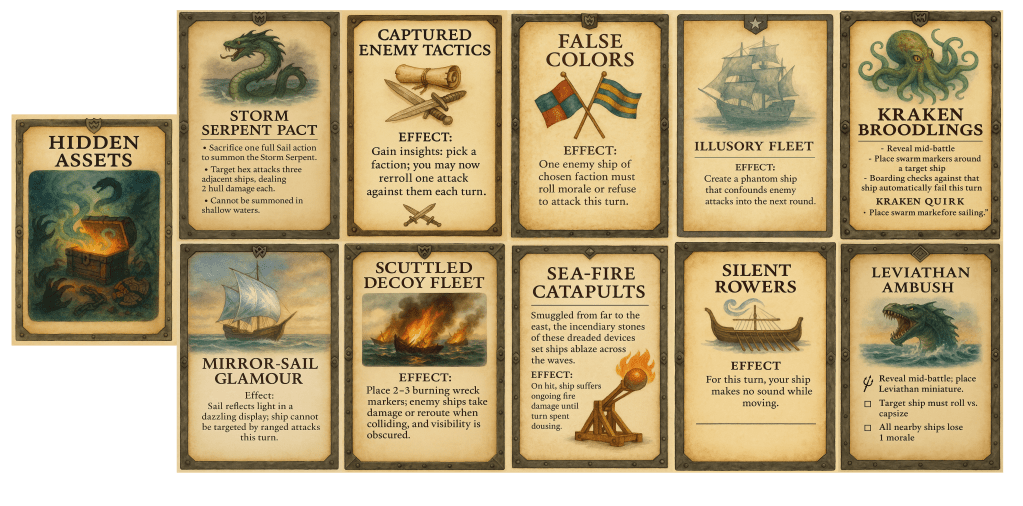
Before battle, players draw secret asset cards to recruit legendary sea-beasts, conduct some genius battle maneuver, or craft devastating magical artifacts. These assets are hidden until revealed at critical moments, enabling double-bluffs.
3. Professor J. R. R. Tolkien
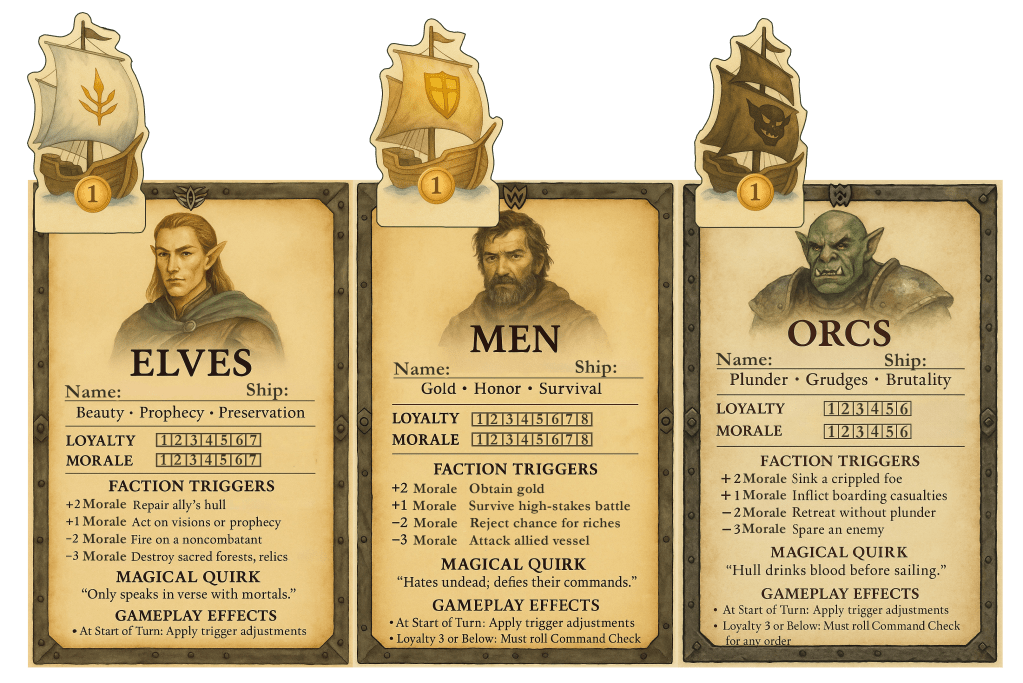
Each ship’s captain not only has the personality profile, but also dual Morale and Loyalty tracks, which are recorded on Living Loyalty cards. Orcs are motivated by plunder, personal grudges, and displays of brutality. Elves, by beauty, prophecy, and preservation. Men, by gold, honor, and survival. Disregarding a faction’s ethic by orders in battle or allowing the morale to suffer from specific battle conditions can result in mutiny or refusal to act.
4. The Monkey King
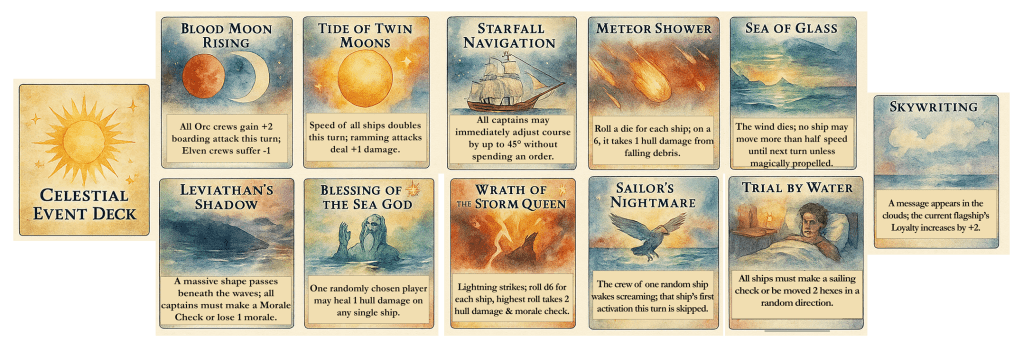
A “Celestial Event Deck” is drawn each round, representing maddeningly unpredictable supernatural occurrences that shift the seas and circumstances. It’s chaos every round, and it can turn the tide in your favor if you’re quick thinking and flexible, or it can crash your dreams into burning wrecks.
It sounds really fun. Have you played?
Some solo playtesting, yeah. It’s not perfect, and there are times you have to wing it and just go with whatever makes sense. Yet it hangs together surprisingly well. I’m not taking this any further, and we’re definitely not developing this for sale, but was super fun and satisfying.
What about the vision of immediate, on-demand game prototypes? Possible?
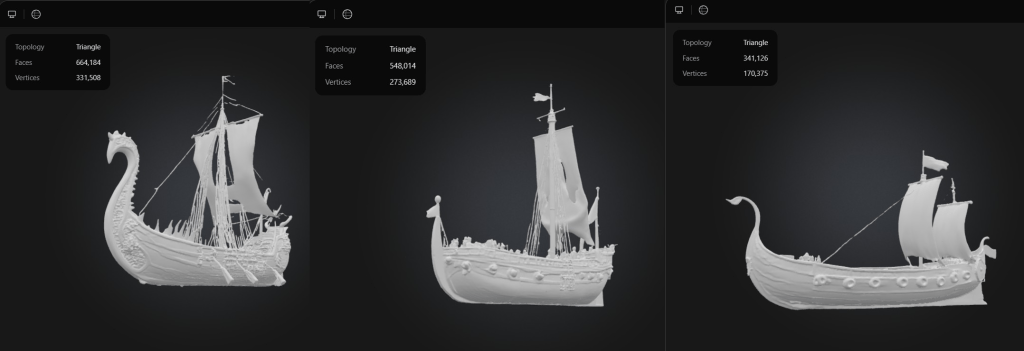
Oh yeah, just not now without a lot of manual work. I tried Meshy to generate some actual miniatures I could 3D print, and got something. I could tell at a glance they were going to need a bunch of cleanup in Blender before I tried printing them, and I was honestly exhausted with this process by that point. So nope, I went with printout standees for which you’d need the plastic stands. I stole some of those from a Gloomhaven box I had sitting around.
Still, if you’re asking me whether this on-demand, completely customizable future is possible based on this experiment, I’d say absolutely we’re headed into that world. I see a place for ChatGPT connected to a color printer with card stock, a 3D printer, and maybe a Silhouette Cameo or something like that for perforation (to avoid all that annoying scissor cutting), and you could really have something once the large language models mature a bit more.
Anything else to say before the download button?
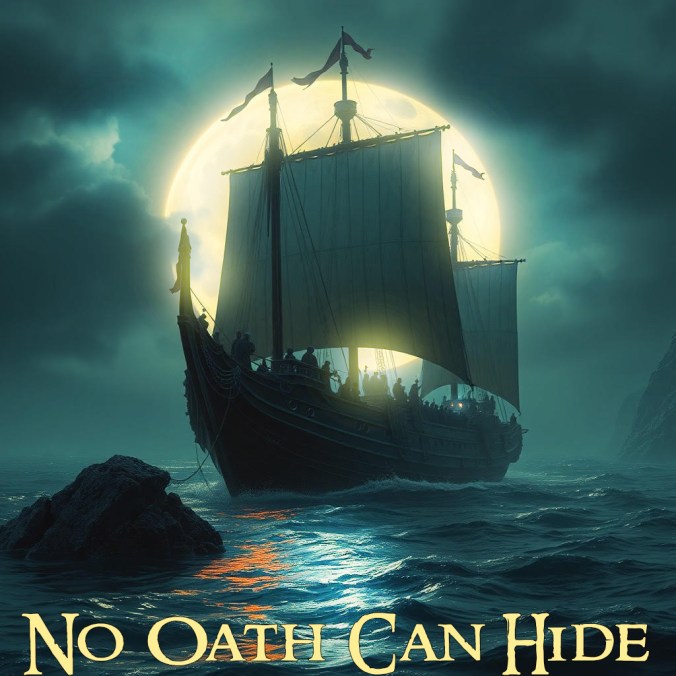
Well of course! There’s a theme song for the game. You really need to hear this. Remember, I didn’t design anything, including the logo at the top of this article. Neither did I write the lyrics or the melody. I just gave ChatGPT some direction on what sort of lyrics I was looking for with some example songs and the mood, iterating a few times for the right verses and choruses, then fed that into the Suno music generator with some more direction on Celtic, ethereal folk music and whatnot. Then I listened to a few and picked the best.
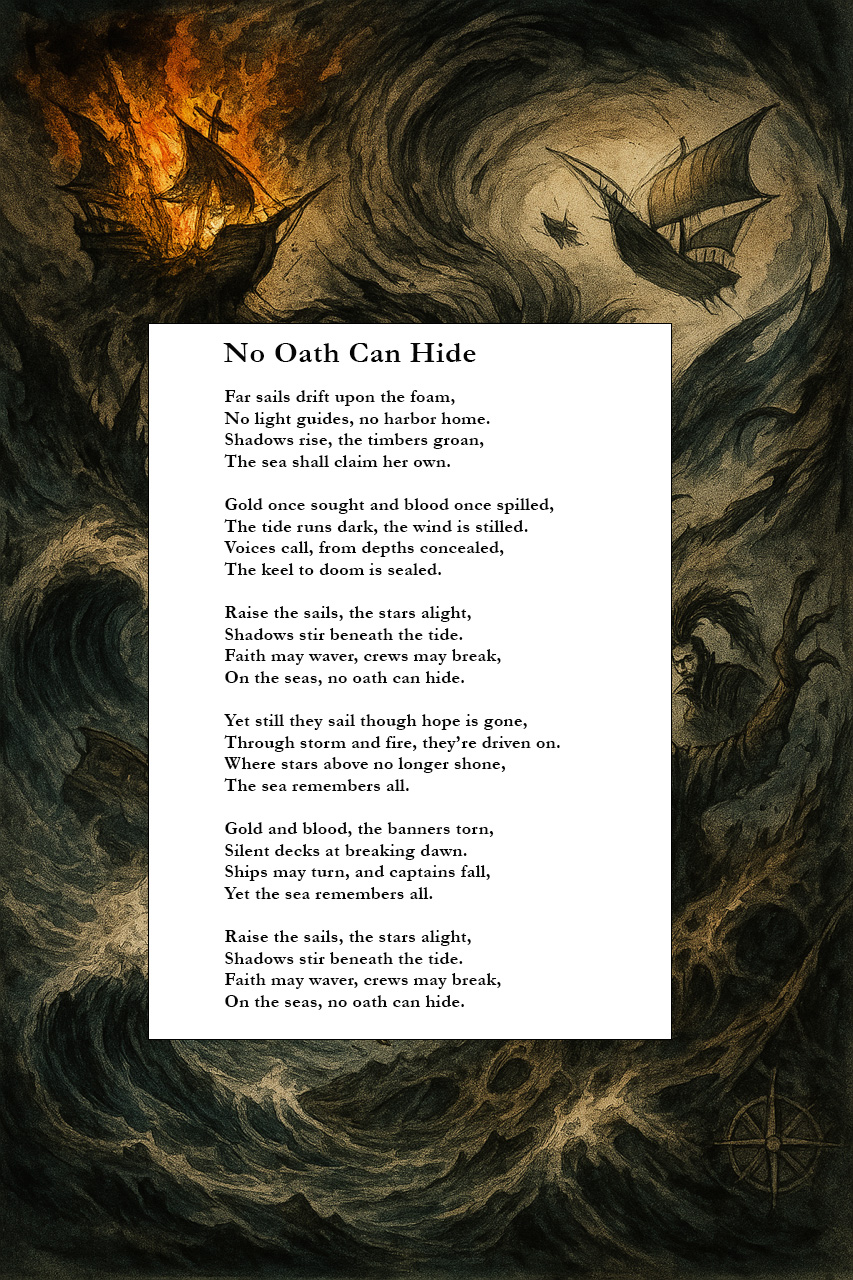
And honestly, I love it! It’s called No Oath Can Hide. Smash the button below to listen. Here are the lyrics.
Alright, then. Show me a download button!
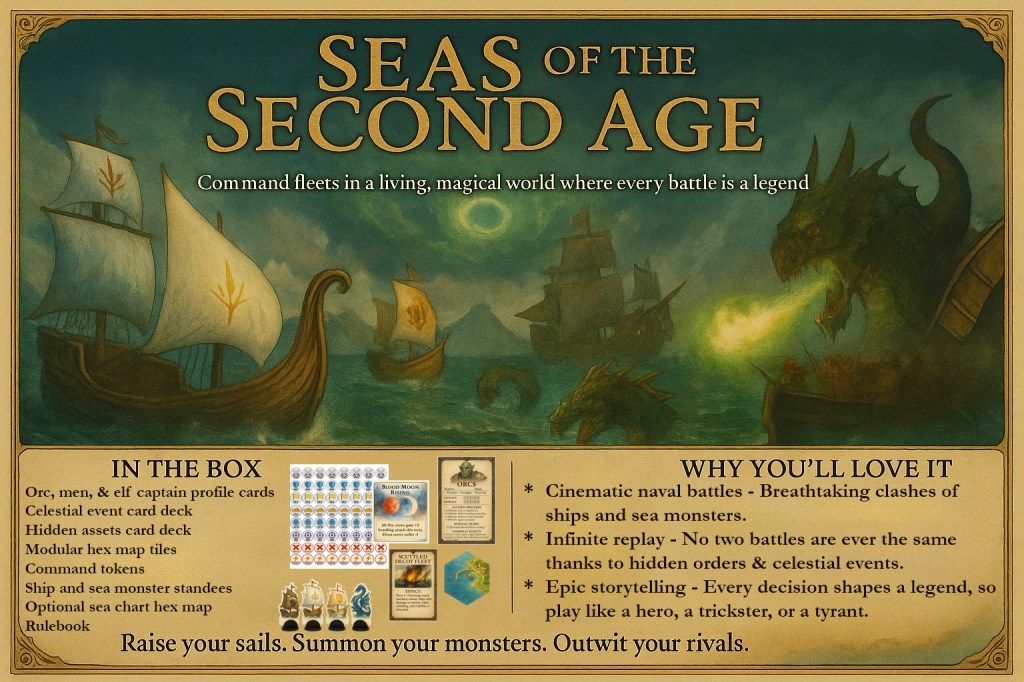
Sounds good. I hope you like it, or at least that can use some of these accessory goodies in whatever homebrewed games you’re dreaming up. The DOWNLOAD button links to a zip file containing everything you need to play apart from dice and some plastic stands for the ships, which means the stuff illustrated and listed below.
I hope you love it. What an amazing experience, and I’m looking forward to hearing what you think of all this. Don’t try to sell this anywhere though – it’s basically a glorified fan fiction that should be available for free.
Till next time,

 Grailrunner Publishing