Riffing Ideas Like Stan Lee: The Marvel Method With AI

Assuming there is an afterlife, and that I get to hug three people of my choosing for just how wonderful they were and how much they impacted me, I’m thinking (today at least, the list changes):

  1. Robin Williams
  2. Pausanius (explained here)
  3. Stan Lee

Honorable mention to Nicholas of Myra since he was Santa Claus.

Let’s talk about Stan Lee for a minute, and the miraculous collaborative technique he popularized, in many ways pioneered in comics writing called “The Marvel Method”.

Listen to him explain it here.

The stories Stan used to tell of the old days of Marvel are truly fascinating and inspiring. His mom got him the job with a cousin (it was Timely Comics then). Pretty much all the adults quit or didn’t care and were never around the office, leaving him as a teenager who knew nothing about the business pretending everything was fine.

All manner of folks apparently went on business as usual with the in’s and out’s of the office, never really knowing the kid that was always in was the one basically running everything. As he matured in the business, and couldn’t keep up with the many writing responsibilities, he relied on what came to be called “The Marvel Method”, meaning he would provide an outline or maybe just an idea to the artists, and they would go nuts from there, expanding the basic plot thread into intricate panels of story without words.

Stan would take what they sent, whatever they sent, and add the dialogue and narration, riffing off what they had provided since he only knew the basics of the story. With geniuses like Steve Ditko and Jack Kirby to work with, he made magic.

Here’s what you might have seen, for example, sent in by John Buscema:

We’ve stated our position on generative AI tools here at Grailrunner before. Bottom line, although many occupations are threatened by this rapidly evolving technology, it isn’t going away. In fact, it’s a new industrial revolution. We believe tools like Stable Diffusion and ChatGPT have a place in the world, but see them more like stock image websites or reference or idea books.

Like George Lucas did back in the day with Ralph McQuarrie’s mind-expanding images, the art and the ideas can dance together and make beautiful new worlds.

What’s that got to do with Stan Lee?

There’s a new experimental generative AI program called AI Comic Factory hosted on huggingface here. Looks like this:

You select the style and layout, then enter a prompt. When you hit the Generate button, it lays out a set of comic panels based on your choices and entry that are impressive.

While I have no intention of packaging these up for our Salt Mystic line, it really is fun to describe some of the elements of our IP and see what looks like a Humanoids comic illustrated by Phil Gemenez pop up in a few seconds with interesting graphic elements that inspire more ideas to pursue.

Look at these to see what I mean. My prompts were variations of cowboys entering dimensional portals, stone golems (glowing or otherwise), beautiful fantasy cities and majestic airships, that sort of thing. All very much in line with Salt Mystic adventuring.

I’m drooling at this. It’s incredible how inspiring this can be! When I’m looking for descriptions for a character now, or costumes (which I hate describing), or an interesting perspective for a city, I can go back to these and dream.

Recently, I started playing with Actions in Photoshop to turn images to pen & ink drawings with the click of a button. I have a very nice gallery of ball lightning carbines now to drop in to whatever I’m working on. For the header image, I grabbed one of those, color matched and graded it after compositing it in. I cut it off to fit the panel so it would look like it belonged.

Then I grabbed a cartoon dialogue bubble from a Google search and used Comic Sans font in Photoshop to add the gunslinger’s words. Not sure what he’s pissed about, or who in that city is going to pay for it, but it sends my mind reeling.

Anyway, that’s what I wanted to suggest to you today. If you’re going to try it out, don’t forget to be respectful of the artists who worked on the images that trained tools like these, but don’t be afraid to collaboratively build something new with them either.

Let us know what you think.

Till next time,
Jack Kirby’s Genius Of Composition & What We Can Learn From Him

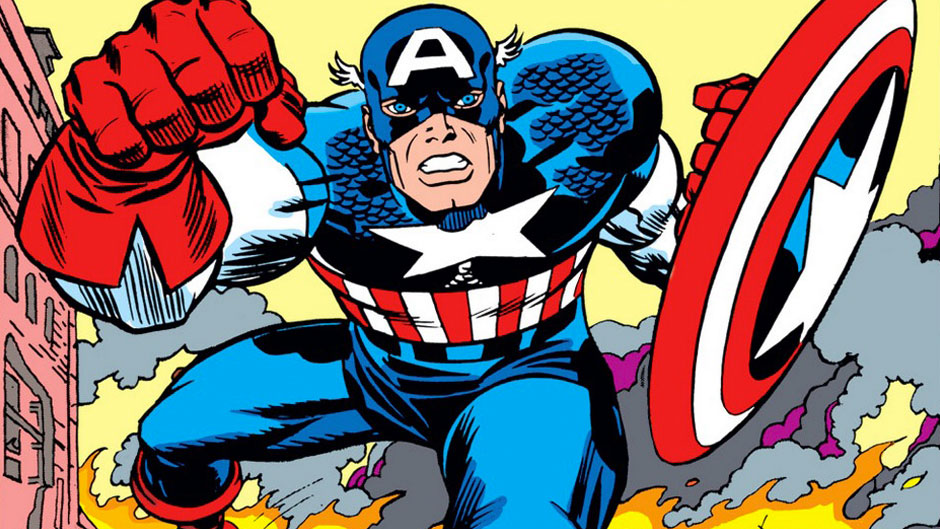
captain-america

So it’s a bit of a thing to people who particularly dig the history of comic books to credit either Jack Kirby or Stan Lee for some of the huge, transformative things that happened to Marvel in the sixties after the first Fantastic Four issue came out…but not both. A silly debate, because it was both of them with incredible chemistry and the beautiful, messy mix of amazing timing and talent that only happens a precious few times in any art form.

But I was watching this documentary about Jack Kirby that got me thinking about him in a different way than I ever had. If you don’t know who the guy is, you should google that right now or go to a place like here to see his style – you’ve seen it, maybe you just don’t know it. The guy’s American history and has influenced a majority of the guys illustrating comics today – it’s worth your time to know more about him.

The documentary I’m talking about is here:Part 1, Part 2, Part 3, Part 4, Part 5

What got me thinking was this: several of the artists they spoke to about Kirby said something I’d thought a lot when I was a kid – why does this Kirby guy keep getting work when he doesn’t know how to draw? Yet they kept going back to him because there was something there they found magnetic. The anatomy is wrong. The rules of perspective are twisted. Things don’t contort that way. It’s just all wrong. Yet the more they went back to him, the more influential he got to them. It soaked into their heads, like it did mine, because it was so different, because it broke the rules so irreverently, because it laid a new vocabulary of action and power and movement for an art form that was still trying to figure itself out. People needed to know how to say things graphically; and they needed to break out of some of the tried and tested methods because they were boring and tedious and based on a weird and forced application of old school comic strip doodling methods to prose stories. Instead, Jack Kirby was blasting fists out of the page and drawing gargantuan freaking alien ships or drawing guys who were just supposed to be sitting, but looked like they were about to rip the paper they were printed on apart. He put energy on the page and ignored what was going on everywhere else.

He worked from noon till early morning mostly, in a cramped basement with little space and crappy air conditioning, surrounded by science fiction pulps. When he was helping shatter and shape an entire industry for decades, that’s the kind of place where he was doing it. He’d reach behind him and grab a pulp, steal an idea and rejigger it till it was his, then charge it like a spring and draw it. Guys that watched him draw said he’d start at one corner and incredibly just make his way across to make it all work somehow, like it was all in his head to begin with.

  1. Kirby’s work ethic was inspiring. If I get bad news of some kind or if it’s a sunny day, or if I’m still stressed from work, I let a novel go for days without touching it. Like a little baby, whining. This guy jetted for half a day or more, never once missing a deadline, no matter how ridiculous it was.
  2. He paid attention to what other people were doing, sure, but set fire to it and crafted his own way of doing things that was entirely original, instantly recognizable as his and his alone, and didn’t let the things he knew technically get in the way of that. This advice is screaming at me.
  3. Just as an add-on, I always love to hear stories of guys who made the big time and weren’t too in love with themselves to bring folks into their world. Kirby and his wife, Roz made lunch for fans who made the trek to their little house – he’d show them around and even give them artwork. Actors now get a lot of credit for this kind of thing, when publicists really set them up.

Go look up some Kirby and remember what he managed to accomplish. If you think it’s wrong at first, pay closer attention and see if your opinion changes. He gets in your head, man. He gets in your head.

More Than Movies To Some Of Us

I was a geeky kid and alone often when I was growing up. I dug comics and science fiction, probably because Star Wars came out when I was six and my cousin had a million comics. Or maybe it was something else. Not sure how I got started; but I got started. One thing I was very consistent about was that DC comics – the ones with Superman, Batman, the Legion Of Superheroes and all those guys for the uninitiated, were boring to me; and I couldn’t relate to anyone in them. Marvel blew my mind. I would look for the Stan Lee box in the letters page and though I had no idea what, ‘Excelsior’ meant, it was awesome because he kept saying it. He could have said, ‘Baba ginouj’; and I’d have thought that was awesome too. Whatever. Guy was and is a genius of both marketing and mythmaking. I’ve at least made sure my kids have seen him a couple of times and heard him speak, so they crack up when he does all these cameos in the Marvel movies.

My point though, is this. The big stories we’re seeing in movies now that draw a billion bucks each time out, the ones drawing all the crowds, I read those stories the first time around. They were amazing on the page; and I felt just as excited back then sprawled under a pool table or up in a tree reading those on a summer day as a kid. I felt like Peter Parker was a buddy of mine, just a little older; and I absolutely rooted for him whether he was in the red and blue tights and swinging around buildings or getting crap from somebody at school because he was smart and quiet. He made sense to me. I remember being shocked that they’d actually let Bullseye kill Elektra, that Jean Grey was going crazy as Dark Phoenix, that all those X-Men were actually dying in, ‘Days Of Future Past’, and how awful and sad it was that Captain Marvel (the one that was a guy) had cancer like my grandmother did. One big thing I understood well was just how badly Peter Parker just really missed his uncle, and that, even though these were picture stories, Uncle Ben wasn’t coming back. Wow, you know? Those guys like Chris Claremont and Stan and Frank Miller made things that are timeless and powerful.

So my family makes fun of me when I see Captain America or some of these other guys up on the screen now and they’ve nailed the character so well. I watched, ‘Superman Returns’ and ‘Man Of Steel’ and thought they were awful. I’ve seen every X-Men movie; and they’re okay. I avoided, ‘Batman V. Superman’ because I’m just done with crappy adaptations that dodge the heart behind these stories and make slap-happy noise that looks like a video game. Somehow though, for whatever reason, the people at Marvel under Disney have managed (mostly) to make changes where it doesn’t matter at all and to keep the things that were so great. No joke, when I watched ‘Civil War’ with my wife and kids and Tony Stark was recruiting Peter Parker in Pete’s bedroom, pulling down the uniform, I was almost wiping away tears. That’s the Peter from when I was a kid! He was nervous and hiding his secret and smart and awed by being around the Avengers. They nailed it. Again. I don’t know who to credit for that; but they’re bringing back some old stories and some old friends that I hadn’t thought of in years and making me feel like I’m up in a tree on a July day with a comic book rolled up in my hand, munching on a fruit roll-up. Keep it up, guys!