Best day of the year. No doubt at all. I love Christmas in all its crazy-train, circus-riot, flashing chili peppers. I’m sorry if it’s not your jam, and I completely get that for some people. But for me, it’s a warm, crackling fire and pumpkin pie, making the dog wear a goofy sweater, eating at Harvey’s in Kansas City at Union Station, snacking on exotic candy and cookies from World Market, and just enjoying family.
I hope yours has in store for you whatever warms your heart.
2025 was another fun building year for Grailrunner. We published our bibliomancy RPG Salt Mystic: Book of Lots in the Spring and submitted to the Ennie Awards. No dice on the Ennie’s (see what I did there, bibliomancy fans?) but a good experience nonetheless. Following that, we rebooted the Grailrunner store, including the Discovery Series of t-shirts and also started selling our first art prints there. Click the “Shop Now” button to check that out.
Upcoming, we’ve got two Grailrunner novels still in the works: Mazewater (set in the Salt Mystic universe) and a horror novel likely to be titled Line (set in what we hope to launch as a series of blues-saturated highway terror stories we’ll call Highway of Ashes).
We’re also refreshing the art on the Salt Mystic tabletop skirmish game. That’s particularly exciting because feedback has always been that people wish we hadn’t gone with the 3D art of the original. We’re fixing that, so be patient. So far, they look fantastic – there are just a lot of them and only so much time in the day (and budget).
I’m hoping in 2026 we can at least get started on a marvelous idea that’s been bubbling around the Grailrunner creation station for a few months now: a fantasy fishing roleplaying system to be called Dreamwater. If we can get this put together, and if you at all see the attraction of sitting by a beautiful lake with a fishing rod in hopes of catching a magical fish that speaks and possibly changes into a fighting beast, then we’ve got your back with this one. Will be amazing.
Anyway, thanks for hanging around with us this year and stopping by to see what nonsense we get up to. I’m always interested to see where people are that read our posts – drop us a note here or on the Facebook page to stay in touch. Let’s hope we can keep finding novelties of history to tell you about, fascinating creators to interview, great pulp science fiction of the past to highlight, and amazing freebies to send your way. Have a look here to see if you missed anything cool.
Anyway, in celebration of the year and this holiday season, I wanted to point you to some beautiful and nostalgic Christmas illustrations to enjoy.
To honor Christmases of the past, I came across a few vintage Christmas illustrations and links to their sources that sent my mind reeling. I love the windey-turney path by which we got so many of our Christmas traditions, and these really caught my eye:
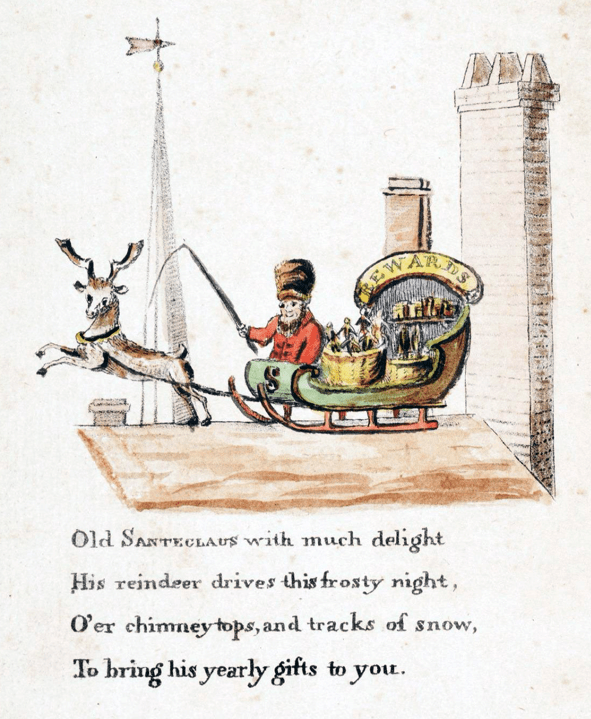
In 1821, a small illustrated paperback titled The Children’s Friend: A New-Year’s Present, to the Little Ones from Five to Twelve was published. It contained quite possibly the first mention and illustration of Santa’s reindeer and sleigh and predated Twas The Night Before Christmas by 2 years. It may have even inspired Clement Clarke Moore to write that poem, which of course gave us the core of our modern Santa Claus.
And of course the famous cartoonist, Thomas Nast fine-tuned the Santa we know and love today in his wonderful illustrations, many of which are compiled in a book titled Christmas Drawings for the Human Race. Here’s a link so you can take a look at the entire book. It’s a real treat to see some of these masterworks and know as you appreciate the craftmanship and warmth that these very pictures are what taught us how the jolly old elf looks and makes his way. In many ways, Nast described all this for us, and he did it to help heal America from its wounds from the Civil War.
Here are a few of those gorgeous illustrations, which are hilarious and charming. You really should take a few minutes to go see the full series of art pieces. They’re important history, but also just magical.
That’s what I wanted to bring you today. I wish for you all the joy that you can wish this Christmas and for a shining, prosperous new year.
Since we kicked off Grailrunner around 2016 or so, I’ve intentionally left out references to me personally or the contractors I work with. My thought was to keep this super professional and focus on inspiring ideas and cool tools or giveaways that prod other people’s imaginations. Grailrunner Publishing is just a network of like-minded folks that help me put new things into the world, with the potential for other like-minded folks to (hopefully) catch a spark here and unleash their own.
I’ve noticed, however, that a lot of Youtubers are finding these days that their audiences seem to want to know more about them personally, beyond whatever terrain building tips or historical curiosities they talk about. Then occasionally, we get asked the magic question:
Who is Grailrunner?
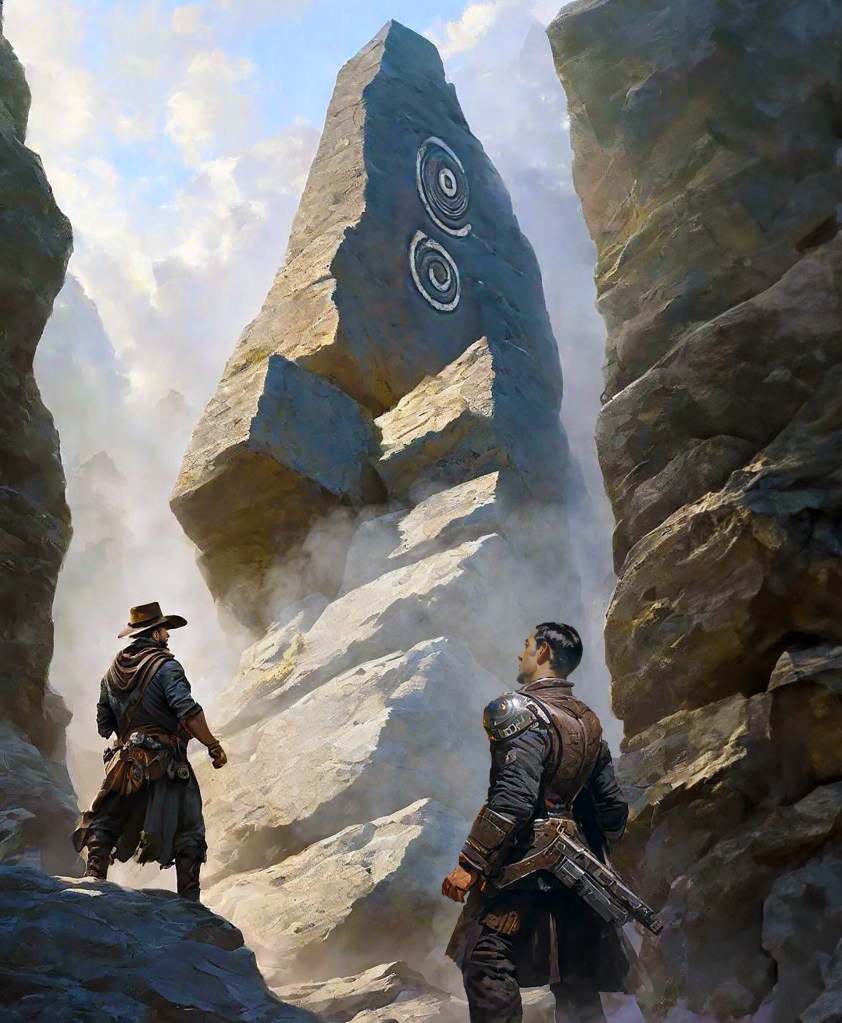
So for giggles, I’ve rewritten the ABOUT page to tell the origin story and shed a little light on that, specifically recounting the strange experience I had in a rock gorge in Oman in 1997 that poured jet fuel into what became Grailrunner and our signature property, Salt Mystic.
No fairy tales. No gimmicks. That happened. Go read it to see what I mean. Over a decade later when I read that C.S. Lewis had a similar experience that turned into the Narnia series, it struck a chord with me big time. But anyway, in order to celebrate this slight shift in the Grailrunner approach to you guys, I thought it would be awesome to have something cool and free for you to enjoy.
So I wrote a Grailrunner theme song.
I was going for Springsteen/Bob Dylan-style poetry with a modern rock vibe, and I wanted to include a variation on our slogan: “Dreams are engines. Be fuel.” Not an easy task, I’ll grant you. It wasn’t a pretty process. I’m also bad about mixed metaphors, so if you detect any traces in the lyrics of shifting imagery, just be cool about it.
And no, that isn’t me singing. I used Suno, an AI app, to take the lyrics and generate a bunch of variations – all in a rock & roll direction but with some tweaks on other styles to get something nice that didn’t sound like everyone else. I think it turned out fantastic.
Anyway, let me know what you think about all this. And if you liked the song, I’d especially appreciate hearing that as my wife thinks it’s too loud and fast. We kind of all need to tell her how wrong she is about that.
It’s been a month since we published SALT MYSTIC: BOOK OF LOTS, a solo roleplaying game based on our multi-media Salt Mystic setting. There are some bright spots, some hopeful notes, and a world of pain. Overall, we’re still incredibly proud of the product and seeing and hearing people appreciate it in the wild is an experience like nothing else!
We thought it would be helpful for anybody thinking of putting your own book out to see what we tried: what worked, and what didn’t…and what still might. Care to come along?
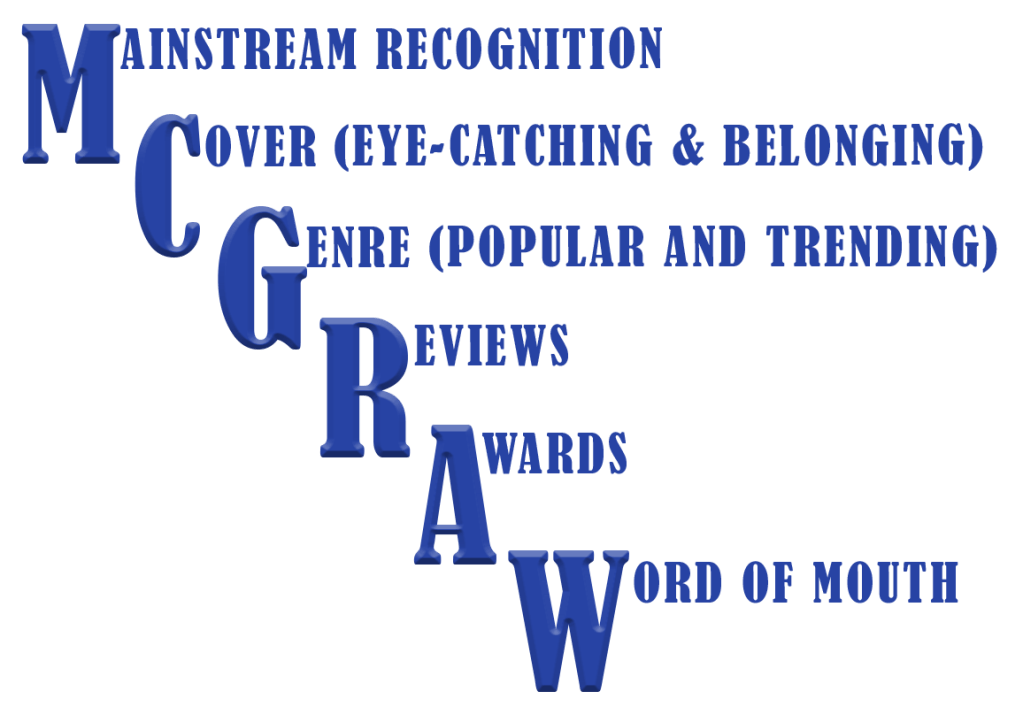
Way back in 2016, I wrote a short article defining some indie publishing principles based on lessons from the launch of my first book: TEARING DOWN THE STATUES. The principles were consolidated into the acronym “MCGRAW”, suggesting the key elements necessary for publishing success (Mainstream recognition, an eye-catching Cover that looks like it belongs with books like it, a popular Genre, as many Reviews on major listing sites as possible, Awards to add validation that the book merits attention, and Word of Mouth.) We kept these in mind this launch and tried to incorporate what we could, although the genre of tabletop roleplaying is so saturated and so dominated by Dungeons & Dragons that we were working uphill and digging holes from the beginning.
Still, hope springs eternal, and this is a product we believe in mightily, knowing from its ideation that nobody else was doing anything like it.
What was the pre-launch like?
February was a hot mess, finalizing the proofs and shaking trees to try and get attention from bloggers and gaming news sites. Short of providing free pizza delivered by cosplayers who do magic tricks, I’m not sure what else we could have done to get mentions from some of these guys – we reached out to 20 and got one “No, Thanks” and absolute crickets otherwise. That’s offering a free physical copy for review, by the way. Local gaming store wasn’t interested, and I didn’t have the heart to cold call others. My ego can only take so much bruising!
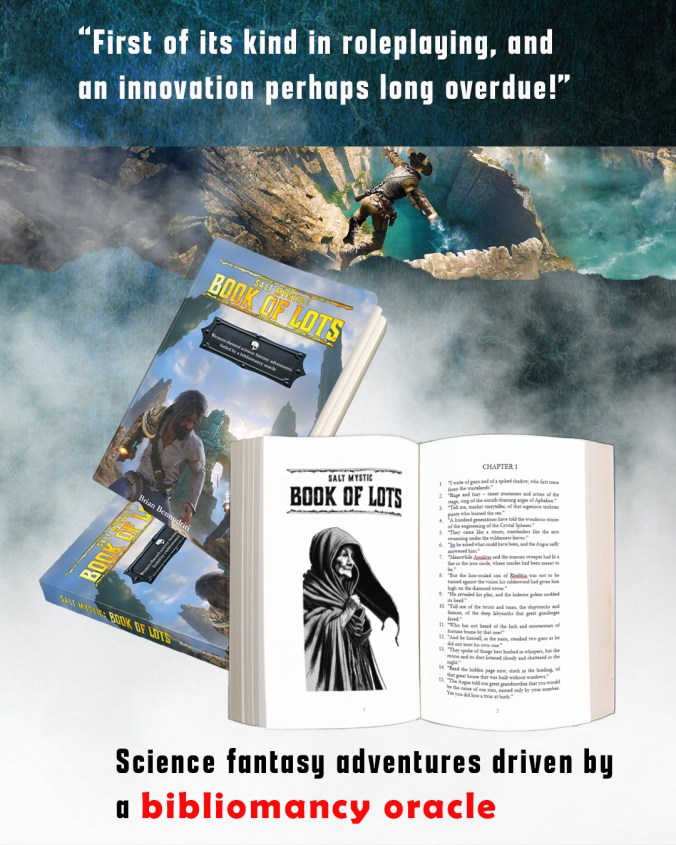
I pushed my Photoshop skills to the breaking point generating ad assets to use in social media and ad campaigns, stirring up some images that I think really popped! Here’s my favorite, though we had to switch it out to juice the click rate after things got rolling.
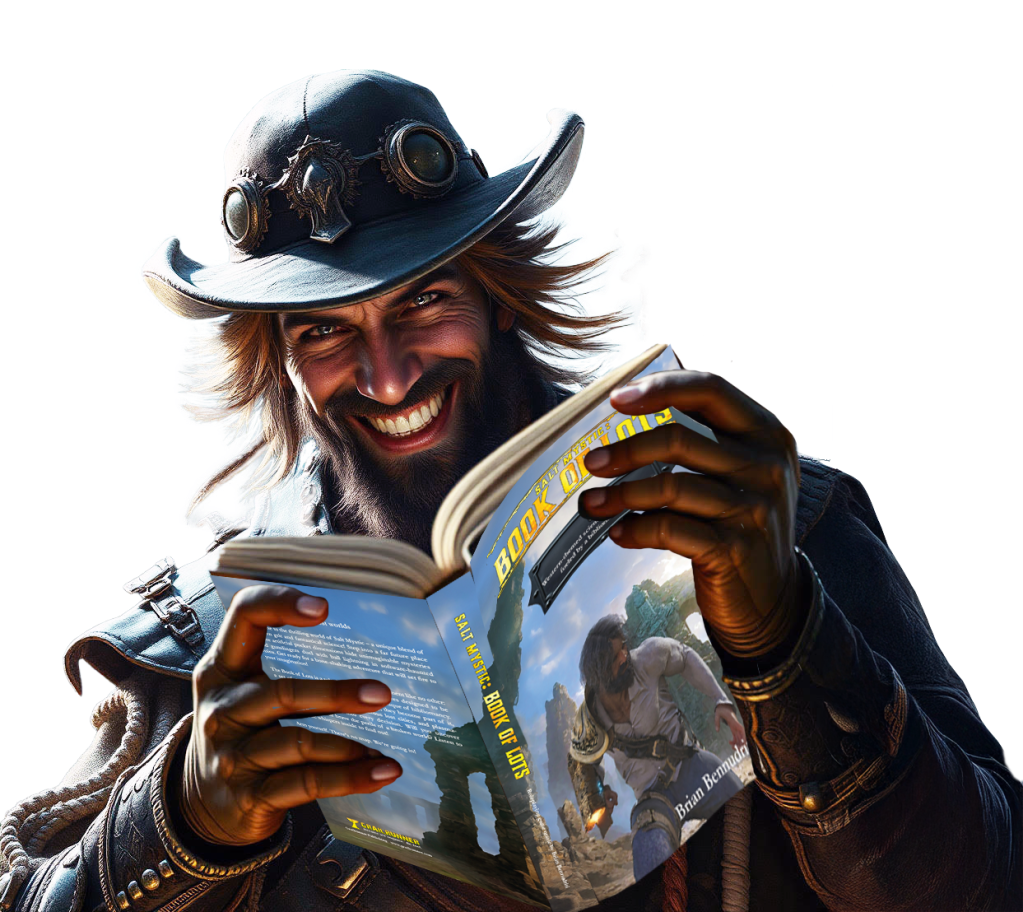
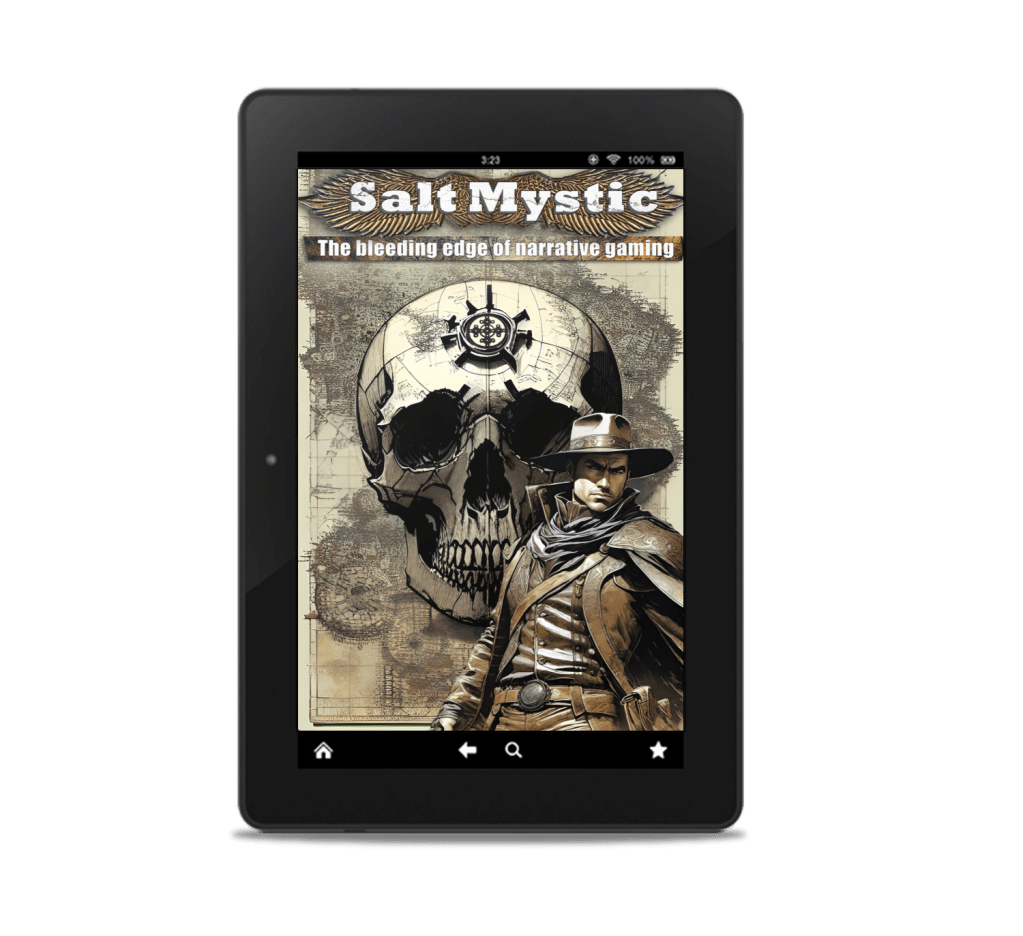
I’m a big fan of Absolute’s 3d cover generator and Envato’s PlaceIt – both to generate mock up’s of the cover in various places. We generated this one below for banners through RPG Geek and some other sites:
We came SOOOO close to hiring an artist we’ve been targeting for years now, and he might yet come on board for a promotional poster, so I won’t jinx anything by saying more. That would be amazing, so wish us luck! Anyway, he was swamped with other things, so the heavy lifting on graphics was still in-house.
How did you handle distribution setup?
The book is available at booksellers globally through Ingram Spark, and also on Amazon thru Kindle Direct Publishing, as well as the pdf on Drivethru RPG. We got the barcode direct from Bowker to retain full distribution rights – there are strings attached to the freebies. Honestly, setup was fairly painless for Kindle Direct, but I thought at one point Ingram was going to leave me with facial tics!
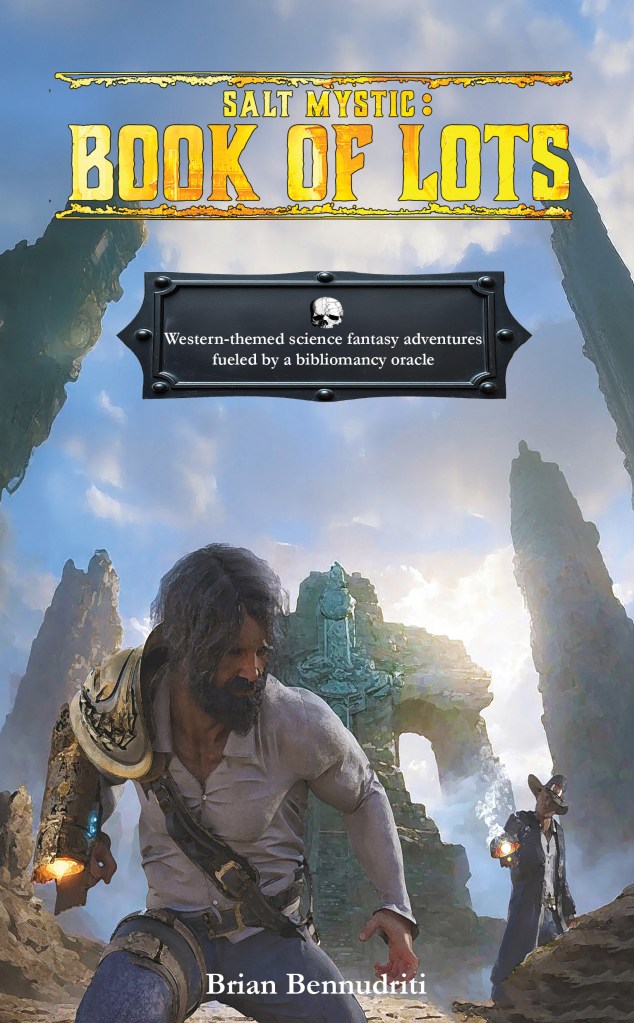
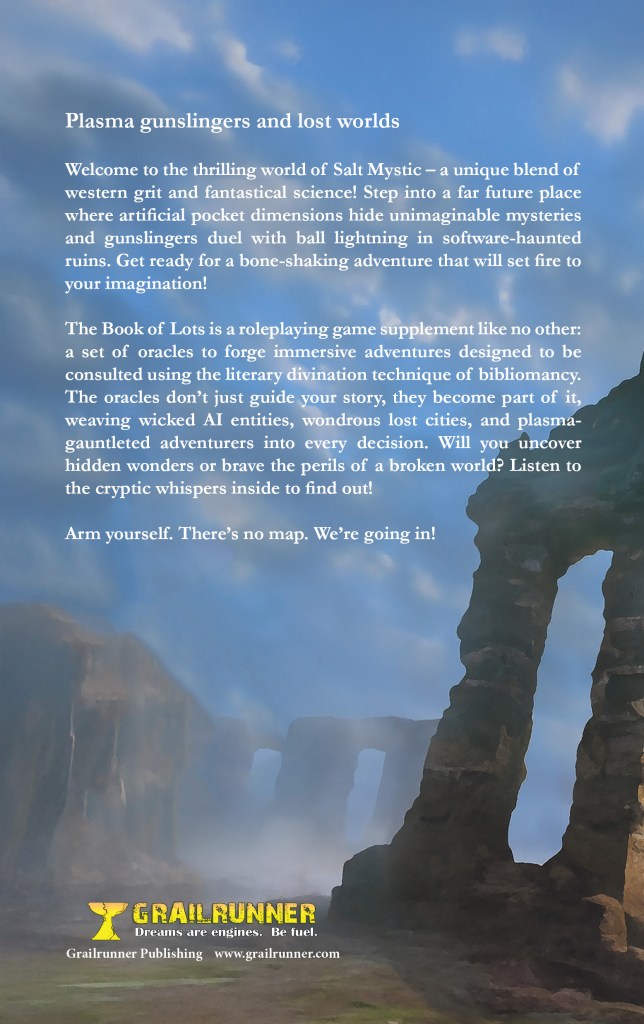
The cover file was a high res jpg I’d built in Adobe Illustrator, and it included some transparent png images (the title and the Grailrunner logo). The art was done with Daz Studio for the figures, some Blender and Photoshop filters for the forearm weapons, and some AI help for the background, everything composited and color graded in Photoshop then dropped into Illustrator for the text and placements. This is what that looks like, front and back:
Weird white outlines were appearing in the digital proof around anything that was a png in the image. Maddening! Nobody at Ingram Customer Service was responding, and internet advice was kind of all over the place. I tried various export presets and never resolved it, at last approving the digital proof even with the outlines in hopes that it was in fact a screen artifact only (as some advice suggested). Thankfully, the issue didn’t show up in the physical version.
As for offering a physical version through Drivethru RPG, I basically gave up. They seem to be saying they use the same print house as Ingram, though a different division or something? I dunno. Anyway, much worse issues with anything that was a png, including the interior art! A true disaster! I’m sure they would say it’s my fault, but I bailed entirely and just offer the digital version through them. My blood pressure thanked me immediately!
How did you advertise?
We ran campaigns on Facebook, through Google, Amazon, and on RPG Geek. The book is also listed this month on Ingram’s home page and in the World Reader, iCurate Connection, and Indiewire newsletters, all via Ingram (~28,000 circulation for the newsletters). Through the Independent Book Publishers Association, the book will be represented at the American Library Association conference in Philadelphia this June. We’ll see how all that works out, but here are some initial experiences:
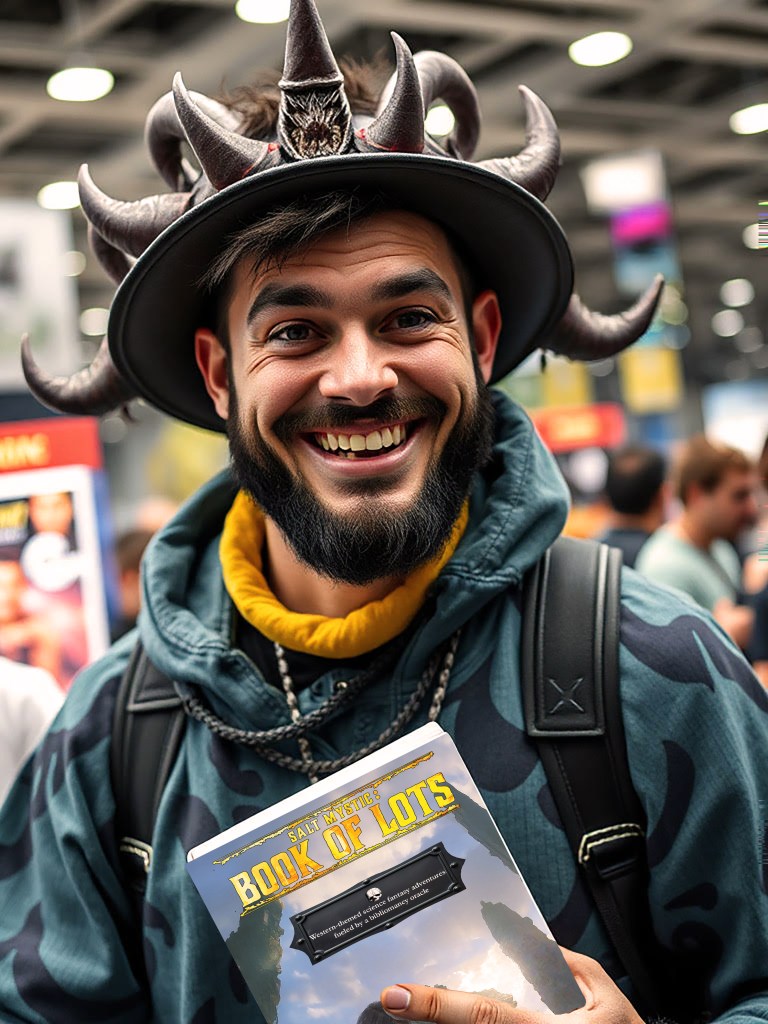
Meta (Facebook) started at 2.1% click rates with tens of thousands of impressions as well as loads of shares and likes and bookmarks. It all felt great until we saw that precious little of that was converting to sales. Internet research was suggesting a good click rate was 2% for search ads and 0.1% for display ads like banners, but for us it was just a lot of activity with poor conversions. By changing the graphics out to a grinning gunslinger and tweaking the copy a bit, we doubled the click rate to 4.2%. We’ll see if all those bookmarks and shares pay off down the line!
GoogleAds was impressive, as their algorithm learns as you go, tweaking things to improve the reach. We wound up with a 5.1% click rate by the campaign’s end, which we view as solid. We even had one day peak at the end at 8.1%! All campaigns led to the same Amazon listing, so we can’t separate sales by campaign but I thought a lot of this experience overall.
RPG Geek was a little disappointing. Multiple banner and display ads dominated the site for a month. The thinking here was that this site entirely specializes in roleplaying games, so you couldn’t find a more on-the-nose target audience! Still, click rates flatlined at 0.1% for two weeks, till the same changes as above doubled that to a paltry 0.18% by campaign end.
Amazon: We only launched the Amazon ads in the last week or so – it’s a little early to report any results. I’d also never added any A+ content to a listing before, so that was new. Of course, I added that gunslinger since he seems to catch eyeballs, along with a very short description of the book.
So, was it a good launch?
Could have done more on pre-launch to get some mentions, honestly. We need to work on a solid email list and social media following though the new content required for that is a bit threatening when everyone has day jobs. Reviews remain super difficult to get, though some favorables have popped up that we didn’t arrange. Overall, sales are ramping up very slowly. Glacially, you might say.
What’s next?
I submitted SALT MYSTIC: BOOK OF LOTS for consideration in the 2025 Ennie Awards, which is the Super Bowl of RPG’s! Any mentions at all would be high octane fuel for me. That’s a long shot, of course, just because of the ridiculous amount of talent in the field these days. Still, you never know…
*
I hope some of this was helpful or at least entertaining. Warts and all, this is how things have gone so far and the plan going forward. I’m sure the outside observer can find all manner of beasties and stinking swamps herein, but from the inside, it’s a wild, crazy bucking bronco we’re just happy to hold onto!
Back in October of 2023, we celebrated being at the halfway mark in completing a thrilling new project at Grailrunner. Incredibly, and I can’t believe I’m finally typing this, we’re finished! This puppy is ready to run!
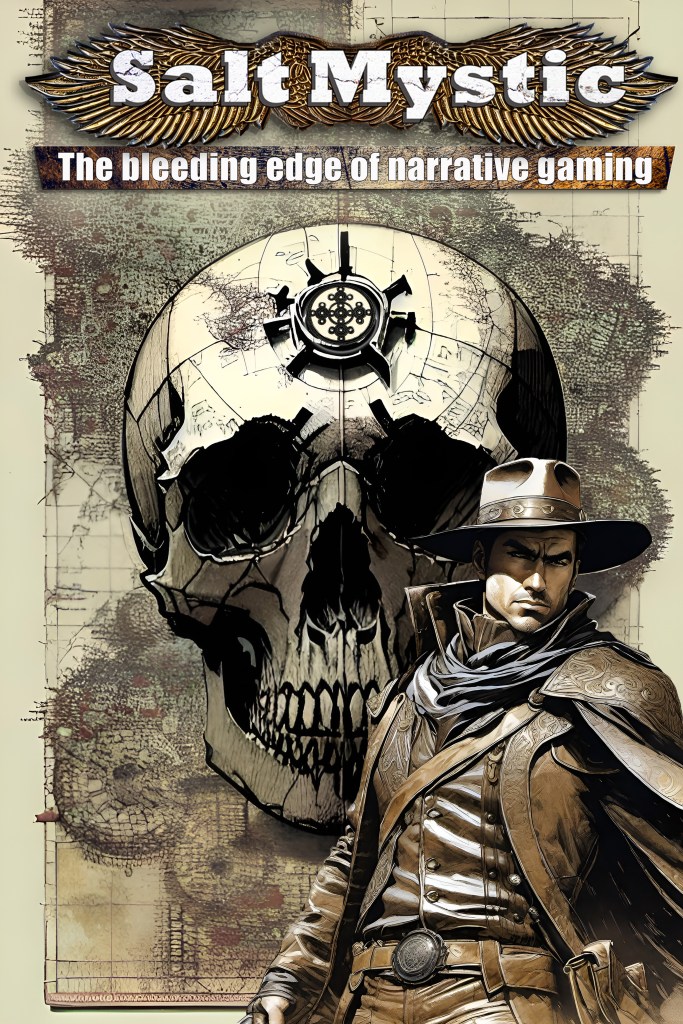
March 1st, 2025, we are launching SALT MYSTIC: BOOK OF LOTS, a roleplaying game & supplement aimed at the solo player providing western-themed science fantasy adventures through a bibliomancy oracle.
Who are we?
If you’re new around here, we’re Grailrunner, an indie publisher of science and speculative fiction fiction and games. Our driving passion and special emphasis is on the creative process – innovations in immersive storytelling. Read about that here.
What is the BOOK OF LOTS?
The spirit behind the whole project was to provide the thrill and danger of exploration and adventure inside the cover of a book and to open a fully realized world accessible through the fortune-telling mechanics of bibliomancy.
Contents of this 265 page book include an introduction to a far-future setting (western-themed, so plasma-gauntlet dueling cowboys delving pocket worlds), a simple, streamlined set of rules enabling a player to use no ruleset at all or even dice outside of the book, and a 40,000+ word set of short passages, consulted via bibliomancy to judge outcomes and events, adding story prompt flavor to judgements. Also included are a map and atlas descriptions of locations in the setting, 13 traditional nested oracle tables to further drive events in the story and a detailed index.
How does it work?
We walk you through it in a prologue with a detailed Quick Start example, but the general idea is to use the setting descriptions, the atlas and map, and the oracles tables to build out the skeleton of a character and story following a framework we call the Five Questions. Then, either use the roleplaying game rules of your choice (like D&D or Free League’s Year Zero system) or use the barebones, streamlined rules of this book to start experiencing your story.
Either once per in-game day or as you see fit, consult the lots by holding a specific question in your mind and turning to a random passage on a random page, locating a 1 -3 line passage (called a “lot”) and its number. A question might be “What will I find on the other side of this hill?” or “What happens when I try to climb the walls of these ruins?”
The rules provide for YES/NO answers as well as more sophisticated outcome judgements, but, more importantly, add a layer of story prompt-style chaos and randomness to what happens.
Shoot me a comment here on this article if you’d like to know more or if you’re interested in a review copy.
Since we’re a teensie little indie publisher, it’s super hard to get attention and drum up interest in new products, especially if they’re very different or not related to dungeons. If you’re willing to post something for yourself linking to this announcement, it would be tremendously appreciated!
Every little kind word helps!
*
Anyway, that’s the big announcement. I hope you can feel some of the excitement here on our side. This has been an incredible and life-changing amount of work. It’s nice to start telling people about it.
I lost over thirty years in my art journey because I (stupidly) took a wrong turn based on what should have been great advice. Let me tell you about that, how exactly I went off the rails, and what a ridiculously talented Korean artist said that got me back on the journey.
If you care about the process of visual creation, whether it’s you doing the creating or just a spectator’s interest in how all that works, then this one’s for you.
Why does this matter?
Crap, man, I’d like to be thirty years better in drawing and painting! I hate that I stepped away for that long. I’m the chief illustrator for Grailrunner, and its lead writer, and its game designer. I need to get a lot done myself to control costs, but somehow keep a high standard on quality of art to convey the unique (we think) property we’re trying to build with the Salt Mystic line.
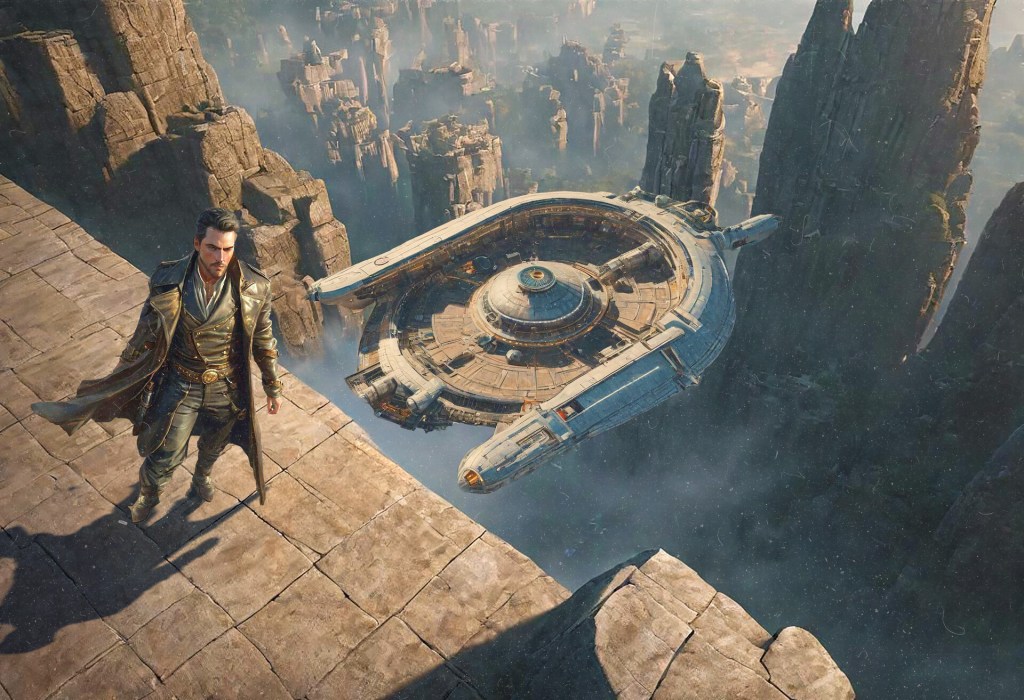
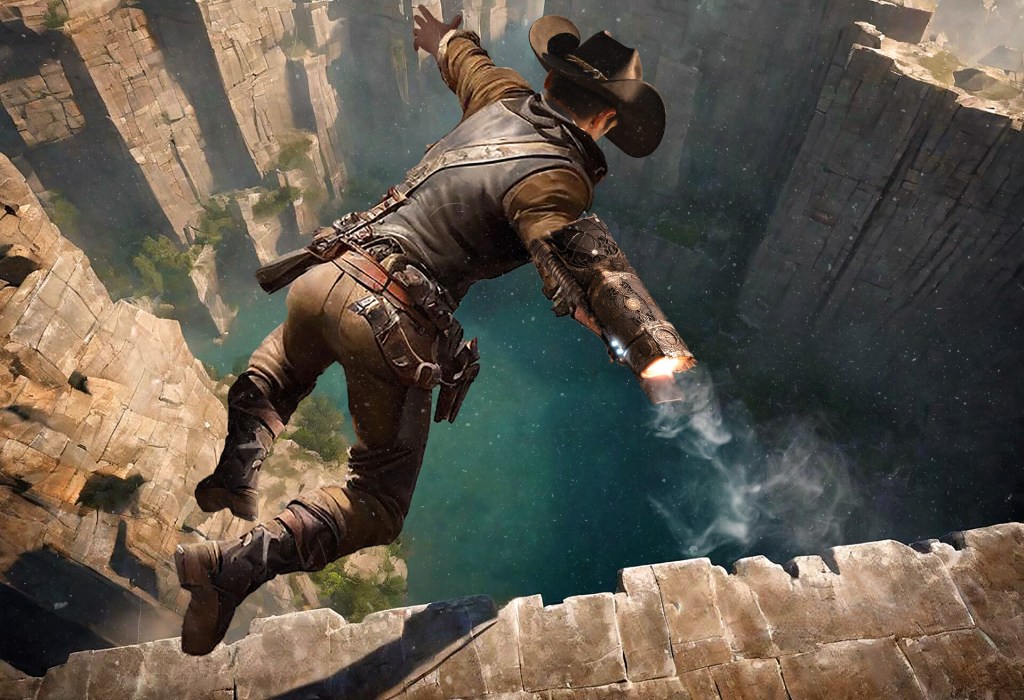
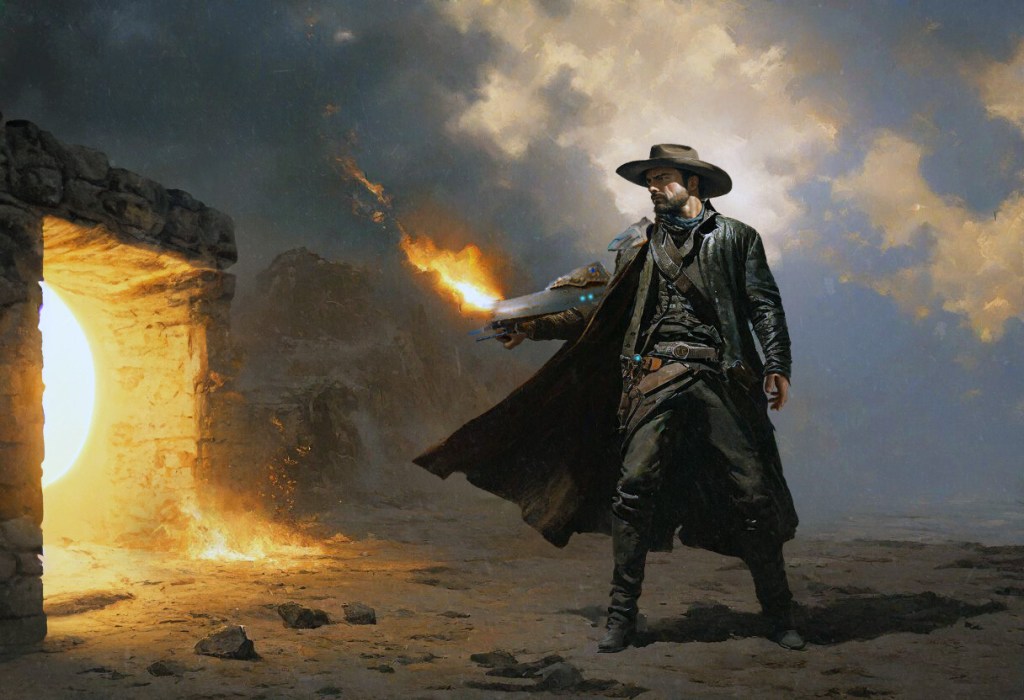
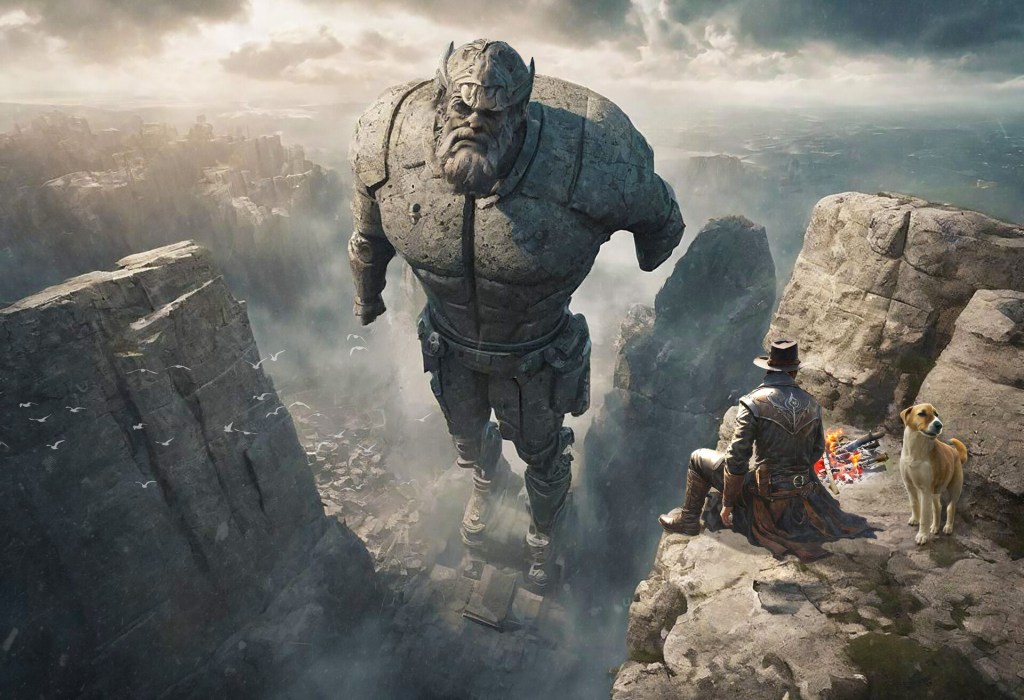
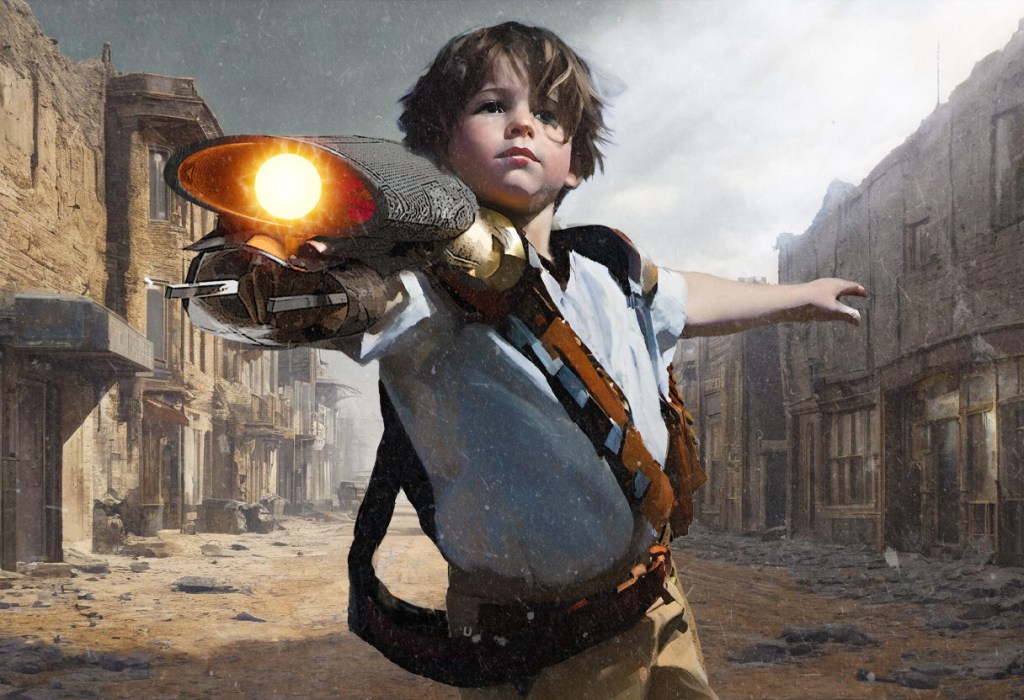
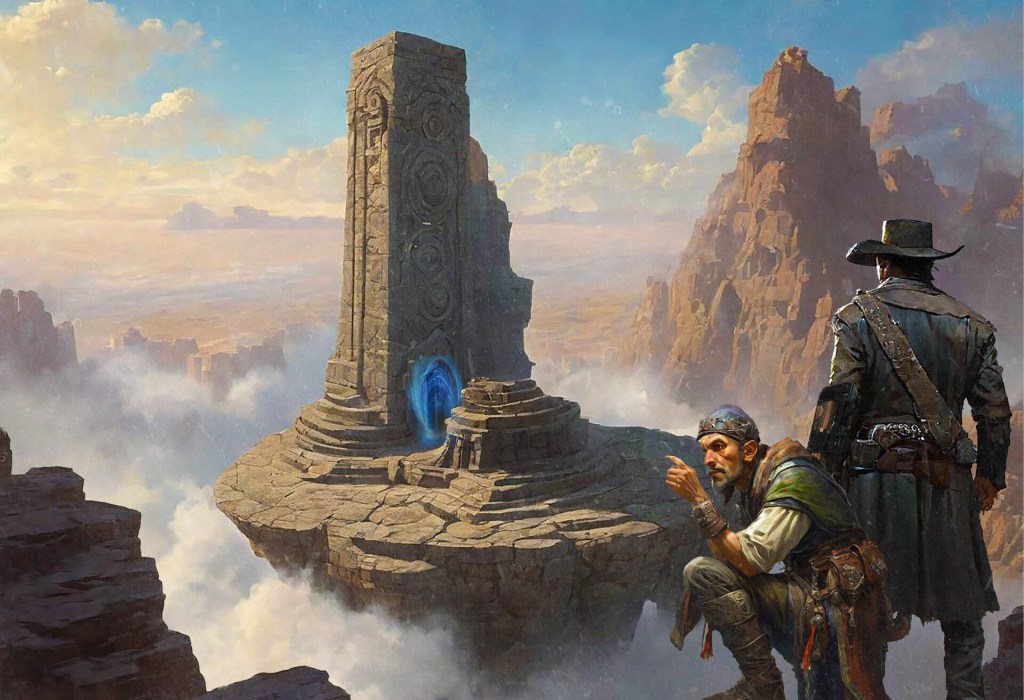
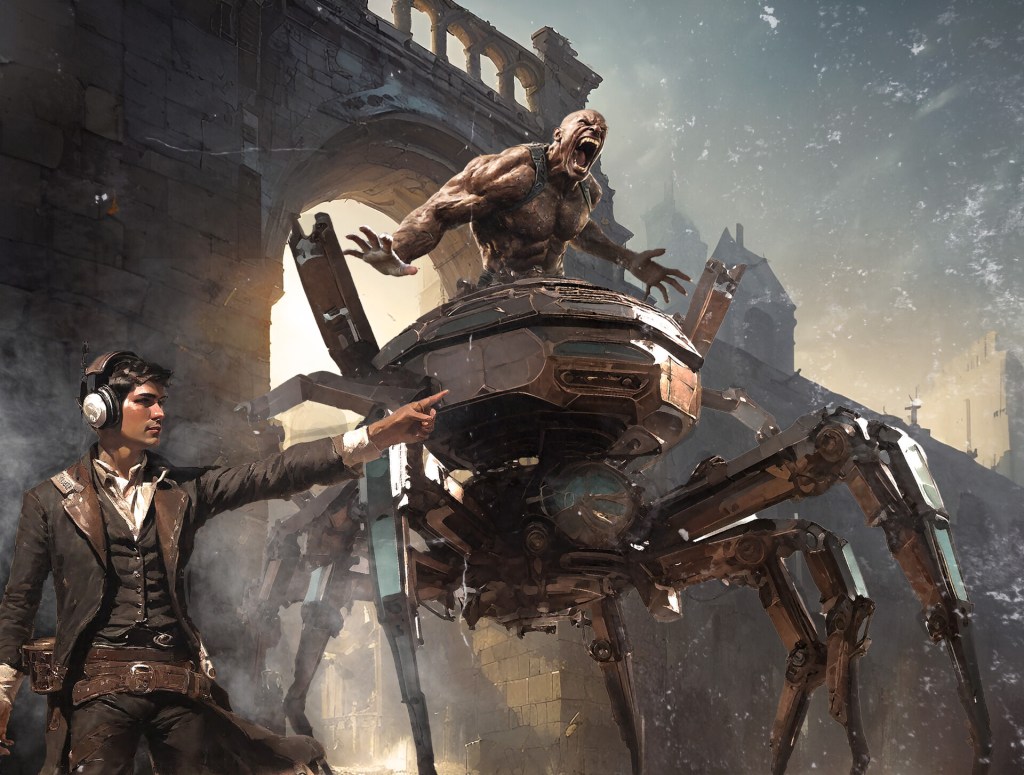
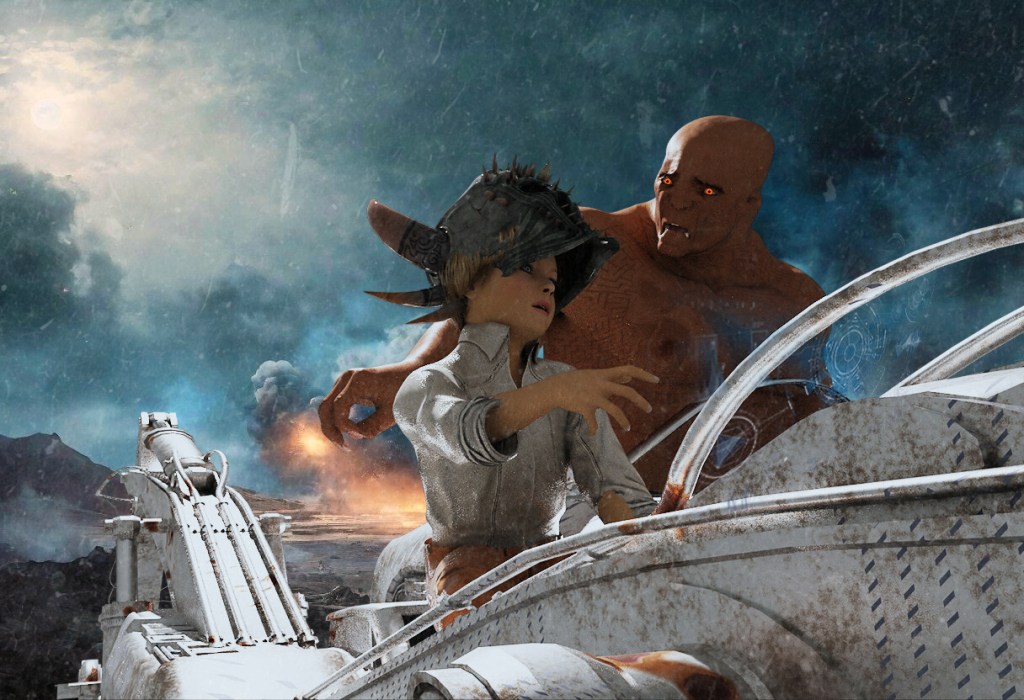
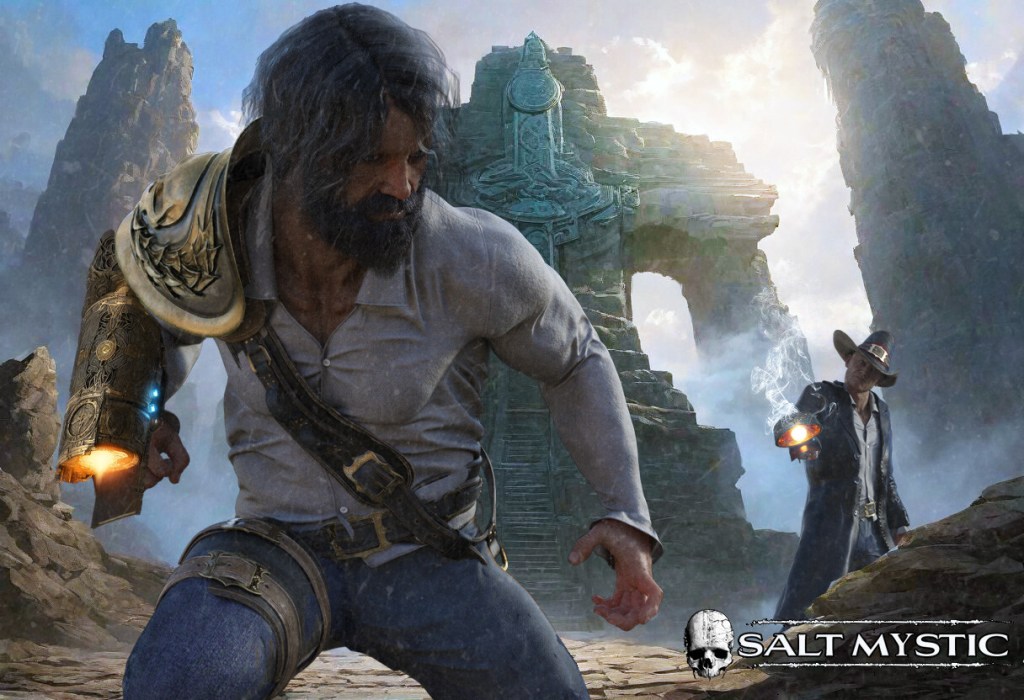
The images below represent the style of work I’m building these days, relying heavily on photobashing and concept art techniques (with folks like Imad Awan as my virtual gurus). The Grailrunner house design standard is semi-realistic digital painting with grungy overlay, western themed adventurers almost always carrying the signature weapon (a gauntlet-based plasma weapon that doubles as a shield in duels), exploring statue-riddled, software-haunted ruins with shimmering dimensional portals. We aim for vibrant or earthy colors, lots of smoke and grit, with implied stories (often illustrating flash fiction on Salt Mystic lore cards).
See the lot of them (and trace my hopefully improving style) at the Artstation account. Yes, I use AI-generated bits to composite exactly like I do with stock images but generally composite everything into something new and paint over them such that the transformation is meaningful and my own.
It gets the job done, at least I think. Still, I wish they were grittier. I wish they broke more new ground than they do. I envy the striking shapes and designs of a lot of concept art out there for cinema and gaming – the kind of images that stick with you even if you don’t know the context. Artstation is great for inspiration, but it can also crush your dreams if you compare yourself to anybody.
What’s prompted this reminiscence about bad art advice?
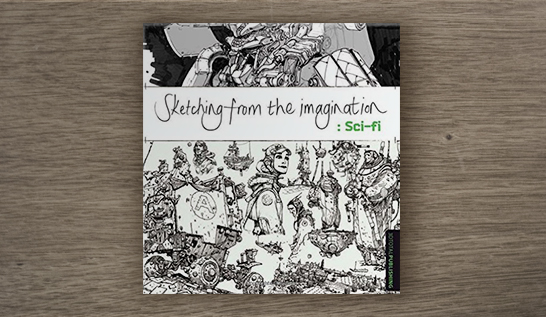
Well, I came across this book called Sketching From The Imagination: Sci Fi by 3DTotal Publishing. I wrote about it here. That was October, which seems like an eternity ago. I posed for myself the challenge of returning to traditional pencil and ink drawing in a sketchbook to push my imagination harder than ever before. The dream is to explore a blank page with loose shapes and vague ideas to summon phantoms into form and create groundbreaking designs and concepts. Then these wild new beasties and tech and colorful characters would then find homes in the fiction or game settings.
How’s that going?
Meh. I was so much rustier than I thought I was. I’ll share some pages here to embarrass myself and stay accountable to you for improving. We’ll get to that. But let’s talk about that advice.
When I was a kid, I filled scores of sketchbooks and countless backs of trashed dot-matrix printer paper my dad had brought home from work. Drawings of super heroes and sci fi vehicles and cities were my jam. Comic books were my main source of imagery, so everything I was drawing had bold outlines and underwhelming composition. The stories weren’t being told by the images in a self-explanatory way – I didn’t think about that sort of thing. I was alone a lot, so I didn’t share these with anybody, nor did I get any feedback.
Flash forward to one day in art class, Middle School I guess, the teacher strolled by to see whatever I was working on and stopped to say something about my approach that resonated with me. He pointed at the paper and said something profound:
“Real world things don’t have outlines. Draw what you see.”
It shook me. Hadn’t thought about that. Good point. So I gave it everything I had to incorporate his advice into how I drew. Back home, hovering the pencil over the paper, for the life of me I couldn’t figure out where or how to make a mark to start the drawing if you couldn’t outline it.
For this post, I looked through some old crates to find a particular drawing that would be humiliating to show but really staked the ground for when I began to turn away from drawing entirely. The picture in my head was a Dungeons & Dragons-style adventure party with a lady wizard, a swordsman, and an elf planning their next move on a morning beach with foamy, ripply water lapping at their feet. Maybe a dying campfire in the foreground with smoke rising in front of them. I couldn’t find it, unfortunately.
Anyway, it was horrid. Everything on the page was so light, you couldn’t even make it out. I was petrified to start drawing outlines again, and I couldn’t see how to force shadows and contrast to draw out the shapes. It threw my perspective. It threw my focus on their faces. It ruined everything. It was the last sketchbook I really did anything with until decades later, at least in any serious way.
Sounds bad. What’s different now then?
I get it now. Youtube changes everything, doesn’t it? Contrasting light and dark, the subtle use of textures, faking details, focusing and directing the viewer’s eyes across the image, and strategic use of busy and rest areas…I never went to art school. That all may be common sense to you, but it’s a glorious rainmaker for me to see all that in action artist after artist, listening to these marvelous and generous people draw magnificent things and explain their thought process as they go. Great time to be alive, isn’t it?
I travel a lot, so I keep an art pack and sketchbook. Pigma FB, MB, and BB brush pens, Staedtler pigment liners, a mechanical pencil, and some Graphix watercolor felt pens. Since October, I’ve put the practice time in almost every night at least for a half hour. It wasn’t a pleasant return.
The dream is to draw from imagination though: new things. What I’ve learned from artist after artist in their podcasts, Youtube or ImagineFX interviews is that drawing from reference is far more common. A lot of the guys you see on video drawing or painting have their reference images off screen.
Reference images! That wasn’t why I got into this gig. If I wanted a copy of an image, I’d take a picture. It was disheartening to me to hear professionals talk about light table tracing for their outlines…to see fantasy illustrators mash up references to form fantasy beasts – all of it copying what they saw. That was my problem back in the first place, right?
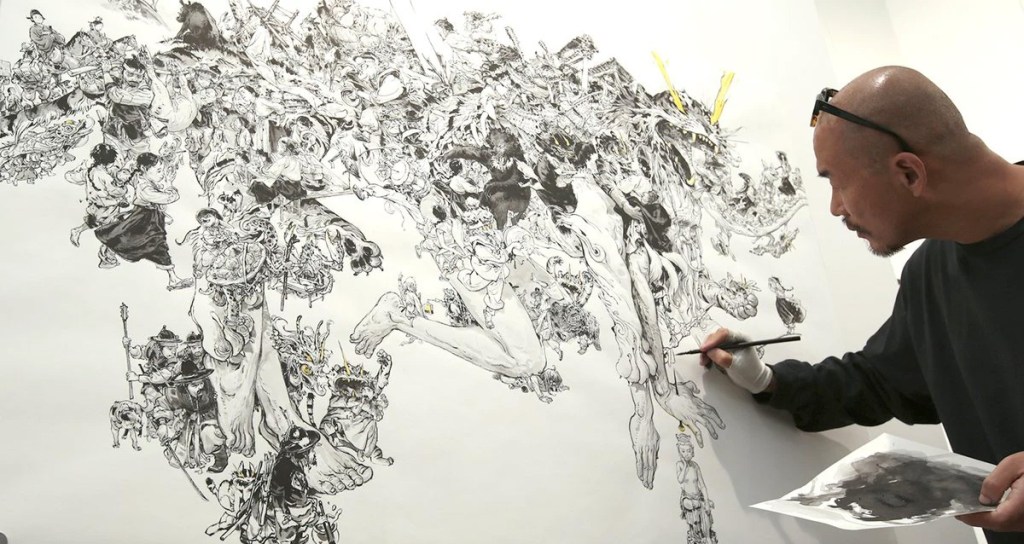
Then I came across this genius: Kim Jung Gi. Rest in peace.
Please google him if this flame of wonder is unfamilar to you. He drew from his imagination like a magical fountain spews sparkly fairies. He just walked up to paper and went nuts, drawing fish-eyed perspective, highly intricate intertwined figures, scores of objects and novel, distinct, and interesting characters at a high rate of speed and without slowing. How’d he do that?
That guy didn’t have any reference images. That’s what I wanted. I had to go deep to understand what he did right that I was doing wrong that could unlock this magic. Exploration on the blank page…finding ideas haphazardly that were uniquely my own…I wanted to bottle this magic for myself. How in the world did he get to the point he could do it so wonderfully. Then I heard him say it (through a translator):
“Don’t draw what you see. Draw what you HAVE seen.”
His point was you have to do the reference images and understand forms and shapes in three dimensional space before you can do what he did. He explained the lifetime of sitting in public places filling thousands of pages drawing what he saw and forcing himself to draw it from another angle. That was the key – he drew what he saw with a lifetime of practice, but still practiced summoning those images from his memory to try them from different angles.
He drew what he HAD seen. It was a big realization for me, this idea of examining the reference image – not just to get better at copying it, but to run your mind’s eye all over it in three dimensions to understand it better and to file that away to fuel your imagination.
Now THAT’s what artists actually do. They don’t copy. They understand.
I wish that guy was still alive. He was amazing.
Agreed. Now how about sharing your progress?
Ugh. Here you go. Don’t be judgey. Wish me luck that things improve. Go ahead. Click the book.
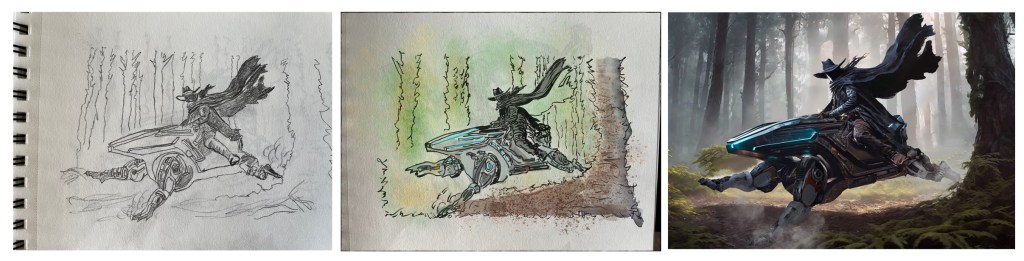
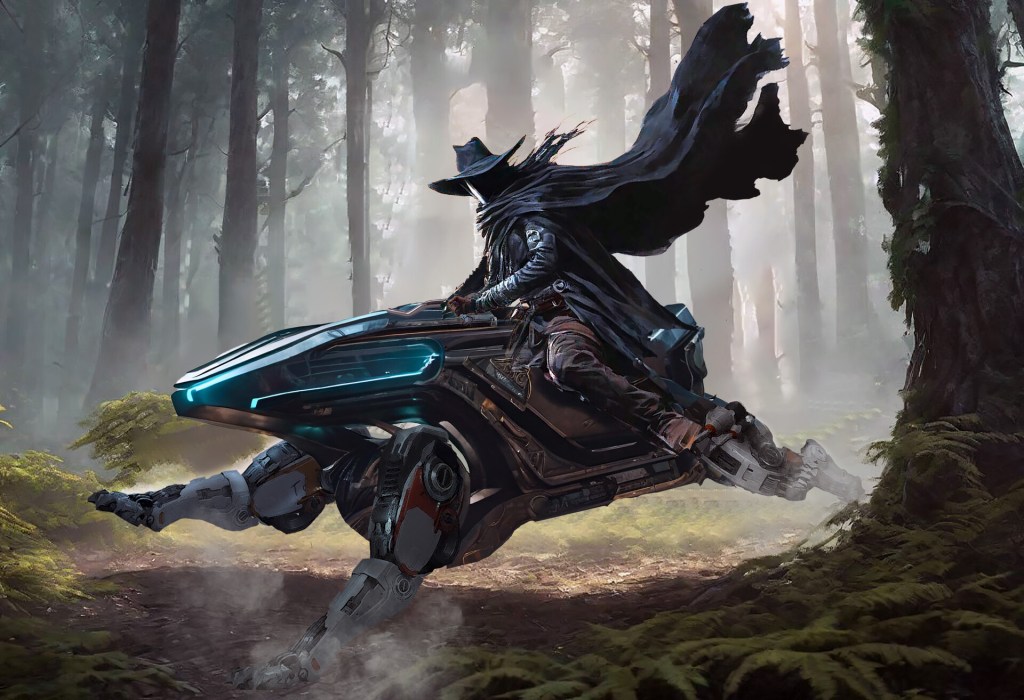
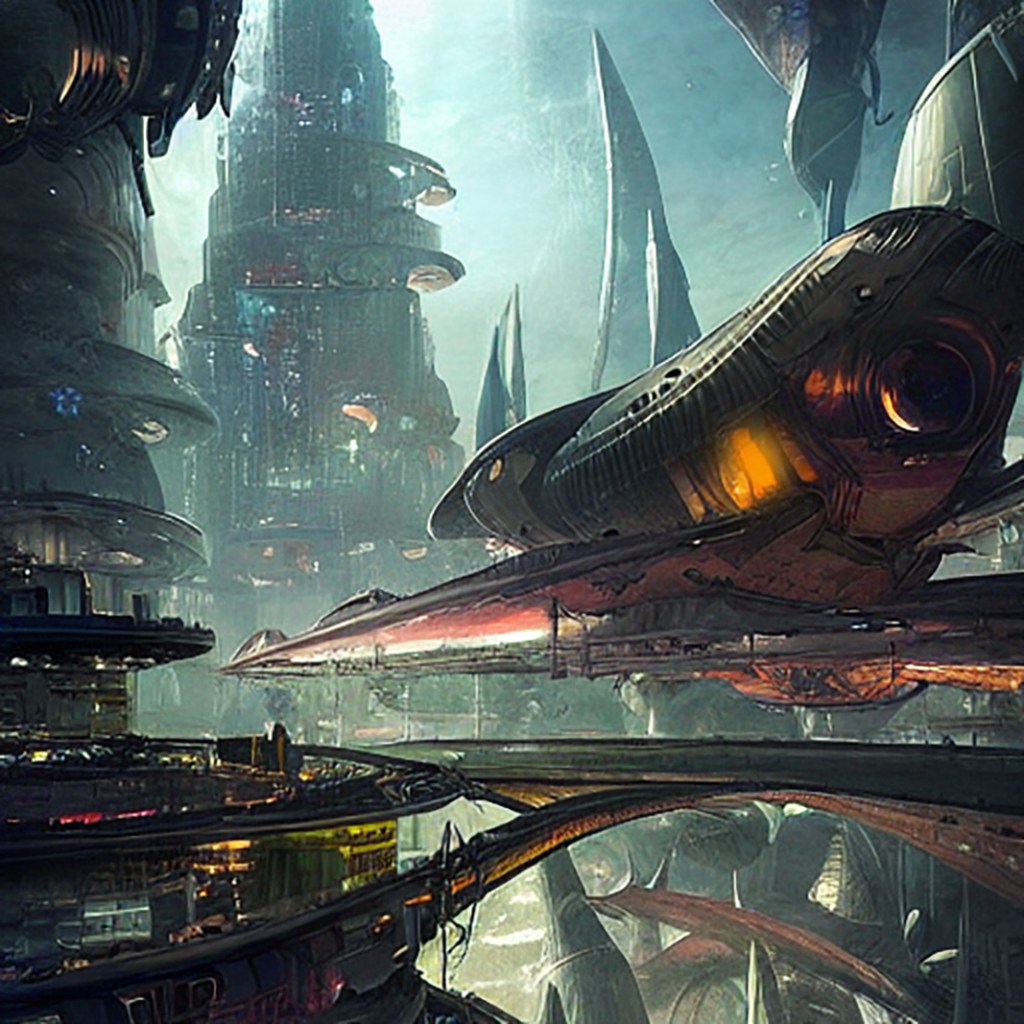
Ouch. I hope you don’t lose all trust in me, should you have had any. Photobashing is an entirely different beast than battling blank pages with a mechanical pencil. I’ll keep at it. The beast-shaped robotic vehicle in the header image was a minor victory in this experiment: called a “sporecutter”, it’s the first concept that’s come from the new approach that might actually make it to the fiction. Page 15 in the sketchbook file here is the front runner for the design of an important vehicle in the Mazewater: Master of Airships novel I’m working on. That’s another possible win.
That’s what I wanted to talk to you about today. I hope it was enlightening or helpful, should this be a journey you find compelling for yourself. Otherwise, I hope I still brightened your day a bit and made you think.
One of the most exciting things we do around here at Grailrunner is introduce new bits of the lore of our Salt Mystic setting in the form of Lore Cards. A fusion of art and short fiction, it’s an important mechanism for us to introduce and test these mini-expansions of concepts that will wind up ultimately as game cards or in the books or stories.
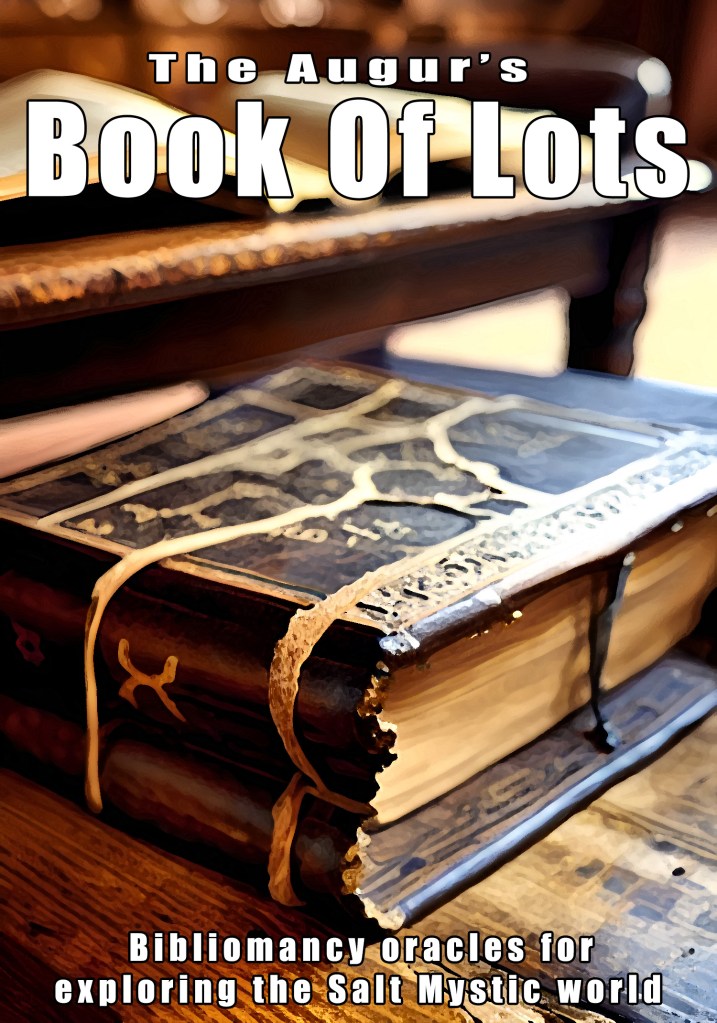
A product we have heavily active in development right now is a bibliomancy-based oracle book for roleplaying in the Salt Mystic universe to be called The Augur’s Book Of Lots.
In order to bring that to life, all manner of new encounter types, new places, and historical figures and their stories are needed. It’s an incredible, life-changing experience for me personally to explore all that and watch it unfold like a big, crazy flower, and I can’t wait for you to see it. Seriously, this whole world is building itself and waiting for you to slide a ball lightning carbine on your arm and take a cautious step through the gates…
Today, we thought we’d introduce you to a new exciting, and sometimes terrifying, addition to the world of the Salt Mystic: the chimera.
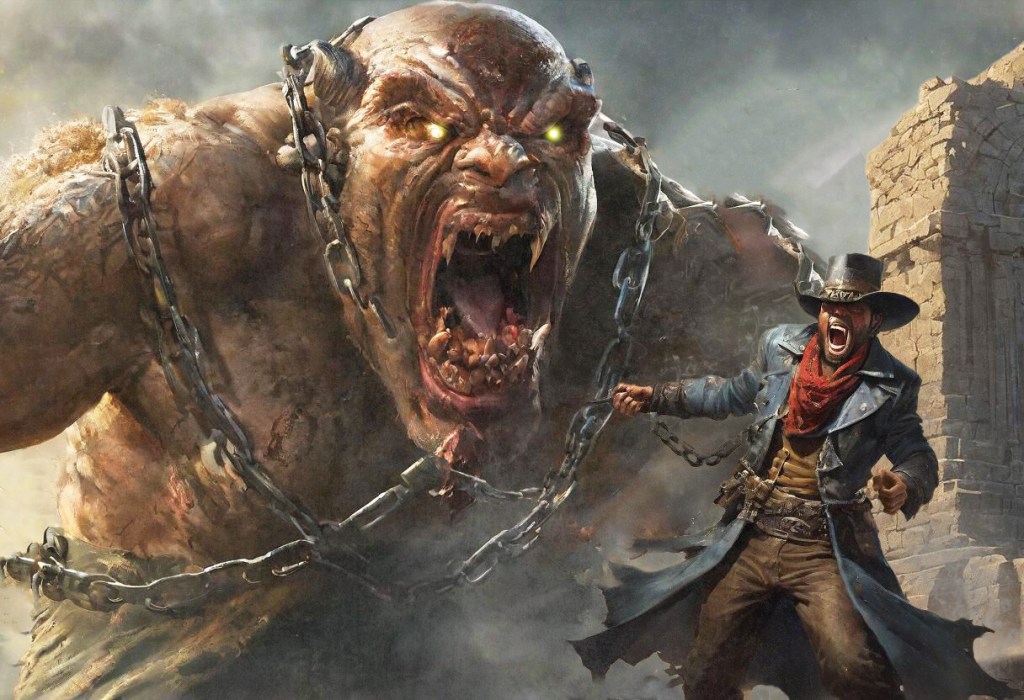
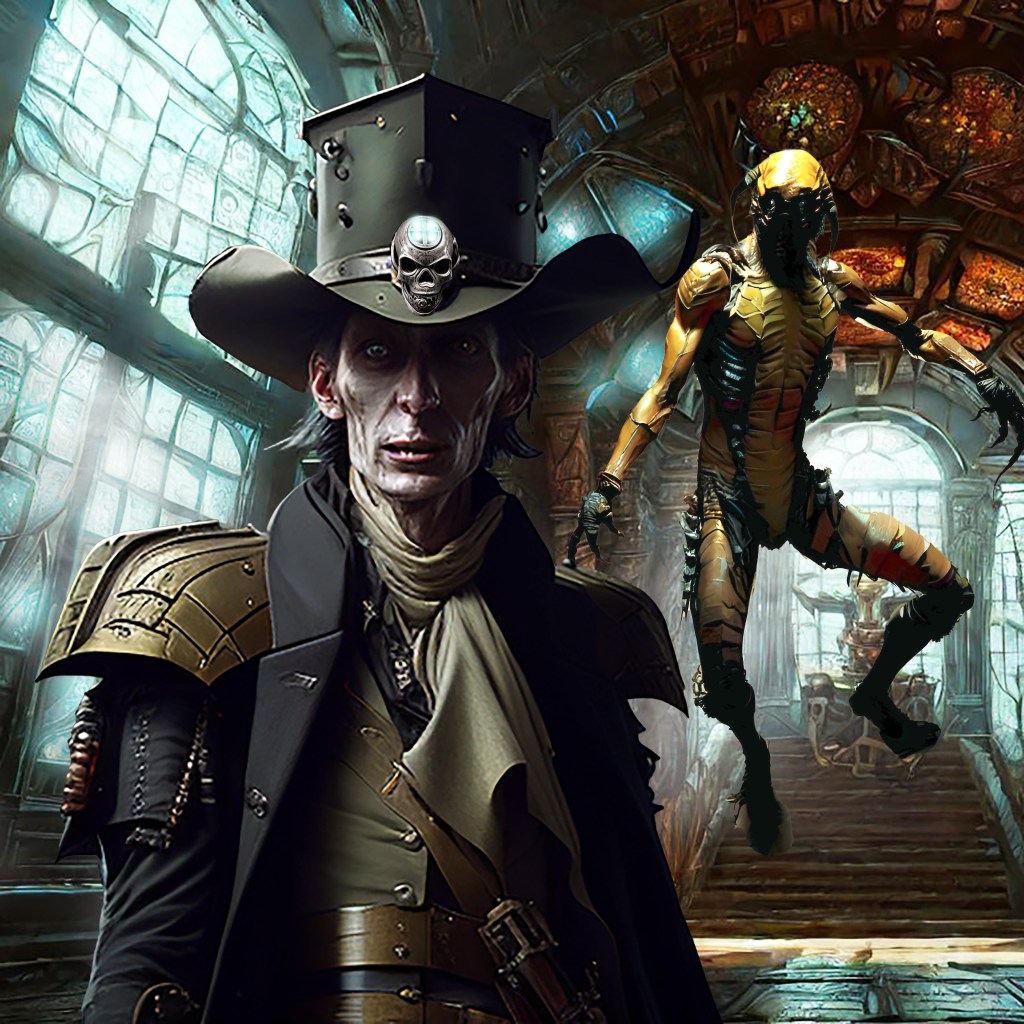
The sneaky fellow leaping on our hapless narrator today is part man / part scorpion. In the oracle book so far, we’ve met countless hybrids like this already, though this particular combination freaks me out the most.
As for the art, as always it’s a paintbash with the heavy lifting done in Photoshop. In this case, the bounty hunter, the skull on his hat, the backdrop, and the scorpion-man were all drawn from various iterations of Stable Diffusion or Wonder, with heavy correction and repair. I discovered the ‘puppet warp’ in Photoshop, which is my new favorite trick!
After compositing them together and color grading everything, I added some Stock nebulosity overlays from Nucly to make the diffuse smoke around the windows, blending them in Screen mode. The positioning of the scorpion-man was tricky – it made more sense for him to be creeping around behind our clueless bounty hunter, but the more I looked at him in mid-air, the creepier and more interesting I found it to be.
I wanted the skull on the bounty hunter’s hat to glow, so that along with the window glow was just some soft brush painting in Color Dodge blend mode.
Anyway, we hope you like the final product. Let us know what you think, and please check back periodically for updates on the stuff we’ve got cooking.
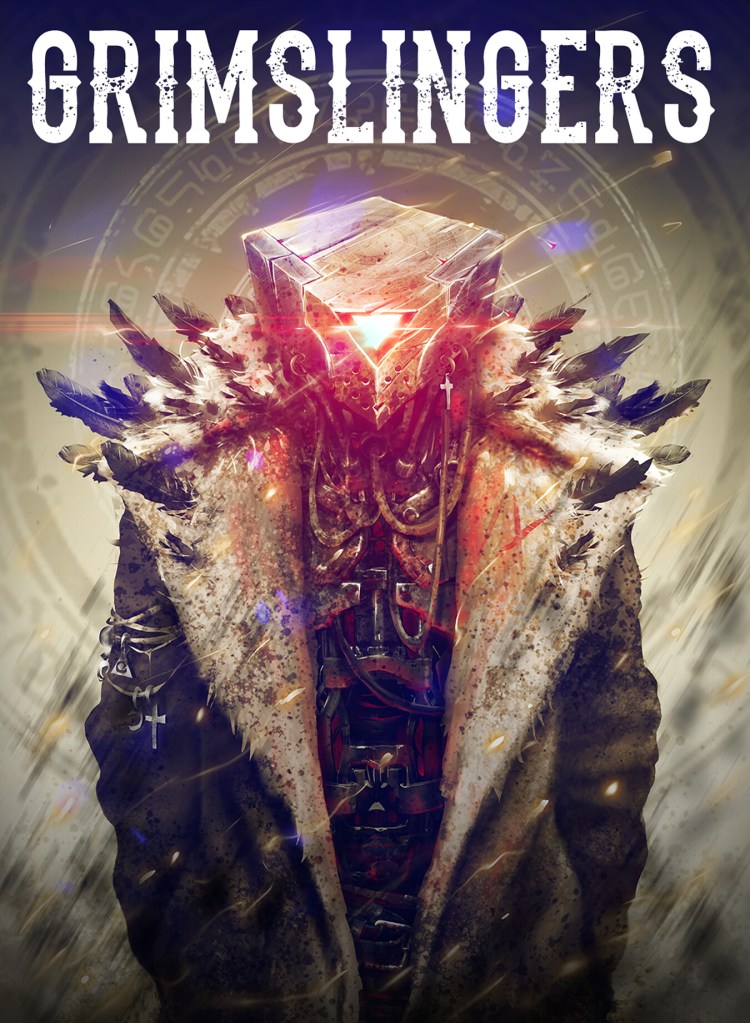
We’re continuing our Inspirational Creator Series of interviews this week, checking in with Stephen Gibson – artist, writer, game designer, and creator of the Grimslingers line of tabletop games. He’s had some exciting personal developments since we last spoke in 2020, and remains one of the most popular interviews we’ve hosted here on Grailrunner. Click here to read that original interview.
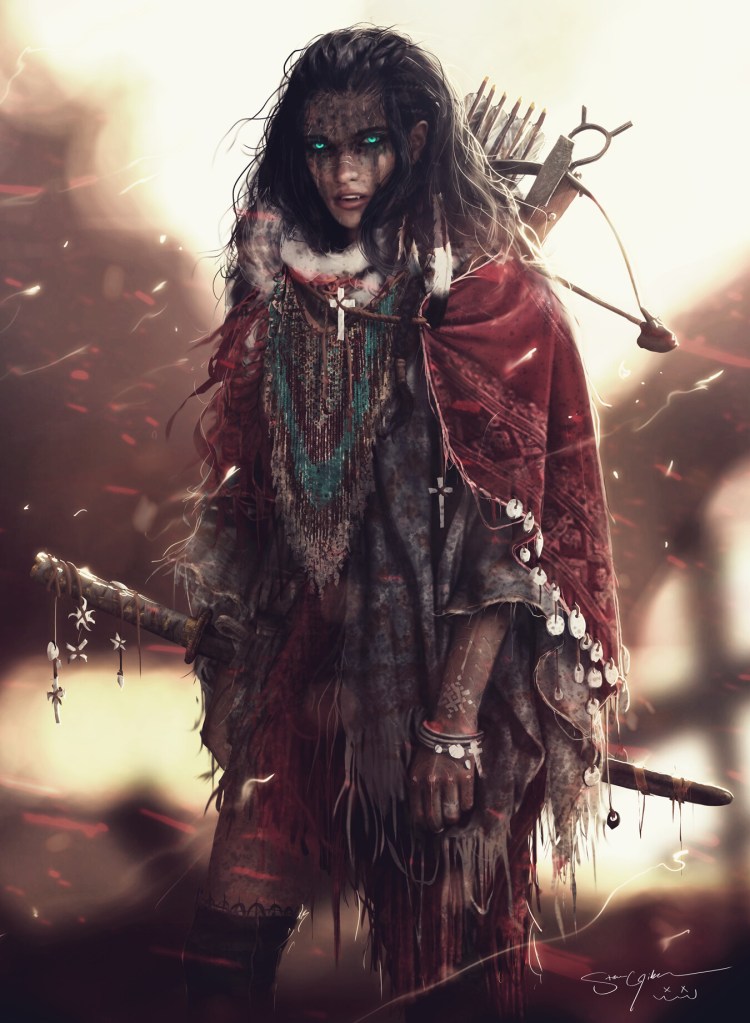
He had been Art Director at Arcane Wonders at the time, designing a supporting app for Grimslingers and trying to find time to catch some sleep. His art has popped up recently on book covers, and he’s even been featured in the art magazine, ImagineFX. In 2022, he made a big switch to Sumo Digital in Newcastle in England and added another member to his growing family!
Fascinating dude, great guy, and incredibly talented. What else could a Grailrunner ask for in finding inspiration?!
Stephen, apart from the occasional “wassup”, we last chatted in October of 2020, before zombie movies came to life with a global pandemic. You were one of the first interviews in a series we did on inspirational creators, and yours in particular remains the most popular of all that we did. Apparently, Henrietta the magic hen is quite the ambassador for you!
It has been a lifetime! I’m flattered at the reception and find it hilarious (but not all that surprising) that Henrietta has stolen the hearts of your readers. She’s also one of the illustrations I spent the least amount of time on. I’m sure there’s a lesson in there somewhere…
At the time, you were deep in playtesting on Grimslingers 2, and had featured a detailed map and some app screenshots in various places on social media. Then I suspect life happened and you needed to focus on your work as Art Director at Arcane Wonders among other things. Were you or your family impacted seriously by COVID? I hope everyone is well.
Life indeed happened, as it does to us all. I had my third child, among other big life changes and yeah, COVID!!! I spent most of Covid gaining weight and wishing I had the energy to work on Grimslingers 2.
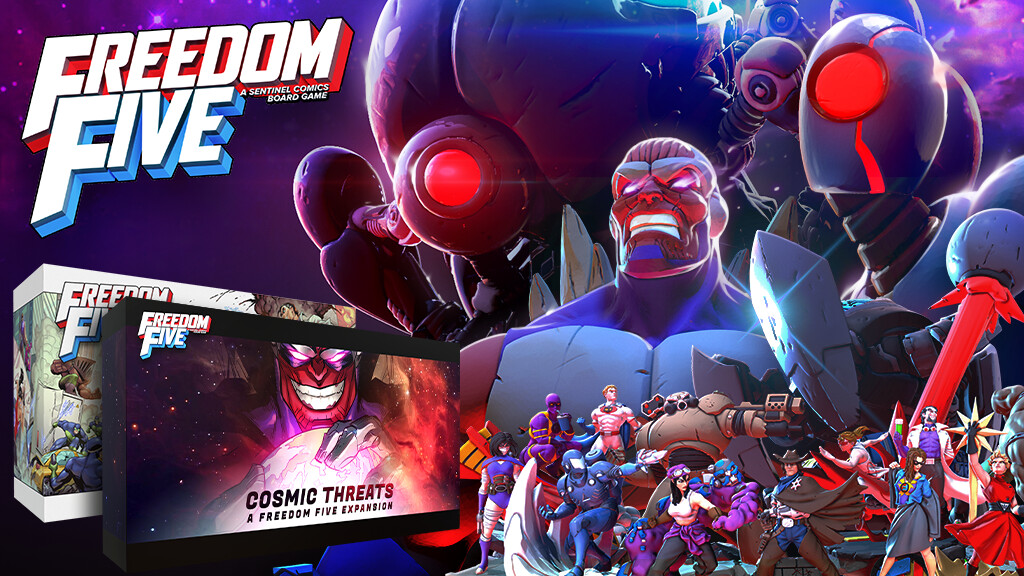
To prepare for this chat, I dug back through your (sparse) posts, and you seemed super passionate about an Arcane Wonders release called Freedom Five. It sounded like a tremendous amount of work – how was that experience?
Art wise, Freedom Five was a lot of fun because I was able to work with some extraordinarily talented artists. I’m particularly proud of the comic book panel style card art we had for ability cards. Each ability card really sold the story of the ability on it. The campaign was a whirlwind that seemed doomed a little ways in but we were able to turn it around and I’m immensely proud of my hand in that (which meant a few sleepless nights re-working the entire campaign page).
It was a tremendous amount of work (and still is, it still hasn’t shipped to backers). We were very ambitious, but the project also got hit hard by the pandemic. We funded right before poop hit the fan and the world plummeted into chaos, and that meant all of our numbers, estimates and expectations for producing this game got thrown out the window.
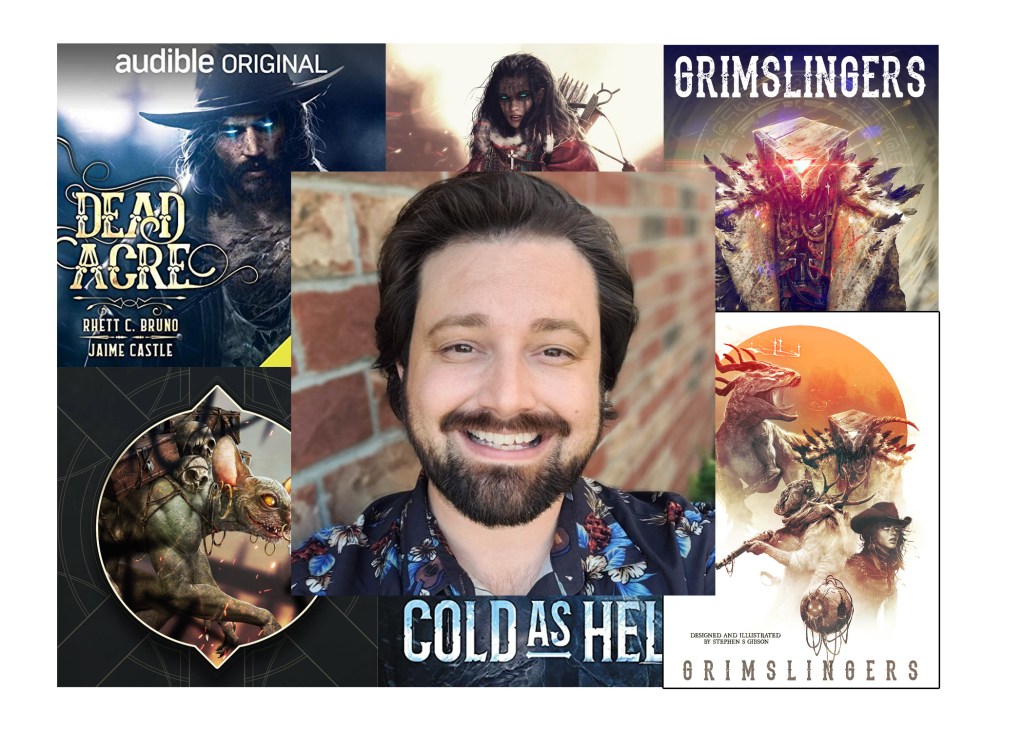
I was incredibly jealous of the cover image you did for Cold As Hell, the book by Rhett Bruno and Jaime Castle. I saw your mysterious post about it around May of 2021, then stumbled randomly across it on the Barnes & Noble shelf this past summer. Looks amazing. (Offer stands for you to do a piece for Grailrunner’s Salt Mystic setting any time you like.)
“Shot dead in a gunfight many years ago, now he’s stuck in purgatory, serving the whims of the White Throne to avoid falling to Hell. Not quite undead, though not alive either, the best he can hope for is to work off his penance and fade away.” – that’s from the Amazon description. I see why you were attracted to the project.
The author approached me to see if he could use some of my Grimslinger art for his cover (Pocket Watch Will to be exact). That was a first for me, haha. Instead we worked out producing a new piece of art and I think that was for the best! I’m quite fond of that cover, it certainly evokes a mood!
You’ve described your workflow as being heavy on photobashing and digital painting in Photoshop. Describe your desk setup – an old post showed a Wacom tablet among other things. How do you set up for work?
My “Grimslingers” style is photobashing, but I’m just as comfortable doing cartoons or comic-esque stuff. Right now I actually don’t have a desk or even a computer, I sold it on to move to the UK and start a new job! HOWEVER, I used to have a Wacom Cintiq 24HD Pro, an ultra-wide primary monitor and a beefy PC to boot. I also use a Logi Ergo M575 trackball mouse. It allows me to use the mouse without needing a ton of space to move it around, that way I can switch between pen, keyboard and mouse without too much movement (why do much movement when little movement good?).
Barceline: Vampire EaterLuella And The Gaia MindIcarus: The Iron Witch
You mentioned on Artstation you’d used Unreal Engine 5 for the first time in kitbashing some Victorian environmental pieces for TacticStudios. What did you think?
I think every artist should had some 3D software in their repertoire. Unreal is fantastic for kitbashing and I wish I had more time to spend with it! It’s one of my main goals as an artist, to develop my 3D bashing and sculpting skills more. For me, that’s the next step in my evolution.
Daemonic Soul HunterValenciaAl’Miago The Wizard
Congratulations on being featured in the December 2022 issue of ImagineFX. Best quote ever, regarding your approach to art: “…splicing in new images to fill out the character until I can’t stand to look at it anymore.”
You also said something near and dear to the mission of Grailrunner Publishing: “The world needs more passion projects and less corporate-controlled products.” Tell me what you mean by that and why it’s important.
Getting featured along other incredibly talented artists in ImagineFX was a big moment for me as an artist! Certainly a highlight of my journey thus far! My quote partly had to do with my frustration with truly unique and visionary ideas being disregarded because their considered more of a gamble – which they are! I totally get why business entities take the approach that they do in train to “paint by numbers” games and play things safe. But playing it safe doesn’t move our industry forward. It’s the risk takers that got us where we are now, and it’s the risk takers that will push us forward.
In my opinion, a game like Grimslingers wouldn’t have ever happened if I had to pitch it to publishers, it’s just far too wild and to weird a mix of genres and styles. There are some visionary and forward thinking publishers out there (more in the board game world compared to the video game world) and I truly do appreciate them. Cheers to the risk-takers! It’s a difficult and dangerous task, but the soul of our industry lives with them
KipperThe Witch KingNyunyo And Alma
One more question before we get to Grimslingers – you’ve settled in now at Sumo Digital in Newcastle. Tell us why this move, what’s exciting about it, and what sorts of things you’ll be working on.
Covid shook my confidence in the board game industry, and life rocked my personal finances (to the extent that I wasn’t able to keep up with my bills). As a father of three, I’m not at a point in my life anymore where I’m willing to ride out risky situations for too long. After college I had signed up for a job alert service to which I never unsubscribed. One day, I got a job alert for a position at Digital Extremes (a studio in my town that happens to make the ultra-successful looter shooter, Warframe!) The job description fit me perfectly and was the push I needed to help me feel like I could exist in the video game industry. I updated my resume, my portfolio, I started learning new software (like UE5). I interviewed with several studios (and yes, I did get the interview with Digital Extremes!).
I lacked experience in the video games industry so I knew (or I thought I knew) that I’d never find a job as an Art Director, so I was applying to concept artist positions. I interviewed with Ubisoft for the Splinter Cell remake, TacticStudios for an unannounced project, Digital Extremes for Warframe and Atomhawk for Character Concept Artist. They were all very promising and I had a few interviews with each, but Atomhawk seemed the most exciting to me, and they seemed the most excited about me. Unfortunately the job fell through because of some changes to their projects. What I didn’t know at the time was that Atomhawk is part of a larger group, Sumo Digital, and one of their recruiters reached out to me, apologized the opportunity fell through but if I was interested in relocating to the UK, there might be something for me. I thought it was a joke but turns out it wasn’t! Not only that, it was for an Art Director role – a job listing I had seen but didn’t apply to because it was asking for far more experience than I had (let that be a lesson to you all!).
There’s more to the story but the heart of it is this: Changing your life is difficult and scary, but it can be done. Work hard, play nice with others, put yourself out there, it’ll work out. Good things are waiting for those who put in the effort to achieve them.
Speaking of Grimslingers, what can you tell us about what’s coming up (and generally when we can expect to see it)?
Unfortunately, I don’t have any Grimslingers news at this time…but one day, echoing through the winds, you’ll begin to hear the faint whispers of news from far away lands, tickling your ear tubes with the promise of more Grimslingers!
What is it about the stories of the Forgotten West, magic-toting grimslingers, Icarus and his mysterious missions, that inspires you? Why so much passion into this setting?
The answer is simple I think: it’s me. It’s all just an expression and wild re-interpretation of my personality and life experiences. A collection of things I love and adore and a world in which I make no compromises and have no limits.
And if you could launch some grimslingers out into the world on your own missions, what would you have them do exactly?
Definitely go get me some pizza, this covid weight isn’t going to maintain itself!!!
Stephen, anything else you’d care to let us know or places you’d like folks to keep an eye on for your doings?
In a few years’ time, games I’ll have art directed at Sumo Digital hitting the market. I hope you all love what you see and will be able to spot my unique flare to approaching art!
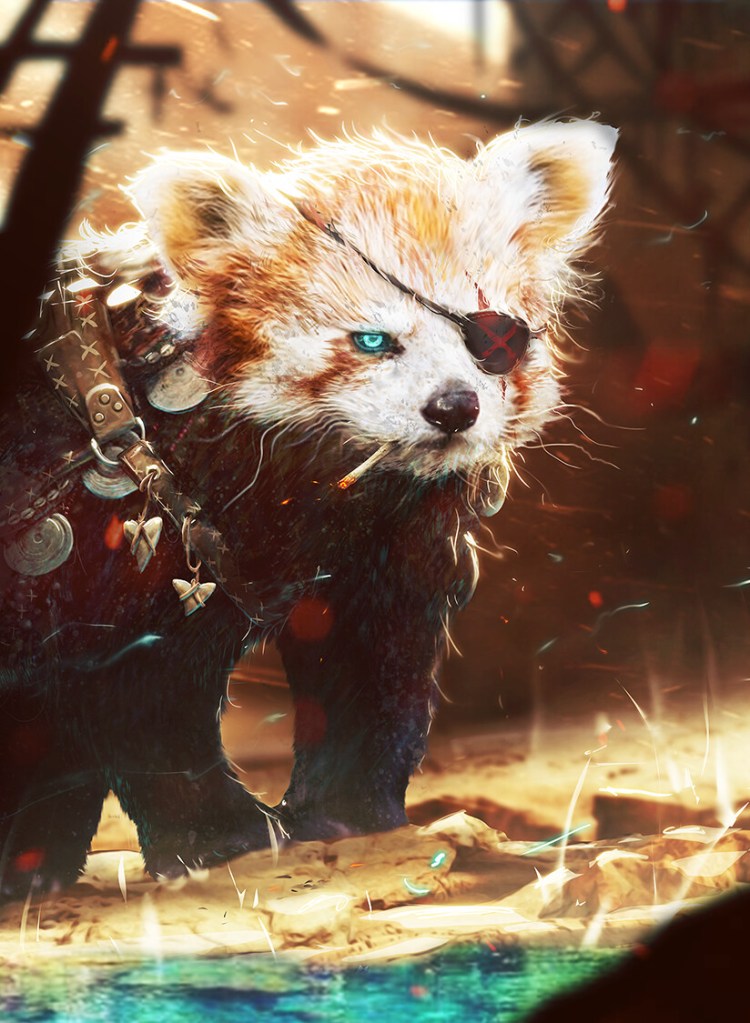
Special request – if there’s an illustration of Red, the salty panda pirate out there, I think we need to see that.
Thanks very much, Stephen. And best of luck in the new company and new continent!
Adventures are a hunger, fundamental to who we are. But what makes them work?
Literally everything we try at Grailrunner is about pushing boundaries in imagination. Often, that takes the form of contorting tabletop game mechanics for experiments in immersive storytelling. Then we give that stuff away for free in case it’s entertaining, though we’ve learned bits and pieces along the way about what makes adventures work…and what is missing when they don’t.
Which is the point.
For example, we built wargame terrain and a narrative scenario to play out a story using the game mechanics of Privateer Press’s popular Warmachine. It was a thrilling ride we called…
The Black Ruins Massacre
Turned out amazing – go follow these links to see what I mean:
One of the more popular things we’ve ever done here on the site was to write up an illustrated recap of a solo Dungeons & Dragons adventure in Wizards Of The Coast’s Tales Of The Yawning Portal. I routinely use a ridiculous D&D character named Firebeetle to try out different roleplaying game rulesets, and in that case, I put him through a harrowing ordeal called Clueless In The Sunless Citadel. Click these guys here to see what that was all about, and download the free pdf. Only takes about a half hour or so to read, but it’s fun.
Clueless In The Sunless Citadel
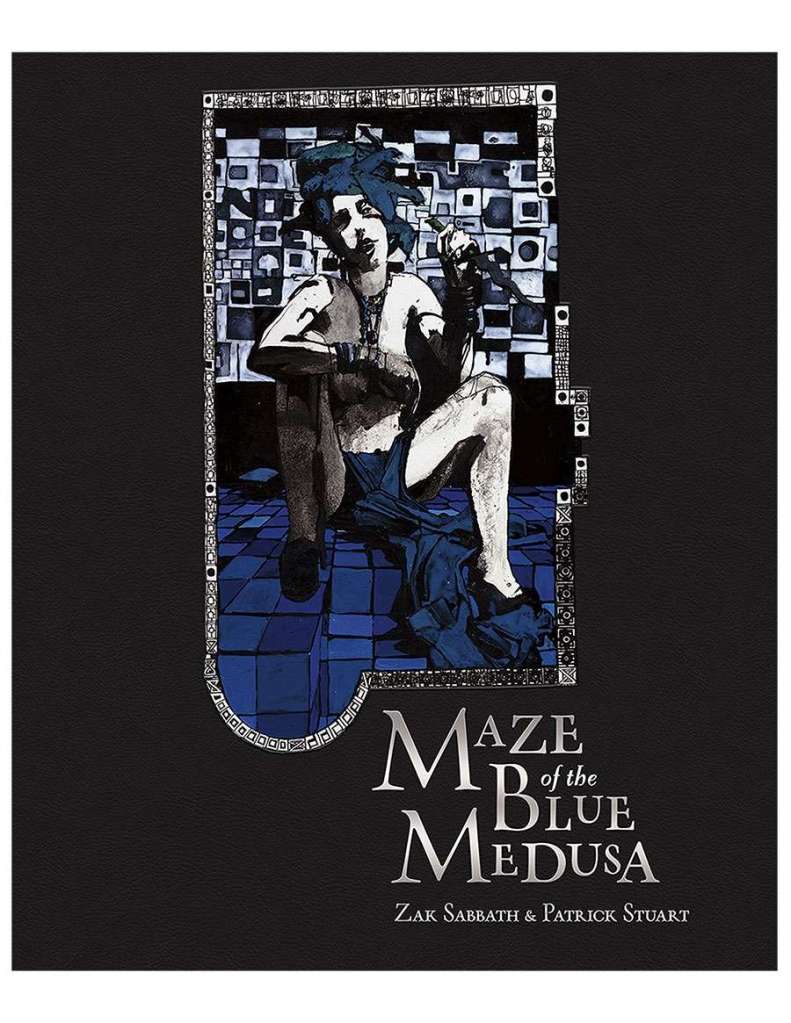
So anyway, I was in a big old used bookstore called McKay’s in Nashville, TN a few weeks ago. I strolled to the RPG section with no particular goal in mind and found an odd, strangely electrifying, though ultimately unsatisfying hardback called Maze Of The Blue Medusa. I knew as soon as I read the back, felt the weight and texture of it in my hands, as soon as I flipped through a few pages, that this was something special.
Maze Of The Blue Medusa
(I understand there is some controversy around one of the creators behind this book, so I’ll stick to the work itself in my comments.)
The book describes a system-neutral dungeon complete with a detailed map, illustrations, a bestiary and associated encounter dice tables, and intricately detailed descriptions of every one of its over 300 rooms. In every room, something weird is happening, something grotesque and surreal is creeping about, and crumbs of an over-arching story are dropped.
However, unlike so many mega-dungeon books with their Tolkein tropes and endless loot crates and traps, this whopper is written like an art project, with text that reads like it’s for shrewd adults capable of seeing irony and social commentary in its encounters.
I excitedly cracked it open when I got the chance to run young Firebeetle through his paces inside the Maze.
And I wasn’t into it.
It just didn’t click for me. The adventure escaped me, and it was just going through motions with no point. I couldn’t find a story hook that mattered. Each room seemed weird and vaguely interesting, but nothing popped or sparkled for me. The encounters were tedious and amounted to nothing. Here’s a Youtube video of some dudes in an actual play session of Maze Of The Blue Medusa – watch that for a few minutes and I suspect you’ll see what I mean.
Even with a great GM and some funny players, this wasn’t an adventure so much as a haughty stroll through the bohemian part of town where I don’t really fit in. I wanted the awe and danger of exploration inside the covers of a book and found only a meaningless series of weird things. Maybe that was my fault, but the mechanisms available just didn’t work the way I wanted.
That was on my mind when I heard of a little book by Emmy Allen called The Stygian Library, I thought maybe I had found redemption.
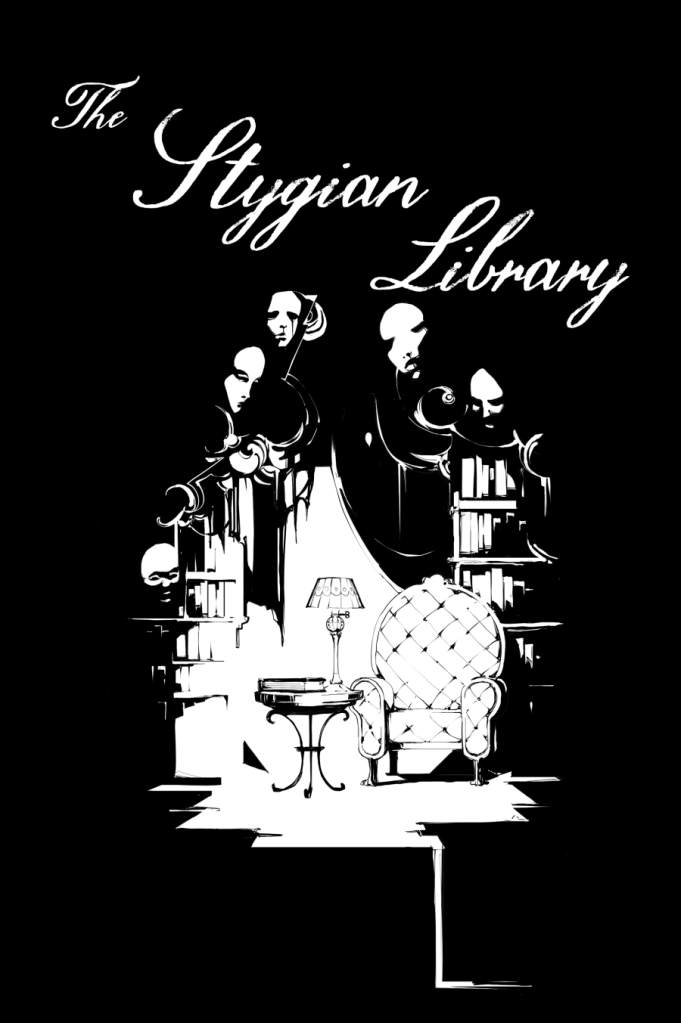
The Stygian Library
Pick up the older version of this booklet free here. It’s available in a remastered version here.
The Stygian Library bills itself as a dungeon for bibliophiles, promising a procedurally generated fantasy library you can explore in ever deeper levels. That sounded amazing, requiring you to map your way (though you can run blindly and get lost). Much like Blue Medusa, this wasn’t written with solo play in mind, but with enough dice tables and imagination, I figured I could rewire it.
Emmy delivers a wild bestiary including golems made of paper, animated books that follow you around, mysterious creeping librarians working on enigmatic calculations, even a half-man, half octopus that eats brains. Nice.
You roll for the levels you’re entering, details about them at first glance and also if you search around, as well as random events and, when prompted, encounters of a friendly or a violent flavor depending on your choices so far.
I took this idiot inside.
Firebeetle
Firebeetle was a name I was given for my very first D&D character back in the day. I recreate him in any game system I’m testing out because he amuses me.
He’s an aimless adventurer, in it for the thrill, always ready to take up a quest or try a mysterious corridor, picking up random things along the way and relying on his luck to seem him through. He’s not really charming, but thinks he is. Loves the ladies. Gets into trouble practically at every destination.
Firebeetle has a tendency to stumble into dimensional portals (as I try new game systems), finding himself in underground dungeons in the Middle Ages (D&D), Viking-era Iceland in an impossible city made of clusters of hot air balloons (Ironsworn RPG system), or in the far future on a dying space station (Starforged RPG system).
He just kind of goes with it. And it all works out in the end.
Neither Blue Medusa, D&D, Ironsworn, nor Starforged were delivering on the premise I was searching for: the awe and danger of exploration inside the covers of a book. Maybe Emmy’s Stygian Library would be the trick. I love libraries.
I put this ridiculous booklet together during conference calls in the COVID-19 quarantine, and I treated it as the opening sequence before entering the Stygian Library. It was going to be called Five Days In Boghallow, a fighting romp with a funny undead sidekick. Literally the only reason I’m including a link here is to give you a feel for this character. He’s such an idiot.
Anyway, I’ll give you the airplane view of what went down inside the Stygian Library and make my point for the day:
On what happened inside the Library…(keep in mind, virtually all of this was determined by dice rolls and game mechanics)
Bereft, the undead knight and Firebeetle entered the Library from the pit into which they’d fallen. They were amused by a couple of animated books that followed them around like cats, though the creepy librarians kept appearing to whisk the books away into the shadows. Something they read inside the cover of one of the books gave them a quest to find some machinery in the deep levels of the endless Library. They encountered bees made of paper (swatted them away) and a golem (ignored it) and paid visits to a planetarium, a pile of treasure, the master catalog of contents, and a hall of taxidermy before managing to be entirely lost and stranded inside an ever-shifting labyrinthine library.
Ahh, I thought. Here’s where things pick up for young Firebeetle. He’s stuck now. Looking for some machines or something.
They kept pressing on, ever deeper, picking up all manner of treasures and vaguely defined books that seemed promising. ‘Let’s see Firebeetle’s careless attitude work his way out of this mess’, I said to myself.
Then inside a giant paper beehive, a bird-like bandersnatch started pecking at Firebeetle’s sword to steal it (because it was shiny). Stupid bird-thing. When they finally killed it, the fact that they were killers turned the Library into a deadlier place. This would pick things up then, as the Library beasties got nastier and the hapless adventurers grew more desperate to find a way out.
In an enormous statuary, Bereft and Firebeetle were accosted by a floating skull, attended by floating teeth that were enthralled with its every word. It grew increasingly insulting, commenting on their appearance and bumbling like they were museum curiosities, before it began to smash itself into Firebeetle muttering something like, “See, students, how a skull may stomp a bug without the need of feet!”.
They ultimately shattered the pompous skull, scattered its minions, and dealt handily with some phantoms the encountered as well. And they did, believe it or not, wind up in the chamber they sought with its outlandish calculation engines, where the hooded Librarians worked their mysterious mathematics.
And would you believe it…and I honestly didn’t make this up at all…the dice rolls delivered Firebeetle an intangibility potion. It’s the one thing that would get him back to an escape from the Library, with treasure and books in hand. I mean…I tried to put the guy in danger and make a madcap adventure of the whole thing, and his ridiculous luck somehow just pulled him out of it.
The Stygian Library was amusing, even interesting and novel, definitely worth your attention if any of this sounded like your cup of tea, but overall it failed to deliver the spice I was seeking: the awe and danger of exploration, except in the covers of a book.
So what am I saying then?
Here’s my point. And I learned this through all these experiments with different game systems through comparison with the one I’m testing now – Forbidden Lands by Free League Publishing. The difference has been night and day. And I believe I know why.
Solo RPG game play is absolutely possible. It’s enjoyable and surprising, stretching your imagination and your sense of fun. It may even rewire your personality as you rip and stretch aspects of yourself that don’t see enough light of day. It takes a few things though, which I’ve found in Forbidden Lands more so than with these other systems, including The Stygian Library:
In my day job when we deal with companies making big changes, we use something called The Airplane Model to define the major elements that make things happen, that drives people to do things. I’m applying this to manufacturing adventure. Hear me out:
Adventures work when:
(Vision) …there is a meaningful purpose to what the characters are doing – a destination and a clear, important goal that you find interesting. The Forbidden Lands ruleset offers a Legend Generator that covers this well. I believe I was missing this in many of my random exploration experiments.
(Sense Of Belonging) …the characters matter to you, fleshed out with formative events that made them who they are. I trusted the Formative Events dice tables in the Forbidden Lands to build a person for me, a hunter named Colter, and he’s starting to feel like someone I’ve known a very long time.
(Sense Of Contributing) …the decisions that your characters make have consequences. I felt in the Maze Of The Blue Medusa and to some extent in The Stygian Library that the random conflicts and odd bits of treasure were irrelevant. Curating good dice tables, like the Action and Theme oracles in Ironsworn and others is fantastic for surprises and a sense of wonder and discovery, but what you do has to mean something or there’s no weight to what’s happening
(Sense Of Progression) …there is a clear, definable sense that progress is being made against the purpose. Ironsworn, Starforged, and The Stygian Library all three provide an abstract Progress Tracker intended to keep score of how things are going in the story versus goals, but I found that unrelatable in solo play. Boring and meaningless, even. I’ve found I start to give up on the adventure entirely if there isn’t any meaningful progress or sense that things are moving along. In the case of Forbidden Lands, a deliciously detailed map is provided which is incredibly satisfying.
(Sense Of Urgency) …time is ticking, and there is a real possibility of dying or losing something precious. Particularly in D&D 5th Edition, I feel like it’s kind of hard to die. One thing I’m seeing in the Forbidden Lands ruleset is that the stats are unforgiving, and there are lots of things able to kill my character. It forces me to make Colter plan more, and think creatively about his decisions since he could die so readily.
And that’s what I wanted to say about all this. It’s been interesting, testing all these systems out and trying to use them to breathe life into a story I can experience.
The awe and danger of exploration, except in the covers of a book. Possible?
I’m a visual thinker, big time. If you’re explaining something to me, I’m probably picturing what you’re talking about so I can follow what you’re saying and make something useful of it. If the picture starts to fade on me, then you may as well be speaking jibberish. That’s why rapid prototyping concept art is such a gamechanger for me, at least, in storytelling and game design. And it can do much more than prototype, as long as you’re not afraid to spit and polish.
In the last few months, AI art generators have taken off like a rocket and are rapidly improving in functionality, customization, and capabilities. Stable Diffusion, Codeway’s Wonder, and Artbreeder are my favorites right now, depending on the functionality I’m looking for. Midjourney and Dall-E have stolen all the oxygen out of the room as far as the media running with this narrative, but for fantasy / speculative fiction concept art they don’t offer the styles and datasets I need.
At Grailrunner, we’ve recently incorporated AI-aided art into our workflow for marketing images, for the website graphics, and to some extent in our products. I’m sorry if you’re an artist who feels threatened by this marketplace shift, but it really is a technology that is unlikely to go away or accept a lot of regulation. At this point, with millions of images generated per day across multiple apps, it feels more like an unstoppable tsunami you should probably figure out how to surf.
We just added another Lore Card to the Story Arcade here on the site and thought it would be fun to show a behind-the-scenes on the work, mainly to show how we’re using this fantastic new tool in what we do here.
What’s photobashing?
Photobashing is a technique where artists merge & blend photographs or 3D assets together while painting and compositing them into one finished piece. This is used by concept artists to speed up their workflow and achieve a realistic style. –Concept Art Empire
Stephen Gibson, Art Director and designer of Grimslingers makes an interesting comment about this: “My current style for Grimslingers is photo/3D bashing. I collect images to splice together and keep painting over it, splicing in new images to fill out the character until I can’t stand to look at it anymore.” -Interview, Nov 2022 ImagineFX
Funny, huh? Anyway, photobashing is a big part of my concept art journey. I started off trying to paint everything myself and realized that’s not where my talent lies. Things accelerate and honestly look a lot better if I pull together stock images or 3d assets from places like Turbosquid, Shutterstock, Archive3d.net, Free3d.com, Nasa (nasa3d.arc.nasa.gov/models), Sketchfab and Daz Studio into Blender and work out compositions there. A lot of museums are starting to upload their collections as 3d models as well, typically for free!
Pulling assets together
Blender is still my go-to tool for compositing 3d assets into something useful because you can manage the placement and lighting and mess around with textures in Substance Painter. Incredible flexibility, but it’s time consuming. It’s also a place to build up assets that are unique to a world I’m creating (and so won’t be available anywhere. Then Photoshop. Always Photoshop. Nothing is done till it’s been through Photoshop. It’s a thing.
The ball lightning carbine
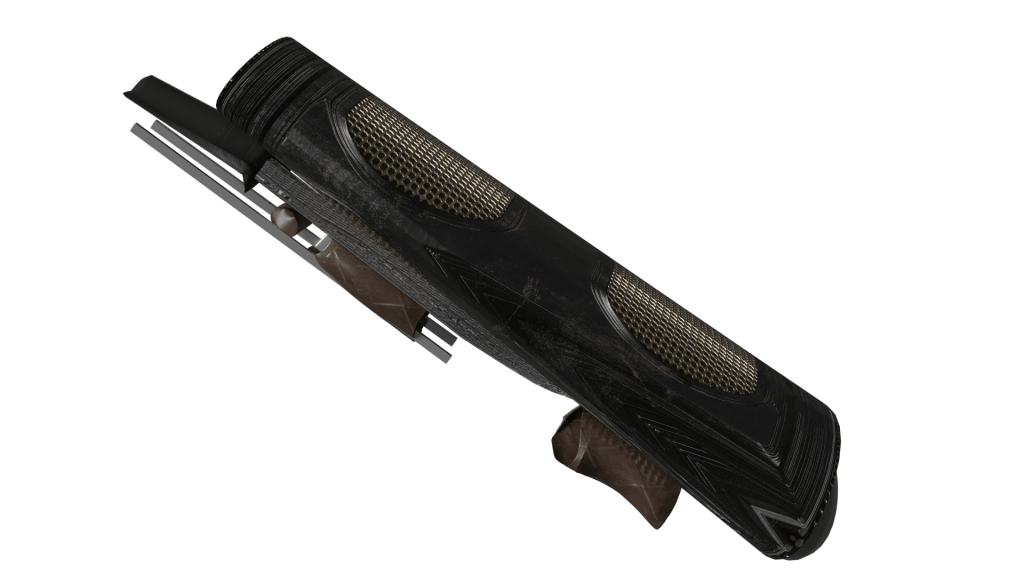
This is an example of what I’m talking about. The ball lightning carbine is a distinctive weapon, strapped to the arm of practically any adventurer in Grailrunner’s Salt Mystic universe. I made this thing in Blender with some parts from various models (a motorcycle, crutch, and I forget what all). The frame of it and the leather straps were just cylinders that I squashed and pulled into place, then added textures. Now I’ve got this thing in a hundred styles and orientations.
1. For our new Lore Card, it started with an idea: a dramatic aerial view of a carbine gunslinger on a mountaintop with a wide valley below him. Sometimes the story comes first, but in this case only the mental image. I’d write the story behind that guy after I saw him.
2. With Stable Diffusion, I experimented with a series of prompts suggesting the aerial view, the mountain top and valley, and the “fantasy gunslinger”. It took patience, not going to lie about that. And I cycled through several artists incorporated in the prompts to try different styles as well (you can mix artists too!).
3. Once I got something that looked like it would work for me, it needed some basic touch-up painting and color & tone adjustments in Photoshop. There was also an annoying misshapen character standing there (instead of my gunslinger that I asked for!) that had to be just erased. Photoshop has vastly improved capabilities now for easily removing stuff.
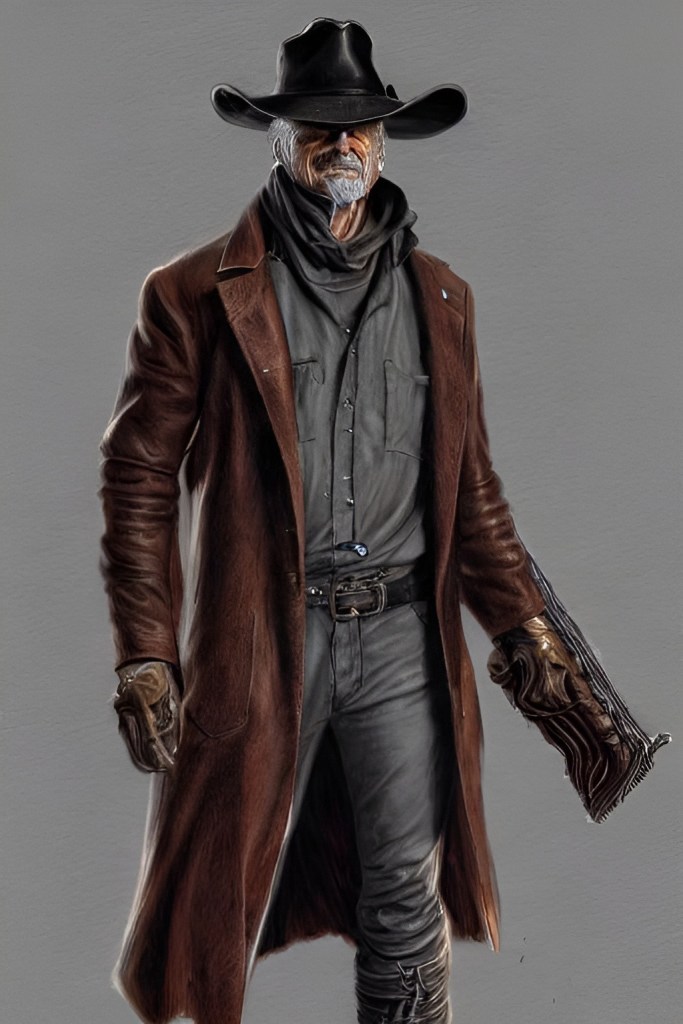
4. I still needed that gunslinger though, and went back into the cycle loop trying various iterations and prompts to get a guy in the right posture and wearing the long, gunslinger coat I was looking for.
This is the character I eventually went with. They can turn out with three arms and nightmarish faces, the fingers often run together and look like tendrils. Seriously, the output isn’t always mind-blowing, but here at least I saw the outline I wanted and general textures.
A bonus was the weird almost rectangular thing he had on his left arm, which if I squinted looked to me like our carbine without any extra editing.
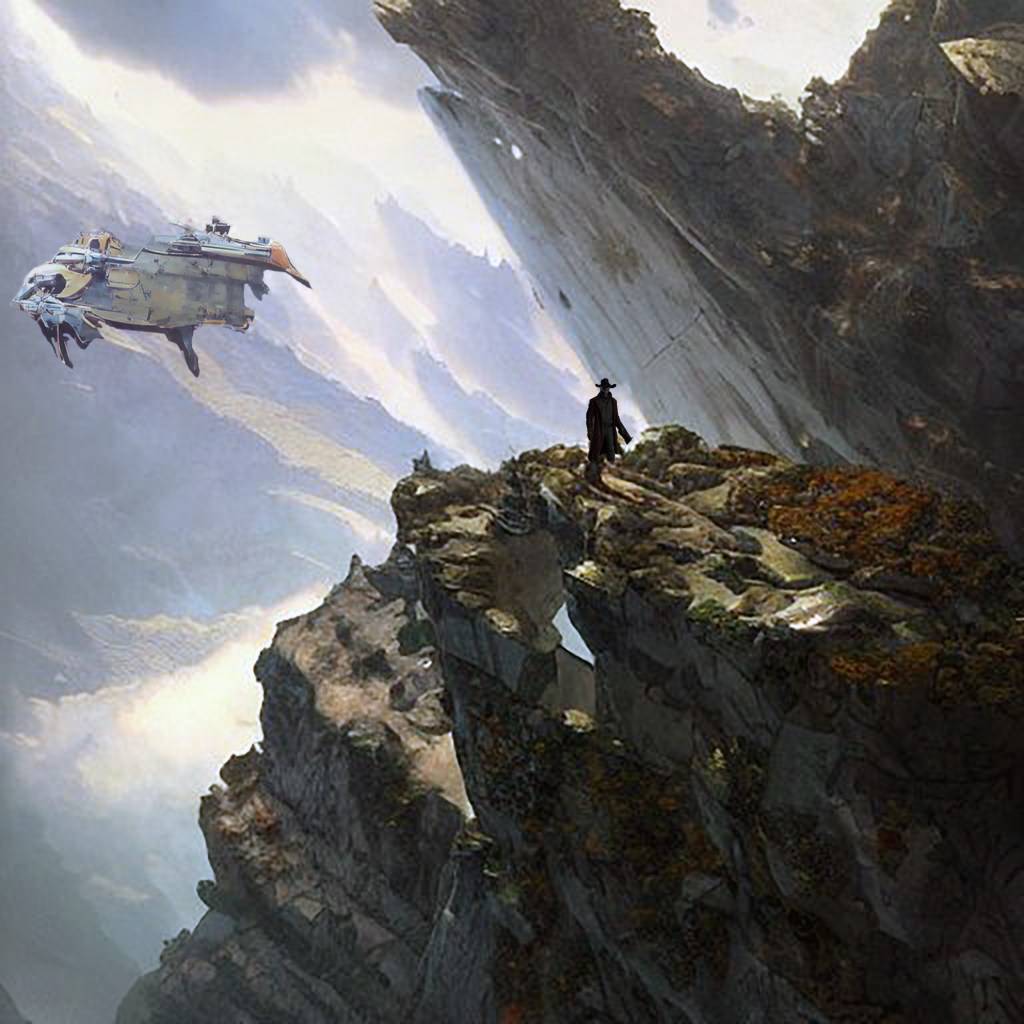
5. I cut him out of his background and placed him on the mountaintop, gave him a little shadow, and darkened him to almost a silhouette. I was close, but it was bugging me that he was up on the high plateau without a clear story of how he got there.
6. I already had an asset for an airship from a previous work that I repurposed here. There’s a fantastic feature in Photoshop for automatically adjusting color grading and tone to match another image, so much of the hard work was done for me with that option. I just needed to trim it up a bit and place it in context.
One thing we’ve heard loud and clear from you is that you feel it’s hard for someone to first get into the Salt Mystic universe without having the Sourcebook And Core Rules. You’ve got your battle deck, your own copy of the book, and you’re ready to smash some tornadoes together. Your head’s swimming with images of gunslingers dueling with ball lightning and abandoned sparkling oriel gateways leading to treasures and ruin.
Yet there’s a lot of gaming options out there (and so very little spare time!), you struggle to get someone to buy any of that for themselves, so there’s no one to play the game with.
We hear you. And we’re fixing it.
Starting today, the free ebook available right here on the Grailrunner site will include:
Two full color Volume One starter decks, available in print & fold format
Dice cards and a measuring ruler
A fully realized narrative scenario complete with short fiction and table setup guidance
An assortment of sample terrain elements, including one customized for the included scenario
The included adventure scenario is particularly dear to my heart, because we mostly stick to flash fiction at Grailrunner. We’ve always kind of thought people like their non-mainstream stories super short, high impact, lots of shock and cool ideas, with great eye-catching illustrations. Like we’ve attempted with the Lore Cards. The novels will be great when they come, but that moves incredibly slowly for me at least.
Yet you asked for more now. Thank you!
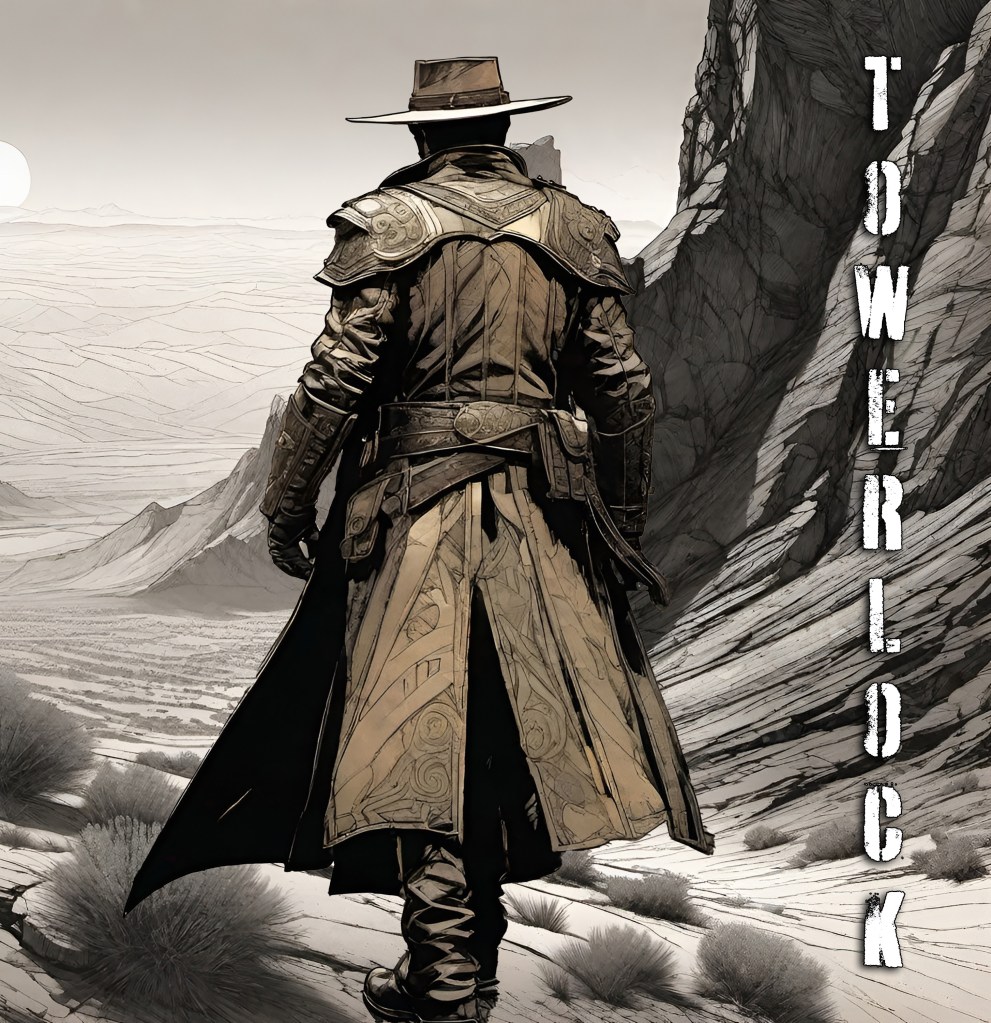
The bonus game scenario is titled “Towerlock”. We wanted to elaborate on a fan favorite character, the devilish all-seeing wildcat who calls herself “The Wake”, bringing her to life in a way that might surprise anyone that has gotten to know her so far. Or thinks they have.
The accompanying tale exists to help you visualize the unique battlefield conditions that will exist in the game scenario. The pressure cooker conversation between The Wake and this mysterious adventurer with whom she apparently has history is your chance to ask yourself just what you’d do to either attack or defend the summit of that mountain. You know your assets, your liabilities. Then…what would you do? Play and find out.
Towerlock: An abandoned oriel terminus has been discovered on the summit of a towering granite butte in the desert country in Jasphouse Province. A single oriel gateway leads to artificial pockets of space left over from The Infinite Republic, and could contain treasures and technologies beyond belief. Yet a terminus might contain as many as twenty such gates. No one nation can be allowed to control that sort of thing.
Karak and a vanguard watch from Alson in the Mountains got to the summit first and established an operation financed by an enigmatic partnership known only as Towerlock. He will need to plan his defenses carefully and consider all possible avenues for assaults and seiges.
Segmond and a vanguard watch from Tanith in the Salt Flats has arrived to take the summit back. He’ll need to analyze the defenses being set up, consider all intelligence he can gather, and prepare as devious or as bloody an assault as he can muster to have any chance at success.
Wonders beyond imagination could be ripe for the taking. But the fight will take place on a sheer vertical wall, and anyone who’s defeated falls like rain. Good luck. Draw well.
What’s your strategy?
Anyway, that’s what we wanted to let you know today. It’s a big deal to us, and will hopefully open the door to more folks dipping into this fascinating, experimental world that’s so unbelievably building itself.
Make sure you’re signed up for notifications for new articles here on the site; we plan to post a sample chapter from the upcoming novel, Mazewater: Master Of Airships.






















 Grailrunner Publishing