If you need to know a bit more about what we’re doing with Salt Mystic, feel free to check this out here.
In the Salt Mystic Sourcebook And Core Rules, we define seven different ages into which the long history of this setting is divided. The brief snapshots there allowed us to drop maddening hints of some intriguing twists and adventures that occurred thousands of years ago, but we never really get the chance to dig in to those earlier time periods. Maybe one day these will all be their own novel series or art lines – but for now, we’re in the Guardian Age, man. It’s enough work bringing that to glorious life!
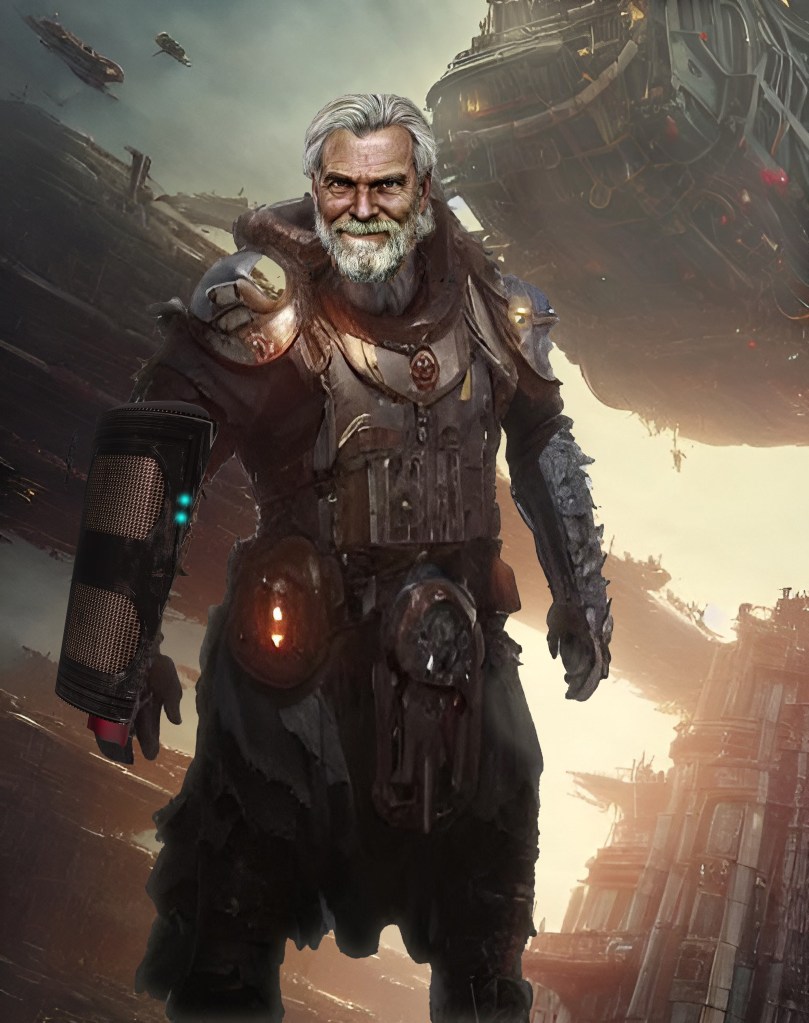
So this new lore card was a chance to flesh something out that I thought was interesting. There’s already a guy named Murmur in the Salt Flats character cards that has an Artificial Intelligence sprite inhabiting his armor that we’ve always thought was funny. This lore card was where we go big with that.
Horrifyingly big.
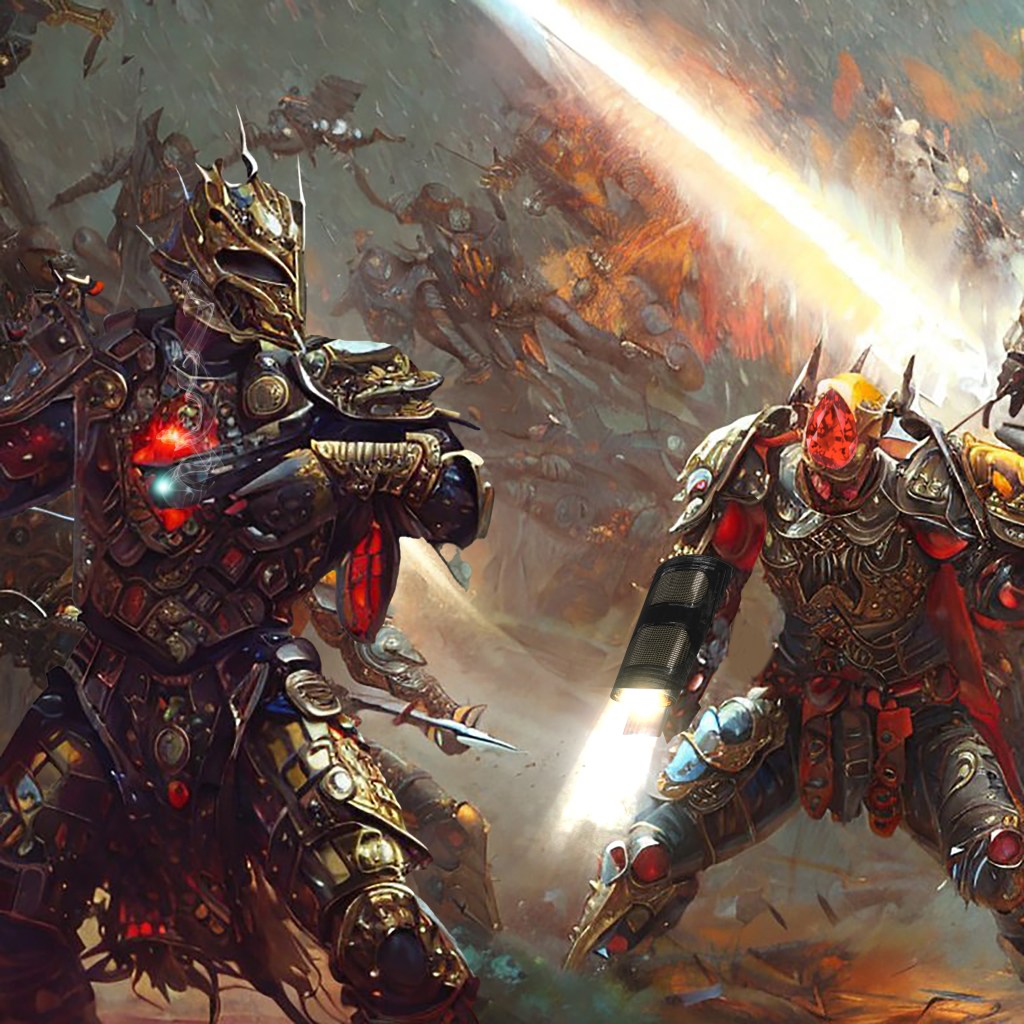
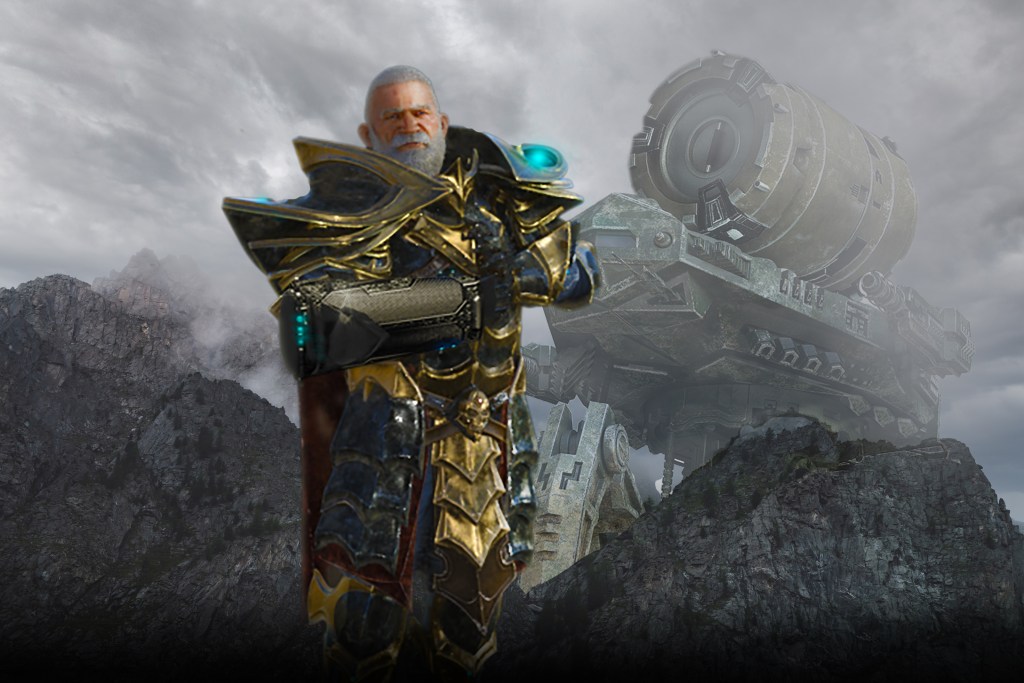
As for the art, as always it’s a photobash and paintover of some different elements pulled from a few sources. The background is an AI-generated image of a battlefield. The warriors’ jeweled armor was inspired by Grant Morrison’s 18 Days art book (which accompanied the web series), based on the storyline of the Mahabharata. The carbine was built in Blender as a 3d model, textured with a steel plating from Textures.com. The ruby faceplate of the guy turning on his general was taken from a freely available png – literally just googled “ruby gemstone” or something like that.
I especially love the way the smokey flames turned out, spewing from that fellow’s gauntlet-based plasma weapon. There are at least three overlays on that, all from Nucly. I wanted it to seem like he’s firing that weapon up, and his general has just now realized that he’s stepped over some kind of line.
Anyway, we hope you like the art piece and accompanying flavor text. Let us know what you think.
Occasionally as we build out the Salt Mystic universe, some spooky new threats pop into existence that surprise even us. Right now, I’m 23k words into a standalone novel set in this world that will shake it like an earthquake, introducing new weaponry and technology, several exciting new locations, and a host of new terrors!
Enter the Day Giant.
If you’re new here, let me back up a bit. The Salt Mystic setting is an experiment in immersive storytelling that fuses art, fiction, and games into a unique and thrilling experience. Right now, it’s a novel that introduces the main narrative, a terrain-based trading card wargame that expands and breathes life into that narrative, a growing line of branded merchandise (including our first art print!) and freely downloadable illustrated flash fiction called Lore Cards.
Click the wings to learn more:
We’ve been hard at work dropping new Lore Cards over the past few weeks, so make sure you stop by every once in a while to see what’s new. The Story Arcade is what we call the repository of cards, and it’s a place to get inspired for your own games of Salt Mystic or to fuel elements in the Roleplaying Game system of your choice.
Click the medallion to see all the current Lore Cards:
Although Salt Mystic is at heart a western-inspired science fiction setting, with a theme of exploring lost and hidden worlds, I feel like no adventure stories are complete without a terror that sticks in your mind and creeps around there. In the Work In Progress novel, to be called Mazewater: Master Of Airships, you’ll be introduced to a scrappy, gangly fellow named Lamberghast Mazewater, who faces such a threat with a quivering voice, a shaking hand, and armed with only his big heart. More to come on that as it develops.
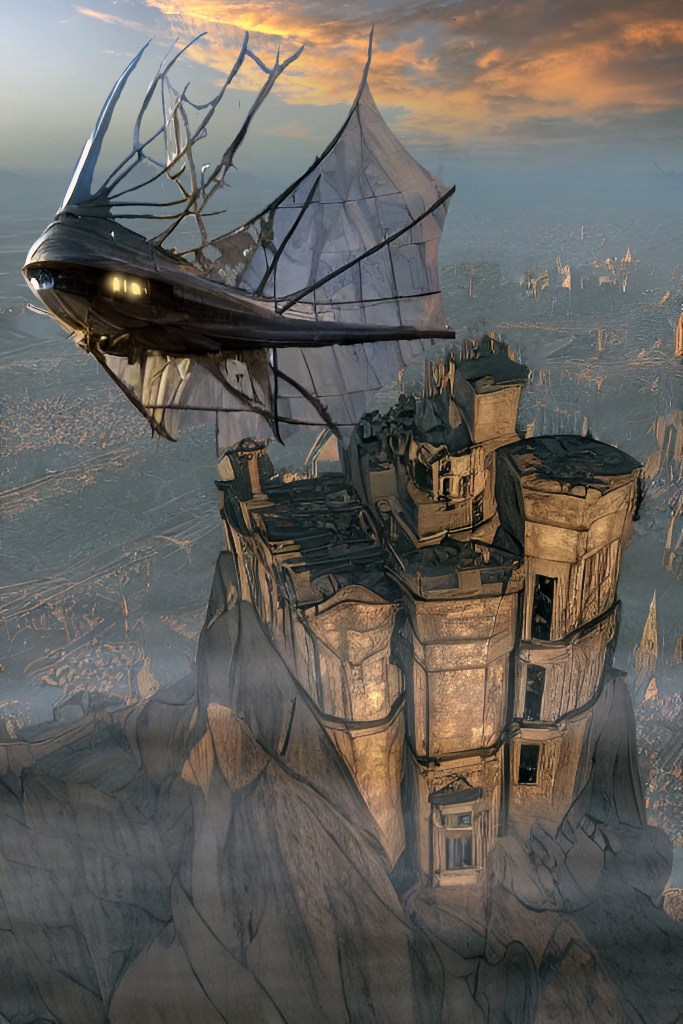
A vortex glider high over a watchtowerLamberghast MazewaterMazewater At Vimana Station
The artwork
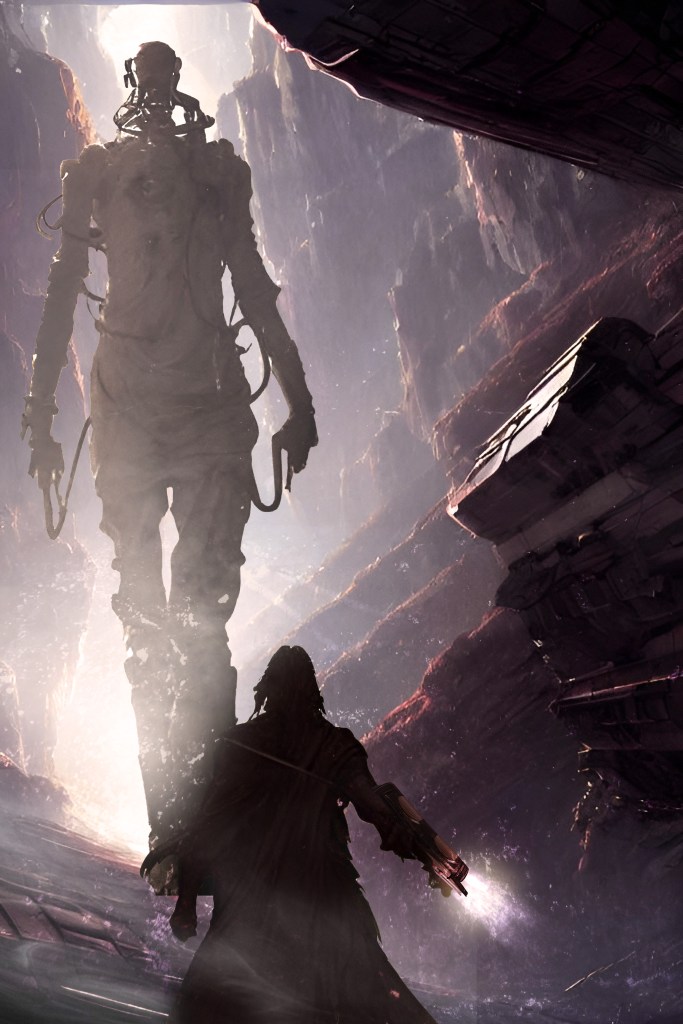
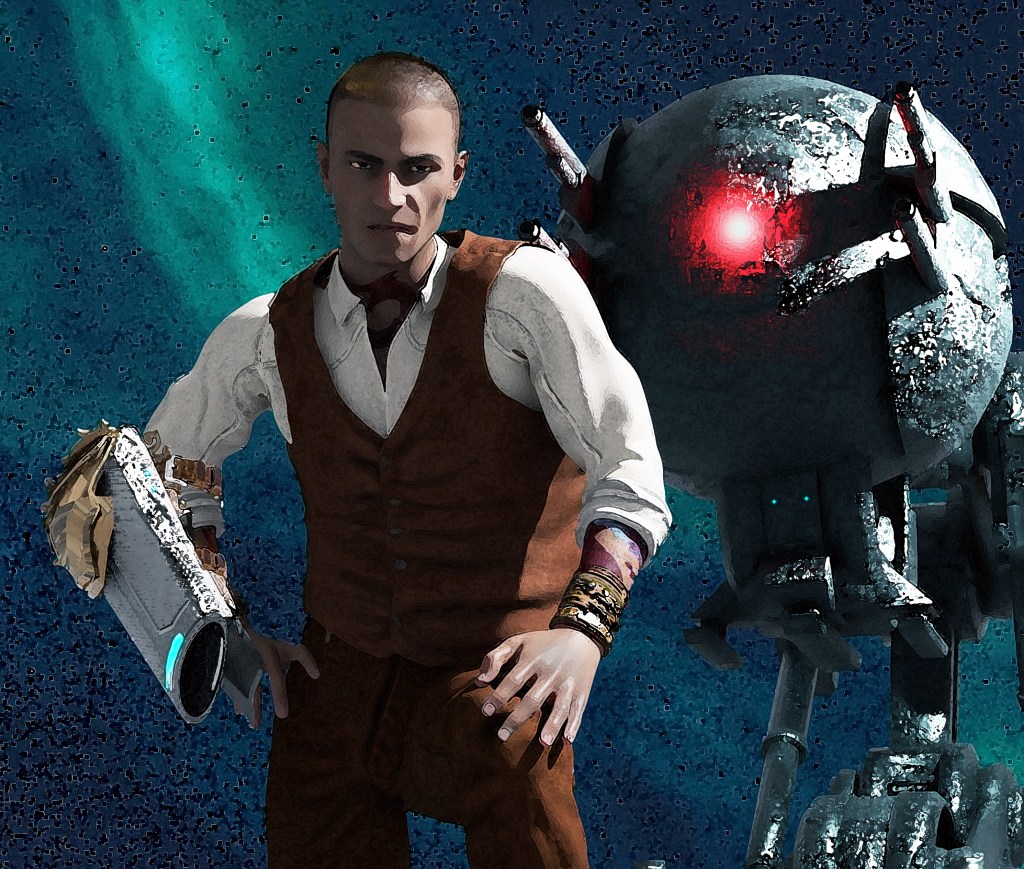
The art for the new Lore Card was produced combining elements from two AI art generators, then painting over them and completing the composition and adjustments in Photoshop. This approach is a real game changer for small indie publishing companies like us! Sometimes, the image comes first and then the story. It was the reverse this time – I knew the giant’s general appearance and that I wanted a gunslinger facing off with him. That’s all I knew though.
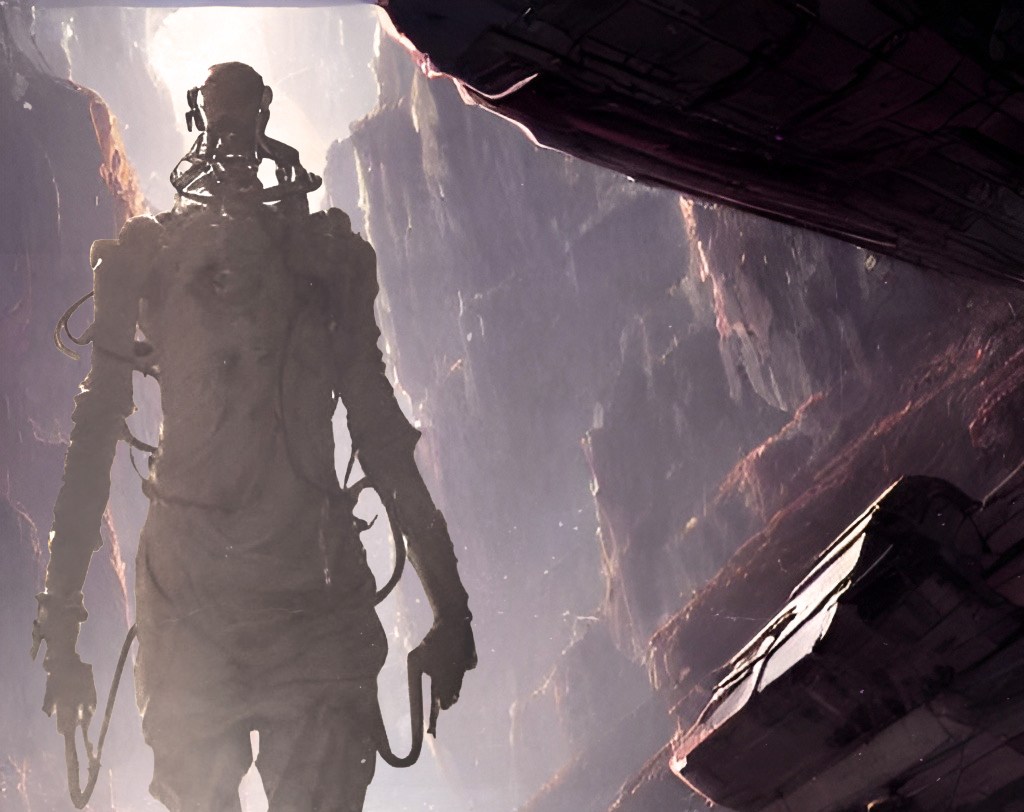
The giant: It took many, many iterations with Codeway’s Wonder app using text prompts like “enormous thin giant in rags with oxygen mask and exoskeleton” till I got something vaguely like what I had in my head. The color was wrong, as was the perspective, the tone, and it had bits and bobs all over it that were unwanted. I cut it out, trimmed the odd bits, then altered the perspective so his top half was smaller.
The canyon: The canyon was another round of iterations, in both Stable Diffusion and Wonder, till I got a mashup composition of rocks and lighting that generally gave me something to trigger the eyes to see the giant as huge. I wanted light coming from behind it, so I juiced that with a Color Dodge and soft brush.
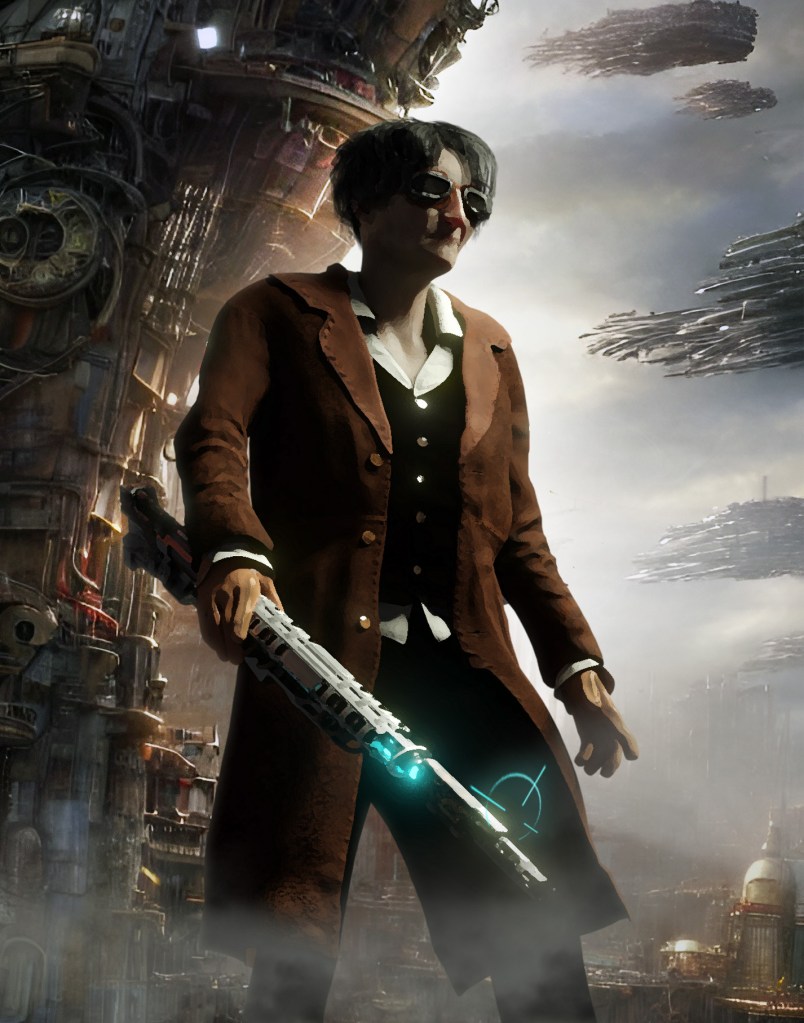
The gunslinger: The gunslinger was a third round of iterations, in Wonder. The text prompts were things like “fantasy gunfighter in long coat holding his arm out”. This one had bits and bobs coming off it as well, and the coloring was terrible. He also had weird holes and discolorations all over him, which I had to correct.
The weapon: The ball lightning carbine is a long-standing custom item I use all the time. I built and textured it in Blender. This time, I cut out parts of it to show it partially concealed by his sleeve and brightened the barrel’s tip (with the Dodge tool) to show it glowing from the heat inside the barrel.
There’s a company called Nucly that offers various overlays for Photoshop – I included a ‘god ray’ overlay and morphed it to emit from the gunslinger’s weapon. That looked cool already, but something unanticipated happened once I started making adjustments.
The lighting: I superimposed a grunge texture over the entire image in Screen mode, which roughed up the look of it in a way I really liked. However, I noticed the Color Dodge blur coming from behind the giant as well as the charge firing out his weapon reacted with the grunge overlay for even cooler lighting effects than I’d planned. I really liked how that turned out, honestly.
Color grading: I tried various warming and cooling filters over the entire image, and tried adjusting its color grading to various images whose color schemes I liked. This warming filter (an evening sun shade of orange) won me over because of what it did to the canyon rock.
Here’s the final image, which will also eventually appear (in altered form) on an upcoming Volume Two game card next year (click on the image to see the Lore Card and read the associated story):
I hope you like the art and the story, guys. Let me know what you think! Till next time,
Writers are weird little machines, man. When our brains should be resting or thinking about bills or whether the lawn needs mowing, they often run off the rails behind the scenes trying to answer questions: questions like what would it be like to duel someone with ball lightning.
All the way back in the nineties when I first started conjuring images that would become Grailrunner’s Salt Mystic universe, certain concepts came out of the dreamspace whole, all on their own and fully formed (all page references relate to the Salt Mystic Sourcebook And Core Rules):
A mountainside carved with the statue of a bearded man, whose outstretched hand cradled a mighty waterfall (page 46)
A vehicle with articulated legs and a swivel chair that climbs vertical walls (page 40)
A ramming war vehicle that moves in all four directions (page 41)
People who are modified for perfect memories and powers of observation with forehead tattoos (page 28)
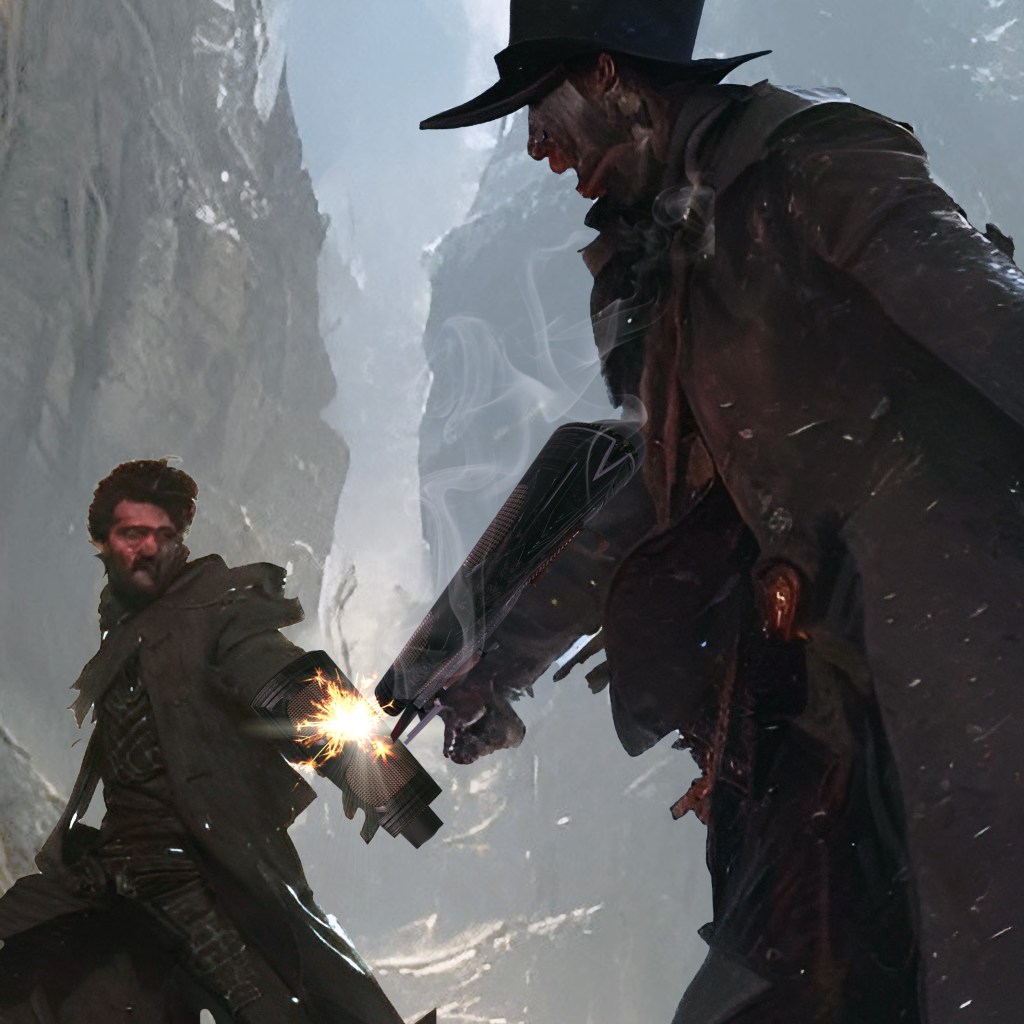
But one of my favorite images was two dudes dressed like cowboys in long coats, staring each other down with a weird weapon strapped to their arms like shields. I knew from the beginning the weapon fired ball lightning because I was fascinated by ball lightning, ever since it was featured in an old episode of Arthur Clarke’s Mysterious World. (Great show). I also knew the weapon doubled as a shield, meaning you could block incoming fire. That meant a trade-off – when you’re blocking, you’re not firing. When you’re firing, you’re exposed. I liked that. I called it the ‘ball lightning carbine’.
It was a vague, exciting idea till I got to write the first action scene using the ball lightning carbine in the 2015 novel, Tearing Down The Statues. It’s in Chapter 4, called “A Cannon Off The Rails”. I remember the thrill of writing it, because of a particular line of dialogue I worried over including:
Several gunfighters had surrounded a dangerous character named Cyprian, which I signaled with all my might to be a terrible idea. That was entirely my point, that this was their very bad idea.
“You want to see something amazing?”
That’s what Cyprian said, grinning, with his head lowered in the shadows, right before he turned into an avenging fury and wreaked all manner of havoc on those poor guys. I mean, I chuckled after getting that chapter wrapped up. It had been a long time since the picture drifted in like soap bubble, so it was fun to see it in words at least.
The carbine duel became for me a primary mechanic for action in the setting, as well as for the cards in the Salt Mystic tabletop game. In fact, I’m going with it for our primary (hopefully iconic) aesthetic for the random adventurer out poking in the wilds through abandoned oriel gates or mad War Marshals who’ve seen terrible things.
What’s got me thinking about this is I had a fascinating conversation recently with a tornado that looks like a human being who calls himself Doc Brock on this very topic. Incidentally, I interviewed him back in 2020 – you should go read that. Although he’s the designer and creator of a fighting game (Future Fighter), he’s also a musician and pathologist. Most importantly for our topic today, he’s studied martial arts for over 35 years and has a process-oriented mind to break down a topic he’s asked about.
I wanted to know what he’d do with a carbine strapped to his arm.
“When you’re talking about million degree plasma, it takes martial arts out of the equation”, Brock explained. “The main consideration is to avoid getting hit. If you get hit at all, the fight is over.” (I’m paraphrasing his comments).
This was interesting to me because I was thinking about Kung Fu movies, where the guys are sizing each other up considering different fighting styles before rushing in to whirl about like mad in a complicated, blurry flash. In my mind, you could either hang back and focus on accuracy (like they say Wyatt Earp used to do, steady and aiming and using the opponent’s panic to your advantage) or rush in close and combine gunfire with hand-to-hand combat moves (like smashing a dude’s face with the carbine itself).
“You’d have to consider your opponent’s size and weight. A bigger guy, say 6 feet, 250 pounds, can’t move around quickly and is a big target. With him, you might try and lead him in the direction you want him to go. Maybe a shot to one side to get him to move into the line of your next shot. Either way, always aim for the chest though. Always.”
He agreed that it’s a terrible idea for someone in a carbine duel to drop to the ground for any reason, “It takes an incredible amount of time and energy in a fight to get off the ground, and when you’re down there, you’re completely vulnerable. That’s something you should never do.”
After asking me how long the charge lasts on the carbine, he made another strategic point, “It seems to me the key is to drain your opponent’s weapon. Once they’re out of ammo, this fight is over. No one is surviving a shot from one of these.”
And that comment caught my attention, because I honestly hadn’t given a lot of thought to how many shots one of these could get off (I said roughly 30 to avoid sounding like a writer who hasn’t considered his own creations). It struck me that some carbines (like Cyprian in the novel and Waymaker, a card in the Salt Mystic game) have modified carbines with dual breakers that fire twice. That creates some new tension and a trade-off, now that it’s clear such a modification would drain the charge twice as quickly. I liked the story possibilities there!
“What’s the range on these plasma balls?”
And he got me again, because the only thing that came into my head was “2 inches”, that being the scale distance range in the tabletop game.
Which led us to talking about wiffle balls.
I suggested to Brock that the only reason these spheres have velocity is due to the electromagnetic rails inside the housing which capture the ball lightning once it’s generated by the breaker and slings it outward when the palm trigger is clutched. I used the analogy of a wiffle ball, those plastic, perforated balls that go quickly about six feet when you throw them before the air catches them and they slow to a crawl and drop.
My thought was the ball lightning would move at a blinding speed for a few feet, then slow and eventually just hover like soap bubbles should they fail to strike a target.
“That paints a whole different battlefield if they hover like that. I can imagine a mine field around these guys as they fight.”
And that’s a picture somebody needs to write or paint. I mean, that’s awesome. I may take that one on at some point.
Overall, it was really fascinating to chat with somebody willing to break down what a carbine duel would look like, what a person trained in martial arts would think about facing somebody packing one of these. I wish I’d taken better notes – he was full of suggestions, even directing me to a particular episode of a TV show called Farscape with a similar weapon (cool, but ugh since I thought this was unique).
It also makes much more sense now why so many of these guys are wearing the long cowboy coats – it’s disorienting in the panicked gunfight how large someone is and where their body actually is.
Anyway, what do you think a carbine duel would look like? What approach would you take if there’s a guy staring you down and packing one of these? I’d like to know…
Ugh. Bad news. The artist I was trying to snag for the packaging for the upcoming Salt Mystic tabletop game is swamped. If you’re not up to date on what I’m talking about – catch up here. Everybody’s got a day job, and his is art director at a game publisher. I only found out he was taking occasional freelance work in the last few weeks and tried to pounce, with no dice. I’m a little bummed about that because he’s amazing, and his style would be perfect for the tuck boxes the game’s card decks will come in.
We agreed another time maybe. If things work out well, we can possibly bring him in for some premium cards in volume two or something. Stay tuned, I guess?
But now I need packaging designs for two card deck boxes that sizzle and pop, that highlight what the game is about and communicate its unique lore or technology and how it differs from Star Wars or Warhammer 40k or whatever. Needs to be clear about being science fiction, but feel kind of like a cowboy image…striking and adventurous, but at a glance clear what sort of game we’re talking about.
No pressure at all.
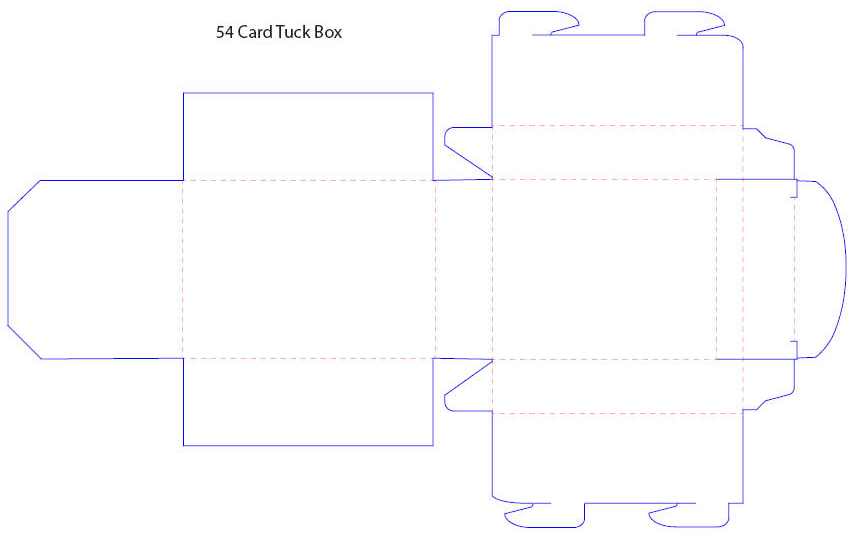
And the image needs to fit in this template:
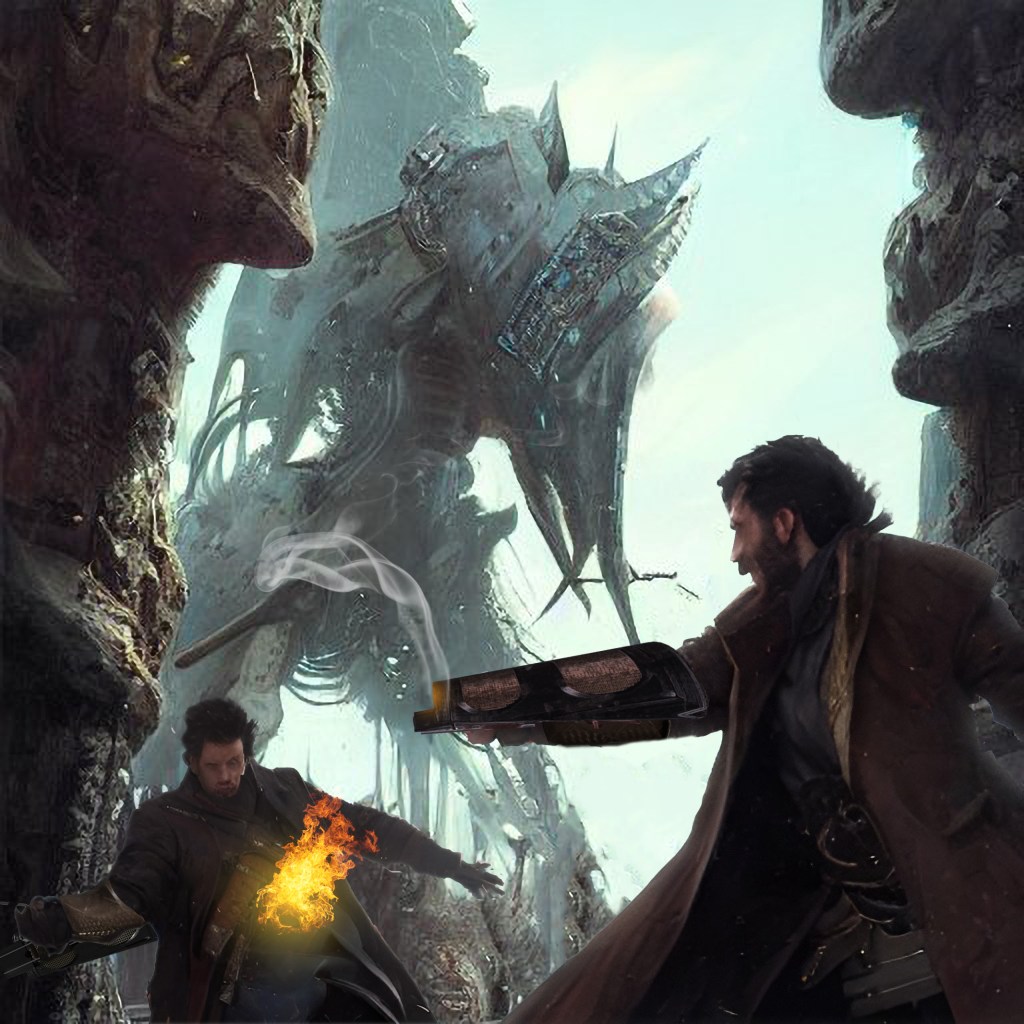
If you download the Basic Rules and take a peek at pages four and five, those two dudes are the point of these decks: War Marshals. Tough guys, to be sure…devious and fast with their ball lightning carbines….but also tactical and strategic geniuses at commanding their factions. The two tuck boxes need to highlight their respective War Marshal very prominently. Then I’ll need space on one side for introductory game wording, some exciting blurb about the lore, and a little copyright and legal stuff.
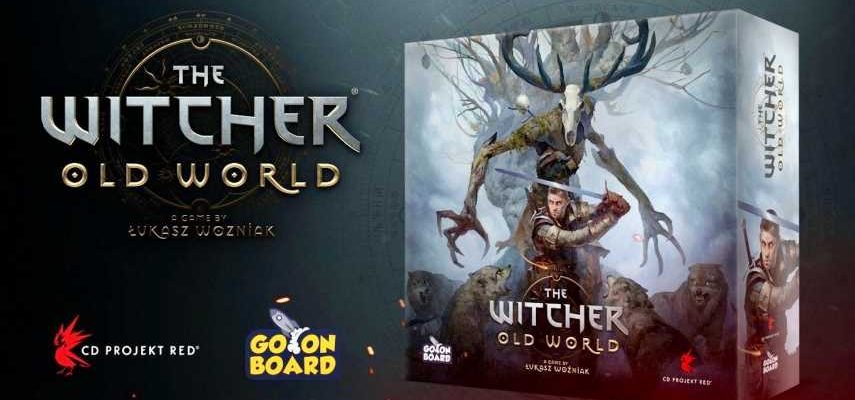
Saw this packaging for an upcoming game based on The Witcher that really impressed me:
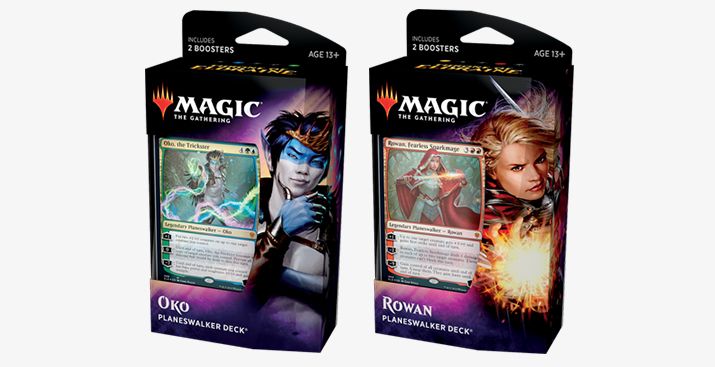
I suppose the thing that struck me most about it was I have had box designs for Magic: The Gathering decks in mind – with shades of blue and green and glowing eyes, hovering magical glyphs and whatnot. But none of that makes sense here, not from the aesthetics or elements of the Salt Mystic worldbuilding, not from the standpoint of looking different on the shelf, and also just to distance from other card games.
But these Witcher: Old World graphics pop big time for me. I like the coloring, the dramatic lighting and smoke, the sense of danger and action. It’s eye-catching and intriguing. So I took a stab at something like I thought my ideal artist might have come up with (the guy who’s too busy), and with this box in mind. That’s the image at the top of this article. Now I’m just kind of staring at it, letting it soak in to see whether I like it. I’d need to fade the edges and fade to black more at the bottom of the box, as well as include a dramatically dark field for the back of the box for the wording and logos.
So I would I rather be writing? Because that’s what started all this?
Yes, I would rather be writing. But none of this world will exist without the visuals and an exciting way to engage with the stories happening in it. Gotta do it, man. Gotta do it.
Looking for thoughts on packaging here – what do you think?





 Grailrunner Publishing