The wonderfully strange Christmas mythology of J.R.R. Tolkien

The guy who wrote Lord of the Rings developed a Christmas mythology. Did you know that?

Take a look at this wonderfully ridiculous illustration below by J.R.R. Tolkien of a polar bear falling down a flight of stairs carrying an enormous pile of Christmas presents. It’s worth remembering that the same imagination responsible for the fall of Númenor and the horrors of the Mines of Moria was also occupied with things like this.
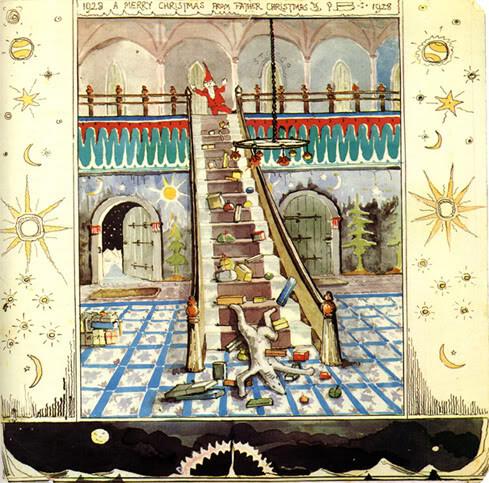
My wife recently got me a copy of Tolkien’s Father Christmas Letters and I thought I would share that with you in case you needed something awesome, fascinating, and heartwarming to rev up your Christmas season.

What are you talking about?

Beginning in 1920, Tolkien wrote illustrated letters to his children in the guise of Father Christmas, continuing the tradition through 1943. The letters arrived with elaborate handwriting, illustrations, decorated envelopes and specially drawn North Pole postage stamps.

Father Christmas wrote in a shaky script, apparently owing to his considerable age (but probably to hide the Professor’s handwriting). His chief assistant, the North Polar Bear, had a rather distinctive handwriting of his own and occasionally inserted commentary disputing Father Christmas’s version of events. And honestly, the bear is hilarious. He gets into hijinks and mischief, comes off as a little grumpy sometimes, but is a steadfast and courageous guardian to Santa when the North Pole Cliff House where they reside comes under attack.

The letters have been collected into a book you can read straight through, set with reproductions of the letters and the original illustrations. I thought going in that this would be a superficial read, too childish and maybe too personal & specific towards his own kids to have anything for me. Anyway, when I’d first heard about it a few days ago, the guy mentioning it said reading it was one of his holiday traditions.

And instead, it was great. Truly great. The Professor never stops surprising me!

What’s this about a Christmas mythology?

Ah, that’s where it gets particularly interesting. True to form, Tolkien stayed remarkably consistent from year to year with a coherent lore. For instance, in 1926 he told them how the North Polar Bear had accidentally set off 2 years worth of the northern lights and mentioned it again the next year, and a goblin battle has consequences in subsequent years.

A goblin what?!

There are these ancient caves beneath the North Pole, inhabited by goblins with a longstanding grudge against Father Christmas. Strange inscriptions and prehistoric drawings cover the walls (you can see them for yourself in the illustrations). There are underground expeditions, battles, secret passages and goblins riding enormous bats. The North Polar Bear, despite his unfortunate tendency to wreck things, turns out to be quite formidable when dealing with goblins.

The letter dated December 21st, 1933 is particularly rich. I won’t spoil anything here, but in a few handwritten letters to his kids, the Professor developed a lore robust enough to make a movie from it that would beat virtually anything coming out from Hollywood these days. If Studio Ghibli put this together, it could be an annual classic!
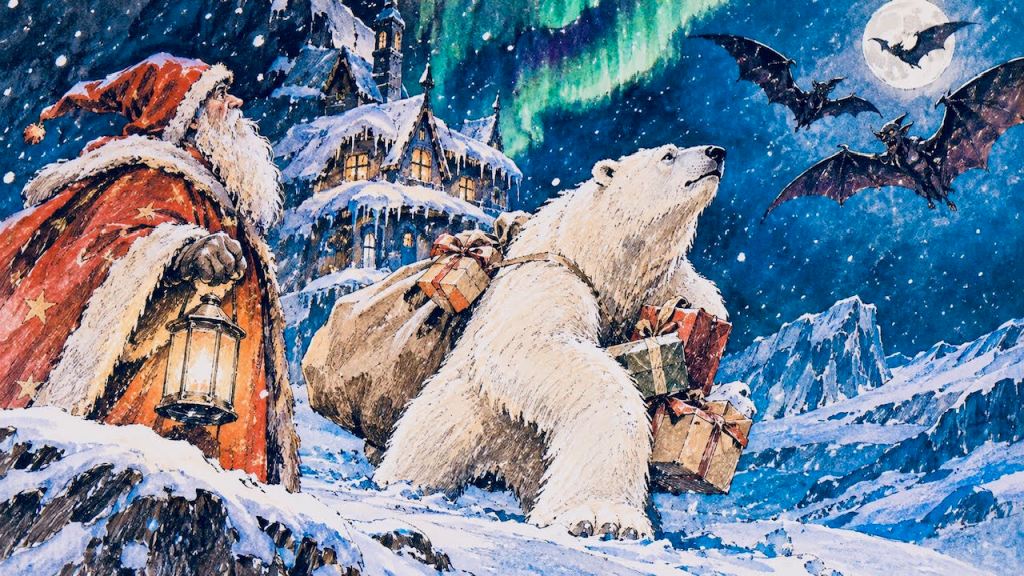
What’s fascinating to me is that Tolkien was developing these things during the years in which Middle-earth was taking shape. The Hobbit was published in 1937, well into the period covered by these letters. And although the North Pole of the letters isn’t part of Middle-earth, there are some familiar preoccupations at work here. Ancient underground civilizations. Forgotten histories preserved in strange markings on walls. Malevolent creatures stirring beneath the surface of the world. Unusual alphabets. Great catastrophes remembered and retold by the people who experienced them.

Even the North Polar Bear’s discovery of the goblin caves suggests a world considerably older and more complicated than the relatively cozy little corner of it occupied by Father Christmas.

Tolkien apparently couldn’t help himself. Give the man a Christmas tradition to embellish and before long there are ancient ruins and competing civilizations.

I love that about him.

What else was going on up there?

There are snow-elves, red gnomes (mortal enemies of the goblins, it seems), the Man in the Moon, and two young polar bears named Paksu and Valkotukka. There are mishaps involving fireworks and floods, and the recurring logistical nightmare of getting Christmas presents distributed throughout the world.

There’s a geography to all this nonsense, too. Father Christmas lives in Cliff House for much of the correspondence, following the destruction of his previous home.

And because the letters were written over so many years, these things accumulate. Characters remember previous disasters. Relationships develop. Old enemies return. The consequences of one year’s adventures become part of the following year’s story.

It sounds like the format is almost its own character…

Absolutely. We’ve talked quite a bit here at Grailrunner about ways of experiencing imaginary worlds outside the confines of a traditional novel. And one of the things I find particularly compelling about these letters is that they aren’t presented as stories about an imaginary place.

They’re presented as things that came from that place.

The handwriting tells you something about the person writing. The illustrations are eyewitness accounts of extraordinary events. The postage stamps imply an infrastructure of some kind. The scribbled interruptions from the North Polar Bear suggest things happening just beyond the edges of the paper. There’s even the delicious possibility that Father Christmas isn’t giving you an entirely fair account of something, judging by the bear’s objections.

Consider how differently you’d experience all this if it were simply a collection of short stories written in the third person. There’s something magical about holding a thing in your hands that purports to have come from somewhere impossible.

Anyway, about those illustrations…

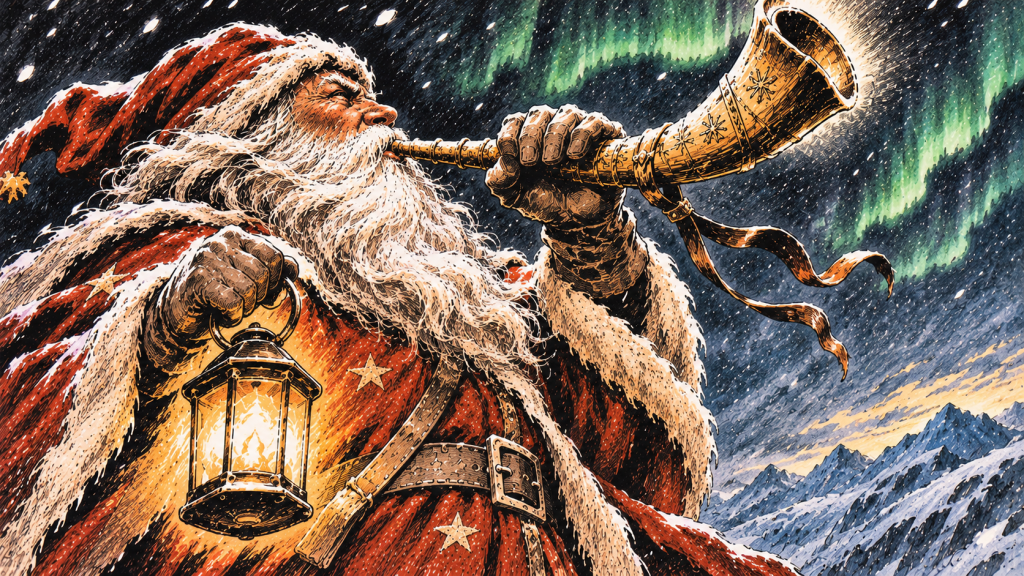
I’ve been working lately on expressive pen & ink illustration, particularly trying to combine the irregular shadows of Bernie Wrightson as the skeleton for the image with Nick Marinkovich’s scratchy grunge streaks and splatter to give it energy. I’m studying Joseph Clement Coll as well – to avoid framing everything in neat little rectangles. It will be cool if I ever really get it worked out on the paper.

And Tolkien’s Christmas mythology offers some surprisingly wonderful opportunities to play with that.

There’s the contrast of warm candlelight against the blackness outside a window. The enormous, lumbering bulk of a polar bear against the wiry little shapes of goblins. The strange architecture of a house built at the edge of the world. The possibilities for dramatic perspectives in those underground caverns.

It’s a side of Christmas imagery we don’t see very often. A little eerie, a little absurd, and still somehow charming.

If you’re inclined to pick up Letters from Father Christmas, don’t make the mistake of thinking it’s just a curiosity for Tolkien completists or a sweet little book to read to children. Spend some time with the illustrations and the odd details scattered throughout the correspondence.

There’s a marvelous little fantasy world tucked away in there.

Till next time,
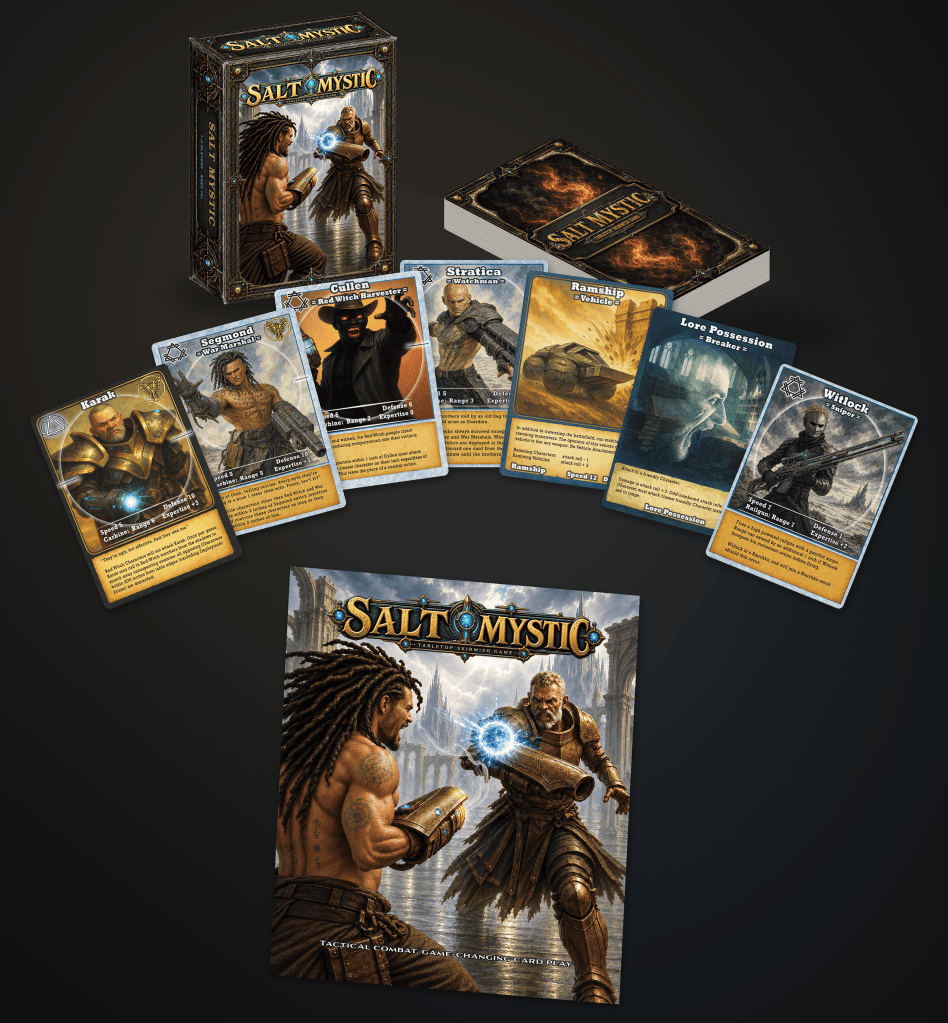
Announcement: the Salt Mystic card game is live with refreshed art and repackaged as a starter set!!

We said we’d let you know when the proofs were right. Well, the proofs are right. The refreshed Salt Mystic Starter Set is live!

If you’ve been following along, you’ve already heard me confess to some questionable decisions about the old card art. Turns out learning a new trick in Blender and needing that trick on a game card are two entirely different things. It took me an embarrassingly long time to sort that out.

The new art had a better question to answer. What would make you pick up one of these cards and want to know where that gunslinger came from, or what happened in the patch of ruins they’re fighting over?

So what’s in the box?

We’ve repackaged the game into a single 72-card Starter Set featuring Karak: The Hammer of the Red Witch and his Mountains faction versus Segmond: The Loreblade and his wily Salt Flats faction.

Karak’s Mountains deck and Segmond’s Salt Flats deck are both in there, along with terrain, measuring cards, and player aids. The Start Here card has a QR code for the refreshed rules, and First Clash walks you through your first fight.

If you’re new around here, Salt Mystic is a science-fantasy skirmish game where you move the cards around the table. Turn a gunslinger to face a threat. Tuck them behind a rock outcropping. Get cocky about how far away the other guy is and find out exactly what a ball lightning carbine can do.

Where can I learn more?

By the way, we’re celebrating all this by way of a very special reunion with an old friend.

Oh yeah, who’s that?

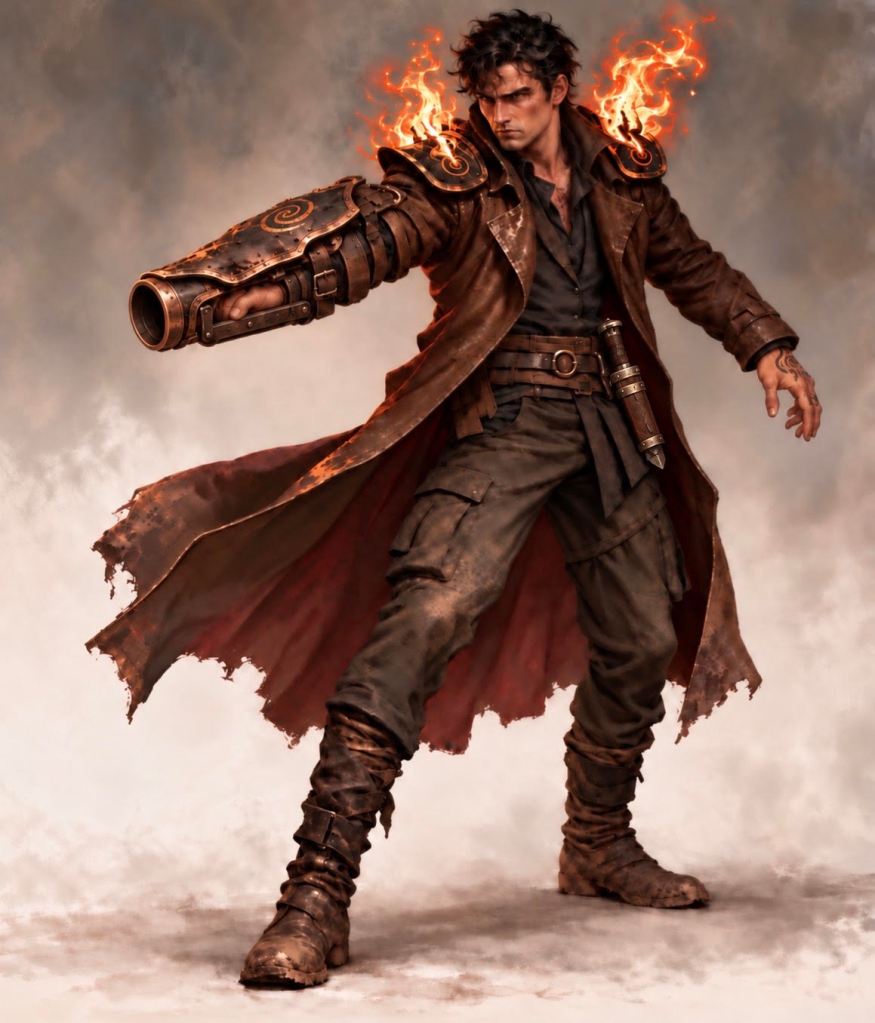
Brian here. One of my personal favorite characters in all of the Salt Mystic universe is a volatile powder-keg fellow named Cyprian. The image of him has been with me since the original novel, Tearing Down the Statues: the thing that started all of this. Unnaturally tall, in a long leather coat with heavily tattooed hands in red & black, and with the illusion of flames erupting from black shoulderboards, he’s unpredictable and deadly with the signature weapon in Salt Mystic: the ball lightning carbine.

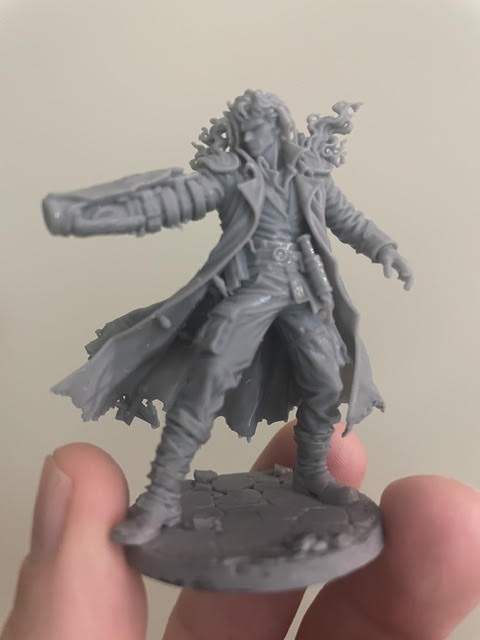
I thought it would be awesome to 3d print him.

Ooh, is there a model?

There’s something funny about spending all this time getting plasma gunslingers to look right on flat pieces of cardboard and then turning around to see if I can get one of the first people in this world to stand up on the desk. I’ve known Cyprian a long time. I want to see how that coat looks when I can turn him around in my hand.

I uploaded the text of Tearing Down the Statues to the Pro version of ChatGPT and asked for a better illustration than I would be able to come up with. It took a few passes to get it right but when it finally landed, I was very, very impressed! You can see the tattered, weathered coat, the carbine shield, that deadly ballistic knife he carries, and those amazing shoulder boards. Very cool.

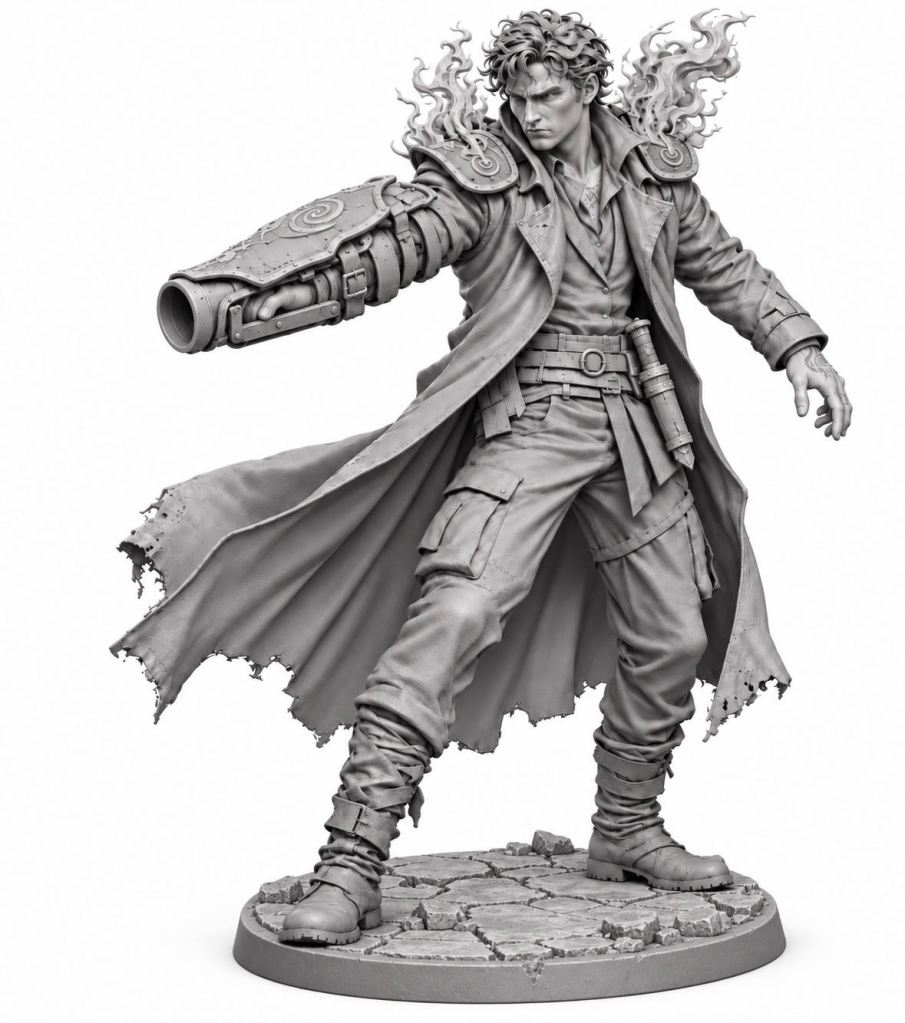
Then I converted that illustration to a new image appropriate to load to Meshy AI: a separate AI tool which generates 3d models from images. I had it add a base, remove the color, and emphasize some geometry better so Meshy would pick up on it. Then I took that to Meshy and got the STL file.

It took me forever, back in ChatGPT, to close some shell holes and fix some errors Meshy left procedurally. Then I spent forever in Chitubox trying to get the supports right. I never did successfully address some internal cavities but the supports wound up great. I’m not a 3d modeler, man. Not at all. And I don’t have the patience to find all those overhangs and fix them one by one. So I just printed it and hoped for the best.

I’ll be honest, when I scraped that thing off the printer plate for the first time and saw that guy there in my hand, a character who existed only in my ghostly imagination for over a decade, I got emotional.

It was really great to actually meet him.

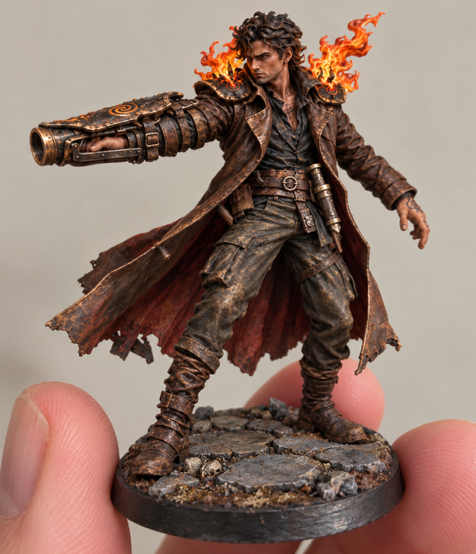
I uploaded the pic of the printed model and had AI generate the paint scheme, which is portrayed here. I didn’t paint that, thought I’d love to pass that off as my handiwork. I wish I could tell you my paint job was that awesome. Unfortunately, no.

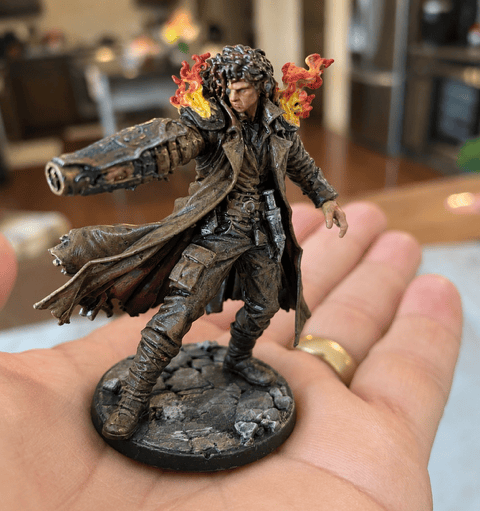
But anyway, I liked what I saw and read off all my acrylic paint colors from old sets I had lying around and some Privateer Press colors. Plus, I bought some metallic paints from Amazon back in the day which always turned out well. That way, ChatGPT knew what specific colors to use in its step-by-step painting instructions. Very prescriptive and helpful.

And nuln oil. I love nuln oil. It forgives all sins in bad paint jobs by making shadows in crevices. I totally need that sort of magic in painting models.

And there’s my guy. Cyprian. In my hand, pointing his gun at me from my bookshelf.

Maybe this doesn’t mean anything to you and you can’t relate to why I’d be excited. But I hope that’s not the case. Fifteen years ago, I wracked my brain to come up with a cool aesthetic for this guy. I remembered Firestorm from the old DC comics and his flaming head illusion. I remembered old John Wayne and Clint Eastwood movies. I gave him a scar on his face just to give him a history and thought bright red & black tattoos on his hands would be unique.

It was me trying to dream up a fascinating character and summon imagery without being able to really see the guy.

And here he is.

Anyway, your takeaway should be that the Salt Mystic game is renewed and repackaged for easier entry to this world and you should check it out.

Your second takeaway is this author guy wrote a book with a character important to him and through modern wizardry is holding an accurate model of him in his hand. If we had flying cars, I’d truly agree we’re living in the future. I thought I’d share one of my favorite scenes from the book with this guy, Cyprian Talgo, to give you some context so the celebration makes sense. He’s in a corridor in an undersea complex surrounded by four gunfighters who’ve made the mistake of telling him they’d like to see what he can do with that weapon.

Click the arrow to expand the scene.

“You want to see something amazing?”

“Did I upset you, lapdog?” Cyprian’s voice was soft.

“You can’t just threaten them like that. Jeopardizes the whole structure we’ve got here. You brought it on yourself, honestly. And I’ve got a lot of anticipation here; because I was just going to have someone put a slug in your forehead on the ship. A couple of the guys thought better of it to see what you could do.”

“Risky.”

“I don’t know about that. Fascinating though. Nobody’s going to start a war over you…the world isn’t like that anymore, Talgo.”

“Less chatter!” The guy behind Cyprian spat this out.

“You want to see something amazing?” Cyprian’s grin was sinister. Thrilled.

Another of those surrounding Cyprian, the one with a burn on his cheek, smiled wickedly, “Whatever. Rich boy.”

The young Talgo watched the face of the one who’d last spoken, the one excitedly awaiting a show full of drama and color, swirling action and a thrilling recount for his friends. He did the same for some of the others and saw the same eagerness, a boyish delight in a playground brawl with the biggest kid in school. He had clearly seen this before and was maybe surprised at how alike these sorts of people are.

“I know your tricks, jay bird.” A darker man to Cyprian’s side spoke, one with an eye squinting more than the other. “Two breakers in your carbine – fires twice as fast. You prance around like a dancing idiot while we panic and try not to shoot each other because you’re you. They write books about you.”

Ventrey had been watching the olive man who’d spoken, then at last turned back to Cyprian, “Give me back my gun.”

Cyprian kept silent. He turned his eyes to each of the men about him, waiting on one of them to do something other than threaten. Impatiently, he raised his eyebrow and gently shook his head as if to signal ‘well, I’m waiting’. Perhaps they were only blustering. At any rate, when he moved, it was with ferocity.

Like a crocodile attacking, Cyprian leaned in and thrust his right heel behind him, crunching backwards the knee of the man approaching him there. The fellow quickly went down grunting like an animal and collapsing around that knee. Before he had even fallen, Cyprian had shifted his carbine to his forearm and slung a ball of lightning through the falling man’s forehead exploding it in charred and smoking fragments.

Smoothly as if he’d seen their return fire in slow motion or on game film beforehand, Cyprian twisted the insulated shield of his carbine through the air blocking their shots in sequence. He spun a full circle throwing his carbine arm out to smash Ventrey’s jaw with the barrel, drawing out a tooth and fired multiple precise shots off, throwing the others into defensive moves shielding themselves. Lightning popped and rushed around them and hissed as balls popped out of existence in searing flames.

— Tearing Down the Statues, Chapter 4

*

That’s what I wanted to share with you today. I’d be highly honored if you checked out the new game and let us know what you think. It’s been years of work culminating in something everyone involved with Grailrunner is very proud of.

Till next time,