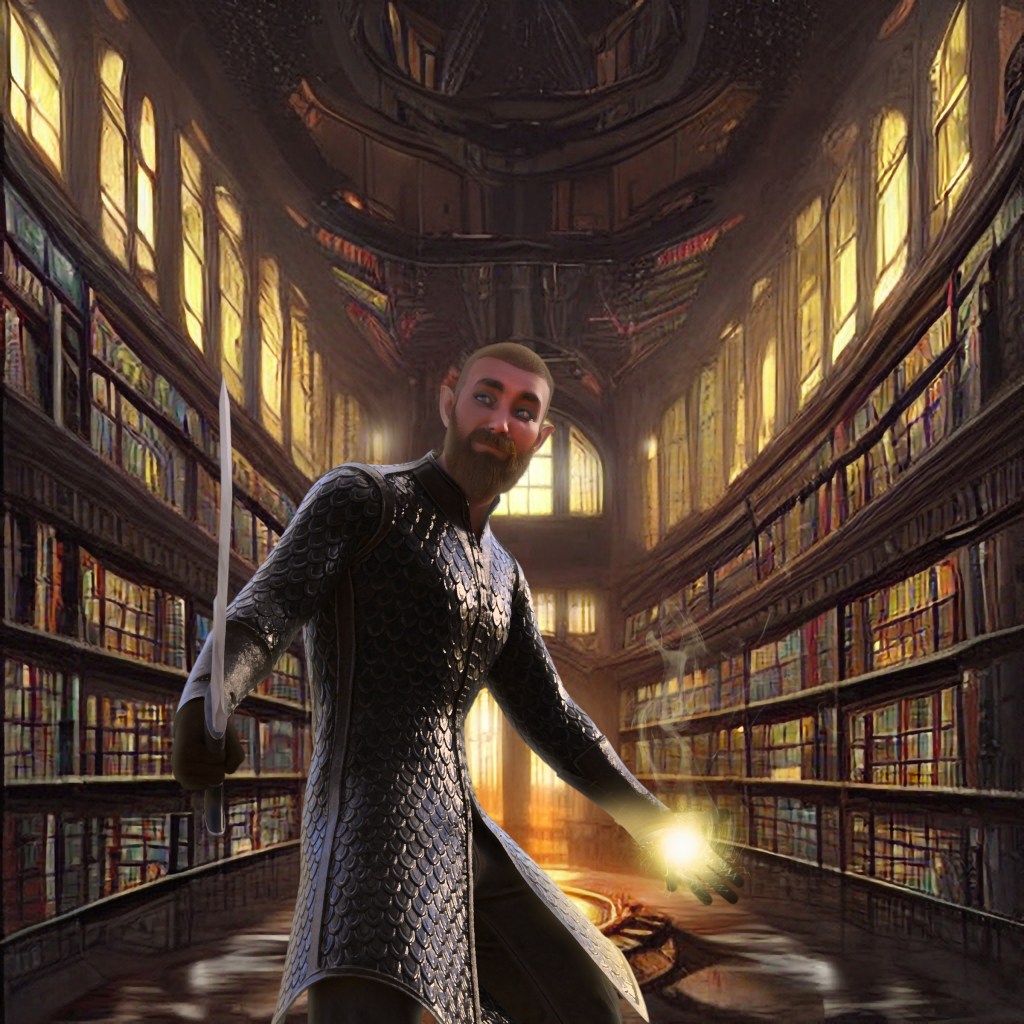
Firebeetle In The Stygian Library: Experiments In Solo RPG Storytelling

Adventures are a hunger, fundamental to who we are. But what makes them work?

Literally everything we try at Grailrunner is about pushing boundaries in imagination. Often, that takes the form of contorting tabletop game mechanics for experiments in immersive storytelling. Then we give that stuff away for free in case it’s entertaining, though we’ve learned bits and pieces along the way about what makes adventures work…and what is missing when they don’t.

Which is the point.

For example, we built wargame terrain and a narrative scenario to play out a story using the game mechanics of Privateer Press’s popular Warmachine. It was a thrilling ride we called…
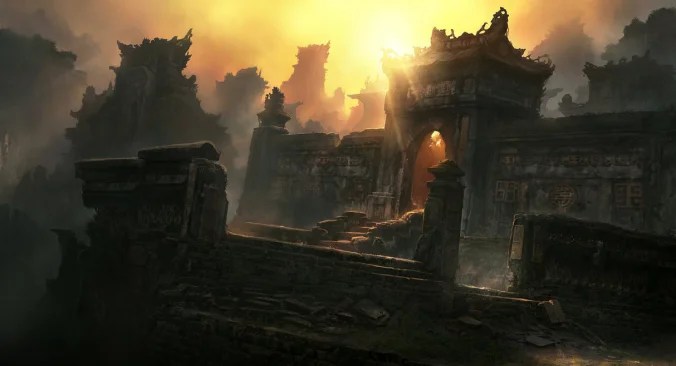
The Black Ruins Massacre

Turned out amazing – go follow these links to see what I mean:

One of the more popular things we’ve ever done here on the site was to write up an illustrated recap of a solo Dungeons & Dragons adventure in Wizards Of The Coast’s Tales Of The Yawning Portal. I routinely use a ridiculous D&D character named Firebeetle to try out different roleplaying game rulesets, and in that case, I put him through a harrowing ordeal called Clueless In The Sunless Citadel. Click these guys here to see what that was all about, and download the free pdf. Only takes about a half hour or so to read, but it’s fun.
Clueless In The Sunless Citadel

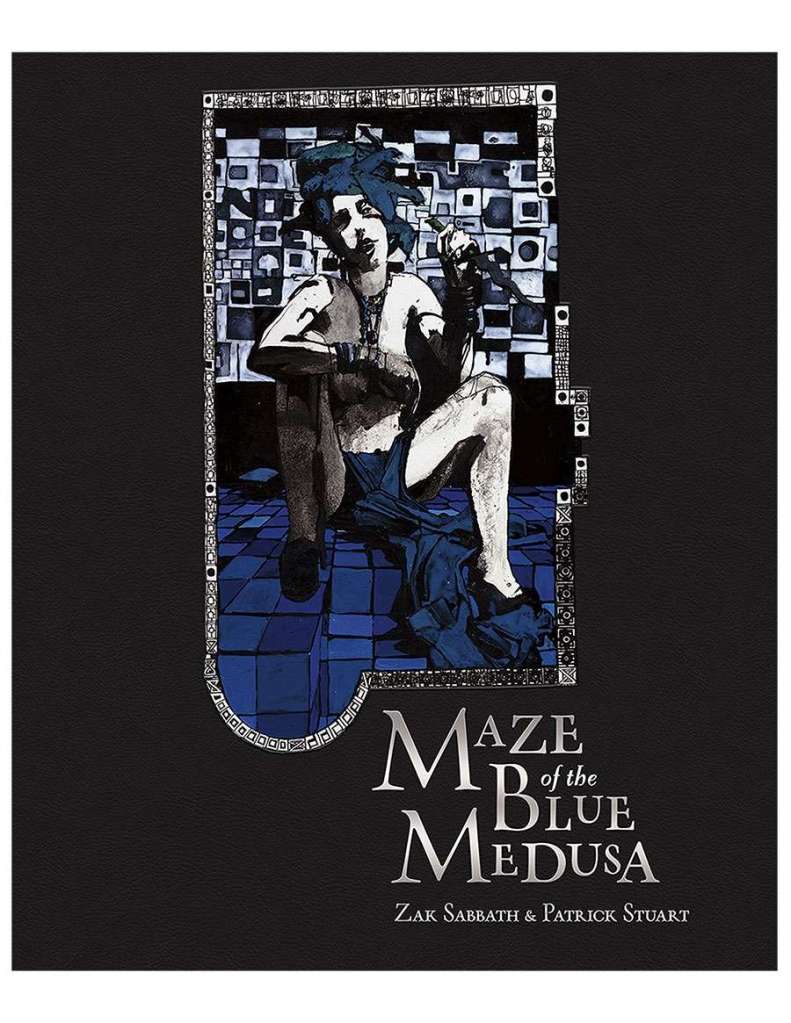
So anyway, I was in a big old used bookstore called McKay’s in Nashville, TN a few weeks ago. I strolled to the RPG section with no particular goal in mind and found an odd, strangely electrifying, though ultimately unsatisfying hardback called Maze Of The Blue Medusa. I knew as soon as I read the back, felt the weight and texture of it in my hands, as soon as I flipped through a few pages, that this was something special.

Maze Of The Blue Medusa

(I understand there is some controversy around one of the creators behind this book, so I’ll stick to the work itself in my comments.)

The book describes a system-neutral dungeon complete with a detailed map, illustrations, a bestiary and associated encounter dice tables, and intricately detailed descriptions of every one of its over 300 rooms. In every room, something weird is happening, something grotesque and surreal is creeping about, and crumbs of an over-arching story are dropped.

However, unlike so many mega-dungeon books with their Tolkein tropes and endless loot crates and traps, this whopper is written like an art project, with text that reads like it’s for shrewd adults capable of seeing irony and social commentary in its encounters.

I excitedly cracked it open when I got the chance to run young Firebeetle through his paces inside the Maze.
And I wasn’t into it.

It just didn’t click for me. The adventure escaped me, and it was just going through motions with no point. I couldn’t find a story hook that mattered. Each room seemed weird and vaguely interesting, but nothing popped or sparkled for me. The encounters were tedious and amounted to nothing. Here’s a Youtube video of some dudes in an actual play session of Maze Of The Blue Medusa – watch that for a few minutes and I suspect you’ll see what I mean.

Even with a great GM and some funny players, this wasn’t an adventure so much as a haughty stroll through the bohemian part of town where I don’t really fit in. I wanted the awe and danger of exploration inside the covers of a book and found only a meaningless series of weird things. Maybe that was my fault, but the mechanisms available just didn’t work the way I wanted.

That was on my mind when I heard of a little book by Emmy Allen called The Stygian Library, I thought maybe I had found redemption.

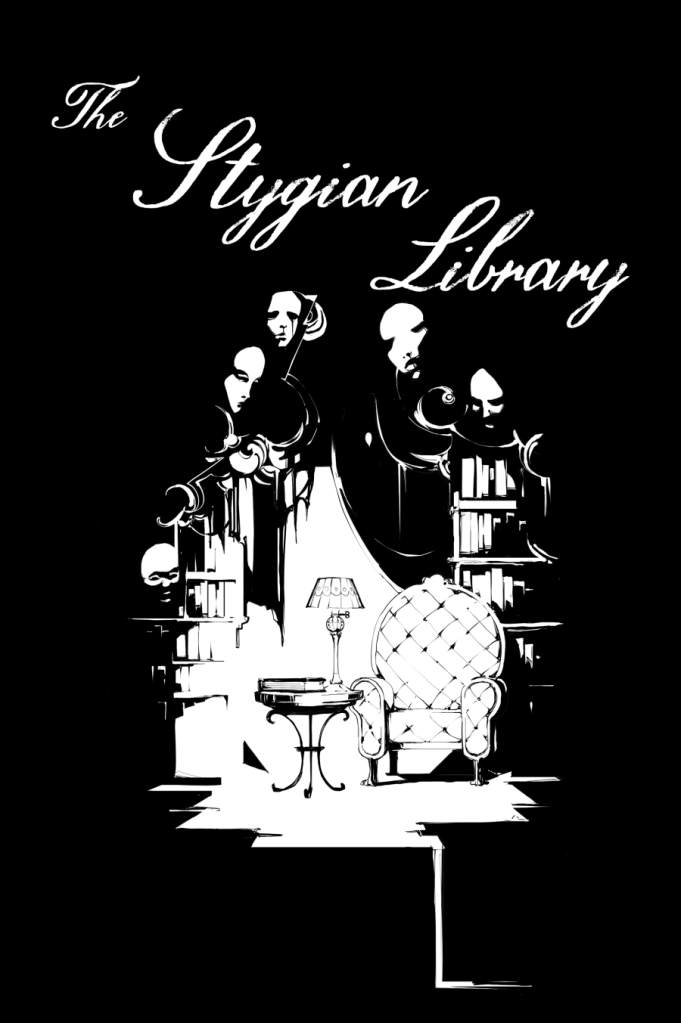
The Stygian Library

Pick up the older version of this booklet free here. It’s available in a remastered version here.

The Stygian Library bills itself as a dungeon for bibliophiles, promising a procedurally generated fantasy library you can explore in ever deeper levels. That sounded amazing, requiring you to map your way (though you can run blindly and get lost). Much like Blue Medusa, this wasn’t written with solo play in mind, but with enough dice tables and imagination, I figured I could rewire it.

Emmy delivers a wild bestiary including golems made of paper, animated books that follow you around, mysterious creeping librarians working on enigmatic calculations, even a half-man, half octopus that eats brains. Nice.

You roll for the levels you’re entering, details about them at first glance and also if you search around, as well as random events and, when prompted, encounters of a friendly or a violent flavor depending on your choices so far.
I took this idiot inside.
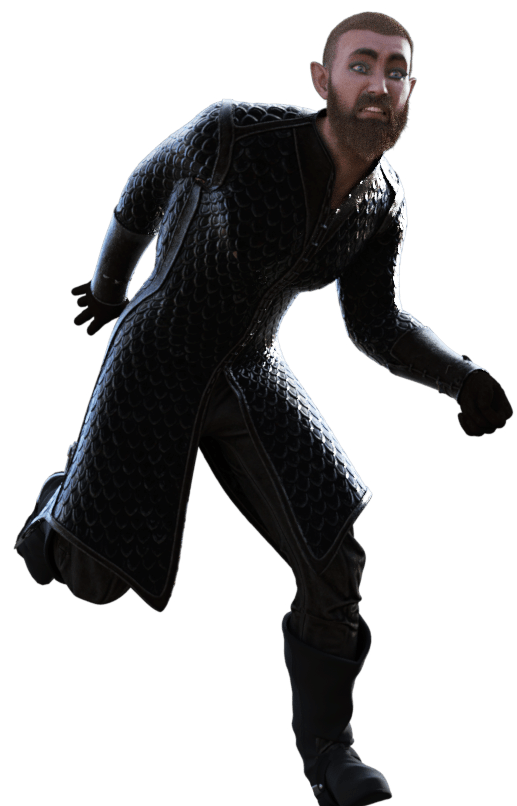
Firebeetle

Firebeetle was a name I was given for my very first D&D character back in the day. I recreate him in any game system I’m testing out because he amuses me.

He’s an aimless adventurer, in it for the thrill, always ready to take up a quest or try a mysterious corridor, picking up random things along the way and relying on his luck to seem him through. He’s not really charming, but thinks he is. Loves the ladies. Gets into trouble practically at every destination.

Firebeetle has a tendency to stumble into dimensional portals (as I try new game systems), finding himself in underground dungeons in the Middle Ages (D&D), Viking-era Iceland in an impossible city made of clusters of hot air balloons (Ironsworn RPG system), or in the far future on a dying space station (Starforged RPG system).

He just kind of goes with it. And it all works out in the end.

Neither Blue Medusa, D&D, Ironsworn, nor Starforged were delivering on the premise I was searching for: the awe and danger of exploration inside the covers of a book. Maybe Emmy’s Stygian Library would be the trick. I love libraries.

I put this ridiculous booklet together during conference calls in the COVID-19 quarantine, and I treated it as the opening sequence before entering the Stygian Library. It was going to be called Five Days In Boghallow, a fighting romp with a funny undead sidekick. Literally the only reason I’m including a link here is to give you a feel for this character. He’s such an idiot.

Anyway, I’ll give you the airplane view of what went down inside the Stygian Library and make my point for the day:

On what happened inside the Library…(keep in mind, virtually all of this was determined by dice rolls and game mechanics)

Bereft, the undead knight and Firebeetle entered the Library from the pit into which they’d fallen. They were amused by a couple of animated books that followed them around like cats, though the creepy librarians kept appearing to whisk the books away into the shadows. Something they read inside the cover of one of the books gave them a quest to find some machinery in the deep levels of the endless Library. They encountered bees made of paper (swatted them away) and a golem (ignored it) and paid visits to a planetarium, a pile of treasure, the master catalog of contents, and a hall of taxidermy before managing to be entirely lost and stranded inside an ever-shifting labyrinthine library.

Ahh, I thought. Here’s where things pick up for young Firebeetle. He’s stuck now. Looking for some machines or something.

They kept pressing on, ever deeper, picking up all manner of treasures and vaguely defined books that seemed promising. ‘Let’s see Firebeetle’s careless attitude work his way out of this mess’, I said to myself.

Then inside a giant paper beehive, a bird-like bandersnatch started pecking at Firebeetle’s sword to steal it (because it was shiny). Stupid bird-thing. When they finally killed it, the fact that they were killers turned the Library into a deadlier place. This would pick things up then, as the Library beasties got nastier and the hapless adventurers grew more desperate to find a way out.

In an enormous statuary, Bereft and Firebeetle were accosted by a floating skull, attended by floating teeth that were enthralled with its every word. It grew increasingly insulting, commenting on their appearance and bumbling like they were museum curiosities, before it began to smash itself into Firebeetle muttering something like, “See, students, how a skull may stomp a bug without the need of feet!”.

They ultimately shattered the pompous skull, scattered its minions, and dealt handily with some phantoms the encountered as well. And they did, believe it or not, wind up in the chamber they sought with its outlandish calculation engines, where the hooded Librarians worked their mysterious mathematics.

And would you believe it…and I honestly didn’t make this up at all…the dice rolls delivered Firebeetle an intangibility potion. It’s the one thing that would get him back to an escape from the Library, with treasure and books in hand. I mean…I tried to put the guy in danger and make a madcap adventure of the whole thing, and his ridiculous luck somehow just pulled him out of it.

The Stygian Library was amusing, even interesting and novel, definitely worth your attention if any of this sounded like your cup of tea, but overall it failed to deliver the spice I was seeking: the awe and danger of exploration, except in the covers of a book.

So what am I saying then?

Here’s my point. And I learned this through all these experiments with different game systems through comparison with the one I’m testing now – Forbidden Lands by Free League Publishing. The difference has been night and day. And I believe I know why.

Solo RPG game play is absolutely possible. It’s enjoyable and surprising, stretching your imagination and your sense of fun. It may even rewire your personality as you rip and stretch aspects of yourself that don’t see enough light of day. It takes a few things though, which I’ve found in Forbidden Lands more so than with these other systems, including The Stygian Library:

In my day job when we deal with companies making big changes, we use something called The Airplane Model to define the major elements that make things happen, that drives people to do things. I’m applying this to manufacturing adventure. Hear me out:

Adventures work when:

  • (Vision) …there is a meaningful purpose to what the characters are doing – a destination and a clear, important goal that you find interesting. The Forbidden Lands ruleset offers a Legend Generator that covers this well. I believe I was missing this in many of my random exploration experiments.
  • (Sense Of Belonging) …the characters matter to you, fleshed out with formative events that made them who they are. I trusted the Formative Events dice tables in the Forbidden Lands to build a person for me, a hunter named Colter, and he’s starting to feel like someone I’ve known a very long time.
  • (Sense Of Contributing) …the decisions that your characters make have consequences. I felt in the Maze Of The Blue Medusa and to some extent in The Stygian Library that the random conflicts and odd bits of treasure were irrelevant. Curating good dice tables, like the Action and Theme oracles in Ironsworn and others is fantastic for surprises and a sense of wonder and discovery, but what you do has to mean something or there’s no weight to what’s happening
  • (Sense Of Progression) …there is a clear, definable sense that progress is being made against the purpose. Ironsworn, Starforged, and The Stygian Library all three provide an abstract Progress Tracker intended to keep score of how things are going in the story versus goals, but I found that unrelatable in solo play. Boring and meaningless, even. I’ve found I start to give up on the adventure entirely if there isn’t any meaningful progress or sense that things are moving along. In the case of Forbidden Lands, a deliciously detailed map is provided which is incredibly satisfying.
  • (Sense Of Urgency) …time is ticking, and there is a real possibility of dying or losing something precious. Particularly in D&D 5th Edition, I feel like it’s kind of hard to die. One thing I’m seeing in the Forbidden Lands ruleset is that the stats are unforgiving, and there are lots of things able to kill my character. It forces me to make Colter plan more, and think creatively about his decisions since he could die so readily.

And that’s what I wanted to say about all this. It’s been interesting, testing all these systems out and trying to use them to breathe life into a story I can experience.

The awe and danger of exploration, except in the covers of a book. Possible?

What do you think?

Till next time,

A Terrifying New Threat Enters The Salt Mystic Universe!

Occasionally as we build out the Salt Mystic universe, some spooky new threats pop into existence that surprise even us. Right now, I’m 23k words into a standalone novel set in this world that will shake it like an earthquake, introducing new weaponry and technology, several exciting new locations, and a host of new terrors!

Enter the Day Giant.

If you’re new here, let me back up a bit. The Salt Mystic setting is an experiment in immersive storytelling that fuses art, fiction, and games into a unique and thrilling experience. Right now, it’s a novel that introduces the main narrative, a terrain-based trading card wargame that expands and breathes life into that narrative, a growing line of branded merchandise (including our first art print!) and freely downloadable illustrated flash fiction called Lore Cards.

Click the wings to learn more:

We’ve been hard at work dropping new Lore Cards over the past few weeks, so make sure you stop by every once in a while to see what’s new. The Story Arcade is what we call the repository of cards, and it’s a place to get inspired for your own games of Salt Mystic or to fuel elements in the Roleplaying Game system of your choice.

Click the medallion to see all the current Lore Cards:

Although Salt Mystic is at heart a western-inspired science fiction setting, with a theme of exploring lost and hidden worlds, I feel like no adventure stories are complete without a terror that sticks in your mind and creeps around there. In the Work In Progress novel, to be called Mazewater: Master Of Airships, you’ll be introduced to a scrappy, gangly fellow named Lamberghast Mazewater, who faces such a threat with a quivering voice, a shaking hand, and armed with only his big heart. More to come on that as it develops.

The artwork

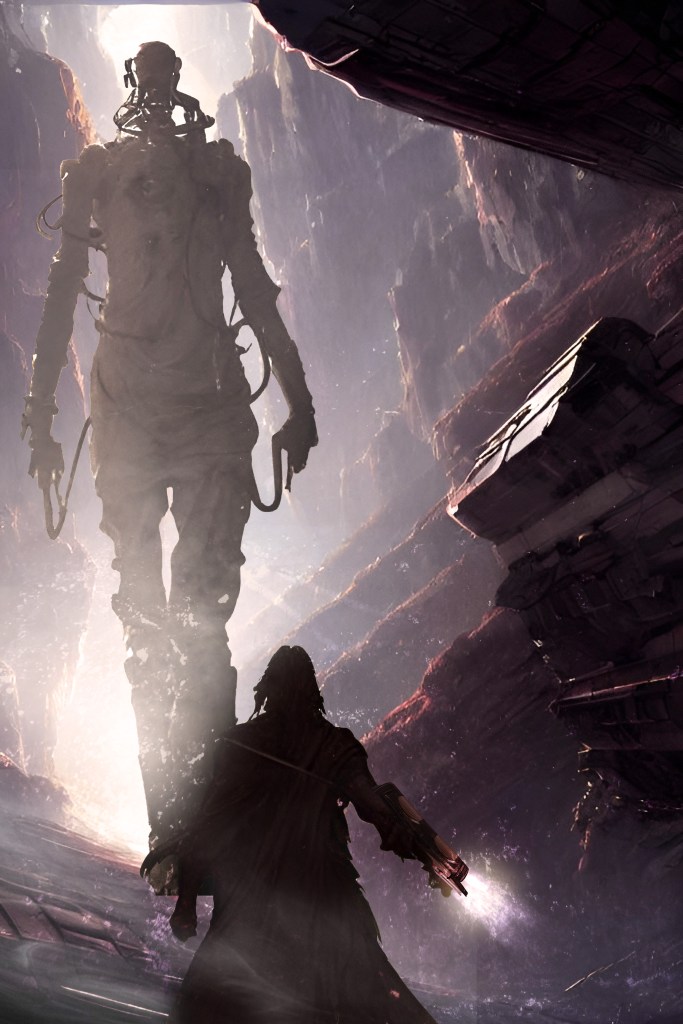
The art for the new Lore Card was produced combining elements from two AI art generators, then painting over them and completing the composition and adjustments in Photoshop. This approach is a real game changer for small indie publishing companies like us! Sometimes, the image comes first and then the story. It was the reverse this time – I knew the giant’s general appearance and that I wanted a gunslinger facing off with him. That’s all I knew though.

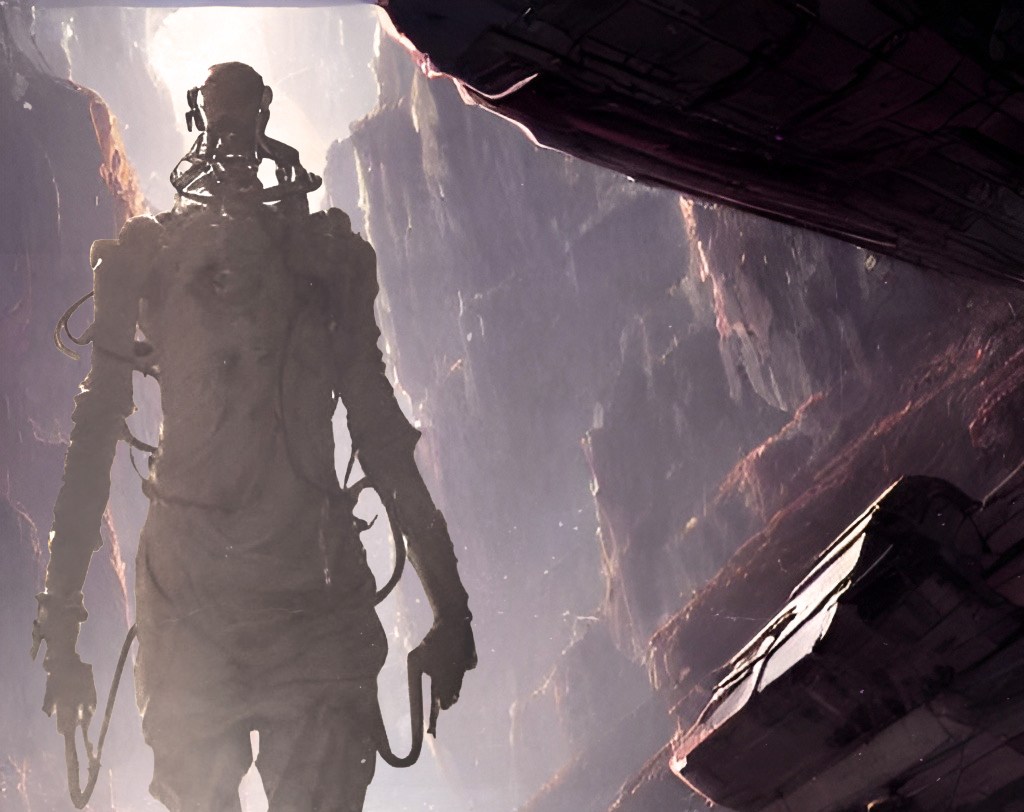
The giant: It took many, many iterations with Codeway’s Wonder app using text prompts like “enormous thin giant in rags with oxygen mask and exoskeleton” till I got something vaguely like what I had in my head. The color was wrong, as was the perspective, the tone, and it had bits and bobs all over it that were unwanted. I cut it out, trimmed the odd bits, then altered the perspective so his top half was smaller.

The canyon: The canyon was another round of iterations, in both Stable Diffusion and Wonder, till I got a mashup composition of rocks and lighting that generally gave me something to trigger the eyes to see the giant as huge. I wanted light coming from behind it, so I juiced that with a Color Dodge and soft brush.

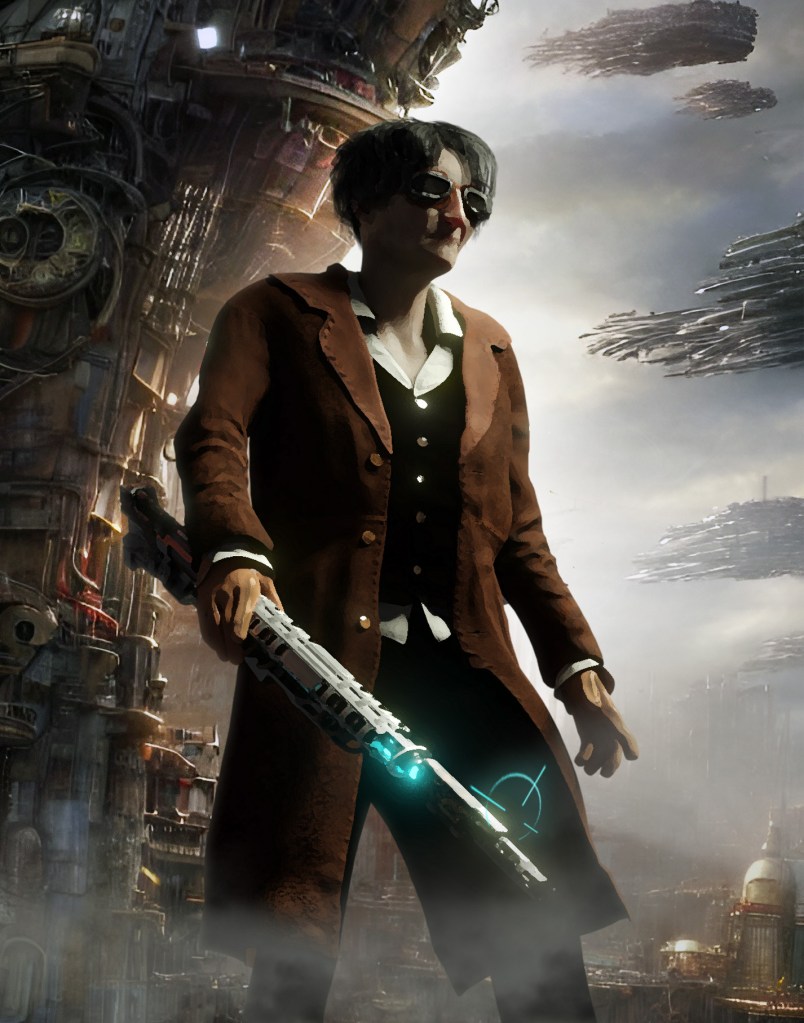
The gunslinger: The gunslinger was a third round of iterations, in Wonder. The text prompts were things like “fantasy gunfighter in long coat holding his arm out”. This one had bits and bobs coming off it as well, and the coloring was terrible. He also had weird holes and discolorations all over him, which I had to correct.

The weapon: The ball lightning carbine is a long-standing custom item I use all the time. I built and textured it in Blender. This time, I cut out parts of it to show it partially concealed by his sleeve and brightened the barrel’s tip (with the Dodge tool) to show it glowing from the heat inside the barrel.

There’s a company called Nucly that offers various overlays for Photoshop – I included a ‘god ray’ overlay and morphed it to emit from the gunslinger’s weapon. That looked cool already, but something unanticipated happened once I started making adjustments.

The lighting: I superimposed a grunge texture over the entire image in Screen mode, which roughed up the look of it in a way I really liked. However, I noticed the Color Dodge blur coming from behind the giant as well as the charge firing out his weapon reacted with the grunge overlay for even cooler lighting effects than I’d planned. I really liked how that turned out, honestly.

Color grading: I tried various warming and cooling filters over the entire image, and tried adjusting its color grading to various images whose color schemes I liked. This warming filter (an evening sun shade of orange) won me over because of what it did to the canyon rock.

Here’s the final image, which will also eventually appear (in altered form) on an upcoming Volume Two game card next year (click on the image to see the Lore Card and read the associated story):

I hope you like the art and the story, guys. Let me know what you think! Till next time,

Chance Favors The Prepared Mind: Where Do Writers Get Their Ideas?

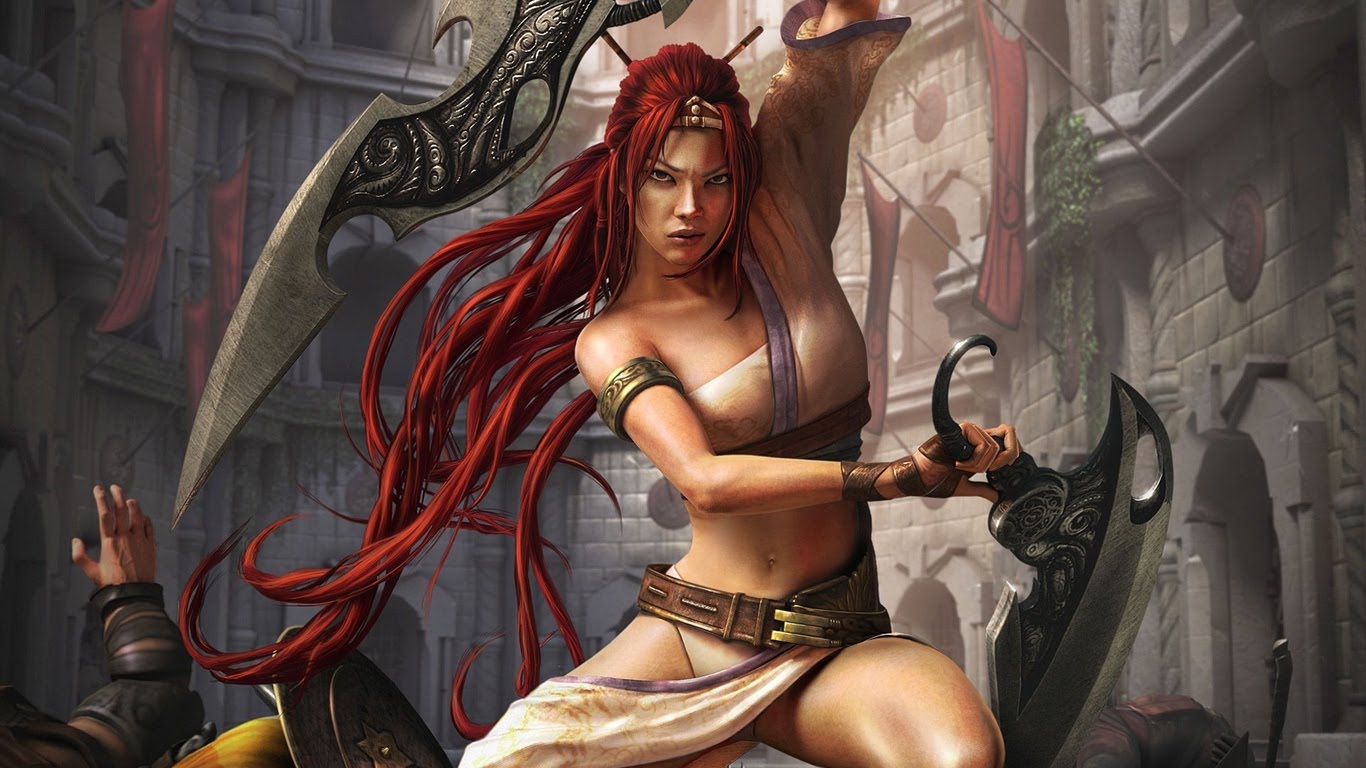
inspiringwallpapers_net-fantasy-warrior-girl-with-blades-1366x768

Louis Pasteur said that ‘Chance favors the prepared mind’; and that’s a fantastic quote. His point, I’m assuming, is that your mind is your instrument or your weapon, whichever metaphor does it for you. Whatever you’re up to in life, bathe yourself in stuff that will help you get better at it. Let cool, helpful things soak in. Then you’ll be luckier because you’ll notice opportunities you might not have otherwise.

So what does the hot warrior goddess picture I’ve attached here have to do with that? I’ll get to her in a little while. Go with me here.

Recently, I was thinking about where writers get their ideas. People ask that literally all the time. I bought a book years ago called, ‘It Came From Schenectady’ by a science fiction writer plagued by the question so often he started giving that answer when people asked him. Schenectady. That’s maybe a little funny. If you’ve read even a few articles on this blog, in fact, or the philosophy, it hopefully shines through that breaking ground in speculative fiction is kind of a big deal to me. I want to do whatever I can for myself and for other aspiring writers to BRING NEW THINGS INTO THE WORLD.

So I was turning that over in my head while coincidentally making my way through a book on the ancient city of Ugarit. This was a cosmopolitan city full of diverse folks and multiple languages, flourishing in 1500-1200 BC even though it was sandwiched between two superpowers of the day: Egypt and the Hittite Empire. My aim was to learn about the city and what life was like there; but the notion of finding story ideas was buzzing louder, so I was finding them on almost every page.

The theme in my head was very helpful to the writer in me; and it was this: just look for the strain on people. When there is some kind of tension set up, pulling on a person, there is a story to tell. I saw it in the tension between the two superpowers tugging on Ugarit. I saw it in the 1930’s race of archaeologists and linguists trying to be first to decipher the newly found script. I saw it in the very architecture of the city itself.

For example, the main city itself had two massive temples, one to Dagon (head honcho) and one to Baal (fertility guy, had sex with a cow while hiding from the god of death), with a library in between. The palace was on the other side of town and was bigger than the temples. There was a very rich guy named Rapanou whose house had thirty four rooms and his own library. I went dark for a few paragraphs as my mind wandered to the image of a teenage priest in training, leaned against one of the big temple statues and staring up at Rapanou’s house jealously, maybe wondering about one of the daughters who lived there. Maybe one of the statues would start speaking to him one full-moon night…

A few pages later, I came across this bit:

“Priests also had a military function, as is clear from references to them in administrative texts describing auxiliary military personnel; they are also listed in an army payroll text. Their role was that of support personnel, providing advice of a religious or oracular nature to military commanders. They were, in other words, an intelligence corps, purporting to provide divine counsel with respect to strategy and military operations.” -‘Ugarit And The Old Testament’ by Peter C. Craigie

That got me going on my little guy, because I saw him caught up in a rebellion against the Hittites, when all he wanted was to be left to his stone tablets and dreaming. I could see war-ragged army generals desperately shouting for divine insight into a hairy battle when the little priest was coming to doubt his own beliefs. Maybe because of something the statues had said. Maybe because of something Rapanou’s wild daughter had said.

You see how this just kind of gets going, right? Spitballing. Weaving together stuff from everywhere like a jazz riff on whatever I’m reading or whatever I’m doing. That’s how it works for me. The book had just described the little port towns on the sea as having no more than maybe a hundred people in them. I know what little rinky dink towns are like; and so, probably, do you. Then I read this:

“It’s possible that naval conscripts were drawn from the coastal towns where men would already have seagoing experience in merchant and fishing vessels”

I saw a new guy, then, who’ll probably meet up with the other guy. This dude loved his quiet little foggy port-village, though he maybe dreamed of adventures…then he got pulled into this same conflict the priest was in. Now I had a couple of folks stirring into the soup, and the possibility  of massive naval battles, which I love, and talking statues that had offered a mystery of some kind. I’m also reading Patricia McKillip’s “Riddle Master” trilogy, so probably the statues had offered a riddle.

But it was still kind of plain, needed to go crazy. Needed something with pep. Riddles have been done. So I totally lost whatever I was reading and just put it down to ponder…what is REALLY going on with this mysterious riddle?

Ahhh…I had watched a couple of Harry Potter movies over Christmas, so Voldemort’s horcrux dealie-o was in my head too. The riddle was not given to the priest to help him at all, it was given him to become alive…to be spread among the minds of men enough to form a vessel for something to enter into. Something, obviously, terrible.

The warrior goddess up there was to represent Anat, the terrible war goddess of the Ugaritic Mythology who used to storm the throne room of the all-father so angry he would hide from her, and who would tear off so many soldiers’ heads and gut them with such glee she should laugh as she waded through all the blood. You should read some of Baal’s cycle of stories where she appears. She’s fantastic. Maybe it’s her that started all this riddle business, just because she’d be fun to write.

Like a late Christmas present, I realized then that history handed me a nice finish for all this. Around 1200 BC, Ugarit got blasted from history by a mystery invasion of people from the sea. We know almost nothing about all that. Fantastic. It writes itself.

Look, I’m never going to write this story. If you’d like to, have at it. Be my guest. It’s fun to dip into it, though, and make my overall point for today.

If you’re stuck looking for ideas…or if you’re interested in where (at least some) writers get their ideas, remember I said this: look for the strain on people, the forces tugging a person in more than one direction. Bathe yourself in fiction or non-fiction, or travel, or talk to people, or whatever information you can get lost in, and dig up things that shine. Then string them together and turn up the gas.

What I’m hoping…what I aspire to do…is not to forget that last part. Be original. Turn it up to crazy and do something new.

Louis Pasteur changed everything about disease and healing when he did what he did. His quote is a sound one. Let’s live it.


Breaking Through To What Really Scares You

spooky-1573491_1280.jpg

I’ve been thinking a lot lately about what actually frightens people. Honestly, I’ve never been in a conversation with someone about ghosts or evil covens where they’ve told me they both BELIEVE those things exist AND are frightened by them. It’s usually a much more casual…’yeah, those things are possible’ kind of comment. Maybe I’ve not gotten out enough – if you have a good story where you got spooked for real, I’d love to hear it. For my part, I wanted to reproduce in a book I’m writing now the feelings in my life when I was actually frightened or shaken to my core. Since I don’t actually buy off on a lot of the supernatural stuff, it has to be much more grounded and personal to get to me. So I thought about September 11th.

All too often, people I interact with are too young to remember what it felt like when the New York towers fell in 2001. I couldn’t relate to the Pentagon fire or the Pennsylvania field; but I absolutely remember being in those towers  when I was a kid – I had family up there. I watched them smoke and fall and remember feeling entirely helpless. File that one away, it’s important.

I’ve also said before in these posts that George Orwell’s 1984 is, in my opinion, the most frightening book ever written. No goblins or possessions. No vampires. Not even a car crash. Just people being terrible to each other in a way I could believe – an awful momentum those people allowed in their society that left them with a nightmare like ‘ROOM 101’ at the ‘Ministry Of Love’ where they torture you to the point of breaking your entire personality. They turn your own children against you. They get in your head with endless propaganda. It left that society helpless. File that away, also important.

Every year, Chapman University conducts a survey of what frightens Americans the most. Check this out:

Capture.JPG

Helplessness is staring you in the face here.

We can’t control huge, man-eating machines like government corruption where compassionless bureaucrats take everything you own or terrorist attacks where a smiling neighbor who always waved at you suddenly sprays bullets into a shopping mall. Look at number three – imagine yourself feeble and alone, your body failing and laying in diarrhea, without any money to pay for food or electricity. Shivers, man. That’s terrible! You’d be helpless.

Ignore some of the political stuff here, the things CNN or Fox told you to worry about; and there are some truly foundational horrors listed here, things that get to the heart of what scares us. We treasure stability and control and predictability. We expect the rules to be fair and unchanging, so we can continue to captain our own lives. Yet as suddenly as a phone call with a diagnosis, you can be the one staring desperately at someone you dearly love beside a hospital bed straining to understand why this doctor is contradicting the last one and why nothing is working. As they waste away. That’s us, man. That’s humans. We can’t control that; and yet we demand to. We’re helpless; and we don’t want to be.

I’m not saying I don’t have anything supernatural in the book I’m writing. Of course I do, I get bored with plain-vanilla things. But my aim is to ask you to concede only one fantastic element and let the implications fall out and shatter from there. So far, I’m having a blast. Along the way, I’m pondering what scares us for real. Things like the ones here on Chapman’s list.

I believe in the end, anybody stringing together words for profit or fun like a lot of us would be more proud of what you’d done with a horror story if you try to break new ground. Use something grounded or contextual with just a hint of the supernatural. Make me love the folks you’ve breathed life into, then tear them apart with something terrible.

That’s the gig, right?


Deep Waters: A Case Study In Adding A Mythic Dimension


shicheng

When I read Stephen King’s Dark Tower series or Isaac Asimov’s Foundation, anytime I read Dune, I get the same vibe as I’m planning to chat with you about in this post…that there’s something ominous and huge going on – a belief system or set of myths or larger than life history affecting events. I dig that tremendously; and I look for it in things I enjoy reading. In fact, when I was growing up, you were either a Luke Skywalker guy or a Han Solo guy – meaning you wanted to be the space cowboy or the brooding, mythic hero. I was a Luke Skywalker guy. The literary take on this is it’s much more interesting in your fiction should you plan to include some sort of belief system if you don’t just recreate the Greek Gods or rip off the American Indians with a ‘Great Spirit’ thing-a-ma-bob.

So I’m going to go deep with this one. Stick with me. I finished an interesting study recently that went way farther that I’d expected. I was googling and flipping through the original materials madly, chasing a huge idea that kept getting bigger. It was like pulling up one of those weeds where the roots keep popping up out of the ground and you finally just cut it when you can’t tell how far it’s really going to go. For me, it started with a random book on my shelf from years ago that had an article about the I Ching in it.

Anyway, another article in that book that caught my attention was about the Kabbala’s  Sefirot. The idea of treating a deity like an engineered contraption, like a set of physics rules you just needed to respect to make jedi-mind-trick things happen tickled both the logic and artsy sides of my brain. So I went deep into the Kabbala – read several books and spent some time reading what its believers found attractive about it. No offense if that’s your thing; but I ultimately found it full of promise and marketing but a big fizzler when you try to pin it down to something useful. It did strike me as fascinating though, the nebulous descriptions of the highest realms of reality – a nameless and unapproachable perfect being so incredibly pregnant with the potential of creation it’s provoked by nothing more than a state of mind. The sefirot idea stuck with me, so I poked into where it came from.

Read the Sefer Yetzirah if you like; but it’s gibberish to me. That was where the sefirot were first described. I bought the Pritzker Edition of The Zohar though, because that’s the big daddy of Kabbala, the place where it really took off. Get far enough into The Zohar; and you’ll get the feeling that nobody’s saying what they really mean and you can stretch and pull to make anything mean what you want it to. Still though, the massive superstructure of the universe having a secret dimension to it, a direct line of sight to a divine machinery, kept things popping. So I went deeper to see what influenced Moses DeLeon (the 13th century Spanish author or the channeler, whichever you dig).

I’ll speed up to make my point, though this took a while to trace. What I found was a pattern of about every two or three hundred years, a very similar theoretical apparatus was showing up in some famous writings. The themes are these:

  • There’s an indescribable, unapproachable entity way up in some higher dimension ready to burst with creative potential
  • This entity is either intelligent or just a principle of the universe, depending on who you’re reading; but it can be influenced either way
  • Since this thing’s perfect, it can’t produce things that aren’t perfect, yet here we are with cancer and weeds and birth defects
  • So this thing has levels beneath it, where things get progressively farther from the top and so are less perfect till you get to us
  • That means there are perfect versions of things somewhere, like flawless templates from which all matter is descended

I had discovered what they call Neo-Platonism. If you already knew that, good for you. I didn’t. It made me think of Object Oriented Programming, because it’s exactly the same idea where you have ‘classes’ defined as templates, then make ‘instances’ of them to tweak for where you use them. Going successively back in time…

  • John Scottus Eriugena (800-877AD) said the entity at the top was God; and He was creating stuff so that He could understand Himself. He said the primary Forms I was talking about above were the patterns of all things located in God’s mind. Eriugena was probably influenced by…
  • Pseudo-Dionysius The Areopagite (late 5th, early 6th century AD) who shared the view of a procession of realms from God but said a rock or a worm was a window upon the entire universe if you only knew how to look at it. He was intrigued by finding his place within that procession and seeing himself inside it, focusing on the sacraments as a way to engage with the apparatus. This guy was probably influenced by…
  • Proclus (412-485AD)  who was head of the Athenian school and thought Plato was divinely inspired. This guy wasn’t Christian, so his view of the thing at the top was more of a nameless ‘One’ you could influence with magic rituals. He was influenced by…
  • Plotinus (205-270AD) who studied Plato religiously. This guy had an inherent distrust of material things because they were a poor image of something higher. He said the supreme dealie-o at the top was a transcendent ball of potentiality, without which nothing could exist. He also said because of its nature of perfection, it couldn’t have a will of its own and couldn’t engage in any activity without becoming imperfect. So he had a procession downwards as well, culminating in matter.
  • The Gnostics were around this same time period, thinking the same sort of thing about matter being wicked and only a pale reflection of the perfect templates up there somewhere.
    • You see how big this is getting, right? 
  • Plato (4th century BC) developed in The Phaedo and in The Republic what’s called his Theory Of Forms . He likened us to people who’ve spent their lives watching shadows on a cave wall, thinking the shadows were what’s real when in fact there’s something making the shadows. Plato extrapolated from this idea that the soul was also a Form, and therefore perfect and unchanging, so..you know…reincarnation. He may very well have been influenced by…
  • Parmenides (5th century BC) who revolted against the sciency philosophers by suggesting there was actually a difference between true, objective reality and the stuff we can see. I’m not sure he started all this though because of…
  • Heraclitus (535 – 475BC) which is where my story ends. I read Remembering Heraclitus by Richard Geldard. Here’s a deep well like you wouldn’t believe. Heraclitus may have written a book and just dropped it off in the famous temple at Ephesus, and soundly changed the world. He described ‘the logos’ as a fiery, invisible rational principle that embedded the universe (like the Force, surrounding us, binding the galaxy together). It’s the wisdom of all of creation. Entirely possible it’s this guy that kicked the whole thing off that led to the same theoretical apparatus inspiring people for millennia.

My point is that this nebulous, vague description of a cosmic apparatus appeals to the logical side of your brain because it sounds like machinery; and you want to figure out how to make it work. It appeals to the creative side of your brain because it leaves so much for you to interpret and add to it. In fact, ,that’s just the way the I Ching appeals as well, presenting itself as reflecting the universe in a little microcosm so you can leverage what it’s up to as it changes.

Since the I Ching has been around in some form for 3,000 years; and the ideas the Kabbala built its palace on for not much less than that, those systems have something to say about how to make your manufactured belief systems resonate with people. Appeal to both the right brain and the left. Show how it could make people’s lives better in some way.

I took a real stab at this myself in Tearing Down The Statues, focusing on the idea that history repeats itself at different scales.

Now you go try and let me know how it turns out for you!

“The cosmos was not made by immortal or mortal beings, but always was, is and will be an eternal fire, arising and subsiding in measure.” -Heraclitus