One Month Into Book Launch: How’s That Going?

It’s been a month since we published SALT MYSTIC: BOOK OF LOTS, a solo roleplaying game based on our multi-media Salt Mystic setting. There are some bright spots, some hopeful notes, and a world of pain. Overall, we’re still incredibly proud of the product and seeing and hearing people appreciate it in the wild is an experience like nothing else!

We thought it would be helpful for anybody thinking of putting your own book out to see what we tried: what worked, and what didn’t…and what still might. Care to come along?

Way back in 2016, I wrote a short article defining some indie publishing principles based on lessons from the launch of my first book: TEARING DOWN THE STATUES. The principles were consolidated into the acronym “MCGRAW”, suggesting the key elements necessary for publishing success (Mainstream recognition, an eye-catching Cover that looks like it belongs with books like it, a popular Genre, as many Reviews on major listing sites as possible, Awards to add validation that the book merits attention, and Word of Mouth.) We kept these in mind this launch and tried to incorporate what we could, although the genre of tabletop roleplaying is so saturated and so dominated by Dungeons & Dragons that we were working uphill and digging holes from the beginning.

Still, hope springs eternal, and this is a product we believe in mightily, knowing from its ideation that nobody else was doing anything like it.

What was the pre-launch like?

February was a hot mess, finalizing the proofs and shaking trees to try and get attention from bloggers and gaming news sites. Short of providing free pizza delivered by cosplayers who do magic tricks, I’m not sure what else we could have done to get mentions from some of these guys – we reached out to 20 and got one “No, Thanks” and absolute crickets otherwise. That’s offering a free physical copy for review, by the way. Local gaming store wasn’t interested, and I didn’t have the heart to cold call others. My ego can only take so much bruising!

I pushed my Photoshop skills to the breaking point generating ad assets to use in social media and ad campaigns, stirring up some images that I think really popped! Here’s my favorite, though we had to switch it out to juice the click rate after things got rolling.
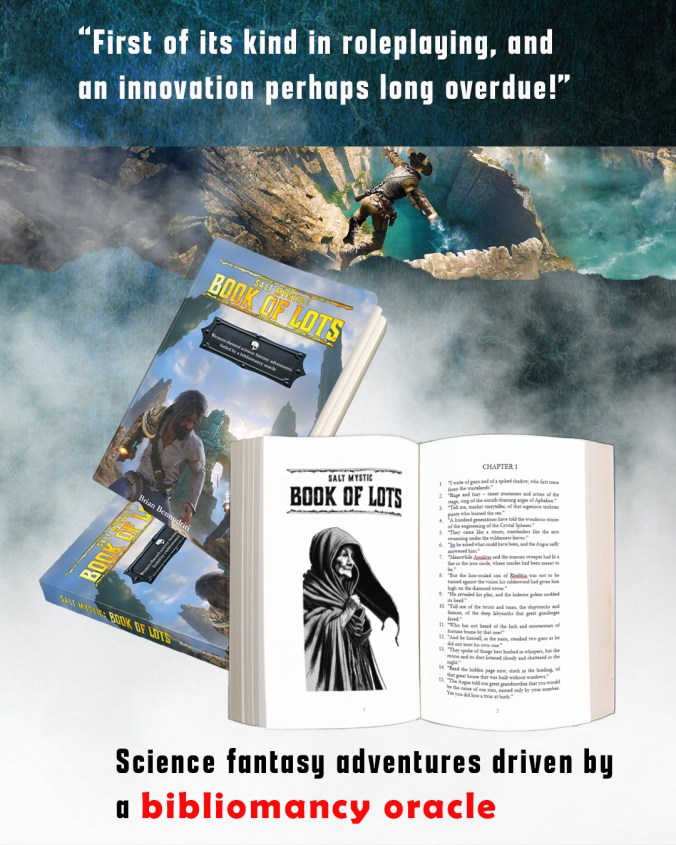
I’m a big fan of Absolute’s 3d cover generator and Envato’s PlaceIt – both to generate mock up’s of the cover in various places. We generated this one below for banners through RPG Geek and some other sites:

We came SOOOO close to hiring an artist we’ve been targeting for years now, and he might yet come on board for a promotional poster, so I won’t jinx anything by saying more. That would be amazing, so wish us luck! Anyway, he was swamped with other things, so the heavy lifting on graphics was still in-house.

How did you handle distribution setup?

The book is available at booksellers globally through Ingram Spark, and also on Amazon thru Kindle Direct Publishing, as well as the pdf on Drivethru RPG. We got the barcode direct from Bowker to retain full distribution rights – there are strings attached to the freebies. Honestly, setup was fairly painless for Kindle Direct, but I thought at one point Ingram was going to leave me with facial tics!

The cover file was a high res jpg I’d built in Adobe Illustrator, and it included some transparent png images (the title and the Grailrunner logo). The art was done with Daz Studio for the figures, some Blender and Photoshop filters for the forearm weapons, and some AI help for the background, everything composited and color graded in Photoshop then dropped into Illustrator for the text and placements. This is what that looks like, front and back:
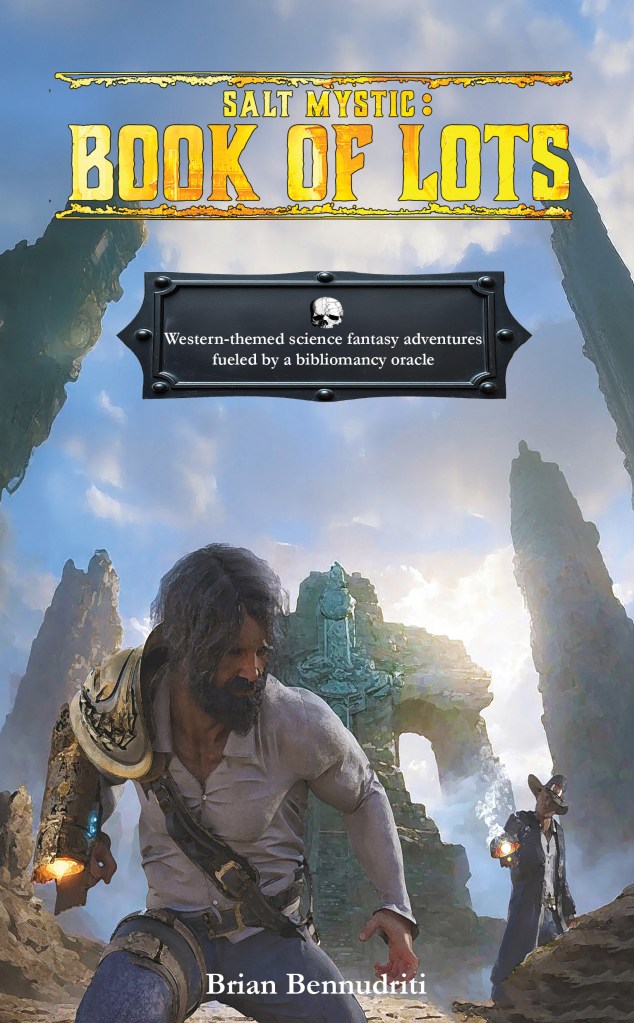
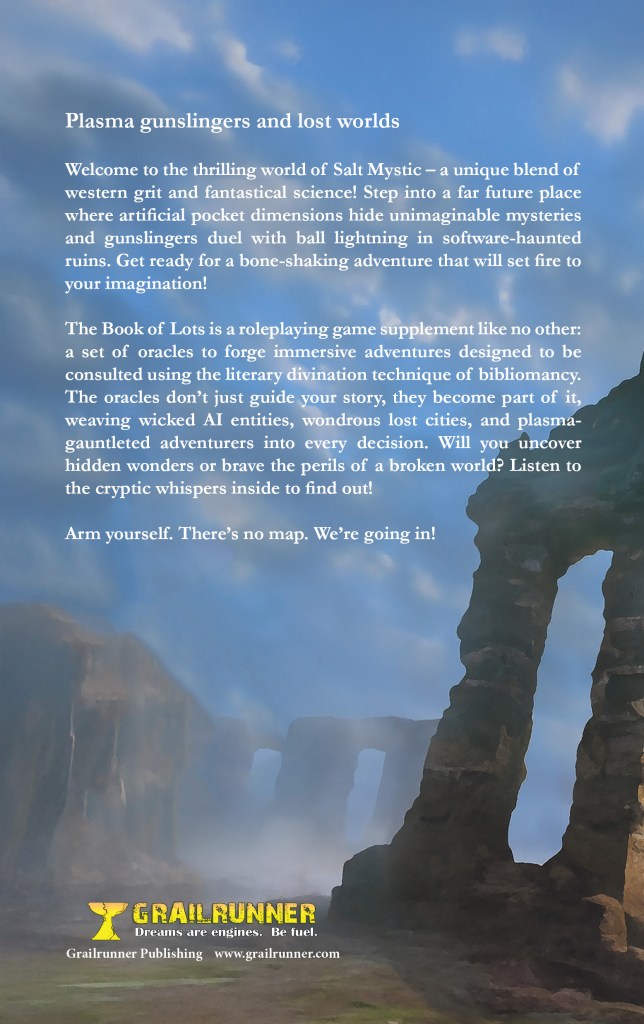
Weird white outlines were appearing in the digital proof around anything that was a png in the image. Maddening! Nobody at Ingram Customer Service was responding, and internet advice was kind of all over the place. I tried various export presets and never resolved it, at last approving the digital proof even with the outlines in hopes that it was in fact a screen artifact only (as some advice suggested). Thankfully, the issue didn’t show up in the physical version.

As for offering a physical version through Drivethru RPG, I basically gave up. They seem to be saying they use the same print house as Ingram, though a different division or something? I dunno. Anyway, much worse issues with anything that was a png, including the interior art! A true disaster! I’m sure they would say it’s my fault, but I bailed entirely and just offer the digital version through them. My blood pressure thanked me immediately!

How did you advertise?

We ran campaigns on Facebook, through Google, Amazon, and on RPG Geek. The book is also listed this month on Ingram’s home page and in the World Reader, iCurate Connection, and Indiewire newsletters, all via Ingram (~28,000 circulation for the newsletters). Through the Independent Book Publishers Association, the book will be represented at the American Library Association conference in Philadelphia this June. We’ll see how all that works out, but here are some initial experiences:

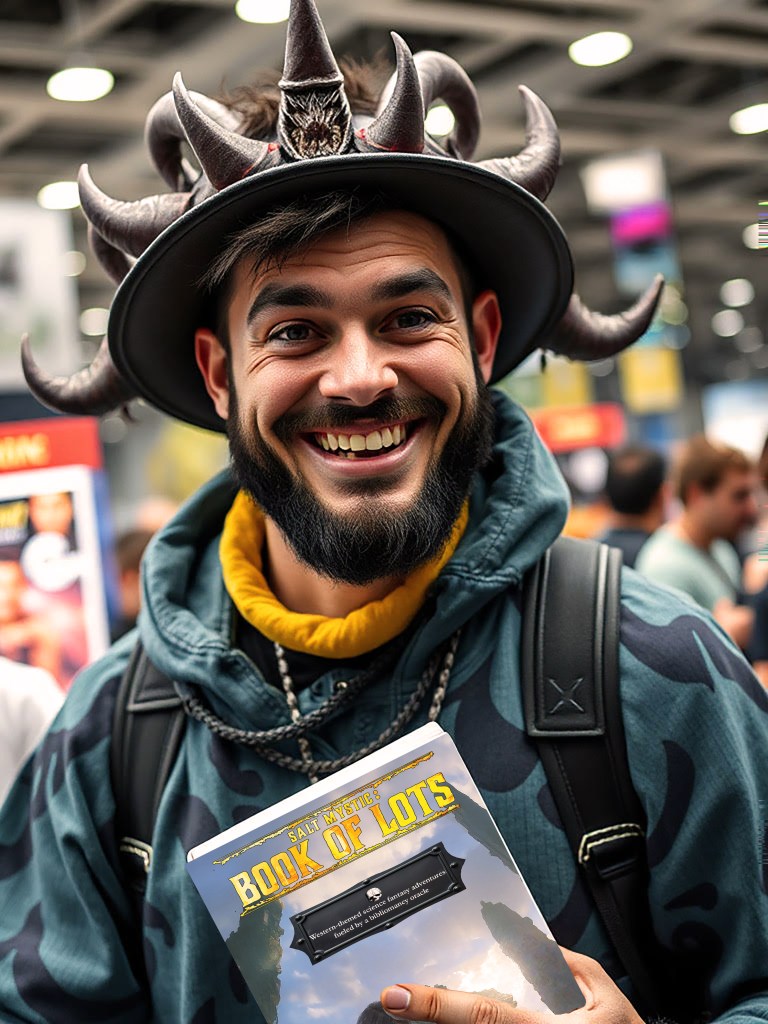
Meta (Facebook) started at 2.1% click rates with tens of thousands of impressions as well as loads of shares and likes and bookmarks. It all felt great until we saw that precious little of that was converting to sales. Internet research was suggesting a good click rate was 2% for search ads and 0.1% for display ads like banners, but for us it was just a lot of activity with poor conversions. By changing the graphics out to a grinning gunslinger and tweaking the copy a bit, we doubled the click rate to 4.2%. We’ll see if all those bookmarks and shares pay off down the line!
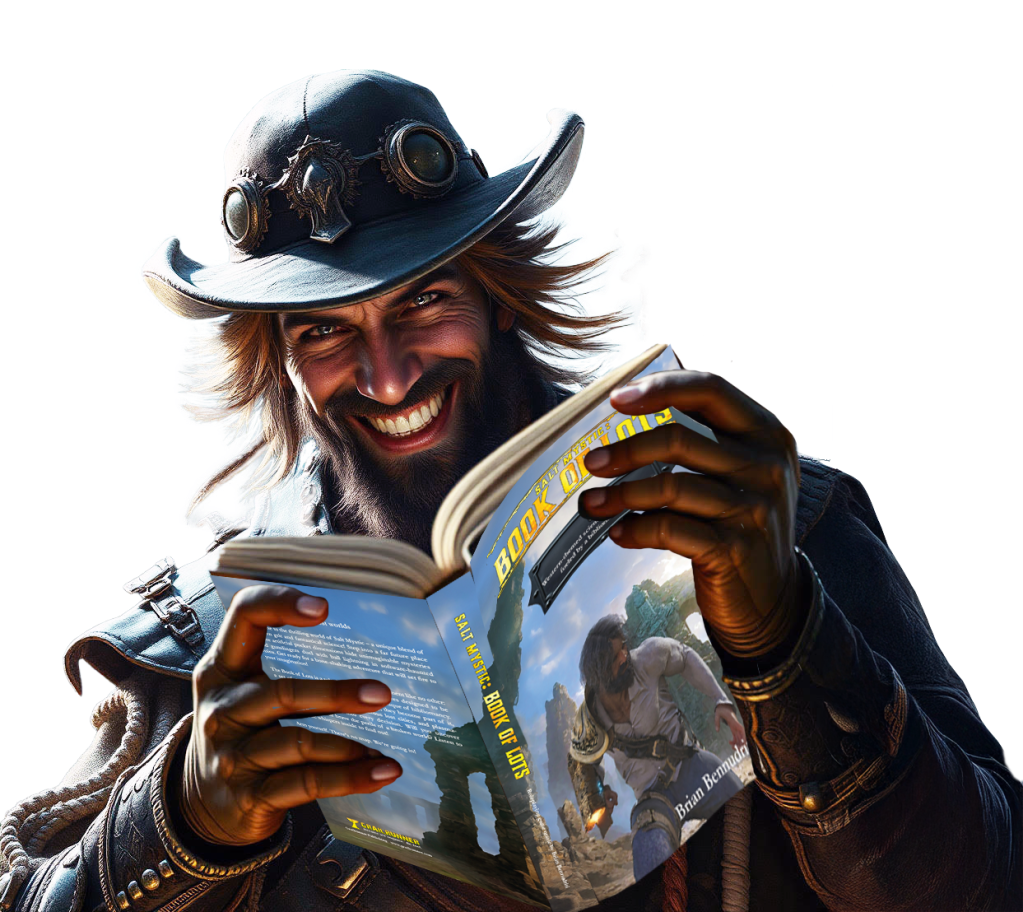
Google Ads was impressive, as their algorithm learns as you go, tweaking things to improve the reach. We wound up with a 5.1% click rate by the campaign’s end, which we view as solid. We even had one day peak at the end at 8.1%! All campaigns led to the same Amazon listing, so we can’t separate sales by campaign but I thought a lot of this experience overall.

RPG Geek was a little disappointing. Multiple banner and display ads dominated the site for a month. The thinking here was that this site entirely specializes in roleplaying games, so you couldn’t find a more on-the-nose target audience! Still, click rates flatlined at 0.1% for two weeks, till the same changes as above doubled that to a paltry 0.18% by campaign end.

Amazon: We only launched the Amazon ads in the last week or so – it’s a little early to report any results. I’d also never added any A+ content to a listing before, so that was new. Of course, I added that gunslinger since he seems to catch eyeballs, along with a very short description of the book.

So, was it a good launch?

Could have done more on pre-launch to get some mentions, honestly. We need to work on a solid email list and social media following though the new content required for that is a bit threatening when everyone has day jobs. Reviews remain super difficult to get, though some favorables have popped up that we didn’t arrange. Overall, sales are ramping up very slowly. Glacially, you might say.

What’s next?

I submitted SALT MYSTIC: BOOK OF LOTS for consideration in the 2025 Ennie Awards, which is the Super Bowl of RPG’s! Any mentions at all would be high octane fuel for me. That’s a long shot, of course, just because of the ridiculous amount of talent in the field these days. Still, you never know…

*

I hope some of this was helpful or at least entertaining. Warts and all, this is how things have gone so far and the plan going forward. I’m sure the outside observer can find all manner of beasties and stinking swamps herein, but from the inside, it’s a wild, crazy bucking bronco we’re just happy to hold onto!

Till next time,

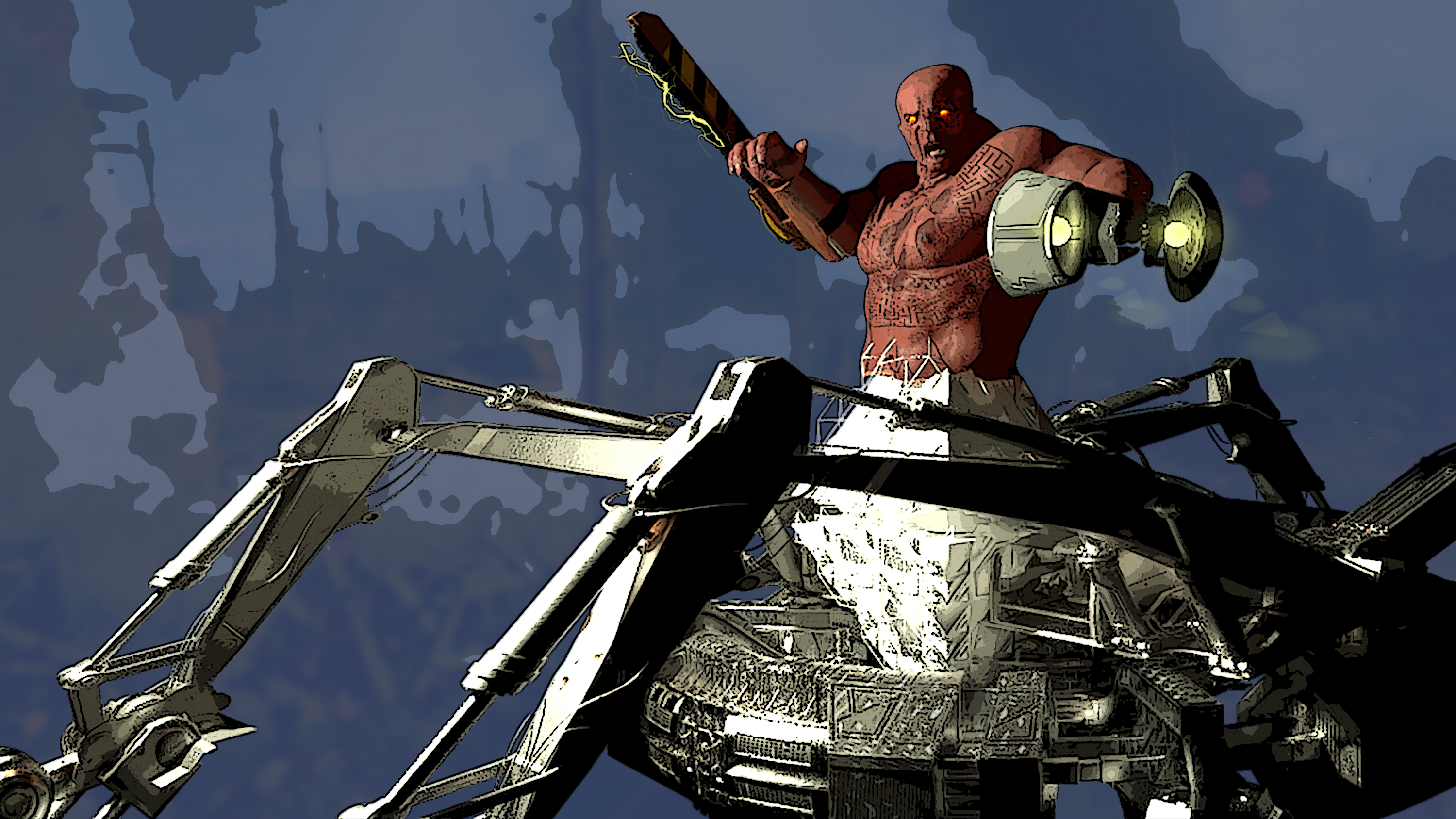
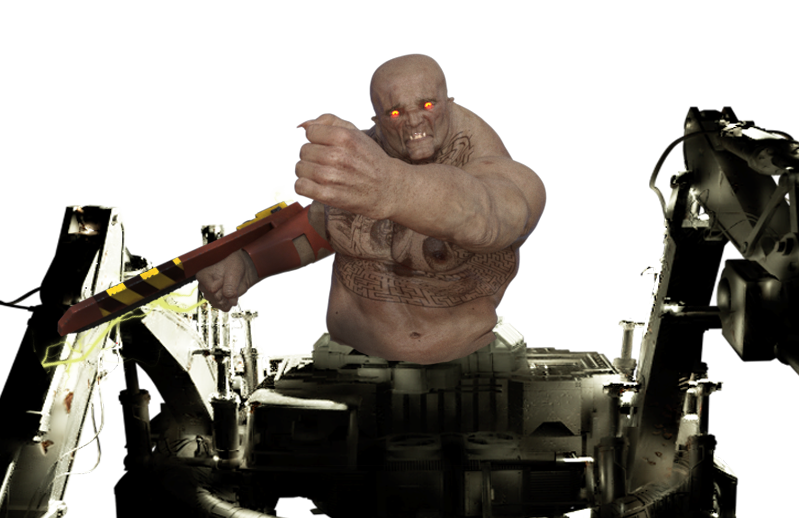
A Terrifying New Threat Enters The Salt Mystic Universe!

Occasionally as we build out the Salt Mystic universe, some spooky new threats pop into existence that surprise even us. Right now, I’m 23k words into a standalone novel set in this world that will shake it like an earthquake, introducing new weaponry and technology, several exciting new locations, and a host of new terrors!

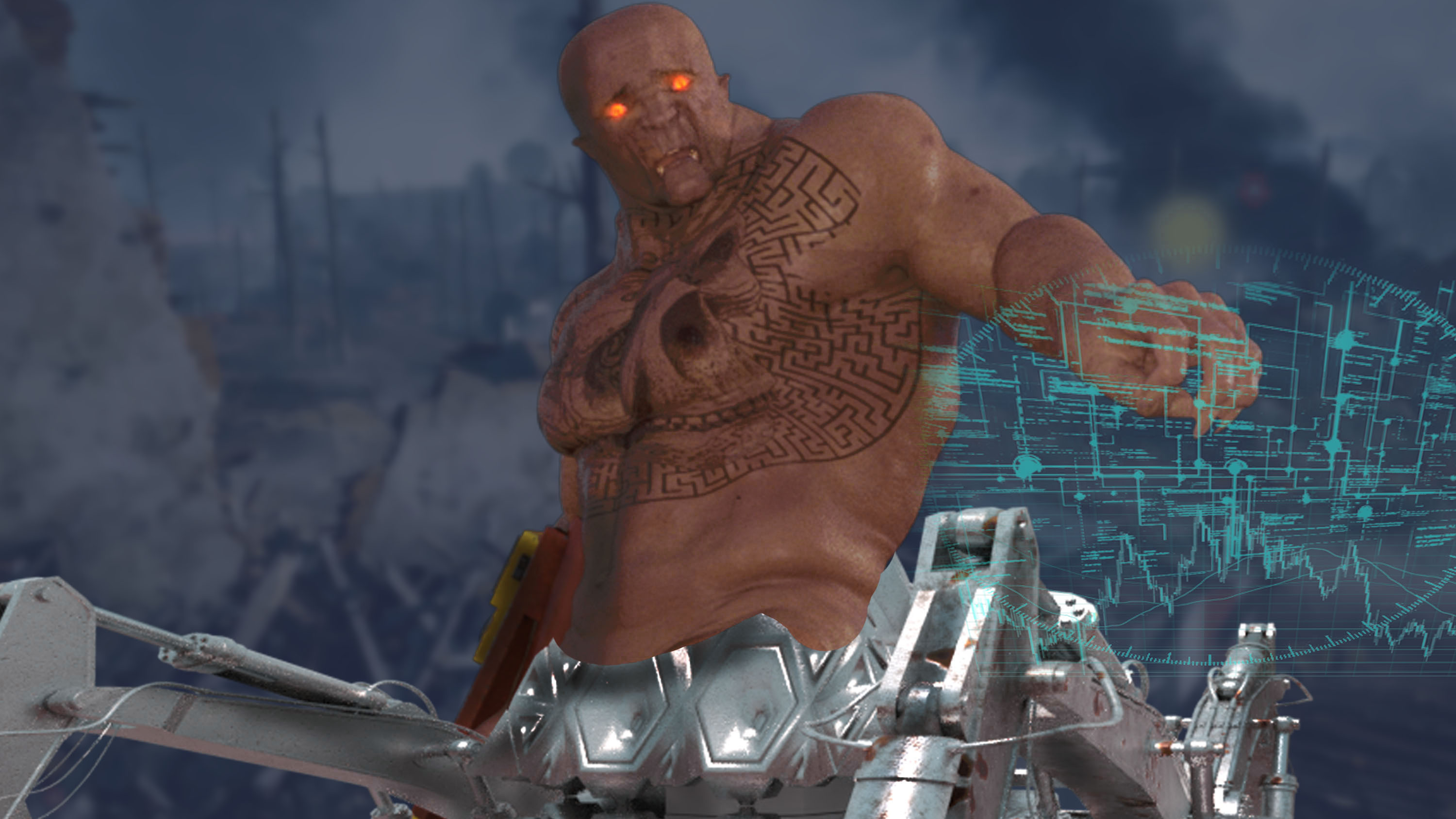
Enter the Day Giant.

If you’re new here, let me back up a bit. The Salt Mystic setting is an experiment in immersive storytelling that fuses art, fiction, and games into a unique and thrilling experience. Right now, it’s a novel that introduces the main narrative, a terrain-based trading card wargame that expands and breathes life into that narrative, a growing line of branded merchandise (including our first art print!) and freely downloadable illustrated flash fiction called Lore Cards.

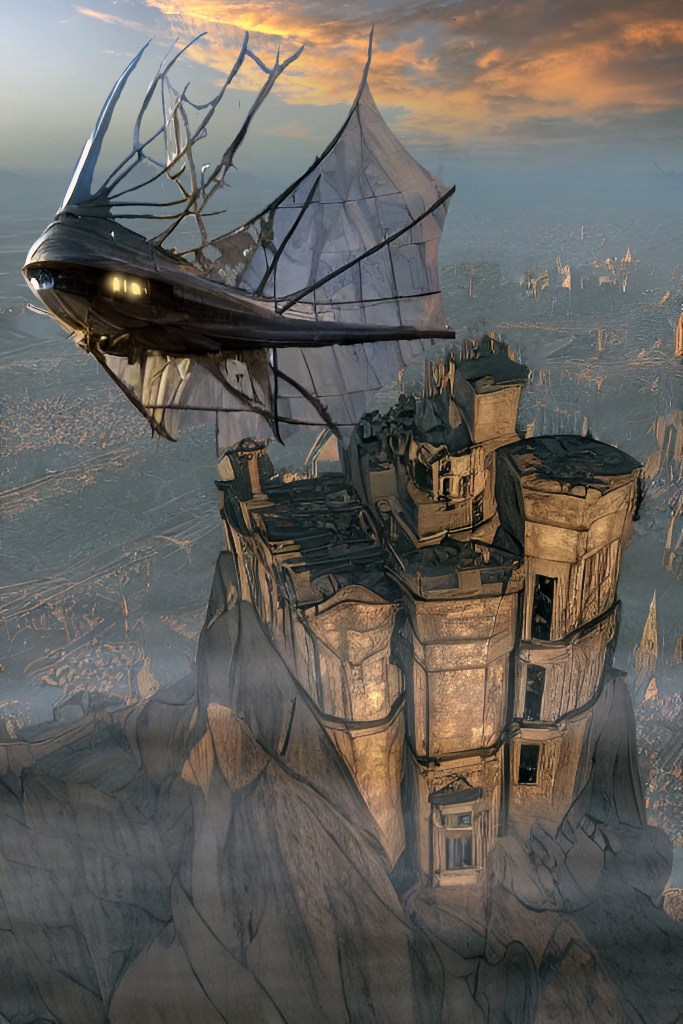
Click the wings to learn more:

We’ve been hard at work dropping new Lore Cards over the past few weeks, so make sure you stop by every once in a while to see what’s new. The Story Arcade is what we call the repository of cards, and it’s a place to get inspired for your own games of Salt Mystic or to fuel elements in the Roleplaying Game system of your choice.

Click the medallion to see all the current Lore Cards:

Although Salt Mystic is at heart a western-inspired science fiction setting, with a theme of exploring lost and hidden worlds, I feel like no adventure stories are complete without a terror that sticks in your mind and creeps around there. In the Work In Progress novel, to be called Mazewater: Master Of Airships, you’ll be introduced to a scrappy, gangly fellow named Lamberghast Mazewater, who faces such a threat with a quivering voice, a shaking hand, and armed with only his big heart. More to come on that as it develops.

The artwork

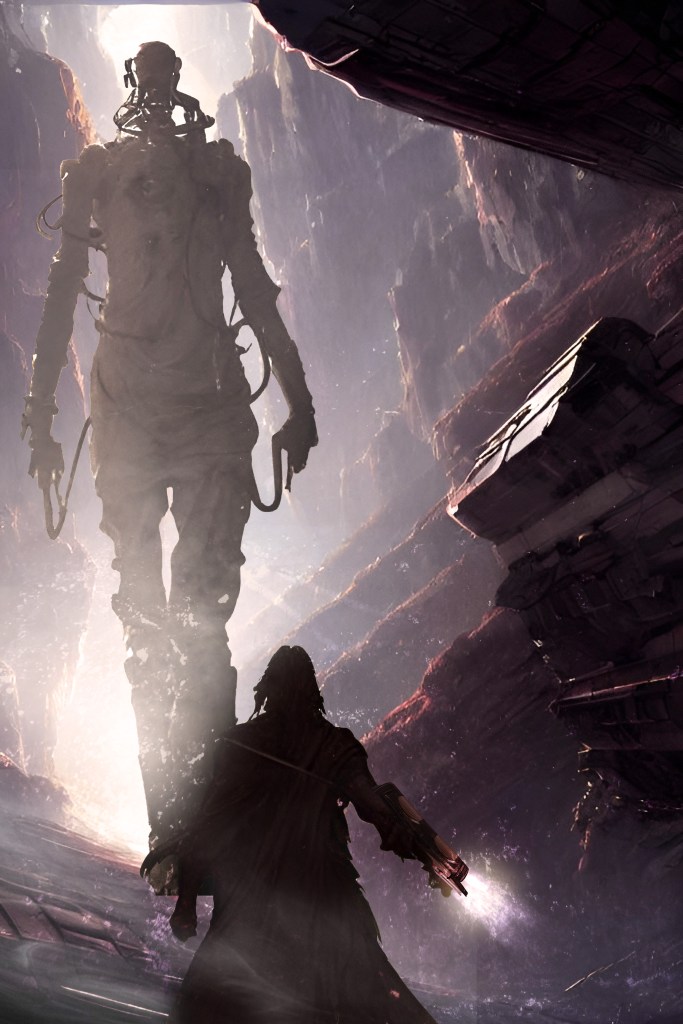
The art for the new Lore Card was produced combining elements from two AI art generators, then painting over them and completing the composition and adjustments in Photoshop. This approach is a real game changer for small indie publishing companies like us! Sometimes, the image comes first and then the story. It was the reverse this time – I knew the giant’s general appearance and that I wanted a gunslinger facing off with him. That’s all I knew though.

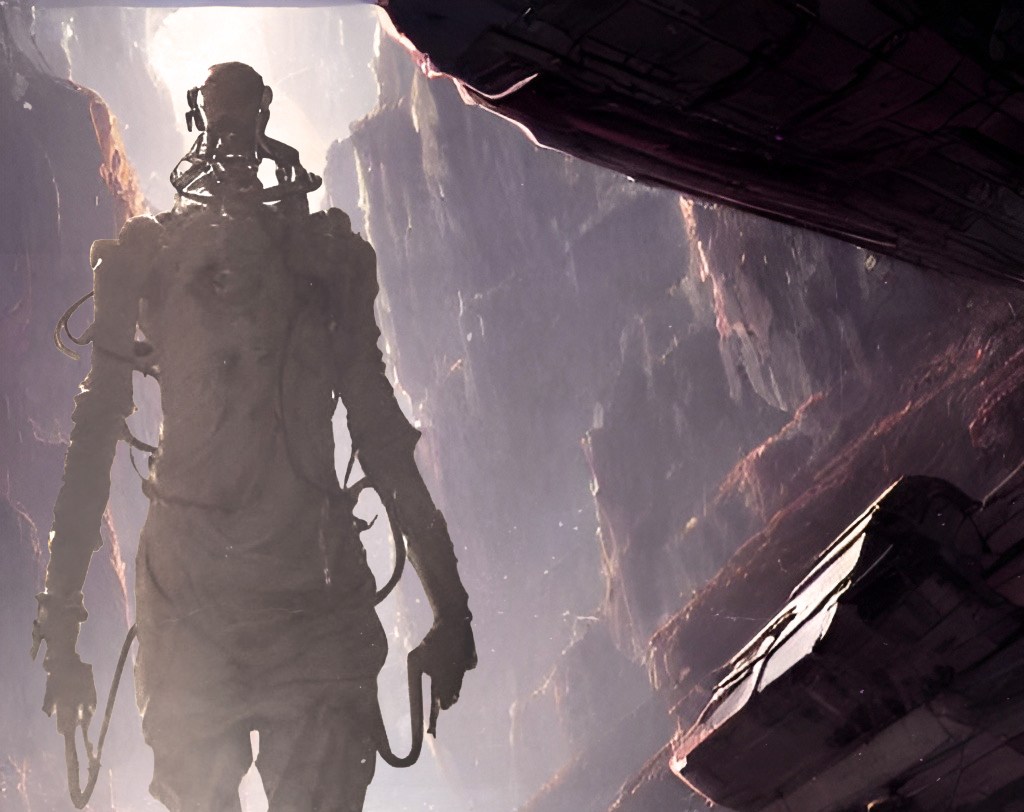
The giant: It took many, many iterations with Codeway’s Wonder app using text prompts like “enormous thin giant in rags with oxygen mask and exoskeleton” till I got something vaguely like what I had in my head. The color was wrong, as was the perspective, the tone, and it had bits and bobs all over it that were unwanted. I cut it out, trimmed the odd bits, then altered the perspective so his top half was smaller.

The canyon: The canyon was another round of iterations, in both Stable Diffusion and Wonder, till I got a mashup composition of rocks and lighting that generally gave me something to trigger the eyes to see the giant as huge. I wanted light coming from behind it, so I juiced that with a Color Dodge and soft brush.

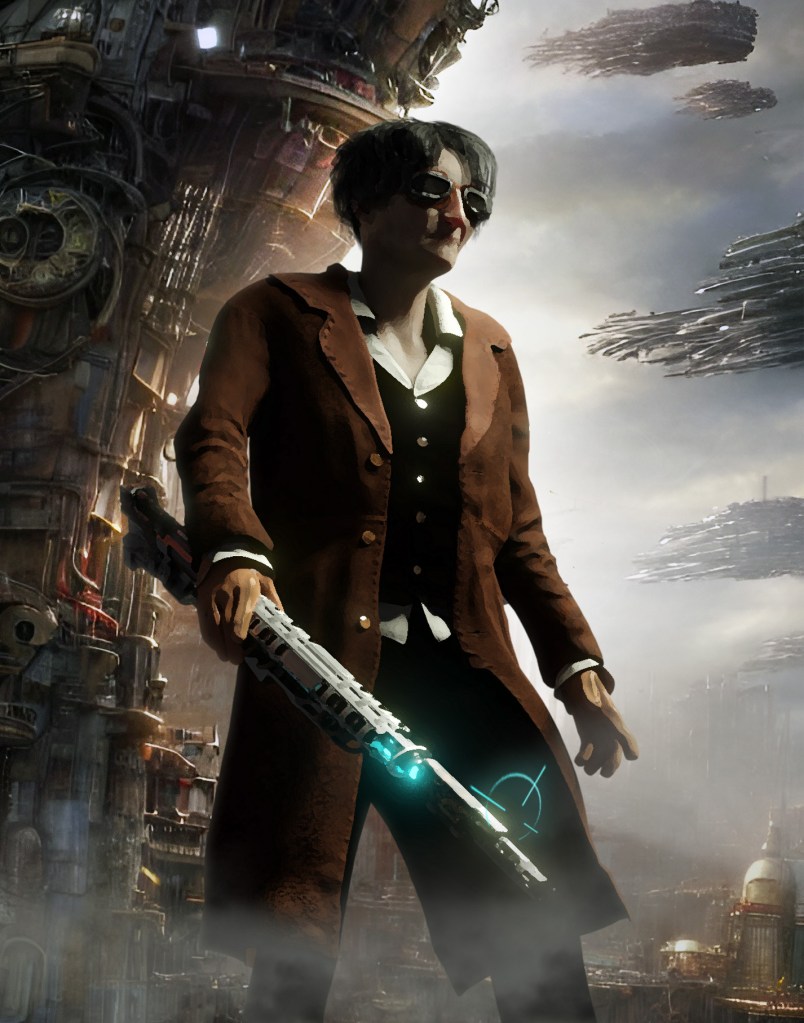
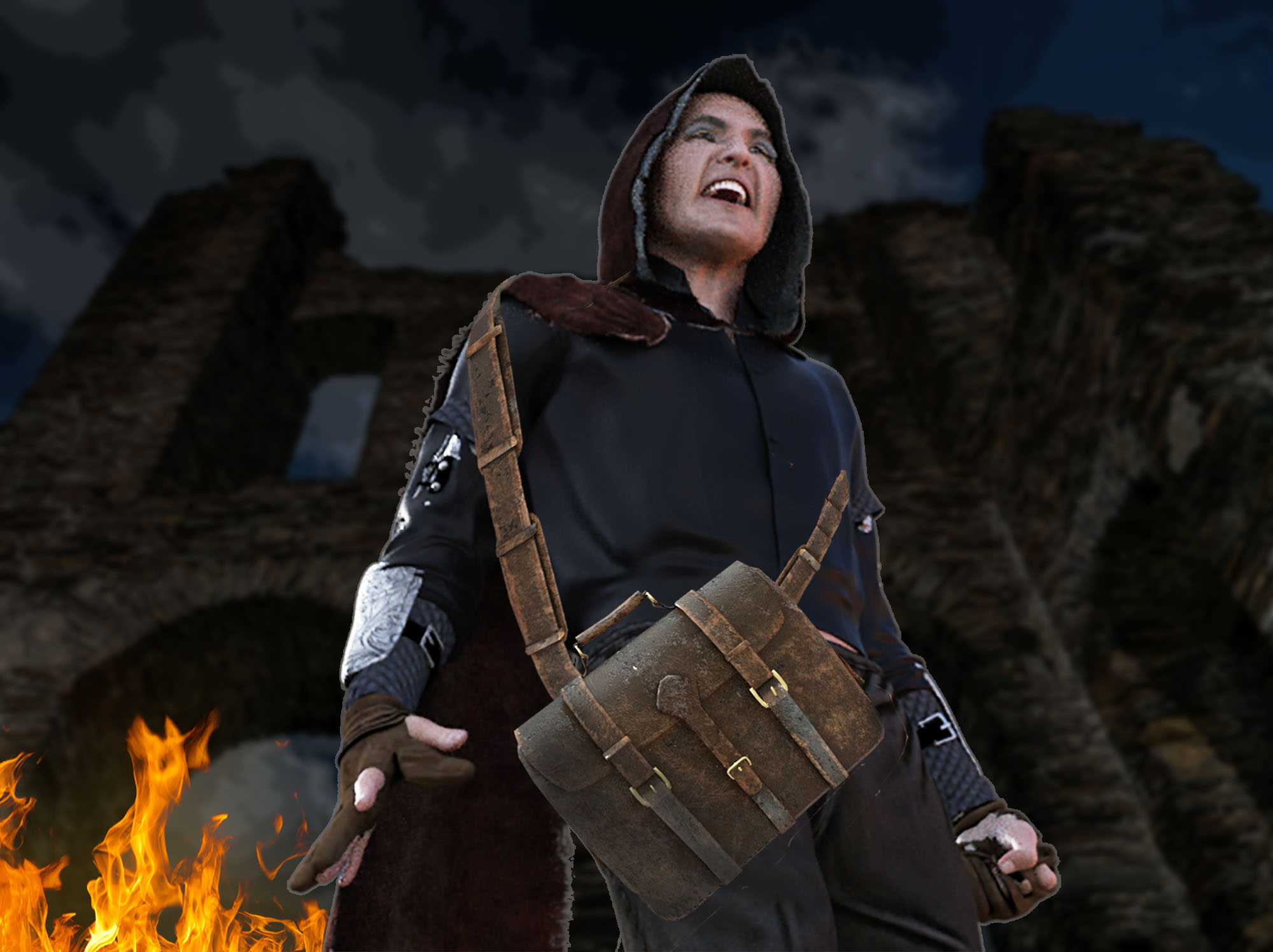
The gunslinger: The gunslinger was a third round of iterations, in Wonder. The text prompts were things like “fantasy gunfighter in long coat holding his arm out”. This one had bits and bobs coming off it as well, and the coloring was terrible. He also had weird holes and discolorations all over him, which I had to correct.

The weapon: The ball lightning carbine is a long-standing custom item I use all the time. I built and textured it in Blender. This time, I cut out parts of it to show it partially concealed by his sleeve and brightened the barrel’s tip (with the Dodge tool) to show it glowing from the heat inside the barrel.

There’s a company called Nucly that offers various overlays for Photoshop – I included a ‘god ray’ overlay and morphed it to emit from the gunslinger’s weapon. That looked cool already, but something unanticipated happened once I started making adjustments.

The lighting: I superimposed a grunge texture over the entire image in Screen mode, which roughed up the look of it in a way I really liked. However, I noticed the Color Dodge blur coming from behind the giant as well as the charge firing out his weapon reacted with the grunge overlay for even cooler lighting effects than I’d planned. I really liked how that turned out, honestly.

Color grading: I tried various warming and cooling filters over the entire image, and tried adjusting its color grading to various images whose color schemes I liked. This warming filter (an evening sun shade of orange) won me over because of what it did to the canyon rock.

Here’s the final image, which will also eventually appear (in altered form) on an upcoming Volume Two game card next year (click on the image to see the Lore Card and read the associated story):

I hope you like the art and the story, guys. Let me know what you think! Till next time,

The long history of the Salt Mystic universe

This image has an empty alt attribute; its file name is skulldudewithcrack.png

Here at Grailrunner, we’re building a storytelling framework we call ‘SALT MYSTIC‘. You can get the point of it here. If you’re going to call something an “immersive storytelling engine”, it needs to have some long legs, right? So we had the idea that it might help to have a reveal of some of the history that led to the software-haunted ruins, screaming statues, and city-sized war machines in which the main storyline is unfolding.

Here’s the familiar setup:

Two thousand years ago, a withered old woman stumbled out of the salt flats declaring her vision of the forces of history, and how to harness them to shape human events.

Naraia was the name they gave to the world-spanning democracy that arose from her teachings, encompassing countless thriving civilizations on land, floating on the seas and tethered to the sea floor, and tucked into pockets of artificial space called oriels. All of it shattered into a thousand pieces a generation ago in a terrifying and almost supernatural conflict called The War Of The Rupture.

But so much happened before!

How could a worldwide nation be possible unless they had seen the anarchy of centuries of soul-destroying war? Where did such miracle machines come from that could serve a civilization this mighty? And what mad travelers and philosophers and generals lived in the hearty days before these shining towers whose lives could feed the kinds of stories the Salt Mystic would weave into her powerful myths?

Let’s take a look at the broad strokes of ten thousand years:

Banner file

First Era:     Misty Antiquity

A muddled time of legends and fables. Many themes of these stories include an ancient technological Singularity, where humanity’s machines rocketed beyond their own understanding and reprogrammed the very matter of their landscapes.  It’s probably just a story.

The most popular figure among the legends of the era tell of Rendel, a mischievous trickster engineer. Typical of his confusing rants, Rendel was famous for asking whether this is the first and original universe in which we live, or if it too began as an oriel.

Rendel

Second Era:     The Brewing

A wild era of exploration and settling where many of the familiar cultures of Naraia developed their own cultures and identities as enclaves or small nation-states.

  • The Red Witch Annex was carved out to isolate and contain their vile ways of seeing the world
  • The first people settled in the barren Salt Flats, hunting with their traditional bladed kites the high flying whitebird
  • In the ancient settlement of Alson high on the mountain plateau, the hallucinogenic algae wine called sana was first brewed
  • The first ball lightning carbine was crafted by a gunsmith whose mysterious lover asked him to bring her a mighty storm in a box

carbine-rendered3

Third Era:     The Merchants’ Wars

The largest conflict in history to that day, when the various enclaves came to realize their bankers and merchants had leagued together across the world in a secret shadow government. Theirs was a lost generation, who learned in the burning wakes of ever-escalating war machines to trust no one at all.

It was a time of devastating economic and psychological warfare where propaganda was brought to its highest effectiveness. Many of the cruelly manipulative stonewisps, artificial intelligence agents of chaos haunting statues and masonry elements, date to this period. It’s noteworthy that this was when the seafloor empires arose in The Tethered Cities, its early peoples fleeing from unrest on the surface.  

One ironic result of all the chaos and fury of the Merchants’ Wars was the planet-wide system of shipping, trade routes, and banking infrastructure that later made Naraia possible.

Fourth Era:     The Philosophers’ Parade

This period in history was notable for the seemingly endless parade of new religions and philosophies, where it was said any stray book casually left in a plaza would sprout a temple from its pages. The superstitions of the Mountain people especially spread like wildfire due to the popularity of their algae wines and wildly inventive folklore.

Although well understood now, it was unknown to the people of the time that many of these belief systems were being engineered for the purpose of uniting the world’s enclaves under one ruler. It was an attempt to conquer without blood or treasure, since previous eras had proven that neither war nor commerce could unite everyone.

One unremarkable nomadic enclave called The Rauchka dramatically lived out their protests of these bloodless coups by transforming into a roving race of jesters, mocking without regard for power or influence. This is important because these prancing, nose-tweaking jesters would later be charged with the important responsibility of humbling those wielding terrible authority under the world government. They were declared untouchable up until the time of Old Man Talgo during The War Of The Rupture.

The end of this era is marked by the arrival of The Salt Mystic, who stumbled from the Salt Flats with a history-shattering vision of the forces of history.

Fifth Era:     Naraia

Within a hundred years of the Salt Mystic’s arrival, a united and mighty civilization arose, spanning from the mountains to the seafloor, across countless pockets of artificial space, and deep into crevices in the earth. This remarkable and unprecedented society was built upon a number of foundation elements:

  • The Augur, a collective hallucination maintained by attendants and providing oracles based on the Salt Mystic’s philosophy
  • Recorders, people chemically and genetically modified to remember every sight, sound and scent they encounter and used for almost supernatural consultation
  • The Malthus, enigmatic errand runners and assassins, able to weaponize the Salt Mystic’s philosophy to shape human events. It was said a single Malthus could not just destroy a city, but make its own people do so.
  • The Rauchka jesters, ever humbling those in power

This pinnacle era of history lasted for almost nineteen hundred years before it decayed from within. By its end, the Augur and its puppet copies were hotbeds of secret files, intrigue, statecraft, and meaningless power plays devoid of wisdom. The Malthus were all but wiped out, with only a handful in hiding in the Trapmaster City under the Yagrada River.

Sixth Era:     The War Of The Rupture

Libraries are filled with reasons for the War Of The Rupture, perhaps the largest possible war ever to be fought. It’s said a billion people died in this nightmare, a conflict of practically everyone against everyone else. The most terrible war engines imaginable blanketed countless battlefields. It was the golden age of war.

The most important figure of this period was known as Old Man Talgo, a minor military figure who rose to unimaginable heights of influence due to his ferocity and battlefield innovations. He was a cruel and vicious man, who pitted his sons as officers in battle against each other for competition and refining.

The Old Man made a bitter enemy of the last clan chief of the Rauchka and swore to erase his people from history, eventually beheading the chief. Strangely, Talgo was said to have gone to the Augur afterwards and hung himself at what he heard there. It was after this that the Rauchka made their sad, desperate pact with a general named Tienna in the Great Valley Cemetery to transform into cyborg engines of war.

Seventh Era:     The Guardian Age

The current era is a time of roving armies and miraculous war machines, scattered like maple seeds for anyone to seize. It’s a time where some of the old legends from the war still live and carry enormous influence, and old grudges. And it’s a time of very old mysteries.

The era is named for the most important myth ever told.

It was said in hushes and whispers throughout the terrible conflicts of the war that the Salt Mystic had foreseen what would become of Naraia. Because of it, she had injected cunningly engineered stories into the folklore and myths the people pass down, ones capable of possessing a person’s soul. Foreseeing the wars and injustice that could emerge, she hid tripwires in these myths that inspire world-shaking guardians when they’re needed the most.

A guardian arises maybe once in a generation. It changes everything.

And it can arise in anyone at all.

(c) Brian Bennudriti. All rights reserved.

Tales from the Salt Mystic universe. Read more here.

Web site header

Blinkstrikers: In Broad Daylight

Blinkstriker profile versus blue backdrop

If asked to describe an assassin, most of us would imagine someone who skulks in shadows and creeps about at night in desolate places. It’s not just to dodge being caught plying their deadly trade; no one paying for assassinations wants trails leading to the buyer! Assassins slip in when you’re alone and do the deed quietly.  No witnesses.

Blinkstrikers are a breed of assassins in the Salt Mystic universe who, you might say, thumb their nose at this idea of skulking at night. You earn that distinctive black hood only one way: a very public, broad daylight execution of an extremely powerful person with at least a thousand witnesses.

Imagine a summer day, crossing a crowded street in a swarming mass of people. Everyone’s laughing or rushing, munching a sandwich. All around you are people and businesses and street cameras. You blink your eyes. That’s where the name comes from. It isn’t the shadows or the night where the Blinkstrikers work. It’s that moment when you simply blink your eyes.

Someone walking beside you falls dead to the ground.

You can stop everyone in that panicked crowd and lock down the city if you like. Everyone will have a story. Everyone heard something. Everyone saw something. None of it will lead anywhere. In fact, it’s like someone almost set things up so the eyewitness information makes things even more confused.

With procedurally generated morphium face masks and clothing, they never look the same twice. Many of the people in the crowd that day were observed and manipulated for days before that moment. Ideas were hypnotically or neurolinguistically implanted to shape what they would say and experience at that moment. It could be that even the target for the hit was manipulated into turning left or pausing at a particular moment by some random and forgotten experience days ago.

Someone in the crowd did it. And you’ll never catch them. Never.

The hardest thing to face about such a person is you have to stop your life and hide away in the shadows to shield yourself against them.

And that’s where the other assassins are!

ascensia

Ascensia: “Half a million people watched my guy fall when I earned this hood. And I’m still here!”

Nampo image2

Nampo: “I sleep fine. These people are animals.”

(c) Brian Bennudriti

Tales from the Salt Mystic universe. Read more here.

When You’ve Heard Every Story, It Changes You

Questforged-revised

Recently, we introduced a new class of beings in the Salt Mystic universe called ‘The Questforged’. Not sure yet just where these guys will lead us, or in what other formats they’ll make their deepest mark. But one thing that strikes me as particularly useful and meta about the concept is that they’re based in a very real way on high impact storytelling, just like the world of the Salt Mystic. That’s what the enigmatic figure of the Salt Mystic herself was doing way back when she stumbled out of the flats mumbling about her vision of history…

telling stories.

In her case, she had a vision of the forces of human history and saw what malicious things would arise from our coming together in a world-spanning civilization, the terrible shattering wars that would arise. So she buried powerful stories into the myths and folklore people passed down, ones capable of virtually possessing very unique people. And those people, as arisen guardians, would go on to inspire change on a global scale.

I see the Questforged as almost the opposite of all that, or more properly a balance to it. In their case, the stories they’re fed are what drives them, much like a guardian. But these poor, sad souls don’t seek out this inspiration. They’re enslaved by it. They don’t find beauty and majesty in unpacked jewels made of myths. They find an opiate.

Here, read a little flash fiction to get to know them better.

Banner file

They called them ‘The Questforged’ because you steered the beast-men by piping alternate realities into their feedstream. If revenge was your guy’s thing, you gave it to him in a genocidal-apocalyptic sort of way. If it was rescuing baby lordlings, then you gave him that in a future messiah storyline. But for every one of them, there was a tailored fiction that could drive them to frenzying heights of annihilation.

Hey, whatever it took to keep them going away from you and not towards you, right?

But there was a balancing act to this storytelling. If your plot was thin or contradictory or marred with a hole in its logic, if your setting failed to mirror a reality of the land which your beast-man knew, or if your characters spoke unnaturally in the manner of someone forcing advances in the narrative, then there was always the terrifying chance to see them turn on the storyteller.

Some part of these hybrid abominations, fused with their lightning weapons and wall-climbing vortex crawlers, wanted to be fooled. Something about slipping into dreamtimes where things were very black and very white in full contrast maybe smothered their own nightmares. That’s just why the whole system ever worked at all. It’s just that after some time, you’ve heard every story. And when you’ve heard every story, it changes you.
It’s a sad and funny thing to know then, that the most revered and honored Questforgers in those days were runted little kids…often the ugliest and most cast out of them. Those were the ones who dreamed the hardest. In even the fiercest of night raids or tower assaults, it was a common yet curious sight to see a tiny ragged child perched inside a nook of the beast-man’s machinery.

They told the stories they needed to, just to belong somewhere. Like all of us do.


(c) Brian Bennudriti

Tales from the Salt Mystic universe.


The Stories Make A Riddle

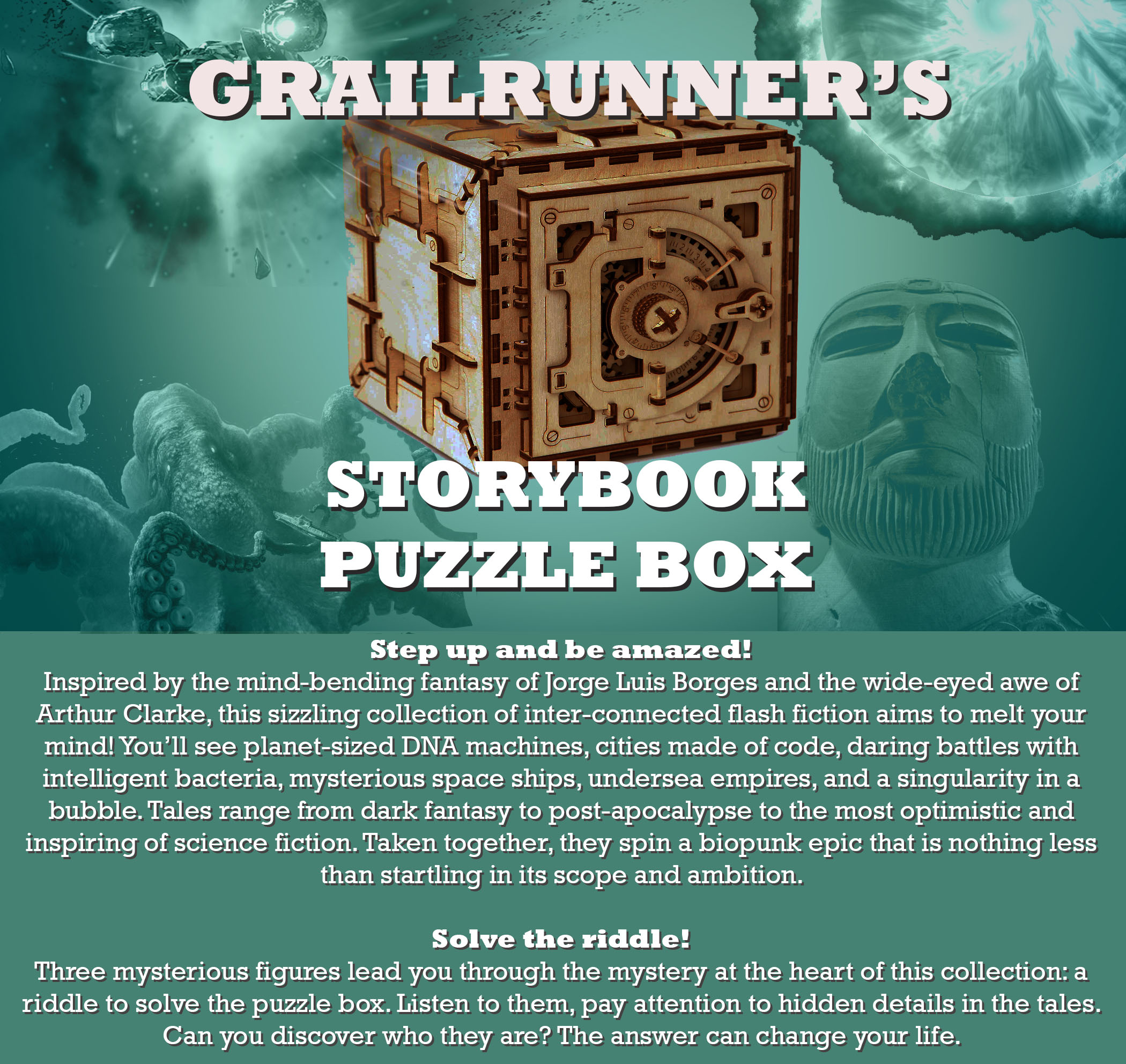
puzzle box-teal

Anybody that’s managed the exhaustive and maddening feat of completing a novel can relate to the weirdness that sets in as things wrap up. A core part of who you are, paper people you lovingly crafted and hid little bits of yourself into are being tortured and dropping like flies. Loose ends you thought were pretty awesome back in the day two years ago jump up out of their hidey holes during your re-read and mock you for forgetting they existed. Cool, shiny objects you’ve been chasing the last couple of months turn out to completely contradict the thing you were planning on having happen.

And so on…

Maybe that’s not you. Maybe you’re the reader that catches those sorts of things when they’re not completely patched up and you savor your find. That’s cool too, you’ll still relate I bet. You’ve wrapped things up and felt a little whisper suggesting you stretch things out a bit, like kids in a pool begging their mom standing there waving her car keys:

“Just a little while longer. Pleeeeease?”

Anyway, this thing has taken longer than I’d anticipated. Like they always do. For almost three years, I’ve been at this collection of short stories, bundled with chapter endings that collectively unroll clues behind a connecting riddle. Sure, I’ve been working on other stuff, wasting too much time goofing off with fascinating time sinks like Warmachine, One Deck Dungeon, and Grimslingers. If you’re not clear on what these are, it’s probably best if you just leave it lying there. Or risk your soul (at least your free time!).

So I’m at 58,000 words roughly. All the stories are locked in place.  Fourteen chapters total. I’ve got four more chapter endings to write, each of which are maybe around 1,200 words apiece. It’s easier now that everything connects; and I know how the larger story ends. I know what happens to everyone. It’s no longer tempting to shove explanations into people’s dialogue, which is a soul-deadening outcome if I’ve not managed to mercilessly extinguish all the times I wound up doing exactly that.

I’ve been incredibly careful to ensure the riddle at the heart of this set of tales has enough clues for someone who’s paying attention to actually solve, but not have it be obvious. I also have in mind the notion that anyone choosing to read through a second time once they know the riddle’s solution would be rewarded in a meaningful way. And I want that solution to be important. I’m intrigued by tapping into the power of how fiction works in our minds to take a targeted shot at making an impact on the reader’s life.

No pressure, right?

So the idea, much like you do with your life, is to turn and shake the daily grind till the time to finish this project falls out of its pockets. Time…a quirky and unpredictable beast, that one.

Wish me luck. See you on the other side.


Introducing: The Tomb Trappers

Trap on door

If you’ve ever been entertained by tales of a daring adventurer dodging terrible traps and solving rune-based puzzles to avoid being impaled by spring-loaded spears, then you’ve probably wondered at some point…

Just who designed and installed all these traps, anyway?!

In the Salt Mystic worlds, there is an entire class of devious engineer called the Tomb Trapper. You can always recognize them by the worn leather trapmaster bag they carry.

Tomb Trapper Laughing

You don’t buy a trapmaster bag; and anyone caught having stolen one is quickly found in glowing ash piles once word gets out. Inside that bag are wonders, no doubt: computronium sensors and morphium canisters that spring to programmable shapes, intelligent stonewisps downloadable into the very masonry of an ancient wall capable of generating riddles…

But the true genius of a Tomb Trapper lies in what they learned deep in the labyrinth city below the Yagrada River. That’s where the Tomb Trapper guild once kept a gloriously malicious school of trapmasters, and its deadly proving ground.

brian-bennudriti-fargo-tomb-trapper

Anyone carrying that bag studied under the most twisted minds who’ve ever built explosive-dusted halls or wound rune-covered clocks or poured oil into flaming statues. They were a wicked, but torturous geniuses, those shadow-haunting monks of the labyrinth city. Anyone carrying that bag not only studied under such people, but also won the labyrinth they built.

To be clear, one didn’t win the labyrinth by escaping or just by sealing away all of your opponents also seeking to graduate. Yes, you had to do those things. It just wasn’t enough. You had to trap one of the guild monks as well.

In fact, that’s the irony of the dead labyrinth city now that it’s abandoned and full of cobwebs and echoes.

They had some excellent students.

Tomb Trapper Cypress

(c) Brian Bennudriti

Tales from the Salt Mystic universe

Learn more about Salt Mystic here.

The Questforged

Questforged with blue background

Here at Grailrunner, we aim in our worldbuilding for the SALT MYSTIC universe to frame a place where almost any type of story can be told. In fact, the notion led us to the concept of the oriel as an artificial pocket space manufactured for explorers to populate or for shelving away mighty battles, where even ancient civilizations could be flourishing because their oriel’s time moves differently to ours.

When you’ve got that kind of span, any sort of monster might arise. Right?

One thing that always struck me as genius about King Kong or Frankenstein was how sad you felt for them. The big ape splattered there on the New York street hadn’t asked to be hauled off on a boat; and he had the heart of a hero. But splat. The reassembled corpse was just trying to make his way and be cool with everyone. But torches.

That line of thought took us recently to a new entry in the Salt Mystic rogue’s gallery: the Questforged.

Here’s a quick piece of flash fiction introducing these poor guys. Let us know what you think.

Banner file

Questforged

Of course we did.

You don’t devise rifles that launch ball lightning and arm-mounted electrostatic chainsaws and fail to have the vision to surgically attach them to vat-grown mutants. Most of the Questforged elect to be sawed in half and hardwired directly into ramships or vortex wall climbers. Honestly, they’re a terror to see. And crazy.

That’s actually not what’s interesting about them, though.

The neurology is based on mass shooters and serial killers, especially wartime basket cases. Technically, they’re just mad all the time and looking for dopamine in the worst way. There’s a terrible truth with these fellows, though, relating to how we manage them.

Sana is a hallucinogenic algae wine grown in magnificent terrace gardens in the mountain cities. It’s pumped directly into their bloodstream, along with liquid computer bots that create manufactured realities for them.

And that’s the heartbreaking story of the Questforged. The people who control these terrible beast-men do so with fairy tales and fantasies about false terrors. They have no cause anchored to the real world, but instead chase stories fed to them by their generals. They are killing imaginary beasts and paper villains.

Not that you’d know the difference.

Questforged-up close


Web site header

(c) Grailrunner Publishing


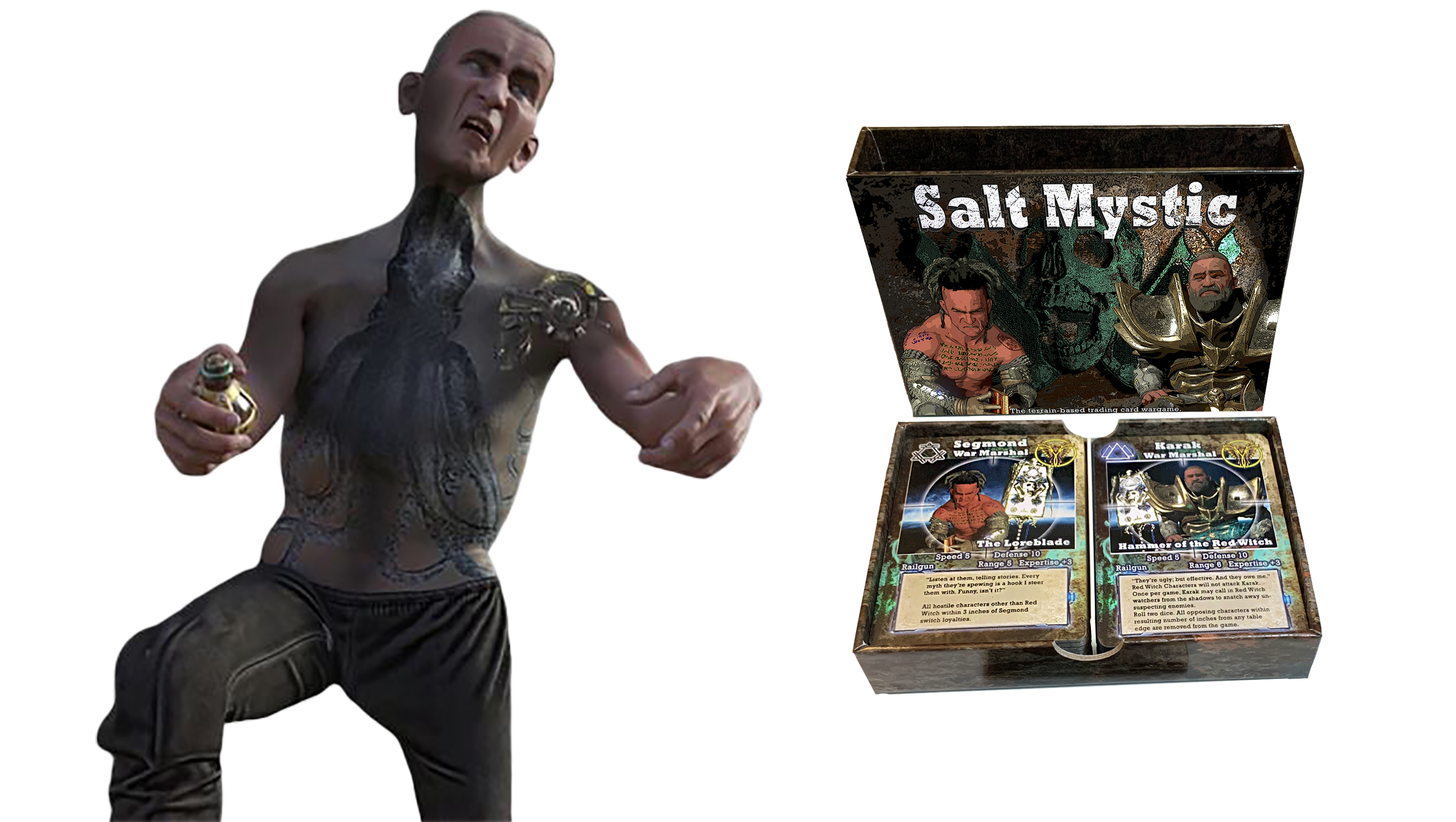
The SALT MYSTIC tabletop game has arrived! Here’s the backstory…

storyteller with box

Well, finally! We at last have something to show you for all the efforts and learning, the mistakes and horrible designs, and the stunted experiments in game mechanics. You guys have been very cool about this little diversion of ours, so thanks for all the input and playtesting, the patience, and interest.

Here’s how this whole thing went down:

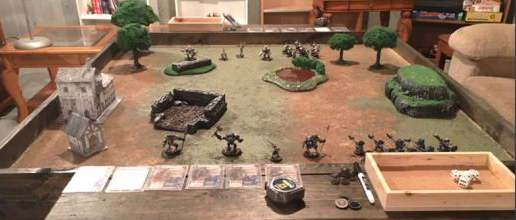
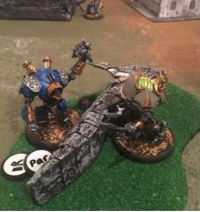
Nov 2017: Dude, I just wanted to play Dungeons & Dragons with my family for my birthday! I told you about it here. We popped into a gaming store (the Geekery!) to pick up some miniatures since I hadn’t done anything like that in decades. I saw some guys playing the tabletop wargame, Warmachine, and I was hooked.

I started learning to make terrain and assemble and paint miniatures. Learned the rules. Discovered Warhammer40K and Malifaux, a couple of other wargames. Then I picked up Magic: The Gathering and nagged the kids and wife into some after-dinner games. It’s like your mind explodes open when you go deep on this sort of pastime, seriously. I had no idea.
Feb 2018: By February, I was tooling on this notion of what I’m calling an Immersive Storytelling Engine, which is a mechanism for engaging people in different ways with an ongoing, overarching storyline. I captured a game on the tabletop at home with some high res pictures and told you about it here.

warmachine-2

warmachine-7

It was frustrating to try and move the ball down the field on this with my own work given how crappy my art skills are. I knew I needed dynamic visuals, so I started playing around with some amazing software that makes it easier:

  • Photoshop for image manipulation and some high level digital painting. Pixabay.com is a favorite stop for stock images to begin with (and thank you, Aaron Nace of Phlearn on Youtube!)
  • Blender for 3D models, lighting effects, and scenery and backgrounds I couldn’t find or massage from existing stock photographs. Turbosquid is a favorite stop for royalty-free models to begin with (and thank you, BlenderGuru on Youtube!)
  • Daz Studio for 3D models of characters (and thank you, Black Sun Comics on Youtube!)
  • Substance Painter for unique textures and materials with which to paint all this.

Nov 2018: I tried a deeper storytelling experiment, which I told you about here. It was called THE BLACK RUINS MASSACRE. The idea was to let the mechanics of a tabletop game decide the narrative. Turned out great, you should go read those four posts. Also got the chance to photograph the fog machine tower on the table:

tower and fog

Feb 2019: By this time, I was stretching my artistic muscles a bit and shared some early images from the SALT MYSTIC world from my 2015 book, TEARING DOWN THE STATUES. While not amazing like the pictures in my head, I felt like this was making it possible to go deep on the idea of expanding the characters, technology, philosophy, and core concepts of that world in an engaging way.
Apr 2019: So this project began…the SALT MYSTIC tabletop wargame intended as a mechanism for telling stories as I had with the Black Ruins Massacre. It had some Malifaux in it, some Magic: The Gathering, some Warmachine…a little Star Wars…a lot of Dune…and some things I picked up in the ‘Tabletop Gaming’ magazine. I announced the project here. Mostly, I tried to avoid the stories and exact characters of the book and focused on enlarging everything, establishing a framework capable of supporting any type of story I might want to tell.

June 2019: Here, I was reaching out for people to help playtest the original game rules and concept cards. My idea was a bit ridiculous – I was hoping people would actually print out the cards and terrain and rulebook as pdf’s and give this a shot. Actually, loads of people responded and said they would do exactly that.

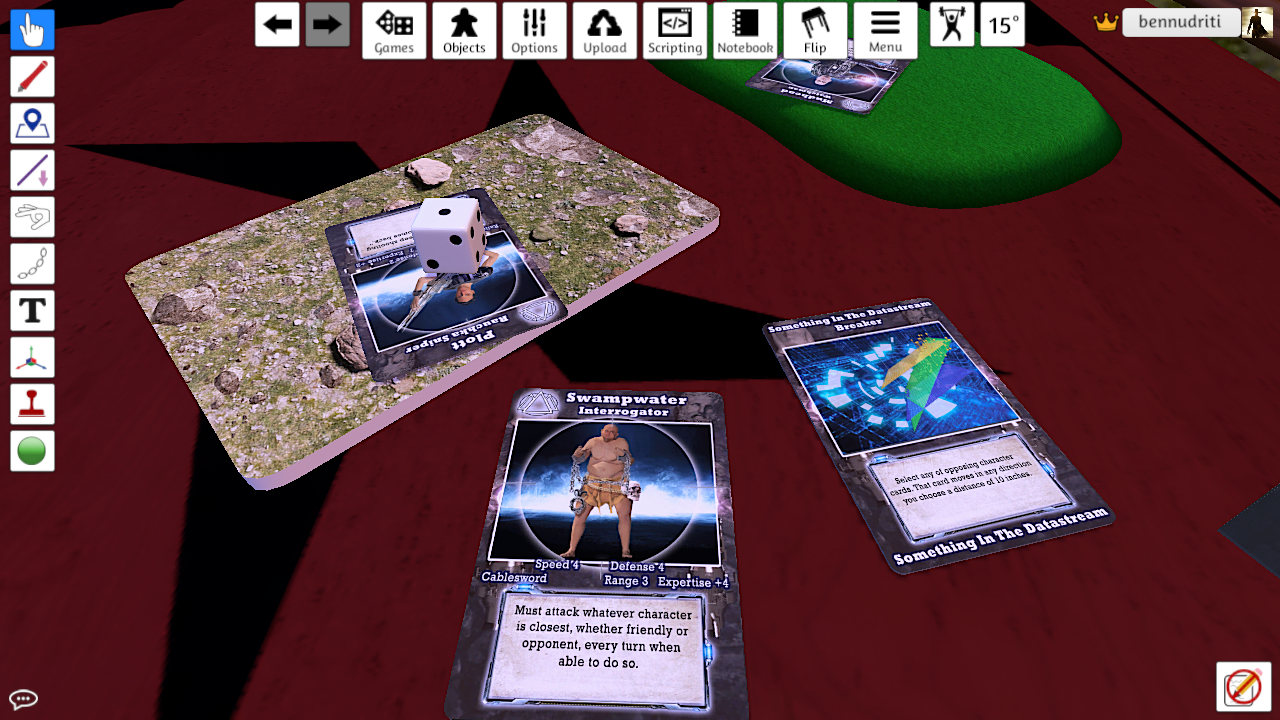
Unfortunately, I heard back from very few people on the hardcopy stuff. Kind of felt bad for the people who did because I was actively updating the art and card text, so the items they printed were in flux. But then, one crazy Scotsman chimed in and said he’d play it like crazy if he could do it ‘on-line with me mates’. He led me to Tabletop Simulator on Steam.

screenshot2

It wasn’t hard at all, actually, to upload the cards and terrain. They give you a template; and you just place your cards directly onto it in Photoshop, then click a few times. This was really helpful, believe it or not. You can reach a lot more avid gamers this way, most of whom are just interested in stealing some of your assets for whatever they’re doing.

But at least they stop by and give feedback after a few tries!

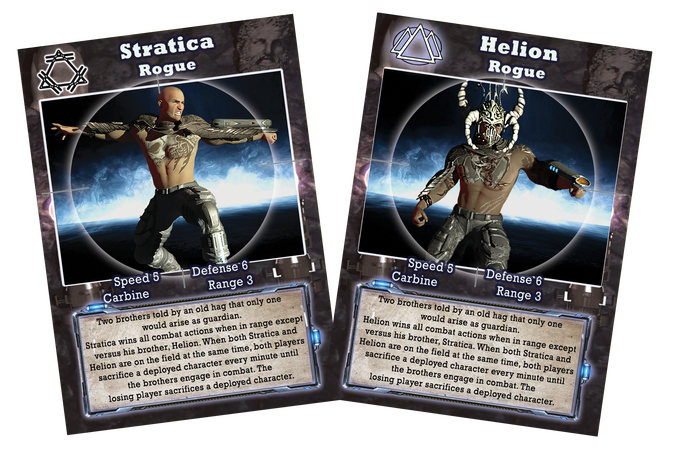
Sept 2019: It was September when something big happened…the first in-game story happened on its own. I wrote about it here. Basically, two brothers told as very young men that only one of them would receive an incredible prize. Only one of them. That drove the rivalry, which led to the accelerated game mechanic when they’re both on the table, sacrificing a player per minute until the brothers meet in battle.

Kind of a small thing in the overall scheme, given that I was interested in using the entire system for a big narrative. Still, the interplay of two particular cards being played driving both a story related to their backstories as well as a shifted game mechanic was hard to resist.

brothers

Just to give a sense of how the development process went, here’s another example.

The experience with the two brothers (above) got me thinking about an implied backstory in the SALT MYSTIC world…the desperate people manufacturing weaponry and vehicles to respond to innovations on the battlefield. The idea here: someone developed a ghost ship capable of phasing through the ground and essentially popping up from nowhere (like a submarine only on the land). It was devastating and unstoppable until someone devised the countermeasure: a tank that disrupts the ghost ship’s space and destroys it (if they can find it, of course).

dirt ships

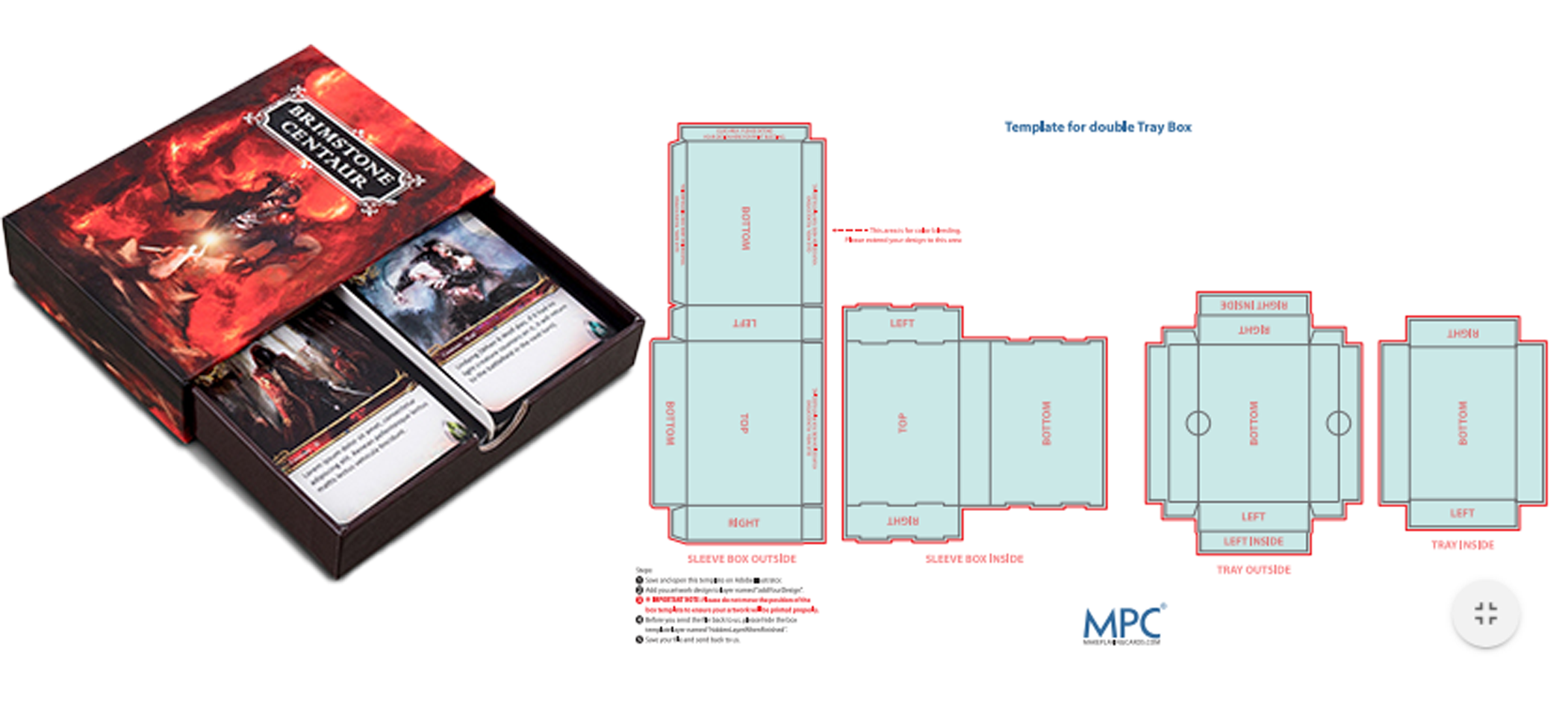
Jan 2020:  After researching a few Kickstarter suppliers, I came across an outfit called MakePlayingCards. Customer Service is responsive; and their print quality and materials are excellent. Templates are clear and easy to use, like this one for the double-deck tray box.

box

I went with this style box, to have two opposing factions in one package as a starter set. The bad news is the freaking box is $20 all on its own. Based on that, plus the two decks and a rule book, the price was going to be out of hand for single purchases. Anybody running a shop could buy a handful and keep their costs down; but I definitely still need to work out some more affordable options.

Up next is to set up the marketplace and make the game available as both a starter set and individual decks with their own customized tuck boxes.

Stay in touch, guys! We’re going to finish this up, then get out a short story collection and horror novel this year. That’s the plan. Then the sequel SALT MYSTIC book can start, supplemented with an expansion of this game entailing an excursion into the massive Augur Temple and its mysterious terraces of artificial space pockets.

It’s going to be fun!

Dreams are engines. Be fuel.


Ever Wonder What Black Sabbath’s ‘Iron Man’ Is About?

steel man

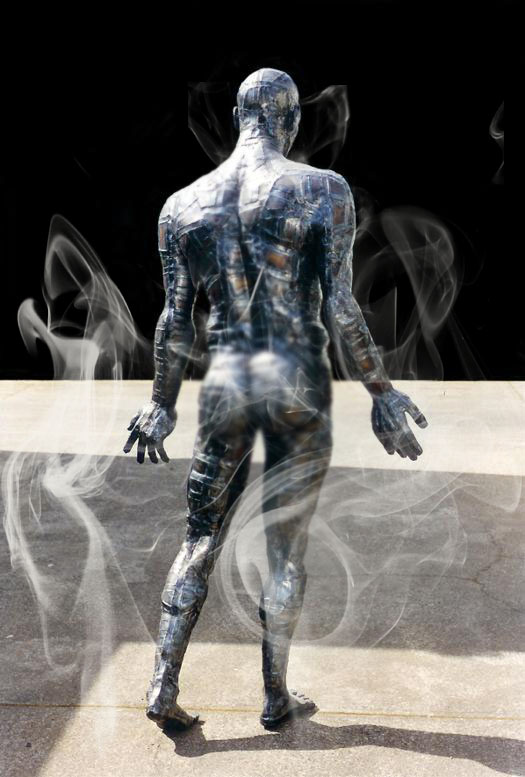
An eerily detailed statue of a metal man shining on the street of a bustling future city, the neon lights and hovercars reflecting across its corroding surface. His face seems to be screaming, his eyes wide in horror. It’s frightening if you stand directly in front, so most people passing by step to the side or lean on its back to take pictures of themselves.

They pretend to kiss its lips and scratch their names upon it. They call it filthy names. And they mock it as a joke. It’s funny and somehow comforting to do so because when you’re near the metal man, there is always a certain feeling you may or not be able to ignore. There’s the sense, somehow, that he’s trying to warn you of something.

You’ll talk to people who swear that’s not a statue at all. They tell the same story because they’ve sensed it there in the plaza with the pigeons fluttering about, as the metal man looked on. They’ll tell you this was a traveler, a mortal man. But this was a man with powerful psychic abilities like no one in history. This traveler had the power to move through time and space with no vessel.

He pushed himself once, to his limits, to go far into the future and maybe see what becomes of us all. Maybe he expected great towers or shining cities or paradises with rockets.

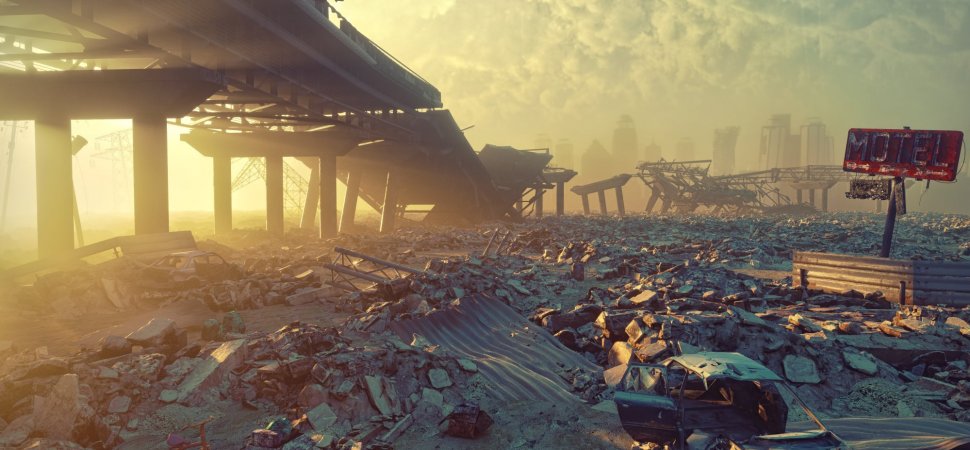
But what he found was apocalypse: smoke and craters and rotting corpses. The cities lay in ruins.

In his horror and disappointment, this traveler returned in tears to warn the people of what he’d seen. But of course, things went terribly wrong with him. Space and time are vast and largely unknown; and there are costs to breaking their rules. An inexplicable field through which he sailed transmuted the very cells of his body into metal, imprisoning and paralyzing him. And here he stands, helpless to pass on a warning anyone will believe.

There is, of course, more to the story that only a very few of the most psychic-sensitives can tell you there in the plaza in the shadow of the silent metal man.

He’s gone entirely insane.

His thoughts are growing louder, more incoherent. He’s screaming inside there, with his terrible and mighty mind. The apocalypse he saw, that no one would believe even if they could sense his warning of it…this apocalypse that laid ruin to the world…

He’s going to cause it.

getty_624678524_361747

I’m supposing you’ve heard the Black Sabbath song, ‘Iron Man’. You should google it if not. Geezer Butler wrote the lyrics that told the story above. I fleshed it out a bit; but the skeleton of it all is there.

Here, read this. That’s an article laying out the inside story. Apparently, Tony Iommi banged out a riff on his guitar. Ozzy loved it and said it sounded “like an iron bloke walking around’. Geezer’s job was bass guitar and lyrics, so he knocked out something that struck his fancy. And here we are with one of the greatest rock songs of all time.

I just found this out recently. Thought it was awesome. Sometimes, you find amazing stories buried in something very, very familiar. There are science fiction lovers out there everywhere, involved in all sorts of things…dreamers, of our tribe.

And they’re making cool things for us.