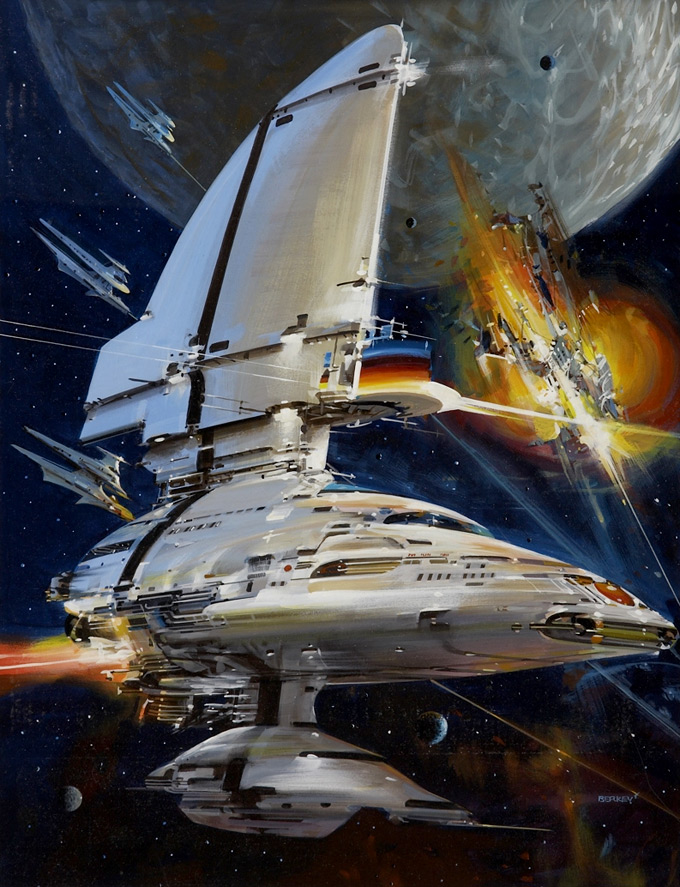
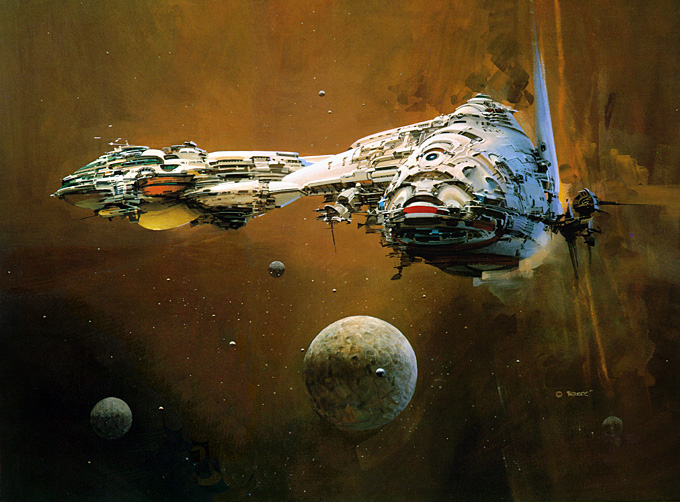
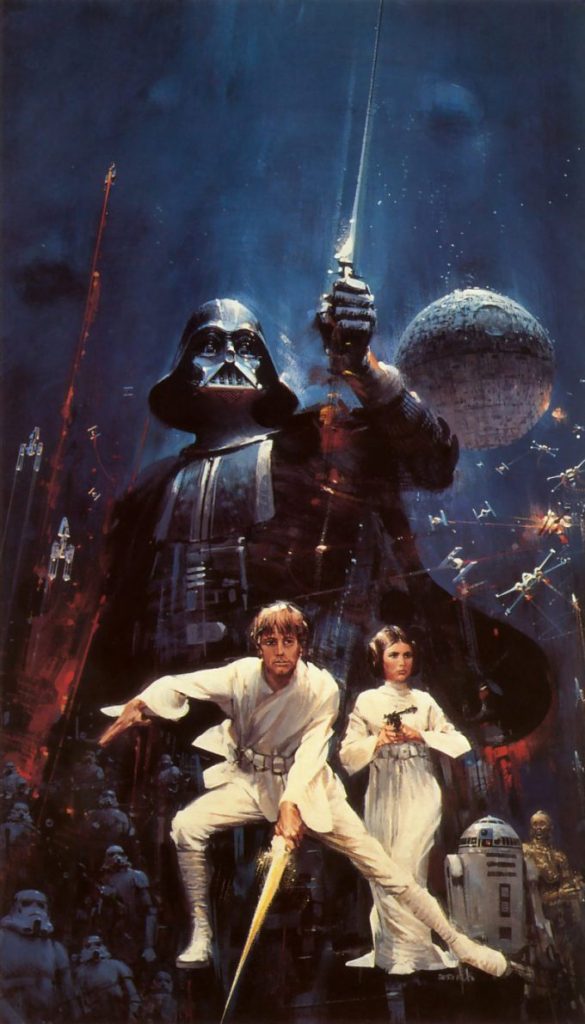
John Berkey was an earth-shattering genius painter of science fiction images. I love everything I’ve ever seen from him. And it isn’t stretching the truth to say that if you view space ships as sleek, aerodynamic vehicles with white plating, that can be traced in many ways right back to him.
Seriously.
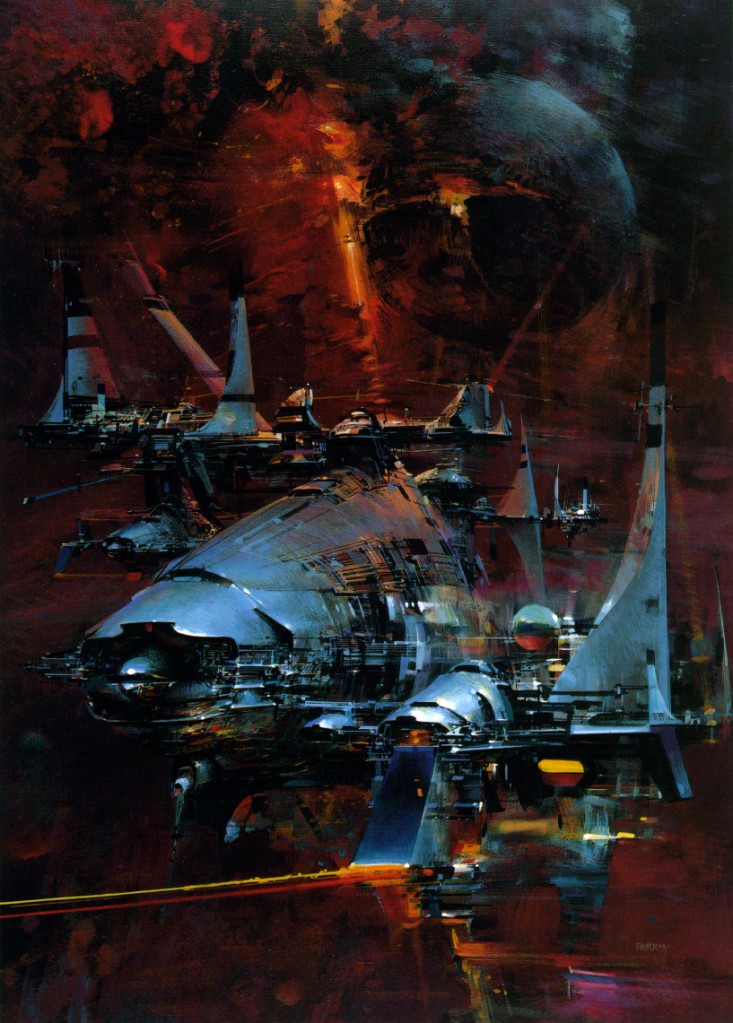
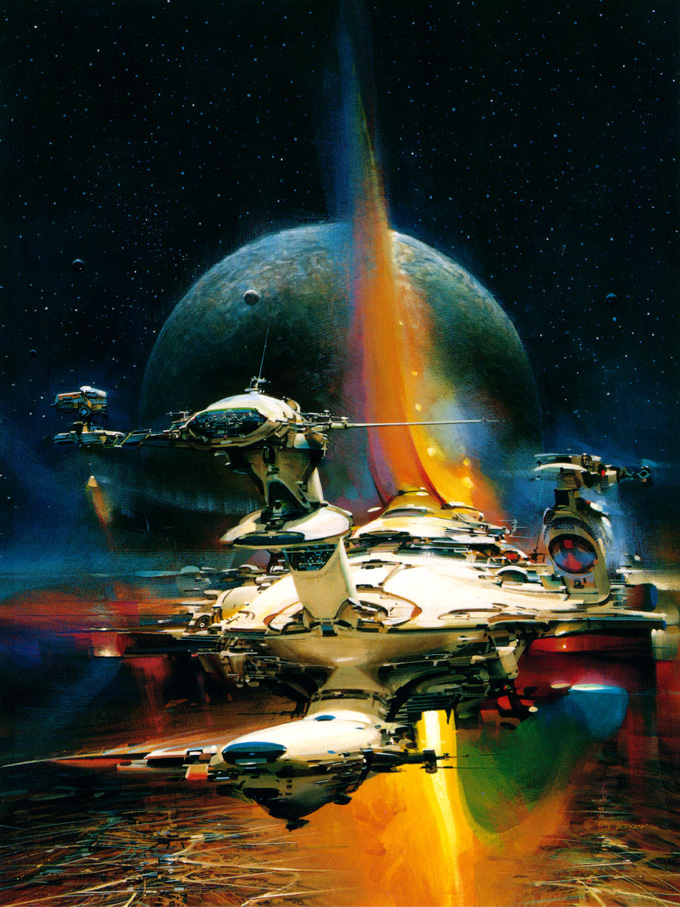
He did these, for example:
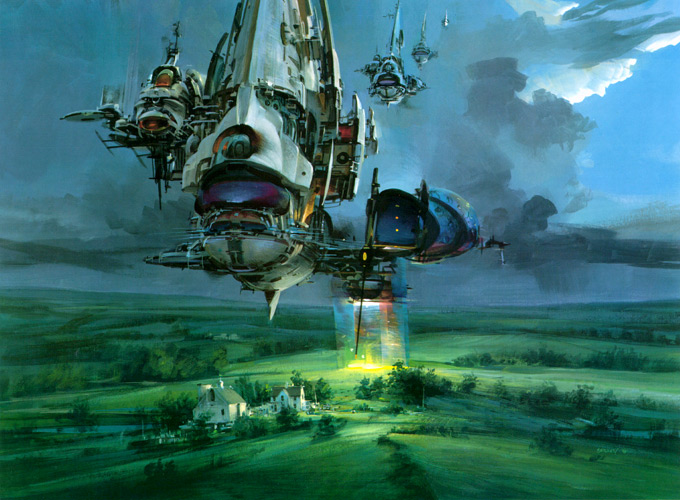
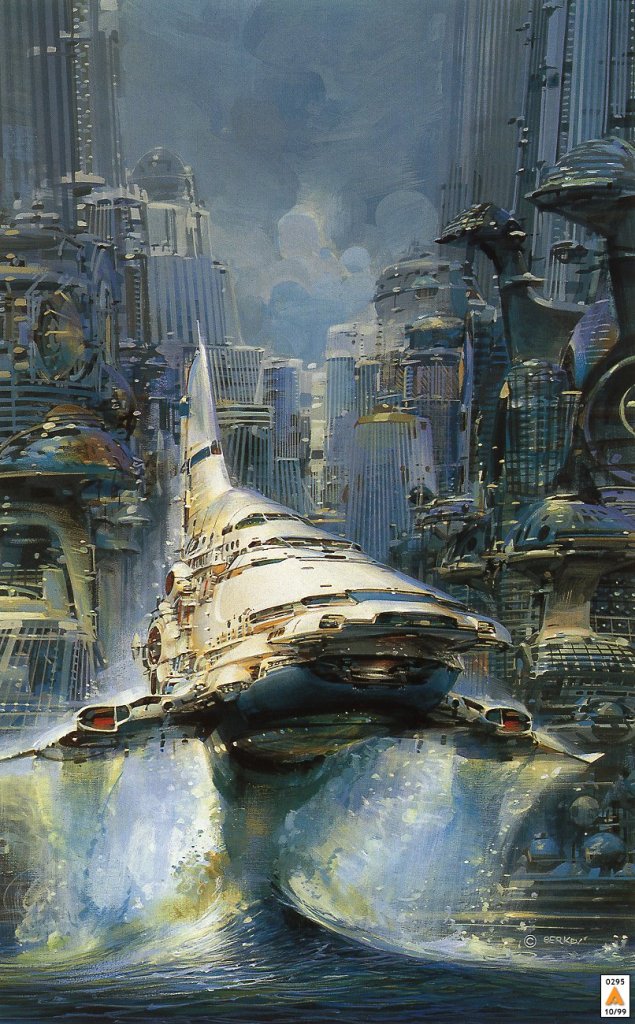
My first introduction to him way back in the day was this masterwork below, which inspired the mile-high vortex cruiser hydrofoils in the Salt Mystic universe. Just look at this beast:
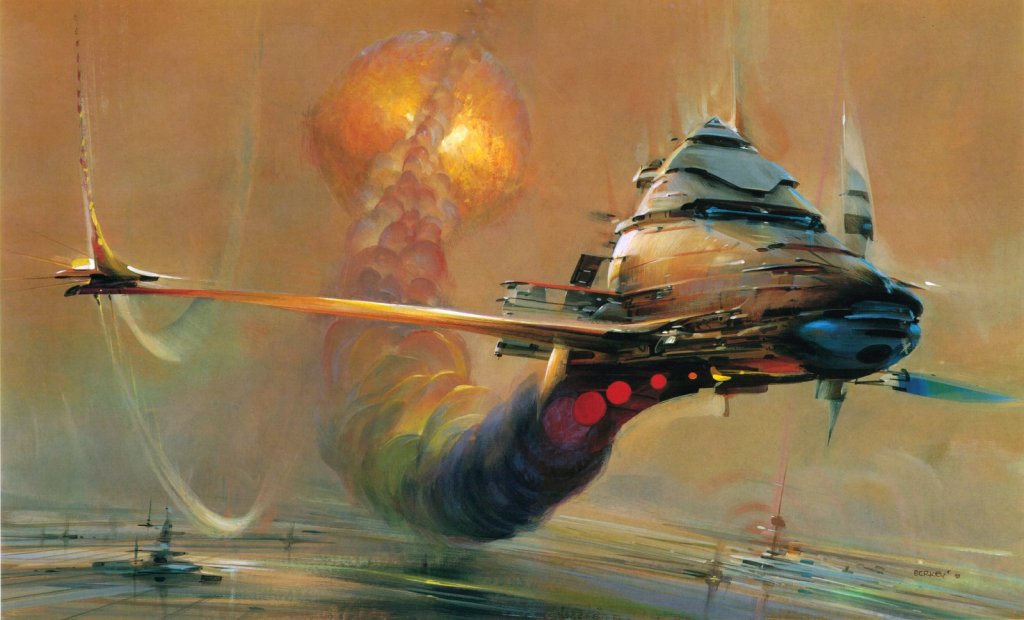
And, of course, he did this one too, which some of you may remember:
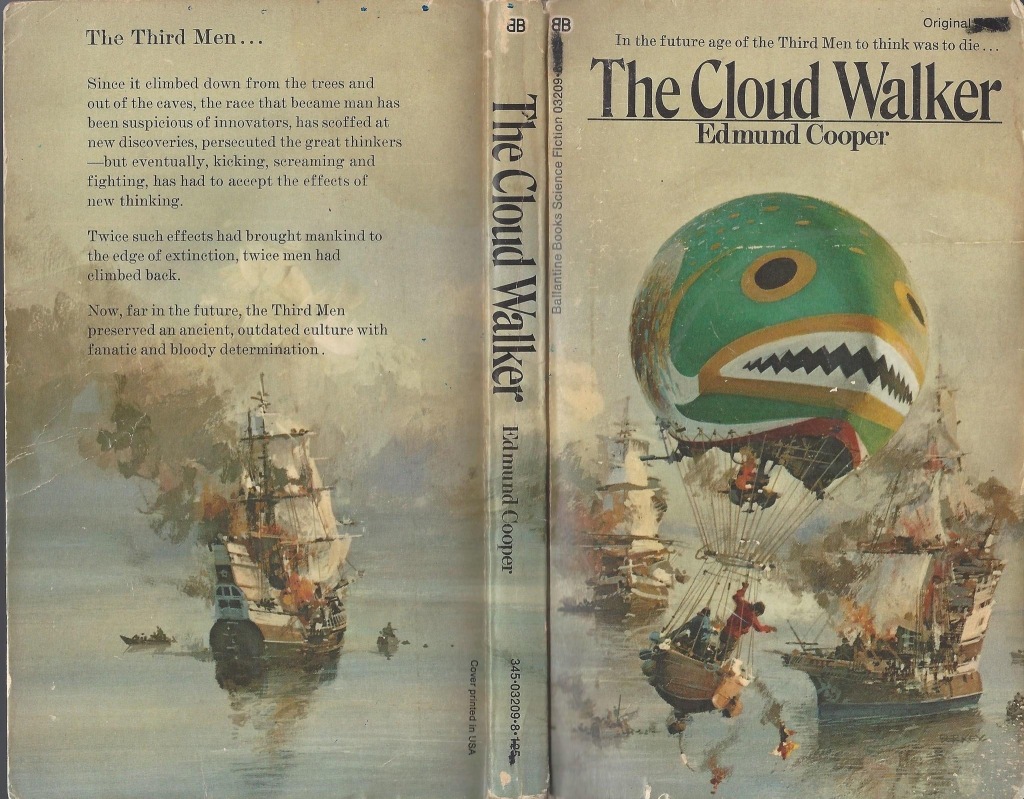
So why am I on again about John Berkey? Well, more than once I’ve seen this haunting, fascinating book cover drift across my social media feed or appear on a used bookstore shelf:
I’d never heard of Edmund Cooper, and it didn’t have space ships or a hook in the back cover text that sealed the deal, so I passed it by multiple times. I’m not that much into humanity turning away from machines because of some uprising or difficulties, like Dune’s Butlerian Jihad or Walter Miller’s A Canticle For Leibowitz. I didn’t really care who the “third men” were, or to read what I imagined would be monotonous pages with religious torch-bearing zealots yammering on in mobs to some plucky machine-builder about how evil computers could be or whatever.
Apologies if that’s your thing, I’m just a bit worn out on those tropes and don’t find them interesting. So I moved on.
But that image though.
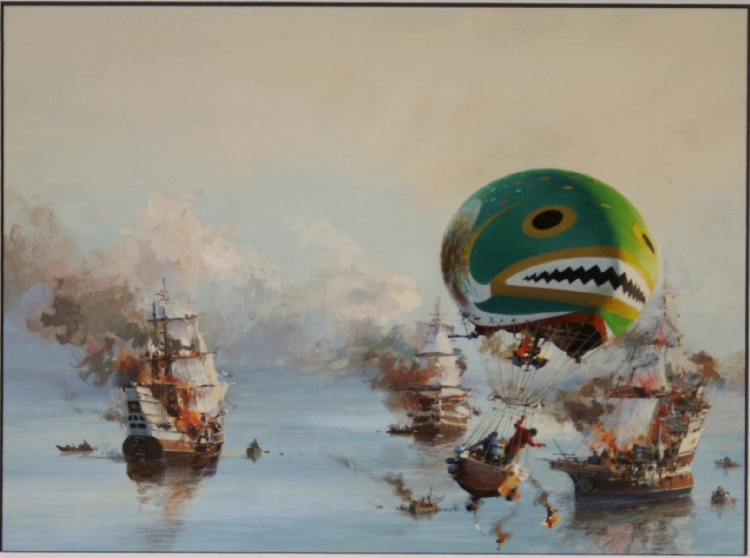
What in the world was the deal with that crazy face emblazoned on the balloon?! I love a naval battle too. Maybe, I thought, after considering Berkey’s fascinating cover art so many times, I should read this book just to settle some questions about what he was painting.
And I’ll cut to the bottom line for you: The Cloud Walker is an easy read, with some mild, pleasant twists on the story you expect to play out here based on the cover description:
The setting is mostly the small town of Arundel in what had once been the county of West Sussex in England after two world wars have decimated the population and turned society against technology in all its forms. The protagonist, Kieron, dreams of building a flying machine, even though he knows what the Luddite priests can do to him if he’s caught. There’s an interesting love triangle, with some mild surprises in how that turns out, and a massive shift in the plot at one point – relating to a pirate invasion, and which ultimately leads to the battle portrayed in Berkey’s marvelous image.
I imagine if you’re a regular reader, you can knock this one out in a couple of days. It was a great experience for me, primarily for one key reason which honestly inspired me to write this article in the first place:
Cooper’s writing style.
C. S. Lewis’ Chronicles Of NarniaL. Frank Baum’s Oz Series
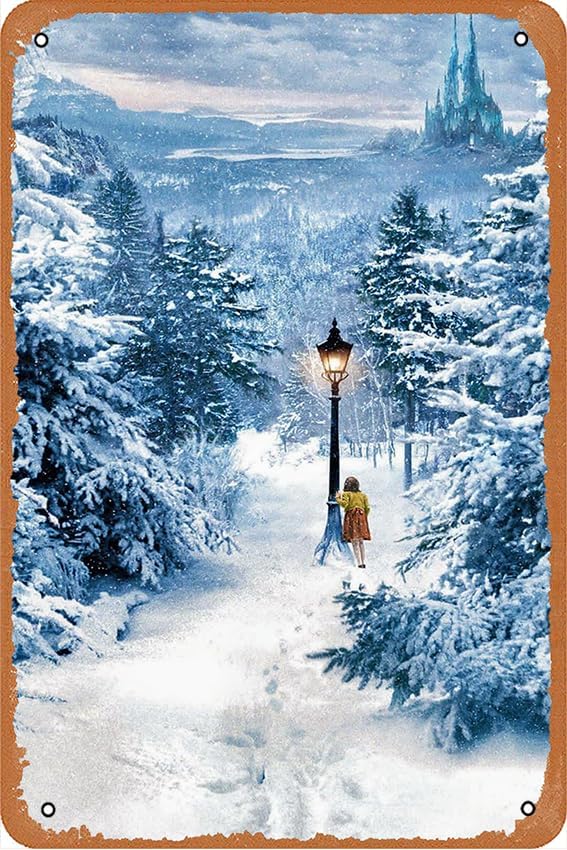
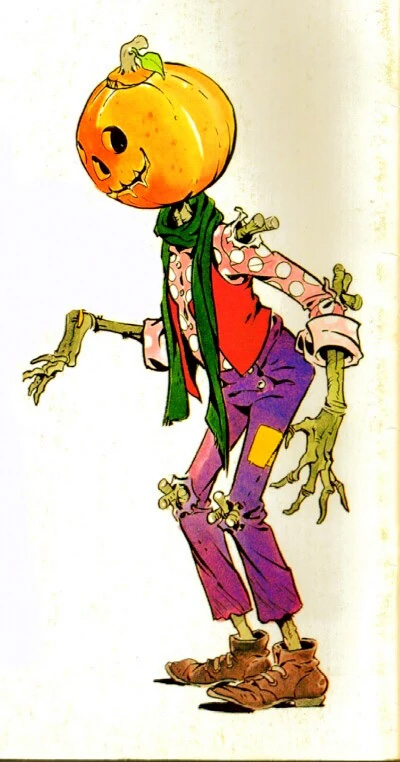
There is a style of storytelling often used in fables and myths that is charming, easily relatable, and that focuses on things common to us all like family, fear of the unknown, betrayal, and friendship. Read any of the Narnia books by C. S. Lewis or the Oz books by L. Frank Baum and enjoy a master class in what I’m talking about here. It’s in the word choice, the easy manner of painting images with words, and the awe and wonder of fantastic beasts and places like you’re sitting by a fire listening to it. Lewis and Baum knew what they were doing.
Cooper isn’t in their league; it just struck me that I was several chapters in before I knew it and sinking wonderfully deeper into his rural landscape, getting to know Kieron and his family, the two ladies, and just why he wanted to take to the air in the first place.
I won’t spoil anything here, but I feel Cooper stuck the landing on the ending (pun intended, you’re welcome).
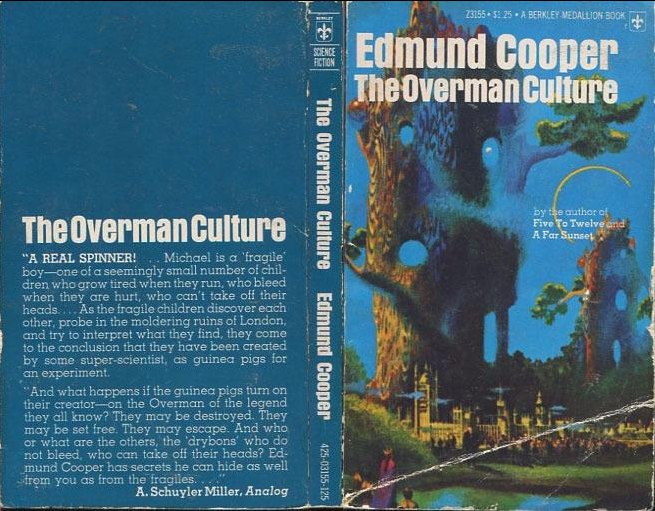
Anyway, I liked it so much I tried another one by Cooper, called The Overman Culture.
Honestly, I hated it. It was the same narrative style, just a meandering and plain mystery box story with some juvenile personal interactions and nowhere near enough happening to keep your interest. I doubt I’ll try Cooper again, though The Cloud Walker will remain with me.
Pick it up sometime if you get the chance. It feels like a comforting fable, and maybe we need more stories like that.
Assuming there is an afterlife, and that I get to hug three people of my choosing for just how wonderful they were and how much they impacted me, I’m thinking (today at least, the list changes):
Honorable mention to Nicholas of Myra since he was Santa Claus.
Let’s talk about Stan Lee for a minute, and the miraculous collaborative technique he popularized, in many ways pioneered in comics writing called “The Marvel Method”.
The stories Stan used to tell of the old days of Marvel are truly fascinating and inspiring. His mom got him the job with a cousin (it was Timely Comics then). Pretty much all the adults quit or didn’t care and were never around the office, leaving him as a teenager who knew nothing about the business pretending everything was fine.
All manner of folks apparently went on business as usual with the in’s and out’s of the office, never really knowing the kid that was always in was the one basically running everything. As he matured in the business, and couldn’t keep up with the many writing responsibilities, he relied on what came to be called “The Marvel Method”, meaning he would provide an outline or maybe just an idea to the artists, and they would go nuts from there, expanding the basic plot thread into intricate panels of story without words.
Stan would take what they sent, whatever they sent, and add the dialogue and narration, riffing off what they had provided since he only knew the basics of the story. With geniuses like Steve Ditko and Jack Kirby to work with, he made magic.
Here’s what you might have seen, for example, sent in by John Buscema:
We’ve stated our position on generative AI tools here at Grailrunner before. Bottom line, although many occupations are threatened by this rapidly evolving technology, it isn’t going away. In fact, it’s a new industrial revolution. We believe tools like Stable Diffusion and ChatGPT have a place in the world, but see them more like stock image websites or reference or idea books.
Like George Lucas did back in the day with Ralph McQuarrie’s mind-expanding images, the art and the ideas can dance together and make beautiful new worlds.
What’s that got to do with Stan Lee?
There’s a new experimental generative AI program called AI Comic Factory hosted on huggingface here. Looks like this:
You select the style and layout, then enter a prompt. When you hit the Generate button, it lays out a set of comic panels based on your choices and entry that are impressive.
While I have no intention of packaging these up for our Salt Mystic line, it really is fun to describe some of the elements of our IP and see what looks like a Humanoids comic illustrated by Phil Gemenez pop up in a few seconds with interesting graphic elements that inspire more ideas to pursue.
Look at these to see what I mean. My prompts were variations of cowboys entering dimensional portals, stone golems (glowing or otherwise), beautiful fantasy cities and majestic airships, that sort of thing. All very much in line with Salt Mystic adventuring.
I’m drooling at this. It’s incredible how inspiring this can be! When I’m looking for descriptions for a character now, or costumes (which I hate describing), or an interesting perspective for a city, I can go back to these and dream.
Recently, I started playing with Actions in Photoshop to turn images to pen & ink drawings with the click of a button. I have a very nice gallery of ball lightning carbines now to drop in to whatever I’m working on. For the header image, I grabbed one of those, color matched and graded it after compositing it in. I cut it off to fit the panel so it would look like it belonged.
Then I grabbed a cartoon dialogue bubble from a Google search and used Comic Sans font in Photoshop to add the gunslinger’s words. Not sure what he’s pissed about, or who in that city is going to pay for it, but it sends my mind reeling.
Anyway, that’s what I wanted to suggest to you today. If you’re going to try it out, don’t forget to be respectful of the artists who worked on the images that trained tools like these, but don’t be afraid to collaboratively build something new with them either.
One of the most exciting things we do around here at Grailrunner is introduce new bits of the lore of our Salt Mystic setting in the form of Lore Cards. A fusion of art and short fiction, it’s an important mechanism for us to introduce and test these mini-expansions of concepts that will wind up ultimately as game cards or in the books or stories.
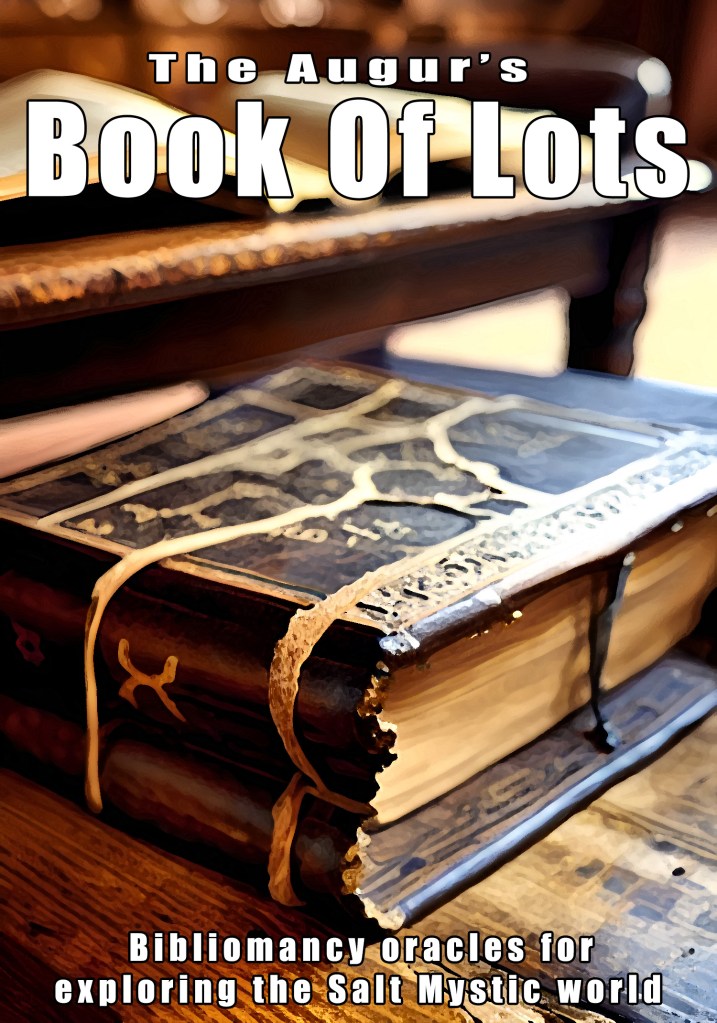
A product we have heavily active in development right now is a bibliomancy-based oracle book for roleplaying in the Salt Mystic universe to be called The Augur’s Book Of Lots.
In order to bring that to life, all manner of new encounter types, new places, and historical figures and their stories are needed. It’s an incredible, life-changing experience for me personally to explore all that and watch it unfold like a big, crazy flower, and I can’t wait for you to see it. Seriously, this whole world is building itself and waiting for you to slide a ball lightning carbine on your arm and take a cautious step through the gates…
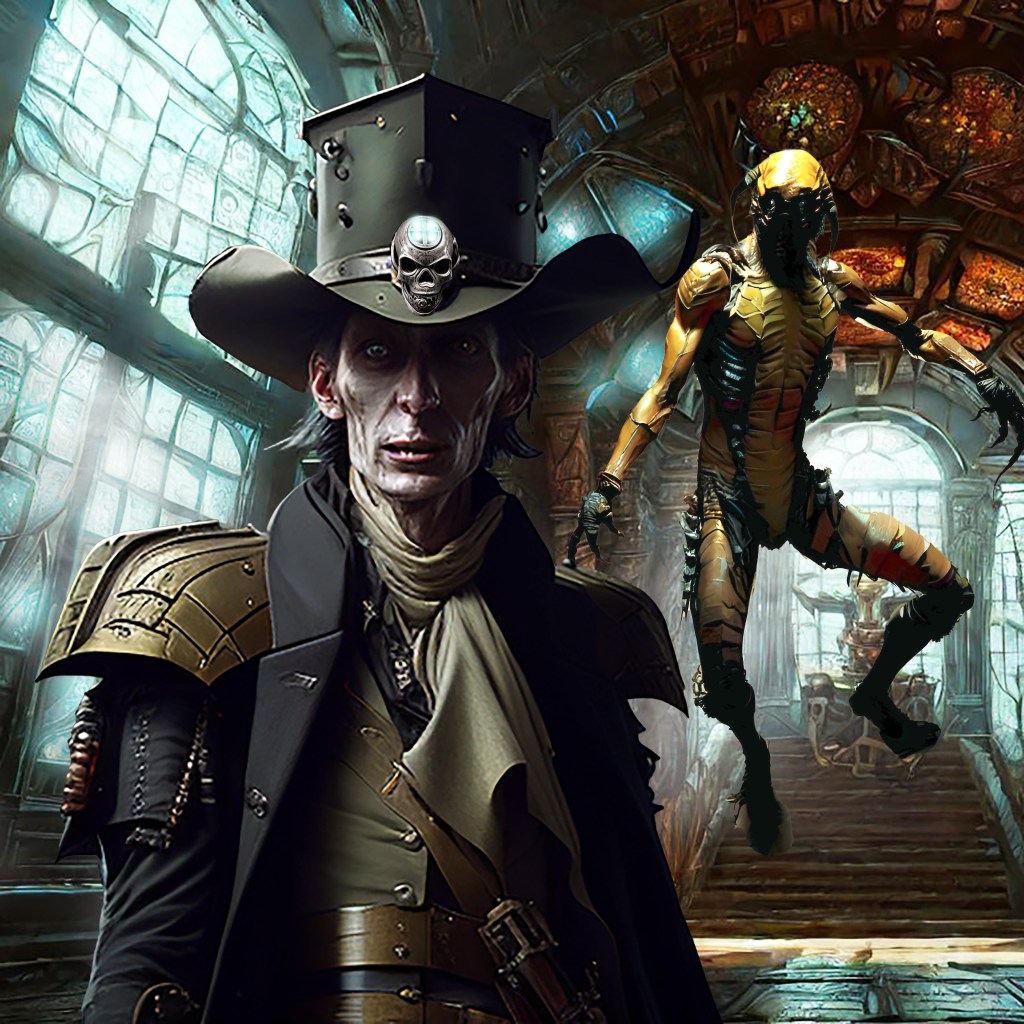
Today, we thought we’d introduce you to a new exciting, and sometimes terrifying, addition to the world of the Salt Mystic: the chimera.
The sneaky fellow leaping on our hapless narrator today is part man / part scorpion. In the oracle book so far, we’ve met countless hybrids like this already, though this particular combination freaks me out the most.
As for the art, as always it’s a paintbash with the heavy lifting done in Photoshop. In this case, the bounty hunter, the skull on his hat, the backdrop, and the scorpion-man were all drawn from various iterations of Stable Diffusion or Wonder, with heavy correction and repair. I discovered the ‘puppet warp’ in Photoshop, which is my new favorite trick!
After compositing them together and color grading everything, I added some Stock nebulosity overlays from Nucly to make the diffuse smoke around the windows, blending them in Screen mode. The positioning of the scorpion-man was tricky – it made more sense for him to be creeping around behind our clueless bounty hunter, but the more I looked at him in mid-air, the creepier and more interesting I found it to be.
I wanted the skull on the bounty hunter’s hat to glow, so that along with the window glow was just some soft brush painting in Color Dodge blend mode.
Anyway, we hope you like the final product. Let us know what you think, and please check back periodically for updates on the stuff we’ve got cooking.
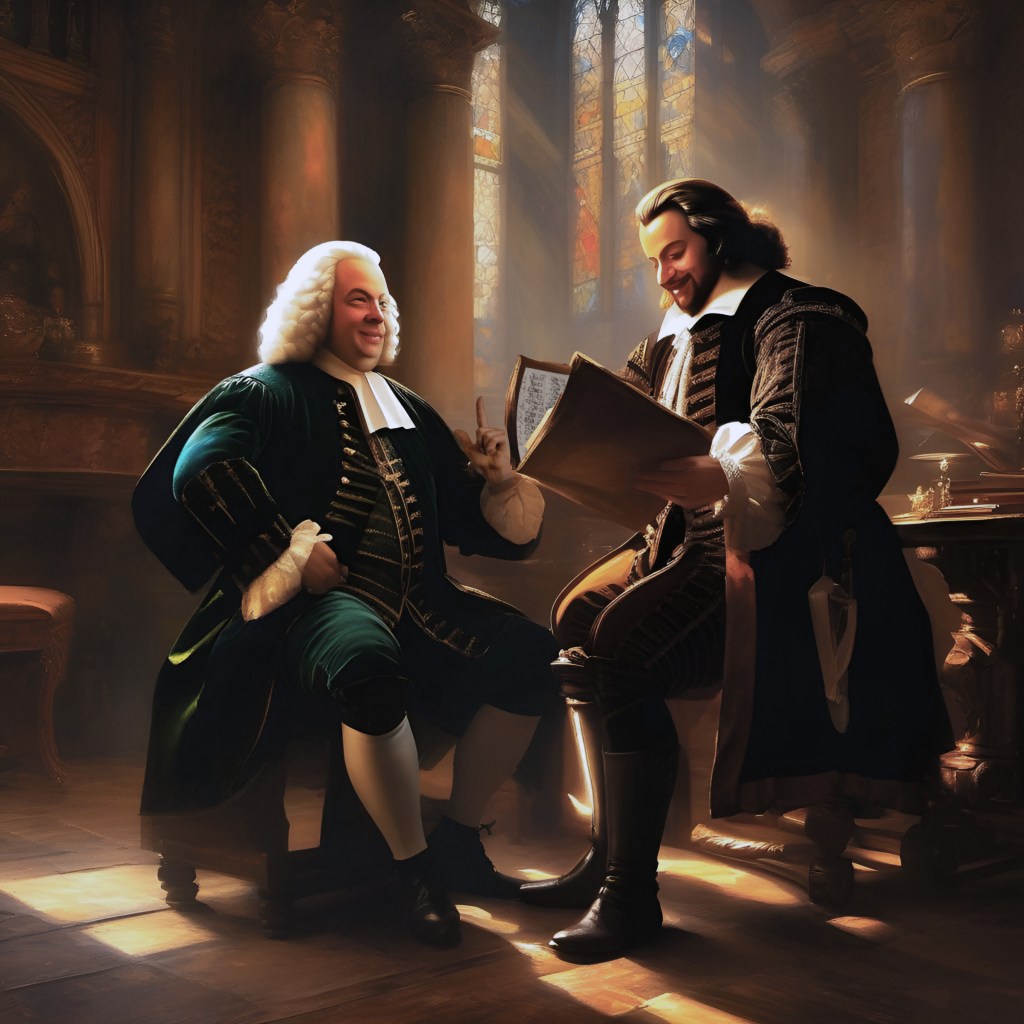
Bach never met Shakespeare. Sorry about the clickbait title. Stick around though, because as always with this site we’re probing the creative process and what inspires it. In the past few weeks I’ve personally been going down a deep well with Johann Sebastian Bach, father of western music, and how his mind worked. I’m finding useful lessons there that I thought you might find helpful if you’re a creator yourself. Special focus here is on writing, hence the Shakespeare reference.
And you don’t have to know a thing in the world about music.
Bach composed music primarily for Sunday church services and often wrote the music for existing hymns or verses written by someone else. It was an aesthetic puzzle for him to solve, and sometimes a difficult one. Certain notes clash with one another and can sound harsh. We (somehow) almost universally feel kind of sad with certain notes and sequences and kind of happy with others. We (again, somehow) expect certain notes to show up after others or else it feels weird and lacking closure. For whatever reason, western ears generally agree on quite a bit about how musical notes should string together into music. Strange, but true.
Bach knew his craft well, understood these basic principles and expectations, and steered his listeners like a sailing ship by leveraging them in his works. He didn’t settle for just solving these aesthetic puzzles but broke every rule and went to places with his imagination that suited his own dazzling, soaring intellect in the process. That helped lay the foundations for western music as we know it today.
I noticed the more I read about Bach’s compositional tactics that those who were analyzing the music would very often say things along the lines of “you expect this, but he does that”. Once you get your head around these fundamental expectations I’m talking about above, it gets a bit clearer what Bach was doing, and what it can mean for a writer or creator in different fields than his.
Here’s an example: Jesu, Joy of Man’s Desiring. This (in my opinion) is one of the most beautiful pieces of music ever written. Bach fit this masterpiece on top of some stanzas written over 60 years earlier by a minister and musician named Martin Janus in 1661. It opens with Bach’s melody, followed by the first phrase of Janus’ chorale, then shortly thereafter the 2nd phrases of both works coincide flawlessly. The freedom with which he went gonzo with his own melody yet managed to fit without seams over the hymn is my point.
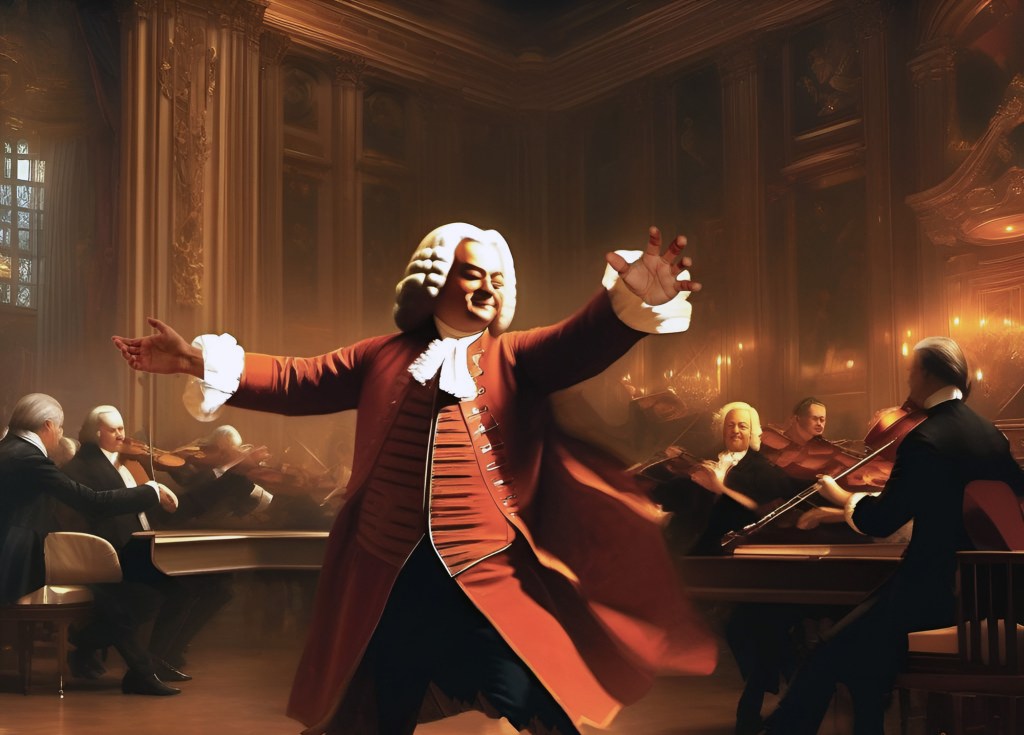
Bach was dancing.
Another example is particularly moving and gets to the heart of the spirituality and emotions that moved him when he was composing.
Sleepers Awake, a Voice Is Calling: An obscure 16th century pastor named Philipp Nicolai had just taken the job in the town of Unna when plague struck and killed half its people. His parsonage overlooked the cemetery. Suffering deeply, yet wishing to record his meditations to encourage the survivors, Nicolai wrote a collection he called “Mirror of Joy” which emphasized shining your own light in expectation of great things, not terrible ones. Bach built his own work on top of Nicolai’s hymn in a masterclass of weaving musical compositions.
In his piece, Bach presents his new melody entirely, then repeats the first three phrases (with 2nd and 3rd swapped) but with Nicolai’s melody in the choral part underneath. Again, separately they sound nothing alike, yet together they are flawless. At one point, Bach’s melody repeats its first phrase over Nicolai’s phrase that does not.
Did you catch that?
Bach wrote something that can repeat its melody and match perfectly in two different places on another melody. In this perfect weave, he was also weaving Nicolai’s times and his own – for Bach’s audience too was being encouraged to shine their own lights into a world that needed hope.
Last example, and another gorgeous one:
Air from the 2nd movement of Bach’s Orchestral Suite No. 3 in D Major. Click the link and listen to the incredibly talented Evangelina Mascardi (who has said she spent up to 6 months at a time learning Bach’s songs). You can stop after the first half when she pauses and moves on to ‘Gavotte’ to see my point here.
Listen closely for the melody – you’ll catch it right away. It’s really beautiful and poignant. People tend to describe this as, not sad…not happy…but something rather that reminds them of happy times, good memories, good friends. Keep listening though. You want him to repeat it. He doesn’t, not exactly. He adds all manner of embellishments and hesitations and dances around the melody he knows you want to hear again.
He gives you what you want, but embroiders it.
So what’s all this got to do with writing?
Recently, I came across a thorough article describing 49 effects possible in literature. At the time I first read it, I was just starting to examine Bach’s approach to composition and his freedom to innovate with tuning, different instruments, and other elements. I was seeing him play with his listener’s expectations, creating tension and dissonance and delaying resolution till it suited his dramatic purposes.
And I was seeing the same possibilities in this list of literary effects, such as pathos, irony, comedy, and others. Readers most certainly have common expectations and tropes, which can be similarly placed in opposition to each other. Bach mastered the elements of his craft and innovated wildly, though always staying in close view of what he knew were his listener’s expectations of resolution.
Maybe some principles apply here:
Consider your characters and their dynamics. Anticipate the readers’ expectations and play with that. Don’t shortcut and focus on “subverting”, which is obnoxious and unpleasant.
Innovate, but stay in view of the compelling engine driving the story…the central character dynamics. Don’t mess that up in your desire to make the plot happen.
Break the attention barrier with something energetic and wild. Bach’s church audience was rude, reading papers, talking loudly, ogling women, endlessly walking in late and leaving early. He demanded their attention with his craft. We should do the same.
Know the elements of your own craft. Be a professional – no obvious mistakes with grammar or plot holes, terrible dialogue or vague character motivations. It breaks the magic.
Feel it. Bach felt it in his soul. He was talking to God. If we’re going to try and make something new for the world, at least we could try and feel it as we do so.
Anyway, I hoped you enjoyed a layman’s take on Bach. Impressive genius, even if you don’t really understand all the nuances of what he was doing.
If you need to know a bit more about what we’re doing with Salt Mystic, feel free to check this out here.
In the Salt Mystic Sourcebook And Core Rules, we define seven different ages into which the long history of this setting is divided. The brief snapshots there allowed us to drop maddening hints of some intriguing twists and adventures that occurred thousands of years ago, but we never really get the chance to dig in to those earlier time periods. Maybe one day these will all be their own novel series or art lines – but for now, we’re in the Guardian Age, man. It’s enough work bringing that to glorious life!
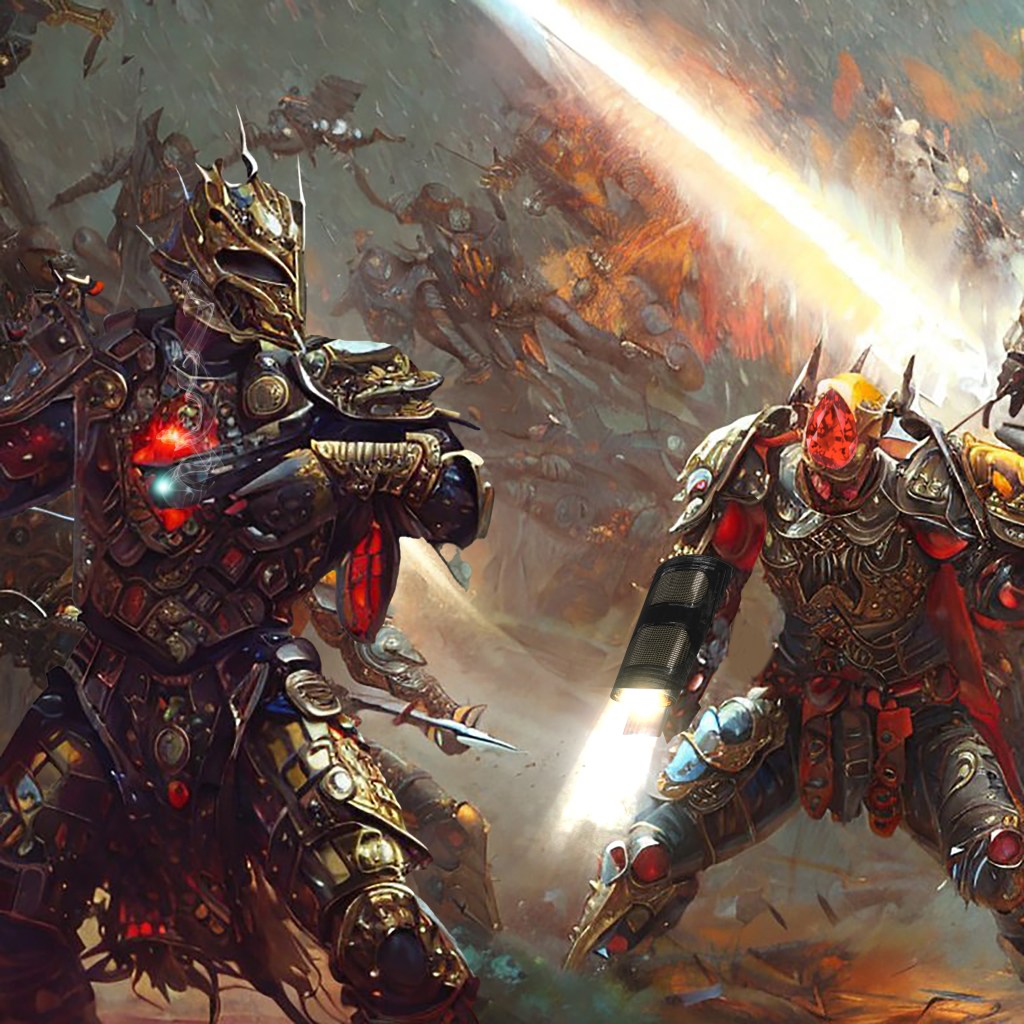
So this new lore card was a chance to flesh something out that I thought was interesting. There’s already a guy named Murmur in the Salt Flats character cards that has an Artificial Intelligence sprite inhabiting his armor that we’ve always thought was funny. This lore card was where we go big with that.
Horrifyingly big.
As for the art, as always it’s a photobash and paintover of some different elements pulled from a few sources. The background is an AI-generated image of a battlefield. The warriors’ jeweled armor was inspired by Grant Morrison’s 18 Days art book (which accompanied the web series), based on the storyline of the Mahabharata. The carbine was built in Blender as a 3d model, textured with a steel plating from Textures.com. The ruby faceplate of the guy turning on his general was taken from a freely available png – literally just googled “ruby gemstone” or something like that.
I especially love the way the smokey flames turned out, spewing from that fellow’s gauntlet-based plasma weapon. There are at least three overlays on that, all from Nucly. I wanted it to seem like he’s firing that weapon up, and his general has just now realized that he’s stepped over some kind of line.
Anyway, we hope you like the art piece and accompanying flavor text. Let us know what you think.
You likely know if you’ve been here at Grailrunner before that we obsess over the creative process. In fact, the whole point of the company, this site, and essentially anything we’ve produced is to dissect, pick apart, rewire, engineer, and shove ammo clips into the imagination. It’s in the logo, man.
Dreams are engines. Be fuel.
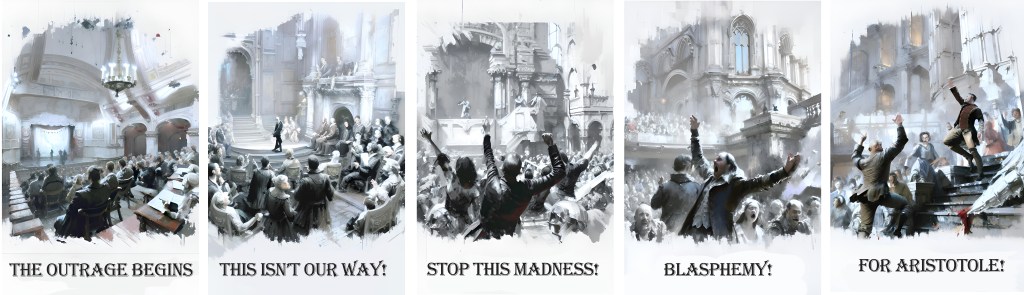
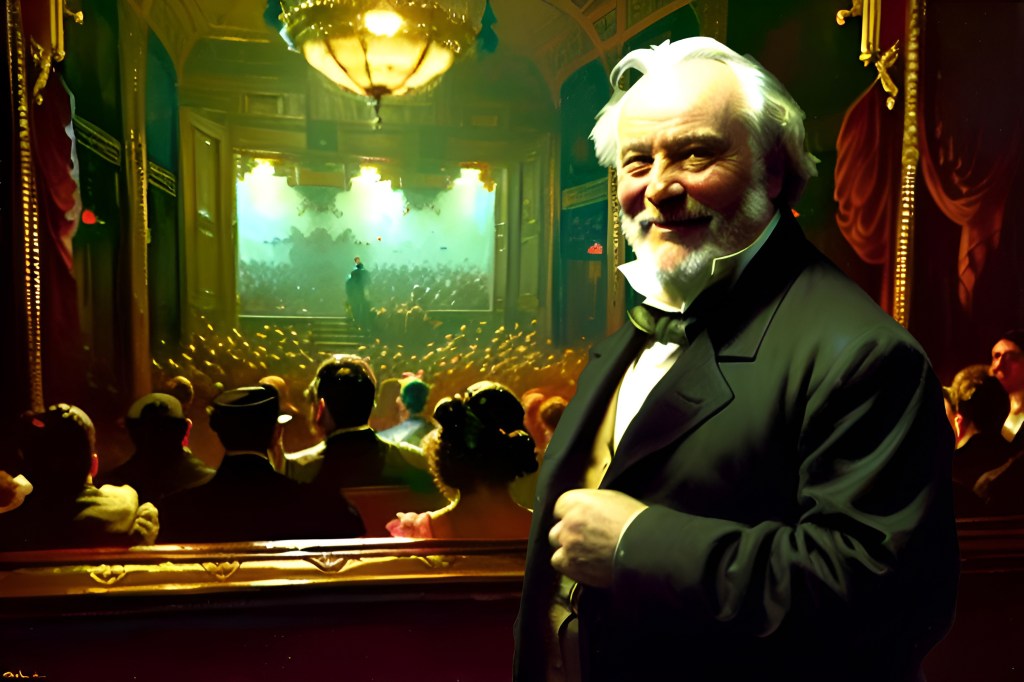
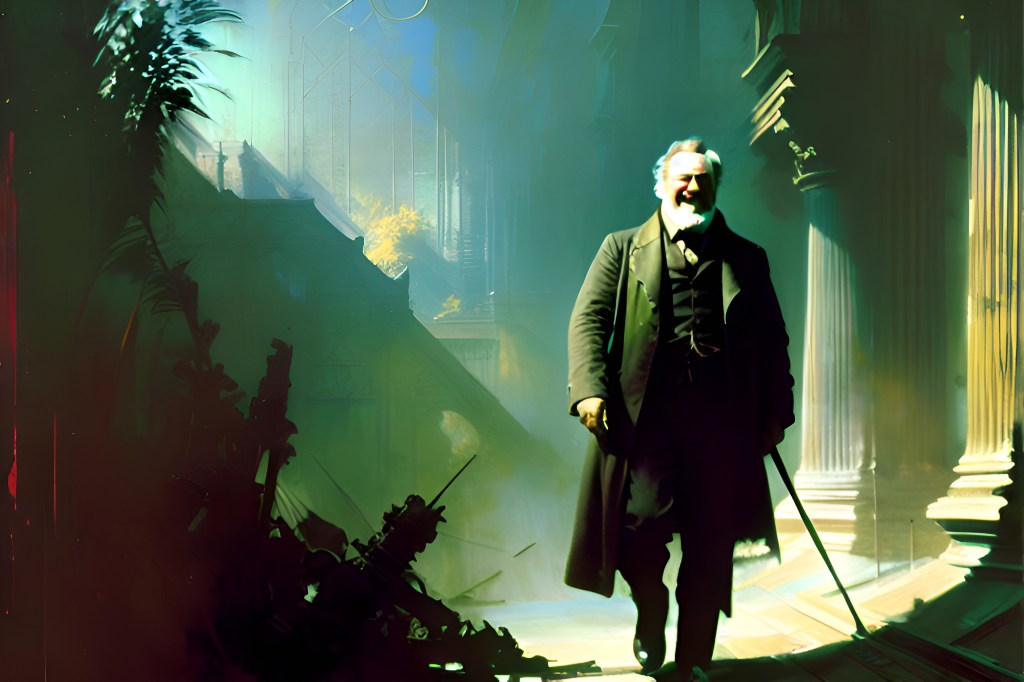
Anyway, there was an interesting riot at a theater on February 25, 1830 in Paris that has a few things to teach us about how to break ground in creative work. And as creators right now, with the looming and worldshaking onset of AI disrupting every outlet of creative work and threatening that age-old security we were all told that computers can’t create, it’s more important than ever that we get really, really good at doing new things.
New things, man. New things. Now AI can’t really do that.
What is the context on this Hernani thing?
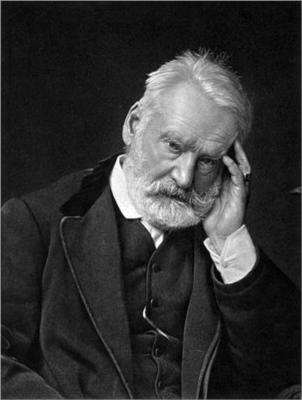
Victor Hugo wrote Les Miserables and the Hunchback Of Notre Dame. That’s where you might know him from.
This guy:
He was a playwright too though, and in his day the structure and content and expectations of plays were widely agreed and rigid. You didn’t mess around with these things if you wanted to be treated seriously and not look like a disrespectful clown. After all, Aristotle analyzed storytelling in tragic drama at an almost divine level 2,000 years before in his Poetics and designed the perfect tragedy, defining the unities:
Unity of time: the action of the play must unfold over a single day
Unity of place: the action must take place in a single setting
Unity of action: the play should comprise only one plot
If you abided by these principles with your play, which was the norm for hundreds of years in Europe, then Aristotle’s intense study of impact and memorability and propriety assured you that you had a well-constructed play. Why deviate from that – you think you know better than Aristotle?
Another non-negotiable was the clear definition of genre: comedy or tragedy. More than just branding, this was crucial to the audience’s interpretation of your work. Is it supposed to be funny, and so pratfalls and misunderstandings and goofy idiots abound? Or is it supposed to be sad, and so have larger-than-life people make key mistakes based on their natures and lose it all?
And finally, you didn’t show things that were grotesque, things that were compulsively ugly or distorted. It was just improper and undignified.
Oh no, what did Victor do?
Well, he wrote this. It’s the preface to a play called Cromwell. It pissed a lot of people off and set the stage for the riots to come later. A few tastes of his blasphemy:
“But the age of the epic draws near its end. Like the society that it represents, this form of poetry wears itself out revolving upon itself. Rome reproduces Greece, Virgil copies Homer, and, as if to make a becoming end, epic poetry expires in the last parturition. It was time. Another era is about to begin, for the world and for poetry.”
“…the grotesque is one of the supreme beauties of the drama.“
“‘But,’ the customs-officers of thought will cry, ‘great geniuses have submitted to these rules which you spurn!’ Unfortunately, yes. But what would those admirable men have done if they had been left to themselves? At all events they did not accept your chains without a struggle.”
Victor was saying that the unities of time and place arbitrarily handicapped the dramatic potential. Check pages 15 and 16 for his blast on unity of place – it being silly to think so much important action would happen in this one spot, and what blah-blah is needed to tell the audience what’s going on elsewhere! He continues on pages 16 and 17 destroying unity of time – it being equal nonsense to expect important events all to happen in a day.
And wow, is that one something Hollywood sequel writers should read!
In summary, he felt the rigid genre conventions of comedy and tragedy were limiting his ability to express wide ranges of emotion and experience, the unities were unnecessary constraints that forced silly adjustments, and, most importantly, he didn’t care for the convention of avoiding the grotesque. He called for a new genre to explore the essentials of life, with beauty and ugliness, good guys and monsters, gold-laid parlors and miserable alleys.
“These rules, man! They’re cramping my style!”
What was Hernani then?
Well, Cromwell was too big in scope to even be staged. It’s 400 pages long and at one point needs the British parliament to enter the stage. His next attempt got banned. Then he wrote Hernani, which censors possibly felt was too ridiculous to bother with.
Plot? Two noblemen and a mysterious bandit are in love with the same woman. A conspiracy is in play, and things get dark ending with a wedding and poison.
Rules broken? Well, the story unfolds over 6 months at various settings. That was naughty of him. You weren’t supposed to show death, violence, or intimate scenes. Hernani opens in the lady’s bedroom and closes with three suicides. Equally naughty. You were supposed to adhere strictly to your chosen genre: comedy or tragedy, but he incorporated farcical dialogue and had a king hiding in a wardrobe. Language should have been clean and high-minded, but he included lines like:
“Is this the stable where you keep the broomstick you ride at night?”
You weren’t supposed to let your lines of a sentence from one line of verse to another, but that happened too. Characters were supposed to be one-note caricatures generally who didn’t change, to represent some trait or concept, though he fleshed them out far more than was typical and allowed transformations (such as Don Carlos becoming a good emperor). And he used stage directions like a madman, which was also strange.
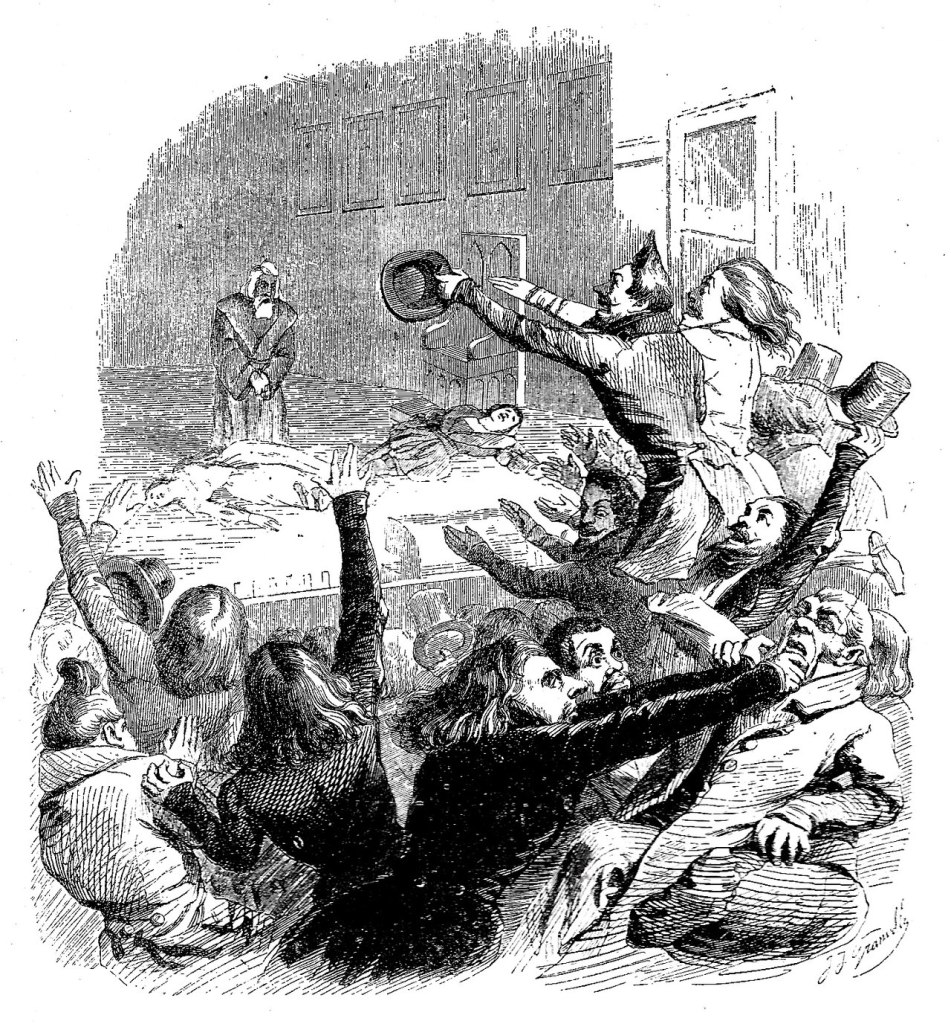
So this happened:
Why was there a riot though?
These Parisians had been through revolutions and guillotines, deaths and restorations of kings, and were reading on a daily basis about massive changes in nations such as Italy and Germany where entire systems of government were being born while others faded. France was still in turmoil politically and censorship was a powerful tool to shut down free thinkers and radicals. Breaking rules in art was linked to breaking other rules, perhaps those tied to abiding by norms set by those in charge.
Today in a politically split country we might feel threatened by those who question gender norms or who bend traditional family structures because we fear what a loss of those foundations might mean for the country’s future, what impact it might have on our children. You see how mad everybody gets about that every day on Twitter. Here in Paris, it was perhaps as scary for them.
In fact, many of those same rioters a few months later in July ousted King Charles X and replaced him with “Citizen King” Louis-Philippe.
Why is this a big deal?
My point today is that it was risky and insightful for Victor Hugo to see these literary conventions as the limiting factors they were and to dare to break them. And when he broke them, it wasn’t for shock value as so many charlatans today offer instead of talent. Victor didn’t break the rules because he was a renegade, he felt they limited his storytelling.
He kept his eye on the point behind what he was doing: telling an impactful story. Maybe Hernani’s plot is nonsense, but that wasn’t what he wanted anybody to take away from it anyway. Read the Cromwell preface. He wanted a new genre free of limits.
Impressive. Impressive to even notice the limits. How many conventions do we abide by and not even notice. Are our prison walls invisible?
What does this have to do with AI ?
AI writing tools like ChatGPT are not going away. They’re seeping into our marketing copy, our kids’ essays, blog and social media posts, even podcast scripts. As creators, there is one important fact behind any AI-based technology like these which can be an asset for us. They are trained on data sets and those data sets include conventions and limitations like those Victor Hugo raged against.
Ask ChatGPT to write you a story about King Arthur or a D&D scenario and it’s painfully generic. We as creators are in an arms race then, as those tools get better. We have to get better.
Lucian Of Samosota’s True History…I can’t believe I waited this long to read this incredible story! I’ve read it twice now, and I’ll probably read it again. You just need to know about this if you are at all into astounding works of the imagination or gonzo science fantasy. For my part, I’m endlessly fascinated by the creative process, particularly when great creators stretch themselves to build what Stephen King has called a “gosh-a-mighty steam shovel of the imagination” – a paraphrase from an old introduction to the Dark Tower.
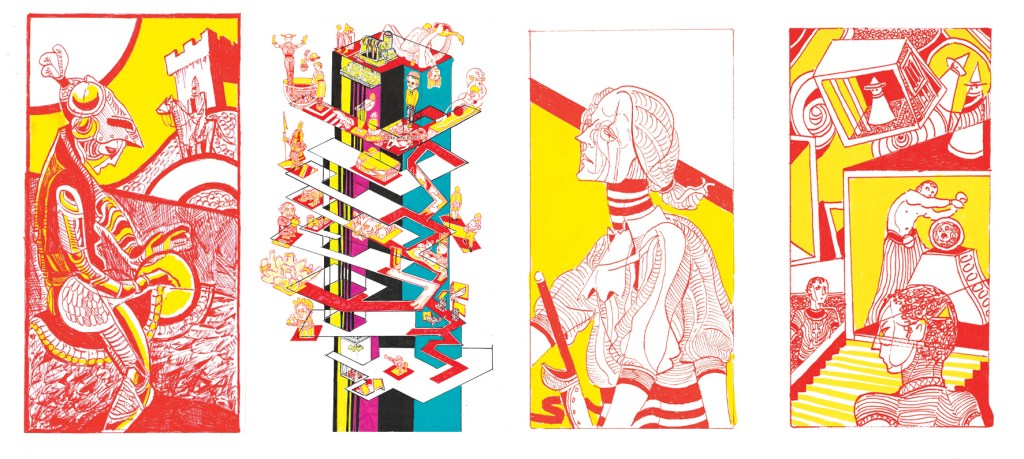
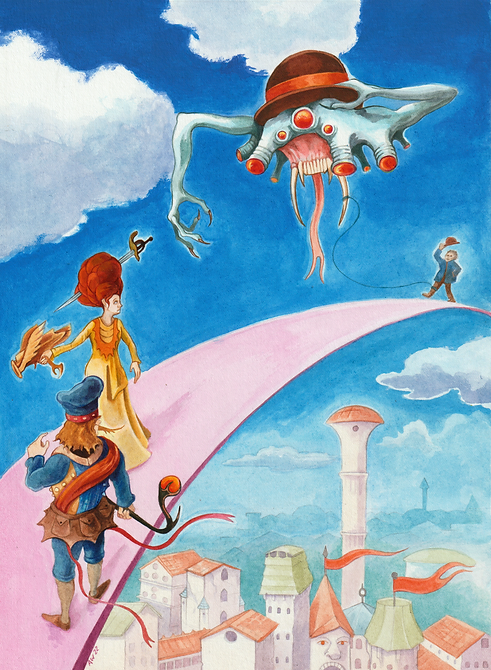
You may know we recently interviewed Daniel Sell of the Melsonian Arts Council, writer and designer behind the Troika roleplaying game. His mind is wired like this too, and in Troika, you might encounter among the crystal spheres a ‘Befouler Of Ponds’ worshipper of the toad church, a gremlin catcher, or a thinking engine with detachable hands that can pilot a golden planar barge.
We’ve also hosted Jeff Grubb, creator of D&D’s Spelljammer, which is another mind-expanding launch into the sort of audacious, rulebreaking idea-festival I’m talking about. Spelljammer was recently revived by Wizards Of The Coast but was first born in the early, heady days of TSR. Check that link to read up on where Jeff dreamed up some of that and how it all came about. I’m just smiling thinking about all that.
But where did science fiction…or science fantasy to be more accurate…come from in the first place? Who was the first guy to put something down that we might recognize as bearing the tropes of space travel, cosmic battles, extraterrestrials, and even robots? And if we can know that, can we also ask what the heck he was thinking that led him down that creative trail?
It was Lucian. Crazy Lucian. He did all of that, and he did it in the 2nd century AD while there was still a Roman Empire.
And what he wrote, in that one cosmos-spanning epic, could seamlessly melt into a Spelljammer or Troika game session or sci fi anime even today. It’s the sort of story where you find a ponderous idea in every paragraph, an impressionist painting in words but with a compelling odyssey. It’s called the True History.
You could almost forget he was joking around when he wrote it. Here’s what he said about you, his future reader:
“It would be appropriate recreation for them if they were to take up the sort of reading that, instead of affording just pure amusement based on wit and humour, also boasts a little food for thought that the Muses would not altogether spurn; and I think they will consider the present work something of the kind. They will find it enticing not only for the novelty of its subject, for the humor of its plan and because I tell all kinds of lies in a plausible and specious way, but also because everything in my story is a more or less comical parody of one or another of the poets, historians and philosophers of old, who have written much that smacks of miracles and fables.
“I would cite them by name, were it not that you yourself will recognise them from your reading. One of them is Ctesias, son of Ctesiochus, of Cnidos, who wrote a great deal about India and its characteristics that he had never seen himself nor heard from anyone else with a reputation for truthfulness. Iambulus also wrote much that was strange about the countries in the great sea: he made up a falsehood that is patent to everybody, but wrote a story that is not uninteresting for all that. Many others, with the same intent, have written about imaginary travels and journeys of theirs, telling of huge beasts, cruel men and strange ways of living.
“Well, on reading all these authors, I did not find much fault with them for their lying, as I saw that this was already a common practice even among men who profess philosophy. I did wonder, though, that they thought that they could write untruths and not get caught at it. Therefore, as I myself, thanks to my vanity, was eager to hand something down to posterity, that I might not be the only one excluded from the privileges of poetic license, and as I had nothing true to tell, not having had any adventures of significance, I took to lying. But my lying is far more honest than theirs, for though I tell the truth in nothing else, I shall at least be truthful in saying that I am a liar. I think I can escape the censure of the world by my own admission that I am not telling a word of truth. Be it understood, then, that I am writing about things which I have neither seen nor had to do with nor learned from others–which, in fact, do not exist at all and, in the nature of things, cannot exist.” -Lucian in his Introduction to the True History
Bear with me here for a synopsis, though it’s a rollercoaster ride like you can’t imagine.
Lucian and his companions set sail through the Pillars Of Hercules, encountering every manner of wonder along the way. Blown off course to an island with a river of wine, they encounter (and barely escape) chimera ladies who are part woman/part grapevine and who transform hapless sailors into vines alongside them should they get overly intimate.
No sooner than leaving that island, a rogue whirlwind whisks them up to the moon where they have arrived in the middle of an interplanetary war between the king of the moon and the king of the sun, fighting over colonization of the planet, Venus. We see hybrid lifeforms and spaceships, giant spiders spinning webs across planets, and entire fleets mobilized in a vivacious, colorful battle that is absolutely mesmerizing. For about 3 pages before he moves on to something else.
Incredible.
The solar fleet wins the battle by blocking out the light of the sun from the moon, winning their surrender. In the truce, mutual colonization is allowed with a tribute to be paid.
After a short tour of the planets and civilization out there, the sailors return to the sea on earth and quickly are swallowed by a 200 mile long whale. I want to make sure you caught that – this isn’t a Jonah and the whale story; it’s 200 miles long and has entire societies living inside it.
Of course, they wage another war, this one of conquest, and eventually have to escape the enormous whale by killing it. In the sea and among the islands (or sailing through the air), they meet everything from giant talking vegetables to talking trees to floating islands to a giant gulf in the ocean itself.
In the climax of the True History, the sailors make it to the Greek/Roman idea of heaven. It’s an island where the heroes of myth and the great philosophers and poets reside. He asks Homer all manner of questions and learns his own future. Of course there is another battle here, this one with zombies.
Not kidding here…zombies. The undead rise from their pits and wage war with the great heroes. It’s just a page or two; blink and you miss it. But it’s there.
And I need to prepare you for the ending. Remember, Lucian was joking. He was messing around, satirizing people who exaggerated their travel tales, and going as boldly and absurdly as his mind could take him.
At the very end, he…
Well, maybe you should read it for yourself to see what happens. Do that here for free.
If you do, read his Life Of Demonax and Alexander The Oracle Monger as well. Both amazing.
Grailrunner is excited to announce the latest addition to our growing Salt Mystic Lore Card set: a mood-setting, rousing vignette titled “Canyon Of Living And Dying”. Download it for free here.
Welcome to the Grailrunner Story Arcade!
Salt Mystic is our rapidly growing western science fiction setting, upon which we’re building everything from novels to games and merchandise. You can learn more about that here. Key to this innovative new way of exploring immersive storytelling is the idea of worldbuilding through a collision of art and fiction. Sometimes the art comes first, then a story is built around it. Sometimes, a story idea percolates and only starts popping after an image is crafted for it.
However it happens, we’re building out locations and settings, characters and background lore, all through experiments and inspirations that often get shared for free on social media and here on the Grailrunner site. The hope is that those of us out there who dream of adventure and exploration, of new worlds and intriguing concepts, we’ll all find a home here! And that you’ll buy books and stuff.
Definitely buy the books and stuff.
The Story Arcade is also a place for people playing the Salt Mystic tabletop wargame to find interesting settings for the battlefields they play upon. That’s where this week’s addition was born, actually.
What was the inspiration for this?
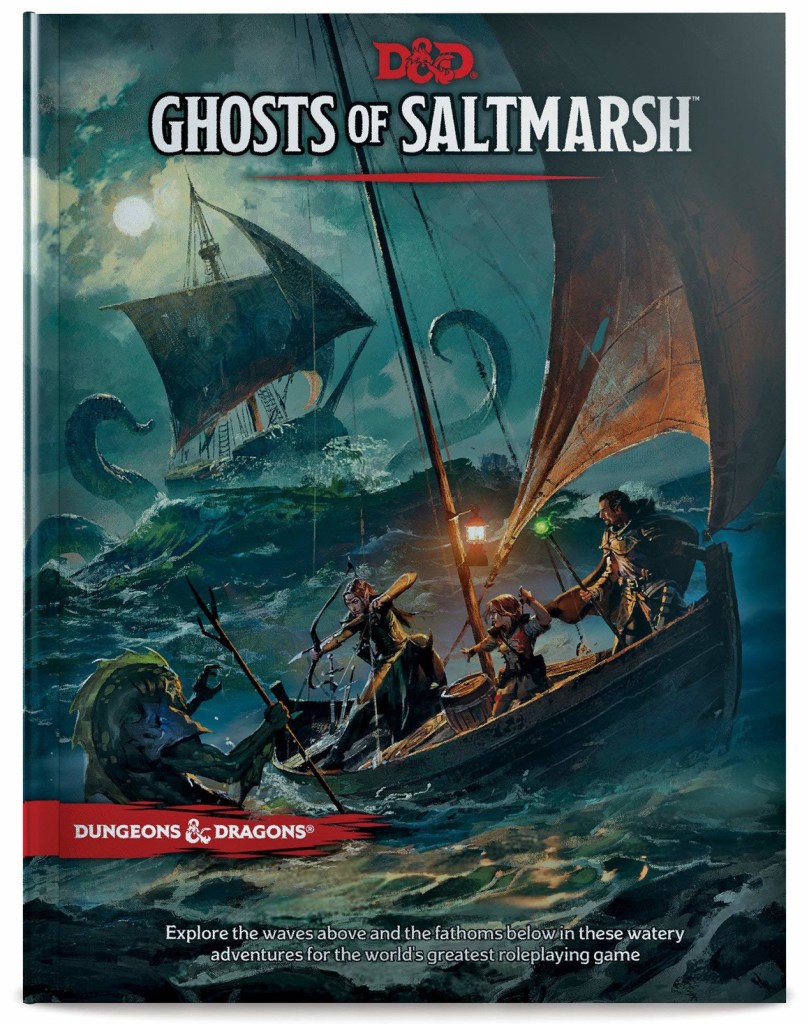
Writing this article here, I was reminded of a really well designed dungeon adventure that appeared in a Wizards Of The Coast compilation titled Ghosts Of Saltmarsh.
Spoiler alert – there is a point in this adventure where the very dungeon setting itself (a ship) starts sinking and flooding. The dungeon destroys itself, and you have to get your characters out or drown. And to me, that’s incandescent genius! I became enamored with the idea of a battlefield setting for the Salt Mystic game where the battlefield floods or sinks or catches fire or otherwise starts snuffing out characters not fast enough to survive.
Generally, I haven’t solved how to convert that to a Salt Mystic terrain book yet. Maybe one day. But one of the ideas that didn’t pan out as I thought about it was a high canyon where the battle was to be fought on crumbling rock walls. I imagined a giant stone golem at the base throwing boulders up at the armies and snatching random people away. It sounded cool, but game rules and art to make that work just didn’t click for me.
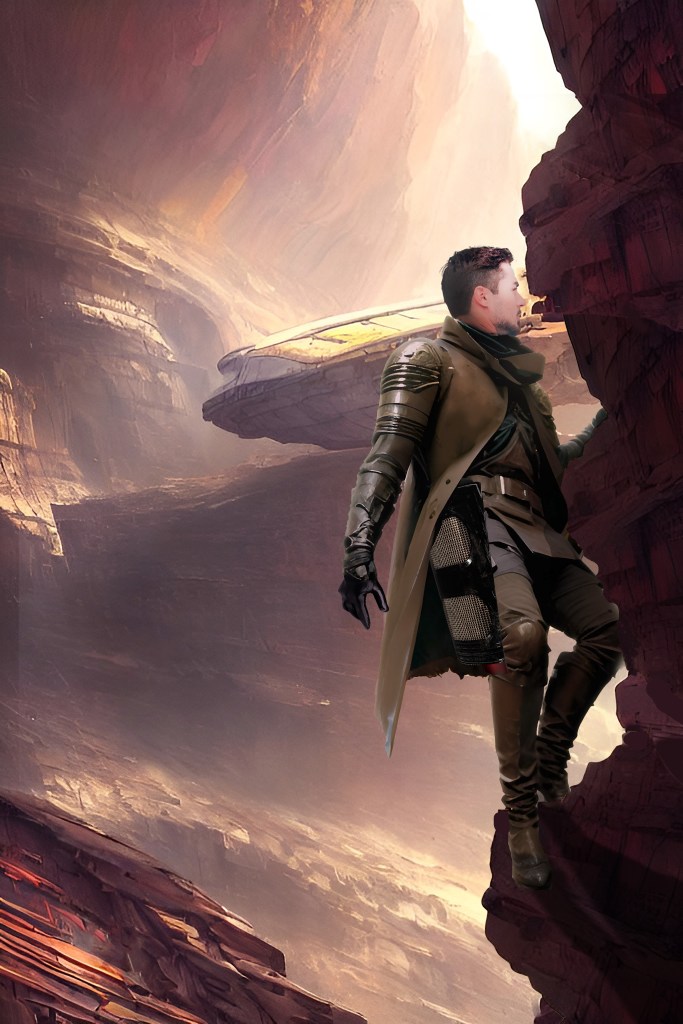
This image is what came of all that. I had the picture of a carbine gunslinger nervously clinging to a high rock wall with a derelict in the mist behind him, precariously perched in an inaccessible place.
What was the process to create the image?
Like most of the imagery I produce, this is a photobash of several elements composited together in Photoshop and painted over. The carbine weapon strapped to his hip is something I generated in Blender, but re-textured recently. The climber is a composite of two AI-generated elements and a handful of stock images, run through a filter in Photoshop and color and light graded to match. The background is a composite of two AI-generated landscapes from two different pieces of software, and I used two overlays from Nucly for lighting effects.
What about the story?
I rewrote that three times, trying to give it a western feel. The idea is a dude from a rinky-dink town in the middle of nowhere deciding that the fear of climbing up there is not as strong as his need to really live, to maybe make a name for himself. Or maybe to solve the mystery of what’s inside that derelict.
In the story, he says “to live is to burn”. I totally stole that from Harlan Ellison, who said he stole it from an Egyptian papyrus. Whoever said it first, it’s awesome.
*
Anyway, I hope you enjoy the new Lore Card. Shoot me a comment or note if you’d care to chat it up about Salt Mystic or where we’re going with all this.
If you’ve never heard of the Troika! roleplaying game, I have a real Scooby snack for you today! As part of our Inspirational Creator Series of interviews, we’ve met with artists, writers, and game designers who break exciting new ground in innovation and imagination.
Today, we’re thrilled to bring you some insights and musings from Daniel Sell, who is not only Director of the Melsonian Arts Council game publishing company, but is also one of its most talented and mind-expanding creators! Just to whet your appetite a bit on that, let’s quote their mission statement:
The Melsonian Arts Council exists to publish table top adventure and role-playing game books unlike anything the medium has on offer. To that end we help artists and writers on the bloodied edge of their craft produce beautiful books while helping readers discover this wide, bright world of independent games they never thought possible.
Come on! That’s awesome, right?! Anyway, welcome back to Grailrunner’s Inspirational Creator Series!
Daniel, you’ve said that you run the Melsonian Arts Council as a way to write games without having anyone tell you what to do while you do it. That’s quotable, just so you know, and maybe tells us a bit about your personality. The fresh and innovative approach you and your team are taking with works like Acid Death Fantasy, The Big Squirm, and Troika! are an inspiring breath of clean air in an industry that gets a little hung up on armored dwarves, dragons, and license restrictions.
Thanks for making time for us!
I’m always happy to talk about myself.
Q. Beyond the obvious fact that you have to make games people will buy, what sorts of projects inspire you the most? Is it the game mechanics, the subject matter, the twist on expectations…what makes you smile when you think about spending that kind of effort and time on making a new game?
The thing that sets me on fire is a project that is relentlessly sincere. A major problem with roleplaying game books is that they’re almost always products before they’re anything else, which sends sincerity right out the window. I want books to rip off the mask of best practices and boring choices and let us see what you really wanted to make.
Q. You’ve talked before about things like D&D’s Planescape boxed set as an inspiration for you, imagining a multiverse that maybe lost some of its magic when you were older. Tell us about what sorts of games, books, or films made that magic for you back in the day and what they did right.
0e and 1e D&D were pretty solidly magic, 2e had a spark of it. Really, lots of games from the 80s and early 90s had a lot of magic to them. They were wild, silly, huge, beautiful and diverse, there were multiple large companies with money making bold choices and beautiful books. Palladium are still at it, and I have an unironic admiration for Uncle Kev and his Glitter Boys et al. (Meet them here) As for books and films, I don’t have much nostalgia for what I consumed back then, it was too hard to find good things before the internet. I still have and love my collection of Fighting Fantasy books, which are almost all immensely bold and idiosyncratic adventures that I love immensely. Something about dungeon merchants and weird things waiting for you to find them just gets me going.
Q. It’s one thing to have cool ideas about games, but quite another to design and publish Ennie award winning works for yourself at your own publishing house. How’d that happen?
I’m not sure. I started publishing when I saw a guide on a blog explaining the method by which one could assemble a zine at home by hand and I thought that looked fun. All I needed was a zine, so I wrote one. I took an adventure I had run in my home game, tidied it up, and published it as The Undercroft #1. Then I had to do a second one. A big part of the joy of RPG writing is the necessary collaboration that is involved, so I started asking around and working with people I knew and respected in the scene. Over the ten issue run I oversaw I met people who had ideas too big to go in a zine so I decided to make a book instead. Like with every other step, I asked around, talked to people doing the thing I wanted to do, and then did that. From there the world opens up a lot, with crowdfunding and trade publishers and shipping and so on. It continues to open up.
Q. In ‘Letters Of JRR Tolkien’, the professor is quoted as saying:
“Part of the attraction of Lord Of The Rings is, I think, due to the glimpses of a large history in the background: an attraction like that of viewing far off an unvisited island, or seeing the towers of a distant city gleaming in a sunlit mist. To go there is to destroy the magic, unless new unattainable vistas are again revealed.”
French poet, Stéphane Mallarmé said, “To define is to kill. To suggest is to create.”
You said in Troika! “Players travel by eldritch portal and non-Euclidean labyrinth and golden-sailed barge between the uncountable crystal spheres strung delicately across the hump-backed sky.”
What’s that all about?
This is true. Part of the impetus to writing Troika! was a disappointment with Planescape. Growing up I had an incomplete smattering of the core books, leaving massive holes in the thing. They suggested infinite worlds of exciting and absurd wonder in little paragraphs here and there between DiTerlizzi artworks. As an adult I bought more books and it turned out that Tolkien was right, the distant towers were made of cardboard. So I now only fill in the bits I want to fill in, and feel I can fill in while maintaining the tension of a world greater than we can take in with one sweep of the head. I never want to lose that sense of discovery again.
Q. What’s a hump-backed sky though?
The humpbacked sky is an English translation of a French translation of a Greek translation of the term that usually gets translated as “vault of the heavens”. I prefer humpbacked sky because it is more literal and also less easily skipped over, forcing you to think about it rather than going “yea yea vault of the whatever”. So it is the undulating heavens between the spheres.
Q. Troika! offers a marvelous parade of character types players can become or encounter. But we need to talk about the rhinoman. Tell me about the rhinoman.
I can’t take credit for the rhinoman. I took it from a picture in The Citadel of Chaos by Steve Jackson, a Fighting Fantasy book I read a lot as a child. The image is so bluntly weird and has haunted me ever since. So I thought everyone else should experience it as I did.
Q. I need to geek out a second. You’ve mentioned M. John Harrison’s Viriconium series as one of your inspirations. I sometimes think I’m close to getting him to agreeing to an interview because those stories have been lifechanging for me personally. What’s your take on that collection?
I love them. I came to them late, after Troika was already written, but they solidified an idea I was unable to grab. The Viriconium stories create their own canon, in a way. The first book is quite a normal fantasy adventure, then it just gets weirder and weirder. The future books use the original books words to summon up complex allusions that only make sense in the context of a Viriconium book. Intensely self referential, like a Gene Wolfe novel but spread over a shorter distance. It’s how I approach the weird of the world now, in layers that people can uncover. Impenetrable non sequiturs is easy, and boring. I want to know that there is a trail back to meaning somewhere, even if it’s hard to find. Just knowing is enough.
Q. Can you describe your process for creating – whether the writing or the game mechanics?
It depends if I’m laying down new work or working on a draft. If it’s new then I wake up and sit in front of a notebook for 4 hours and see what comes out. If it’s a draft I do it in front of a markup word processor because I can’t be trusted with distractions. When writing I limit my reference books since they can become distracting in their own right. I have a book of the names of Catholic saints, a few different books about interesting words, and one or two books of poetry, scripture or product images. The large books are used like divination, when I’m stuck I’ll pick one up and open it at random to see what comes out and use that. The fun part is making that oracle weave in to what you’re doing neatly. I find that process creates a kind of verisimilitude that can’t come from sitting down and making stuff up out of thin air. Going back to Planescape, one of my issues with it is the apparent ease with which they can describe an infinite realm with infinite variety. With this cut-up method we get a taste of real culture, that fractal variance of real life. It’s impossible to make from just one head.
Q. You’ve launched the hardboiled RPG adventure, The Big Squirm quite recently. Anything new you’re working on now is super-secret, but what CAN you tell us about any projects coming out soon?
We’re very busy. I have a few books of my own coming soon; Slate & Chalcedony is a deceptively normal adventure to beat up a wizard in a wizard tower which goes back to my horror roots; Get It At Sutler’s is a (huge) tool for letting your players work a job at a fish market where they can meet people and experience the city of Troika like a native; and I’ll probably have a layer of a Troikan mega dungeon out before that. Otherwise we have another Troika adventure by Andrew Walter, a D&D campaign boxset sequel to Crypts of Indormancy, 2nd editions of Fever Swamp and Fungi of the Far Realms, a Troika based superhero RPG by Christian Kessler, a Dickension burglar RPG by Luke Gearing, and some others I’m probably forgetting. Busy year.
Q. What kind of pitches are you looking for from aspiring writers, artists, or designers right now?
We’re looking for books now. We have a project which we hope to get people involved in creating short adventures set in the city of Troika. Link here for the full brief.
Q. Where can we find more about what you and the Melsonian Arts Council are up to?
www.melsonia.com is the best place to find new things, but we also maintain a stubborn presence on social media for anyone who likes that sort of thing.
Times are tough and getting tougher for everyone, the RPG industry feels overwhelmingly tight and the only people who survive are the rich and the stubborn. Be stubborn and make games, please.
*
Daniel, I can’t stress enough how much your approach and your philosophy towards inspiration and the creative process send us over the moon! Thanks so much for the breakthrough work you and your team are doing at Melsonian Arts Council, and especially for the long nights and brain-wracking I’m sure it took to deliver something as mind-bending as Troika! You’re bringing new and good things into the world – we need many more people like you!
Thanks again for making time for us. Best of luck with the blizzard of new products coming. Have a great year!
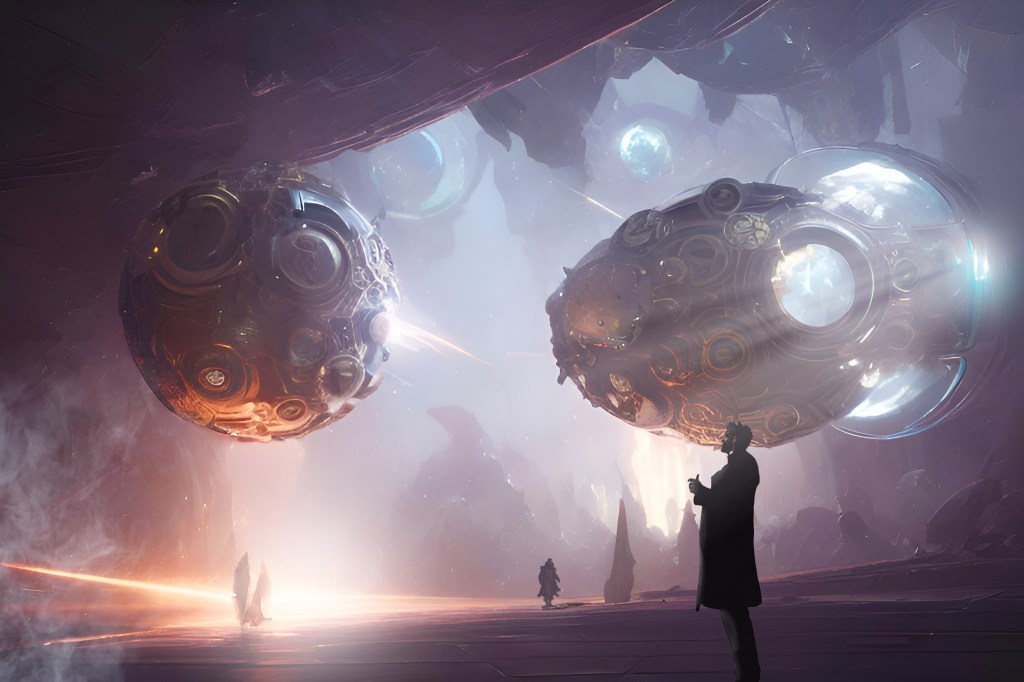
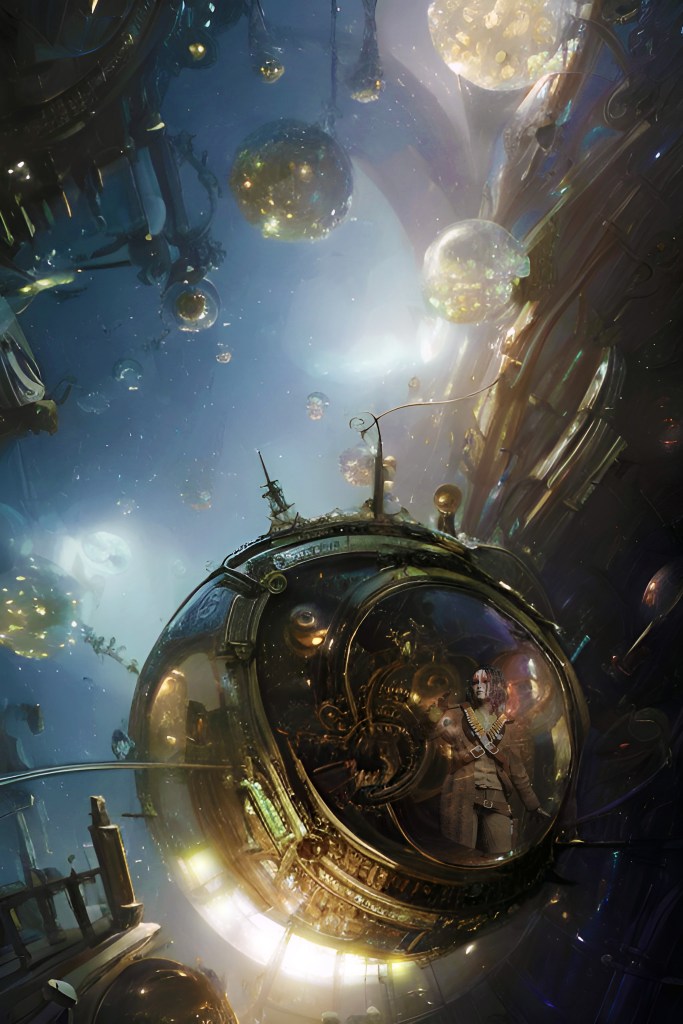
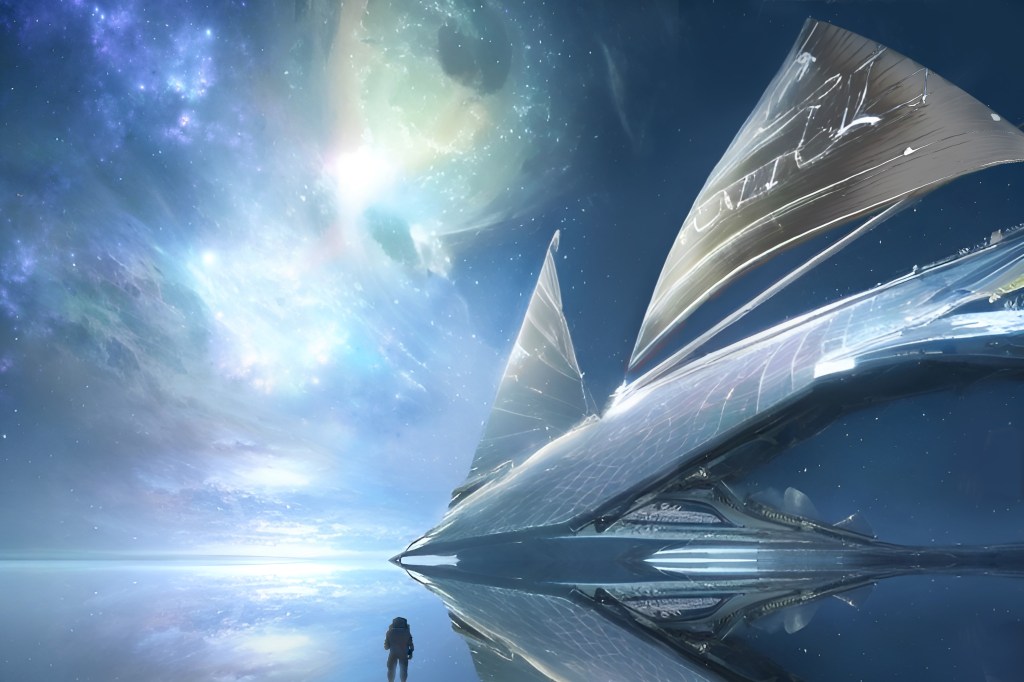
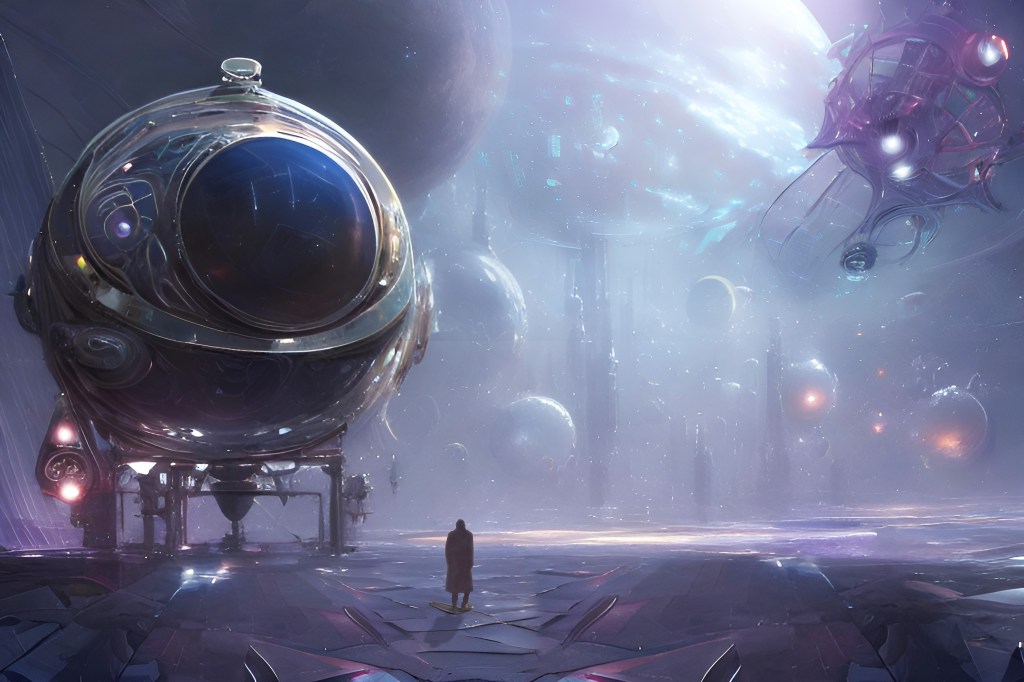
Grailrunner Publishing is excited to announce the second art print we’re making available at our online store, introducing a thrilling new setting within our ever-growing Salt Mystic universe! Welcome to Crystal Spheres Oriel.
Outside the Central Remnants and far beyond the eastern Shifting Wilds where computronium-infused dunes and caverns have gone mad…where only the bravest few have travelled and returned with impossible stories of spaceships and cities among the asteroids…lies the ruined spaceport leading to Crystal Spheres Oriel.
You may have seen glimpses before:
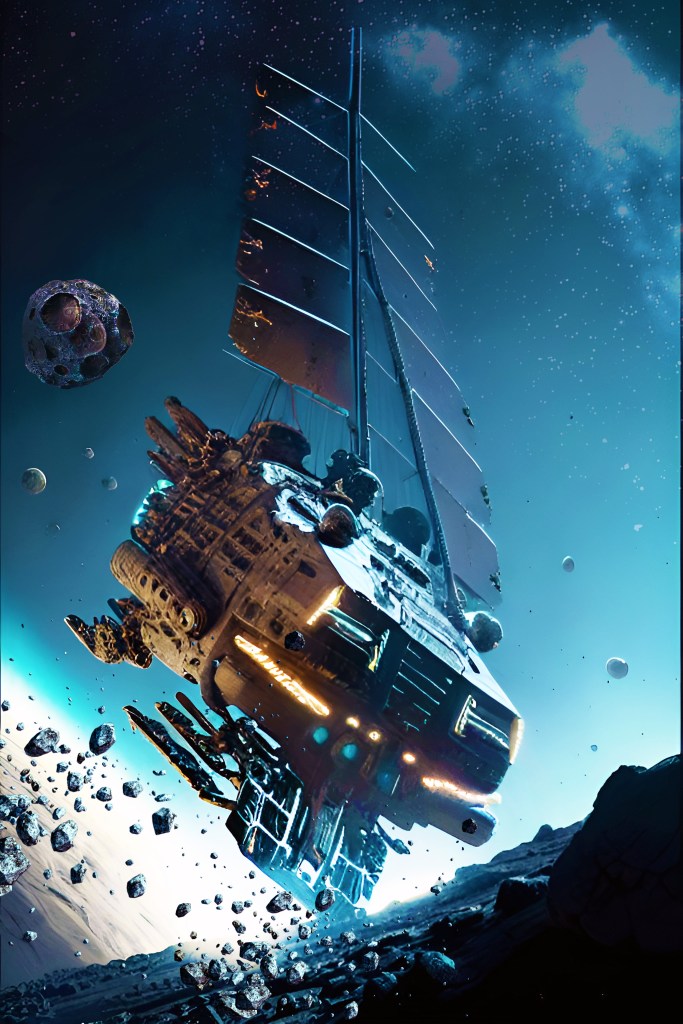
To celebrate this new addition to our setting, we’re offering a new art print in the online Grailrunner Store, a stunning 18″x24″ poster format print of an ion sailship opening a new asteroid mine. Click the image to learn more!
We sincerely hope you will join us in celebrating this opening of a new world of possibilities for storytelling!















 Grailrunner Publishing