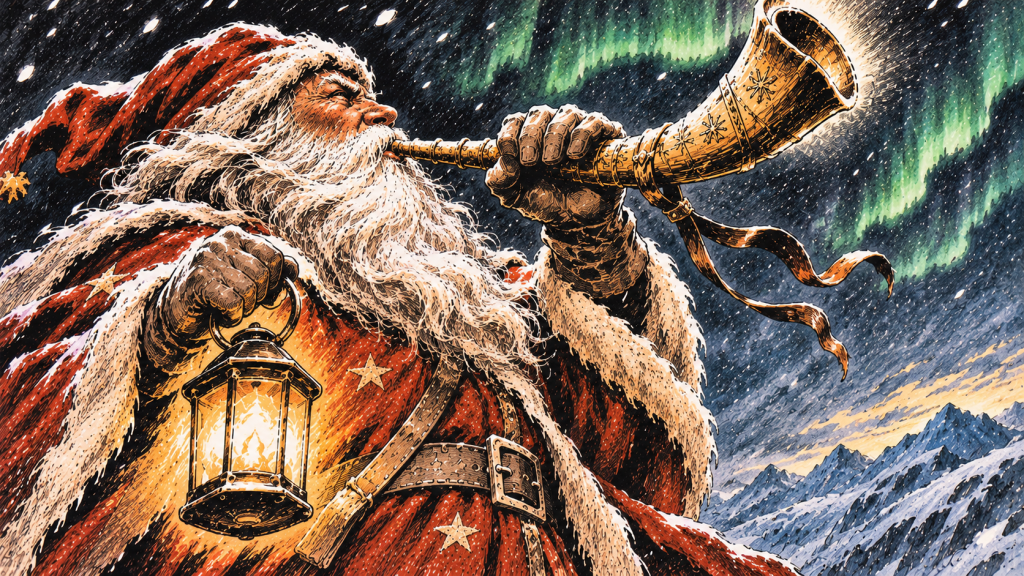
The guy who wrote Lord of the Rings developed a Christmas mythology. Did you know that?
Take a look at this wonderfully ridiculous illustration below by J.R.R. Tolkien of a polar bear falling down a flight of stairs carrying an enormous pile of Christmas presents. It’s worth remembering that the same imagination responsible for the fall of Númenor and the horrors of the Mines of Moria was also occupied with things like this.
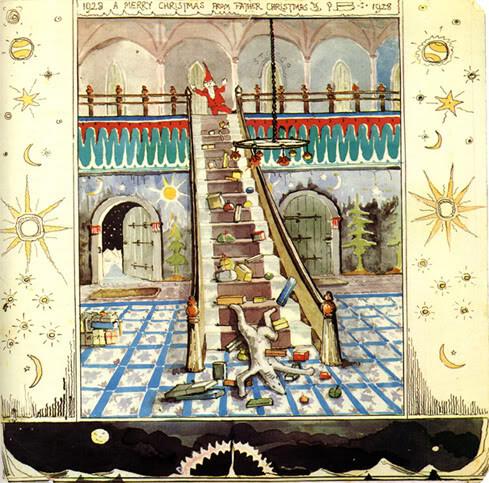
My wife recently got me a copy of Tolkien’s Father Christmas Letters and I thought I would share that with you in case you needed something awesome, fascinating, and heartwarming to rev up your Christmas season.
What are you talking about?
Beginning in 1920, Tolkien wrote illustrated letters to his children in the guise of Father Christmas, continuing the tradition through 1943. The letters arrived with elaborate handwriting, illustrations, decorated envelopes and specially drawn North Pole postage stamps.
Father Christmas wrote in a shaky script, apparently owing to his considerable age (but probably to hide the Professor’s handwriting). His chief assistant, the North Polar Bear, had a rather distinctive handwriting of his own and occasionally inserted commentary disputing Father Christmas’s version of events. And honestly, the bear is hilarious. He gets into hijinks and mischief, comes off as a little grumpy sometimes, but is a steadfast and courageous guardian to Santa when the North Pole Cliff House where they reside comes under attack.
The letters have been collected into a book you can read straight through, set with reproductions of the letters and the original illustrations. I thought going in that this would be a superficial read, too childish and maybe too personal & specific towards his own kids to have anything for me. Anyway, when I’d first heard about it a few days ago, the guy mentioning it said reading it was one of his holiday traditions.
And instead, it was great. Truly great. The Professor never stops surprising me!
What’s this about a Christmas mythology?
Ah, that’s where it gets particularly interesting. True to form, Tolkien stayed remarkably consistent from year to year with a coherent lore. For instance, in 1926 he told them how the North Polar Bear had accidentally set off 2 years worth of the northern lights and mentioned it again the next year, and a goblin battle has consequences in subsequent years.
A goblin what?!
There are these ancient caves beneath the North Pole, inhabited by goblins with a longstanding grudge against Father Christmas. Strange inscriptions and prehistoric drawings cover the walls (you can see them for yourself in the illustrations). There are underground expeditions, battles, secret passages and goblins riding enormous bats. The North Polar Bear, despite his unfortunate tendency to wreck things, turns out to be quite formidable when dealing with goblins.
The letter dated December 21st, 1933 is particularly rich. I won’t spoil anything here, but in a few handwritten letters to his kids, the Professor developed a lore robust enough to make a movie from it that would beat virtually anything coming out from Hollywood these days. If Studio Ghibli put this together, it could be an annual classic!
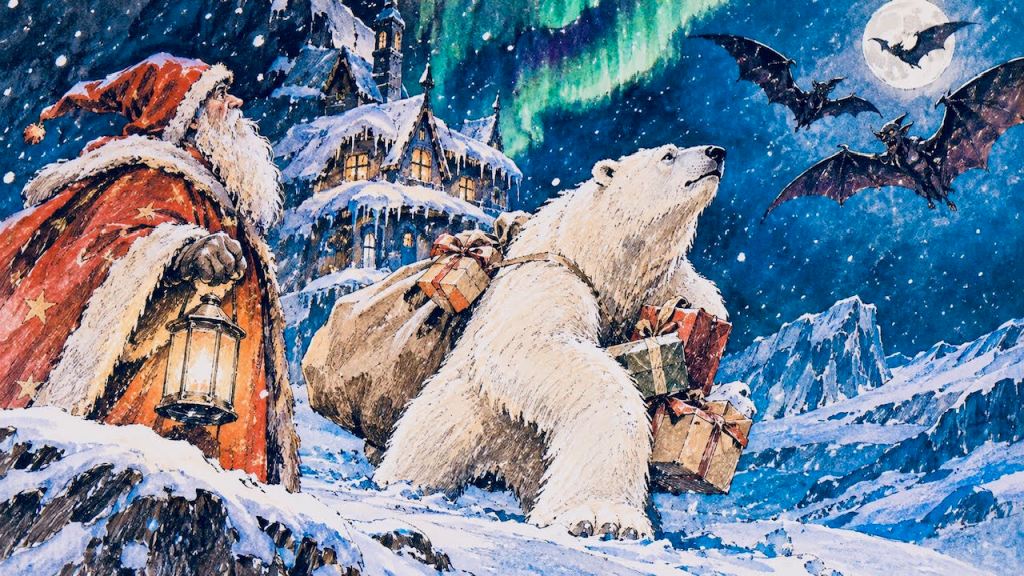
What’s fascinating to me is that Tolkien was developing these things during the years in which Middle-earth was taking shape. The Hobbit was published in 1937, well into the period covered by these letters. And although the North Pole of the letters isn’t part of Middle-earth, there are some familiar preoccupations at work here. Ancient underground civilizations. Forgotten histories preserved in strange markings on walls. Malevolent creatures stirring beneath the surface of the world. Unusual alphabets. Great catastrophes remembered and retold by the people who experienced them.
Even the North Polar Bear’s discovery of the goblin caves suggests a world considerably older and more complicated than the relatively cozy little corner of it occupied by Father Christmas.
Tolkien apparently couldn’t help himself. Give the man a Christmas tradition to embellish and before long there are ancient ruins and competing civilizations.
I love that about him.
What else was going on up there?
There are snow-elves, red gnomes (mortal enemies of the goblins, it seems), the Man in the Moon, and two young polar bears named Paksu and Valkotukka. There are mishaps involving fireworks and floods, and the recurring logistical nightmare of getting Christmas presents distributed throughout the world.
There’s a geography to all this nonsense, too. Father Christmas lives in Cliff House for much of the correspondence, following the destruction of his previous home.
And because the letters were written over so many years, these things accumulate. Characters remember previous disasters. Relationships develop. Old enemies return. The consequences of one year’s adventures become part of the following year’s story.
It sounds like the format is almost its own character…
Absolutely. We’ve talked quite a bit here at Grailrunner about ways of experiencing imaginary worlds outside the confines of a traditional novel. And one of the things I find particularly compelling about these letters is that they aren’t presented as stories about an imaginary place.
They’re presented as things that came from that place.
The handwriting tells you something about the person writing. The illustrations are eyewitness accounts of extraordinary events. The postage stamps imply an infrastructure of some kind. The scribbled interruptions from the North Polar Bear suggest things happening just beyond the edges of the paper. There’s even the delicious possibility that Father Christmas isn’t giving you an entirely fair account of something, judging by the bear’s objections.
Consider how differently you’d experience all this if it were simply a collection of short stories written in the third person. There’s something magical about holding a thing in your hands that purports to have come from somewhere impossible.
Anyway, about those illustrations…
I’ve been working lately on expressive pen & ink illustration, particularly trying to combine the irregular shadows of Bernie Wrightson as the skeleton for the image with Nick Marinkovich’s scratchy grunge streaks and splatter to give it energy. I’m studying Joseph Clement Coll as well – to avoid framing everything in neat little rectangles. It will be cool if I ever really get it worked out on the paper.
And Tolkien’s Christmas mythology offers some surprisingly wonderful opportunities to play with that.
There’s the contrast of warm candlelight against the blackness outside a window. The enormous, lumbering bulk of a polar bear against the wiry little shapes of goblins. The strange architecture of a house built at the edge of the world. The possibilities for dramatic perspectives in those underground caverns.
It’s a side of Christmas imagery we don’t see very often. A little eerie, a little absurd, and still somehow charming.
If you’re inclined to pick up Letters from Father Christmas, don’t make the mistake of thinking it’s just a curiosity for Tolkien completists or a sweet little book to read to children. Spend some time with the illustrations and the odd details scattered throughout the correspondence.
There’s a marvelous little fantasy world tucked away in there.
Till next time,