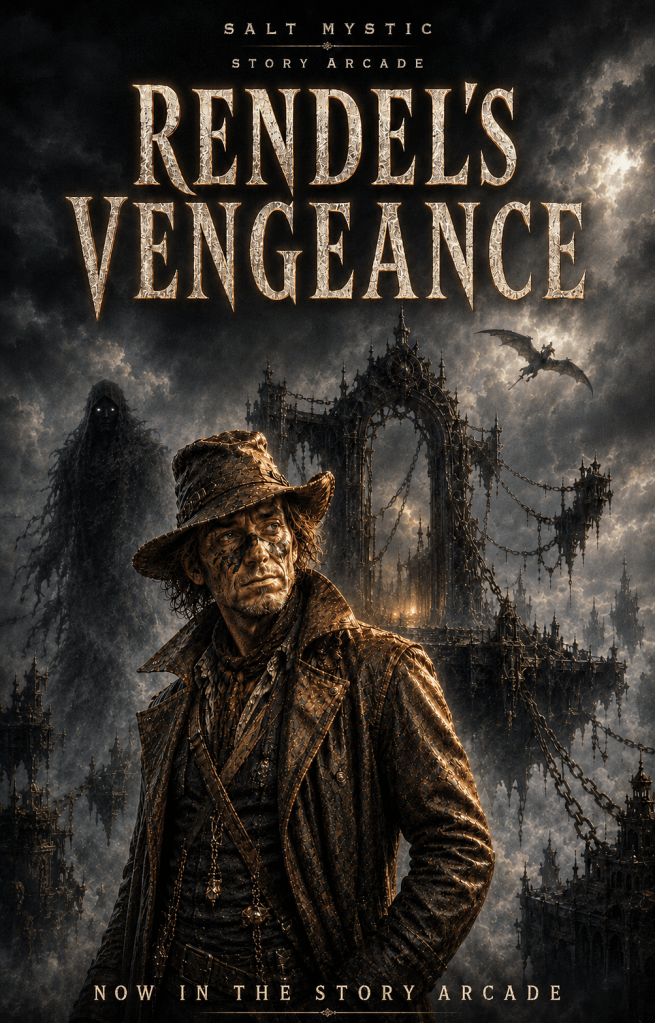
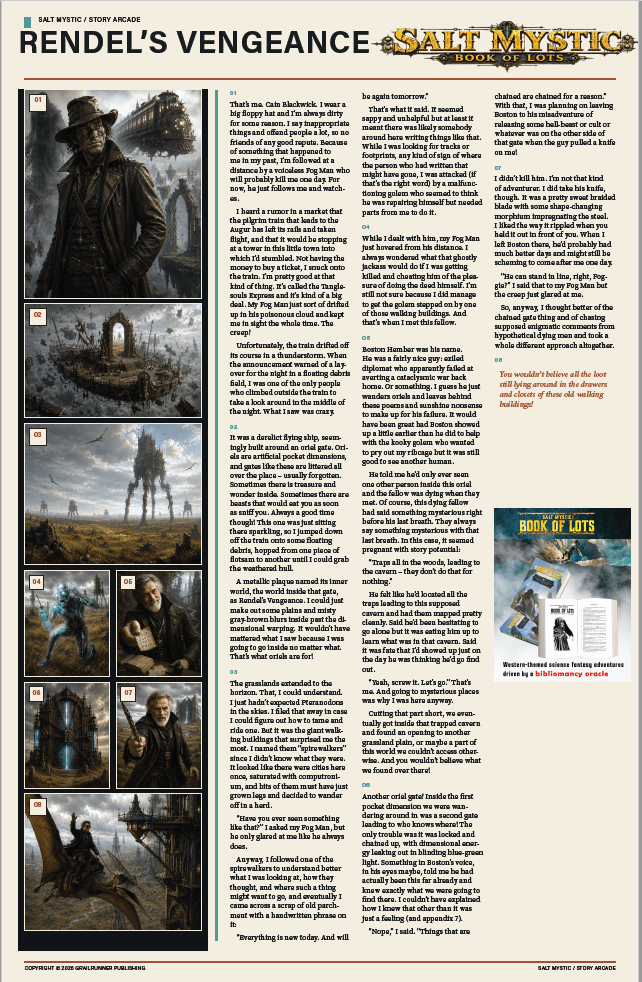
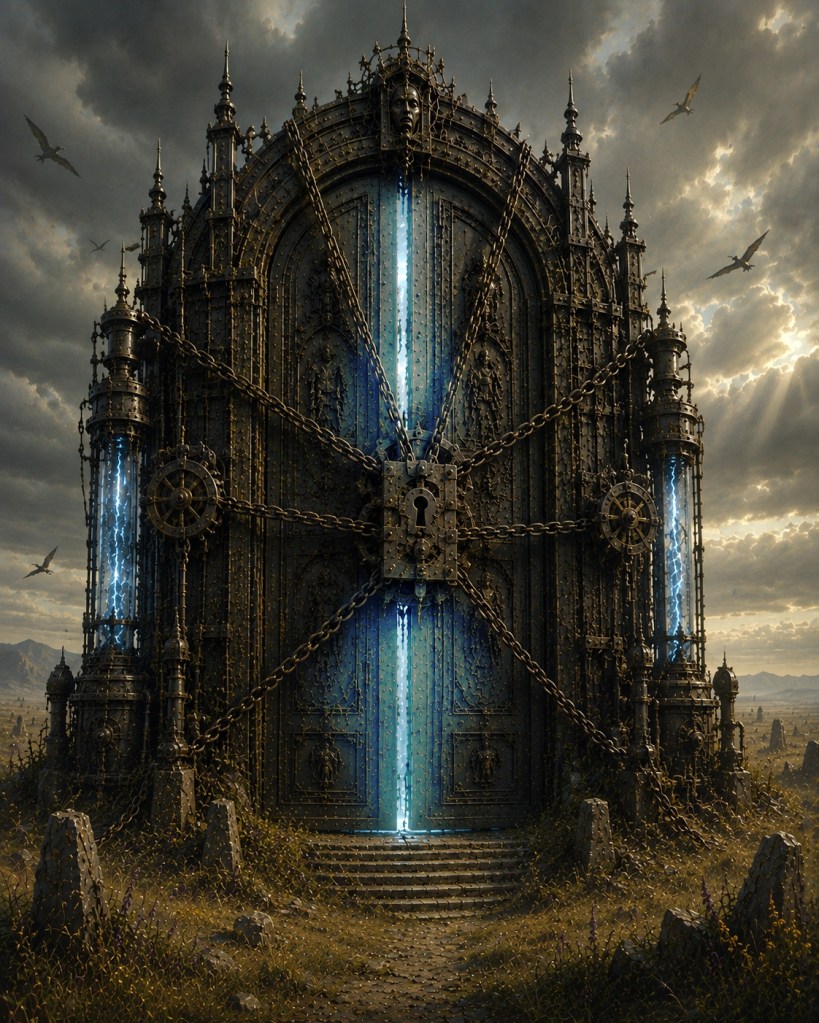
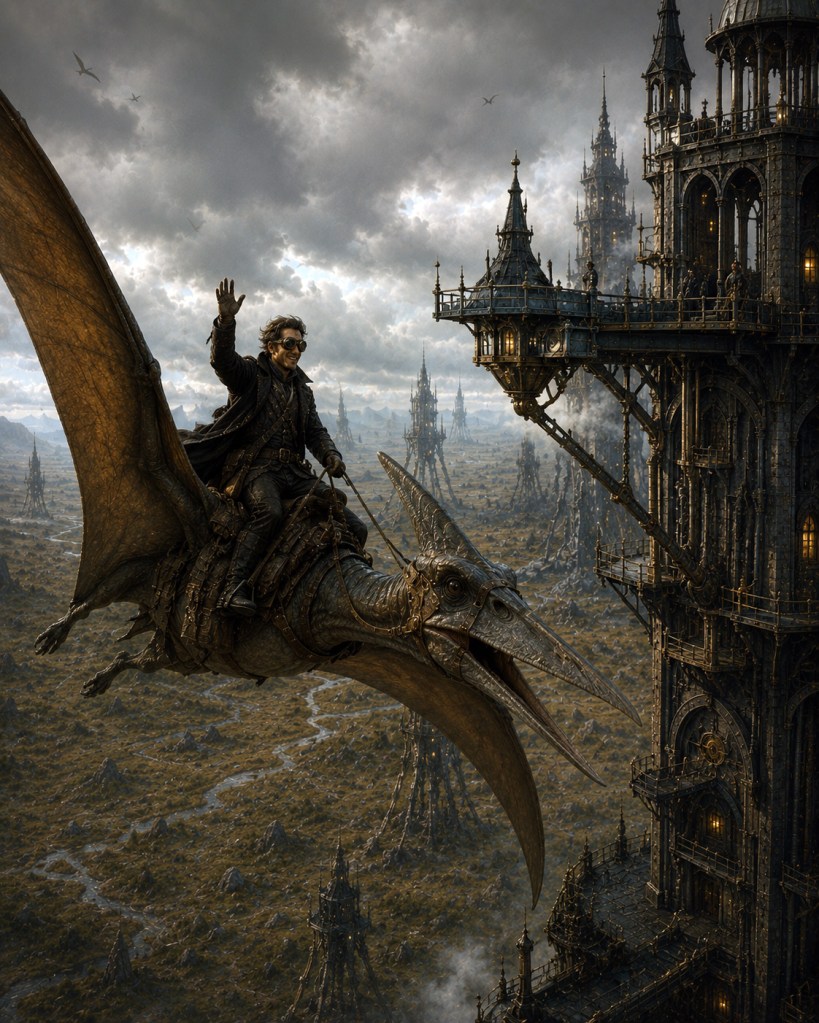
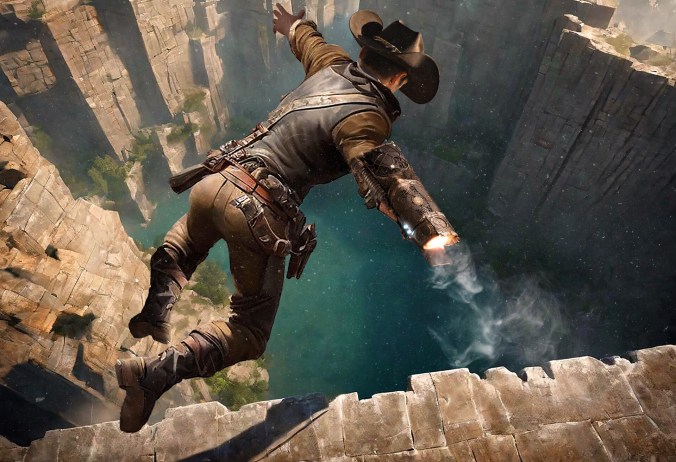
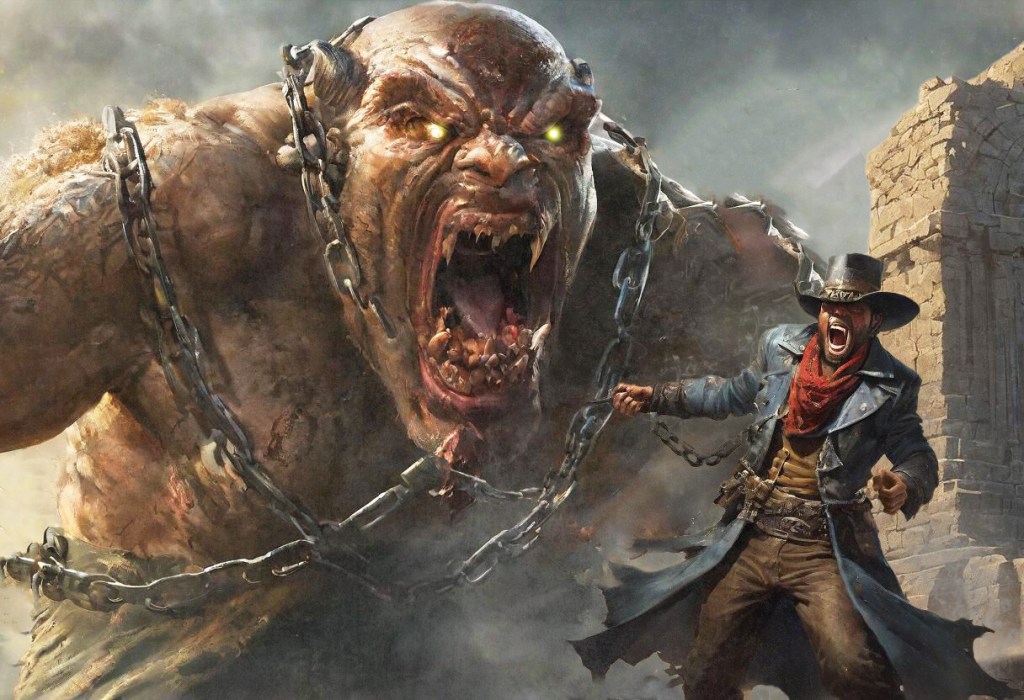
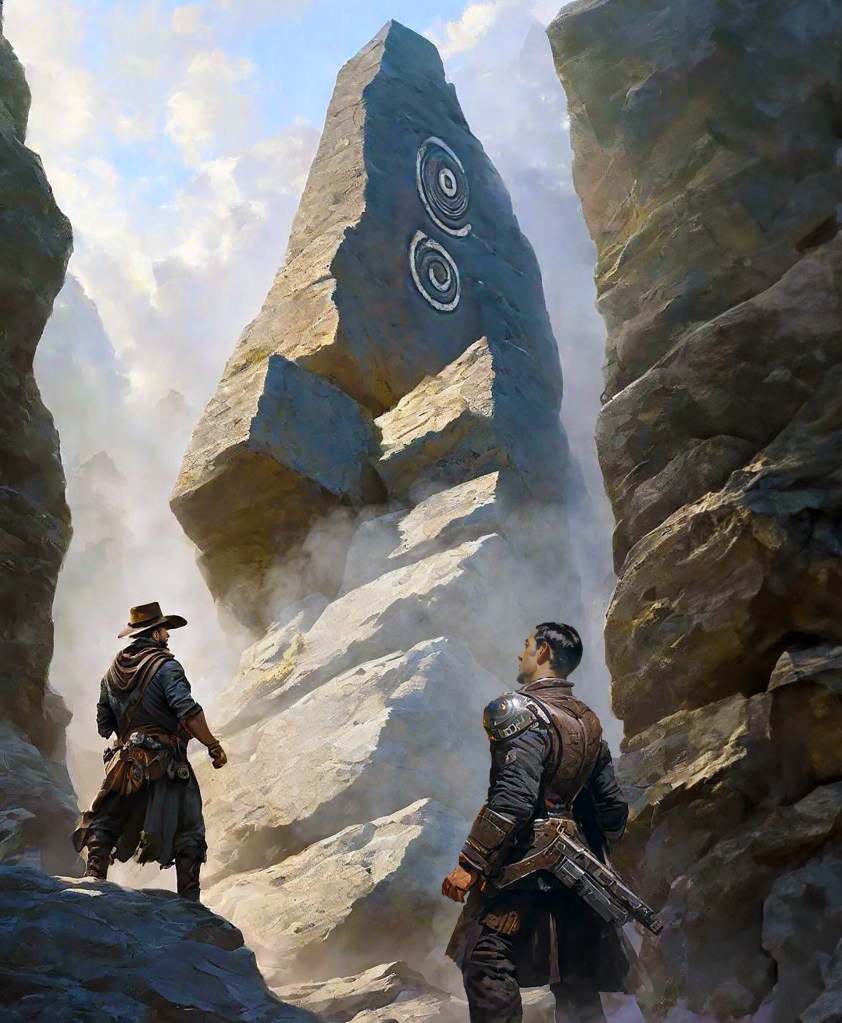
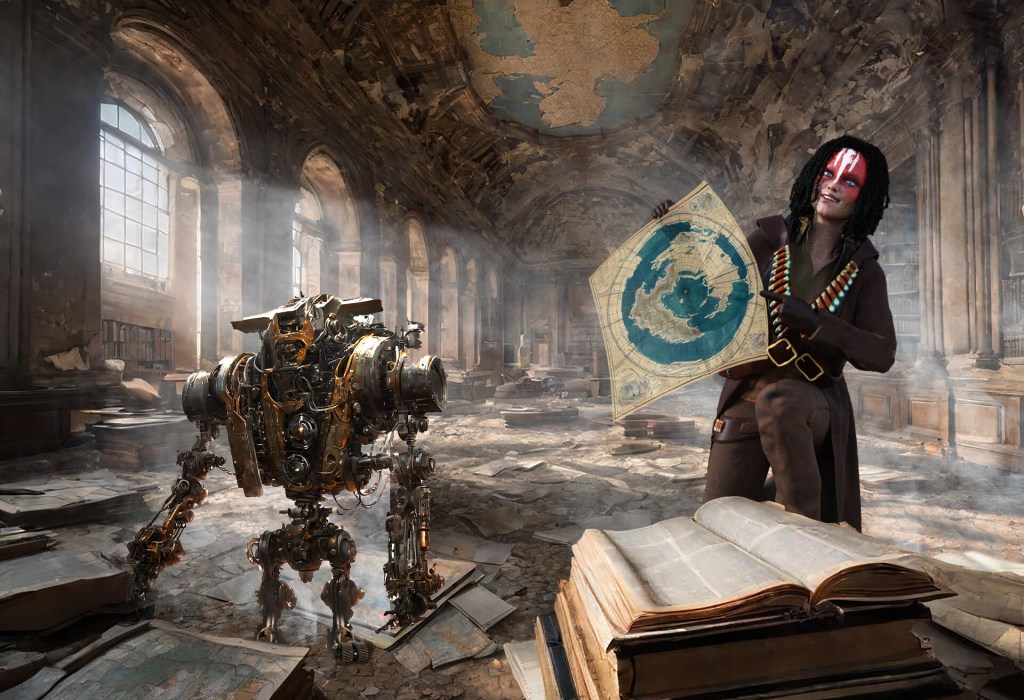
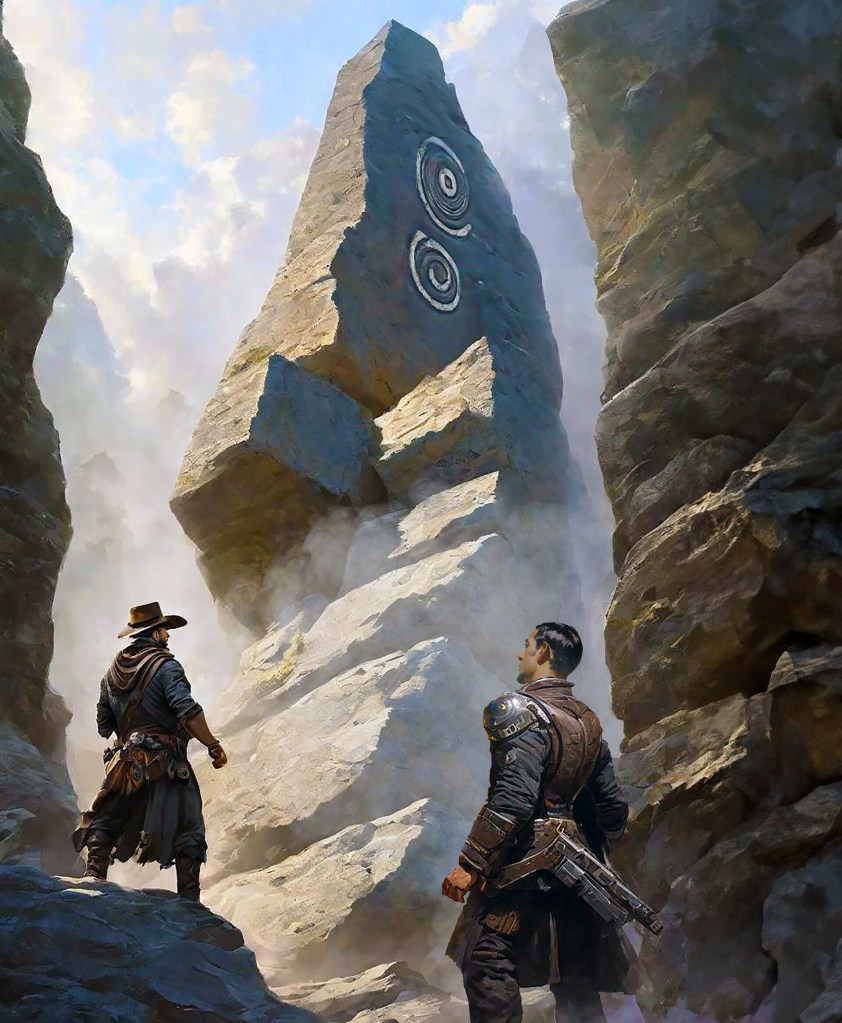
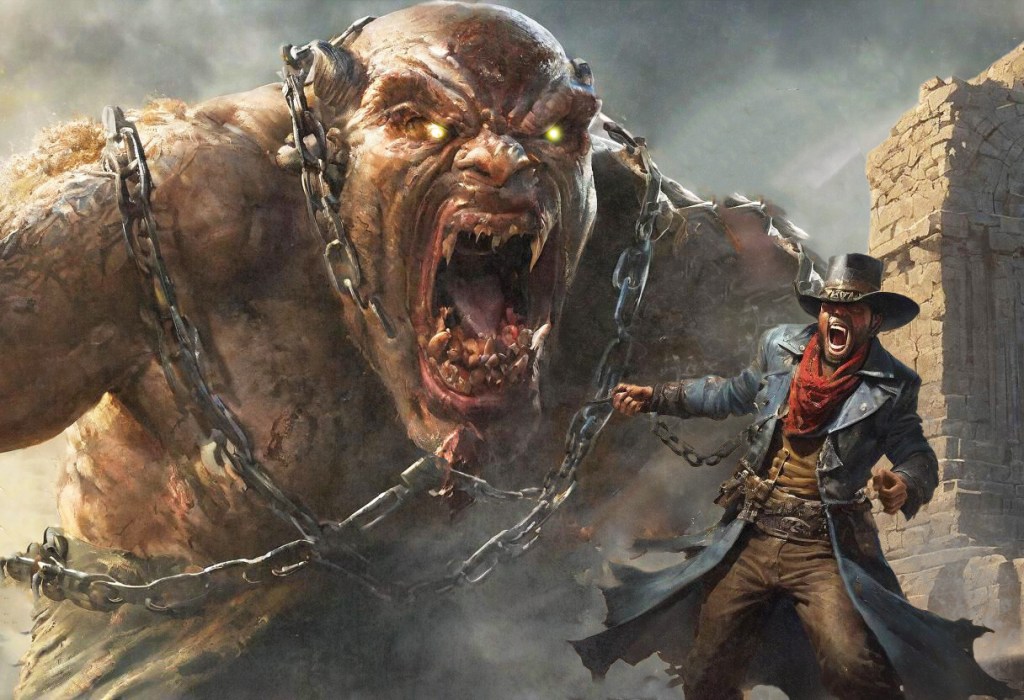
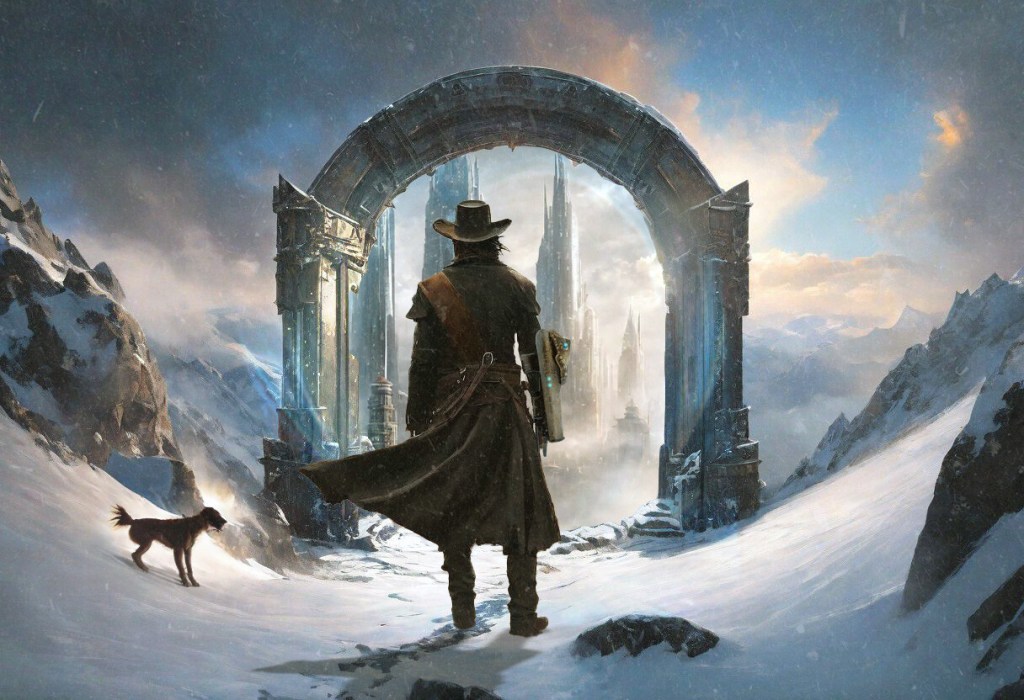
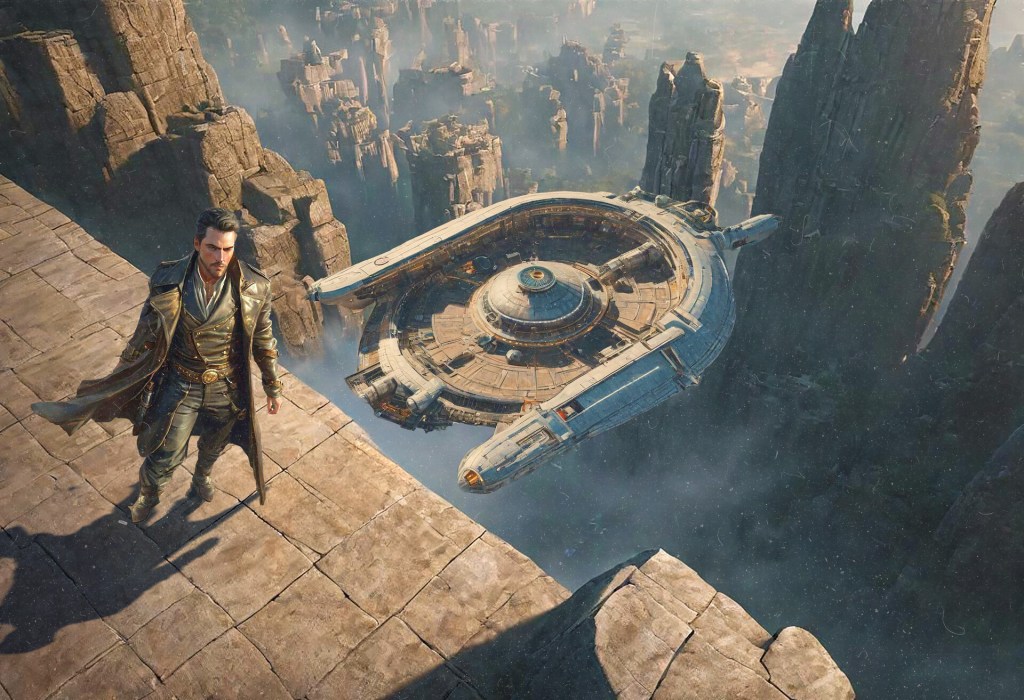
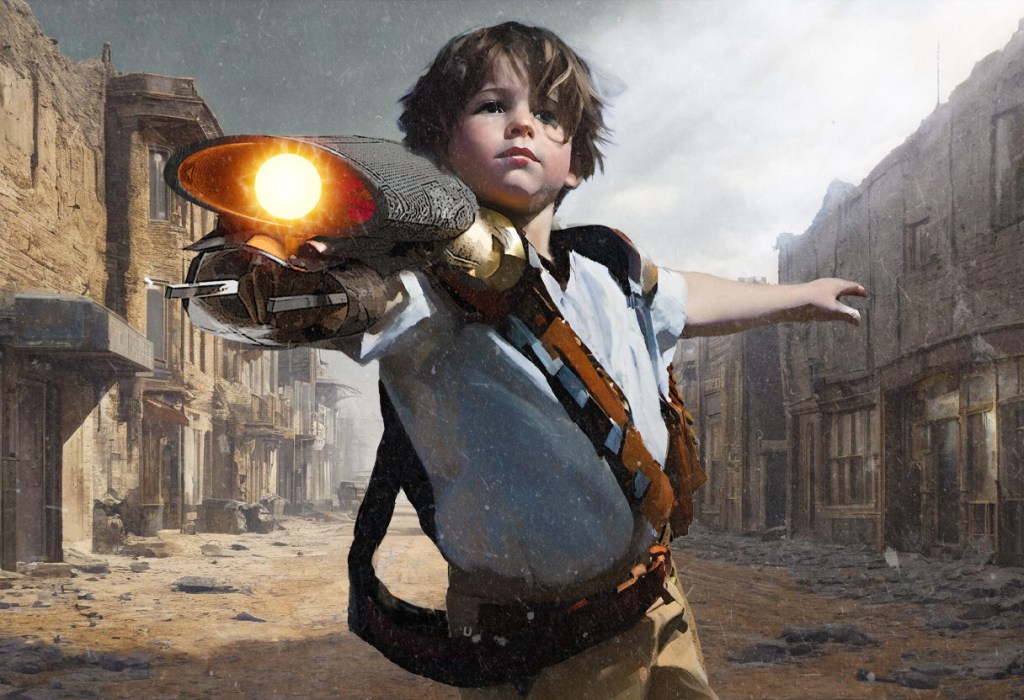
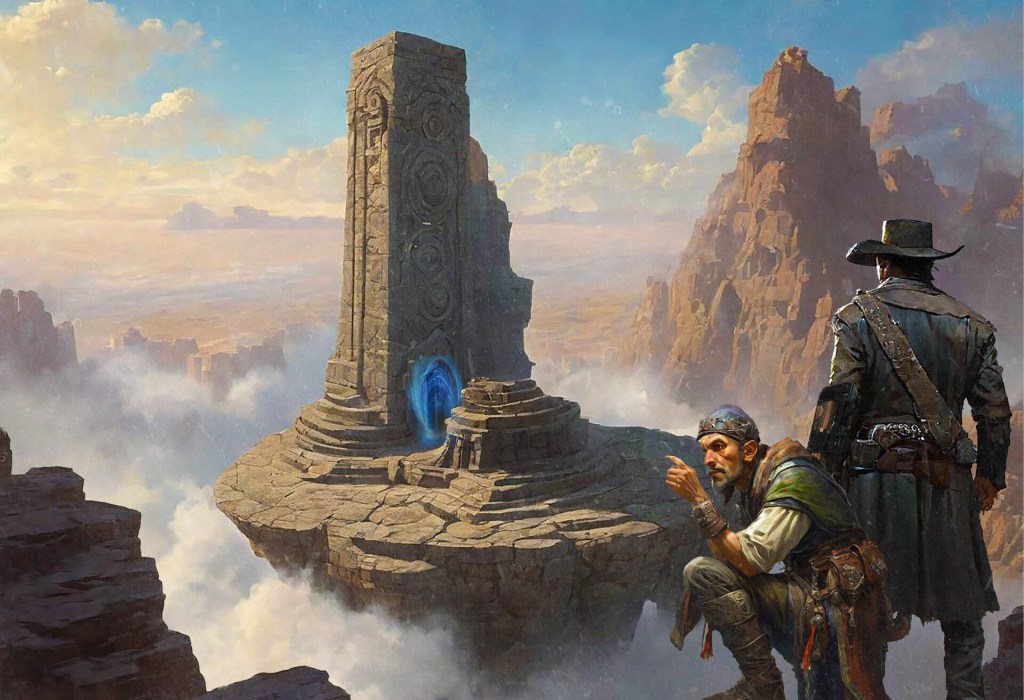
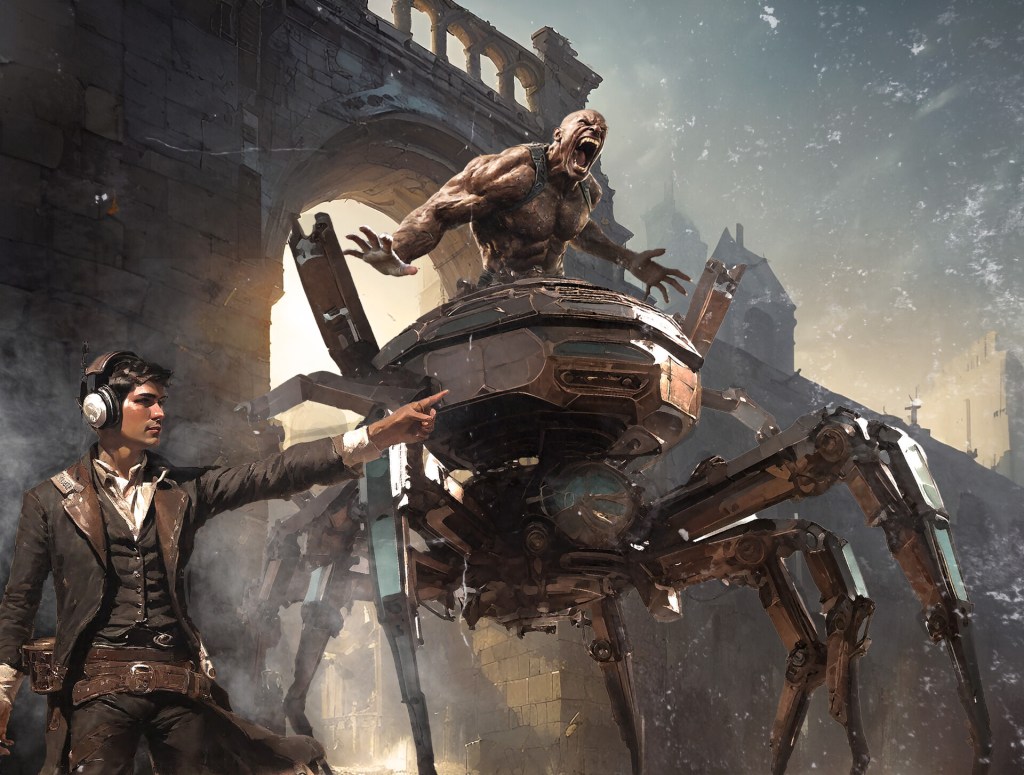
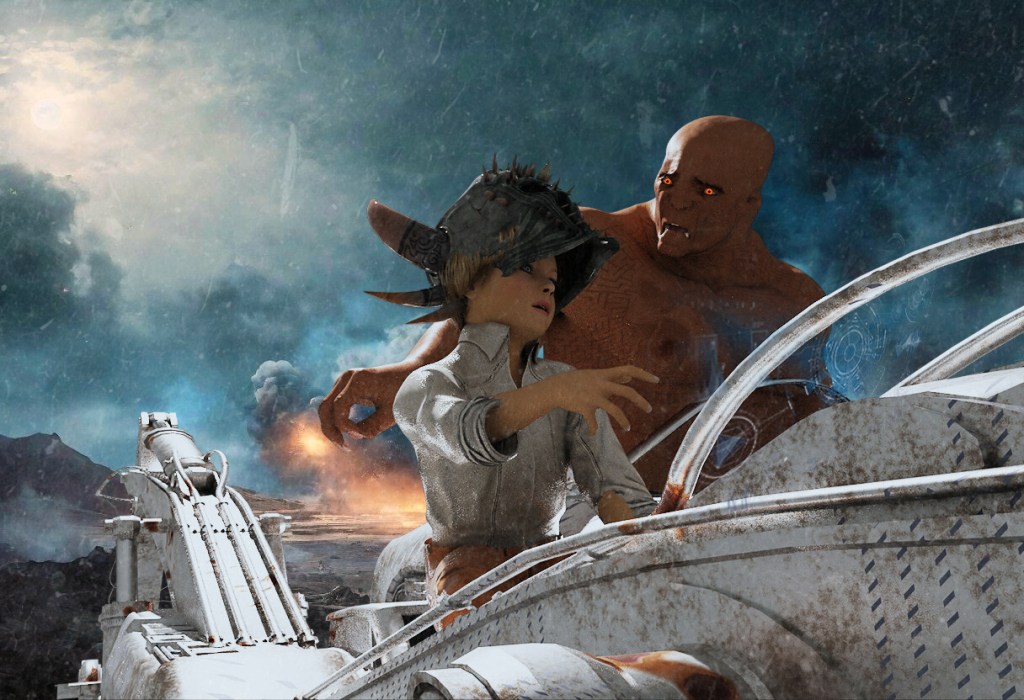
Enter a derelict flying oriel with Cain Blackwick in Rendel’s Vengeance, a new illustrated Salt Mystic science-fantasy adventure. Available for free now in the Story Arcade.
Life got in the way and we’ve not published a Story Arcade lore card in a while. It’s been bugging me that I need to get back into the habit of building out the Salt Mystic world with these immersive little one-shot illustrated flash fiction pieces. People seem to like them, and it’s one way to help on-board people to something I pour so much of my heart into.
To see what’s there on the Story Arcade already, smash the Explore Now button below:
But anyway, I recently took a dive into the Salt Mystic: Book of Lots to do a little solo roleplaying excursion and summoned a fun (and to me, hilarious) story of adventure and exploration that surprised me in its twists and ending. Crazy how roleplaying oracles do that – just flipping pages and answering questions, the occasional crazy decision to see what happens – and BOOM! Adventure!
We put together a new lore card with the illustrations and text of the adventure to store forever in the Story Arcade, and this is possibly something new we’ll do occasionally with that growing library, depending on how you guys feel about it. As always, these are one-page tales set in the Salt Mystic universe and something you can read in less than five minutes.
Click the page below to go straight to the new lore card:
That’s the news today. Feel free to peruse whichever lore card’s teaser or artwork draw your attention and let us know what you thought.
I’m proud that I can raise kids, hold down a pretty demanding day job, deal with adulting, and also manage to publish a novel, a tabletop skirmish game, a book of short stories, and a roleplaying game. I decided many years ago that I would focus my imagination on building out a detailed world rather than bounce around with various unrelated concepts and I feel I’ve learned an incredible amount of fantastic skills along the way.
So the world of Salt Mystic has been my imagination’s playground for over a decade now.
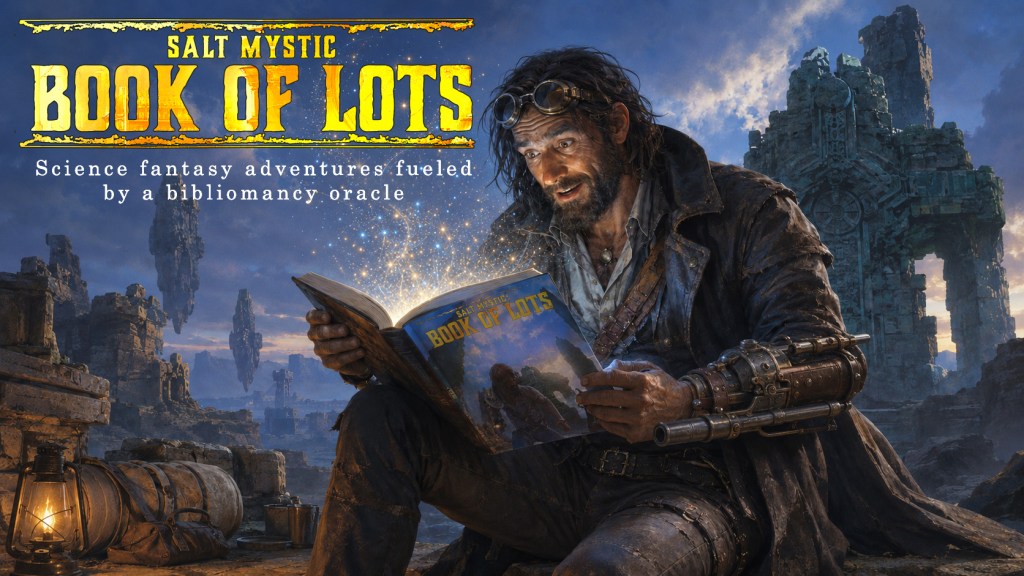
But one thing that sucks about being a writer, at least for me, is that I really…really…struggle to sit down and read something I wrote. I can’t squash the crippling dread that I’ll stumble across a misspelled word, a forgotten fragment I mistakenly left when I edited something, or – and this is the worst – a contradiction or plot hole. The dream I had when I designed our most recent publication, SALT MYSTIC: BOOK OF LOTS, was that I finally had a doorway to step into this world I’ve spent so much time making. It’s a roleplaying game designed from the ground up for solo players but able to simply and cleanly launch you into the Salt Mystic world.
But it’s been a year and a half since I finished it and only earlier today was I able to pick it up for any length of time and peruse the introduction, skim the map, and consult some of the oracles tables in the appendix without the creeping dread peeing on my experience.
And it was kind of awesome, honestly.
Grailrunner claimed when we put this RPG out that it was “effortless roleplaying”. I tested that out by blindly following the oracles for a character generation (appearance, name, and background), an inciting rumor my character heard somewhere, a general storyline theme, a NPC I was to meet, and some places we would go. I intentionally didn’t bring anything to the experience and made an honest effort to just step inside and see who and what I would meet.
Although I wrote all that material, I did so in a mad 3-year fury of flipping through art books and random mythology texts, brainstorming, sketching random blobs, and generally letting my imagination just do what it does with abandon. The truth is – I found a lot of what I saw in my own book unfamiliar enough that it surprised me. So today I thought I’d recap the adventure that resulted with some illustrations for a more dynamic presentation. Pretty much everything that happened was just me following the guidance in the book and doing what I felt like doing along the way.
Care to join me?
*
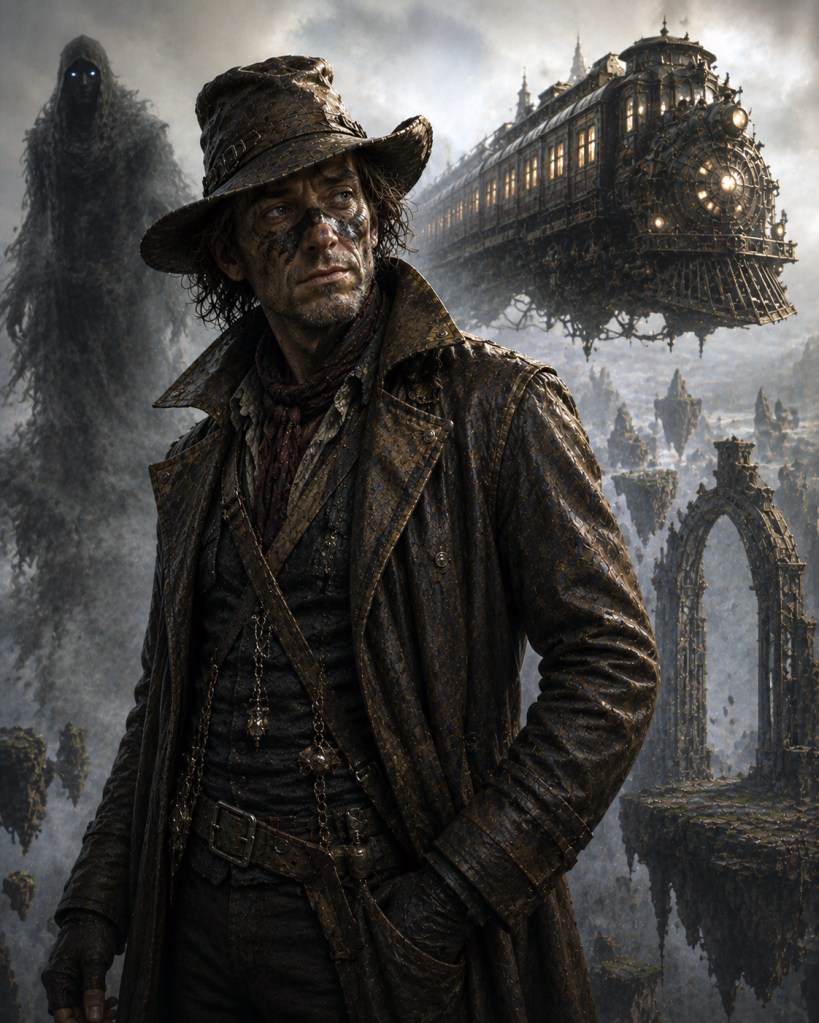
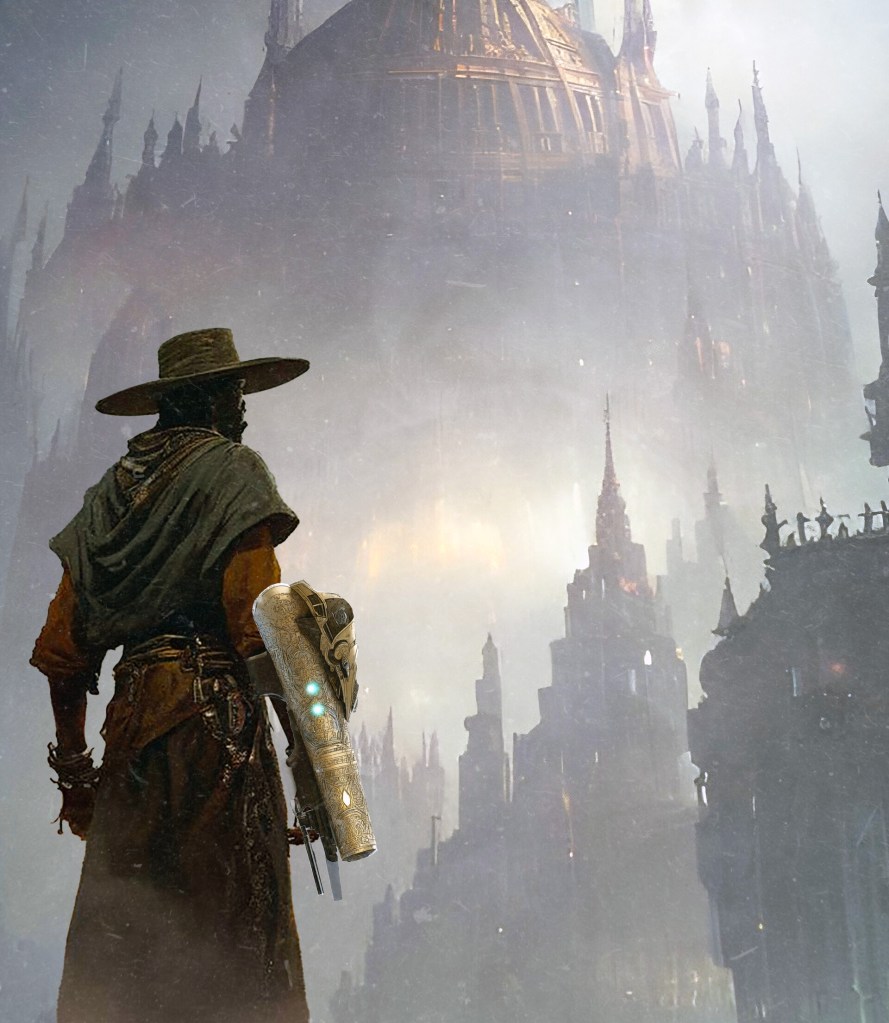
That’s me. Cain Blackwick. I wear a big floppy hat and I’m always dirty for some reason. I say inappropriate things and offend people a lot, so no friends of any good repute. Because of something that happened to me in my past, I’m followed at a distance by a voiceless Fog Man who will probably kill me one day. For now, he just follows me and watches.
I heard a rumor in a market that the pilgrim train that leads to the Augur has left its rails and taken flight, and that it would be stopping at a tower in this little town into which I’d stumbled. Not having the money to buy a ticket, I snuck onto the train. I’m pretty good at that kind of thing. It’s called the Tanglesouls Express and it’s kind of a big deal. My Fog Man just sort of drifted up in his poisonous cloud and kept me in sight the whole time. The creep!
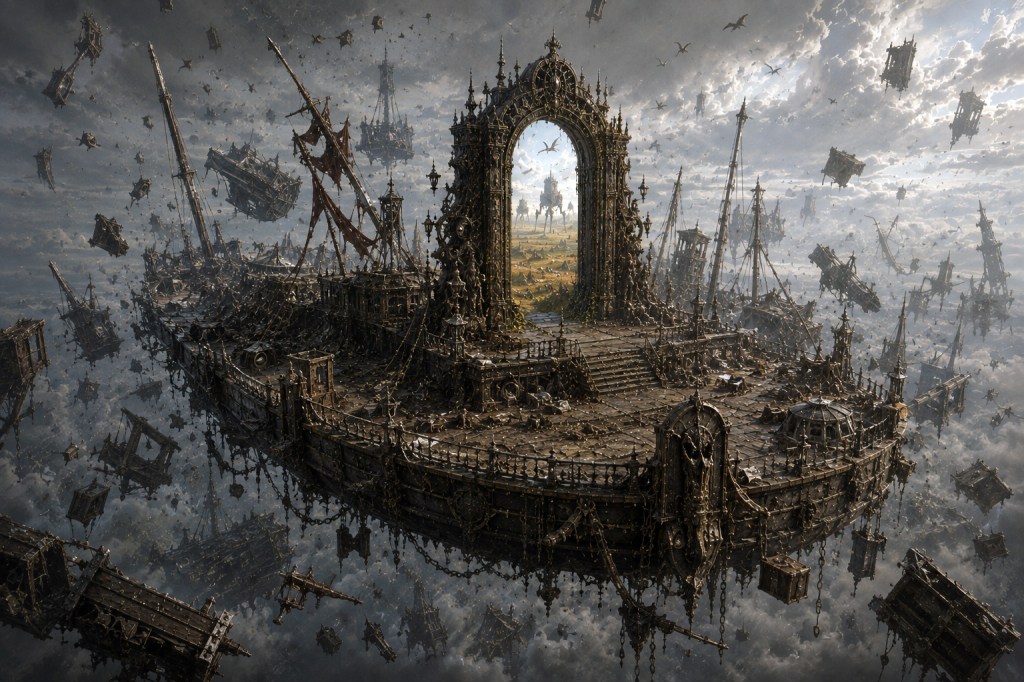
Unfortunately, the train drifted off its course in a thunderstorm. When the announcement warned of a layover for the night in a floating debris field, I was one of the only people who climbed outside the train to take a look around in the middle of the night. What I saw was this:
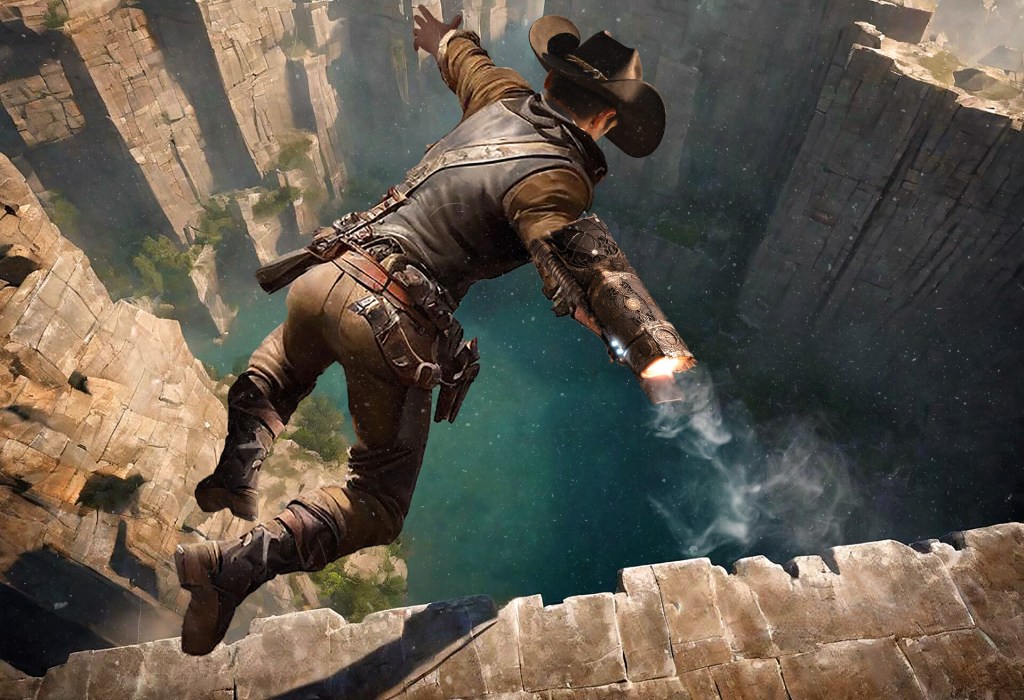
It was a derelict flying ship, seemingly built around an oriel gate. Oriels are artificial pocket dimensions, and gates like these are littered all over the place – usually forgotten. Sometimes there is treasure and wonder inside. Sometimes there are beasts that would eat you as soon as sniff you. Always a good time though! This one was just sitting there sparkling, so I jumped down off the train onto some floating debris, hopped from one piece of flotsam to another until I could grab the weathered hull.
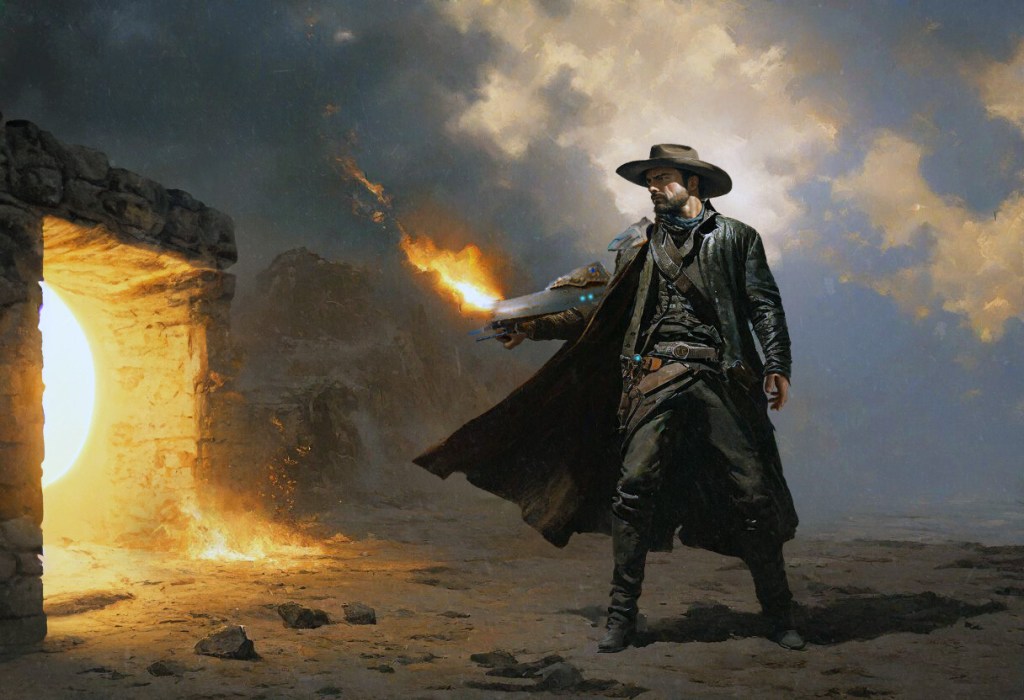
A metallic plaque named its inner world, the world inside that gate, as Rendel’s Vengeance. I could just make out some plains and misty gray-brown blurs inside past the dimensional warping. It wouldn’t have mattered what I saw because I was going to go inside no matter what. That’s what oriels are for!
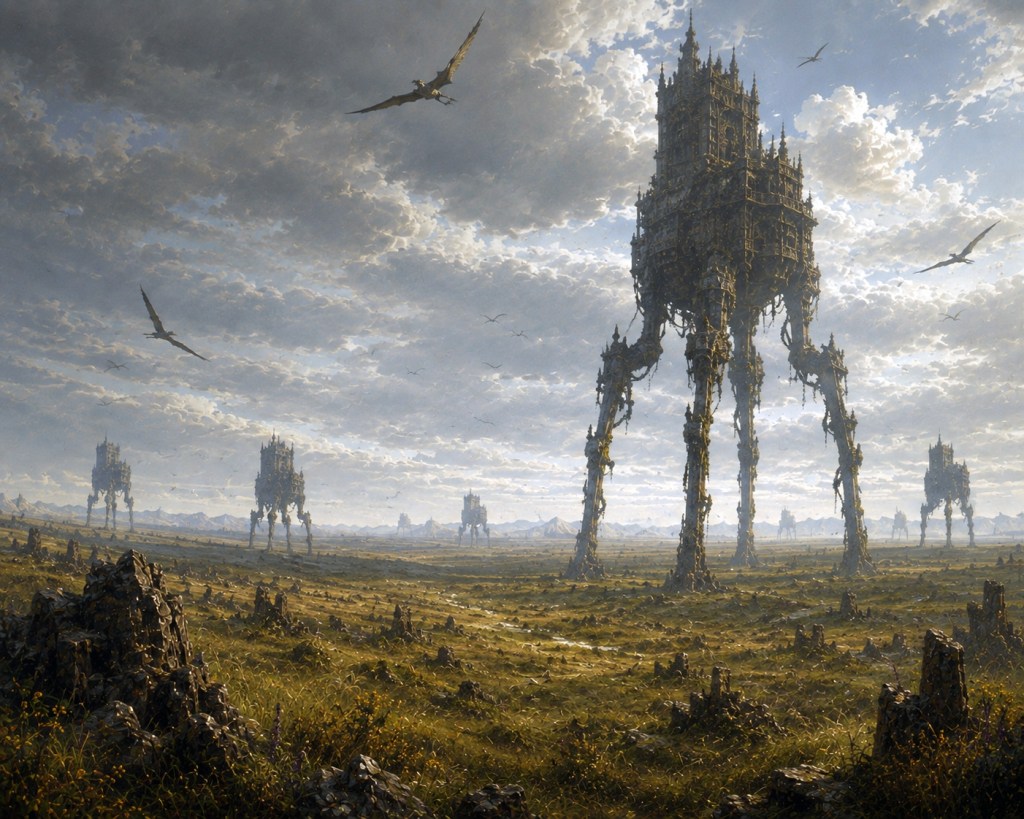
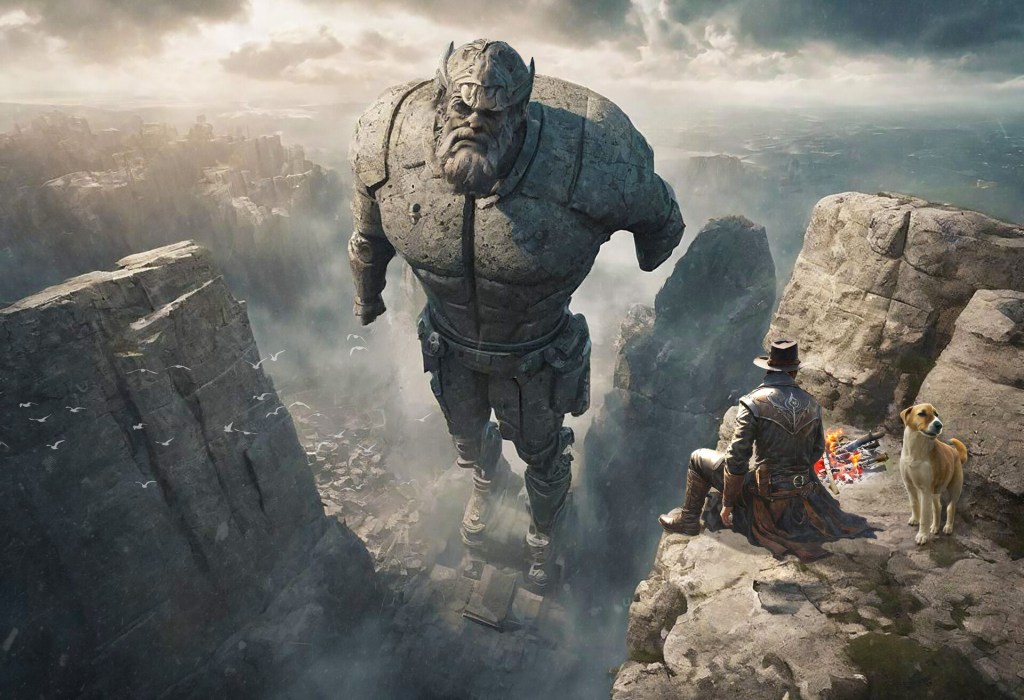
The grasslands extended to the horizon. That, I could understand. I just hadn’t expected Pteranodons in the skies. I filed that away in case I could figure out how to tame and ride one. But it was the giant walking buildings that surprised me the most. I named them “spirewalkers” since I didn’t know what they were. It looked like there were cities here once, saturated with computronium, and bits of them must have just grown legs and decided to wander off in a herd.
“Have you ever seen something like that?” I asked my Fog Man, but he only glared at me like he always does.
Anyway, I followed one of the spirewalkers to understand better what I was looking at, how they thought, and where such a thing might want to go, and eventually I came across a scrap of old parchment with a handwritten phrase on it:
“Everything is new today. And will be again tomorrow.”
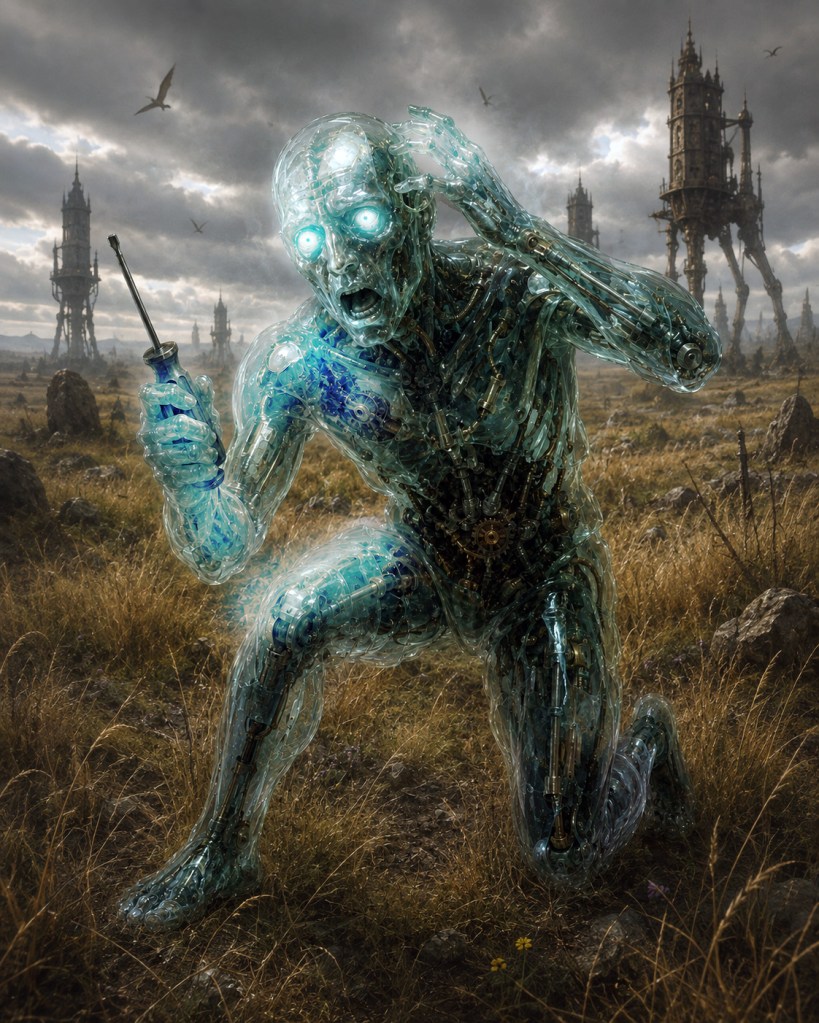
That’s what it said. It seemed sappy and unhelpful but at least it meant there was likely somebody around here writing things like that. While I was looking for tracks or footprints, any kind of sign of where the person who had written that might have gone, I was attacked (if that’s the right word) by a malfunctioning golem who seemed to think he was repairing himself but needed parts from me to do it.
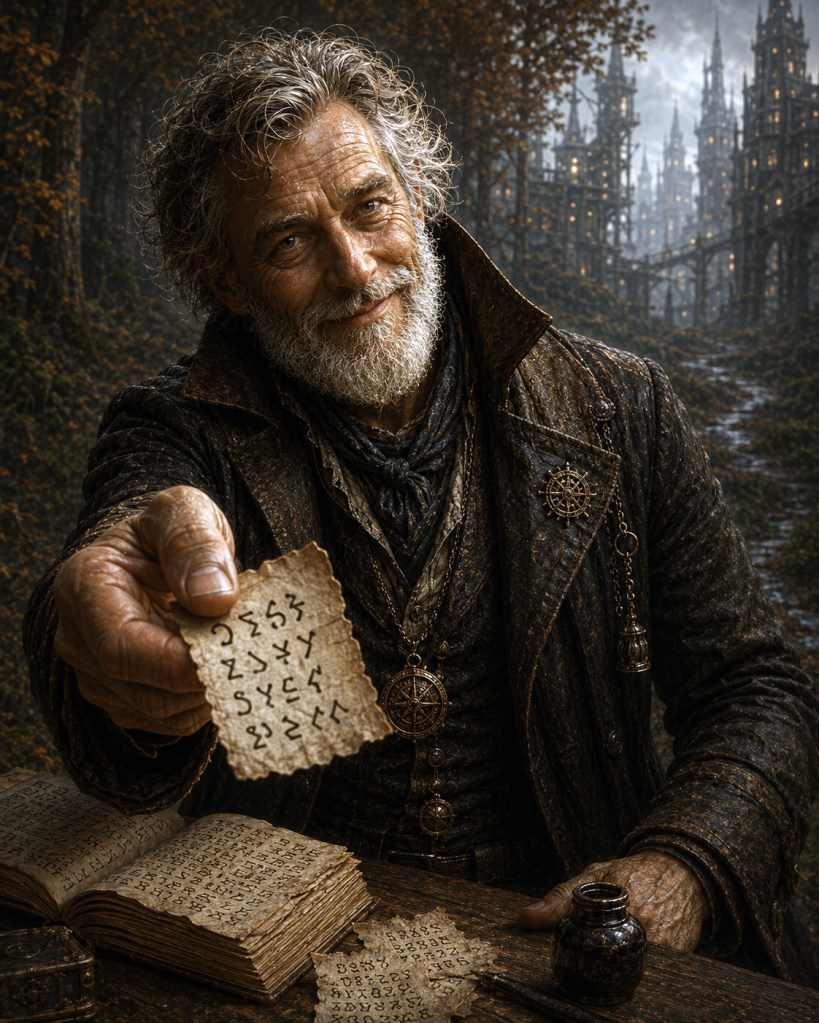
While I dealt with him, my Fog Man just hovered from his distance. I always wondered what that ghostly jackass would do if I was getting killed and cheating him of the pleasure of doing the deed himself. I’m still not sure because I did manage to get the golem stepped on by one of those walking buildings. And that’s when I met this fellow here:
Boston Hember was his name. He was a fairly nice guy: exiled diplomat who apparently failed at averting a cataclysmic war back home. Or something. I guess he just wanders oriels and leaves behind these poems and sunshine nonsense to make up for his failure. It would have been great had Boston showed up a little earlier than he did to help with the kooky golem who wanted to pry out my ribcage but it was still good to see another human.
He told me he’d only ever seen one other person inside this oriel and the fellow was dying when they met. Of course, this dying fellow had said something mysterious right before his last breath. They always say something mysterious with that last breath. In this case, it seemed pregnant with story potential:
“Traps all in the woods, leading to the cavern – they don’t do that for nothing.”
He felt like he’d located all the traps leading to this supposed cavern and had them mapped pretty cleanly. Said he’d been hesitating to go alone but it was eating him up to learn what was in that cavern. Said it was fate that I’d showed up just on the day he was thinking he’d go find out.
“Yeah, screw it. Let’s go.” That’s me. And going to mysterious places was why I was here anyway.
Cutting that part short, we eventually got inside that trapped cavern and found an opening to another grassland plain, or maybe a part of this world we couldn’t access otherwise. And you wouldn’t believe what we found over there!
Another oriel gate! Inside the first pocket dimension we were wandering around in was a second gate leading to who knows where! The only trouble was it was locked and chained up, with dimensional energy leaking out in blinding blue-green light. Something in Boston’s voice, in his eyes maybe, told me he had actually been this far already and knew exactly what we were going to find there. I couldn’t have explained how I knew that other than it was just a feeling (and appendix 7).
“Nope,” I said. “Things that are chained are chained for a reason.” With that, I was planning on leaving Boston to his misadventure of releasing some hell-beast or cult or whatever was on the other side of that gate when the guy pulled a knife on me!
I didn’t kill him. I’m not that kind of adventurer. I did take his knife, though. It was a pretty sweet braided blade with some shape-changing morphium impregnating the steel. I liked the way it rippled when you held it out in front of you. When I left Boston there, he’d probably had much better days and might still be scheming to come after me one day.
“He can stand in line, right, Foggie?” I said that to my Fog Man but the creep just glared at me.
So, anyway, I thought better of the chained gate thing and of chasing supposed enigmatic comments from hypothetical dying men and took a whole different approach altogether.
You wouldn’t believe all the loot still lying around in the drawers and closets of these old walking buildings!
*
I hope you found that as amusing as I did. It was really fun to treat this wonderful book like something I didn’t sweat and stress over for years and just let it do its thing as it was designed to do.
If you want to buy a copy of SALT MYSTIC: BOOK OF LOTS for yourself, just smash the Buy It Now button below:
And that’s what I wanted to bring you today. Till next time,
I’m not against AI as a better Google. For example, I needed to know recently whether crickets still croak at night in late autumn and what wild mustard would smell like if you sat on it. These are the kind of weird questions writers come up with and – if you’re me – completely block the ability to progress with the work until they’re answered.
Here are some others (and trust me, all totally legitimately asked in the context of feverishly trying to complete a science fantasy novel):
What are gorilla boobs called?
Where exactly do blind people place their fingers on someone’s face to read their expression?
What is the difference between a glyph and a sigil?
What causes the black streaks beneath a crying woman’s eyes: eyeliner or mascara?
Say a man’s arm is severed and cauterized by a sentient cablesword – would it steam, bleed, smoke, or all three?
Forgive me. I like odd details when I’m reading books so I want them in my own concoctions. And I want them to be right. Something like Gemini or ChatGPT can handle these iterative conversations to answer questions like these better than a Google search. Far better and much faster.
Okay, what about the writing, though? The creation of the work itself?
I’m also not against AI handling the monotonous and thankless task of resolving thorny punctuation issues. My kryptonite punctuation errors so far have been:
I join two complete thoughts with commas rather than semicolons. I never liked semicolons. They look weird but whatever.
I forget to add commas when I use introductory phrases (“Beneath the plaque Mazewater noticed old carvings.” – missing comma after ‘plaque’
…
You know what – let’s leave that topic. I did a search for punctuation goofs I had to fix and it’s embarrassing. You get my point on an editor that can quickly resolve where a comma goes and whether to bust up a sentence is awesome.
But the writing?
Well, somewhat more controversially, I’m very much in favor of quick and dirty concept art by AI to help me visualize a character or backdrop I’m dreaming up in the way that George Lucas used Ralph McQuarrie and so many others in his own worldbuilding.
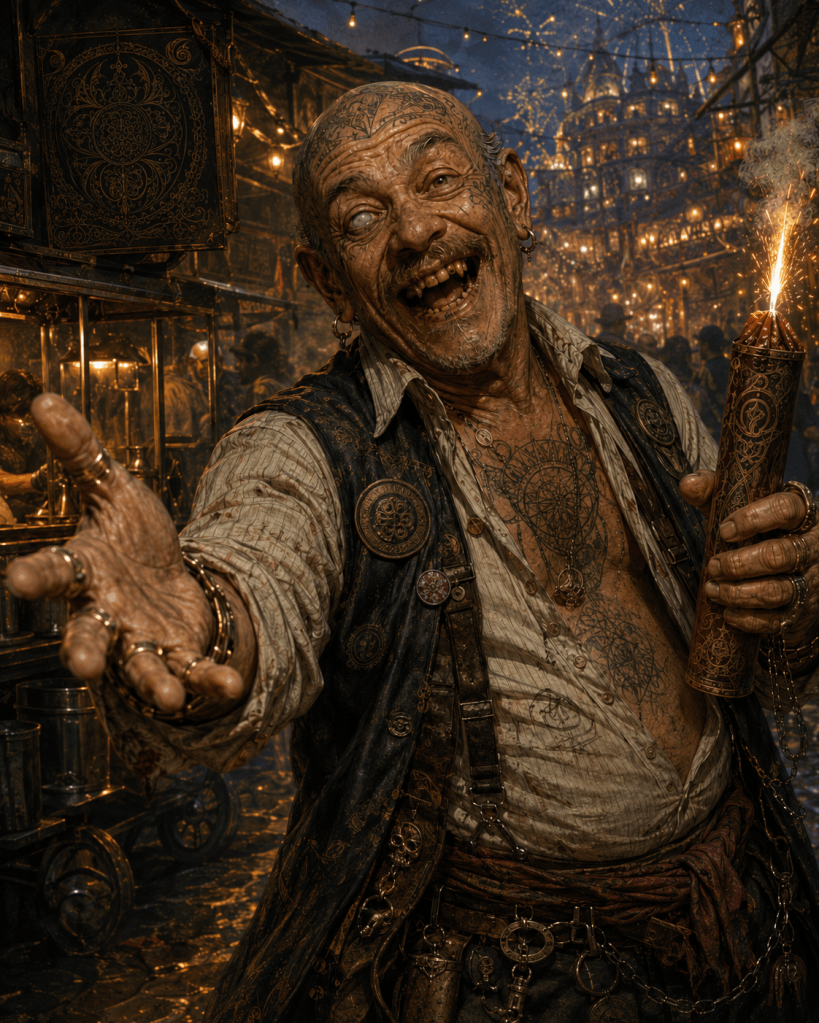
Meet Uncle Ong, for example, based on my descriptions (if you read Mazewater one day, this guy will break your heart – I promise):
So what are you saying?
Yeah, I’m writing this myself. No AI for that. As slow as I am, I still want to say I built something with my own hands. It’s why I’m in the gig in the first place.
Still, a lot of people are avoiding AI because they rightly have concerns about intellectual property and diminishing quality of work that is increasingly produced by software. Legit concerns, yes, but neither is insurmountable. I also feel that, as a creator, failing to have cutting edge AI tools in your kit is like trying to hold back the ocean with a kitchen knife.
Maybe it makes you a person of principle. But it puts you behind your competitors for sure.
I’m Brian Bennudriti, creator of the Salt Mystic universe, and I’m several years in to writing the next novel in that setting. It’s to be titled MAZEWATER. In February, I told you here about my plan to speed up how long it takes me to finish a novel. My record, unfortunately, is 7 years. I’m getting old, man. My kids are practically grown. How likely at this pace is it I finish even a handful of novels like I planned? The ideas inside my head are exploding into life but I can’t capture it in the words quickly enough. Still, it’s the same fire now that lit up my mind as a child…the love of creating an imagined world.
What I told you in that February article remains true and I believe I’m moving with more focus and less backtracking. But I saw a headline the other day that led me down an unpleasant and depressing rabbit hole.
“Nobody plays video games anymore.” That’s what it said. The reason it hit me hard was I’ve long speculated that future storytelling frontiers would be in gaming: tabletop and in large-scale video games. Much like Walt Disney and those early anime illustrators made a true art of cartoons long perceived as childishness before them, like Frank Miller and Neil Gaiman made true literature of comics, again long perceived as childishness, I’ve been convinced that games like Tainted Grail and Elder Scrolls were the future of storytelling.
Yet the article cited research by Matthew Ball, which you can learn more about here. To boil it down for you, there are too many things competing for our attention. We struggle to care about anything new, so gamers play Fortnite, Call of Duty, Grand Theft Auto, Roblox, and Minecraft because it’s easier to just stay where you are. Switching costs are high to learn a new world, even if they are amazing. Everything else is high-dose dopamine in Tik Tok bursts of frenetic nonsense.
You write science fiction & fantasy! What do you care about video games?
The National Endowment for the Arts found that the share of US adults who had read any novel or short story during the preceding year declined from 45.2% in 2012 to 37.6% in 2022. The share reading any book fell from 54.6% to 48.5% over the same period. A separate analysis of the American Time Use Survey found that the proportion of Americans reading for pleasure on a given day fell by approximately 40% between 2003 and 2023—from roughly 28% to 16%.
Yeah, it’s not just video games, man. We’re all hooked on dopamine from our phones, killing our attention spans, and the economics and psychology of dealing with the learning curve and investing in new worlds is stacked very much against something new coming into the literary universe. If I make the most perfect setting and the most interesting characters with dialogue and action that pops, who will read it?
You’re depressing me.
Hold that thought. That same American Time Use Survey said those who still read spent considerable time doing so: approximately 97 minutes on days when they read in 2023. Publishers Weekly reported that US print sales rose slightly in 2025 and remained above pre-pandemic levels, while romance and romantasy experienced strong growth. Audiobook revenue rose 9% in 2025 to $2.43 billion, and fiction accounted for approximately 71% of audiobook sales.
The folks who ARE reading are still voracious about it. If you’ve ever been to a comic or pop culture convention, you’ll meet the most incredible people in the world. And they’re all dreamers who want to enter worlds like this. What I’m saying is they’re still out there, and they’re still consuming massive amounts of content. What is weakening is the audience’s willingness to enter a long work before it has proven its value. People still devote hundreds of hours to stories they love. They are less willing to devote six mediocre hours to finding out whether they might eventually love something.
So what does that mean for storytelling?
I believe I’ve mentioned Yu-Kai Chou and his mind-bending framework for leveraging gaming psychology for human motivation and change management which he calls Octalysis. Read about that here. He’s the first guy I ever heard talk about the steps of game design:
Scaffolding (how players gain a sense that the game is going somewhere so they invest more heavily)
Endgame (how players receive a sense of accomplishment and reward)
I’m seeing parallels for this set of steps in the future of storytelling, honestly. I see an increasing importance on merchandise, art, and social media interaction to draw people in with the hook for the imagined world. I see that future storytellers may have to be more visual thinkers and incorporate strong, intriguing visuals that can be sticky in the minds of people who chance across them. Maybe more than that though, I’m struck by the increasing importance of the opening. That first five pages. If you don’t hook someone there, then you won’t hook them at all. Too much is waiting to steal their attention away, and much of that is optimized through algorithms with their big, pointy teeth to be better at stealing attention than the writer is.
*
Just a few thoughts as I round the corner at about 80,000 words in the work in progress. I thought I’d be ending the book around this word count but I will very likely push it to ~100,000 words. It feels more correct at that length. I promise I’ve trimmed and cut all the fat! I’m not rambling. It’s a tight and intriguing ride in my opinion. Just needs to simmer a bit for these wonderful paper people to feel real and for the world to shake like it needs to.
Anyway, I hope this has been food for thought. I’ll share more about Mazewater over the coming months as things finish up. If you have any questions about it, feel free to let me know.
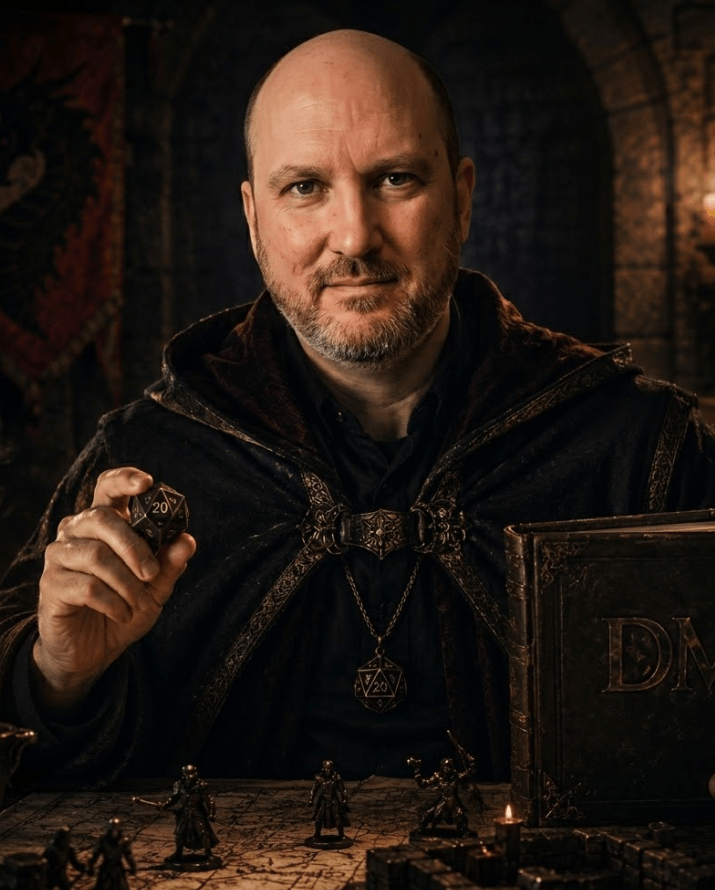
Michael Weems is a lifelong Dungeon Master and entrepreneur, longtime Chief Digital Officer of Heritage Auctions, and creator of ZapGM: an AI-powered tool looking to explode how tabletop worlds are built and experienced. We’re going to dig in with him today and talk about tabletop roleplaying, the potential and the risks of AI tools, and what it takes to build a mind-bending evening in a game.
Welcome back to our ongoing series of interviews with innovative creators in science fiction & fantasy storytelling, art, and gameplay! We call it the Inspiration Creator Series.
Michael, thanks very much for spending some time with us! Dungeon Masters are one of the great unappreciated treasures of the world. If no one ever said so, let me just thank you for the long nights googling folklore, drawing maps, printing off cool handouts, and practicing your weird voices. That’s awesome, and we all appreciate it.
That’s a great intro. Glad to be here.
Q. Let’s get your nerd credentials out of the way so we have everyone’s attention. How far do you go back with D&D or other RPG’s and which ruleset do you prefer?
I’ll explain by way of a trek down memory lane for us, um, more seasoned gamers. I was first introduced to OD&D by my friend’s older brother, I think around 1980-82. That would make me maybe 13 at the time. That friend started running for us soon after, and he got the Basic set with the dice you had to color in yourself with the provided wax pencil. I became a Dungeon Master in high school around ‘83, and a Game Master in college in ‘92 when I got hooked on Gurps and Champions for their one system, infinite worlds approach. Champions turned into Hero Games and I ran that and 3.5/Pathfinder mostly for a few decades. However, some of my favorite experiences have been with the Conan official D20 RPG, Warhammer Wrath and Glory and Eclipse Phase game systems. Those provide nuance that is hard to replicate from an “everything” system, and I highly recommend.
Q. What were your biggest creative inspirations growing up?
This may be cliché since everyone around this time was heavily influenced by them, but my influences came from shows like Star Blazers, Battle of the Planets (Gotchaman), Conan, & Star Wars. Literarily, books like the Stainless Steel Rat by Harry Harrison (I have a very dry sense of humor) and later by Snow Crash by Neal Stephenson and The Neutronium Alchemist by Petter F. Hamilton (I love hard sci-fi). It’s almost embarrassing how normal that is.
Q. In the prep for this chat, I saw that you mentioned having created several RPG’s, even selling 50 copies back at a convention in 1990. Let’s pause on that – pitch that game to me now. What made it different?
I’ll get the boring one out of the way first. I made a game adaptation of the movie “TAG: The Assassination Game”, from 1982. In this game, called Slayer, the players really hunted each other to the death for sport and profit, while the cynical public spurned them on through prizes and ad revenue. With that out of the way, here’s the sale pitch:
You’re a high school junior, your girlfriend Julia just broke up with you, and you are drowning your tears with your buddies down behind the bleachers late one Friday night. As the third beer is just starting to hit, your friend starts telling ghost stories about the local hermit that’s been hanging around campus lately. It’s absurd gossip, and it gets more fanciful as he spins the tale, but you’re loving it. Suddenly, you hear your name screamed from the woods. Not called, but screamed. It’s Julia, you’re positive, and you don’t know what to make of this. A cruel prank. Real trouble? Doesn’t matter, you have the disadvantage “must investigate strange occurrences alone”, so you tell your friends to wait there while you see what’s what.
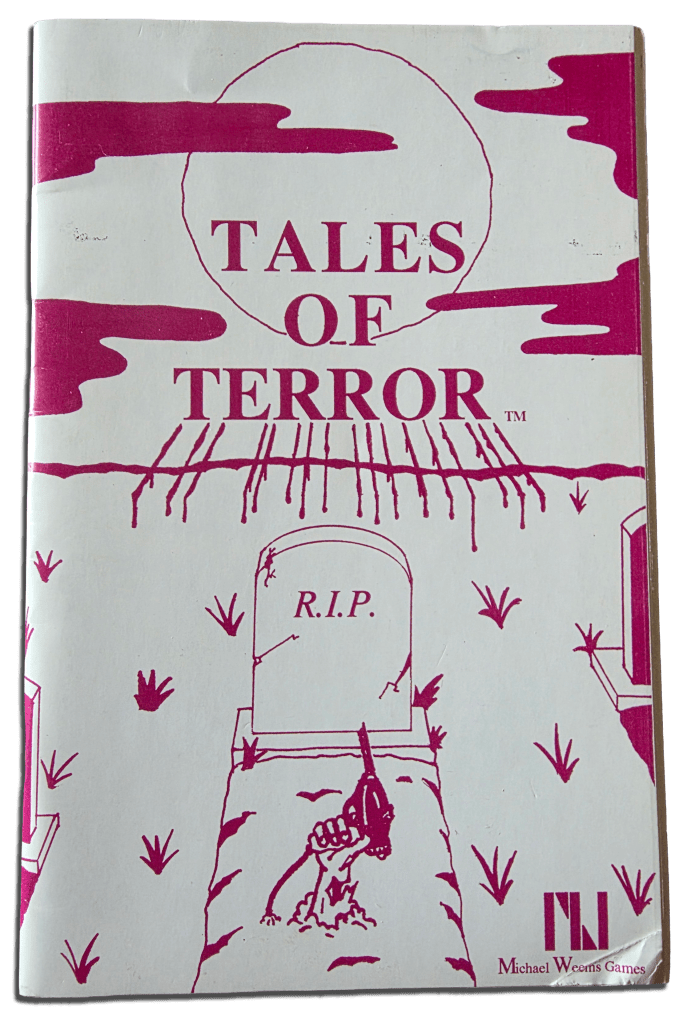
The game is called Tales of Terror. It is a very simple game meant for the rules to take a back seat to the role playing. You play a character in a horror movie, which could be a victim aspiring to be a hero, a monster or a villain. You build your character with advantages and disadvantages that that were all about flavor. For example, a victim might have an advantage of “scream that can be heard a mile away through solid rock” (Julia), but a disadvantage like “must split from group when in danger” (Julia again) or “car won’t start when in danger” (let’s hope that’s not you, because you feel that urgency to investigate). A villain might have “surprise appearance”, but also “must lecture victims for X rounds”, etc.. The game works great with both seasoned role players, and total novices equally well. Thanks for asking, as now I have a strong desire to break it out again.
This was 1991, and I was inspired by “It Came From the Late, Late, Late Show”, which is similarly themed but very different gameplay.
Q. My personal most memorable RPG moment was back in the 90’s playing Call of Cthulhu with my buddy, his semi-girlfriend (which I thought might have been better off as my girlfriend) and some folks I didn’t know. There was this book that drove you crazy if you read it, and my character tore off a page to carry it around and weaponize it. Anytime somebody gave me crap about something, I just showed them the page. Anyway, as I was descending into a basement researching weird noises, my buddy killed me with some floating whirling blades. She begged him to resurrect me. Yes, he won and I was dead. But she was impressed, and that’s what mattered more at the moment.
How about you? What’s your most memorable tabletop moment?
Not joking, I just laughed out loud. I didn’t think I would have to compete with the interviewer, but here goes. I love stories, as they are why we play, but I will limit myself to two and I hope you have room for both.
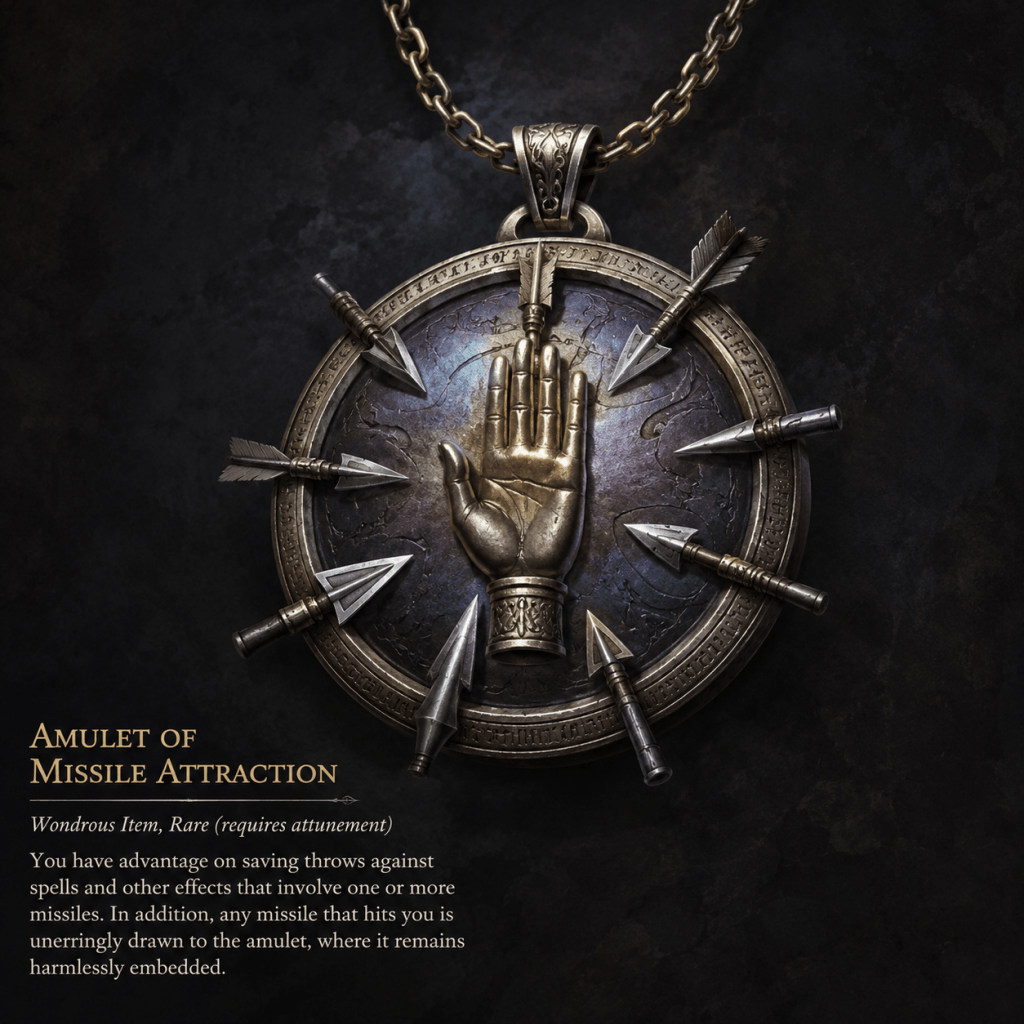
In the first, I was running D&D in college with people that are mostly still in my group today. One of them got an amulet of missile attraction in loot and thought it was missile deflection. The next fight was against a bunch of bugbears, many with bows. This player was a pin cushion by the end of the fight, and I was ready for him to lay it on me. But when the dust settled, I swear he said out loud to the rest of the group, not even remotely ironically, “just think how many times I would have been hit without this amulet!” I had no choice but to tell him the truth; it was too cruel at that point to continue. In his defense, to this day, he swears that I had previously stated that I never give out cursed items. I may have lied.
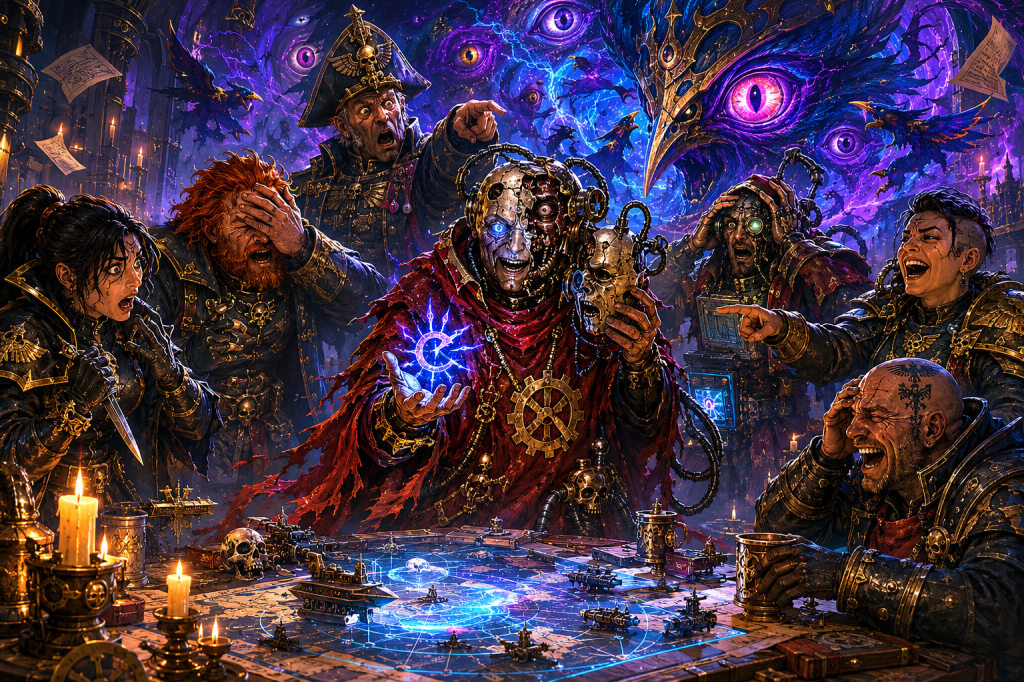
The second story is much more recent, same group. I was running Warhammer and the players were led by a rogue trader and solving a massive mystery involving all the gods of Chaos, with a universe shattering artifact. Throughout the story, the party would encounter subplots relating to one god or another, and discover how these disparate encounters were starting to weave into something larger. The one god that they had not had even an inkling of was Tzeentch, the god of plots and manipulation, among other things. Even though we have some real Warhammer fans in our group, they didn’t take notice of this, so they weren’t as suspicious as they should have been.
My master plot involved getting a Tzeentch spy onto their ship, and this spy was a servitor that they encountered named Solon. He still had some of his faculties and so could communicate better with the party, and they found him at an abandoned ancient research site for the Mechanicus Adeptus. I really hadn’t figured out how I was going to get him to weasel his way onto their ship, and so was going to have to just role-play it based on how they reacted to him. It turns out that their reaction should not have surprised me, because “party see likeable NPC, party adopt NPC”, which is what they promptly did. I was floored, but I knew that when the reveal happened many months later, nobody would believe that I had planned for him to be the spy all along. So I called another close friend, explained to him what happened, and let him know that I would one day call upon him to reveal my secret.
6 months passed, dozens of games where the party was harassed, outmaneuvered, and backstabbed to the point that they started questioning everyone and everything… but inexplicably, not Solon. And then on the final night when the time was right, I stopped and made a phone call without preamble. As the phone rang, I put it on speakerphone and the party started asking what I was doing interrupting the game like that. I just raised a finger and waited. The other friend answered the phone and I said, “I’m here with the group, and it’s time for you to tell them your secret”. When he explained that Solon was a Tzeentch spy and that Tzeentch had orchestrated the entire campaign, the groans and guffaws were like precious food for my soul, and we all laughed until we cried.
I should note here that I don’t think I could have orchestrated such a complex plot over such a long time and with such detail without ChatGPT. I was not a big Warhammer fan prior to running, and so ChatGPT would not only council me on the rules, but also the lore as I went. Together, we brainstormed and created the whole thing with way more detail and accuracy than I could have mustered alone.
Q. What is it about roleplaying games that inspires you? Yes, escapism is nice, but is there something more to it?
I play games for the fellowship and the memories that enrich my life. I lost a friend to a heart attack (sorry for the downer), and what I have left of him are those memories. Maybe they aren’t better memories than playing golf or going clubbing or whatever other people do together, but they feel more intimate to me. Role playing is the kind of shared experience that non-gamers are missing IMO.
Q. Why be the Dungeon Master, though? What made you gravitate to that role rather than just showing up to eat somebody else’s Dorito’s?
I run games for the creative outlet. I try to create universes, plots and NPCs, which lead to interactions that are immersive and fun. I like for the games to be mentally engaging. When I craft a story arc, I never figure out how the players will overcome it. I have realistic events and adversaries with their details and motivations, and the fun for me is seeing how the players solve the problems. Besides apparently lying about cursed items, I have built a level of trust with my players that I run realistic worlds with realistic NPCs, such that they can be creative in their problem solving.
A recent game in Eclipse Phase is a great example. The goal was to save a commune of people who refused digitization from being forcibly uploaded and made into indentured servants for a corporation that held a legal debt claim against them. To the system, it was debt repayment; to them, it was death. The players only had to delay the hired mercenaries long enough for the legal wrangling to work its way through the system.
Since there is no real death in this game when you have a backup of your ego, I thought the players might simply fight the mercenaries. Instead, they uncovered rumors that the commune’s youth were contemplating suicide to avoid being digitized (a throwaway comment I made during role playing off the cuff). The players latched onto that, decided to spread the rumor further, then fake the commune’s suicide pact by collapsing the tunnels they lived in on the moon. In reality, they hid the commune in a secure bunker and let the clock run out while their legal maneuvering took effect.
I adore that sort of outcome.
Q. Tell me about how prepping for games has changed over the years. I imagine the 90’s, the 2000’s, the 2010’s, and now. So we can see the contrast, what was all that like in those different periods?
In the 1990s, prepping for a game meant a pad of notebook paper, a pad of graph paper and a no. 2 pencil. I might occasionally have a printed module, some artwork or other collateral from a Dragon Magazine, or perhaps something I made with Mac Paint on my Plus, but the ideation was all me, and the props were severely limited by my art skills (see the Tales of Terror cover above as proof).
Later, Google helped with the collateral, although I was still limited to my own experience and creativity. I don’t know of many game masters that have a confidant that they can bounce ideas off of, nor artists volunteering their custom art. It’s usually us alone, doing our best. That said, Google Image Search at least gave me a way to visually show what was going on in the game.
More recently, we got AI for both brainstorming and artwork. As it’s gotten better, it’s become an expert on my games and my worlds and is a springboard to take my games to new heights. Not only has my game prep been cut dramatically, but at the same time the game materials have gone way up in quality.
Now, I use my own tool, ZapGM.
Q. And what will it look like in the 2050’s?
About 20 years ago, I saw Ray Kurzweil speak about the singularity and the future of society. Mind blowing stuff that is coming to fruition in the next 5ish years IMO. And more recently, Elon gave an interview where he said that once we hit ASI (Artificial Super Intelligence), that all bets are off, and I tend to take that approach. So 2050’s, tough to say.
But in the shorter term, I think we’ll get AI and robotics to the point where nobody has to work. And I think that, possibly after some turmoil during the transition, we’ll end up with universal high income, where it feels more like retirement than unemployment. As someone who would like to retire in the not-too-distant future, I like to think of it that way. When people tell me they’re retiring, not once have I thought to offer condolences. Instead, I congratulate them on being able to unshackle themselves from the work week just to survive, and on finally being able to thrive by doing whatever they find valuable.
Q. You’re building something exciting right now. Tell us about that.
As I optimized my processes for prepping my games, I started coding ZapGM just for myself. There are prompting techniques, as well as agent scaffolding that can be applied to get levels of consistency, accuracy and creativity that the chatbots can’t do on their own at this point. As I honed that system, my youngest son asked if I could add some features to help him run for his friends. None of them wanted to GM, and he didn’t feel confident enough in the rules, much less the creative side of making new campaigns… so I added more features. Eventually, my party encouraged me to finish out the feature set and launch it for public use, which I recently did. As a long-time entrepreneur, the experience isn’t that new to me, but the fear of failure and rejection is just as real the last time as the first. The site just left early access, so we’ll soon see.
Q. I see exports to Roll20, Foundry, supporting Pathfinder and D&D simultaneously – it seems you’re interested in integrating with what’s going on rather than replacing. Am I wrong about that?
Because I made this tool to be helpful to me, I never saw it as competition for what’s out there. In some respects, it supports whatever game masters are currently doing. One way it does this is with pre-made maps that can be exported to those other systems. I even wrote what I think are the best online guides for importing maps with vectors into Foundry and Roll20, better than their own documentation. Another is with map editing tools that have much easier to use vector creation/editing, square and hex grid support, plus AI inpainting for tweaking maps. I encourage my visitors to use those tools to improve what they’re already doing elsewhere.
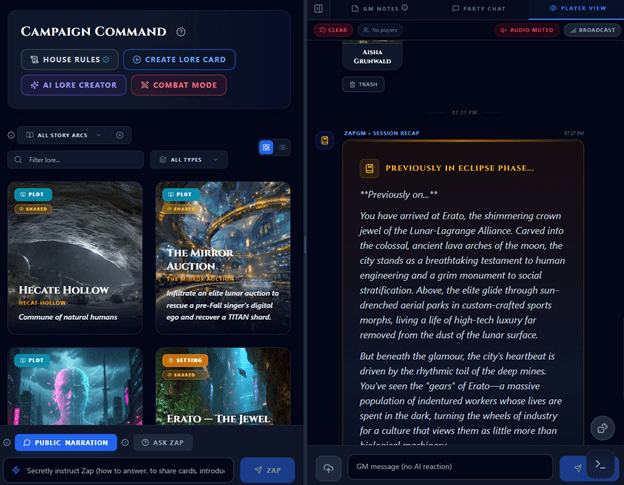
Additionally, ZapGM is a different way of viewing the world building, maintenance and hosting than other systems. It aligns with the way I create and run games, so time will tell if that appeals to a broader audience. You use it in three stages. The first is to brainstorm with Zap about the world and generate rich Lore Cards (Settings, Plots, NPCs, Adversaries, etc.). The second is to broadcast to your players with a shared canvas, where uniquely the players can come back and interact not just with their PCs, but also read the shared lore, create new PCs and Summons and more. And lastly, as the game master hosts the game, the AI can help generate unique narration with text to speech where each NPCs gets their own voice. And one of the coolest features IMO is that there is an AI overseer that watches the narration and automatically suggests and makes approved edits to the Lore Cards. So if the players anger an NPC, the Overseer will suggest noting in the NPCs Lore Card that disposition and that the players get disadvantage on future rolls. And if the game master decides to roll that back or regenerate the narration, the Overseer puts the lore cards back to the way they were before that encounter.
Maybe that sounds just technical, features in a website, but that is some of the most fun I’ve had creatively lately. Figuring out what features to add and then designing them is fun, and I even invented two new features (I have two patents pending). At some points in developing this site, I got so focused that I worked 20 hour days for several weeks straight… and promptly got sick. So I can’t say that I recommend that, but it does illustrate the level of creative energy I was pouring out.
Q. I sometimes see people pushing back on AI like a little guy with a sword wading into the waves swinging left and right and shouting to get off their beach. Yet there’s a lot of passion around this topic. I think AI slop is real but avoidable. Artists should be compensated for their work, but image generation tools are almost certainly going to be a tool in the workflow of future generations just like stock images, filters, 3D nodes, and asset libraries. My take, anyway.
What’s your position on AI in creative arts and particularly, roleplaying games? How do you address some of the valid concerns?
I agree that there are real issues around AI taking jobs, and as I said above, I think society will change in many ways we can’t predict, but we can act humanely and empathetically as we progress toward that new future.
As for game masters and players, I am thrilled with how AI can empower us all. No game master is going to commission artwork for their weekly game with 3 friends, or commission a writer to brainstorm or hone their plots and narration. AI filling this gap is enriching everyone involved IMO. For decades, this has been an unsolved need, and the improvements for me and my players are tangible.
PS. I have a friend that flirts with Grok. Let’s not go there.
Q. You’ve got a great take on Non-Player Characters in games, insisting that they be believable and not “quest dispensers”. Tell me about that.
I almost got a writing degree, and out of that came my passion for storytelling. Good stories are populated by real people, with real motives, that behave in realistic ways. I want my players to be so immersed in role playing their character, that they feel like the world they are inhabiting is real. When that happens, it’s magic. One of my players ended up so drunk in the Conan campaign that they woke up married to the daughter of a local merchant, dowry included (a goat). The wife and the goat stayed with them for the rest of their adventures and were the subject of many shenanigans. I live for that.
Q. All right – let’s wind it up with a banger, then. Tell me your absolute ideal experience you imagine in a roleplaying game. Get crazy.
The year is 2038, my brain is integrated with my AI assistant and my personal humanoid robot is integrated with that. Each of my players, my lifelong friends that have been with me for 50 years or more by now, have the same setup. As we cast a portion of our consciousness into our physical avatars, they step forth both in the real world and into an alternate reality with the aid of AR/VR. Although we are each in our various comfy spaces with our real bodies, me on the shore of Interlaken Switzerland, Brent in his mountain cabin, Matt in a permanent renaissance community, Bill sailing the deep blue and Duane in a Tokyo high-rise, our avatars step into the Conan universe yet again. Something about that world keeps drawing us back.
Your readers might think that I would be only a player now. But something I think many players don’t realize is that game masters do it because they love it, not because they have to. So, I imagine that as we step into the game again, I am both orchestrating the adventure with my AI assistant and also getting to be part of the adventure to boot.
Thank you for giving me this opportunity to share my story. I hope your readers will check out www.ZapGM.com and more importantly, find it useful.
*
Thanks again for your generous time today, Michael. It was a blast, and I’m looking forward to seeing more of what you’re up to as things take off for you.
Here at Grailrunner, we chase imagination as craft. Anything we can bring you that lights the fire of your creativity is fair game, with a special bend towards speculative fiction and fantasy. If you’ve got a willingness to tinker, you should find something here you can use, remix, or otherwise refine for whatever literary, roleplaying, or artistic wonders you’re cooking!
Today’s freebie is a really interesting one for the tabletop crowd, especially anyone who gets that nostalgic, electric feeling when you crack open old-school adventure content and your brain instantly starts building rooms, traps, villains, and bad decisions.
What’s the idea?
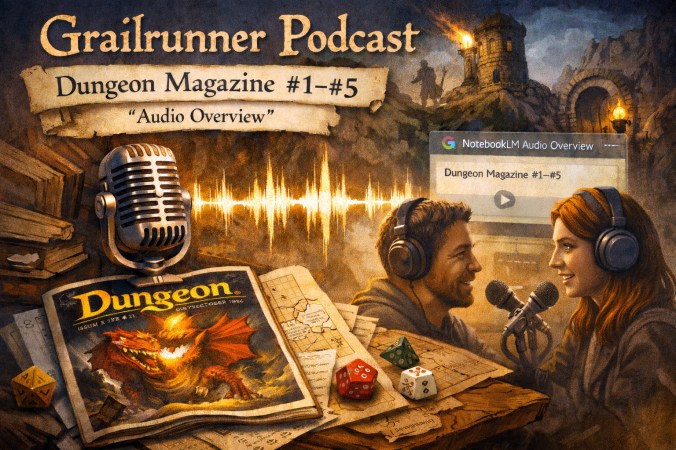
We wanted to turn classic modules from old Dungeon Magazine issues into a listen-able conversation
So, we generated a podcast-style episode using Google’s NotebookLM “Audio Overview” feature: one of those “wait…this is actually useful” tools that can transform your source material into an audio discussion format.
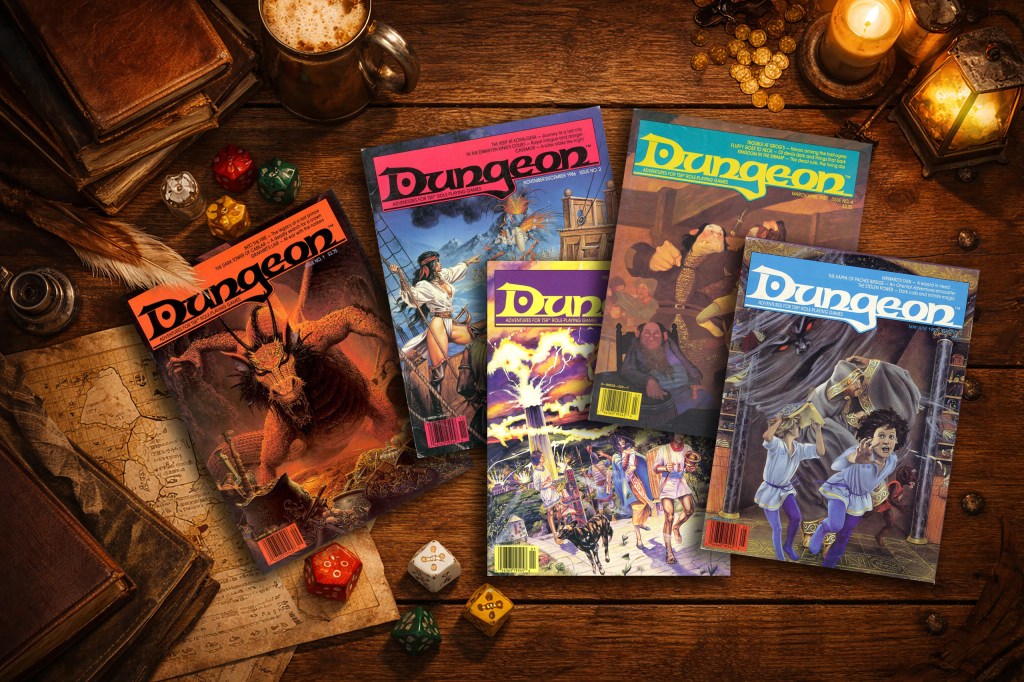
And the source material we fed it is a proper slice of RPG history (which you can download for free thanks to the folks at the Internet Archive – links below):
That’s the on-ramp period: Dungeon Magazine still finding its voice, still doing that early TSR-era thing where the tone can swing from earnest peril to delightfully oddball in the space of a page. It’s an incredible “creative compost pile” for modern GMs: hooks, maps, structures, pacing tricks, and that evergreen lesson that adventures are engines.
What is this (and what is it not)?
This is not a replacement for reading the magazines. It’s not “here are the adventures word-for-word.” Think of it as:
a guided audio tour of themes, adventure structures, and GM sparks
a way to re-encounter old material when you’re driving, cleaning, sketching, or prepping
a fast way to ask: What’s in here that I can steal, remix, and make new?
We like AI tools as levers: ways to turn raw source inspiration into momentum, while still being upfront that AI was used.
Why Dungeon #1–#5?
Because they’re early enough to feel like a time capsule, but polished enough to still be usable at the table. The first five issues show the magazine’s core promise: a buffet of adventures with different moods and play styles. Exactly the kind of variety that keeps a campaign from turning into one long corridor.
Also, if you’re the kind of creator who likes grabbing one great detail: an encounter concept, a villain posture, a dungeon rhythm, and letting it domino into a whole scenario, these issues are loaded with that stuff.
Why NotebookLM for this?
NotebookLM’s Audio Overview is basically a “make my sources talk back to me” button. Google describes it as turning documents and other materials into an “engaging discussion.” blog.google
And that’s the magic. The format doesn’t feel like a lecture. It feels like you’ve got two curious nerds in the room pulling interesting threads out of the stack. For RPG prep, that’s gold because prep is often just asking better questions about material you already have.
What’s the Grailrunner angle?
If you’ve read our recent posts, you know the theme: build year by year, make interesting things, share freebies, keep the creative engine running.
This podcast episode is exactly that energy and another little proof-of-concept that says:
What if “reading old RPG material” became listening to it think out loud and THAT sparked your next session?
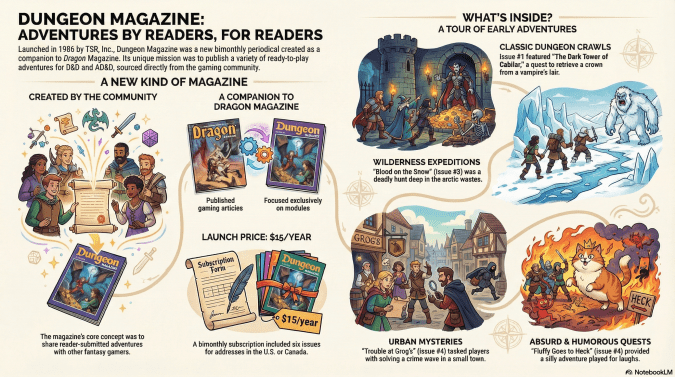
Smash the Podcast Announcement image below to give it a listen for free:
I’d love to know what hits you:
Which issue had the best “I’m stealing that” moment?
Did the audio format surface anything you’d normally skim past?
What should we feed NotebookLM next: old Dragon editorials? a run of White Dwarf? classic sci-fi pulp?
We’ve got a lot cooking for 2026, and if the last year taught us anything, it’s that the best stuff often starts as a weird little experiment you almost didn’t try.
A “bunny trail”is defined as a digression or tangent in a conversation, writing, or research that strays from the main point, often hopping from one related but different topic to another, like a rabbit darting through fields; it can be a useful, curiosity-driven exploration or a time-wasting distraction.
I sometimes feel like that describes me a little too well.
Anyway, happy new year! Let’s kick 2026 off with a new bunny trail and some freebies! This one’s for card game enthusiasts, folks interested in gaming history, and I’m adding a twist for game masters of RPG’s that would like to add some authentic wild west gambling into their next campaign.
Cool?
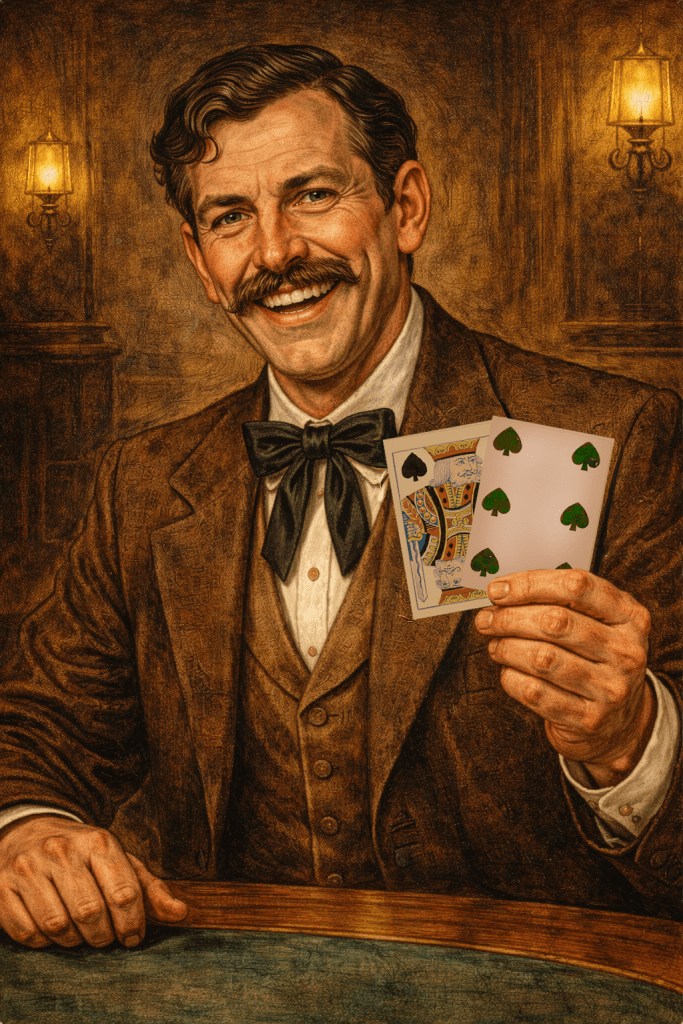
Before the holidays, I read a biography of legendary lawman, Wyatt Earp titled Wyatt Earp: The Life Behind the Legend by Casey Tefertiller. Great read, by the way, but not my point today. I catch odd things in between the lines sometimes when I’m supposed to be paying attention to the main storyline, and one thing that snatched my attention early was Earp’s passion for a card game I’d never heard of called Faro. It sounded awesome; I was surprised it wasn’t more popular now. They used to call it “Bucking the tiger” because some card decks had tigers on their backs. And of course that only makes it more awesome.
How do you play?
The main mechanic of the game is as follows:
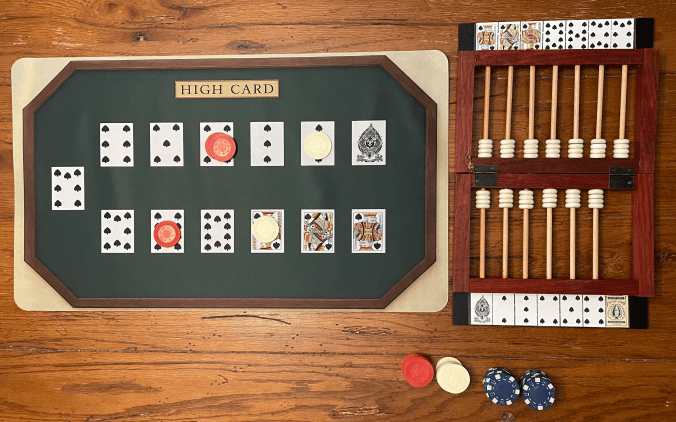
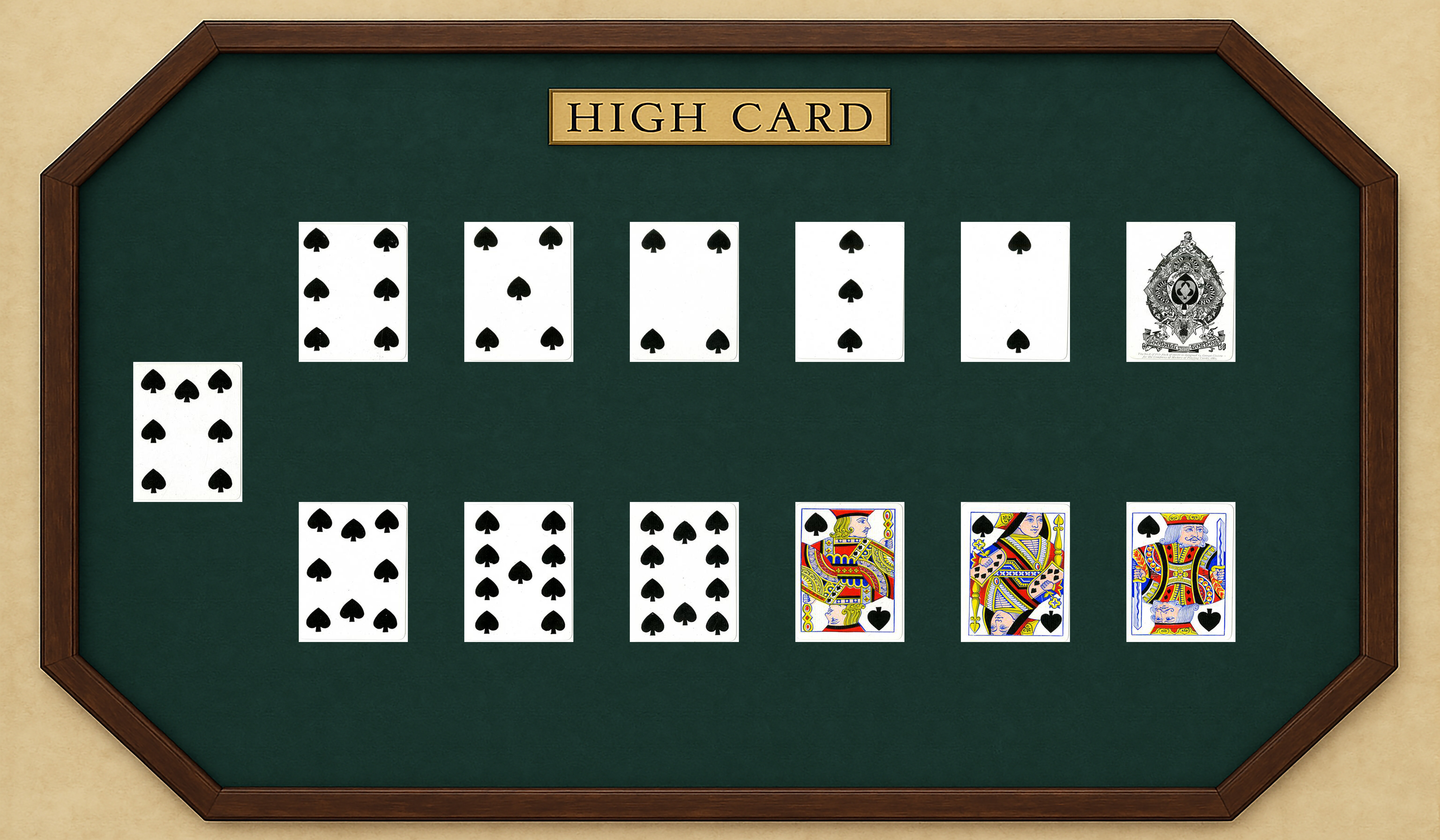
One dealer, multiple players. Standard 52 card deck with no Jokers. Before them on the table is a spread of cards on which they’ll place their bets representing one each of a suit (so Ace is 1, then 2-10 and the face cards). The particular suit on the table doesn’t matter – just what kind of card it is. This layout is just a spot for players to put their chips as they bet on which cards the dealer will draw next each round.
The dealer draws one card at first to “burn the card”, which means nothing other than there needs to be only 3 cards in the final hand so this makes the numbers work. Nobody bets on that one.
After that, the dealer draws two cards at a time, the first being the “losing card” and the second “the winning card”. If you’ve got chips on a “losing card”, the dealer takes them. If you’ve got chips on a “winning card”, the dealer pays you out that many chips. The dealer doesn’t place any bets.
The plaque labeled “High Card” is a bet you can make that the second card will be numerically higher than the first card. Again, if you’re right, then the dealer pays you out however much you bet. Dealers can entice you to take advantage of that bet by upping the payout ratio (“High card’s paying out two to one next hand!”)
That abacus device was called a “case keeper”. You slide the beads to keep track of what cards have been drawn so players can know better what’s left in the deck to be drawn. It makes the game much more exciting towards the last few hands as you have better information.
The final hand of three cards is handled differently: players put a penny on the card they bet will be drawn first, then their chips on the card they’re betting will be drawn second (with the third and final card assumed).
Sounds fun. Why don’t people play this anymore?
It appears the house odds aren’t sufficiently in their favor to make this as profitable as poker or some other games. I’ve played it fairly many times now as dealer and can vouch for this – my family broke the bank more than once. Any ties where the dealer draws the same type of card twice go to the house, but that and the probabilities of the game just don’t pay enough, it seems.
And the cheating, which we’ll get to shortly.
So cowboys played this?
Oh yeah, big time! Anybody moving cattle to sell them in the bigger towns and with a little extra money in their pocket couldn’t wait to get as drunk as possible and play Faro. The house knew when to give out free drinks to shift the odds more in their favor, and when to send pretty ladies over as well for more distraction – offering rooms upstairs of course.
You mentioned cheating?
Oh, man was there cheating! Have a look at this book titled Faro Exposed: or The Gambler and His Prey by Alfred Trumble. It was published in 1882 and details the wildest machinations and sleights of hand that dealers would employ to make it all but impossible for players to win. And I heartily recommend this book if you’re at all interested in this game because it’s an incredible read.
The introduction of a mechanical means of dealing called a “dealing box” was supposed to give the gambler a sense that he was dealing with a fair game as it doled out cards one at a time through its apparatus. Supposedly, this took the sleight of hand and manipulations of the dealer out of play, but Trumble walks through multiple chapters worth of how that was also nonsense.
Here’s a funny quote from the book:
“But the reader will ask. Are there no honest gamblers? I answer no. Emphatically no. The sun shines not upon one honest gambler in all this broad land.”
Where did you get the stuff to play?
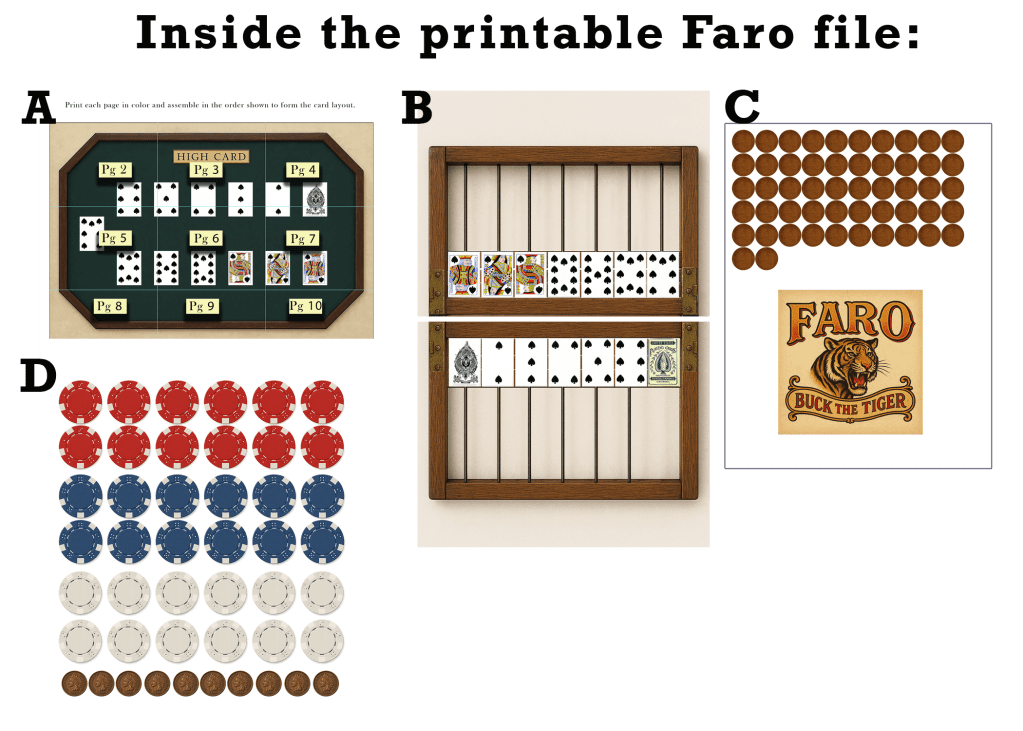
Here’s where today’s freebies come in! I made everything in Photoshop so it can be printed out on regular 8.5 x 11″ paper and assembled on the table. If you have a card deck, printer, scissors, and tape, you’re good to go. I included poker chips and pennies just for completeness but unless you have a Silhouette Cameo or a lot of patience, you’ll probably just use tokens or coins instead. That’s fine.
I wanted it to look cool and authentic though. The cards came from a Wiki Commons reproduction of 1880’s era cards. The coins too.
There are several pdf’s in the download:
A: The Faro card layout itself in several pages for accuracy on size – print and place per the instructions.
B: The Faro case keeper in 2 pages – just print and assemble per the picture. You’ll use pennies or tokens in place of the abacus beads and just slide them along the dowels in the image.
C: Some tokens to use (if you choose) on the Faro case keeper as well as the Tiger logo
D: Some poker chips and pennies (if you don’t have any handy yourself)
That looks great, thanks! Anything for roleplaying gamers?
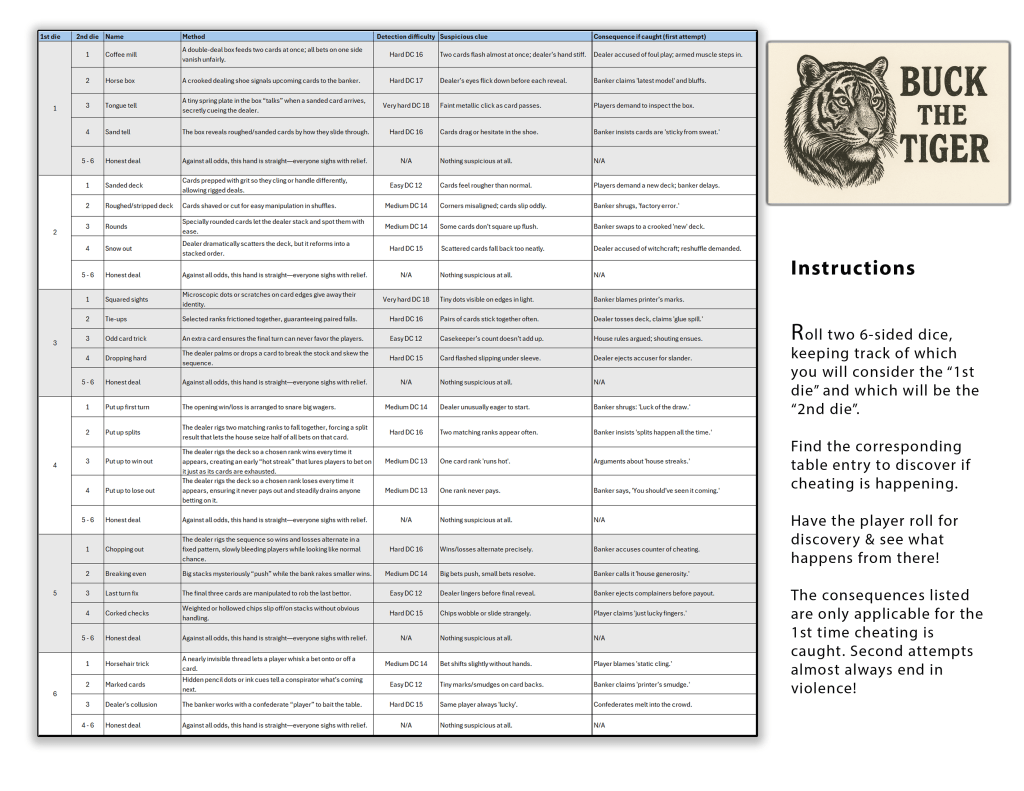
Trumble’s extensive descriptions of cheating methods made me wonder if this wouldn’t be a lot of fun in a roleplaying campaign – something quick to drop in to a wild west scenario in the ruleset or storyline of your choice where players could actually play the card game, gamble authentically, and be cheated. The game master could drop clues that cheating was happening, and dice rolls could decide how obvious that is and which authentic cheating methods were occurring.
Here’s what that wound up looking like:
Roll two D6’s to decide the situation from the table, then use Perception rolls (or whatever your ruleset uses for that) to decide whether it’s noticed or not. If it is noticed, then the table offers details on the clues to drop and also the consequences if the player decides to do something about it (first notice only – after that, guns come out!)
Here’s that table in a printable pdf as well if you think that sounds interesting:
If you’d like a high resolution 24″ x 14″ jpg of the Faro table to have a playmat printed (like I did), just click the image below for that. I used Frogigo (link here).
And that’s what I wanted to bring you today. I hope you’re as intrigued as I was – it really is a fun game, and the images of sly dealers and drunk gamblers, the ensuing gunplay, that all was just fuel for my imagination. We played this like crazy over Thanksgiving and Christmas. My dad especially loved it.
Best day of the year. No doubt at all. I love Christmas in all its crazy-train, circus-riot, flashing chili peppers. I’m sorry if it’s not your jam, and I completely get that for some people. But for me, it’s a warm, crackling fire and pumpkin pie, making the dog wear a goofy sweater, eating at Harvey’s in Kansas City at Union Station, snacking on exotic candy and cookies from World Market, and just enjoying family.
I hope yours has in store for you whatever warms your heart.
2025 was another fun building year for Grailrunner. We published our bibliomancy RPG Salt Mystic: Book of Lots in the Spring and submitted to the Ennie Awards. No dice on the Ennie’s (see what I did there, bibliomancy fans?) but a good experience nonetheless. Following that, we rebooted the Grailrunner store, including the Discovery Series of t-shirts and also started selling our first art prints there. Click the “Shop Now” button to check that out.
Upcoming, we’ve got two Grailrunner novels still in the works: Mazewater (set in the Salt Mystic universe) and a horror novel likely to be titled Line (set in what we hope to launch as a series of blues-saturated highway terror stories we’ll call Highway of Ashes).
We’re also refreshing the art on the Salt Mystic tabletop skirmish game. That’s particularly exciting because feedback has always been that people wish we hadn’t gone with the 3D art of the original. We’re fixing that, so be patient. So far, they look fantastic – there are just a lot of them and only so much time in the day (and budget).
I’m hoping in 2026 we can at least get started on a marvelous idea that’s been bubbling around the Grailrunner creation station for a few months now: a fantasy fishing roleplaying system to be called Dreamwater. If we can get this put together, and if you at all see the attraction of sitting by a beautiful lake with a fishing rod in hopes of catching a magical fish that speaks and possibly changes into a fighting beast, then we’ve got your back with this one. Will be amazing.
Anyway, thanks for hanging around with us this year and stopping by to see what nonsense we get up to. I’m always interested to see where people are that read our posts – drop us a note here or on the Facebook page to stay in touch. Let’s hope we can keep finding novelties of history to tell you about, fascinating creators to interview, great pulp science fiction of the past to highlight, and amazing freebies to send your way. Have a look here to see if you missed anything cool.
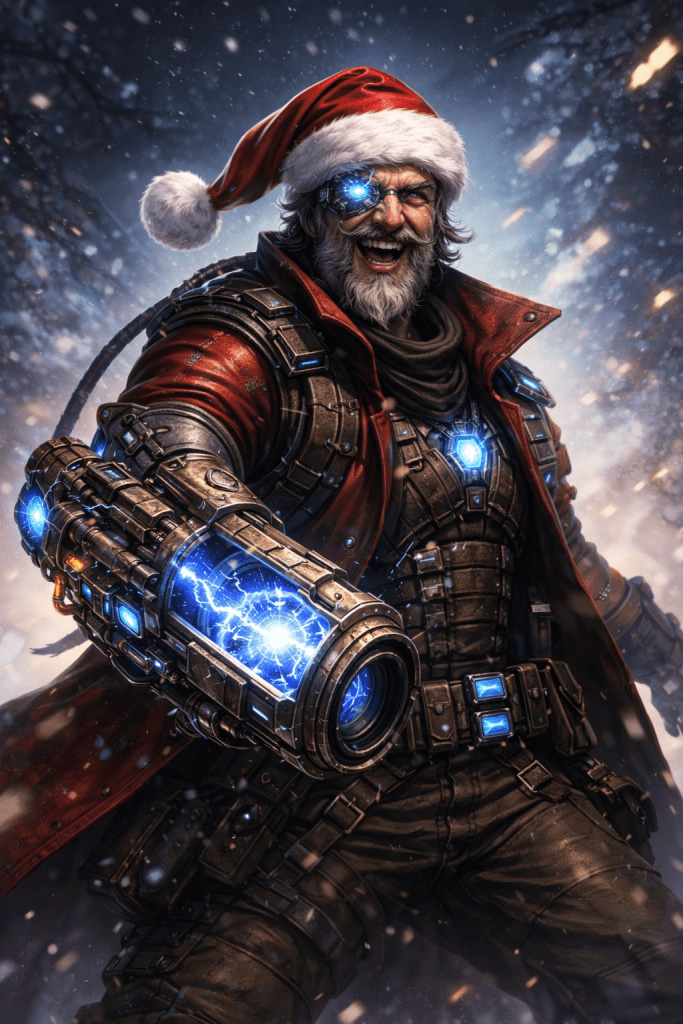
Anyway, in celebration of the year and this holiday season, I wanted to point you to some beautiful and nostalgic Christmas illustrations to enjoy.
To honor Christmases of the past, I came across a few vintage Christmas illustrations and links to their sources that sent my mind reeling. I love the windey-turney path by which we got so many of our Christmas traditions, and these really caught my eye:
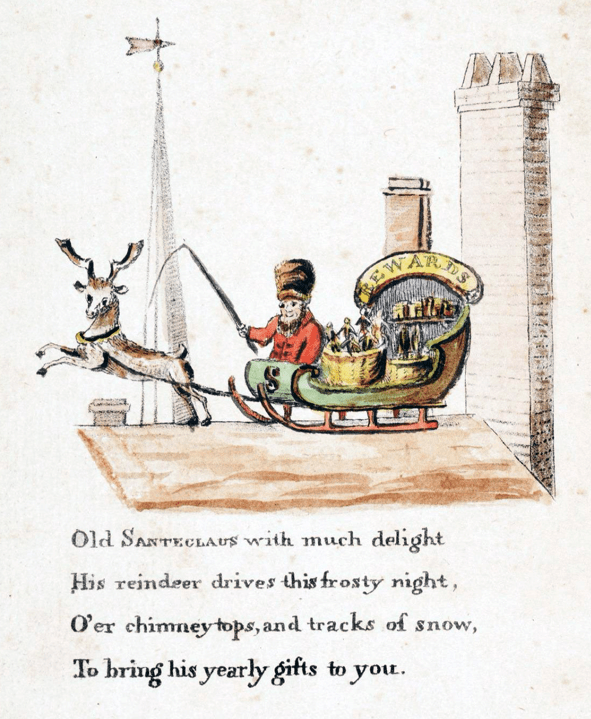
In 1821, a small illustrated paperback titled The Children’s Friend: A New-Year’s Present, to the Little Ones from Five to Twelve was published. It contained quite possibly the first mention and illustration of Santa’s reindeer and sleigh and predated Twas The Night Before Christmas by 2 years. It may have even inspired Clement Clarke Moore to write that poem, which of course gave us the core of our modern Santa Claus.
And of course the famous cartoonist, Thomas Nast fine-tuned the Santa we know and love today in his wonderful illustrations, many of which are compiled in a book titled Christmas Drawings for the Human Race. Here’s a link so you can take a look at the entire book. It’s a real treat to see some of these masterworks and know as you appreciate the craftmanship and warmth that these very pictures are what taught us how the jolly old elf looks and makes his way. In many ways, Nast described all this for us, and he did it to help heal America from its wounds from the Civil War.
Here are a few of those gorgeous illustrations, which are hilarious and charming. You really should take a few minutes to go see the full series of art pieces. They’re important history, but also just magical.
That’s what I wanted to bring you today. I wish for you all the joy that you can wish this Christmas and for a shining, prosperous new year.
It’s been a month since we published SALT MYSTIC: BOOK OF LOTS, a solo roleplaying game based on our multi-media Salt Mystic setting. There are some bright spots, some hopeful notes, and a world of pain. Overall, we’re still incredibly proud of the product and seeing and hearing people appreciate it in the wild is an experience like nothing else!
We thought it would be helpful for anybody thinking of putting your own book out to see what we tried: what worked, and what didn’t…and what still might. Care to come along?
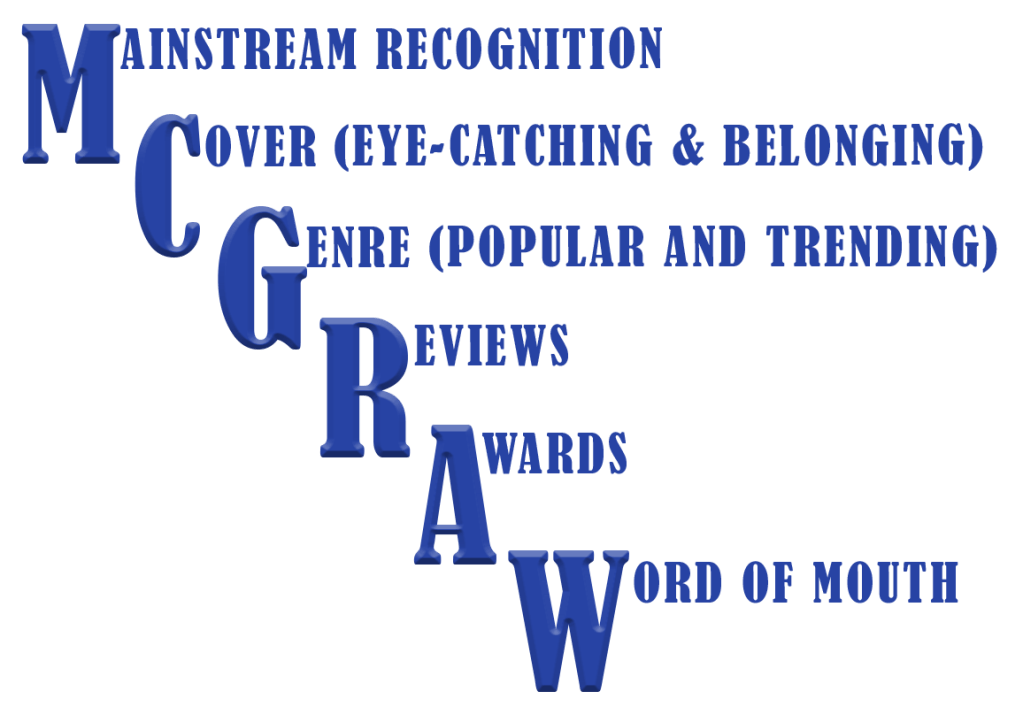
Way back in 2016, I wrote a short article defining some indie publishing principles based on lessons from the launch of my first book: TEARING DOWN THE STATUES. The principles were consolidated into the acronym “MCGRAW”, suggesting the key elements necessary for publishing success (Mainstream recognition, an eye-catching Cover that looks like it belongs with books like it, a popular Genre, as many Reviews on major listing sites as possible, Awards to add validation that the book merits attention, and Word of Mouth.) We kept these in mind this launch and tried to incorporate what we could, although the genre of tabletop roleplaying is so saturated and so dominated by Dungeons & Dragons that we were working uphill and digging holes from the beginning.
Still, hope springs eternal, and this is a product we believe in mightily, knowing from its ideation that nobody else was doing anything like it.
What was the pre-launch like?
February was a hot mess, finalizing the proofs and shaking trees to try and get attention from bloggers and gaming news sites. Short of providing free pizza delivered by cosplayers who do magic tricks, I’m not sure what else we could have done to get mentions from some of these guys – we reached out to 20 and got one “No, Thanks” and absolute crickets otherwise. That’s offering a free physical copy for review, by the way. Local gaming store wasn’t interested, and I didn’t have the heart to cold call others. My ego can only take so much bruising!
I pushed my Photoshop skills to the breaking point generating ad assets to use in social media and ad campaigns, stirring up some images that I think really popped! Here’s my favorite, though we had to switch it out to juice the click rate after things got rolling.
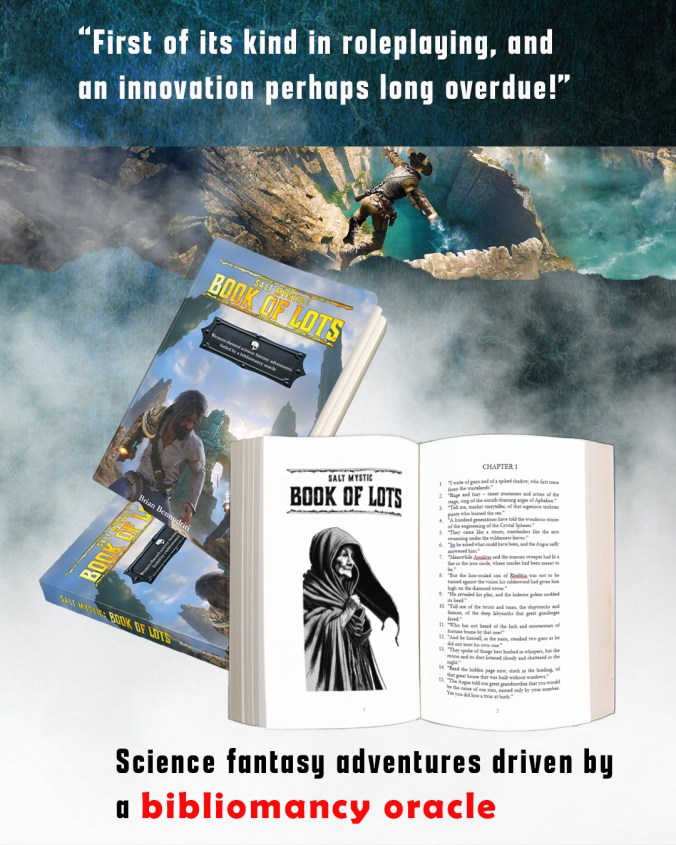
I’m a big fan of Absolute’s 3d cover generator and Envato’s PlaceIt – both to generate mock up’s of the cover in various places. We generated this one below for banners through RPG Geek and some other sites:
We came SOOOO close to hiring an artist we’ve been targeting for years now, and he might yet come on board for a promotional poster, so I won’t jinx anything by saying more. That would be amazing, so wish us luck! Anyway, he was swamped with other things, so the heavy lifting on graphics was still in-house.
How did you handle distribution setup?
The book is available at booksellers globally through Ingram Spark, and also on Amazon thru Kindle Direct Publishing, as well as the pdf on Drivethru RPG. We got the barcode direct from Bowker to retain full distribution rights – there are strings attached to the freebies. Honestly, setup was fairly painless for Kindle Direct, but I thought at one point Ingram was going to leave me with facial tics!
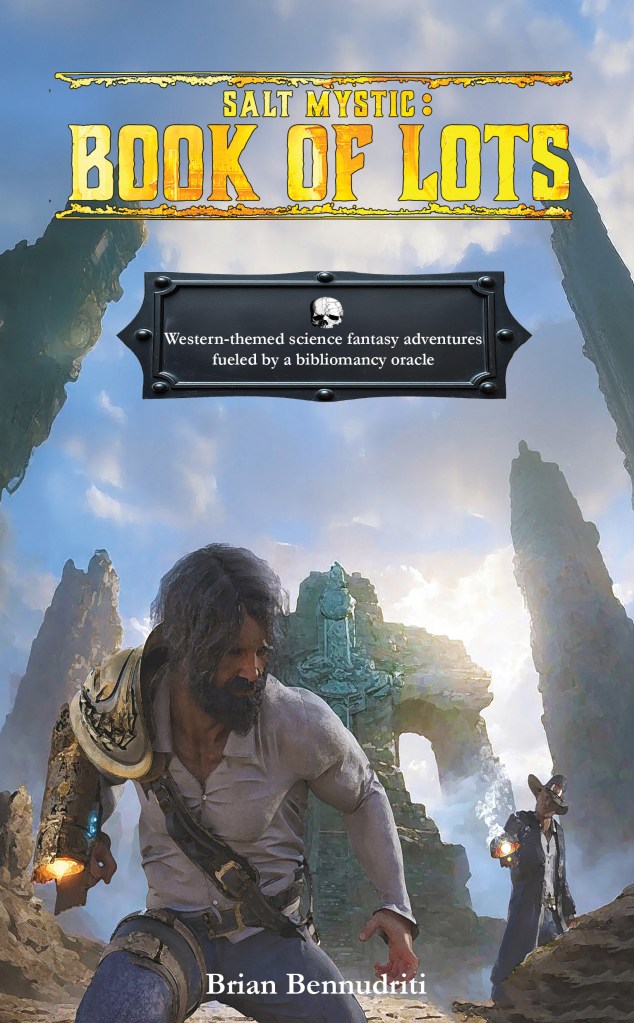
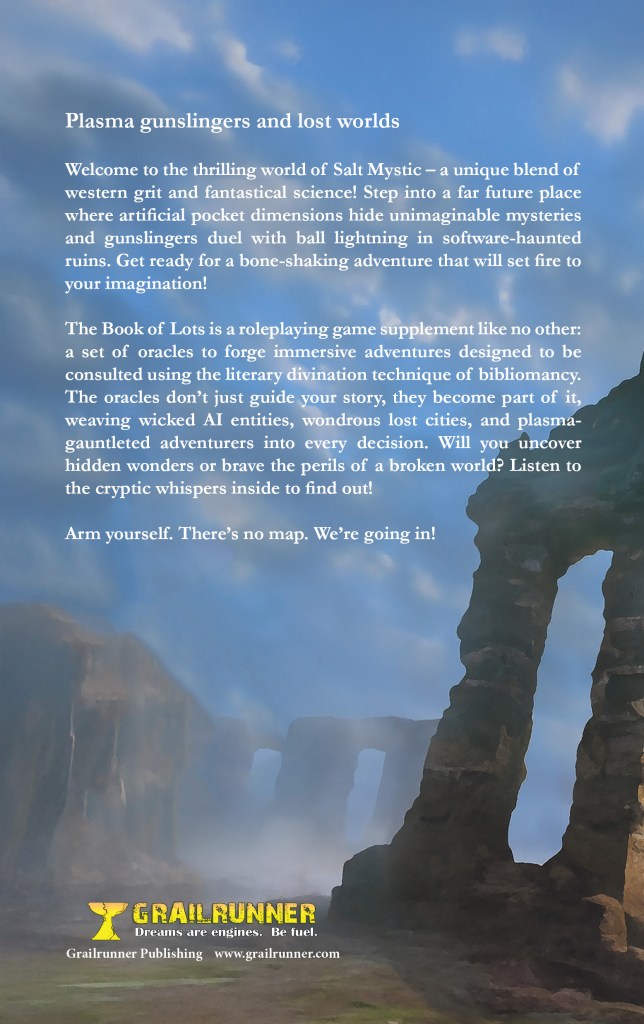
The cover file was a high res jpg I’d built in Adobe Illustrator, and it included some transparent png images (the title and the Grailrunner logo). The art was done with Daz Studio for the figures, some Blender and Photoshop filters for the forearm weapons, and some AI help for the background, everything composited and color graded in Photoshop then dropped into Illustrator for the text and placements. This is what that looks like, front and back:
Weird white outlines were appearing in the digital proof around anything that was a png in the image. Maddening! Nobody at Ingram Customer Service was responding, and internet advice was kind of all over the place. I tried various export presets and never resolved it, at last approving the digital proof even with the outlines in hopes that it was in fact a screen artifact only (as some advice suggested). Thankfully, the issue didn’t show up in the physical version.
As for offering a physical version through Drivethru RPG, I basically gave up. They seem to be saying they use the same print house as Ingram, though a different division or something? I dunno. Anyway, much worse issues with anything that was a png, including the interior art! A true disaster! I’m sure they would say it’s my fault, but I bailed entirely and just offer the digital version through them. My blood pressure thanked me immediately!
How did you advertise?
We ran campaigns on Facebook, through Google, Amazon, and on RPG Geek. The book is also listed this month on Ingram’s home page and in the World Reader, iCurate Connection, and Indiewire newsletters, all via Ingram (~28,000 circulation for the newsletters). Through the Independent Book Publishers Association, the book will be represented at the American Library Association conference in Philadelphia this June. We’ll see how all that works out, but here are some initial experiences:
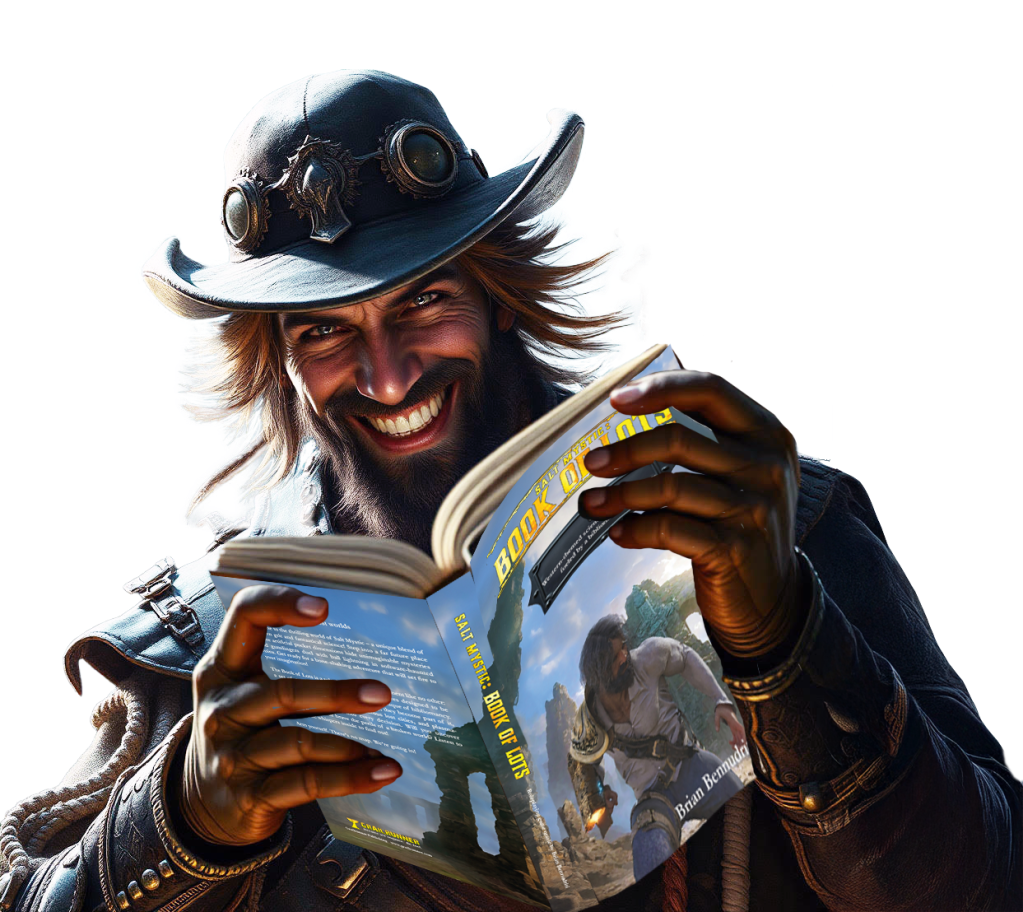
Meta (Facebook) started at 2.1% click rates with tens of thousands of impressions as well as loads of shares and likes and bookmarks. It all felt great until we saw that precious little of that was converting to sales. Internet research was suggesting a good click rate was 2% for search ads and 0.1% for display ads like banners, but for us it was just a lot of activity with poor conversions. By changing the graphics out to a grinning gunslinger and tweaking the copy a bit, we doubled the click rate to 4.2%. We’ll see if all those bookmarks and shares pay off down the line!
GoogleAds was impressive, as their algorithm learns as you go, tweaking things to improve the reach. We wound up with a 5.1% click rate by the campaign’s end, which we view as solid. We even had one day peak at the end at 8.1%! All campaigns led to the same Amazon listing, so we can’t separate sales by campaign but I thought a lot of this experience overall.
RPG Geek was a little disappointing. Multiple banner and display ads dominated the site for a month. The thinking here was that this site entirely specializes in roleplaying games, so you couldn’t find a more on-the-nose target audience! Still, click rates flatlined at 0.1% for two weeks, till the same changes as above doubled that to a paltry 0.18% by campaign end.
Amazon: We only launched the Amazon ads in the last week or so – it’s a little early to report any results. I’d also never added any A+ content to a listing before, so that was new. Of course, I added that gunslinger since he seems to catch eyeballs, along with a very short description of the book.
So, was it a good launch?
Could have done more on pre-launch to get some mentions, honestly. We need to work on a solid email list and social media following though the new content required for that is a bit threatening when everyone has day jobs. Reviews remain super difficult to get, though some favorables have popped up that we didn’t arrange. Overall, sales are ramping up very slowly. Glacially, you might say.
What’s next?
I submitted SALT MYSTIC: BOOK OF LOTS for consideration in the 2025 Ennie Awards, which is the Super Bowl of RPG’s! Any mentions at all would be high octane fuel for me. That’s a long shot, of course, just because of the ridiculous amount of talent in the field these days. Still, you never know…
*
I hope some of this was helpful or at least entertaining. Warts and all, this is how things have gone so far and the plan going forward. I’m sure the outside observer can find all manner of beasties and stinking swamps herein, but from the inside, it’s a wild, crazy bucking bronco we’re just happy to hold onto!
Back in October of 2023, we celebrated being at the halfway mark in completing a thrilling new project at Grailrunner. Incredibly, and I can’t believe I’m finally typing this, we’re finished! This puppy is ready to run!
March 1st, 2025, we are launching SALT MYSTIC: BOOK OF LOTS, a roleplaying game & supplement aimed at the solo player providing western-themed science fantasy adventures through a bibliomancy oracle.
Who are we?
If you’re new around here, we’re Grailrunner, an indie publisher of science and speculative fiction fiction and games. Our driving passion and special emphasis is on the creative process – innovations in immersive storytelling. Read about that here.
What is the BOOK OF LOTS?
The spirit behind the whole project was to provide the thrill and danger of exploration and adventure inside the cover of a book and to open a fully realized world accessible through the fortune-telling mechanics of bibliomancy.
Contents of this 265 page book include an introduction to a far-future setting (western-themed, so plasma-gauntlet dueling cowboys delving pocket worlds), a simple, streamlined set of rules enabling a player to use no ruleset at all or even dice outside of the book, and a 40,000+ word set of short passages, consulted via bibliomancy to judge outcomes and events, adding story prompt flavor to judgements. Also included are a map and atlas descriptions of locations in the setting, 13 traditional nested oracle tables to further drive events in the story and a detailed index.
How does it work?
We walk you through it in a prologue with a detailed Quick Start example, but the general idea is to use the setting descriptions, the atlas and map, and the oracles tables to build out the skeleton of a character and story following a framework we call the Five Questions. Then, either use the roleplaying game rules of your choice (like D&D or Free League’s Year Zero system) or use the barebones, streamlined rules of this book to start experiencing your story.
Either once per in-game day or as you see fit, consult the lots by holding a specific question in your mind and turning to a random passage on a random page, locating a 1 -3 line passage (called a “lot”) and its number. A question might be “What will I find on the other side of this hill?” or “What happens when I try to climb the walls of these ruins?”
The rules provide for YES/NO answers as well as more sophisticated outcome judgements, but, more importantly, add a layer of story prompt-style chaos and randomness to what happens.
Shoot me a comment here on this article if you’d like to know more or if you’re interested in a review copy.
Since we’re a teensie little indie publisher, it’s super hard to get attention and drum up interest in new products, especially if they’re very different or not related to dungeons. If you’re willing to post something for yourself linking to this announcement, it would be tremendously appreciated!
Every little kind word helps!
*
Anyway, that’s the big announcement. I hope you can feel some of the excitement here on our side. This has been an incredible and life-changing amount of work. It’s nice to start telling people about it.
I lost over thirty years in my art journey because I (stupidly) took a wrong turn based on what should have been great advice. Let me tell you about that, how exactly I went off the rails, and what a ridiculously talented Korean artist said that got me back on the journey.
If you care about the process of visual creation, whether it’s you doing the creating or just a spectator’s interest in how all that works, then this one’s for you.
Why does this matter?
Crap, man, I’d like to be thirty years better in drawing and painting! I hate that I stepped away for that long. I’m the chief illustrator for Grailrunner, and its lead writer, and its game designer. I need to get a lot done myself to control costs, but somehow keep a high standard on quality of art to convey the unique (we think) property we’re trying to build with the Salt Mystic line.
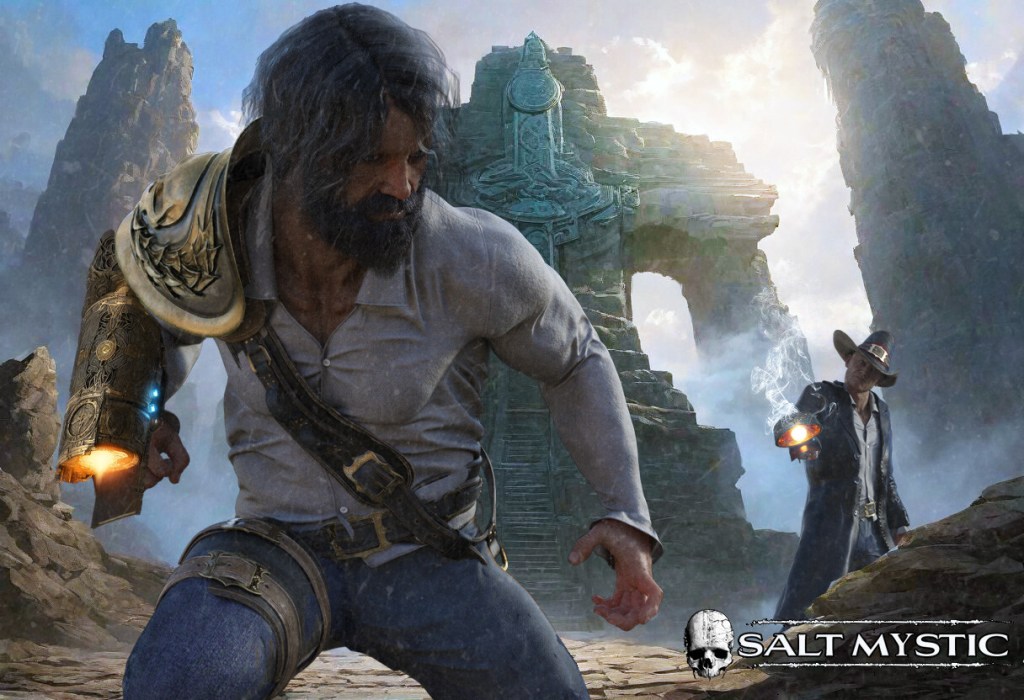
The images below represent the style of work I’m building these days, relying heavily on photobashing and concept art techniques (with folks like Imad Awan as my virtual gurus). The Grailrunner house design standard is semi-realistic digital painting with grungy overlay, western themed adventurers almost always carrying the signature weapon (a gauntlet-based plasma weapon that doubles as a shield in duels), exploring statue-riddled, software-haunted ruins with shimmering dimensional portals. We aim for vibrant or earthy colors, lots of smoke and grit, with implied stories (often illustrating flash fiction on Salt Mystic lore cards).
See the lot of them (and trace my hopefully improving style) at the Artstation account. Yes, I use AI-generated bits to composite exactly like I do with stock images but generally composite everything into something new and paint over them such that the transformation is meaningful and my own.
It gets the job done, at least I think. Still, I wish they were grittier. I wish they broke more new ground than they do. I envy the striking shapes and designs of a lot of concept art out there for cinema and gaming – the kind of images that stick with you even if you don’t know the context. Artstation is great for inspiration, but it can also crush your dreams if you compare yourself to anybody.
What’s prompted this reminiscence about bad art advice?
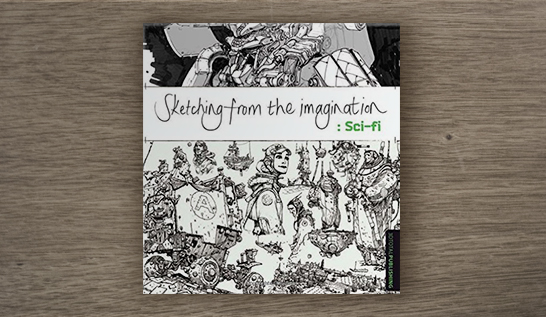
Well, I came across this book called Sketching From The Imagination: Sci Fi by 3DTotal Publishing. I wrote about it here. That was October, which seems like an eternity ago. I posed for myself the challenge of returning to traditional pencil and ink drawing in a sketchbook to push my imagination harder than ever before. The dream is to explore a blank page with loose shapes and vague ideas to summon phantoms into form and create groundbreaking designs and concepts. Then these wild new beasties and tech and colorful characters would then find homes in the fiction or game settings.
How’s that going?
Meh. I was so much rustier than I thought I was. I’ll share some pages here to embarrass myself and stay accountable to you for improving. We’ll get to that. But let’s talk about that advice.
When I was a kid, I filled scores of sketchbooks and countless backs of trashed dot-matrix printer paper my dad had brought home from work. Drawings of super heroes and sci fi vehicles and cities were my jam. Comic books were my main source of imagery, so everything I was drawing had bold outlines and underwhelming composition. The stories weren’t being told by the images in a self-explanatory way – I didn’t think about that sort of thing. I was alone a lot, so I didn’t share these with anybody, nor did I get any feedback.
Flash forward to one day in art class, Middle School I guess, the teacher strolled by to see whatever I was working on and stopped to say something about my approach that resonated with me. He pointed at the paper and said something profound:
“Real world things don’t have outlines. Draw what you see.”
It shook me. Hadn’t thought about that. Good point. So I gave it everything I had to incorporate his advice into how I drew. Back home, hovering the pencil over the paper, for the life of me I couldn’t figure out where or how to make a mark to start the drawing if you couldn’t outline it.
For this post, I looked through some old crates to find a particular drawing that would be humiliating to show but really staked the ground for when I began to turn away from drawing entirely. The picture in my head was a Dungeons & Dragons-style adventure party with a lady wizard, a swordsman, and an elf planning their next move on a morning beach with foamy, ripply water lapping at their feet. Maybe a dying campfire in the foreground with smoke rising in front of them. I couldn’t find it, unfortunately.
Anyway, it was horrid. Everything on the page was so light, you couldn’t even make it out. I was petrified to start drawing outlines again, and I couldn’t see how to force shadows and contrast to draw out the shapes. It threw my perspective. It threw my focus on their faces. It ruined everything. It was the last sketchbook I really did anything with until decades later, at least in any serious way.
Sounds bad. What’s different now then?
I get it now. Youtube changes everything, doesn’t it? Contrasting light and dark, the subtle use of textures, faking details, focusing and directing the viewer’s eyes across the image, and strategic use of busy and rest areas…I never went to art school. That all may be common sense to you, but it’s a glorious rainmaker for me to see all that in action artist after artist, listening to these marvelous and generous people draw magnificent things and explain their thought process as they go. Great time to be alive, isn’t it?
I travel a lot, so I keep an art pack and sketchbook. Pigma FB, MB, and BB brush pens, Staedtler pigment liners, a mechanical pencil, and some Graphix watercolor felt pens. Since October, I’ve put the practice time in almost every night at least for a half hour. It wasn’t a pleasant return.
The dream is to draw from imagination though: new things. What I’ve learned from artist after artist in their podcasts, Youtube or ImagineFX interviews is that drawing from reference is far more common. A lot of the guys you see on video drawing or painting have their reference images off screen.
Reference images! That wasn’t why I got into this gig. If I wanted a copy of an image, I’d take a picture. It was disheartening to me to hear professionals talk about light table tracing for their outlines…to see fantasy illustrators mash up references to form fantasy beasts – all of it copying what they saw. That was my problem back in the first place, right?
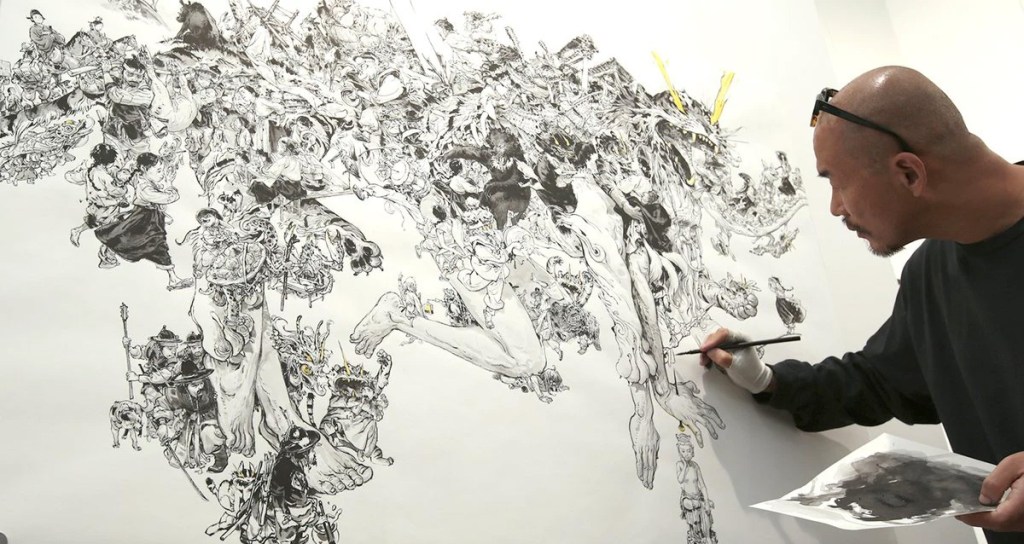
Then I came across this genius: Kim Jung Gi. Rest in peace.
Please google him if this flame of wonder is unfamilar to you. He drew from his imagination like a magical fountain spews sparkly fairies. He just walked up to paper and went nuts, drawing fish-eyed perspective, highly intricate intertwined figures, scores of objects and novel, distinct, and interesting characters at a high rate of speed and without slowing. How’d he do that?
That guy didn’t have any reference images. That’s what I wanted. I had to go deep to understand what he did right that I was doing wrong that could unlock this magic. Exploration on the blank page…finding ideas haphazardly that were uniquely my own…I wanted to bottle this magic for myself. How in the world did he get to the point he could do it so wonderfully. Then I heard him say it (through a translator):
“Don’t draw what you see. Draw what you HAVE seen.”
His point was you have to do the reference images and understand forms and shapes in three dimensional space before you can do what he did. He explained the lifetime of sitting in public places filling thousands of pages drawing what he saw and forcing himself to draw it from another angle. That was the key – he drew what he saw with a lifetime of practice, but still practiced summoning those images from his memory to try them from different angles.
He drew what he HAD seen. It was a big realization for me, this idea of examining the reference image – not just to get better at copying it, but to run your mind’s eye all over it in three dimensions to understand it better and to file that away to fuel your imagination.
Now THAT’s what artists actually do. They don’t copy. They understand.
I wish that guy was still alive. He was amazing.
Agreed. Now how about sharing your progress?
Ugh. Here you go. Don’t be judgey. Wish me luck that things improve. Go ahead. Click the book.
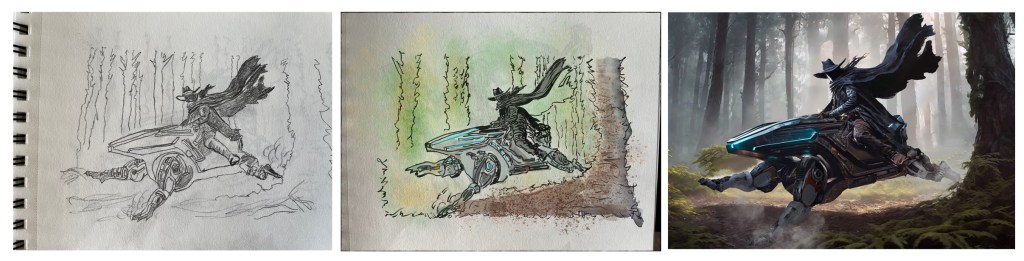
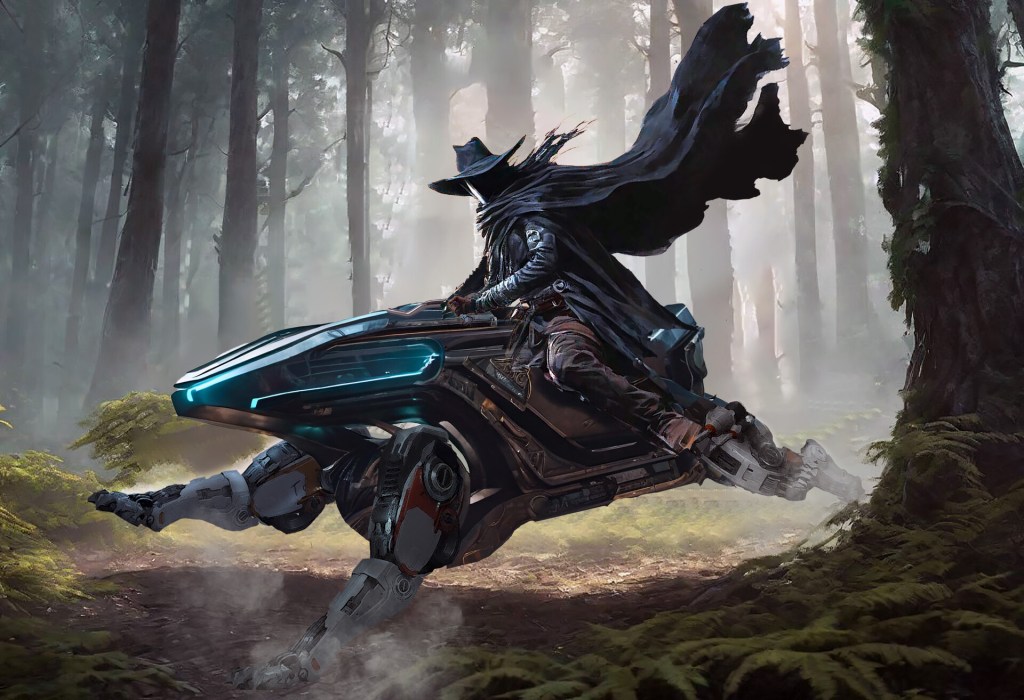
Ouch. I hope you don’t lose all trust in me, should you have had any. Photobashing is an entirely different beast than battling blank pages with a mechanical pencil. I’ll keep at it. The beast-shaped robotic vehicle in the header image was a minor victory in this experiment: called a “sporecutter”, it’s the first concept that’s come from the new approach that might actually make it to the fiction. Page 15 in the sketchbook file here is the front runner for the design of an important vehicle in the Mazewater: Master of Airships novel I’m working on. That’s another possible win.
That’s what I wanted to talk to you about today. I hope it was enlightening or helpful, should this be a journey you find compelling for yourself. Otherwise, I hope I still brightened your day a bit and made you think.