One of the most exciting things we do around here at Grailrunner is introduce new bits of the lore of our Salt Mystic setting in the form of Lore Cards. A fusion of art and short fiction, it’s an important mechanism for us to introduce and test these mini-expansions of concepts that will wind up ultimately as game cards or in the books or stories.
A product we have heavily active in development right now is a bibliomancy-based oracle book for roleplaying in the Salt Mystic universe to be called The Augur’s Book Of Lots.
In order to bring that to life, all manner of new encounter types, new places, and historical figures and their stories are needed. It’s an incredible, life-changing experience for me personally to explore all that and watch it unfold like a big, crazy flower, and I can’t wait for you to see it. Seriously, this whole world is building itself and waiting for you to slide a ball lightning carbine on your arm and take a cautious step through the gates…
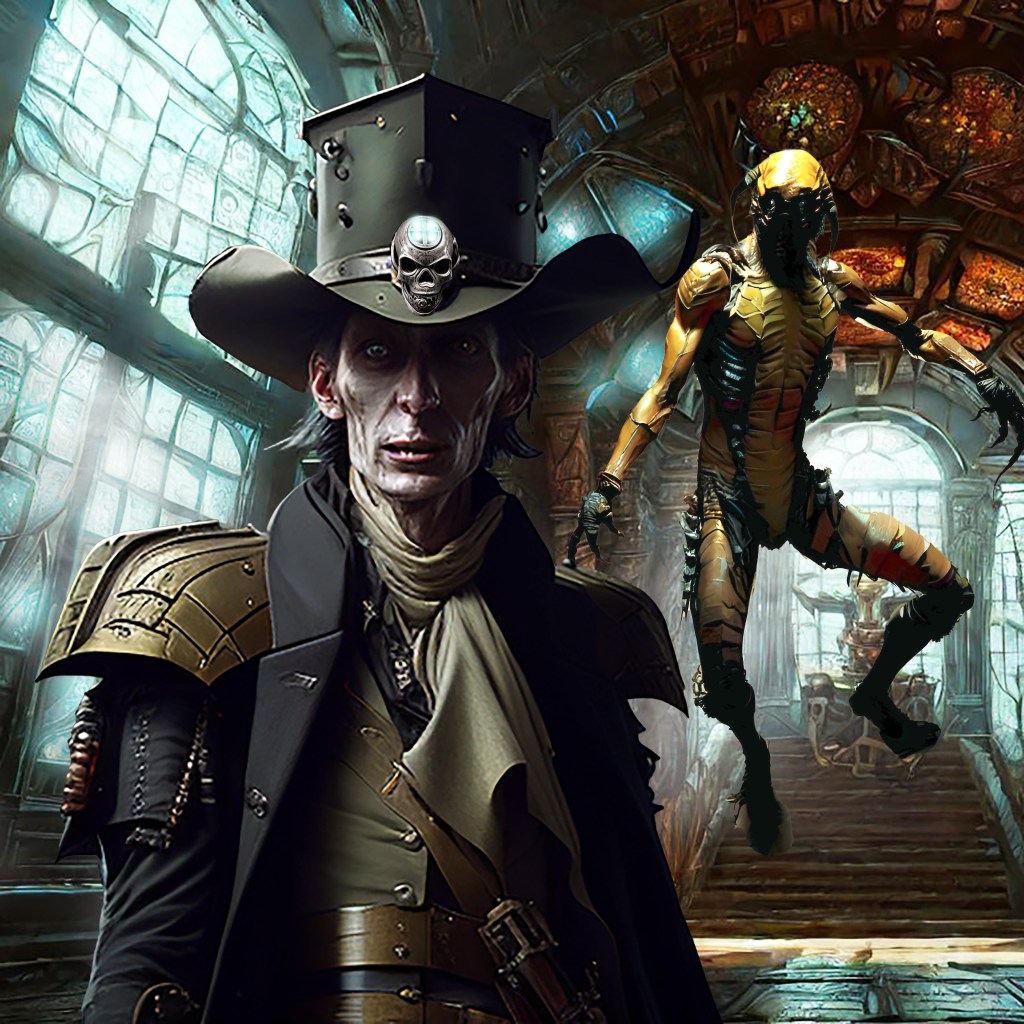
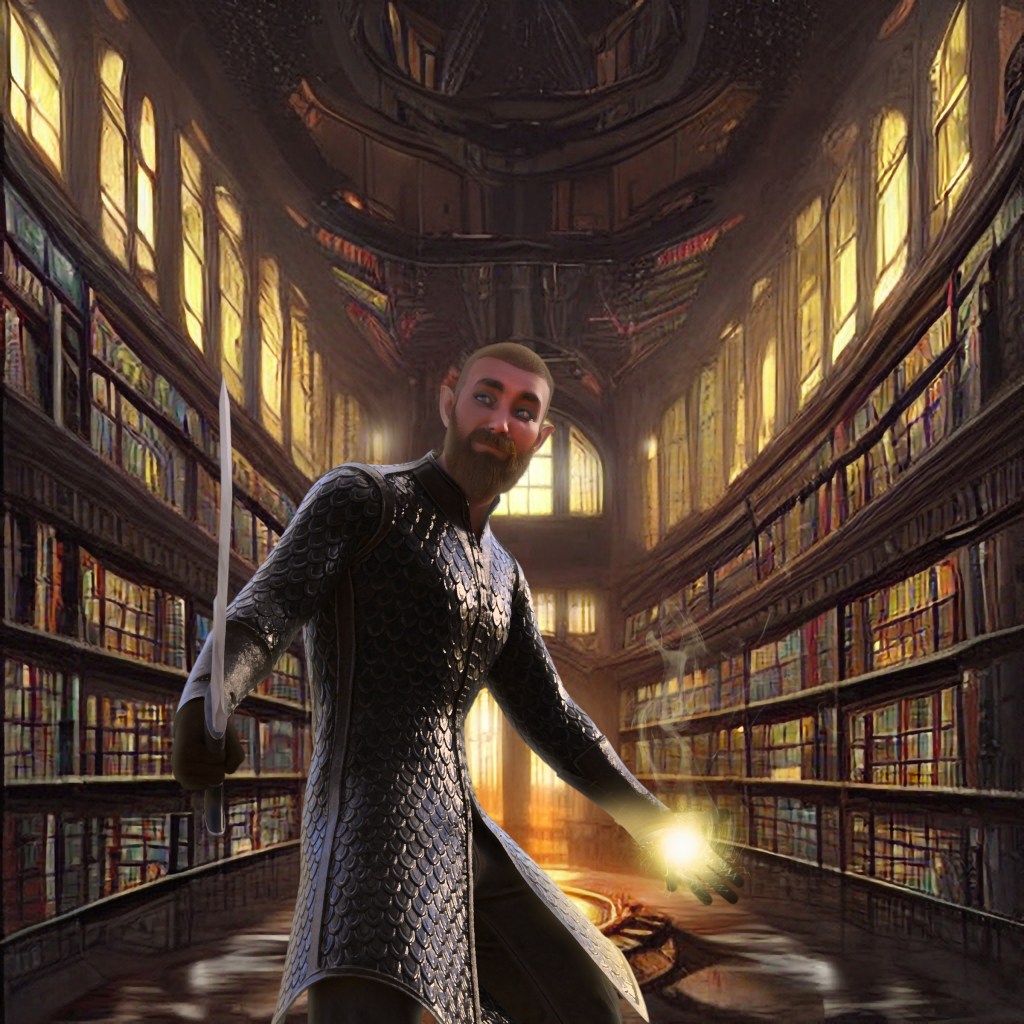
Today, we thought we’d introduce you to a new exciting, and sometimes terrifying, addition to the world of the Salt Mystic: the chimera.
The sneaky fellow leaping on our hapless narrator today is part man / part scorpion. In the oracle book so far, we’ve met countless hybrids like this already, though this particular combination freaks me out the most.
As for the art, as always it’s a paintbash with the heavy lifting done in Photoshop. In this case, the bounty hunter, the skull on his hat, the backdrop, and the scorpion-man were all drawn from various iterations of Stable Diffusion or Wonder, with heavy correction and repair. I discovered the ‘puppet warp’ in Photoshop, which is my new favorite trick!
After compositing them together and color grading everything, I added some Stock nebulosity overlays from Nucly to make the diffuse smoke around the windows, blending them in Screen mode. The positioning of the scorpion-man was tricky – it made more sense for him to be creeping around behind our clueless bounty hunter, but the more I looked at him in mid-air, the creepier and more interesting I found it to be.
I wanted the skull on the bounty hunter’s hat to glow, so that along with the window glow was just some soft brush painting in Color Dodge blend mode.
Anyway, we hope you like the final product. Let us know what you think, and please check back periodically for updates on the stuff we’ve got cooking.
If you’ve never heard of the Troika! roleplaying game, I have a real Scooby snack for you today! As part of our Inspirational Creator Series of interviews, we’ve met with artists, writers, and game designers who break exciting new ground in innovation and imagination.
Today, we’re thrilled to bring you some insights and musings from Daniel Sell, who is not only Director of the Melsonian Arts Council game publishing company, but is also one of its most talented and mind-expanding creators! Just to whet your appetite a bit on that, let’s quote their mission statement:
The Melsonian Arts Council exists to publish table top adventure and role-playing game books unlike anything the medium has on offer. To that end we help artists and writers on the bloodied edge of their craft produce beautiful books while helping readers discover this wide, bright world of independent games they never thought possible.
Come on! That’s awesome, right?! Anyway, welcome back to Grailrunner’s Inspirational Creator Series!
Daniel, you’ve said that you run the Melsonian Arts Council as a way to write games without having anyone tell you what to do while you do it. That’s quotable, just so you know, and maybe tells us a bit about your personality. The fresh and innovative approach you and your team are taking with works like Acid Death Fantasy, The Big Squirm, and Troika! are an inspiring breath of clean air in an industry that gets a little hung up on armored dwarves, dragons, and license restrictions.
Thanks for making time for us!
I’m always happy to talk about myself.
Q. Beyond the obvious fact that you have to make games people will buy, what sorts of projects inspire you the most? Is it the game mechanics, the subject matter, the twist on expectations…what makes you smile when you think about spending that kind of effort and time on making a new game?
The thing that sets me on fire is a project that is relentlessly sincere. A major problem with roleplaying game books is that they’re almost always products before they’re anything else, which sends sincerity right out the window. I want books to rip off the mask of best practices and boring choices and let us see what you really wanted to make.
Q. You’ve talked before about things like D&D’s Planescape boxed set as an inspiration for you, imagining a multiverse that maybe lost some of its magic when you were older. Tell us about what sorts of games, books, or films made that magic for you back in the day and what they did right.
0e and 1e D&D were pretty solidly magic, 2e had a spark of it. Really, lots of games from the 80s and early 90s had a lot of magic to them. They were wild, silly, huge, beautiful and diverse, there were multiple large companies with money making bold choices and beautiful books. Palladium are still at it, and I have an unironic admiration for Uncle Kev and his Glitter Boys et al. (Meet them here) As for books and films, I don’t have much nostalgia for what I consumed back then, it was too hard to find good things before the internet. I still have and love my collection of Fighting Fantasy books, which are almost all immensely bold and idiosyncratic adventures that I love immensely. Something about dungeon merchants and weird things waiting for you to find them just gets me going.
Q. It’s one thing to have cool ideas about games, but quite another to design and publish Ennie award winning works for yourself at your own publishing house. How’d that happen?
I’m not sure. I started publishing when I saw a guide on a blog explaining the method by which one could assemble a zine at home by hand and I thought that looked fun. All I needed was a zine, so I wrote one. I took an adventure I had run in my home game, tidied it up, and published it as The Undercroft #1. Then I had to do a second one. A big part of the joy of RPG writing is the necessary collaboration that is involved, so I started asking around and working with people I knew and respected in the scene. Over the ten issue run I oversaw I met people who had ideas too big to go in a zine so I decided to make a book instead. Like with every other step, I asked around, talked to people doing the thing I wanted to do, and then did that. From there the world opens up a lot, with crowdfunding and trade publishers and shipping and so on. It continues to open up.
Q. In ‘Letters Of JRR Tolkien’, the professor is quoted as saying:
“Part of the attraction of Lord Of The Rings is, I think, due to the glimpses of a large history in the background: an attraction like that of viewing far off an unvisited island, or seeing the towers of a distant city gleaming in a sunlit mist. To go there is to destroy the magic, unless new unattainable vistas are again revealed.”
French poet, Stéphane Mallarmé said, “To define is to kill. To suggest is to create.”
You said in Troika! “Players travel by eldritch portal and non-Euclidean labyrinth and golden-sailed barge between the uncountable crystal spheres strung delicately across the hump-backed sky.”
What’s that all about?
This is true. Part of the impetus to writing Troika! was a disappointment with Planescape. Growing up I had an incomplete smattering of the core books, leaving massive holes in the thing. They suggested infinite worlds of exciting and absurd wonder in little paragraphs here and there between DiTerlizzi artworks. As an adult I bought more books and it turned out that Tolkien was right, the distant towers were made of cardboard. So I now only fill in the bits I want to fill in, and feel I can fill in while maintaining the tension of a world greater than we can take in with one sweep of the head. I never want to lose that sense of discovery again.
Q. What’s a hump-backed sky though?
The humpbacked sky is an English translation of a French translation of a Greek translation of the term that usually gets translated as “vault of the heavens”. I prefer humpbacked sky because it is more literal and also less easily skipped over, forcing you to think about it rather than going “yea yea vault of the whatever”. So it is the undulating heavens between the spheres.
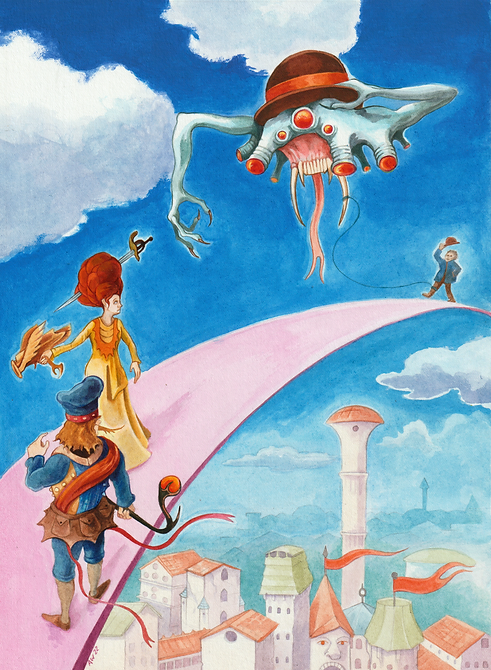
Q. Troika! offers a marvelous parade of character types players can become or encounter. But we need to talk about the rhinoman. Tell me about the rhinoman.
I can’t take credit for the rhinoman. I took it from a picture in The Citadel of Chaos by Steve Jackson, a Fighting Fantasy book I read a lot as a child. The image is so bluntly weird and has haunted me ever since. So I thought everyone else should experience it as I did.
Q. I need to geek out a second. You’ve mentioned M. John Harrison’s Viriconium series as one of your inspirations. I sometimes think I’m close to getting him to agreeing to an interview because those stories have been lifechanging for me personally. What’s your take on that collection?
I love them. I came to them late, after Troika was already written, but they solidified an idea I was unable to grab. The Viriconium stories create their own canon, in a way. The first book is quite a normal fantasy adventure, then it just gets weirder and weirder. The future books use the original books words to summon up complex allusions that only make sense in the context of a Viriconium book. Intensely self referential, like a Gene Wolfe novel but spread over a shorter distance. It’s how I approach the weird of the world now, in layers that people can uncover. Impenetrable non sequiturs is easy, and boring. I want to know that there is a trail back to meaning somewhere, even if it’s hard to find. Just knowing is enough.
Q. Can you describe your process for creating – whether the writing or the game mechanics?
It depends if I’m laying down new work or working on a draft. If it’s new then I wake up and sit in front of a notebook for 4 hours and see what comes out. If it’s a draft I do it in front of a markup word processor because I can’t be trusted with distractions. When writing I limit my reference books since they can become distracting in their own right. I have a book of the names of Catholic saints, a few different books about interesting words, and one or two books of poetry, scripture or product images. The large books are used like divination, when I’m stuck I’ll pick one up and open it at random to see what comes out and use that. The fun part is making that oracle weave in to what you’re doing neatly. I find that process creates a kind of verisimilitude that can’t come from sitting down and making stuff up out of thin air. Going back to Planescape, one of my issues with it is the apparent ease with which they can describe an infinite realm with infinite variety. With this cut-up method we get a taste of real culture, that fractal variance of real life. It’s impossible to make from just one head.
Q. You’ve launched the hardboiled RPG adventure, The Big Squirm quite recently. Anything new you’re working on now is super-secret, but what CAN you tell us about any projects coming out soon?
We’re very busy. I have a few books of my own coming soon; Slate & Chalcedony is a deceptively normal adventure to beat up a wizard in a wizard tower which goes back to my horror roots; Get It At Sutler’s is a (huge) tool for letting your players work a job at a fish market where they can meet people and experience the city of Troika like a native; and I’ll probably have a layer of a Troikan mega dungeon out before that. Otherwise we have another Troika adventure by Andrew Walter, a D&D campaign boxset sequel to Crypts of Indormancy, 2nd editions of Fever Swamp and Fungi of the Far Realms, a Troika based superhero RPG by Christian Kessler, a Dickension burglar RPG by Luke Gearing, and some others I’m probably forgetting. Busy year.
Q. What kind of pitches are you looking for from aspiring writers, artists, or designers right now?
We’re looking for books now. We have a project which we hope to get people involved in creating short adventures set in the city of Troika. Link here for the full brief.
Q. Where can we find more about what you and the Melsonian Arts Council are up to?
www.melsonia.com is the best place to find new things, but we also maintain a stubborn presence on social media for anyone who likes that sort of thing.
Times are tough and getting tougher for everyone, the RPG industry feels overwhelmingly tight and the only people who survive are the rich and the stubborn. Be stubborn and make games, please.
*
Daniel, I can’t stress enough how much your approach and your philosophy towards inspiration and the creative process send us over the moon! Thanks so much for the breakthrough work you and your team are doing at Melsonian Arts Council, and especially for the long nights and brain-wracking I’m sure it took to deliver something as mind-bending as Troika! You’re bringing new and good things into the world – we need many more people like you!
Thanks again for making time for us. Best of luck with the blizzard of new products coming. Have a great year!
Adventures are a hunger, fundamental to who we are. But what makes them work?
Literally everything we try at Grailrunner is about pushing boundaries in imagination. Often, that takes the form of contorting tabletop game mechanics for experiments in immersive storytelling. Then we give that stuff away for free in case it’s entertaining, though we’ve learned bits and pieces along the way about what makes adventures work…and what is missing when they don’t.
Which is the point.
For example, we built wargame terrain and a narrative scenario to play out a story using the game mechanics of Privateer Press’s popular Warmachine. It was a thrilling ride we called…
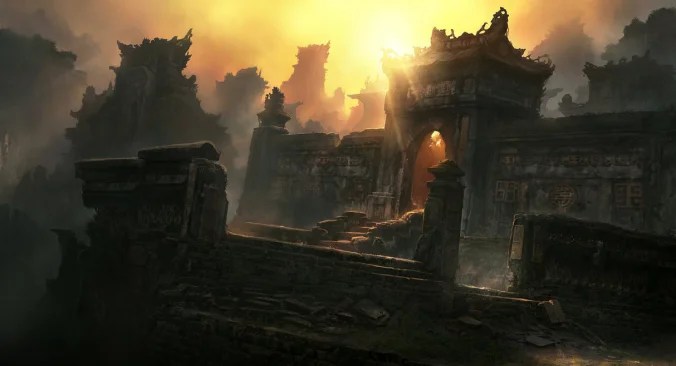
The Black Ruins Massacre
Turned out amazing – go follow these links to see what I mean:
One of the more popular things we’ve ever done here on the site was to write up an illustrated recap of a solo Dungeons & Dragons adventure in Wizards Of The Coast’s Tales Of The Yawning Portal. I routinely use a ridiculous D&D character named Firebeetle to try out different roleplaying game rulesets, and in that case, I put him through a harrowing ordeal called Clueless In The Sunless Citadel. Click these guys here to see what that was all about, and download the free pdf. Only takes about a half hour or so to read, but it’s fun.
Clueless In The Sunless Citadel
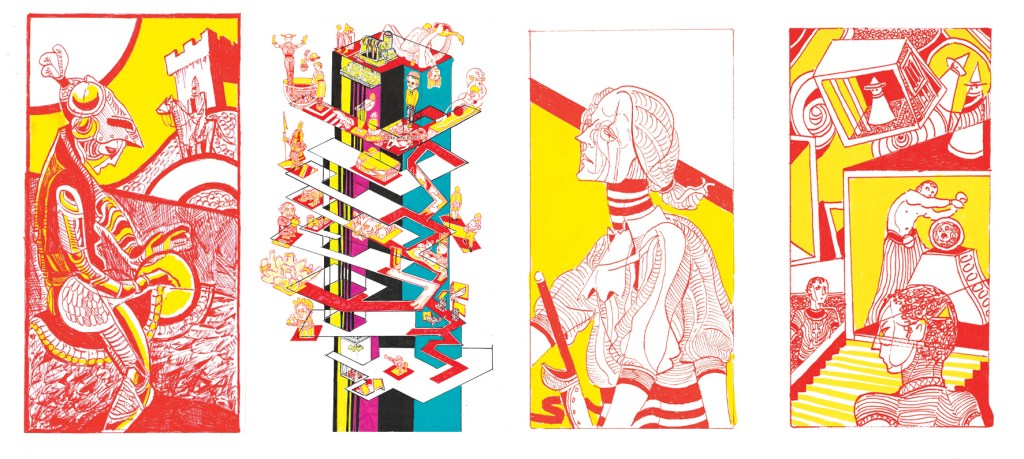
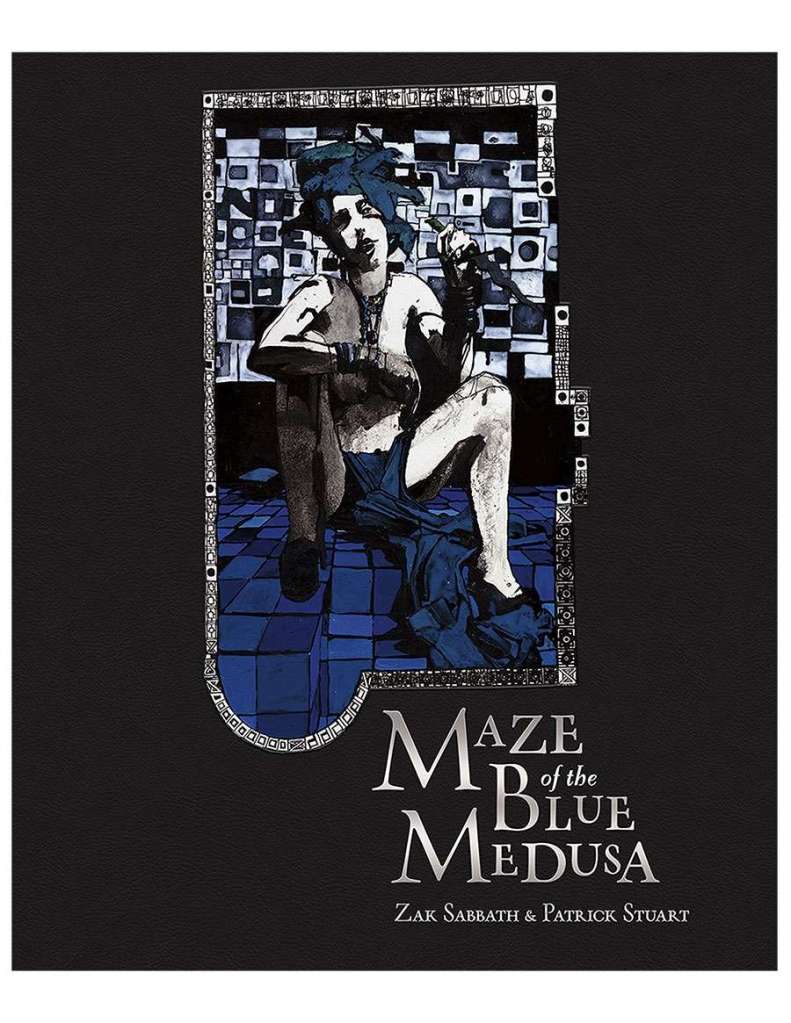
So anyway, I was in a big old used bookstore called McKay’s in Nashville, TN a few weeks ago. I strolled to the RPG section with no particular goal in mind and found an odd, strangely electrifying, though ultimately unsatisfying hardback called Maze Of The Blue Medusa. I knew as soon as I read the back, felt the weight and texture of it in my hands, as soon as I flipped through a few pages, that this was something special.
Maze Of The Blue Medusa
(I understand there is some controversy around one of the creators behind this book, so I’ll stick to the work itself in my comments.)
The book describes a system-neutral dungeon complete with a detailed map, illustrations, a bestiary and associated encounter dice tables, and intricately detailed descriptions of every one of its over 300 rooms. In every room, something weird is happening, something grotesque and surreal is creeping about, and crumbs of an over-arching story are dropped.
However, unlike so many mega-dungeon books with their Tolkein tropes and endless loot crates and traps, this whopper is written like an art project, with text that reads like it’s for shrewd adults capable of seeing irony and social commentary in its encounters.
I excitedly cracked it open when I got the chance to run young Firebeetle through his paces inside the Maze.
And I wasn’t into it.
It just didn’t click for me. The adventure escaped me, and it was just going through motions with no point. I couldn’t find a story hook that mattered. Each room seemed weird and vaguely interesting, but nothing popped or sparkled for me. The encounters were tedious and amounted to nothing. Here’s a Youtube video of some dudes in an actual play session of Maze Of The Blue Medusa – watch that for a few minutes and I suspect you’ll see what I mean.
Even with a great GM and some funny players, this wasn’t an adventure so much as a haughty stroll through the bohemian part of town where I don’t really fit in. I wanted the awe and danger of exploration inside the covers of a book and found only a meaningless series of weird things. Maybe that was my fault, but the mechanisms available just didn’t work the way I wanted.
That was on my mind when I heard of a little book by Emmy Allen called The Stygian Library, I thought maybe I had found redemption.
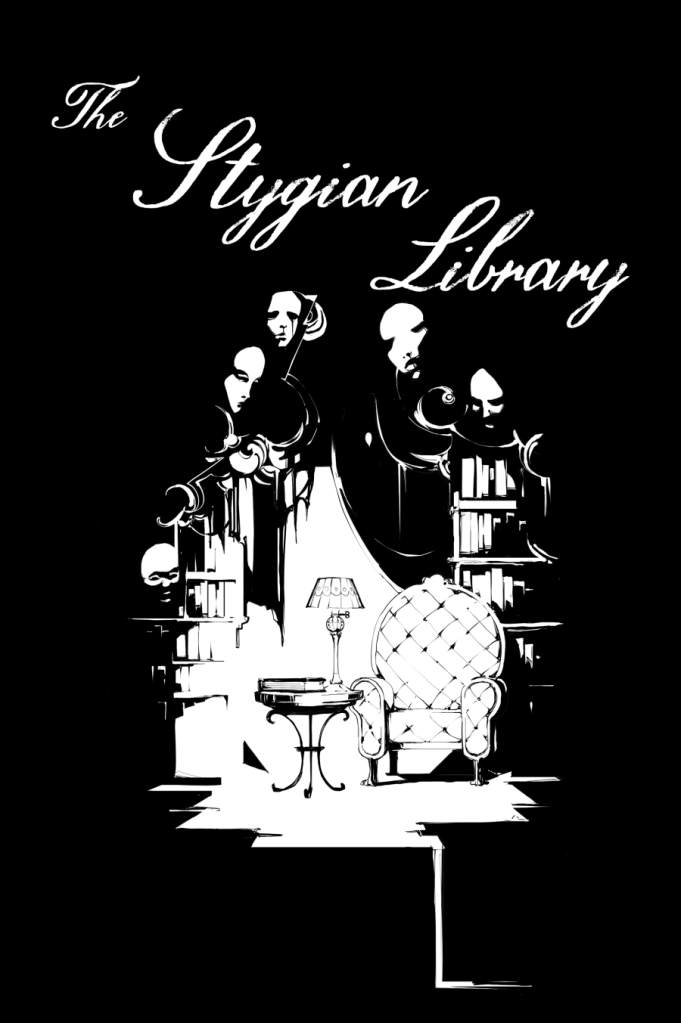
The Stygian Library
Pick up the older version of this booklet free here. It’s available in a remastered version here.
The Stygian Library bills itself as a dungeon for bibliophiles, promising a procedurally generated fantasy library you can explore in ever deeper levels. That sounded amazing, requiring you to map your way (though you can run blindly and get lost). Much like Blue Medusa, this wasn’t written with solo play in mind, but with enough dice tables and imagination, I figured I could rewire it.
Emmy delivers a wild bestiary including golems made of paper, animated books that follow you around, mysterious creeping librarians working on enigmatic calculations, even a half-man, half octopus that eats brains. Nice.
You roll for the levels you’re entering, details about them at first glance and also if you search around, as well as random events and, when prompted, encounters of a friendly or a violent flavor depending on your choices so far.
I took this idiot inside.
Firebeetle
Firebeetle was a name I was given for my very first D&D character back in the day. I recreate him in any game system I’m testing out because he amuses me.
He’s an aimless adventurer, in it for the thrill, always ready to take up a quest or try a mysterious corridor, picking up random things along the way and relying on his luck to seem him through. He’s not really charming, but thinks he is. Loves the ladies. Gets into trouble practically at every destination.
Firebeetle has a tendency to stumble into dimensional portals (as I try new game systems), finding himself in underground dungeons in the Middle Ages (D&D), Viking-era Iceland in an impossible city made of clusters of hot air balloons (Ironsworn RPG system), or in the far future on a dying space station (Starforged RPG system).
He just kind of goes with it. And it all works out in the end.
Neither Blue Medusa, D&D, Ironsworn, nor Starforged were delivering on the premise I was searching for: the awe and danger of exploration inside the covers of a book. Maybe Emmy’s Stygian Library would be the trick. I love libraries.
I put this ridiculous booklet together during conference calls in the COVID-19 quarantine, and I treated it as the opening sequence before entering the Stygian Library. It was going to be called Five Days In Boghallow, a fighting romp with a funny undead sidekick. Literally the only reason I’m including a link here is to give you a feel for this character. He’s such an idiot.
Anyway, I’ll give you the airplane view of what went down inside the Stygian Library and make my point for the day:
On what happened inside the Library…(keep in mind, virtually all of this was determined by dice rolls and game mechanics)
Bereft, the undead knight and Firebeetle entered the Library from the pit into which they’d fallen. They were amused by a couple of animated books that followed them around like cats, though the creepy librarians kept appearing to whisk the books away into the shadows. Something they read inside the cover of one of the books gave them a quest to find some machinery in the deep levels of the endless Library. They encountered bees made of paper (swatted them away) and a golem (ignored it) and paid visits to a planetarium, a pile of treasure, the master catalog of contents, and a hall of taxidermy before managing to be entirely lost and stranded inside an ever-shifting labyrinthine library.
Ahh, I thought. Here’s where things pick up for young Firebeetle. He’s stuck now. Looking for some machines or something.
They kept pressing on, ever deeper, picking up all manner of treasures and vaguely defined books that seemed promising. ‘Let’s see Firebeetle’s careless attitude work his way out of this mess’, I said to myself.
Then inside a giant paper beehive, a bird-like bandersnatch started pecking at Firebeetle’s sword to steal it (because it was shiny). Stupid bird-thing. When they finally killed it, the fact that they were killers turned the Library into a deadlier place. This would pick things up then, as the Library beasties got nastier and the hapless adventurers grew more desperate to find a way out.
In an enormous statuary, Bereft and Firebeetle were accosted by a floating skull, attended by floating teeth that were enthralled with its every word. It grew increasingly insulting, commenting on their appearance and bumbling like they were museum curiosities, before it began to smash itself into Firebeetle muttering something like, “See, students, how a skull may stomp a bug without the need of feet!”.
They ultimately shattered the pompous skull, scattered its minions, and dealt handily with some phantoms the encountered as well. And they did, believe it or not, wind up in the chamber they sought with its outlandish calculation engines, where the hooded Librarians worked their mysterious mathematics.
And would you believe it…and I honestly didn’t make this up at all…the dice rolls delivered Firebeetle an intangibility potion. It’s the one thing that would get him back to an escape from the Library, with treasure and books in hand. I mean…I tried to put the guy in danger and make a madcap adventure of the whole thing, and his ridiculous luck somehow just pulled him out of it.
The Stygian Library was amusing, even interesting and novel, definitely worth your attention if any of this sounded like your cup of tea, but overall it failed to deliver the spice I was seeking: the awe and danger of exploration, except in the covers of a book.
So what am I saying then?
Here’s my point. And I learned this through all these experiments with different game systems through comparison with the one I’m testing now – Forbidden Lands by Free League Publishing. The difference has been night and day. And I believe I know why.
Solo RPG game play is absolutely possible. It’s enjoyable and surprising, stretching your imagination and your sense of fun. It may even rewire your personality as you rip and stretch aspects of yourself that don’t see enough light of day. It takes a few things though, which I’ve found in Forbidden Lands more so than with these other systems, including The Stygian Library:
In my day job when we deal with companies making big changes, we use something called The Airplane Model to define the major elements that make things happen, that drives people to do things. I’m applying this to manufacturing adventure. Hear me out:
Adventures work when:
(Vision) …there is a meaningful purpose to what the characters are doing – a destination and a clear, important goal that you find interesting. The Forbidden Lands ruleset offers a Legend Generator that covers this well. I believe I was missing this in many of my random exploration experiments.
(Sense Of Belonging) …the characters matter to you, fleshed out with formative events that made them who they are. I trusted the Formative Events dice tables in the Forbidden Lands to build a person for me, a hunter named Colter, and he’s starting to feel like someone I’ve known a very long time.
(Sense Of Contributing) …the decisions that your characters make have consequences. I felt in the Maze Of The Blue Medusa and to some extent in The Stygian Library that the random conflicts and odd bits of treasure were irrelevant. Curating good dice tables, like the Action and Theme oracles in Ironsworn and others is fantastic for surprises and a sense of wonder and discovery, but what you do has to mean something or there’s no weight to what’s happening
(Sense Of Progression) …there is a clear, definable sense that progress is being made against the purpose. Ironsworn, Starforged, and The Stygian Library all three provide an abstract Progress Tracker intended to keep score of how things are going in the story versus goals, but I found that unrelatable in solo play. Boring and meaningless, even. I’ve found I start to give up on the adventure entirely if there isn’t any meaningful progress or sense that things are moving along. In the case of Forbidden Lands, a deliciously detailed map is provided which is incredibly satisfying.
(Sense Of Urgency) …time is ticking, and there is a real possibility of dying or losing something precious. Particularly in D&D 5th Edition, I feel like it’s kind of hard to die. One thing I’m seeing in the Forbidden Lands ruleset is that the stats are unforgiving, and there are lots of things able to kill my character. It forces me to make Colter plan more, and think creatively about his decisions since he could die so readily.
And that’s what I wanted to say about all this. It’s been interesting, testing all these systems out and trying to use them to breathe life into a story I can experience.
The awe and danger of exploration, except in the covers of a book. Possible?







 Grailrunner Publishing