Deep Waters: A Case Study In Adding A Mythic Dimension


shicheng

When I read Stephen King’s Dark Tower series or Isaac Asimov’s Foundation, anytime I read Dune, I get the same vibe as I’m planning to chat with you about in this post…that there’s something ominous and huge going on – a belief system or set of myths or larger than life history affecting events. I dig that tremendously; and I look for it in things I enjoy reading. In fact, when I was growing up, you were either a Luke Skywalker guy or a Han Solo guy – meaning you wanted to be the space cowboy or the brooding, mythic hero. I was a Luke Skywalker guy. The literary take on this is it’s much more interesting in your fiction should you plan to include some sort of belief system if you don’t just recreate the Greek Gods or rip off the American Indians with a ‘Great Spirit’ thing-a-ma-bob.

So I’m going to go deep with this one. Stick with me. I finished an interesting study recently that went way farther that I’d expected. I was googling and flipping through the original materials madly, chasing a huge idea that kept getting bigger. It was like pulling up one of those weeds where the roots keep popping up out of the ground and you finally just cut it when you can’t tell how far it’s really going to go. For me, it started with a random book on my shelf from years ago that had an article about the I Ching in it.

Anyway, another article in that book that caught my attention was about the Kabbala’s  Sefirot. The idea of treating a deity like an engineered contraption, like a set of physics rules you just needed to respect to make jedi-mind-trick things happen tickled both the logic and artsy sides of my brain. So I went deep into the Kabbala – read several books and spent some time reading what its believers found attractive about it. No offense if that’s your thing; but I ultimately found it full of promise and marketing but a big fizzler when you try to pin it down to something useful. It did strike me as fascinating though, the nebulous descriptions of the highest realms of reality – a nameless and unapproachable perfect being so incredibly pregnant with the potential of creation it’s provoked by nothing more than a state of mind. The sefirot idea stuck with me, so I poked into where it came from.

Read the Sefer Yetzirah if you like; but it’s gibberish to me. That was where the sefirot were first described. I bought the Pritzker Edition of The Zohar though, because that’s the big daddy of Kabbala, the place where it really took off. Get far enough into The Zohar; and you’ll get the feeling that nobody’s saying what they really mean and you can stretch and pull to make anything mean what you want it to. Still though, the massive superstructure of the universe having a secret dimension to it, a direct line of sight to a divine machinery, kept things popping. So I went deeper to see what influenced Moses DeLeon (the 13th century Spanish author or the channeler, whichever you dig).

I’ll speed up to make my point, though this took a while to trace. What I found was a pattern of about every two or three hundred years, a very similar theoretical apparatus was showing up in some famous writings. The themes are these:

  • There’s an indescribable, unapproachable entity way up in some higher dimension ready to burst with creative potential
  • This entity is either intelligent or just a principle of the universe, depending on who you’re reading; but it can be influenced either way
  • Since this thing’s perfect, it can’t produce things that aren’t perfect, yet here we are with cancer and weeds and birth defects
  • So this thing has levels beneath it, where things get progressively farther from the top and so are less perfect till you get to us
  • That means there are perfect versions of things somewhere, like flawless templates from which all matter is descended

I had discovered what they call Neo-Platonism. If you already knew that, good for you. I didn’t. It made me think of Object Oriented Programming, because it’s exactly the same idea where you have ‘classes’ defined as templates, then make ‘instances’ of them to tweak for where you use them. Going successively back in time…

  • John Scottus Eriugena (800-877AD) said the entity at the top was God; and He was creating stuff so that He could understand Himself. He said the primary Forms I was talking about above were the patterns of all things located in God’s mind. Eriugena was probably influenced by…
  • Pseudo-Dionysius The Areopagite (late 5th, early 6th century AD) who shared the view of a procession of realms from God but said a rock or a worm was a window upon the entire universe if you only knew how to look at it. He was intrigued by finding his place within that procession and seeing himself inside it, focusing on the sacraments as a way to engage with the apparatus. This guy was probably influenced by…
  • Proclus (412-485AD)  who was head of the Athenian school and thought Plato was divinely inspired. This guy wasn’t Christian, so his view of the thing at the top was more of a nameless ‘One’ you could influence with magic rituals. He was influenced by…
  • Plotinus (205-270AD) who studied Plato religiously. This guy had an inherent distrust of material things because they were a poor image of something higher. He said the supreme dealie-o at the top was a transcendent ball of potentiality, without which nothing could exist. He also said because of its nature of perfection, it couldn’t have a will of its own and couldn’t engage in any activity without becoming imperfect. So he had a procession downwards as well, culminating in matter.
  • The Gnostics were around this same time period, thinking the same sort of thing about matter being wicked and only a pale reflection of the perfect templates up there somewhere.
    • You see how big this is getting, right? 
  • Plato (4th century BC) developed in The Phaedo and in The Republic what’s called his Theory Of Forms . He likened us to people who’ve spent their lives watching shadows on a cave wall, thinking the shadows were what’s real when in fact there’s something making the shadows. Plato extrapolated from this idea that the soul was also a Form, and therefore perfect and unchanging, so..you know…reincarnation. He may very well have been influenced by…
  • Parmenides (5th century BC) who revolted against the sciency philosophers by suggesting there was actually a difference between true, objective reality and the stuff we can see. I’m not sure he started all this though because of…
  • Heraclitus (535 – 475BC) which is where my story ends. I read Remembering Heraclitus by Richard Geldard. Here’s a deep well like you wouldn’t believe. Heraclitus may have written a book and just dropped it off in the famous temple at Ephesus, and soundly changed the world. He described ‘the logos’ as a fiery, invisible rational principle that embedded the universe (like the Force, surrounding us, binding the galaxy together). It’s the wisdom of all of creation. Entirely possible it’s this guy that kicked the whole thing off that led to the same theoretical apparatus inspiring people for millennia.

My point is that this nebulous, vague description of a cosmic apparatus appeals to the logical side of your brain because it sounds like machinery; and you want to figure out how to make it work. It appeals to the creative side of your brain because it leaves so much for you to interpret and add to it. In fact, ,that’s just the way the I Ching appeals as well, presenting itself as reflecting the universe in a little microcosm so you can leverage what it’s up to as it changes.

Since the I Ching has been around in some form for 3,000 years; and the ideas the Kabbala built its palace on for not much less than that, those systems have something to say about how to make your manufactured belief systems resonate with people. Appeal to both the right brain and the left. Show how it could make people’s lives better in some way.

I took a real stab at this myself in Tearing Down The Statues, focusing on the idea that history repeats itself at different scales.

Now you go try and let me know how it turns out for you!

“The cosmos was not made by immortal or mortal beings, but always was, is and will be an eternal fire, arising and subsiding in measure.” -Heraclitus

Smashing Paradigms Like Halloween Pumpkins!

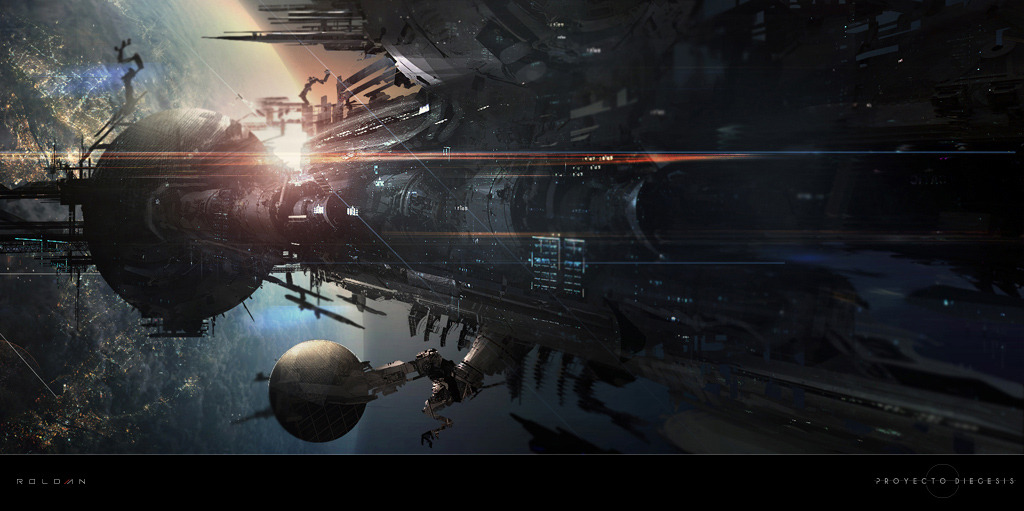
Juan_Pablo_Roldan_03

Art by Juan Pablo Rolda

Let’s talk about being stuck in paradigms and not even knowing it. The reason you should care – if you’re an aspiring writer or somebody interested in the craft of storytelling, then you probably want to break some kind of new ground. At least for me, I like to think I’m an original, coming up with cool stuff that inspires other people. When somebody tells me I wrote something that really made them think or that gave them the shivers…or best of all, that made them want to know more…that’s fireworks to me! So paradigms are cancer. Off with their head – if you know what I mean!

Here’s an example, for the science fiction nerds out there like myself. Maybe it was Star Trek that started this, not sure; but have you noticed when you’re watching basically any show or movie set on a spaceship that the doors swish open and closed automatically? That would require motion sensors and motors. The doors always look like heavy industrial steel. In fact, everything looks like industrial steel and huge! Just huge. But stop and think about it for just a second – space has precious little resources; and every bit of mass you take along with you takes up more energy to move the ship at all. Massive freaking spaceships made of heavy steel with silly, unnecessary things like automatic doors are a bit unlikely. “Hold on, genius”, you might say. “These aren’t science text books. Energy is free in my story. If I want doors to swish shut automatically, maybe I’m thinking about emergency containment!” Blah blah. Maybe – and you have to ask yourself this – maybe you’re just coasting on paradigms Gene Roddenberry set up decades ago.

Why are spaceships always gray metal? Is it because that’s most likely, or because Navy ships have been battleship gray; and that was the paradigm folks like George Lucas just carried on from the trailblazing pulp cover artists of the 1930s? When you’re at the airport, are the planes gray? You can disagree; but my guess is the economics of space travel either in our future or in whatever alternative universe you’re dreaming up, say commercial enterprises will be building ships for space travel. They won’t have to worry about obscuring visibility in ocean environments like the Navy does. I’m saying spaceships probably won’t be battleship gray with all sorts of squiggly machinery and useless lights blinking all over their hulls. Think about it. Isn’t it more likely they’ll be smaller, probably modular vessels with logos and smooth shielded hulls, light on mass and with relatively small hallways and workspaces, maybe capable of linking up into larger structures?

Gravity? Every show you’ll watch has their folks walking around and nothing floating. That means you’re assuming the ship spins or you should at least hand-wave something about ‘gravity generators’ or something. Why not just make it spin? How hard is that?

Don’t get me started on robots. The pulps set the stage for human-looking robotics; and we’re still living with that. We’ll probably get there, no doubt. But what’s the point of all that design if the job you’re giving it is to clean the floor or pilot the ship or load cargo or to repair things? Why make it look human with all the expense and complications and liabilities, to do mundane things like that? Form will follow function, right? That’s actually how the world really works when manufacturing plants have to actually spend money on R&D and machinery and raw materials and labor to make something real. Those slick little Roomba vacuum cleaners are a fantastic example of this. They look nothing like C3PO; but they can suck up dog hair like nobody’s business.

I’m going to end with my least favorite paradigm of all because your argument should build to a climax, shouldn’t it? I mean, this one really…really needs to go. If you’re guilty of it, please stop and question yourself. I purposely avoid the heck out of this one because it’s so tired and lazy and ridiculous by now. Yet it’s hard to stay away from it. I’ve veered very close and hated myself afterwards, like when you eat the whole bag of those little chocolate doughnuts. Stop. Stay away. Go back.

‘The chosen one’. Oh my God, how many times have you heard somebody say this? Look, I understand that to set up a mythology, some sort of over-arching roller coaster you want your characters to get swept up in, this is a handy little trick. Just make the main guy the chosen one; and all sorts of mysterious things can happen. Then you can show all the whiz-bang stuff they can do and didn’t know, so replicate the ‘coming of age’ motif which everybody loves so much. Me too. But isn’t it getting old? We’re pretty sophisticated in our appreciation of narrative structure and themes by now, so isn’t it time to put this one to bed? It almost never makes sense anyway, when you poke on who chose them and why.

Anyway, I should really practice what I’m preaching here. When you agree to move beyond some of these deeply entrenched themes or backdrop devices, it gets challenging. There’s maybe even an argument to be made that things like I’m talking about here are the common vocabulary now, so to change them up too much makes the reader confused or uncomfortable and distracts from what you’re really trying to say. Honestly, if we’ve thought about it that much, then we probably did our due diligence and should have the big, freaking steel doors swish open and closed if we feel like it.

All I’m saying is think about it first.

Getting Over Free And Rewiring Your Imagination

expansortext

Back in the day, pre-internet and when the only way to hit it big was to get signed by a big publishing house, you hounded magazines to sell short stories as much as you could. You got in print. All the names you’d recognize from those days offered that advice; and I sadly admit to listening to my dot matrix printer bweh-bweh-bweh in the corner of my desk while I bent those little metal clips on the manila envelope time and time again patiently sending off stories so I could make a name for myself to finally see the way clear before me. The only cool story I have from those days is a terribly cruel rejection letter from the guy who ran Asimov’s magazine accusing me of stealing the story idea (naming some obscure piece I’d never heard of and saying the other guy did it better). Now that I think about it – there was a guy named Vampire Dan who ran something called The Story Emporium at one point, who said nice things about what I sent him and always said I was ‘close’. He was awesome; but that’s beside my point.

Where I’m going with this is – you sold everything. Nothing was free. Guys like Harlan Ellison were brutal about it, chasing every dime for reprints and mentions and ripoffs. Basic economic common sense says you don’t give your hard work away because it has value. Giving it away means it’s crap and you couldn’t sell it. Right? Hold onto that for a minute.

My brain builds up steam. What I mean by that is my job can be technical; and if I’m not careful, I’ll be exclusively reading science journals and history books, learning statistical programming, building robotic arms, or whatever my left brain decides to chase with precious little stretching of my imagination. It can make my writing a little dodgy and stiff, and the ideas a little plain-Jane and cardboard because I’m not exercising that part that mishears things on purpose, that plugs and unplugs things I see around me to rewire them into something else. Everybody says you’re supposed to write every day; and they’re of course right about that. It matters. Our brains are neuroplastic, meaning you can rewire them yourself just by what you think about. It would be incredibly helpful for a writer to be able to dredge up an inspiring idea to stretch on like taffy any time he needs it. Confidentially, it helps me tremendously at work too because I’m always being presented something people are stuck on. Different ways of thinking break out of that kind of rut.

When I recently started in earnest to build a platform for future book launches, I finally got the light bulb to spark on – that old school thinking about not giving things away for free doesn’t hold true in the internet age. Nothing gets attention on-line like FREE. It’s amazing. Book giveaways are critical because of how you get reviews; and no book sells without reviews. Twitter, Facebook and Goodreads or whatever media you want to talk about, they’re all swamped and crowded with authors pumping books. Nonsense. Sales are about trust; and somebody who’s looking for an author needs to trust them. It is an incredibly intimate relationship between author and reader…a joining of the minds that must be honored and treated as precious. What this all means is it’s not only okay to give your work away for free, it’s important to do so. Setting up a place on Facebook where you can share a piece of flash fiction or a story idea you never intend to build a book around – that gives you a fantastic place for people to get to know your style, to trust you, and also forces you to sit down once a day and do it!

Go see what I mean here and let me know which ones you like best. I’ve come to notice already that people seem to appreciate most the ones with images attached. Give it a shot yourself and see if it doesn’t stretch you to look for slick story ideas around you more often.

The Making Of A Mind-Bender

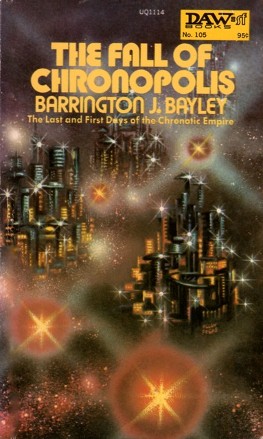
TheFallOfChronopolis.jpg

Standard warning – this is not a book review! I’m going to analyze how a science fiction author twists a story idea around like a diamond to craft a fascinating mind-bender of a book. Though I’ll likely spoil the crap out of it, we’ll hopefully pick up on best practices for anybody looking to squeeze novelty and freshness out of a concept they might have for a book or story.

“With a hollow booming sound the Third Time Fleet materialized on the windswept plain. Fifty ships of the line, the pride of the empire and every one built in the huge yards of Chronopolis, were suddenly arrayed on the dank savanna as if a small city had sprung abruptly into being in the wilderness”

Because I’ve read it a jillion times and because you should too, I picked for this exercise a 1974 time travel novel by a guy capable of turning your brain into salt water taffy but still leave a smile on your face. Seriously, why are you not reading Barrington Bayley? Go get Knights Of The Limits if you want a sampler pack. The book we’re going to look at is The Fall Of Chronopolis.

The core idea:

There’s an empire that stretches across time instead of space

Time travel has been done to death; and it’s usually stupid and full of holes. Look, you’re probably nowhere near the Doctor Who fan I am – I adore that show in all its forms; but mostly they contradict themselves at will and skim over uncomfortable goofs. Admit that, so we can move on. Here, Bayley has an interesting twist on the galactic empire idea that’s been around since the 1930s. Already a good start. People go back to those 1930s pulps even now. They did a lot of things right; and so did he with this one.

But how to make that work?

Bayley built a theory of how time is structured to try and solve how his core idea could function, how the citizens would travel across the empire and how they’d be ruled. It’s a natural progression once you have an idea, right? Just answer the obvious questions about your idea. He tells us time is like a frothy ocean with our reality and perception of it like stable skim on the surface. Yet under special circumstances, you can go deeper into the potential realities lying below, a horrid and ghostly place where souls can be dissolved into nothingness. Nice – loads of chance for drama and action there.Giant freaking time barriers were set up at the rearward past and forward future like walls around the empire. Specially protected ‘achronal archives’ exist inside buffers which are compared to duplicate archives outside the buffers enabling them to become aware of any disruptions to the timestream…like people or cities disappearing from history. There’s your empire.

Which raises more questions…

There are obvious problems that are going to come up with all of this…you can imagine the debate that went on in his head at this point. Like a courtroom, putting his idea on trial, my guess is he knew right away he needed a way to smooth contradictions, and a way for them to have a conflict of some kind. So his theory of the ocean of time needed to expand a bit. If you can imagine standing ripples on the water, no different from you and I holding a rope at the two ends with me popping up and down quickly so my end goes up when yours goes down…that point between us where the direction switches is called a node. Bayley imagined us existing at a node in time – stable points that move forward one second per second. There are just several of these; and the empire stretches across seven of them. Since they’re all that’s stable though, wrecks in the hinterlands between nodes dissolves all souls onboard into the terrible sea of potentiality. Come on! Once you stretch out an idea like that, of course it’s going to happen in the story! It’s writing itself at this point!

…and implications…

I can also imagine in Bayley’s spitballing session on this idea just trolling over everyday things to bounce his time empire idea across them and see what comes out. Relationships, for example. He imagines a young narcissistic prince who seduces his future self into a romance at node 1. He constructed a religion around how his empire would view the sea of potential, and the special reverence attached to the sacred moment when a Physics lab assistant first discovered the principle which would enable time travel.

Add the conflict and stir…

Once the initial idea is set up, it just needs tension. I imagine Bayley still working his central idea, twisting and turning it to see what war would look inside this framework. Giggling maliciously, I’m sure, he gave us an enemy empire existing in the future beyond a long period of unpopulated nuclear wasteland, begun by dissident time travelers from the empire itself. Cool beans. Conflict was automatic with this one, wasn’t it? Suddenly, the archivists start reporting entire sprawling cities have vanished from history, which no one remembers. The automatic rule of science fiction is to keep pushing the idea – how far can this go? Bayley describes the ultimate goal of a time war as disrupting the founding of your enemy – basically, get behind them and muck it up. It’s really fascinating to read all this…just incredibly innovative.

I’ll wrap it up to leave at least a little mystery to it all. The overall point this time around is the ideas will come from mishearing something around you, from hammering differences into something you see in a movie or book or something somebody tells you, whatever. The job then is to twist it around in the light for:

  1. Your first-pass explanation of how things will work with this idea
  2. Answers to the obvious questions resulting from step 1
  3. Teasing out implications of all that on everyday things
  4. Finding conflict that leverages the idea, not something boring that didn’t need it

That’s my take on it, anyway. You can go read Bayley now.


‘Sun Of Suns’ by Karl Schroeder

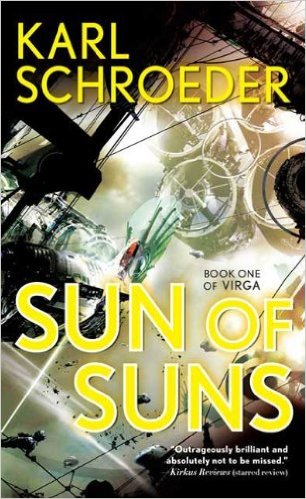
sun-of-suns

What do you REALLY ask of a book, anyway? Isn’t it true that if you can just get lost in some cool world, check out of this one for a while, maybe run into some chin-scratching ideas along the way, meet some fictional folks who you care about one way or the other – love or hate or whatever, then it’s all cool? Me too. Here’s one.

So I tried a different Schroeder book a while back (‘Lady Of Mazes’) and saw enough potential to try him again, though his style was bugging me. Seemed to ramble a bit. Don’t point at me, I’m the one typing here. This one was worlds better though. I’ll prove it – see what you think. It’s called, ‘Sun Of Suns’, by Karl Schroeder, first in his, ‘Virga’ series.

Virga is a massive fullerene balloon three thousand kilometers in diameter but filled with air. There are spherical lakes and massive chunks of floating rock – all aimless. The people living in Virga form and ignite their own little fusion suns for light and heat; but that leaves huge swathes of the atmosphere left in winter where there are no towns. There isn’t a single government or even a single planetoid where these folks live either – they’re on individual floating towns made from huge wood and rope wheels, spun for centripetal gravity. You can jump from one to the other if they’re close enough. You can fly from one to the other on hover bikes. It takes a few pages to get used to what he’s painting for you; but I haven’t come across such memorable imagery for a while. Would be amazing to see maybe in anime if not live action.

The story centers on a guy named, Hayden whose tiny town was slaughtered by a larger town six years ago when they tried to set off their own sun to gain independence. Hayden’s looking for revenge, targeting the Admiral who he’s almost certain (but not entirely certain) led the attack. He of course gets in the fireworks and intrigue of something larger with everyone he’s mad at, but also with a mysterious lady who is impossibly not even from Virga at all. The Admiral’s wife is beautiful but conniving and nasty; and Hayden tags along with her for a sizeable chunk of the narrative. She’s also the subject of the second book in the series, ‘Queen Of Candesce’.

When I was a kid in summertime, I’d ride my bike down our long driveway and around the yard imagining I was on a hover bike, stopping in at a floating maintenance shop and spying for somebody preparing for the revolution or whatever. This book had every bit of that, which smoked my mind a little because how the heck could something so weird in my head show up in print now? Schroeder did an ‘Inception’ on me. That was fun to see.

One scene in the book made my Physics mini-me flinch a bit; but he redeemed himself and nailed something down that is incredibly unique and worth the price of admission on its own. I don’t think it’s a spoiler; but you may think so. If you’re worried about that, skip the next paragraph and join me at the end. I’ll wait for you there.

The key characters pay a visit to a small town that has inserted itself into a massive spherical ball of water. They used a water-repellent cone the size of a freaking town and wedged it into the sphere, carving out a place where they constructed their buildings and hide away from all the intrigue and conflict within Virga. Flinch, read it, stick with where he’s going…incredible idea, maybe could work…wouldn’t want to live there…hope they don’t fire any guns at the walls.

My point is this then: great book! I read a lot of pulp science fiction from the 1930’s and 1940’s like ‘Brigands Of The Moon’ by Ray Cummings or ‘The Metal Monster’  or ‘The Ship Of Ishtar’ by Abraham Merritt. ‘Sun Of Suns’ has that feel of fun and danger and outlandish technology. Don’t look for deep philosophical musings or ominous quests or galactic battles here, you won’t find them. Read my first paragraph again up there…if those things make it happen for you, then give this book a shot. Let me know what you think.

Why You Should Be Reading R. A. Lafferty: The Madman Of Oklahoma

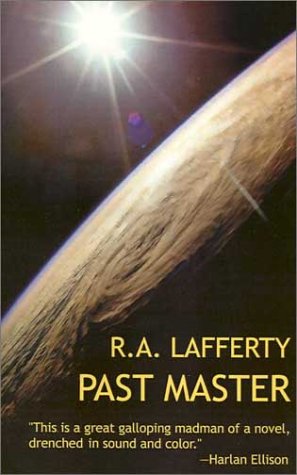
lafferty-past-master

You’ve probably heard R.A. Lafferty quoted if you haven’t read him. I came across him first when Neil Gaiman said a particularly good line he’d used in his, ‘Sandman’ series was a Lafferty line. Maybe you recall it – the creepy witches called ‘The Kindly Ones’ said something like, ‘They can kill you; but we can kill you worse’. That’s actually a chapter title in Lafferty’s, ‘Fourth Mansions’. A rocking book, if you haven’t read it, about four secret societies vying to take control of the future of humanity. The reason you read it is not the plot, because you know…whatever…I can’t really say what’s going on; and I’ve read it twice. You read it because he drops these word-nuggets that sparkle. The title of the first chapter is, ‘I Think I Will Dismember The World With My Hands’. The ninth chapter is, ‘But I Eat Them Up, Federico, I Eat Them Up’. If you don’t love that kind of thing, then take a pass on the guy I guess; but you’re missing out. At least try, ‘Past Master’ because its plot is good too, there’s a great story, and there are more sparkling quotes for you.

Here are some quotes, see what you think:

  • ‘It looks like a good year for monsters’ – Fourth Mansions
  • ‘I’d like to be gentle to you with with a meat cleaver, Justin’ -The Emperor’s Shoestrings
  • ‘It is an awful and sickening thing to see a good man grow rich and respected.’ – The Underneath Man
  • ‘The first implement made by man was not a scraper or celt or stone knife, it was a crutch.’
  • ‘My magic can whip your magic; and my dog can whip your dog’ -All The Skies Are Full Of Fish
  • ‘Most of the trouble that comes to people in this world comes from reading the wrong books.’ -Try To Remember
  • ‘I have certain riddles to ask the woods and the mountain, and they do not speak when others are present’
  • ‘Which was first, you, or the belief in you?’ -Past Master

So back to what I view as his masterpiece, though everybody you talk to who digs this guy has a different view on that. For me, it’s, ‘Past Master’. A description from the interwebs:

‘Past Master is set in the year 2535 on the world of Astrobe, a utopian Earth colony that is hailed as Golden Astrobe, “mankind’s third chance”, after the decline of both the Old World and New World on Earth. Despite idealistic intentions, it is suffering moral and social decline that may be terminal for both Astrobe and the human race.

In an attempt to save their dying civilization, its leaders use time travel to fetch Sir Thomas More (chosen for his fine legal and moral sense) from shortly before his death in the year 1535 to be the president of Astrobe. More struggles with whether to approve of the Astrobian society, noting its possible connections to his own novel Utopia. His judgements soon lead him into conflict both with destructive cosmic forces on Astrobe and with its leaders who thought him a mere figurehead who could be manipulated.’

End quote. If you’ve ever read Harlan Ellison’s short story, ‘Repent, Harlequin Said The TickTock Man’, and loved it because the trickster guy in the story is thumbing his nose at the people who think they’re in charge, then this book may just work for you like it does me. Thomas More sticks it to the man, if you know what I mean. By the way, if you haven’t read Ellison’s story, what the crap, man!? Get that done, then come back. Sheesh, you’re lucky we found that out!

Lafferty, man. Go read this guy. He saved himself from alcohol through his writing; and he made the world a better place because of it. You owe him at least a look. Let me know what you think!