For some roleplaying gamers, the thrill of the game comes from cautious, dangerous exploration of the unknown with a hissing, hungry beast potentially down every corridor. For some, it’s the “beer and pizza” comradery and casino-like feel of the dice deciding life and death. Many love the unfolding stories, to gather “there I was” anecdotes like they’re candy.
But some of us want some blood and consequences.
Youtube is crammed with advice on how to make your tabletop RPG combat more realistic, but there’s a fellow you’re going to meet here who may have cracked that code with a rocketship of a game from the turn of the millennium called The Riddle of Steel.

So you should know…Jake studied and taught at a leading historical martial arts organization, was co-founder of the Historical European Martial Arts Alliance, and held championship and rank positions in multiple disciplines including the number one position in the United States for the longsword. He’s not just some nerd cranking out dice mechanics, though when we spoke, he shocked me with his depth of RPG knowledge and passion. He’d even heard of Feng Shui Action Movie Roleplaying, which that alone would have made him awesome.
Here he is. Watch this and try not to grin at this guy.
Anyway, today he might be head of the European cybersecurity business for a global consulting firm and a Ted Talk waiting to happen, but why brag about that when you created something many consider as the most realistic simulation of combat in a tabletop game? I sat down with Jake in December to talk about everything from The Witcher to D&D, from the reality of trying to stab someone with a sword to being front-row at some legendary developments in roleplaying games. Our chat was a fascinating tornado of influences and inspirations, and, sadly, I can only present here the heaviest-hitting topics and exchanges to keep the size manageable (puns intended). I hope you enjoy hearing from him as much as I enjoyed our conversation.
Welcome back to our Inspirational Creator Series!

As always, my main interest in hearing from Jake was to understand his inspirations and influences, what drove him to create something in the first place and from what wells he may have drawn as he did so. Before we get into any of that or in any details here, let me hook you a bit on what innovations and experimentation made Riddle of Steel unique.
Riddle of Steel Overview
The game itself (Driftwood Publishing 2001) is a D10 dice pool system, meaning you’re trying to accumulate as many 10-sided dice as you can for various rolls to see whether you get the outcome you want as the story plays out. The setting is a massive continent on a roughly earth-sized world (both named Weyrth) and replicates many familar low fantasy sword & sorcery elements. – though with plenty of room for vicious, deadly combat. And that’s where the system really shines.
Spiritual Attributes: Like many systems, characters receive stats based on their backstory and natures to affect dice rolls. Here, these include Strength, Agility, Toughness, Endurance, and Health as well as Will Power, Wit, Mental Aptitude, Social, and Perception. However, this ruleset also provides for Spiritual Attributes such as Conscience, Destiny, Drive, Faith, Luck and Passion: traits derived from your character’s backstory and which can change over the course of the game. They have mechanical consequences for gameplay but also have a magical way of driving roleplaying and heightening dramatic moments.
Combat Initiative: Commonly, the turn order of combat moves in a roleplaying game is determined by an Initiative dice roll. In Riddle of Steel, opposing players (or the game master rolling for a non-player character) declare a fighting stance up front which can provide stronger attacks and defenses at the cost of predictability and flexibility. Players then simultaneously uncover either a RED or a WHITE die to either ATTACK or WAIT. Imagine two boxers eyeing each other amid their footwork to gauge the next move and size up their options.
Terrain: The ruleset encourages description of and integration with the environment in which the combat is taking place. In fact, page 77 offers Target Numbers to roll against so that things like swampy ground or tight spaces affect gameplay. To me, this opens up all kinds of interesting twists in a fight given the props and surrounding conditions either fighter might take advantage of.
Hit Location Zones: When you make your attack, it isn’t blindly at the opponent so much as an attempt to strike a specific target. It’s part of the attack. Looks like this:
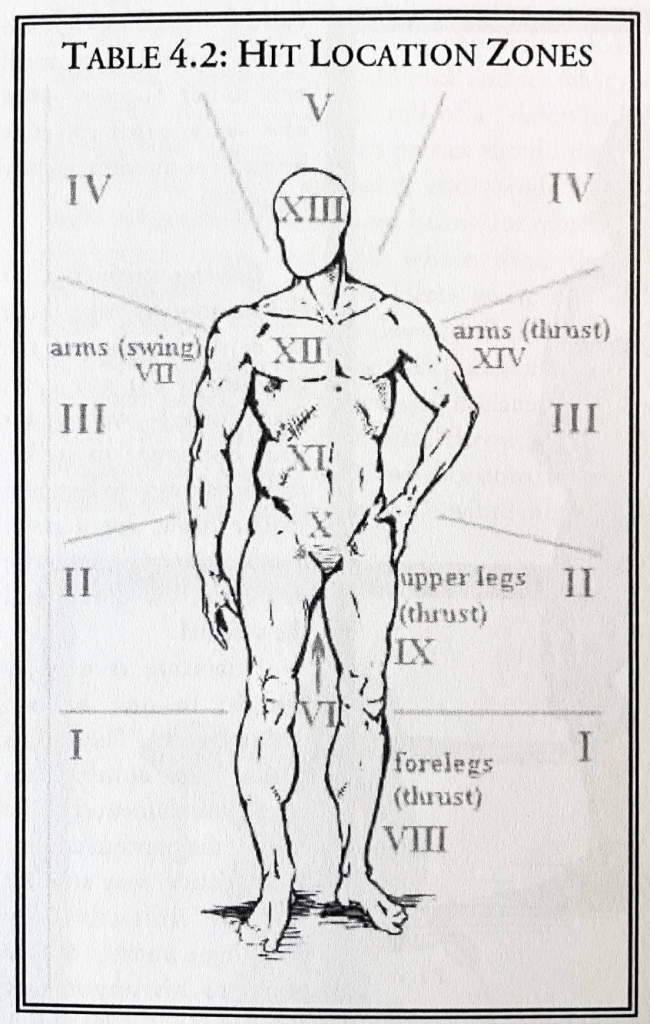
Detailed Damage Tables: I understand this is one of the areas for which the Riddle of Steel ruleset was often criticized as being too clunky and slowing down the game. My take is a bit different though. There are tables here for Cutting, Puncture, and Bludgeoning damage for each Hit Location Zone. Just have them handy and printed separately, man. Doesn’t take long to find what happened And it brings a gruesome and fierce edge to the fight. Honestly, combat doesn’t take longer than a turn or two in this game anyway.
That’s right. You can die in combat in Riddle of Steel. Fast.
Let’s Hear From The Designer!
Jake, What were some of your earliest influences and inspirations? [The actual conversation has been paraphrased and edited for flow and space considerations.]
“I started with D&D Second Edition, kind of a blend of 2nd and 1st Edition because I came in on the cusp between the two. At some point, I also played Shadowrun, and played a pretty healthy amount of Warhammer Fantasy roleplay, which was my favorite of the lot. And fictional inspirations too. I’d read some great novel that I wanted to play in a game. I would look at which of the games that I played would be easiest to hack or home brew.
“I bought a D30 once in a game store as a novelty. What the hell do you use that for, right? So Marvel Studios back in the early 90’s in the heyday of Jim Lee and the New X-men rebranding, they published these cards. You know, collector cards of all the Marvel X-men superheroes with stats on the back. So I used my D30 and those stats to write my first ever coherent roleplaying game. I don’t know. I was, maybe 12 or 13. Then at one point in high school, the whole World of Darkness thing got really huge. So I played some Vampire, some Werewolf, and some of those other spinoff games. And GURPS, this idea of modularity and all that. These were all heavy, heavy points of inspiration for me.”
And The Witcher books?
“Right. I spent a couple of years living and working in Poland and learned to speak Polish. I started reading them before the last one was published. I read Sapkowski’s works while I was in Poland, in Polish, and I was just so energized by them! I thought they just captured my imagination in a huge way! When I got back to the U.S. in late 1999, early 2000, I wanted to play The Witcher. I wanted to do something that had this vibe of really cool combat, right? I wanted to do something where the players are making choices about what the character is doing in the fight. I didn’t want to just say ‘you roll, you hit, you roll, you don’t hit, I attack’ – you know. I wanted some degree of tangible, tactical interaction.
“And around that same time, I was introduced to King Arthur Pendragon by Greg Stafford, which is a master class in game design. One of the greatest games ever designed, hard stop. Just phenomenal.

“Fun little side note on that: shortly before Greg died, a common friend of ours introduced us. I consulted on some of the combat rules for what Greg was planning for 6th edition. I signed an NDA – all that stuff, actually sat down with them at Gen Con. I walked him through a whole bunch of armor research…how it really functions and how it’s really fought in. All these things and then…God save us all…he died. I have no idea if any of that made it into the notes for the guy who actually finished 6th edition. My guess is it didn’t, which just kills me because Pendragon is such an incredible game. To have had my name listed as advisor for Pendragon would have been like a crowning nerd achievement. Anyway, Pendragon. Phenomenal!”
Any others?
“Yeah, I was introduced to a Polish game called Dzikie Pola, which means The Wild Fields. It’s the Polish name for eastern Poland, the Ukraine, during the kind of Baroque period – the Polish golden age when it was sabers and Sarmatians and big furry hats. It’s an amazing period, and there is some amazing fiction and historical stuff out there about it! Anyway, it had this really clever dueling system for sabers, and it was the first time I’d seen this kind of approach where you have a number of combat points – like you’ve got 10, the other guy, 8 or whatever. You pick from a list of maneuvers that cost points. Then you contest back and forth. The game’s second edition took all that stuff out though. I don’t know how functional it all was, but the idea was brilliant!
And John Wick was starting to publish his big games: 7th Sea and Legend of the Five Rings. John Wick was kind of the rock star of game designers. He’d won the Origins Award for best game two or three years in a row. I was reading some of his games and looking at his tech, the vibe there. But I tried hacking GURPS. I tried hacking Warhammer Fantasy. I just ultimately decided that I couldn’t hack any of these games to be what I wanted.”
So we’re getting into game design choices for Riddle of Steel, then?
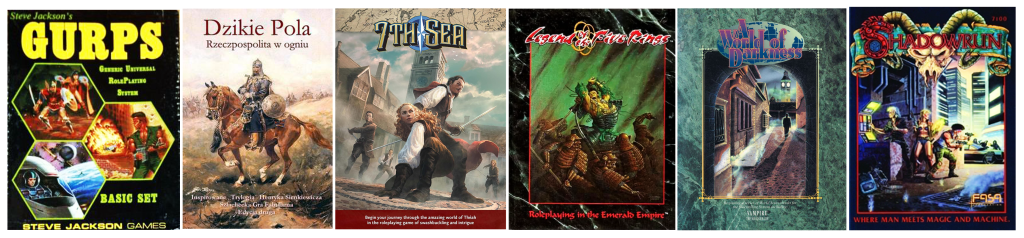
“Yeah. I know from playing Shadowrun that it was fun to roll a handful of dice, right? I knew from playing World of Darkness that I hated when you rolled and hit, then rolled for damage and didn’t do anything. I hated that these things needed to be connected. There was no point in even trying to hack D&D at that point. They’d gone to edition 3.5 and I was like, ‘what are feats’? I definitely went through at least a decade, maybe 15 years, when I was “too cool” for D&D. So I started looking at it as a blank slate with some requirements: I needed you to make combat choices all the time you’re in a fight, choices that had to be meaningful. They have to be impactful and interesting enough that the rest of the table wants to watch.
“There were just things happening in these other games that I was playing that were taking me out of the fiction. There had to be a sense of risk, a sense of danger to promote making certain kinds of decisions. I wanted something exciting to watch, with real decisions that had enough flexibility so you could insert some flash into it. I kind of failed at that, to be honest, but it was a major goal in the game design then.”
Flash. Tell me about that.
“I wanted a system where you could create the kind of things that show up in the Witcher books. Geralt fights in a very flashy way. The word ‘pirouette’ shows up a lot, at least in the Polish. He cut a guy in a pirouette: a somersault and a pirouette. And the guy’s head popped off. I wanted a system where you could plug that kind of stuff in.
I started doing research and realized I needed to know more…not just about games. And I started looking at how weapons were used historically and stumbled across what would later be called the Historical European Martial Arts (HEMA) movement. It blew my face off! It honestly replaced roleplaying games as the primary obsession of my life for the next 20 years. As I researched, I realized how little we knew as a community about the martial arts of the period. Everything I found out, everything I could glean and pull from that made its way into Riddle of Steel. So I stopped worrying about some of the more cinematic, flashy stuff and started thinking about what happened historically…how do I model that in my game? I got an endorsement from a leading historical martial arts organization at the time because I showed them what I was doing. And listen, man, if you’re trying to recreate a historical martial art, you’re a nerd.”
Let’s talk about the art in the book.
“Yeah. The main three artists in the book are myself, a guy named Rick McCann (who also helped design the original sorcery system), and Ben Moore. My high school buddies, right? I was in the art scene, and they were my artist friends. Rick was by far the more professional artist of us. I think he’s a professional artist today.” [Editor’s note – Rick has in fact taught artists at Dreamworks Animation among other places and is indeed available for contracted art]
I’ve got to ask about this one particular image in there. This guy.

“Yeah. That’s Rick. Rick McCann. Rick was really, really good. Rick did the cover.”
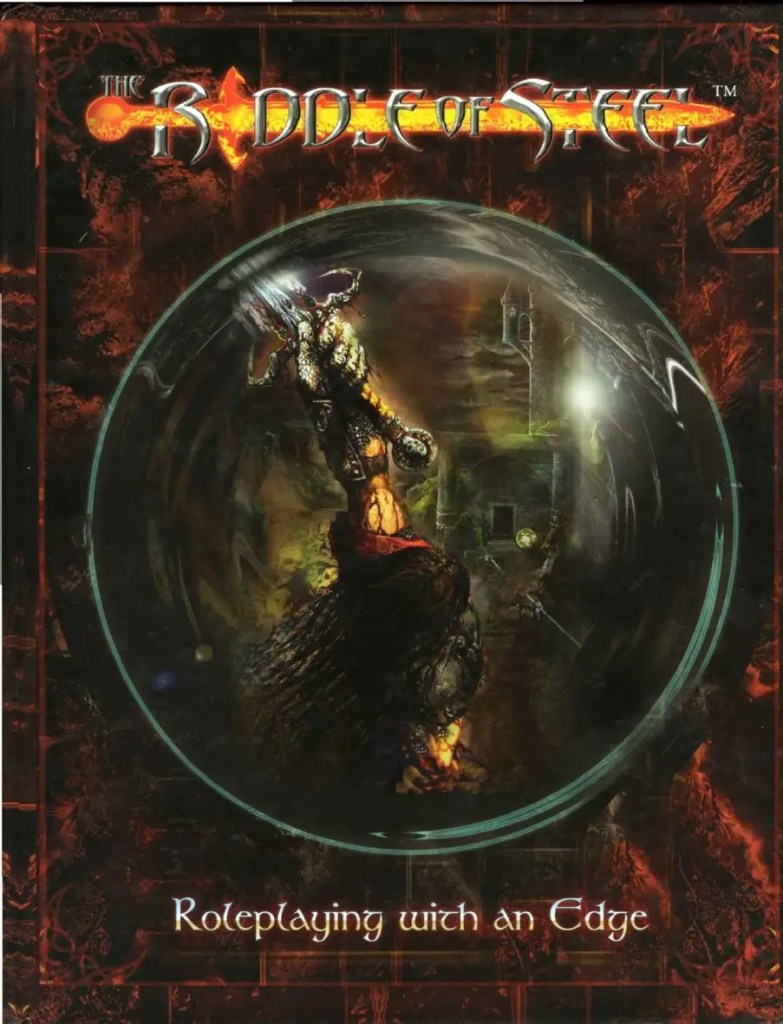
“All the knotwork was done by Ben Moore. All the very clean black and white inked pieces were me, and some of the pencil pieces. And one of the criticisms I got early on like when we first went to GAMA Expo was there was too much art, that I should have used less art and avoided a lot of the lower quality pieces. I guess that’s true. I don’t know. It’s worth pointing out: I just wanted a game for me and my friends to play. I had no intention of publishing. And then I wanted a physical copy because, you know, pdf’s weren’t a thing yet. To get something affordable, I had to print hundreds of copies and so – well crap – if I’m going to print hundreds of copies, I’ve got to sell 299 of them. And so it spiraled like that.”
Fantastic. Just fantastic. Talk about those early days then, as you guys were putting this together.
“I was going to university. Rick and Ben were in art school. I wrote the entire first draft of everything and showed it to these guys. They had some ideas and added to it, then the first large-scale play test of the game was with my old high school D&D group. I went back to visit them. One of the guys in the group – his grandparents ran a doughnut shop. We’d go there in the afternoons after it closed, and we played a whole five-session campaign over a summer week. I was trying to see if my ideas were even going to work at all.
“You look for trends and patterns, what seems to be working. And I went back and designed again. Then the version we originally published, 300 copies, that’s the one we took to the GAMA trade show and to Origins. And when that sold out, we needed another printing, and I found a printer in China or wherever that was affordable, with higher quality print and clearer images.
“It was interesting. Going from the fun part of designing the game and creating this work of art, building it in Pagemaker, putting in the text, picking fonts and graphics, play testing, publishing at the first couple of cons where you’re promoting the game…and there’s so much excitement and energy till you realize you’ve now borrowed more money than you’ve ever had in your life. You’re trying to make this happen, and suddenly it’s a business you’re trying to make money with. And the fun of using it for tax writeoffs becomes not so much fun anymore.”
And you wound up selling it?
“Yes, I sold Driftwood Publishing in 2004, and the rights went to someone else, who then sold it in 2013 to Tavish Campbell of Red Lion Publishing. I haven’t been in contact with Tavish in a decade, and I wonder if he’s not dead!” [Editor’s note: we tried contacting Tavish for this article. We really did. If any of you can help reach him, Jake would like to catch up!]
“But I learned a lot as a designer. As I write a successor game, whatever it winds up being called, I’ve got great stuff. In the event that I ever get around to finishing and publishing it, I understand my priorities as a designer so much better now because I have words that describe things that I simply felt as a 22 year old.”
You said European Martial Arts blew your face off. Give me one concrete example of what you meant by that.
“I think the first thing was – I saw this video of a guy doing what we call a flourish, just swinging the sword around shadow-boxing with an early rapier, something you could cut with. The blade was moving so fast, and it was so lethal-looking. The economy of movement! Up until that point, every time I’d seen somebody wielding a sword, it was an actor performing staged choreography that came from either modern sport fencing or from traditional stage combat (which is meant to be inefficient and safe by design). If you look at the sword fighting even in some of the better films like Lord of the Rings, you can see they’re intentionally swinging at each other’s swords and not at each other. So I saw this guy who was not a stage fencer, moving his weapon in a way that was like – Oh my God, this is fast! It looks lethal. It looks beautiful.
“And the second thing that blew my face off was realizing there are hundreds of books written during that time period that tell you how to use these instruments. The whole HEMA movement was about taking a martial artist and a historical book and slamming these things together. We were actually experimenting to recreate lost arts by taking people who knew how to move and getting them to try and interpret these historical sources and make that come to life.”
If somebody’s reading this and wants to get their hands on a book like that, name a good one.

“There’s a website called The Wiktenauer that contains dozens if not hundreds of these manuscripts. Translated photocopies. All kinds of stuff. My stupid claim to fame is that I named it. I had nothing else to do with its creation. It’s a play on wiki and then the master, Johannes Lichtenauer.”
How does The Burning Wheel RPG fit into all this?
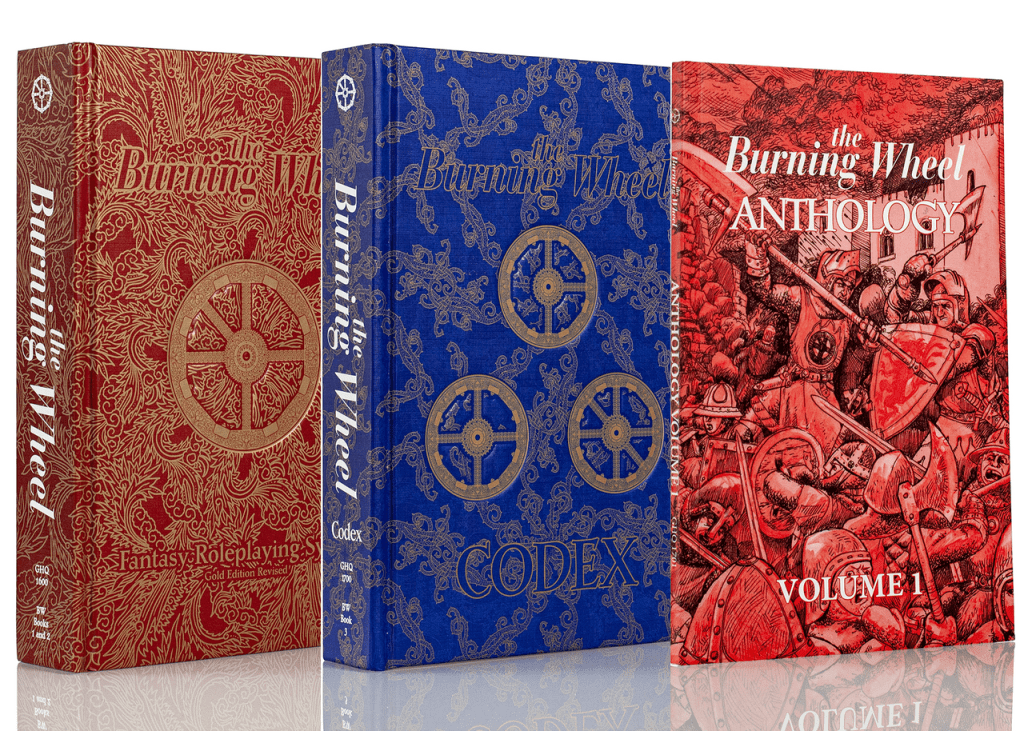
“Luke Crane and I became friends actually. The Burning Wheel and Riddle of Steel approached the same problems in different ways. We had very similar design priorities, and so when we first met each other in 2002 or 2003, we were definitely looking at each other crazy, like, whoa – hold on, are you like a competitor? Are you an enemy? And a year later we were very close friends, and he is still one of my closest friends to this day. I spent many years going to Gen Con as a member of Burning Wheel HQ crew, just quietly being this guy who also wrote this other game.”
All right. It’s time. Let’s have some advice from the designer of Riddle of Steel on how to fight in the game. What do I need to know?
“Dump as many stats as you can to get a high reflex score. The higher the combat pool, the better. The name of the game is not to land a hit; it’s to drain the other guy’s pool and then land a hit. Once you land a hit, press your advantage. But focus on not getting hit first. Pressing and gaining the initiative. If you gain the initiative, keep it. If you throw a WHITE die and your opponent throws a RED, and he comes at you with a small number of dice, parry with slightly more than he did. If you parry with too much, he’ll use the feint.
“The odds are in your favor if he attacks with a lot of dice. Use the counter maneuver when you attack. If you think you’ve got a chance to go for the jugular, go high and throw a lot of dice into it. But if you think he’s going to counter that, you’ll get killed. So get to know your opponent. If he uses a lot more defense dice, then call a feint.”
Jake, you’ve been amazing! Thanks for your time here.
“Yeah, by all means! As you can see, I’m happy to talk about all this stuff. I still enjoy it. Thanks for spending time to hear me rant.”
*
For Grailrunner readers, it may be expensive or at times impossible to find a copy of Riddle of Steel out there in the wild right now. Here’s a link to a Quick Start Guide from Driftwood Publishing by Stephen Barringer that’s publicly available for free.
Hopefully you enjoyed our chat. For me, it was an absolute blast! I’ll leave you with the opening words from Riddle of Steel:
Since the dawning of time, when Triumph the Forger-God pounded out the world from the mists and ores of heaven, mean have sought the Riddle of Steel.
Few have found it.
What is it?
It is invincibility – to strike with all and to be struck by none.
It is understanding – to ask questions and to know the answers.
It is peace – to walk without fear, to know that the end is in your own hands.
It is skill – to feel the elegance found in violence, and to know the beauty found in stillness.
It is Spirit – to gaze into the face of your God and to know him before he comes for you.
What is the Riddle of Steel? Where is it found?
That is the question with no answer.”
Till next time, guys.







 Grailrunner Publishing