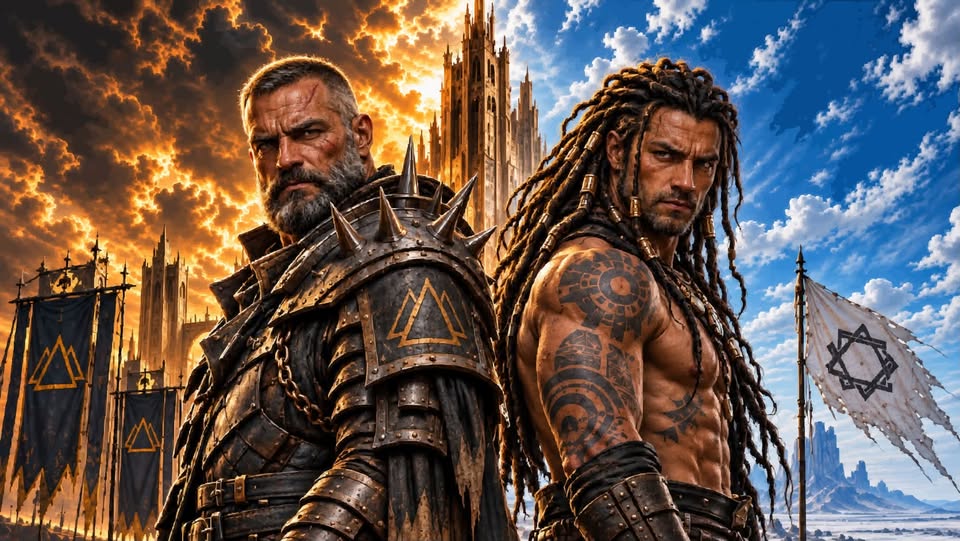
Announcement: the Salt Mystic card game is live with refreshed art and repackaged as a starter set!!

We said we’d let you know when the proofs were right. Well, the proofs are right. The refreshed Salt Mystic Starter Set is live!

If you’ve been following along, you’ve already heard me confess to some questionable decisions about the old card art. Turns out learning a new trick in Blender and needing that trick on a game card are two entirely different things. It took me an embarrassingly long time to sort that out.

The new art had a better question to answer. What would make you pick up one of these cards and want to know where that gunslinger came from, or what happened in the patch of ruins they’re fighting over?

So what’s in the box?

We’ve repackaged the game into a single 72-card Starter Set featuring Karak: The Hammer of the Red Witch and his Mountains faction versus Segmond: The Loreblade and his wily Salt Flats faction.
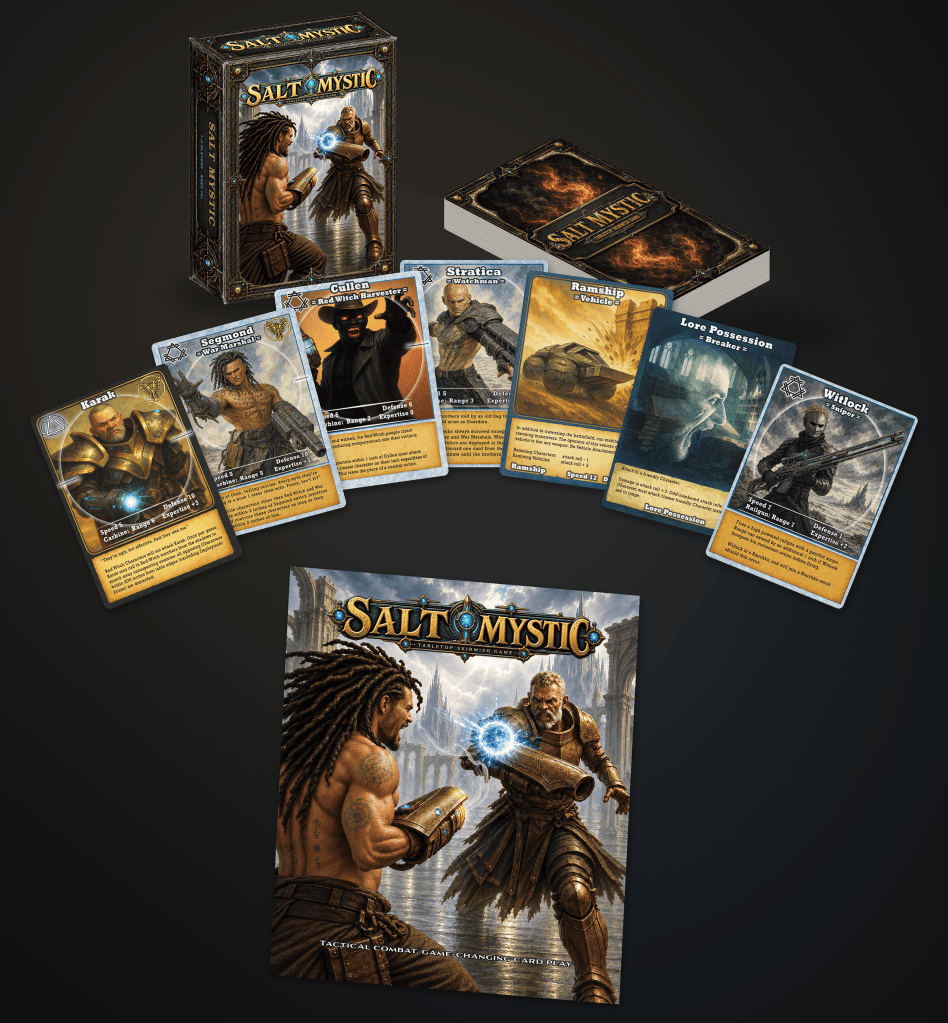
Karak’s Mountains deck and Segmond’s Salt Flats deck are both in there, along with terrain, measuring cards, and player aids. The Start Here card has a QR code for the refreshed rules, and First Clash walks you through your first fight.

If you’re new around here, Salt Mystic is a science-fantasy skirmish game where you move the cards around the table. Turn a gunslinger to face a threat. Tuck them behind a rock outcropping. Get cocky about how far away the other guy is and find out exactly what a ball lightning carbine can do.

Where can I learn more?

By the way, we’re celebrating all this by way of a very special reunion with an old friend.

Oh yeah, who’s that?

Brian here. One of my personal favorite characters in all of the Salt Mystic universe is a volatile powder-keg fellow named Cyprian. The image of him has been with me since the original novel, Tearing Down the Statues: the thing that started all of this. Unnaturally tall, in a long leather coat with heavily tattooed hands in red & black, and with the illusion of flames erupting from black shoulderboards, he’s unpredictable and deadly with the signature weapon in Salt Mystic: the ball lightning carbine.

I thought it would be awesome to 3d print him.

Ooh, is there a model?

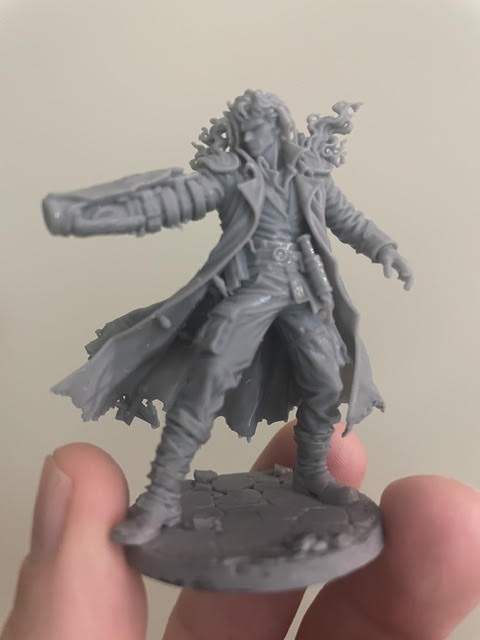
There’s something funny about spending all this time getting plasma gunslingers to look right on flat pieces of cardboard and then turning around to see if I can get one of the first people in this world to stand up on the desk. I’ve known Cyprian a long time. I want to see how that coat looks when I can turn him around in my hand.
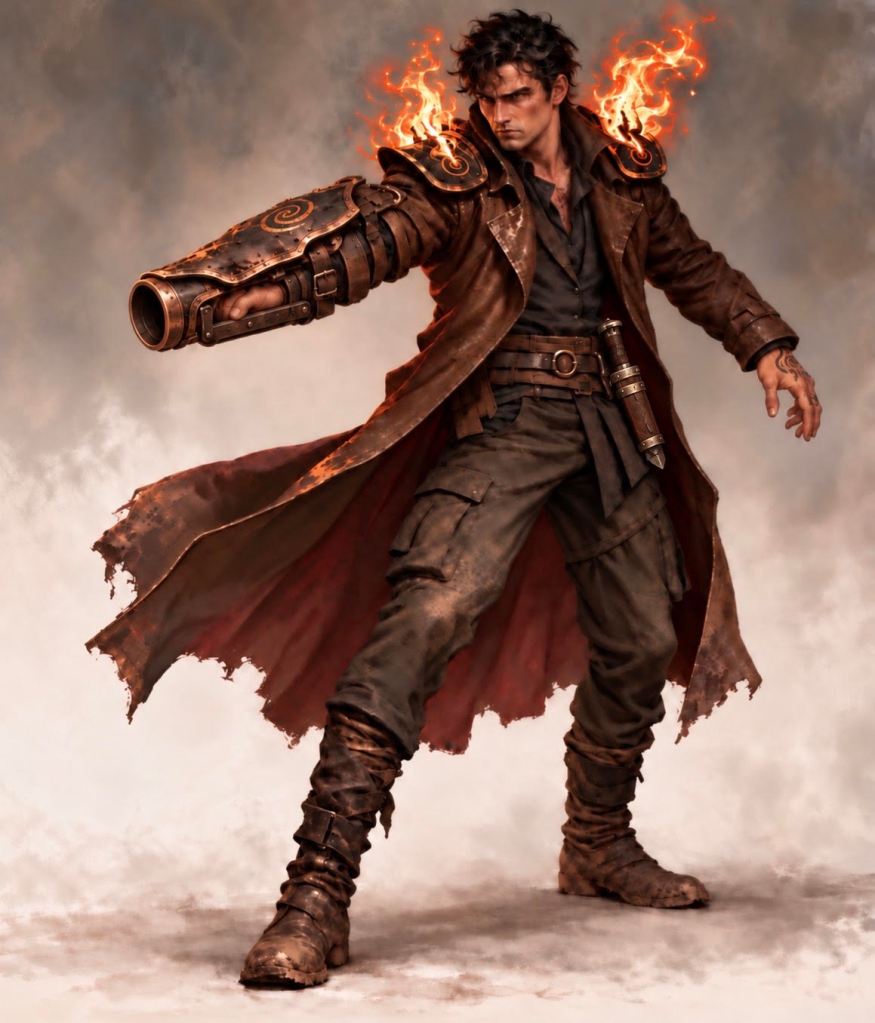
I uploaded the text of Tearing Down the Statues to the Pro version of ChatGPT and asked for a better illustration than I would be able to come up with. It took a few passes to get it right but when it finally landed, I was very, very impressed! You can see the tattered, weathered coat, the carbine shield, that deadly ballistic knife he carries, and those amazing shoulder boards. Very cool.

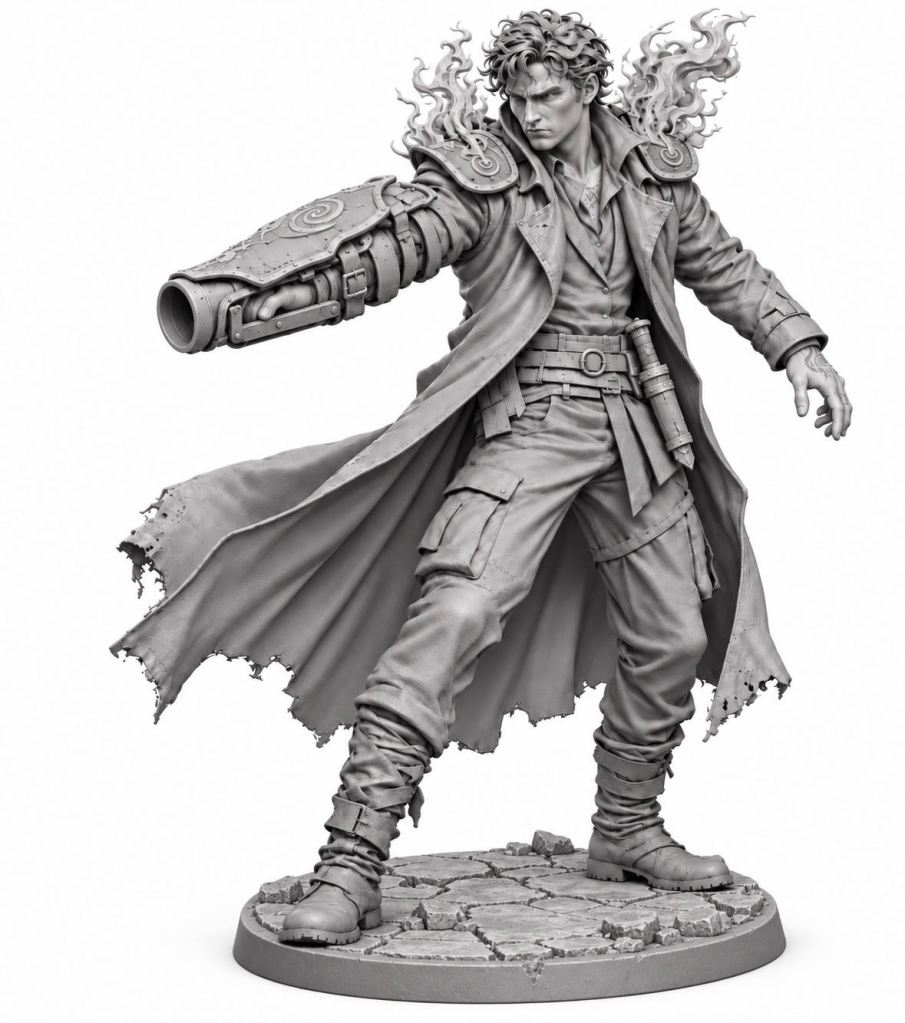
Then I converted that illustration to a new image appropriate to load to Meshy AI: a separate AI tool which generates 3d models from images. I had it add a base, remove the color, and emphasize some geometry better so Meshy would pick up on it. Then I took that to Meshy and got the STL file.

It took me forever, back in ChatGPT, to close some shell holes and fix some errors Meshy left procedurally. Then I spent forever in Chitubox trying to get the supports right. I never did successfully address some internal cavities but the supports wound up great. I’m not a 3d modeler, man. Not at all. And I don’t have the patience to find all those overhangs and fix them one by one. So I just printed it and hoped for the best.

I’ll be honest, when I scraped that thing off the printer plate for the first time and saw that guy there in my hand, a character who existed only in my ghostly imagination for over a decade, I got emotional.

It was really great to actually meet him.
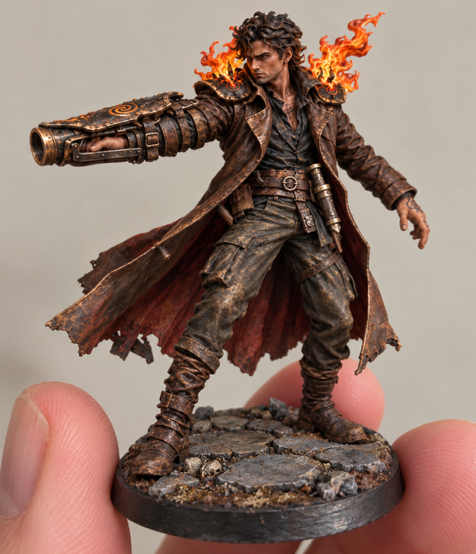
I uploaded the pic of the printed model and had AI generate the paint scheme, which is portrayed here. I didn’t paint that, thought I’d love to pass that off as my handiwork. I wish I could tell you my paint job was that awesome. Unfortunately, no.

But anyway, I liked what I saw and read off all my acrylic paint colors from old sets I had lying around and some Privateer Press colors. Plus, I bought some metallic paints from Amazon back in the day which always turned out well. That way, ChatGPT knew what specific colors to use in its step-by-step painting instructions. Very prescriptive and helpful.

And nuln oil. I love nuln oil. It forgives all sins in bad paint jobs by making shadows in crevices. I totally need that sort of magic in painting models.

And there’s my guy. Cyprian. In my hand, pointing his gun at me from my bookshelf.

Maybe this doesn’t mean anything to you and you can’t relate to why I’d be excited. But I hope that’s not the case. Fifteen years ago, I wracked my brain to come up with a cool aesthetic for this guy. I remembered Firestorm from the old DC comics and his flaming head illusion. I remembered old John Wayne and Clint Eastwood movies. I gave him a scar on his face just to give him a history and thought bright red & black tattoos on his hands would be unique.

It was me trying to dream up a fascinating character and summon imagery without being able to really see the guy.

And here he is.
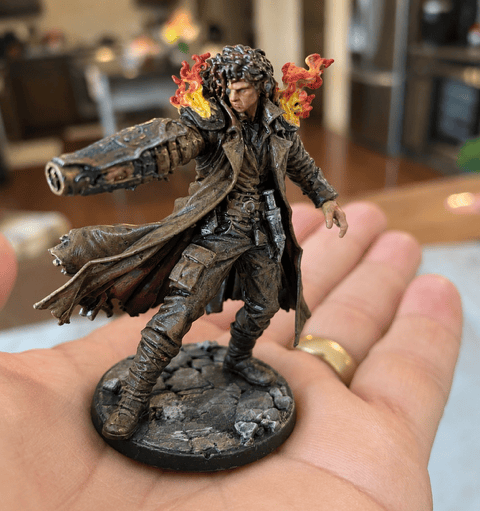
Anyway, your takeaway should be that the Salt Mystic game is renewed and repackaged for easier entry to this world and you should check it out.

Your second takeaway is this author guy wrote a book with a character important to him and through modern wizardry is holding an accurate model of him in his hand. If we had flying cars, I’d truly agree we’re living in the future. I thought I’d share one of my favorite scenes from the book with this guy, Cyprian Talgo, to give you some context so the celebration makes sense. He’s in a corridor in an undersea complex surrounded by four gunfighters who’ve made the mistake of telling him they’d like to see what he can do with that weapon.

Click the arrow to expand the scene.

“You want to see something amazing?”

“Did I upset you, lapdog?” Cyprian’s voice was soft.

“You can’t just threaten them like that. Jeopardizes the whole structure we’ve got here. You brought it on yourself, honestly. And I’ve got a lot of anticipation here; because I was just going to have someone put a slug in your forehead on the ship. A couple of the guys thought better of it to see what you could do.”

“Risky.”

“I don’t know about that. Fascinating though. Nobody’s going to start a war over you…the world isn’t like that anymore, Talgo.”

“Less chatter!” The guy behind Cyprian spat this out.

“You want to see something amazing?” Cyprian’s grin was sinister. Thrilled.

Another of those surrounding Cyprian, the one with a burn on his cheek, smiled wickedly, “Whatever. Rich boy.”

The young Talgo watched the face of the one who’d last spoken, the one excitedly awaiting a show full of drama and color, swirling action and a thrilling recount for his friends. He did the same for some of the others and saw the same eagerness, a boyish delight in a playground brawl with the biggest kid in school. He had clearly seen this before and was maybe surprised at how alike these sorts of people are.

“I know your tricks, jay bird.” A darker man to Cyprian’s side spoke, one with an eye squinting more than the other. “Two breakers in your carbine – fires twice as fast. You prance around like a dancing idiot while we panic and try not to shoot each other because you’re you. They write books about you.”

Ventrey had been watching the olive man who’d spoken, then at last turned back to Cyprian, “Give me back my gun.”

Cyprian kept silent. He turned his eyes to each of the men about him, waiting on one of them to do something other than threaten. Impatiently, he raised his eyebrow and gently shook his head as if to signal ‘well, I’m waiting’. Perhaps they were only blustering. At any rate, when he moved, it was with ferocity.

Like a crocodile attacking, Cyprian leaned in and thrust his right heel behind him, crunching backwards the knee of the man approaching him there. The fellow quickly went down grunting like an animal and collapsing around that knee. Before he had even fallen, Cyprian had shifted his carbine to his forearm and slung a ball of lightning through the falling man’s forehead exploding it in charred and smoking fragments.

Smoothly as if he’d seen their return fire in slow motion or on game film beforehand, Cyprian twisted the insulated shield of his carbine through the air blocking their shots in sequence. He spun a full circle throwing his carbine arm out to smash Ventrey’s jaw with the barrel, drawing out a tooth and fired multiple precise shots off, throwing the others into defensive moves shielding themselves. Lightning popped and rushed around them and hissed as balls popped out of existence in searing flames.

— Tearing Down the Statues, Chapter 4

*

That’s what I wanted to share with you today. I’d be highly honored if you checked out the new game and let us know what you think. It’s been years of work culminating in something everyone involved with Grailrunner is very proud of.

Till next time,

A lost card game of the wild American west

A “bunny trail”is defined as a digression or tangent in a conversation, writing, or research that strays from the main point, often hopping from one related but different topic to another, like a rabbit darting through fields; it can be a useful, curiosity-driven exploration or a time-wasting distraction.

I sometimes feel like that describes me a little too well.

Anyway, happy new year! Let’s kick 2026 off with a new bunny trail and some freebies! This one’s for card game enthusiasts, folks interested in gaming history, and I’m adding a twist for game masters of RPG’s that would like to add some authentic wild west gambling into their next campaign.

Cool?

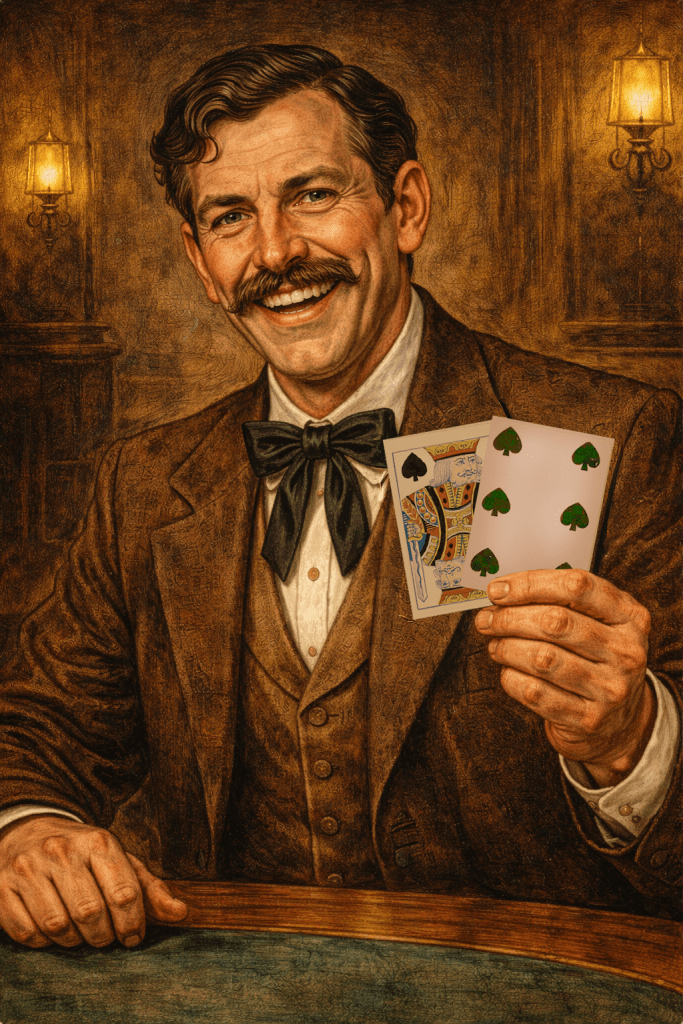
Before the holidays, I read a biography of legendary lawman, Wyatt Earp titled Wyatt Earp: The Life Behind the Legend by Casey Tefertiller. Great read, by the way, but not my point today. I catch odd things in between the lines sometimes when I’m supposed to be paying attention to the main storyline, and one thing that snatched my attention early was Earp’s passion for a card game I’d never heard of called Faro. It sounded awesome; I was surprised it wasn’t more popular now. They used to call it “Bucking the tiger” because some card decks had tigers on their backs. And of course that only makes it more awesome.

How do you play?

The main mechanic of the game is as follows:

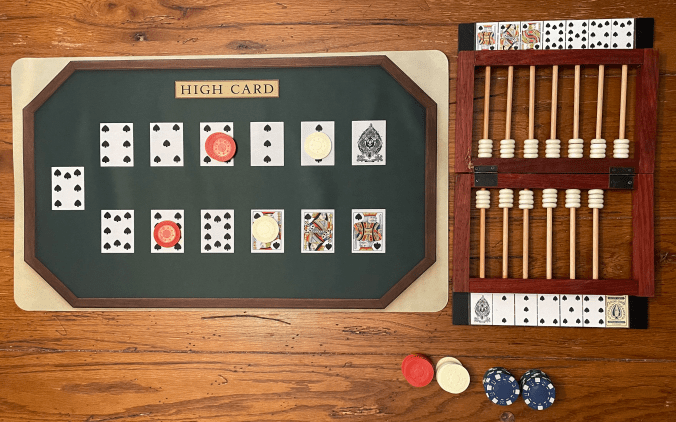
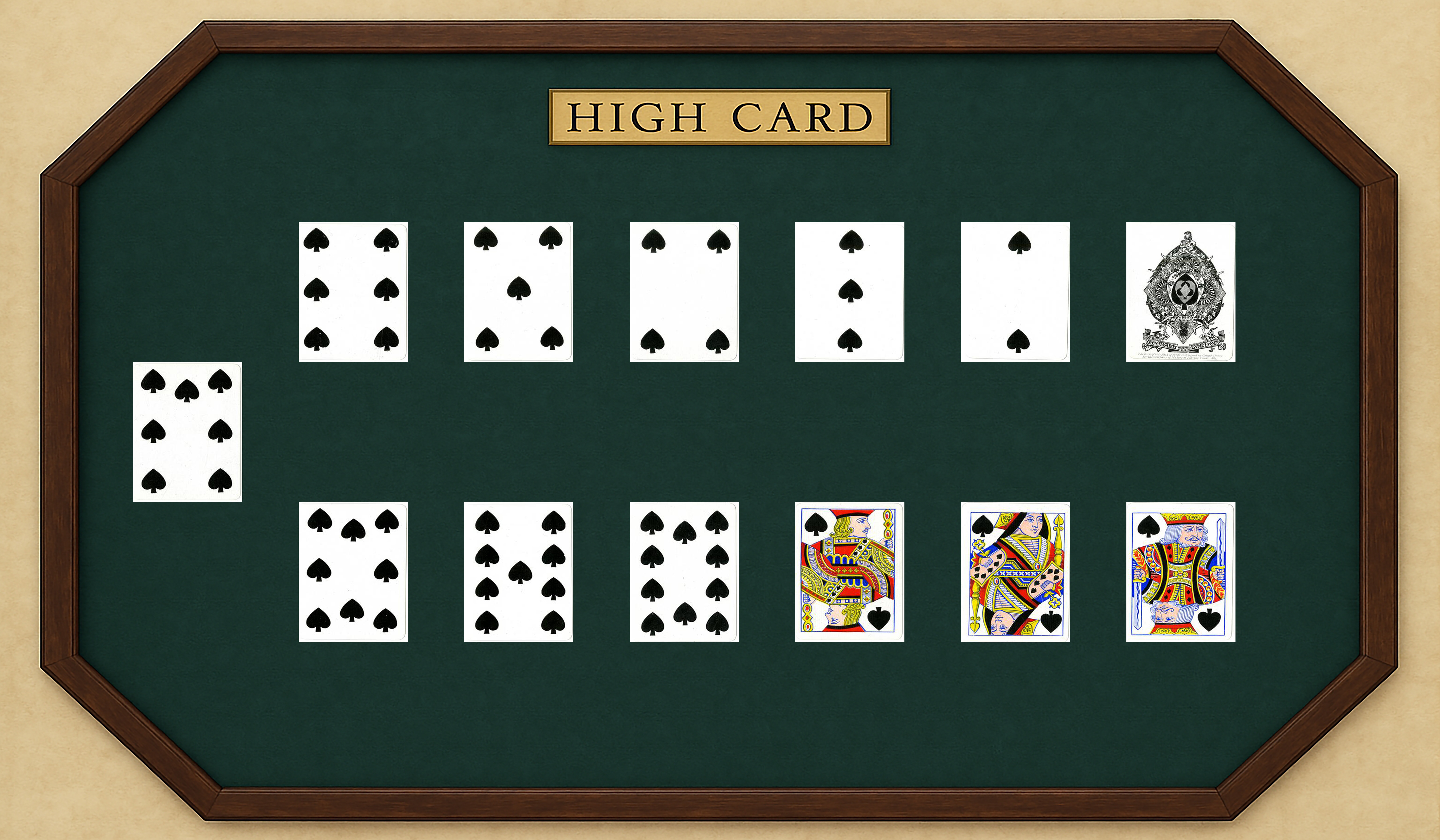
One dealer, multiple players. Standard 52 card deck with no Jokers. Before them on the table is a spread of cards on which they’ll place their bets representing one each of a suit (so Ace is 1, then 2-10 and the face cards). The particular suit on the table doesn’t matter – just what kind of card it is. This layout is just a spot for players to put their chips as they bet on which cards the dealer will draw next each round.

The dealer draws one card at first to “burn the card”, which means nothing other than there needs to be only 3 cards in the final hand so this makes the numbers work. Nobody bets on that one.

After that, the dealer draws two cards at a time, the first being the “losing card” and the second “the winning card”. If you’ve got chips on a “losing card”, the dealer takes them. If you’ve got chips on a “winning card”, the dealer pays you out that many chips. The dealer doesn’t place any bets.

The plaque labeled “High Card” is a bet you can make that the second card will be numerically higher than the first card. Again, if you’re right, then the dealer pays you out however much you bet. Dealers can entice you to take advantage of that bet by upping the payout ratio (“High card’s paying out two to one next hand!”)

That abacus device was called a “case keeper”. You slide the beads to keep track of what cards have been drawn so players can know better what’s left in the deck to be drawn. It makes the game much more exciting towards the last few hands as you have better information.

The final hand of three cards is handled differently: players put a penny on the card they bet will be drawn first, then their chips on the card they’re betting will be drawn second (with the third and final card assumed).

Sounds fun. Why don’t people play this anymore?

It appears the house odds aren’t sufficiently in their favor to make this as profitable as poker or some other games. I’ve played it fairly many times now as dealer and can vouch for this – my family broke the bank more than once. Any ties where the dealer draws the same type of card twice go to the house, but that and the probabilities of the game just don’t pay enough, it seems.

And the cheating, which we’ll get to shortly.

So cowboys played this?

Oh yeah, big time! Anybody moving cattle to sell them in the bigger towns and with a little extra money in their pocket couldn’t wait to get as drunk as possible and play Faro. The house knew when to give out free drinks to shift the odds more in their favor, and when to send pretty ladies over as well for more distraction – offering rooms upstairs of course.

You mentioned cheating?

Oh, man was there cheating! Have a look at this book titled Faro Exposed: or The Gambler and His Prey by Alfred Trumble. It was published in 1882 and details the wildest machinations and sleights of hand that dealers would employ to make it all but impossible for players to win. And I heartily recommend this book if you’re at all interested in this game because it’s an incredible read.

The introduction of a mechanical means of dealing called a “dealing box” was supposed to give the gambler a sense that he was dealing with a fair game as it doled out cards one at a time through its apparatus. Supposedly, this took the sleight of hand and manipulations of the dealer out of play, but Trumble walks through multiple chapters worth of how that was also nonsense.

Here’s a funny quote from the book:

“But the reader will ask. Are there no honest gamblers? I answer no. Emphatically no. The sun shines not upon one honest gambler in all this broad land.”

Where did you get the stuff to play?

Here’s where today’s freebies come in! I made everything in Photoshop so it can be printed out on regular 8.5 x 11″ paper and assembled on the table. If you have a card deck, printer, scissors, and tape, you’re good to go. I included poker chips and pennies just for completeness but unless you have a Silhouette Cameo or a lot of patience, you’ll probably just use tokens or coins instead. That’s fine.

I wanted it to look cool and authentic though. The cards came from a Wiki Commons reproduction of 1880’s era cards. The coins too.

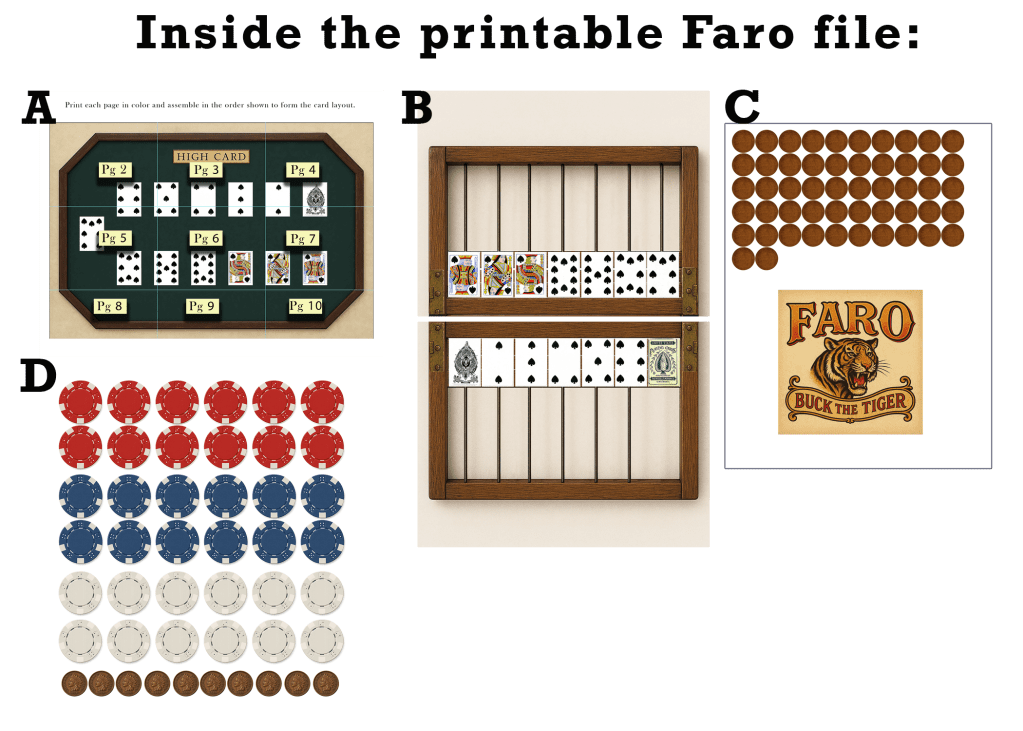
There are several pdf’s in the download:

  • A: The Faro card layout itself in several pages for accuracy on size – print and place per the instructions.
  • B: The Faro case keeper in 2 pages – just print and assemble per the picture. You’ll use pennies or tokens in place of the abacus beads and just slide them along the dowels in the image.
  • C: Some tokens to use (if you choose) on the Faro case keeper as well as the Tiger logo
  • D: Some poker chips and pennies (if you don’t have any handy yourself)

That looks great, thanks! Anything for roleplaying gamers?

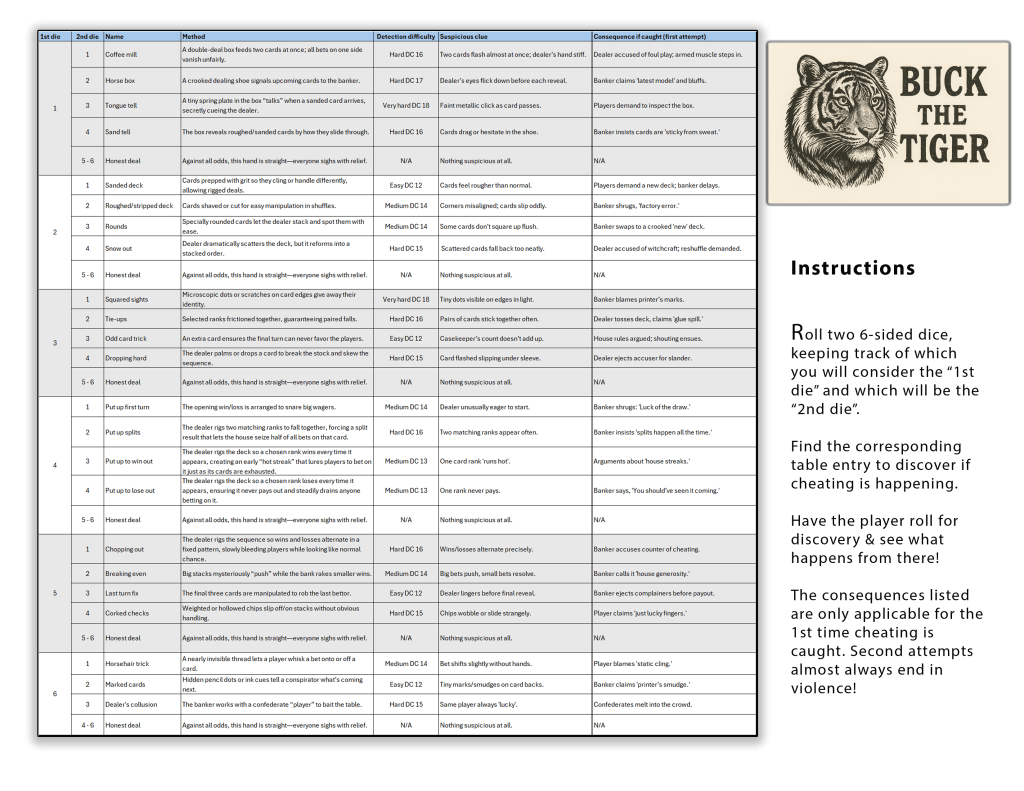
Trumble’s extensive descriptions of cheating methods made me wonder if this wouldn’t be a lot of fun in a roleplaying campaign – something quick to drop in to a wild west scenario in the ruleset or storyline of your choice where players could actually play the card game, gamble authentically, and be cheated. The game master could drop clues that cheating was happening, and dice rolls could decide how obvious that is and which authentic cheating methods were occurring.

Here’s what that wound up looking like:

Roll two D6’s to decide the situation from the table, then use Perception rolls (or whatever your ruleset uses for that) to decide whether it’s noticed or not. If it is noticed, then the table offers details on the clues to drop and also the consequences if the player decides to do something about it (first notice only – after that, guns come out!)

Here’s that table in a printable pdf as well if you think that sounds interesting:

If you’d like a high resolution 24″ x 14″ jpg of the Faro table to have a playmat printed (like I did), just click the image below for that. I used Frogigo (link here).

And that’s what I wanted to bring you today. I hope you’re as intrigued as I was – it really is a fun game, and the images of sly dealers and drunk gamblers, the ensuing gunplay, that all was just fuel for my imagination. We played this like crazy over Thanksgiving and Christmas. My dad especially loved it.

Anyway, till next time,

Hacking Salt Mystic’s Tomb Trappers: Let’s Get Crazy!

If you’ve never played Salt Mystic before, take a quick diversion here and see what the fuss is all about. You can pick up the free basic rules there or take the deep dive with the Sourcebook And Core Rules. Simply said, it’s a terrain-based wargame played on a tabletop with cards, dice, and some basic elements representing terrain. It’s a little more “beer and pizza” than most wargames out there, and is quick to pick up and just start bashing each other for a Friday night’s delight.

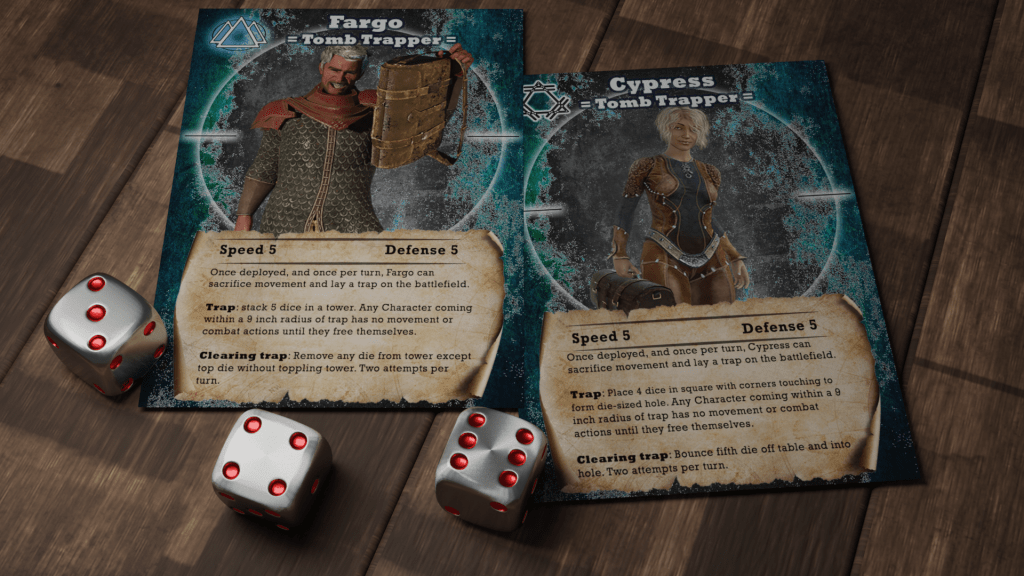
One type of card (and a core piece of the lore) is called the “Tomb Trapper”. Take a look at the respective entry from the Sourcebook below.

So in summary, this is a type of character you can have on your tabletop in the game who uses the goodies in that satchel to build amazing traps that lock down your opponent’s characters and give you an edge. That little dial apparatus in the sourcebook entry’s image is a key tool – set the proper code and programmable matter oozes out and builds the desired trap mechanics.

I wish I could pick one of those up somewhere, would love to see it work (and have a few people in mind for it)!

Anyway, one comment we’ve gotten from folks is they want more options in traps and flexibility in using Tomb Trappers on the tabletop. The cards come with default traps designed to be tough without being impossible and easy to set up & execute using only a small number of dice. This is simulating a situation where the trapped character card is locked down in place and struggling to free themselves. With some skill and/or luck, they just might do that!

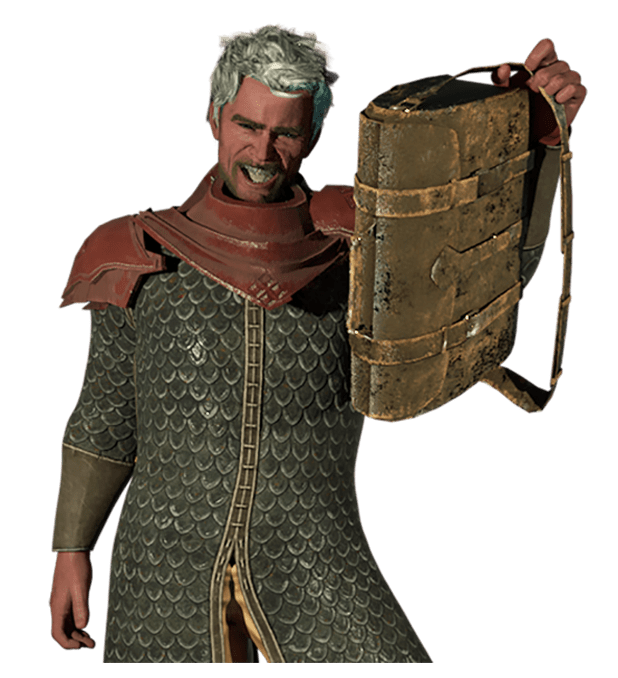
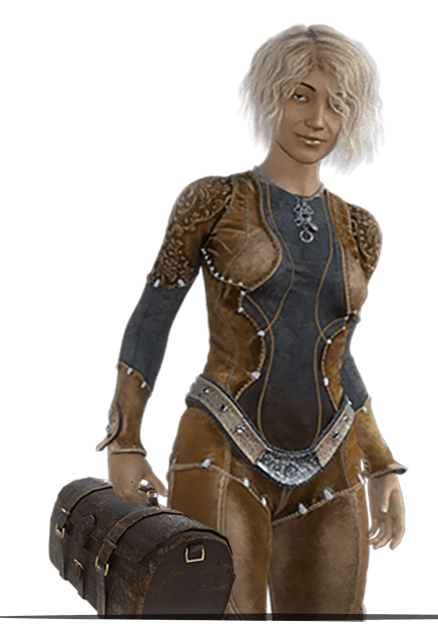
Here’s Fargo, Tomb Trapper for the Mountains faction:

Once deployed, and once per turn, Fargo can sacrifice movement and lay a trap on the battlefield.

Trap: stack 5 dice in a tower. Any Character coming within a 9 inch radius of trap has no movement or combat actions until they free themselves.

Clearing trap: Remove any die from tower except top die without toppling tower. Two attempts per turn.

And here’s wily Cypress, from the Salt Flats:

Once deployed, and once per turn, Cypress can sacrifice movement and lay a trap on the battlefield.


Trap: Place 4 dice in square with corners touching to form die-sized hole. Any Character coming within a 9 inch radius of trap has no movement or combat
actions until they free themselves.


Clearing trap: Bounce fifth die off table and into hole. Two attempts per turn.

But hey, let’s hack this! Let’s break out of the default traps and deployment mechanic to bring a new level of play to the table.

Pre-staged and hidden traps

The whole point of the Salt Mystic game is to tell an engaging story. There’s always a narrative framing the battle, and the challenges and dynamics of interaction between the terrain and the people IS the engine driving everything. So let’s make the terrain more interesting using the Tomb Trappers.

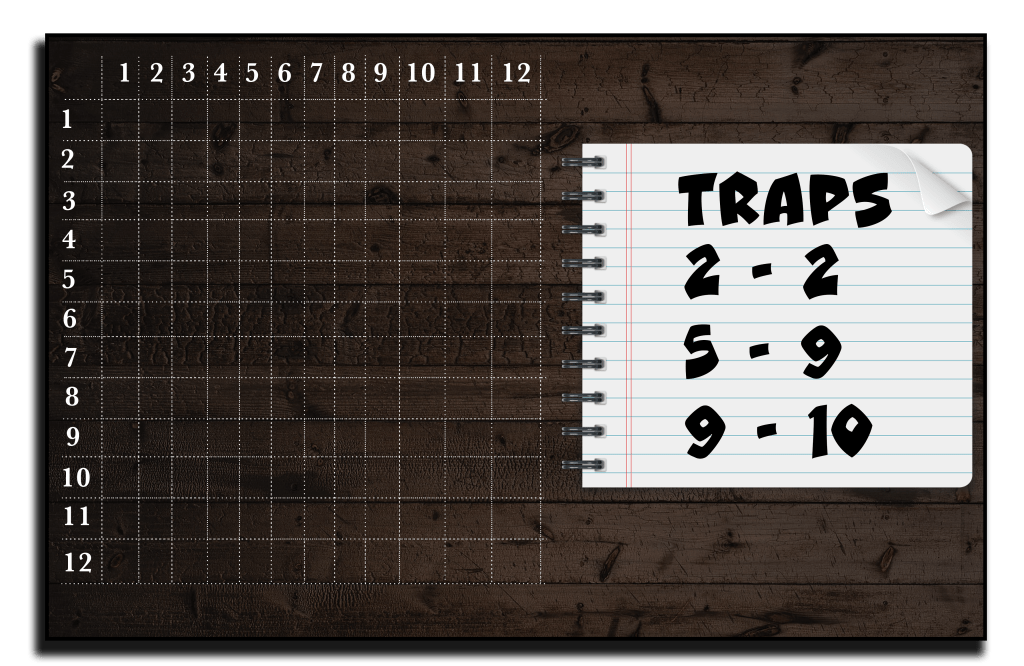
Imagine a grid on the tabletop running 1 – 12 horizontally and 1 – 12 vertically:

We’ll read rows, then columns when referencing these, and we’re picking 12 so that two 6-sided dice can reference them in a solo game. In this example, a player has chosen three locations for hidden traps during setup, prior to gameplay. The locations are written down and concealed so no one can change their minds later.

The key difference between this deployment mechanic and the default one obviously is that the opposing player can’t know where the traps are and thereby avoid them. Anybody moving is in jeopardy of getting trapped. Just call out the trap when you’ve lured your opponent into the right spot and grin deviously as they struggle to free themselves!

Considerations:

-Agree up front on how many traps are allowed, and whether sacrificing a card from the starting battle deck is necessary for each trap.

-The Wolfpack Mode for solo Salt Mystic game play requires a roll of two 6-sided dice each turn for the phantom player anyway. To simulate the phantom player having pre-staged traps, check for a trap each time that initial roll contains a “1”. Roll against the grid to determine the location and compare it to where your characters are located.

Example:

The phantom player’s Wolfpack turn roll was 1 and 5. That roll was required anyway, since that’s how the phantom player’s deployments and moves are determined in the Wolfpack rule set. Since there was a 1 on at least one of the dice however, additional rolls are needed to check for traps. First roll: 4 + 7 = 12, Second roll: 3 + 6 = 9. We reference rows, then columns, so there is a trap at row 12, column 9. Any friendly characters in that grid square are trapped. Trap locations change each turn (how devious!).

Alternate traps

You can really let your imagination run wild on this one! Basically, anything your wicked little mind can conjure here is fair game. Consider the spirit of the traps though:

  • Traps should be difficult, but not impossible
  • Easy to set up & execute using only a small number of dice or other readily available supplies
  • Should require a little luck, a little skill

Design a trap by answering three questions:

  1. What triggers your trap? Example: approach within 9 inches, etc
  2. How should the trap be set up on the tabletop?
  3. How does the opposing player clear the trap?

Feel free to enhance the narrative a bit by outlining a little more detail to the hideous nature of your invention: (programmable matter collapses into quicksand, massive pincers the size of a horse spring from the ground, the ground tilts into a spiked pit, and on it goes…)

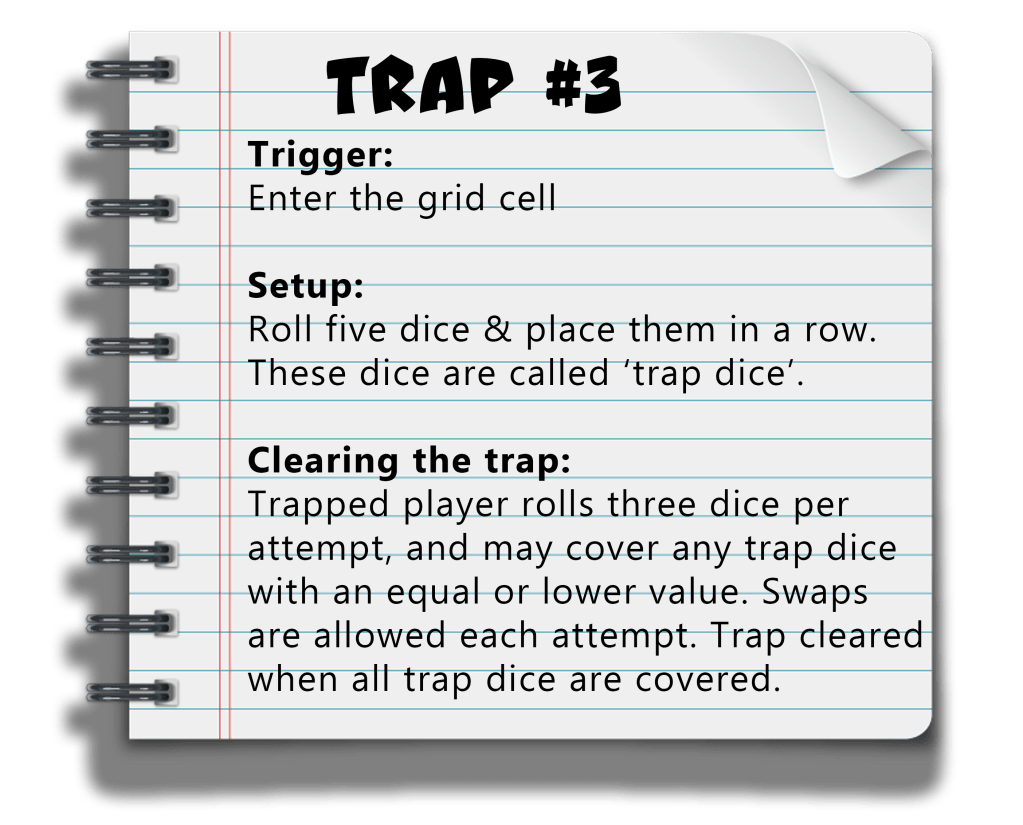
Let’s try it. Here’s what happens should the opposing player enter the respective grid cell per hack number one above – and up springs a cloud of geometrically poisonous vapor contained in a thin film that pops if he moves.

Considerations:

-Agree up front on the deployment mechanic as described either in the default card text or in hack number one above

-In the case where you’ve designed multiple custom traps, agree up front on how to select which trap has been sprung

So let us know what you think. Loads of potential here with the Tomb Trappers.

While I was writing this, we talked about maybe hacking the core rules a bit and staging an unbalanced scenario where one character (any card with an Expertise stat) goes up against an opponent at slightly reduced strength (10 less cards in the starting battle deck) – trying to escape a building entirely loaded with traps (at least 6). Objective would be to get to a specific spot on the table without dying. Seems like it would be a hoot if the opposing player is required to deploy all their Vehicles and Vehicle Attachments out in the open so the lone wolf can try and take them.

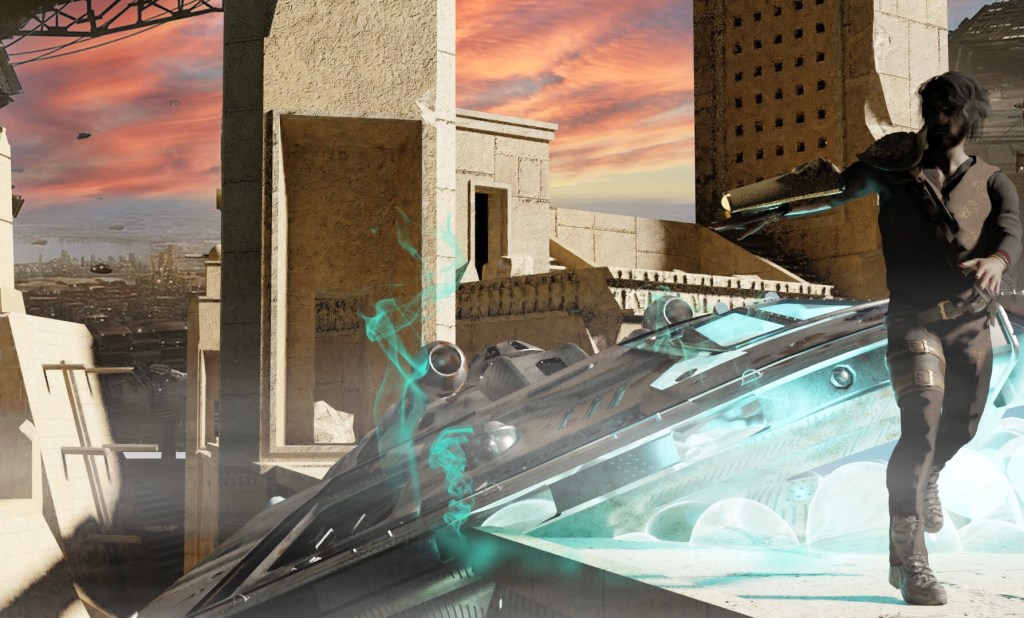
Here’s the art and flash fiction that inspired that:

A carbine gunslinger on the run. A Dirt Wraith rises, ghost-like through the very walls. Its quantum foam bubbles sizzle as loud as a waterfall. They knew he was here all along. She lied. And that will cost her. They’ll have traps all in the building, every corridor. Watchmen are patrolling the streets below. If there’s a Dirt Wraith, then maybe they’ll have something deadly down there he can seize and turn against them. Time is short, and they are many. He’ll have to be fast and unpredictable.

What would you do?

Till next time, guys. We’re always looking for feedback and ideas. Shoot them our way. And Merry Christmas!