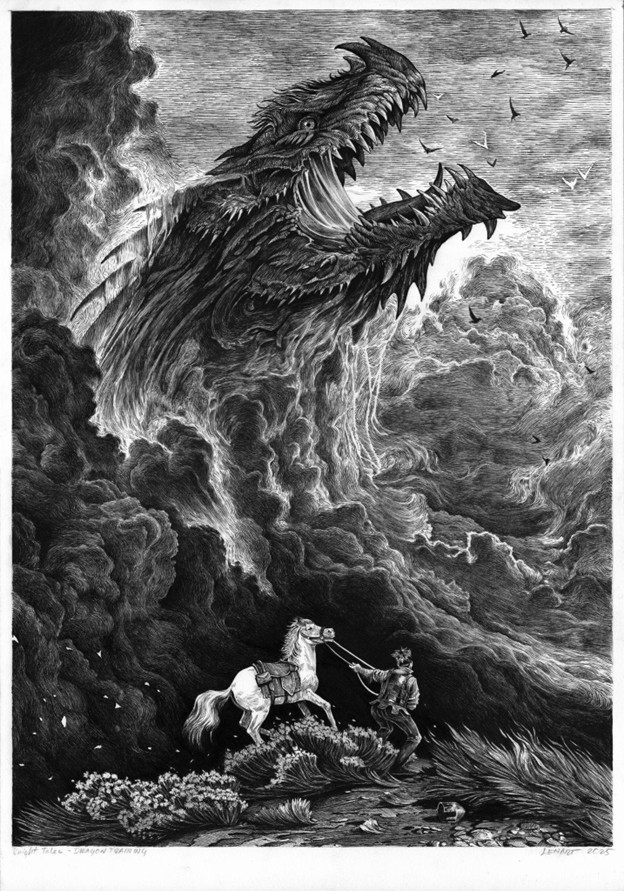
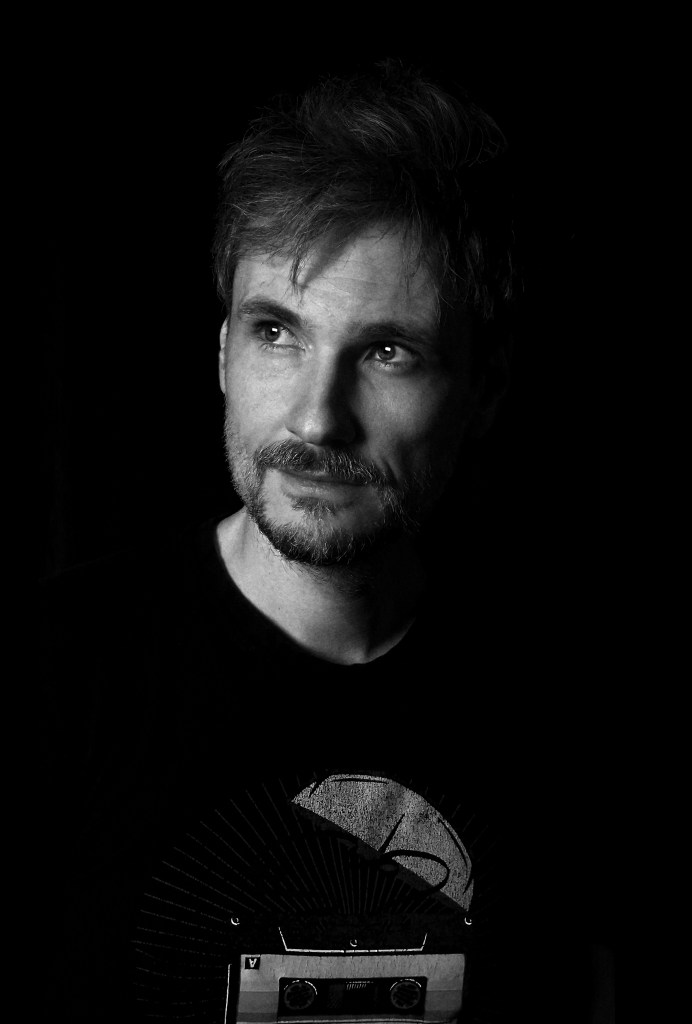
Let’s talk to Mateusz Lenart: award-winning game director and modern-day pen & ink master

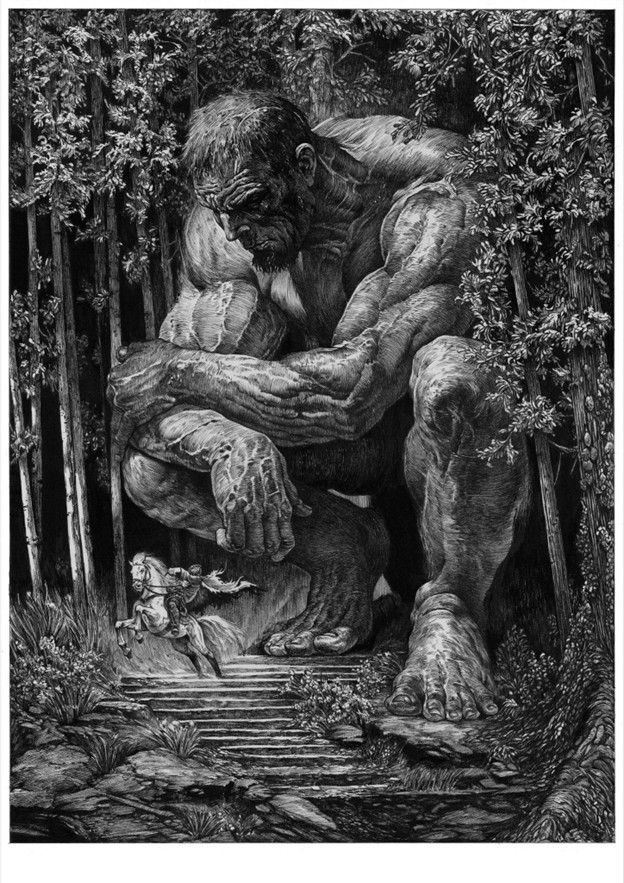
At Grailrunner we thrive on conversations that sit at the crossroads of imagination and craftmanship. Mateusz Lenart doesn’t just know the place – he’s set up shop there and is drawing crowds! From his role as Creative Director at Bloober Team (Layers of Fear, Observer, Blair Witch, The Medium, and the Silent Hill 2 remake) to his own powerhouse artwork – especially in traditional pen & ink, Lenart brings an artist’s eye, a comic reader’s energy, and a storyteller’s genius into the ever-shifting worlds of modern games and illustration.

Welcome to Grailrunner, Mateusz! And welcome to our ongoing series titled:

1. When we spoke to game designer, Jake Norwood (The Riddle of Steel), he mentioned a fascinating Polish RPG called Dzikie Pola. Polish fantasy author Krzysztof Piskorski (Tainted Grail) is a long-time target of ours for an interview to cover his incredible fantasy worlds. And if we’re talking Tainted Grail, we’re talking illustrator, Piotr Foksowicz – also Polish. And here you are, scaring the crap out of us with groundbreaking psychological horror in video games! Is there something awesome in the water over there?

Well, I can’t reveal too much just yet, but what I can say is that at Bloober Team we’re very much committed to pushing the boundaries of psychological horror. We’ve recently announced another remake in the Silent Hill franchise – this time going back to the very beginning with the first game – and not long ago we released Cronos: The New Dawn, another horror experience from our studio. Our portfolio has always been about exploring the darker corners of the human mind, and we intend to keep building on that tradition with future titles.

2. You mentioned in a previous interview that American comics from the 90’s were a big inspiration for you to get into art. Can you elaborate on which comics or graphic novels stood out for you, and especially tell us why that was?

A lot of what inspired me came from whatever I could find in the newsstands in Poland — Kioski Ruchu and the like. As most of the kids I devoured the Spider-man and Batman series in particular, even though it wasn’t always easy — my parents weren’t thrilled about me reading them! Those American comics were flashy and visceral, with dynamic art, dramatic panels, and strong emotions. Todd McFarlane’s Spider-man work was unforgettable — the exaggerated lines, the energy of the webs, the theatrical villains.


Beyond the American stuff, European comics played a big role in shaping me, too. I was deeply influenced by Thorgal by Grzegorz Rosiński, and also by the Yans series from the same author — their storytelling, the textures, the atmosphere — all of that showed me other ways comics could work. And then there were lighter, fun reads like Asterix, which taught me humour, caricature, and the power of visual pacing.

3. If I’d peeked over your shoulder as a kid, what would I have seen on the page—spaceships, monsters, superheroes, or something stranger? Why?

Honestly, a bit of everything. I was a pretty meticulous and disciplined kid — I somehow knew early on that learning anatomy would help me in the future, so you’d probably see a lot of sketches of hands, muscles, poses, often copied from anatomy books. At the same time, for fun I was constantly drawing fantasy characters — monsters, elves, knights — usually with little RPG-style stats written next to them for strength, dexterity, and so on.

You’d also find plenty of comic book pages. I loved inventing huge worlds and epic storylines, though most of them lasted maybe two or three pages before I’d abandon the project and jump to the next idea.

And, of course, there was always a darker tone in what I created. I don’t really know why — maybe because the darker stuff always felt more alive to me: more dynamic, more energetic, more full of contrast. That fascination with atmosphere and intensity stuck with me and never really left

4. Polish art, architecture, and history thread through your work. Can you share a specific real-world reference or point of inspiration, maybe even folklore, from your country that shows up in your illustration or concept art?

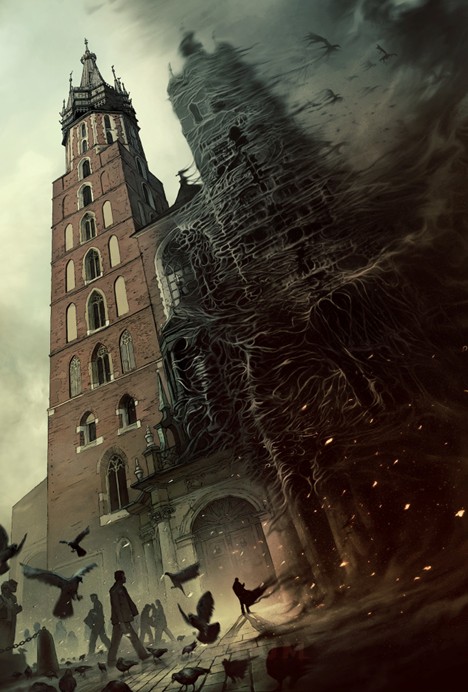
To be honest, there weren’t that many Polish references in my earlier work. Occasionally they appeared — for example, in The Medium I illustrated the towers of St. Mary’s Basilica in Kraków — but Polish architecture or folklore was never my main source of inspiration. At that time I was probably more fascinated by the topography of Middle-earth than by Poland itself.

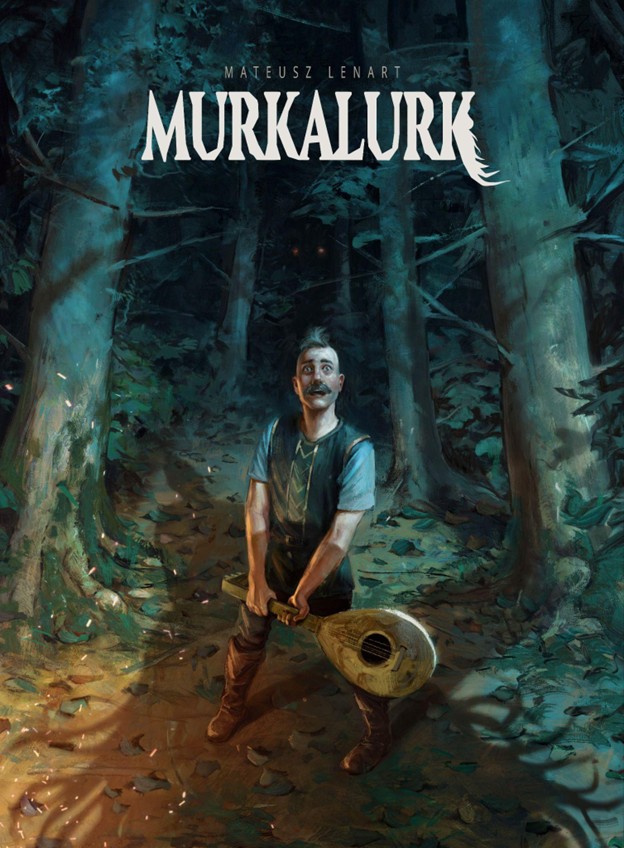
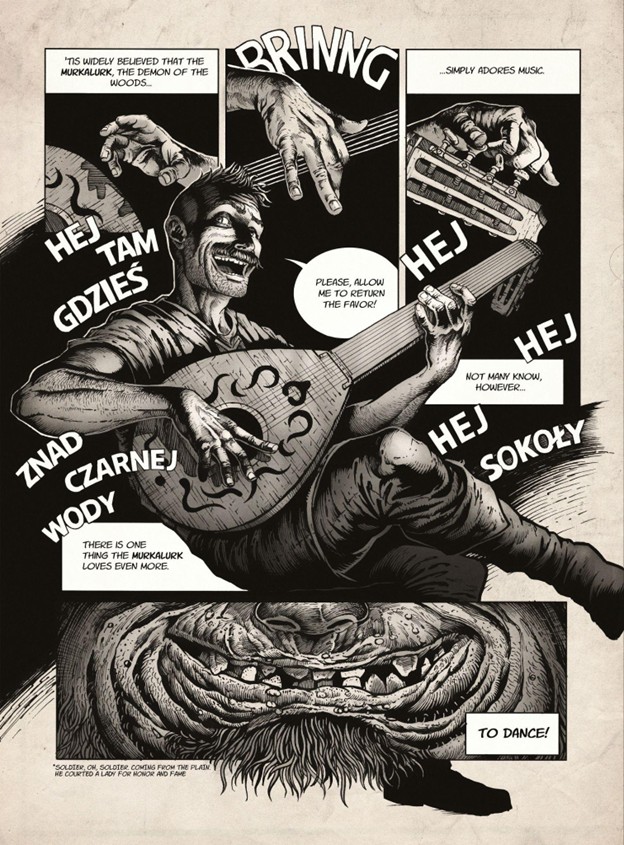
That has changed a bit in recent years. I’ve become much more interested in Slavic mythology, and it’s starting to influence the way I build my own stories. One small experiment was a short comic I created called MURKALURK, which tells the story of an unlucky bard who crosses paths with Slavic demons. Right now, I’m also working on a bigger project — a fantasy world that draws heavily from Slavic myth and culture. So you’ll definitely see more of that in my future work.

5. Awesome. Simply awesome. Why traditional pen & ink? I’ve got to say, when you mentioned 19th century master, Franklin Booth in a previous interview, I got incredibly excited. The guy was on a different level of genius! You also cited Gustave Dore, Bernie Wrightson, and Joseph Clement Coll. What is it about that kind of art that attracts you?

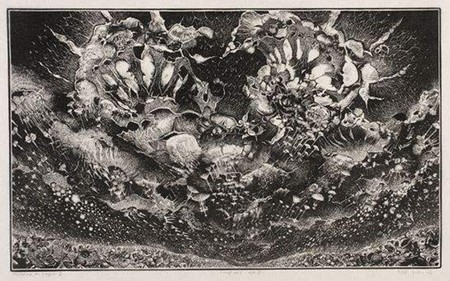
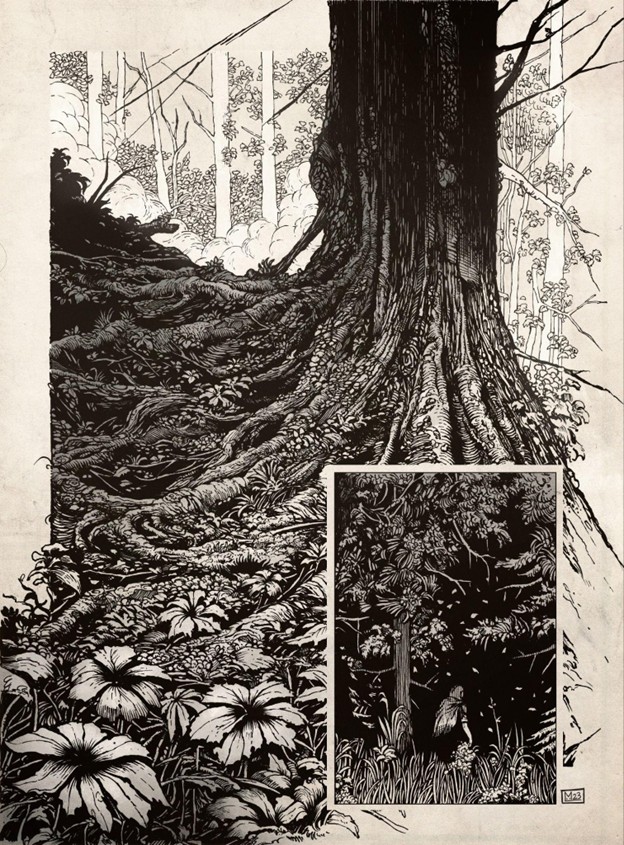
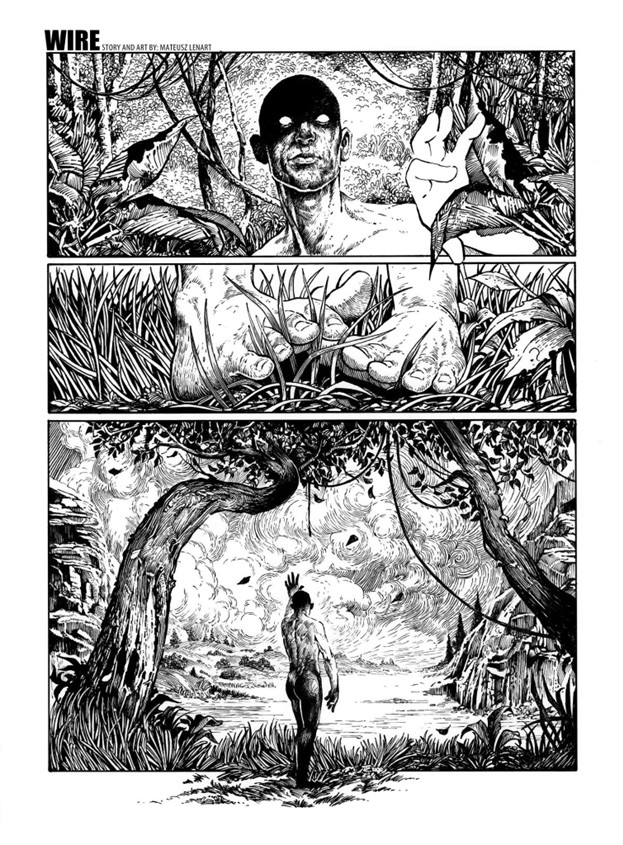
There’s something incredibly powerful about telling a story only with line and value — no color, just light and shadow, rhythm and texture. For me, pen and ink has always felt like the purest way of drawing, where every stroke is deliberate, every line carries weight.

I’ve also always been better in black and white than in color. When I discovered artists like Franklin Booth or Joseph Clement Coll, it opened my eyes to how far you could go with nothing but ink — whole worlds built out of contrast, atmosphere, and detail. There’s a timelessness to that style that I find endlessly inspiring.

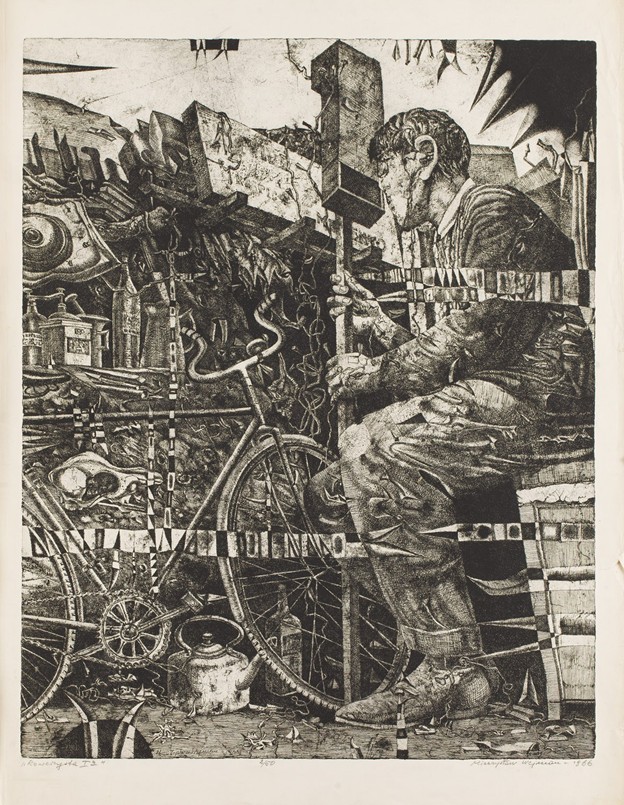
At the same time, I was very drawn to traditional printmaking techniques such as aquatint and linocut. I remember being deeply impressed by the works of Józef Gielniak, especially his Variations for Grażynka, and by Mieczysław Wejman’s aquatints like The Cyclist. When I was a student, I actually imagined myself working with those techniques professionally. But life took a different turn, and I didn’t continue down that path. In a way, pen and ink became a perfect substitute — it gives me a similar sense of precision, rhythm, and texture, without the technical limitations of printmaking.

6. Re-cycle

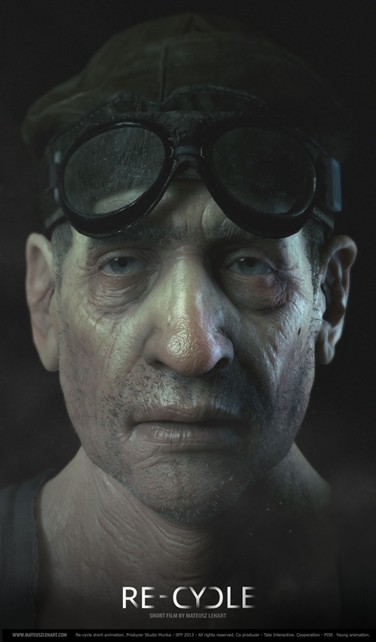
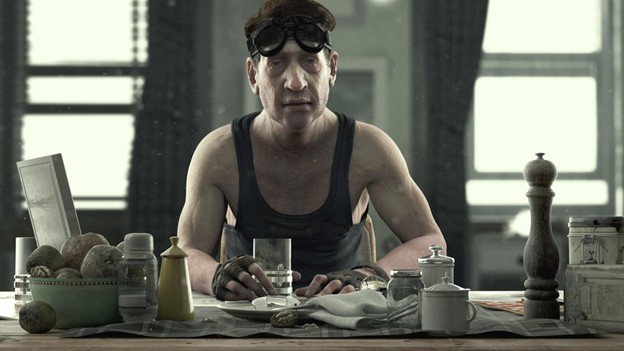
Your animated short Re-cycle is a striking, personal work. What first inspired the idea, and what challenges did you face in bringing it to life? Looking back, how did it shape or grow you as an artist?

I’ve always been someone who can’t focus on just one thing at a time — which is both a blessing and a curse. I started out as a concept artist, but quickly became fascinated with 3D, animation, design, lighting, and filmmaking. It was also a period when Polish short animation was experiencing a renaissance, with creators like Tomasz Bagiński, Damian Nenow, and Grzegorz Jonkajtys making work I deeply admired and wanted to create myself.

I honestly don’t remember exactly where the idea for Re-cycle came from, but, like many of my projects, it carries rather somber tones rather than cheerful ones. It was an interesting project — had I finished it in two years, it might have completely changed the path of my career.

In reality, it took seven years to complete because I kept being pulled into other work. By the time I finished, I was very tired of it, and the technology I had used was already outdated. Looking back, it taught me a lot about perseverance, about balancing multiple interests, and about how long-term projects shape your patience and vision. I do want to return to animation, but to do it properly I’ll need a lot of dedicated time to fully immerse myself in the craft again.

7. Our readers will kill me if I don’t ask about The Medium and Silent Hill, for which you served crucial creative and director roles. What can you tell us about those experiences bringing true psychological horror into the world that made you better as a creator? Did anything from your ink drawing practice or comic-book eye make its way into these massive productions?

Working on The Medium and Silent Hill was incredibly satisfying, but also very different experiences. On The Medium I served more as an art director — helping to shape the Other World — and getting to build an environment inspired by Zdzisław Beksiński’s work was a deeply powerful experience. Trying to translate that kind of surreal, decayed atmosphere into something the player could actually move through taught me a great deal about tone, detail and restraint.

Silent Hill was a step up in both scale and responsibility: the stakes were higher and my role covered design, art and direction. Revisiting one of the most iconic names in horror history is never easy, but it was hugely rewarding. The biggest challenge there was balancing respect for the original material with the need to bring something new and playable to a modern audience — and doing that across a large, multidisciplinary team forces you to be both precise and flexible.

My ink-drawing practice and comic-book eye absolutely found their way into those productions. The lessons of black-and-white work — composition, the economy of line, the power of contrast and negative space — translated directly into how we thought about lighting, silhouettes and level composition. Likewise, the way comics use panel rhythm to control pacing informed how we staged encounters and revealed information to the player: timing, framing and the gaps you leave for the audience’s imagination are universal storytelling tools.

Finally, these projects made me a better creator because they pushed me to scale my instincts. Working on a single illustration is a private act; working on a game means sharing to others your visual language, iterating under constraints, and learning when to cut or simplify for the sake of atmosphere. Film, comics and games aren’t as far apart as they seem — they share the same fundamentals: composition, emotion and the building of tension — and those cross-medium influences keep feeding my work.

8. When you need to design something truly frightening, what rituals or shifts of perspective get you into that mental space—and do you step back out of it deliberately, or carry it until the work is done?

It really depends on the situation. Very often, the things that frighten me most are those that aren’t meant to be frightening at all — finding that uncanny element in an otherwise ordinary scene creates the strongest tension. When you work on horror for a long time, though, you almost become numb to it. Stepping away and then returning to the work helps a little, but you can never truly see it with fresh eyes again. That’s why outside feedback is so essential — we rely on it constantly.

As for rituals, I don’t think I have any special ones. Creating horror, for me, is like any other kind of work: it’s a mix of knowledge, experience, and ideas. To paraphrase Stephen King, most of the time I feel more like a craftsman than a visionary — applying what I know to get the job done. Of course, there are moments of revelation, flashes of inspiration, and when they come you have to grab them and use them. But most of the process is simply the hard, patient work of solving problems over the course of a long production.

9. When you start concept art for a new character or environment, what’s your first step—gesture, thumbnail, written note—and how do you know when that early sketch has ‘spark’ worth pursuing?

It’s a difficult question, because the process can vary a lot. Technically, I almost always start with silhouette, shape, and energy on the page. There are countless tutorials that talk about the power of form, proportion, and so on, and those things are important — but for me the idea itself is what really pushes you forward.

Sometimes a written description of a monster or a character is already enough to spark something interesting. Other times, you have to brute-force your way toward a good idea through dozens of iterations, hoping that at some point something will ‘click.’ References also play a huge role in this stage. Collecting and studying them often triggers unexpected solutions — they can turn a generic design into something unique.

Recognizing the moment when a sketch has enough spark to move forward is always tricky. In my role as creative director, I often have to make that call, and it’s easier when you’re not personally involved in the painting itself. In my personal work, I usually just follow what excites me most, even if I can’t fully explain why. Sometimes it’s purely instinct — you sense there’s something worth pursuing, and you trust yourself to chase it. I’m also aware that, in doing so, I may be overlooking ideas that others would consider stronger.

10. Anything else you’d like to tell us about, including how we can see more of your work?

I try to stay as active as I can creatively. As I mentioned earlier, my biggest problem is that I always want to do everything at once. I’m still working at Bloober Team on our next title — it’s a long process, and one I’ll only be able to share more about in the future.

On the personal side, I recently released a comic/illustrated album called Murkalurk, which was received warmly and motivated me to start working on a larger comic project, loosely inspired by Slavic mythology. Right now, I’m deep in the stage of building characters and writing the story, which is why I haven’t shared much new work online lately.

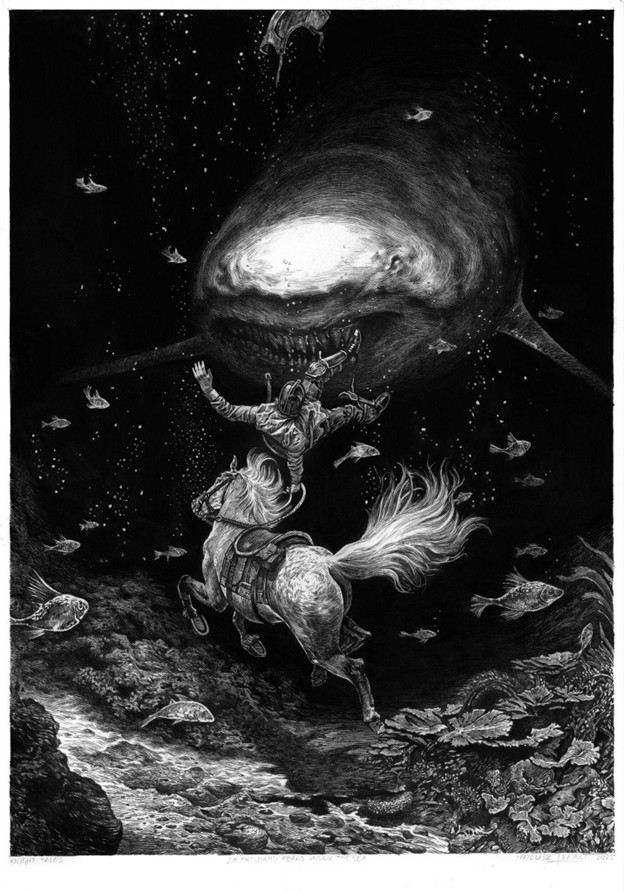
There’s also my ongoing series The Knight’s Tale, created in traditional pen and ink. I hope to find the time to add new chapters to the story of that lost knight. As always, there’s never enough time and far too many ideas.

Hopefully, you’ll be able to see some of these new projects soon on my social channels — mainly on Instagram.

Thank you for the talk.

Thanks for your time and the wonderful art you’ve sent along for us to appreciate! Hopefully we can connect again in the future to see what you’ll have been up to!

*

Mateusz Lenart is an impressive bridge strung between ink and pixel, between the quiet scratch of a pen and the thunder of a horror score. His work reminds us that the best creators aren’t defined by tools but by vision: a sketchbook line that can grow into a world, a half-remembered comic that becomes a camera angle, a personal short film that seeds a new way of seeing. At Grailrunner, we often say “Dreams are engines. Be fuel.” In Mateusz’s hands, those engines are ink-black, smoke-stained, and unstoppable. And we can’t wait to see where they carry him next.

Till next time,
Yes, there’s a Grailrunner theme song now

Since we kicked off Grailrunner around 2016 or so, I’ve intentionally left out references to me personally or the contractors I work with. My thought was to keep this super professional and focus on inspiring ideas and cool tools or giveaways that prod other people’s imaginations. Grailrunner Publishing is just a network of like-minded folks that help me put new things into the world, with the potential for other like-minded folks to (hopefully) catch a spark here and unleash their own.

I’ve noticed, however, that a lot of Youtubers are finding these days that their audiences seem to want to know more about them personally, beyond whatever terrain building tips or historical curiosities they talk about. Then occasionally, we get asked the magic question:

Who is Grailrunner?

So for giggles, I’ve rewritten the ABOUT page to tell the origin story and shed a little light on that, specifically recounting the strange experience I had in a rock gorge in Oman in 1997 that poured jet fuel into what became Grailrunner and our signature property, Salt Mystic.

No fairy tales. No gimmicks. That happened. Go read it to see what I mean. Over a decade later when I read that C.S. Lewis had a similar experience that turned into the Narnia series, it struck a chord with me big time. But anyway, in order to celebrate this slight shift in the Grailrunner approach to you guys, I thought it would be awesome to have something cool and free for you to enjoy.

So I wrote a Grailrunner theme song.

I was going for Springsteen/Bob Dylan-style poetry with a modern rock vibe, and I wanted to include a variation on our slogan: “Dreams are engines. Be fuel.” Not an easy task, I’ll grant you. It wasn’t a pretty process. I’m also bad about mixed metaphors, so if you detect any traces in the lyrics of shifting imagery, just be cool about it.

Here’s a link to hear it.

Here are the lyrics, by the way.

And no, that isn’t me singing. I used Suno, an AI app, to take the lyrics and generate a bunch of variations – all in a rock & roll direction but with some tweaks on other styles to get something nice that didn’t sound like everyone else. I think it turned out fantastic.

Anyway, let me know what you think about all this. And if you liked the song, I’d especially appreciate hearing that as my wife thinks it’s too loud and fast. We kind of all need to tell her how wrong she is about that.

Till next time,
One Month Into Book Launch: How’s That Going?

It’s been a month since we published SALT MYSTIC: BOOK OF LOTS, a solo roleplaying game based on our multi-media Salt Mystic setting. There are some bright spots, some hopeful notes, and a world of pain. Overall, we’re still incredibly proud of the product and seeing and hearing people appreciate it in the wild is an experience like nothing else!

We thought it would be helpful for anybody thinking of putting your own book out to see what we tried: what worked, and what didn’t…and what still might. Care to come along?

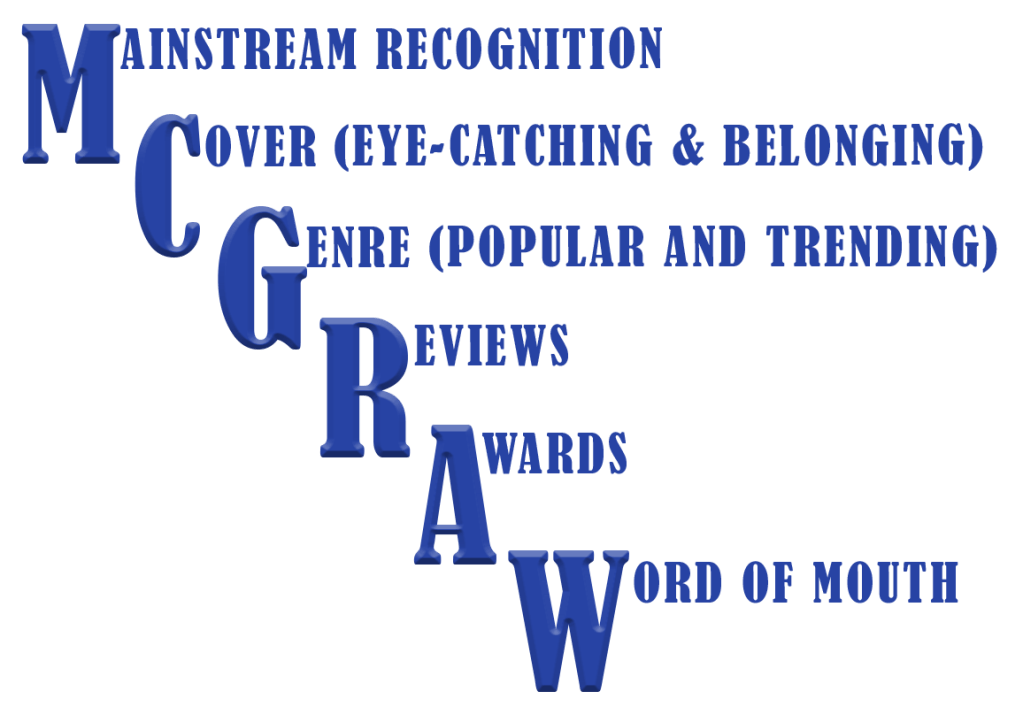
Way back in 2016, I wrote a short article defining some indie publishing principles based on lessons from the launch of my first book: TEARING DOWN THE STATUES. The principles were consolidated into the acronym “MCGRAW”, suggesting the key elements necessary for publishing success (Mainstream recognition, an eye-catching Cover that looks like it belongs with books like it, a popular Genre, as many Reviews on major listing sites as possible, Awards to add validation that the book merits attention, and Word of Mouth.) We kept these in mind this launch and tried to incorporate what we could, although the genre of tabletop roleplaying is so saturated and so dominated by Dungeons & Dragons that we were working uphill and digging holes from the beginning.

Still, hope springs eternal, and this is a product we believe in mightily, knowing from its ideation that nobody else was doing anything like it.

What was the pre-launch like?

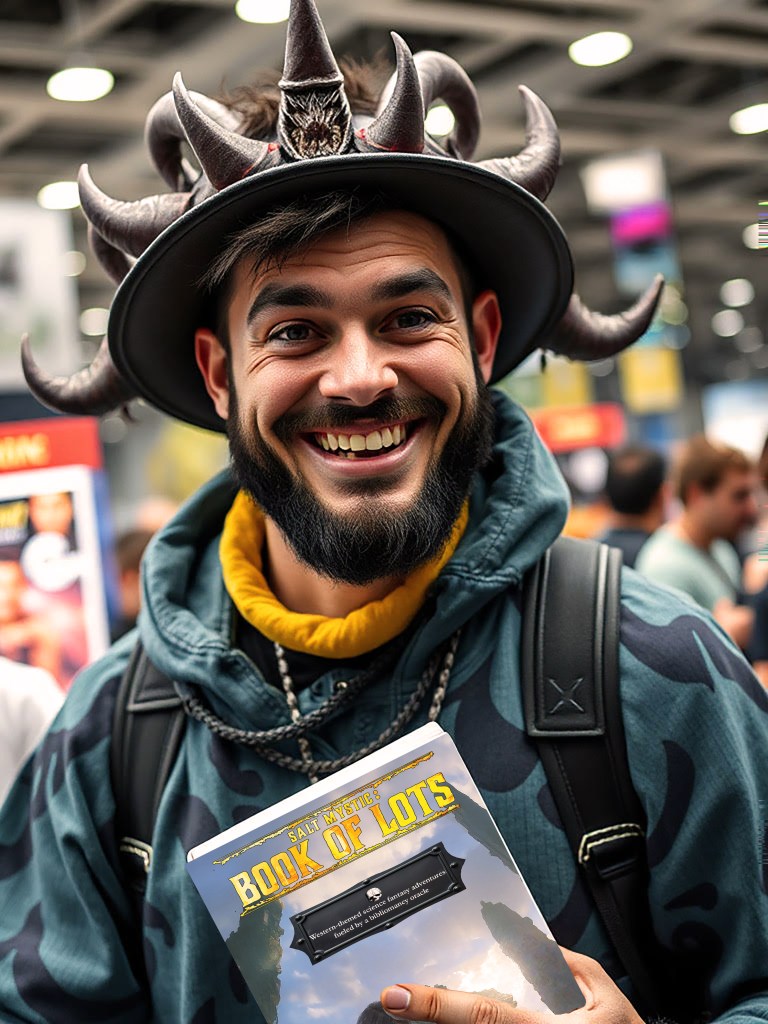
February was a hot mess, finalizing the proofs and shaking trees to try and get attention from bloggers and gaming news sites. Short of providing free pizza delivered by cosplayers who do magic tricks, I’m not sure what else we could have done to get mentions from some of these guys – we reached out to 20 and got one “No, Thanks” and absolute crickets otherwise. That’s offering a free physical copy for review, by the way. Local gaming store wasn’t interested, and I didn’t have the heart to cold call others. My ego can only take so much bruising!

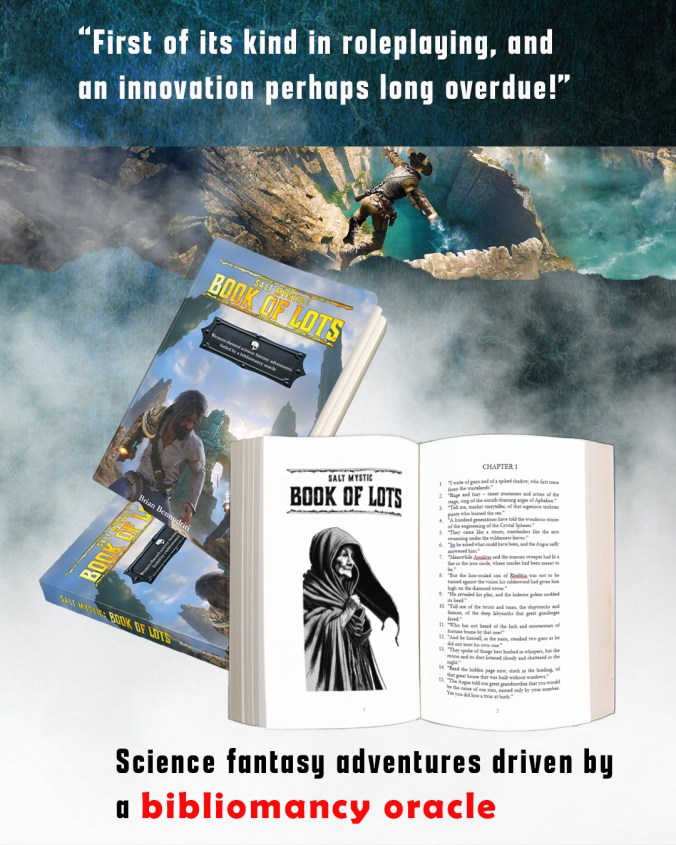
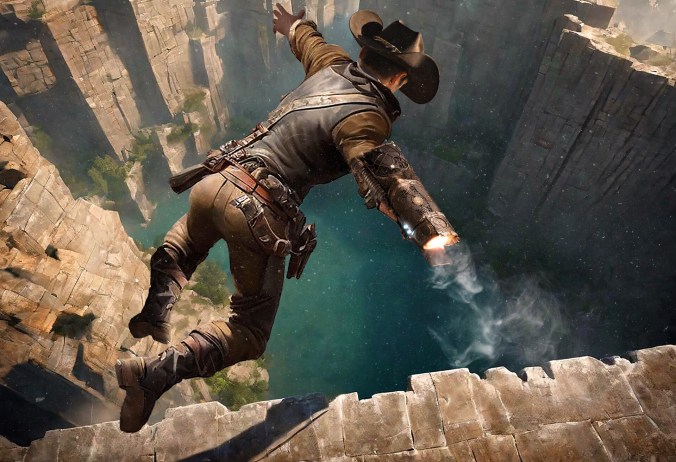
I pushed my Photoshop skills to the breaking point generating ad assets to use in social media and ad campaigns, stirring up some images that I think really popped! Here’s my favorite, though we had to switch it out to juice the click rate after things got rolling.

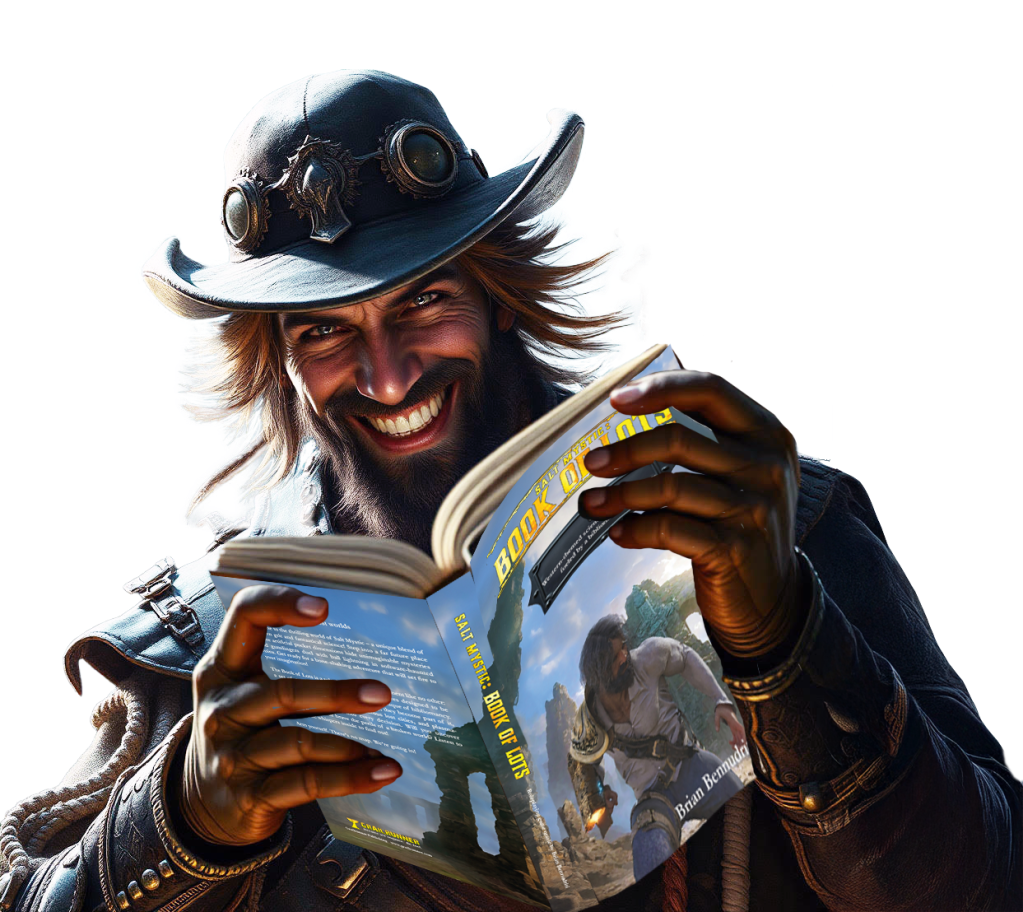
I’m a big fan of Absolute’s 3d cover generator and Envato’s PlaceIt – both to generate mock up’s of the cover in various places. We generated this one below for banners through RPG Geek and some other sites:

We came SOOOO close to hiring an artist we’ve been targeting for years now, and he might yet come on board for a promotional poster, so I won’t jinx anything by saying more. That would be amazing, so wish us luck! Anyway, he was swamped with other things, so the heavy lifting on graphics was still in-house.

How did you handle distribution setup?

The book is available at booksellers globally through Ingram Spark, and also on Amazon thru Kindle Direct Publishing, as well as the pdf on Drivethru RPG. We got the barcode direct from Bowker to retain full distribution rights – there are strings attached to the freebies. Honestly, setup was fairly painless for Kindle Direct, but I thought at one point Ingram was going to leave me with facial tics!

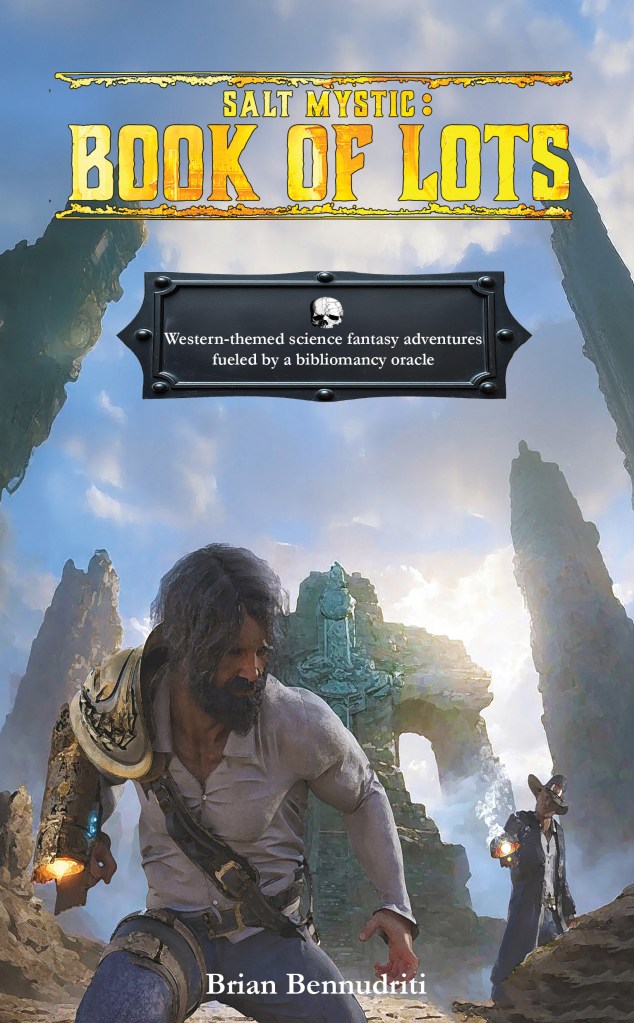
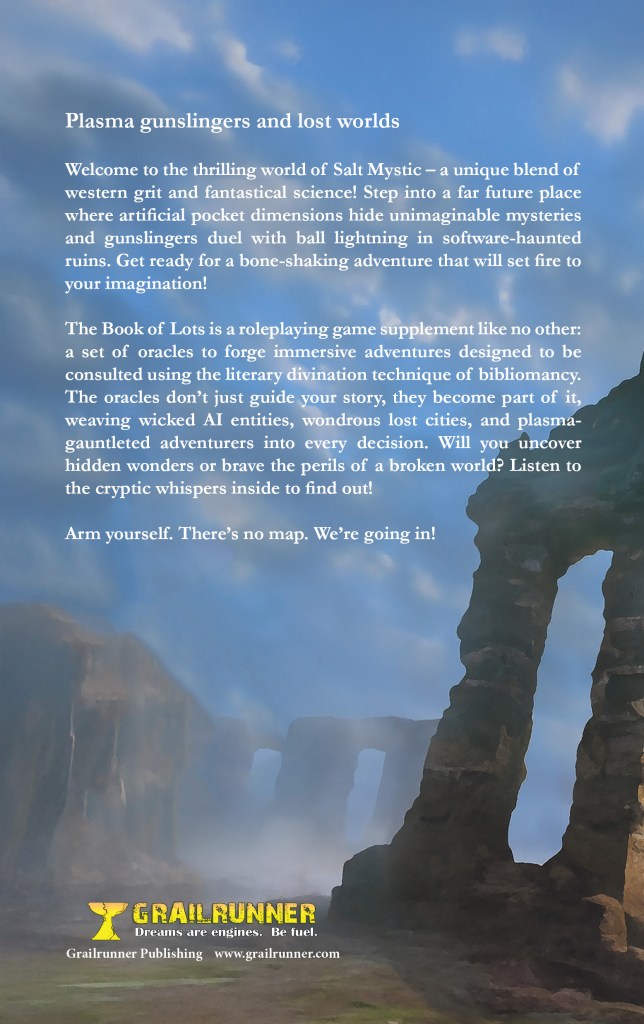
The cover file was a high res jpg I’d built in Adobe Illustrator, and it included some transparent png images (the title and the Grailrunner logo). The art was done with Daz Studio for the figures, some Blender and Photoshop filters for the forearm weapons, and some AI help for the background, everything composited and color graded in Photoshop then dropped into Illustrator for the text and placements. This is what that looks like, front and back:

Weird white outlines were appearing in the digital proof around anything that was a png in the image. Maddening! Nobody at Ingram Customer Service was responding, and internet advice was kind of all over the place. I tried various export presets and never resolved it, at last approving the digital proof even with the outlines in hopes that it was in fact a screen artifact only (as some advice suggested). Thankfully, the issue didn’t show up in the physical version.

As for offering a physical version through Drivethru RPG, I basically gave up. They seem to be saying they use the same print house as Ingram, though a different division or something? I dunno. Anyway, much worse issues with anything that was a png, including the interior art! A true disaster! I’m sure they would say it’s my fault, but I bailed entirely and just offer the digital version through them. My blood pressure thanked me immediately!

How did you advertise?

We ran campaigns on Facebook, through Google, Amazon, and on RPG Geek. The book is also listed this month on Ingram’s home page and in the World Reader, iCurate Connection, and Indiewire newsletters, all via Ingram (~28,000 circulation for the newsletters). Through the Independent Book Publishers Association, the book will be represented at the American Library Association conference in Philadelphia this June. We’ll see how all that works out, but here are some initial experiences:

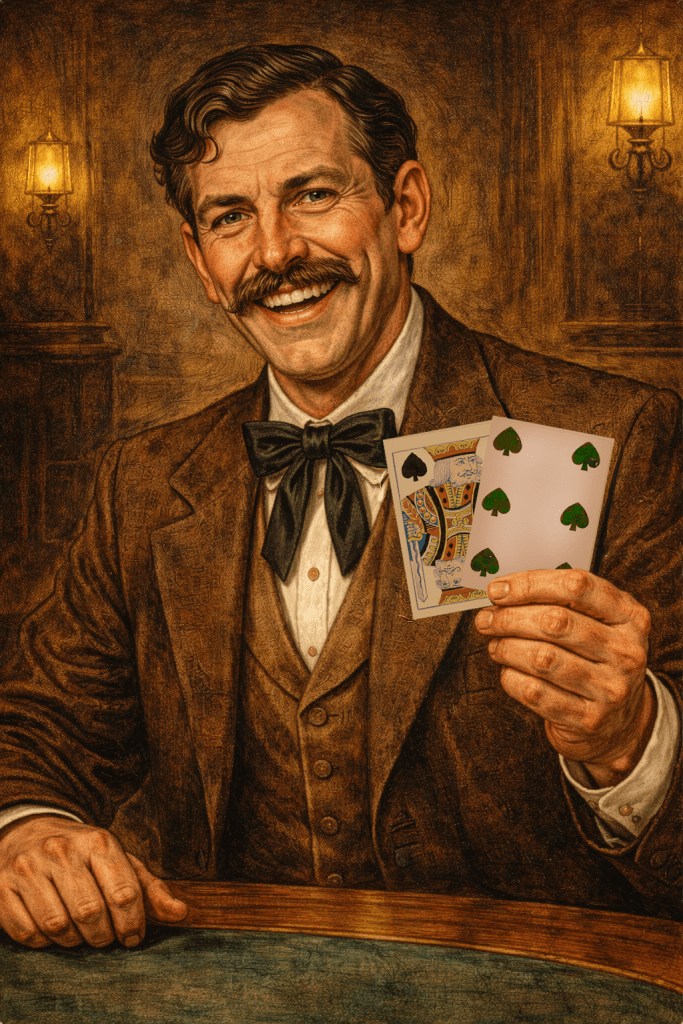
Meta (Facebook) started at 2.1% click rates with tens of thousands of impressions as well as loads of shares and likes and bookmarks. It all felt great until we saw that precious little of that was converting to sales. Internet research was suggesting a good click rate was 2% for search ads and 0.1% for display ads like banners, but for us it was just a lot of activity with poor conversions. By changing the graphics out to a grinning gunslinger and tweaking the copy a bit, we doubled the click rate to 4.2%. We’ll see if all those bookmarks and shares pay off down the line!

Google Ads was impressive, as their algorithm learns as you go, tweaking things to improve the reach. We wound up with a 5.1% click rate by the campaign’s end, which we view as solid. We even had one day peak at the end at 8.1%! All campaigns led to the same Amazon listing, so we can’t separate sales by campaign but I thought a lot of this experience overall.

RPG Geek was a little disappointing. Multiple banner and display ads dominated the site for a month. The thinking here was that this site entirely specializes in roleplaying games, so you couldn’t find a more on-the-nose target audience! Still, click rates flatlined at 0.1% for two weeks, till the same changes as above doubled that to a paltry 0.18% by campaign end.

Amazon: We only launched the Amazon ads in the last week or so – it’s a little early to report any results. I’d also never added any A+ content to a listing before, so that was new. Of course, I added that gunslinger since he seems to catch eyeballs, along with a very short description of the book.

So, was it a good launch?

Could have done more on pre-launch to get some mentions, honestly. We need to work on a solid email list and social media following though the new content required for that is a bit threatening when everyone has day jobs. Reviews remain super difficult to get, though some favorables have popped up that we didn’t arrange. Overall, sales are ramping up very slowly. Glacially, you might say.

What’s next?

I submitted SALT MYSTIC: BOOK OF LOTS for consideration in the 2025 Ennie Awards, which is the Super Bowl of RPG’s! Any mentions at all would be high octane fuel for me. That’s a long shot, of course, just because of the ridiculous amount of talent in the field these days. Still, you never know…

*

I hope some of this was helpful or at least entertaining. Warts and all, this is how things have gone so far and the plan going forward. I’m sure the outside observer can find all manner of beasties and stinking swamps herein, but from the inside, it’s a wild, crazy bucking bronco we’re just happy to hold onto!

Till next time,

Science Fantasy Adventures Fueled By A Bibliomancy Oracle

Back in October of 2023, we celebrated being at the halfway mark in completing a thrilling new project at Grailrunner. Incredibly, and I can’t believe I’m finally typing this, we’re finished! This puppy is ready to run!

March 1st, 2025, we are launching SALT MYSTIC: BOOK OF LOTS, a roleplaying game & supplement aimed at the solo player providing western-themed science fantasy adventures through a bibliomancy oracle.

Who are we?

If you’re new around here, we’re Grailrunner, an indie publisher of science and speculative fiction fiction and games. Our driving passion and special emphasis is on the creative process – innovations in immersive storytelling. Read about that here.

What is the BOOK OF LOTS?

The spirit behind the whole project was to provide the thrill and danger of exploration and adventure inside the cover of a book and to open a fully realized world accessible through the fortune-telling mechanics of bibliomancy.

Contents of this 265 page book include an introduction to a far-future setting (western-themed, so plasma-gauntlet dueling cowboys delving pocket worlds), a simple, streamlined set of rules enabling a player to use no ruleset at all or even dice outside of the book, and a 40,000+ word set of short passages, consulted via bibliomancy to judge outcomes and events, adding story prompt flavor to judgements. Also included are a map and atlas descriptions of locations in the setting, 13 traditional nested oracle tables to further drive events in the story and a detailed index.

How does it work?

We walk you through it in a prologue with a detailed Quick Start example, but the general idea is to use the setting descriptions, the atlas and map, and the oracles tables to build out the skeleton of a character and story following a framework we call the Five Questions. Then, either use the roleplaying game rules of your choice (like D&D or Free League’s Year Zero system) or use the barebones, streamlined rules of this book to start experiencing your story.

Either once per in-game day or as you see fit, consult the lots by holding a specific question in your mind and turning to a random passage on a random page, locating a 1 -3 line passage (called a “lot”) and its number. A question might be “What will I find on the other side of this hill?” or “What happens when I try to climb the walls of these ruins?”

The rules provide for YES/NO answers as well as more sophisticated outcome judgements, but, more importantly, add a layer of story prompt-style chaos and randomness to what happens.

Where will this be available?

Available on Amazon here. Available globally through Ingram, so hundreds of booksellers around the world (though all in English). On Barnes & Noble here. On Drivethru RPG here.

How about the cover?

Here are the front and back:

What next?

Shoot me a comment here on this article if you’d like to know more or if you’re interested in a review copy.

Since we’re a teensie little indie publisher, it’s super hard to get attention and drum up interest in new products, especially if they’re very different or not related to dungeons. If you’re willing to post something for yourself linking to this announcement, it would be tremendously appreciated!

Every little kind word helps!

*

Anyway, that’s the big announcement. I hope you can feel some of the excitement here on our side. This has been an incredible and life-changing amount of work. It’s nice to start telling people about it.

Till next time,
A Celebration! We’ve Hit The Halfway Mark!

Oh boy, has this been harder and infinitely more rewarding than I’d thought it would be!

A few months ago, we announced an exciting new project we’re working on at Grailrunner, expanding our Salt Mystic setting into tabletop roleplaying through a bibliomancy-style oracles book. The core idea is to provide a simple engine for exploring a fully realized science fantasy world with its rich history, colorful people and cultures, and the quirks and dangers of exploration contained in the covers of a book. The innovative twist on standard roleplaying oracles, which typically take the form of dice tables, is it will be constructed in a bibliomancy format.

We’re calling it:

I’m the guy writing it and it’s been life-changing. Seriously. I’ve had to stretch my imagination till it hurts to build out a realistic but fantastical world interesting enough to merit exploring and complex enough to come to glorious life for a solo player as well as for groups with a game master…all while avoiding contradictions with stories and materials we’ve already published.

What is bibliomancy?

It means foretelling the future by interpreting a random passage from a book.

How does that relate to roleplaying games?

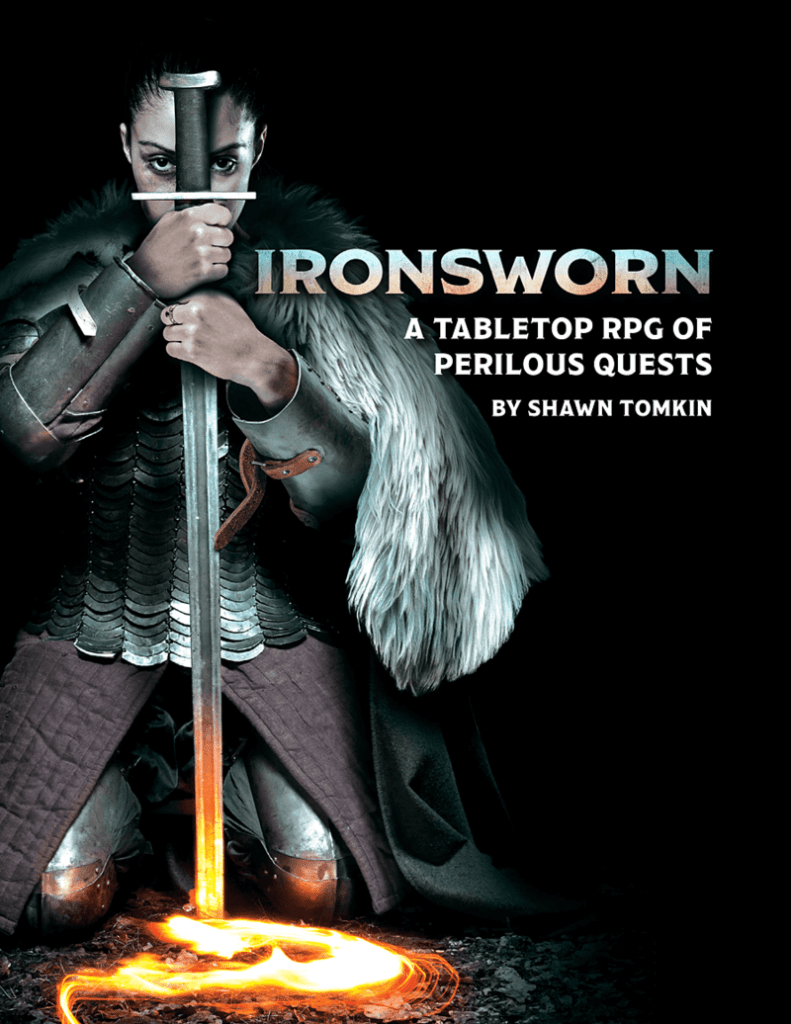
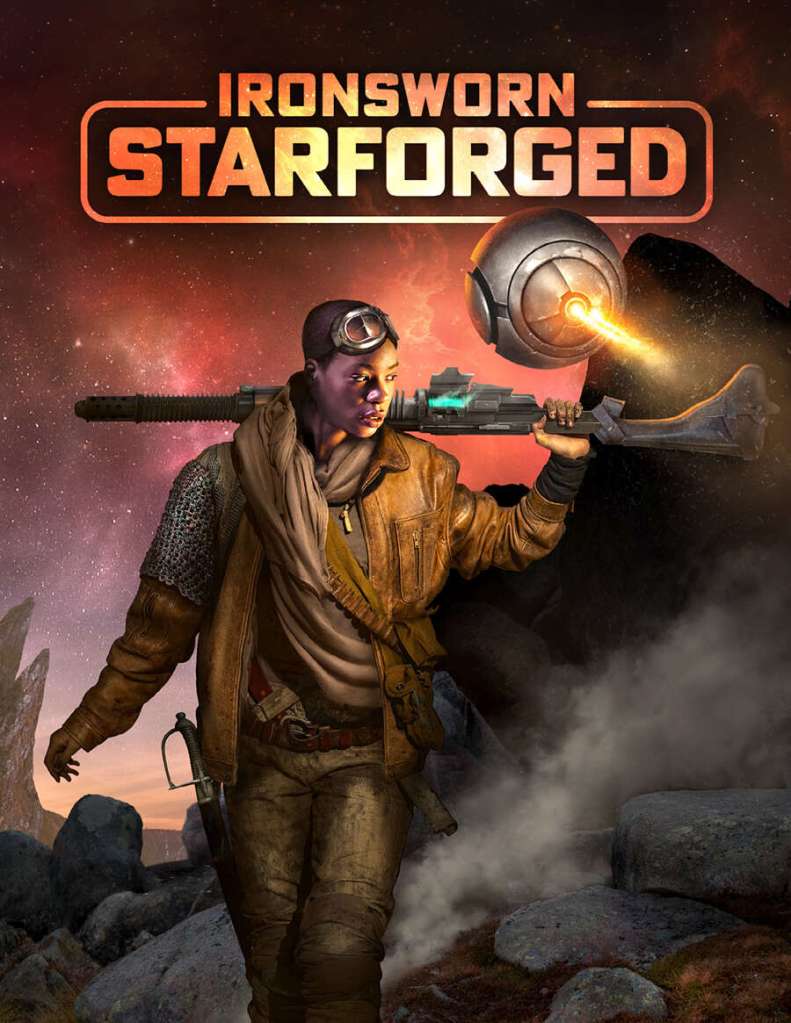
In well-constructed roleplaying games like Shawn Tomkin’s Ironsworn or Starforged, there are layers of dice tables you consult to surprise and throw new encounters and situations at a player. Shawn is a master of this, providing a first impression of a person, then a name, then a more revealed aspect of their character as you get to know them. In Starforged, he provides similar layering for a star system, a planet seen from orbit, then more revealed aspects of settlements as you land your space ship and learn more. This randomness and immersion makes magic happen when you’re trying to avoid a blank page staring back at you (if you’re playing solo) or, worse, a table of players waiting on you to be creative.

More to my point today, he also provides “Action” and “Theme” tables intended to set the scene for a new area you’re exploring or some new situation your player is entering. They’re a bit vague but Shawn has described the marvelous imaginative process we follow in consulting tables like this as “creative interpretation”. What he means is you bring your own thoughts and ideas and filters to bear when you roll for these random descriptive words and make sense of them to drive the story forward.

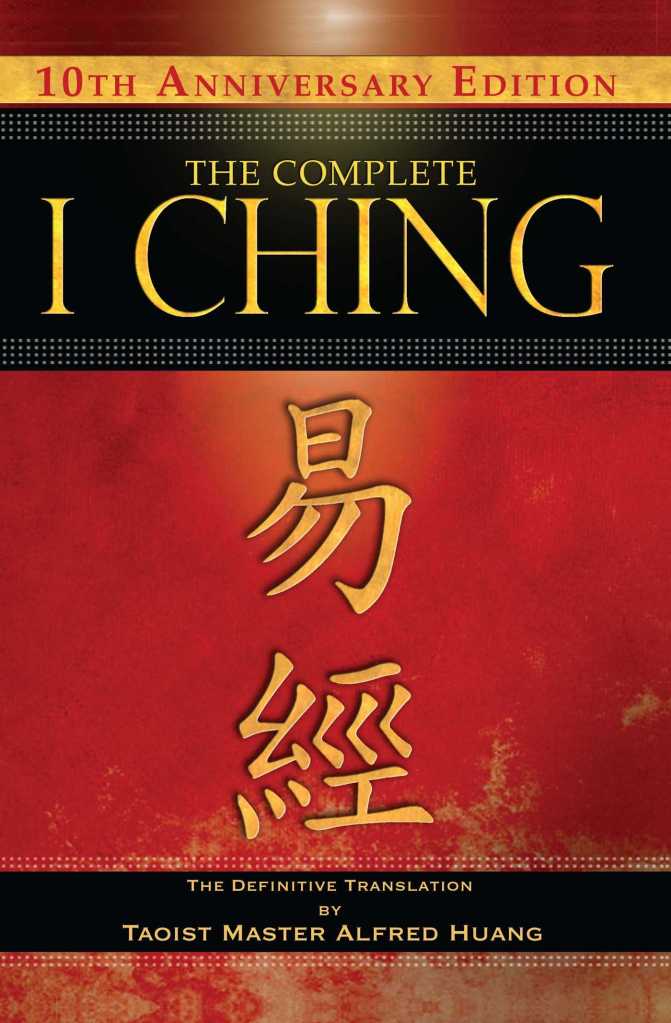
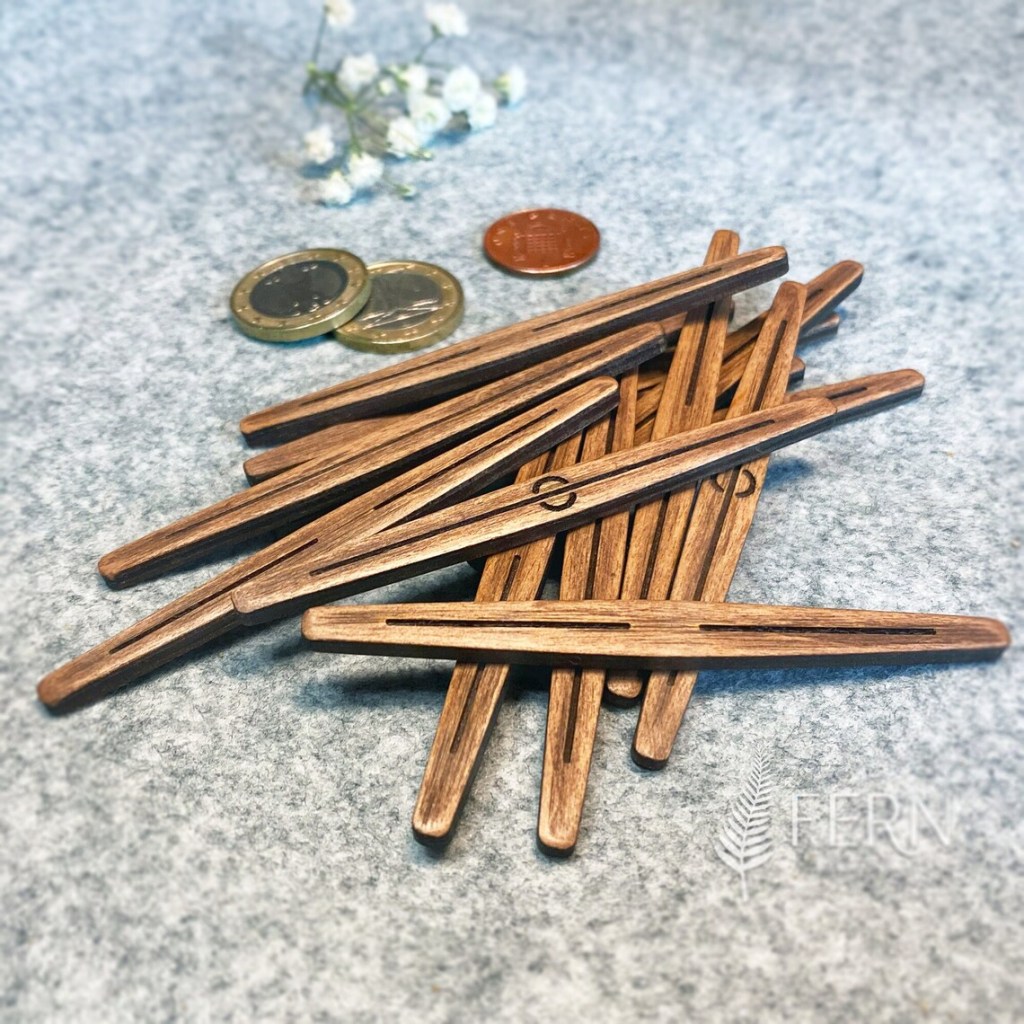
Apologies if you see the I Ching as reflecting a deep reality but I do not and view the creative interpretation process as similarly at work figuring out what a hexagram has to do with a given situation.

So this new book will be a one-stop shop for a roleplaying adventure then?

Yes. I’m being careful to design for use with any roleplaying system (as people are a bit judgey about this) so it can just be an oracles supplement for other systems. However, there are some intriguing things you can only do with bibliomancy mechanics which make it necessary to provide very streamlined rules a solo player or game master can use without any other system (or even dice) at all!

What sorts of new things in the Salt Mystic setting will we see in this?

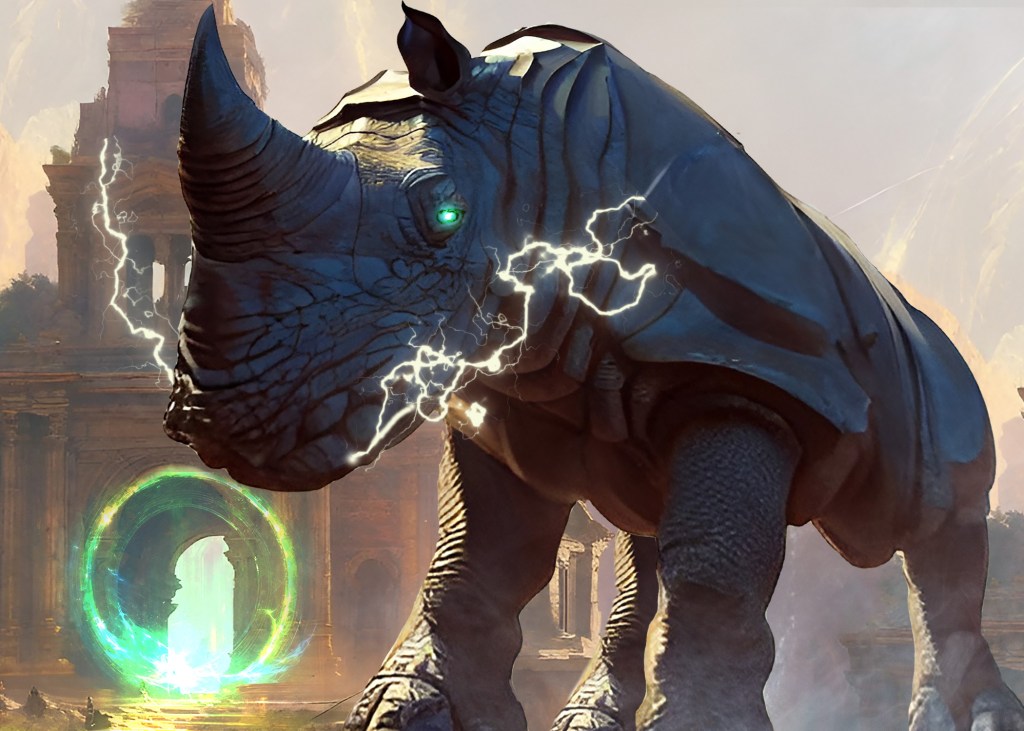
Wow, it surprises me every week! In another project (called Ruinwalker), we already had designed these massive naturally armored rhinos called “towerbeasts”, bio-engineered for ancient wars but still lingering about. Here, as towerbeasts pop up in various places it struck me that they didn’t have the kind of personality dragons do, jealously guarding piles of treasure and breathing white-hot flames.

So…

In Salt Mystic, we have all these abandoned gates to pocket dimensions of artificial space, inside which can be all manner of wonders. Suddenly, towerbeasts got taller in my imagination, and curious, fond of idly poking at and lingering about these gates. They might even jealously protect them, creating ugly encounters for adventurers looking to take a peek inside.

And I had them hiss lightning too, just to make it more interesting.

Fantastic! What else?

Oh, it’s something cool every week or so. My background imagination is always running on this. Let’s leave it for now.

OK, what is the creative process for this? What are your influences?

I wanted this to be on an epic scale, with shimmering cities in the distance and a long, rich history that gets glimpsed but maybe not exhaustively explained, giving the feeling of a world that’s existed a very long time and in which terribly and mighty things have happened. I’ve been rotating at random through several classic epics and transforming a randomly selected phrase into something that makes sense in this setting.

These, so far:

  • The Iliad
  • The Odyssey
  • The Ramayana
  • The Mahabharata
  • Greek mythology
  • Metamorphoses
  • Lucian’s True History
  • Calvino’s Invisible Cities
  • Dante’s Inferno
  • La Morte D’Arthur
  • The Aeneid
  • Beowulf
  • Gilgamesh
  • The Kalevela
  • Lugulbanda
  • Louis L’Amour books
  • The Persian Book of Kings
  • Arabian Nights
  • Parzival
  • Ring of the Nibelung
  • The Raghuvamsa
  • The Song of Roland
  • Pigafetta’s diary
  • The Lives of Saints

For example, if a phrase or encounter from a King Arthur story has a betrayal and a virtuous knight, I’ll keep the betrayal and turn the knight into a famous carbine gunslinger. Magical objects become abandoned & mysterious machines.

I’ve also recently started flipping to random pages in ImagineFX magazines and to interesting images on Artstation for inspiration.

What about the game mechanics?

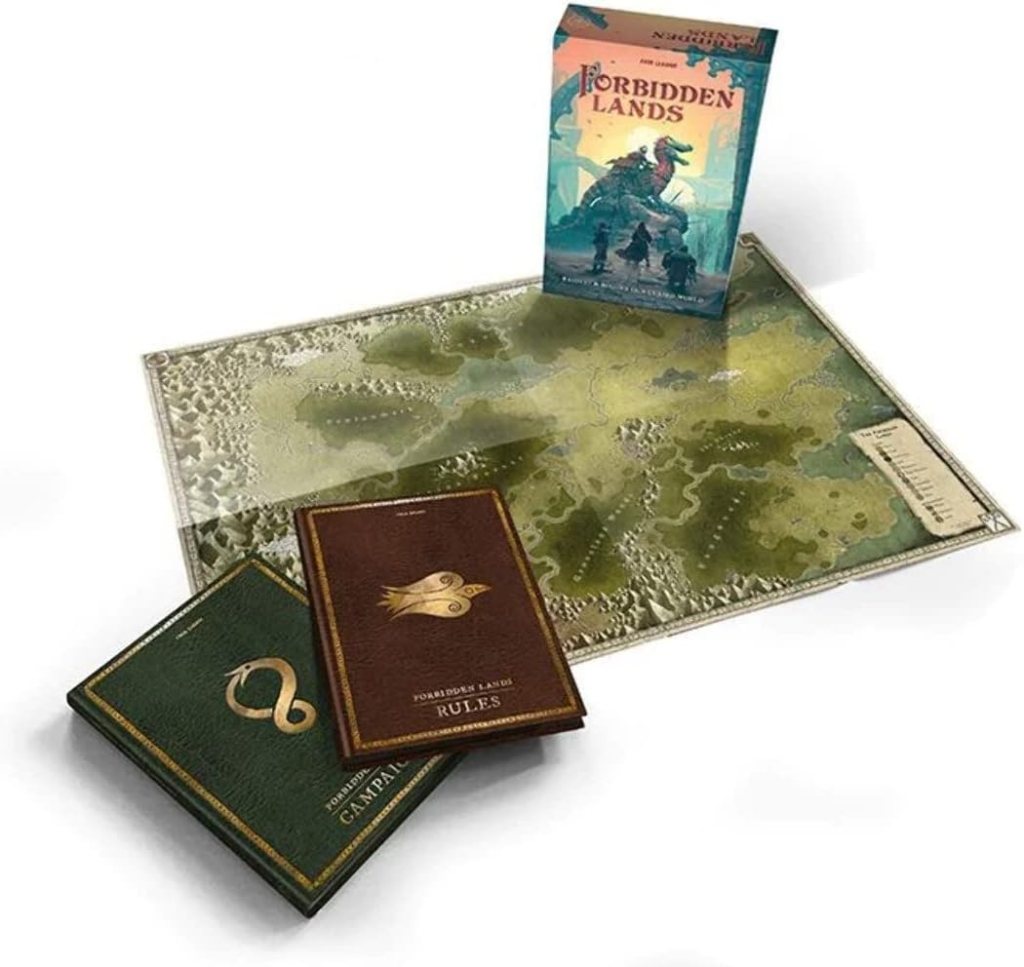
I’ve spent a lot of time researching the best mechanics of various games to translate into a bibliomancy implementation. For exploration, there isn’t a game system better than Free League Publishing’s Forbidden Lands. I’ve taken a spark from them and eliminated dice and the map but tried to keep the general feel of how they treat encounters, story fragments, inventories, and experiences while exploring.

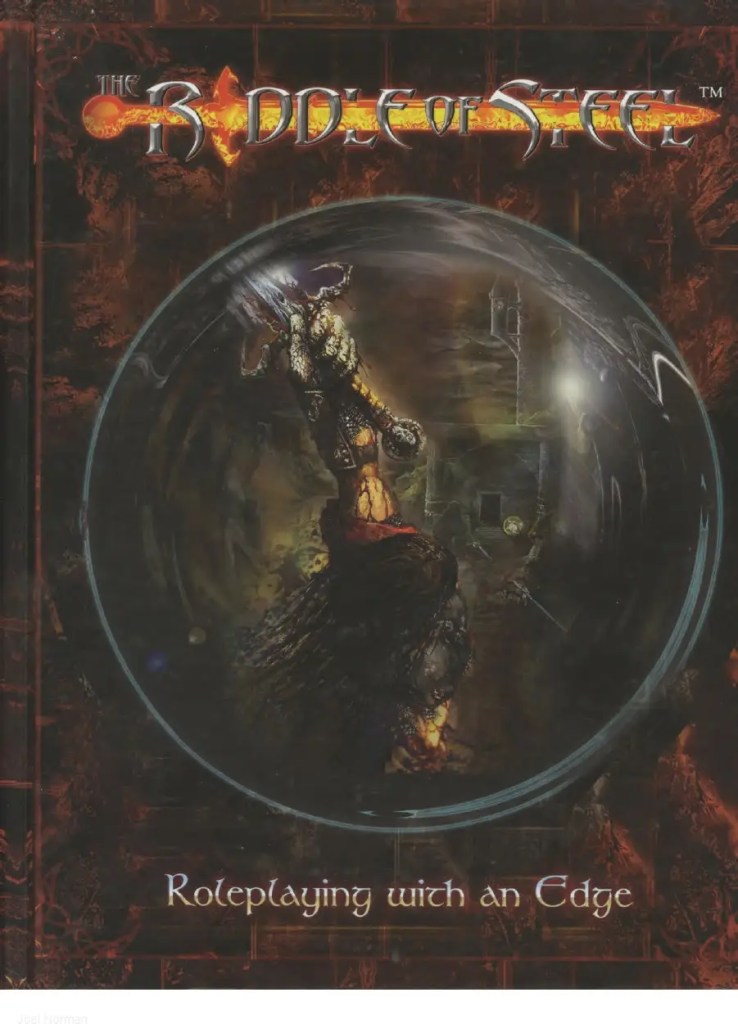
Right now, I’m trying to crack the code on a combat mechanic that doesn’t involve clueless bashing and smashing to grind down hit points. I’m super intrigued by an old, out-of-print game called Riddle of Steel, which contains an innovative and brutal set of rules for realistic combat simulation.

I’ve recently gotten touch with the designer of the game, a fantastic guy named Jake Norwood. We’ll be chatting later this month (I’ll write up the interview for our Inspirational Creator series). Hopefully, I can streamline from the spark of what he has there into something easy but with similar tactics and feel that leverages my format.

Anyway, I just wanted to celebrate a bit and catch everyone up on what’s happening here. I’m targeting 60k words for the text of this, a middling sized novel word count. When I crossed 30k words this week, I felt like cheering. It’s fun, but a real stretch.

I hope this intrigues you, and that you’re okay getting the occasional update as things evolve. Till next time,
New Salt Mystic Lore Card Available For Free Now!

It’s always exciting when we can bring you another lore card: those new bits of the expanding Salt Mystic setting delivered in a unique fusion of flash fiction and original artwork! And they’re free!

You can download any or all of the Lore Cards at the Story Arcade by smashing the button below:

One thing we’re hammering home with the Salt Mystic line, and which will always remain core to it, is this:

In the Salt Mystic universe, cowboy-clad adventurers with ball lightning carbines slung to their arms bravely delve terrifying and thrilling pocket dimensions. The backstory of the Infinite Republic and its collapse, and the unlimited range of possibilities lying in wait out there behind sparkling dimensional gates is the (intentional) engine behind the adventures we’re trying to create.

Read all about the setting here.

So this lore card, called “Newb”, began with the image. I was touring an art museum in Kansas City. And I came across Claude-Joseph Vernet’s “Coastal Harbor with a Pyramid: Evening”, an oil on canvas from 1751.

Here, let me zoom in to the part that struck me:

I just kind of stopped and stared at that part. I mean, what was a pyramid with Roman columns doing on a seashore? And a functional one, at that? It sent my mind reeling, and of course ultimately (as always with me), made me think of sparkling and sizzling gates to artificial pocket dimensions where boundless adventures awaited.

Doesn’t that happen to you?

The artwork for this lore card was based on this, then. I wanted ruins beside a seashore with dudes working their gear along the lines of an exploration party, and I imagined the oriel gate as a shimmering window to another world up on the ruins.

The piece that heads this article is the end result: a paintbash of numerous elements, some of which were drawn from an AI art generator using prompts relating to what I had in mind. Once I composited all the pieces and bits together in Photoshop and color graded everything to match, I tried another trick.

Take a look at this work by Milan concept artist, Edvige Faini:

I am not great with color palettes. In Photoshop, you can match an image to another image’s color palette fairly readily. What I had produced so far in my process was too brown, too plain. It didn’t stand out like I’d hoped, and my adjustments to color and vibrance and hue weren’t giving me the result I wanted.

So I used Edvige’s piece here for the color scheme, matching my art to her color palette. I don’t know what you think, but to me, it’s wonderful. I’m a little overly attached to turquoise, so I’m biased. But still, I like the final product quite a bit.

This was the first lore card where I added the text over the image magazine-style. I’ve been reading a lot of graphic design books so wanted to experiment a bit.

Download the new lore card here.

Till next time, guys:
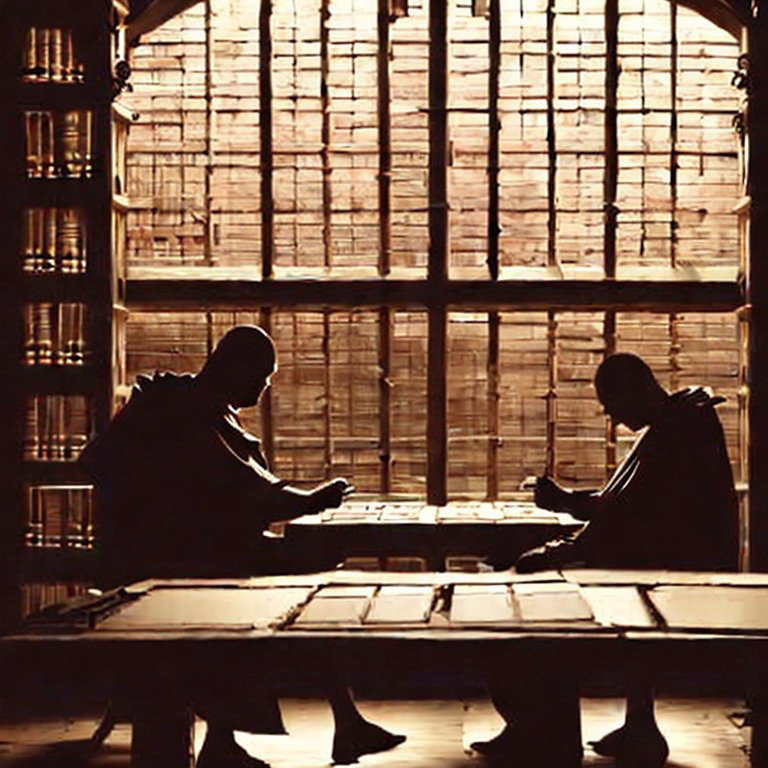
An 11th Century Philosophers’ Game For Meditating On The Universe

Back in 2017, I wrote an article about Herman Hesse’s fascinating Glass Bead Game. The idea of two people at a table moving shiny glass beads around on a complex game board filled with mysterious glyphs, pondering incredible connections between disparate concepts still intrigues me terribly. I imagine a near-impossible breadth of knowledge needed to master this imaginary game, and its best players discovering hidden patterns behind reality and history as they ply their ingenious strategies.

Awesome.

Still, that’s fake. No such thing. Not really. But I wanted to bring something to your attention that has been around since the 11th century and that you can still buy on Etsy or whatever that isn’t fake at all. And if you squint real hard and just go with it, you’ll see something equally fascinating: an engine to tune your mind to the workings of the cosmos (sort of).

Anyway, I’m going deep right now into Medieval cosmology. Don’t ask. I don’t always pick these intellectual bunny trails; sometimes they pick me. Has to do with D&D’s Spelljammer, the Troika roleplaying game, and something I’m going to write up here in the future on Grailrunner. Will be great; I promise. Still cooking.

But this though:

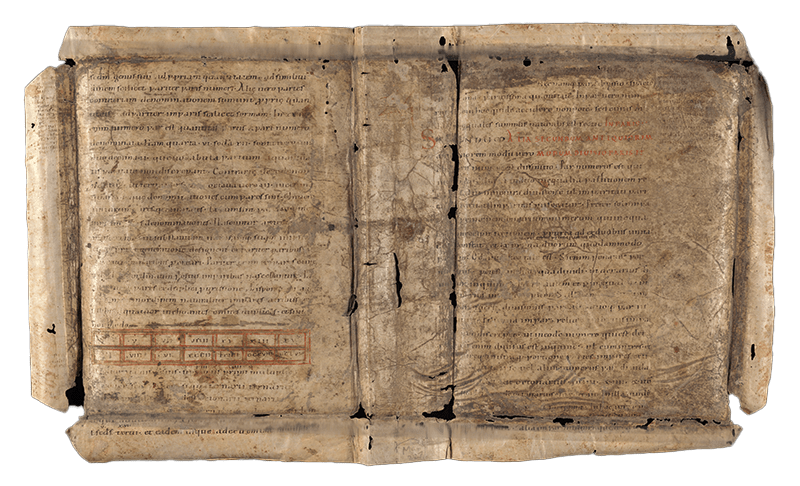
That’s a vellum manuscript dating back to 1000AD, a copy of a work titled De Arithmetica by a philosopher named Anicius Boethius who actually wrote the work in the 6th century. He’s more famous for a conversation with philosophy in woman form called “On The Consolation Of Philosophy”, which is a bit of a mood piece about the fickle nature of fate and how you should deal with that. Not my topic today. Let’s talk about that book in the picture.

“Wait a second. You’re a blog about nerd stuff and science fiction. Why are you on about this right now?”

I hear you. Hold on to that. We bring you inspiration, and wonderful little nuggets that you can file away for your own creations. Edison said “All you need to invent is an imagination and a pile of junk.” And so we proceed…

“So what’s the big deal about Boethius?”

Boethius is important because he served as a bridge between ancient philosophy and the Middle Ages. He didn’t just translate Aristotle, but also commented on the works and added newer insights. He brought ideas from Neoplatonists like Porphyry into wider recognition and helped people make sense of them. In De Arithmetica, he translated De institutione arithmetica libri duo by Nichomachus of Gerasa, who was writing around 100 AD. You see what I mean about this guy being an important bridge of older thinkers, yes?

Philosophy is about pondering things, seeing the beautiful and intricate architecture behind things in flashes of insights and through establishing connections where others can’t see them. Boethius saw the foundation of philosophy as a bedrock he called “the quadrivium”, consisting of arithmetic, geometry, music, and astronomy. Fundamentally and at their innermost core, he might tell you, these four things merge.

“I thought we were talking about a game?”

Yes, we are. Here’s a wikipedia article about Rithmomachia, also called The Philosophers’ Game or The War Of The Numbers. The game is based on the study of numerical proportions and harmonies that Boethius studied and wrote about, much of which you could find perusing through that book up there. In fact, historian David Sepkowski said of Rithmomachia that between the twelfth and sixteenth centuries,

“Rithmomachia served as a practical exemplar for teaching the contemplative values of Boethian mathematical philosophy, which emphasized the natural harmony and perfection of number and proportion, that it was used both as a mnemonic drill for the study of Boethian number theory and, more importantly, as a vehicle for moral education, by reminding players of the mathematical harmony of creation”.

“What?”

Here, check this out to see what he’s talking talking about, then I’ll tell you what it’s like playing this game:

  • Arithmetical proportions: Say I give you the numbers 3 and 15. You can find the missing number between them that would form an arithmetical proportion by summing the first and last numbers of the sequence (3 and 15 for a sum of 18), then dividing by 2. So in this example: 3, 9, 15.
  • Geometrical proportions: Say instead I give you the numbers 2 and 72. You can find the missing number between these that would form a geometrical proportion by multiplying the first and last numbers of the sequence (2 x 72 = 144) then finding the square root of that. So in this example: 2, 12, 72.
  • Harmonic proportions: Say now, finally, I give you the numbers 12 and 20. You can find the missing number between these that would form the harmonic proportion by multiplying the first and last numbers of the sequence and also by 2 (12 x 20 x 2= 480) then dividing that by the sum of the same two numbers I gave you (12 + 20 = 32). So in this example, 480 / 32 = 15 and the sequence is 12, 15, 20.

To the minds of the Greeks, all the way up for centuries after Boethius wrote about this, number sequences like this have a magic to them, because they’re tuned to reality itself. Nature and the cosmos, the very music in the air, the movement of the moon and the stars, all tied in to these perfect, intellectually satisfying numerical relationships. Measure anything in the stars or on the water or in the music from a harp and you’ll find these sequences, they would tell you.

Make fun of that if you want, or look down on it as caveman thinking, but I felt the same kind of magic in school when I studied this little wonder:

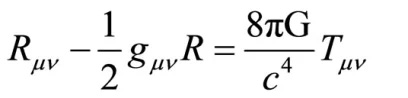
That’s Einstein’s field equations, tying together everything that ever was. It’s one of the most verified things in Physics. Explains how the world goes round, why things fall, and the future of the universe. Gorgeous. Absolutely gorgeous. That’s the way the monks felt playing Rithmomachia, clashing their little game pieces together looking for ways to feel these proportions. Not to just learn them.

To feel them.

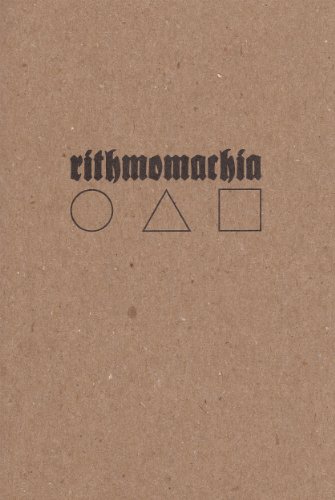
If you’re at all interested in learning more about this wonderful game, seeing its rules clearly delineated for you, and seeing some nice illustrations of game play maneuvers, then head to Amazon and read Rithmomachia by Seth Nemec.

He does an amazing job walking you through why the number sequences mattered to those to whom this game was more than a pastime and a learning mechanism, but rather a way of worshipping and meditating on the very fabric of the cosmos. If you have Kindle Unlimited, it’s free.

I’ve read it four times myself over the years just because he makes the game seem like an awful lot of fun, and somehow important. It makes me want to hop in the minds of those monks and feel the way they felt playing it, and to see that crazy board and its pieces on a big old oak table read to go.

In fact, it was the idea of a philosophers’ game with real-world implications that inspired a story collected in Kyot: The Storybook Puzzle Box. That one’s called The Berserker’s Game, and a far bit darker than Rithmomachia. Read it here if you like.

Overview of Rithmomachia

Quick summary of the game though, so I can tell you whether I beat my son on Christmas Eve or not (and some insights we had playing it):

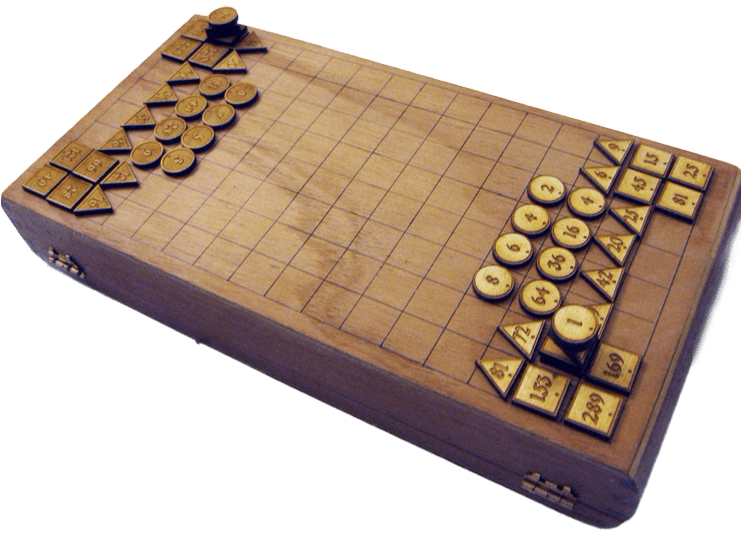
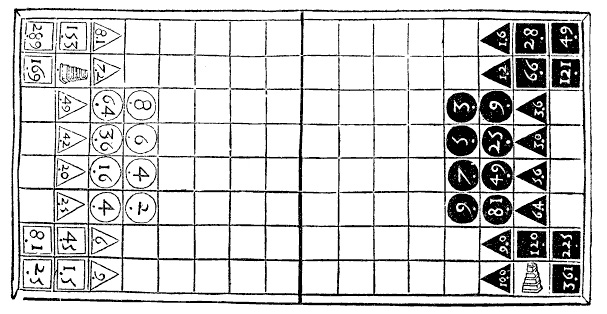
Game pieces: Game pieces are either circles, triangles, or squares, all with numbers on them. The two game piece sets aren’t the same, nor are they symmetrical, though the White player’s pieces are based on even numbers and Black’s pieces on odd numbers. The numbers themselves, their placement in the starting setup, and the movement rulesets are all based on Boethius’s proportions. Precisely defined stacks, one stack per opponent and called ‘pyramids’ are provided for as well.

The board: The board is an 8 x 16 squares grid, basically two chess boards set end to end.

Moves: Everything can move orthogonally or diagonally, but circles move 1 space at a time, triangles 2 spaces at a time, and squares move three spaces at a time. Piece moves can’t come up short – you move exactly 1, 2, or 3 spaces when you move. Pyramids may move in the manner corresponding to their component parts, as long as the requisite shape is represented somewhere in the pyramid (meaning it can’t move a single space any longer if it’s lost all its circles, for example).

*

Attacks: Four basic attacks exist (but the attacking piece does NOT move into their victim’s space as it does in chess or checkers, you just call it and take the piece):

1. Siege is surrounding a target piece on four sides, either orthogonally or diagonally (board edge counts). Surround them and call it, taking the piece.

2. Encounter is when an attacking piece COULD legally move into the space where an opponent’s piece (of equal numerical value) is located. Just call it and take the piece.

3. Eruption is when you multiply the attacking piece’s number by the spaces between it and the target piece to obtain the target’s number. Say your 8 is 2 spaces from your opponent’s 16 (which in this game means side by side because the squares they’re on count in this calculation). Since 8 x 2 = 16, and that’s the target’s number, you call it and take the piece. Division okay too.

4. Deceit is when you surround a target pieces on 2 sides, and the two attacking pieces sum to the target piece’s number.

*

Victory conditions: A number of victory conditions are provided across two categories – those defined based on pieces captured and those defined based on numerical progressions formed with remaining pieces on the board. Simplest possible is Victory Of Goods, meaning pick an overall score (say 100) and the first player to capture pieces summing to that number wins.

“So you’ve played this? What’s that like?”

I built a Rithmomachia board based on Nemec’s book a few years ago when I first encountered the game, just to see how the rules played out, and what differences I experienced in game play between the opposing sides, given the asymmetry of their assigned numbers. It’s been in my closet a while now though. My son is in college, majoring in computer science and math, and I knew he’d be into this when he was back home for Christmas (2022 as I write this). It’s right down his alley now, and he’s devious and sly enough to uncover slick strategies in any new game.

And he’s not afraid to get mean when necessary.

Some interesting insights based on our game play:

  • Eruption is awesome. It’s just awesome. It was our signature move, because of the level of aggression and devastation you can wreak with it. Planning Eruption attacks feels like planning moves for Bishops, Rooks, and the Queen in chess, only slightly more difficult due to running all the permutations through your head.
  • I see now why the checkerboard needs to be as long as it is – Eruption needs spaces on the board to provide for more multiples and make the math behind the attack useful in going after larger numbers. If you’re only multiplying by 1 or 2 each time, that isn’t much to work with.
  • The rules allow you to take multiple pieces in one attack as long as conditions are met for the respective pieces, so we really focused on trying to make that happen. It felt a lot like chess in that respect, with long turns of staring at the board. (We had very little luck in this though.)
  • The fact that you don’t move the attacking piece into the captured piece’s position flavors the entire game very, very differently to chess or checkers. It’s much more cerebral, constantly checking different combinations and possibilities mentally. Since you can’t move and attack in the same turn, this forces you to spend some turns moving just to change up the board configuration.
  • We stuck to very basic attacks and lower numbers. Yet there are numbers on the board like 289 and 361. You’re dividing a lot, trying to seize one of these big pieces, but you can see pretty quickly that won’t be easy at all to just go for the one big kill shot, due to their placement in the startup configuration. We really should have moved more pieces versus the constant attacks, to change up the dynamics of the board

And the single biggest observation that became apparent within the first few moves was surprising to me. I hadn’t expected a game designed by monks for monks, engineered at its core for instruction and meditation on the harmony of the cosmos would be a poker face game of deceit.

“What do you mean?”

So many of the attacks work both ways. Since you can’t move and attack in the same turn, when you move into position for your planned attack, in many cases, the other guy can do it to you instead. That was especially true for us because of our fascination with the Eruption attack. It meant you had to keep a straight face, look elsewhere on the board, even say deceitful things to distract your opponent from what you’re scheming.

Our game deteriorated quickly into a broadsides shootout between our two pyramids and with a few surrounding pieces, blasting away with Eruption attacks since we kept getting confused about what was concealed in the stacks. It was a way of trying to surprise the other guy.

I just hadn’t expected a monk’s game to require so much deception and stealth. Crazy.

“Well, who won?”

I got a lucky strike in, which sent me over the goal for a win. Honestly, it’s just a lot to keep in your head with many, many possible sneak attacks. You start to feel a little paranoid about that.

But overall, I did start to get a feeling for the numerical patterns, the weight of the larger numbers, the reasoning behind their placement and the logic of the startup configuration. It’s a fascinating game, and easy to see why people who felt these patterns were the language of God would see wonder in the board and its pieces.

Anyway, that’s what I wanted to tell you about this week. Great game, and Nemec’s book is worth a read.

What do you think?

Till next time,
Firebeetle In The Stygian Library: Experiments In Solo RPG Storytelling

Adventures are a hunger, fundamental to who we are. But what makes them work?

Literally everything we try at Grailrunner is about pushing boundaries in imagination. Often, that takes the form of contorting tabletop game mechanics for experiments in immersive storytelling. Then we give that stuff away for free in case it’s entertaining, though we’ve learned bits and pieces along the way about what makes adventures work…and what is missing when they don’t.

Which is the point.

For example, we built wargame terrain and a narrative scenario to play out a story using the game mechanics of Privateer Press’s popular Warmachine. It was a thrilling ride we called…

The Black Ruins Massacre

Turned out amazing – go follow these links to see what I mean:

One of the more popular things we’ve ever done here on the site was to write up an illustrated recap of a solo Dungeons & Dragons adventure in Wizards Of The Coast’s Tales Of The Yawning Portal. I routinely use a ridiculous D&D character named Firebeetle to try out different roleplaying game rulesets, and in that case, I put him through a harrowing ordeal called Clueless In The Sunless Citadel. Click these guys here to see what that was all about, and download the free pdf. Only takes about a half hour or so to read, but it’s fun.

Clueless In The Sunless Citadel

So anyway, I was in a big old used bookstore called McKay’s in Nashville, TN a few weeks ago. I strolled to the RPG section with no particular goal in mind and found an odd, strangely electrifying, though ultimately unsatisfying hardback called Maze Of The Blue Medusa. I knew as soon as I read the back, felt the weight and texture of it in my hands, as soon as I flipped through a few pages, that this was something special.

Maze Of The Blue Medusa

(I understand there is some controversy around one of the creators behind this book, so I’ll stick to the work itself in my comments.)

The book describes a system-neutral dungeon complete with a detailed map, illustrations, a bestiary and associated encounter dice tables, and intricately detailed descriptions of every one of its over 300 rooms. In every room, something weird is happening, something grotesque and surreal is creeping about, and crumbs of an over-arching story are dropped.

However, unlike so many mega-dungeon books with their Tolkein tropes and endless loot crates and traps, this whopper is written like an art project, with text that reads like it’s for shrewd adults capable of seeing irony and social commentary in its encounters.

I excitedly cracked it open when I got the chance to run young Firebeetle through his paces inside the Maze.

And I wasn’t into it.

It just didn’t click for me. The adventure escaped me, and it was just going through motions with no point. I couldn’t find a story hook that mattered. Each room seemed weird and vaguely interesting, but nothing popped or sparkled for me. The encounters were tedious and amounted to nothing. Here’s a Youtube video of some dudes in an actual play session of Maze Of The Blue Medusa – watch that for a few minutes and I suspect you’ll see what I mean.

Even with a great GM and some funny players, this wasn’t an adventure so much as a haughty stroll through the bohemian part of town where I don’t really fit in. I wanted the awe and danger of exploration inside the covers of a book and found only a meaningless series of weird things. Maybe that was my fault, but the mechanisms available just didn’t work the way I wanted.

That was on my mind when I heard of a little book by Emmy Allen called The Stygian Library, I thought maybe I had found redemption.

The Stygian Library

Pick up the older version of this booklet free here. It’s available in a remastered version here.

The Stygian Library bills itself as a dungeon for bibliophiles, promising a procedurally generated fantasy library you can explore in ever deeper levels. That sounded amazing, requiring you to map your way (though you can run blindly and get lost). Much like Blue Medusa, this wasn’t written with solo play in mind, but with enough dice tables and imagination, I figured I could rewire it.

Emmy delivers a wild bestiary including golems made of paper, animated books that follow you around, mysterious creeping librarians working on enigmatic calculations, even a half-man, half octopus that eats brains. Nice.

You roll for the levels you’re entering, details about them at first glance and also if you search around, as well as random events and, when prompted, encounters of a friendly or a violent flavor depending on your choices so far.

I took this idiot inside.

Firebeetle

Firebeetle was a name I was given for my very first D&D character back in the day. I recreate him in any game system I’m testing out because he amuses me.

He’s an aimless adventurer, in it for the thrill, always ready to take up a quest or try a mysterious corridor, picking up random things along the way and relying on his luck to seem him through. He’s not really charming, but thinks he is. Loves the ladies. Gets into trouble practically at every destination.

Firebeetle has a tendency to stumble into dimensional portals (as I try new game systems), finding himself in underground dungeons in the Middle Ages (D&D), Viking-era Iceland in an impossible city made of clusters of hot air balloons (Ironsworn RPG system), or in the far future on a dying space station (Starforged RPG system).

He just kind of goes with it. And it all works out in the end.

Neither Blue Medusa, D&D, Ironsworn, nor Starforged were delivering on the premise I was searching for: the awe and danger of exploration inside the covers of a book. Maybe Emmy’s Stygian Library would be the trick. I love libraries.

I put this ridiculous booklet together during conference calls in the COVID-19 quarantine, and I treated it as the opening sequence before entering the Stygian Library. It was going to be called Five Days In Boghallow, a fighting romp with a funny undead sidekick. Literally the only reason I’m including a link here is to give you a feel for this character. He’s such an idiot.

Anyway, I’ll give you the airplane view of what went down inside the Stygian Library and make my point for the day:

On what happened inside the Library…(keep in mind, virtually all of this was determined by dice rolls and game mechanics)

Bereft, the undead knight and Firebeetle entered the Library from the pit into which they’d fallen. They were amused by a couple of animated books that followed them around like cats, though the creepy librarians kept appearing to whisk the books away into the shadows. Something they read inside the cover of one of the books gave them a quest to find some machinery in the deep levels of the endless Library. They encountered bees made of paper (swatted them away) and a golem (ignored it) and paid visits to a planetarium, a pile of treasure, the master catalog of contents, and a hall of taxidermy before managing to be entirely lost and stranded inside an ever-shifting labyrinthine library.

Ahh, I thought. Here’s where things pick up for young Firebeetle. He’s stuck now. Looking for some machines or something.

They kept pressing on, ever deeper, picking up all manner of treasures and vaguely defined books that seemed promising. ‘Let’s see Firebeetle’s careless attitude work his way out of this mess’, I said to myself.

Then inside a giant paper beehive, a bird-like bandersnatch started pecking at Firebeetle’s sword to steal it (because it was shiny). Stupid bird-thing. When they finally killed it, the fact that they were killers turned the Library into a deadlier place. This would pick things up then, as the Library beasties got nastier and the hapless adventurers grew more desperate to find a way out.

In an enormous statuary, Bereft and Firebeetle were accosted by a floating skull, attended by floating teeth that were enthralled with its every word. It grew increasingly insulting, commenting on their appearance and bumbling like they were museum curiosities, before it began to smash itself into Firebeetle muttering something like, “See, students, how a skull may stomp a bug without the need of feet!”.

They ultimately shattered the pompous skull, scattered its minions, and dealt handily with some phantoms the encountered as well. And they did, believe it or not, wind up in the chamber they sought with its outlandish calculation engines, where the hooded Librarians worked their mysterious mathematics.

And would you believe it…and I honestly didn’t make this up at all…the dice rolls delivered Firebeetle an intangibility potion. It’s the one thing that would get him back to an escape from the Library, with treasure and books in hand. I mean…I tried to put the guy in danger and make a madcap adventure of the whole thing, and his ridiculous luck somehow just pulled him out of it.

The Stygian Library was amusing, even interesting and novel, definitely worth your attention if any of this sounded like your cup of tea, but overall it failed to deliver the spice I was seeking: the awe and danger of exploration, except in the covers of a book.

So what am I saying then?

Here’s my point. And I learned this through all these experiments with different game systems through comparison with the one I’m testing now – Forbidden Lands by Free League Publishing. The difference has been night and day. And I believe I know why.

Solo RPG game play is absolutely possible. It’s enjoyable and surprising, stretching your imagination and your sense of fun. It may even rewire your personality as you rip and stretch aspects of yourself that don’t see enough light of day. It takes a few things though, which I’ve found in Forbidden Lands more so than with these other systems, including The Stygian Library:

In my day job when we deal with companies making big changes, we use something called The Airplane Model to define the major elements that make things happen, that drives people to do things. I’m applying this to manufacturing adventure. Hear me out:

Adventures work when:

  • (Vision) …there is a meaningful purpose to what the characters are doing – a destination and a clear, important goal that you find interesting. The Forbidden Lands ruleset offers a Legend Generator that covers this well. I believe I was missing this in many of my random exploration experiments.
  • (Sense Of Belonging) …the characters matter to you, fleshed out with formative events that made them who they are. I trusted the Formative Events dice tables in the Forbidden Lands to build a person for me, a hunter named Colter, and he’s starting to feel like someone I’ve known a very long time.
  • (Sense Of Contributing) …the decisions that your characters make have consequences. I felt in the Maze Of The Blue Medusa and to some extent in The Stygian Library that the random conflicts and odd bits of treasure were irrelevant. Curating good dice tables, like the Action and Theme oracles in Ironsworn and others is fantastic for surprises and a sense of wonder and discovery, but what you do has to mean something or there’s no weight to what’s happening
  • (Sense Of Progression) …there is a clear, definable sense that progress is being made against the purpose. Ironsworn, Starforged, and The Stygian Library all three provide an abstract Progress Tracker intended to keep score of how things are going in the story versus goals, but I found that unrelatable in solo play. Boring and meaningless, even. I’ve found I start to give up on the adventure entirely if there isn’t any meaningful progress or sense that things are moving along. In the case of Forbidden Lands, a deliciously detailed map is provided which is incredibly satisfying.
  • (Sense Of Urgency) …time is ticking, and there is a real possibility of dying or losing something precious. Particularly in D&D 5th Edition, I feel like it’s kind of hard to die. One thing I’m seeing in the Forbidden Lands ruleset is that the stats are unforgiving, and there are lots of things able to kill my character. It forces me to make Colter plan more, and think creatively about his decisions since he could die so readily.

And that’s what I wanted to say about all this. It’s been interesting, testing all these systems out and trying to use them to breathe life into a story I can experience.

The awe and danger of exploration, except in the covers of a book. Possible?

What do you think?

Till next time,
Announcing A Massive Freebie From Grailrunner!

Ahhh…free stuff. Who doesn’t love it?

One thing we’ve heard loud and clear from you is that you feel it’s hard for someone to first get into the Salt Mystic universe without having the Sourcebook And Core Rules. You’ve got your battle deck, your own copy of the book, and you’re ready to smash some tornadoes together. Your head’s swimming with images of gunslingers dueling with ball lightning and abandoned sparkling oriel gateways leading to treasures and ruin.

Yet there’s a lot of gaming options out there (and so very little spare time!), you struggle to get someone to buy any of that for themselves, so there’s no one to play the game with.

We hear you. And we’re fixing it.

Starting today, the free ebook available right here on the Grailrunner site will include:

  1. Two full color Volume One starter decks, available in print & fold format
  2. Dice cards and a measuring ruler
  3. A fully realized narrative scenario complete with short fiction and table setup guidance
  4. An assortment of sample terrain elements, including one customized for the included scenario

The included adventure scenario is particularly dear to my heart, because we mostly stick to flash fiction at Grailrunner. We’ve always kind of thought people like their non-mainstream stories super short, high impact, lots of shock and cool ideas, with great eye-catching illustrations. Like we’ve attempted with the Lore Cards. The novels will be great when they come, but that moves incredibly slowly for me at least.

Yet you asked for more now. Thank you!

The bonus game scenario is titled “Towerlock”. We wanted to elaborate on a fan favorite character, the devilish all-seeing wildcat who calls herself “The Wake”, bringing her to life in a way that might surprise anyone that has gotten to know her so far. Or thinks they have.

The accompanying tale exists to help you visualize the unique battlefield conditions that will exist in the game scenario. The pressure cooker conversation between The Wake and this mysterious adventurer with whom she apparently has history is your chance to ask yourself just what you’d do to either attack or defend the summit of that mountain. You know your assets, your liabilities. Then…what would you do? Play and find out.

Towerlock: An abandoned oriel terminus has been discovered on the summit of a towering granite butte in the desert country in Jasphouse Province. A single oriel gateway leads to artificial pockets of space left over from The Infinite Republic, and could contain treasures and technologies beyond belief. Yet a terminus might contain as many as twenty such gates. No one nation can be allowed to control that sort of thing.

Karak and a vanguard watch from Alson in the Mountains got to the summit first and established an operation financed by an enigmatic partnership known only as Towerlock. He will need to plan his defenses carefully and consider all possible avenues for assaults and seiges.

Segmond and a vanguard watch from Tanith in the Salt Flats has arrived to take the summit back. He’ll need to analyze the defenses being set up, consider all intelligence he can gather, and prepare as devious or as bloody an assault as he can muster to have any chance at success.

Wonders beyond imagination could be ripe for the taking. But the fight will take place on a sheer vertical wall, and anyone who’s defeated falls like rain. Good luck. Draw well.

What’s your strategy?

Anyway, that’s what we wanted to let you know today. It’s a big deal to us, and will hopefully open the door to more folks dipping into this fascinating, experimental world that’s so unbelievably building itself.

Make sure you’re signed up for notifications for new articles here on the site; we plan to post a sample chapter from the upcoming novel, Mazewater: Master Of Airships.

Till next time,
Designing a tabletop wargame: update!

The wheels turn slowly, my friends. But they do turn. We’re making glacial headway on the tabletop game we’ve been talking about for a couple of years now – but in recent days, some exciting things have been happening!

If you’re a visitor, welcome! I’ve got a gift for you. Download the basic ruleset for an introduction and overview, to get some cool ideas on how this bad-boy will start cranking once it’s up and running to tell some gosh-a-mighty, romping, stomping tales of science fictiony goodness.

Proofs of the deluxe version of the Core Rules And Sourcebook have come in, and we weren’t happy with the color and print quality. The cover looked great, but some of the textured pages were a bit muddy. We’re also including two starter decks and some papercraft terrain you can pull out and play with immediately – those need to pop in clarity and brightness more than we were seeing with the proofs. So we’ve beefed up to a higher print quality standard and are waiting on the second round of proofs on that.

The game is played with tremendous flexibility, including different War Marshal decks you can begin with, and customize from there. Those guys needed their own tuck boxes. We approved the first design, and the proof arrives any day. This guy here:

We also got a head start on the quarterly (hopefully quarterly!) digital magazine which will serve as sounding board and announcement central for upcoming products (like the terrain tile deck we started working on and can hopefully be ready before year-end). Here’s a draft for the potential cover of issue one – let us know what you think!

I started writing the feature story for the first ish, with a scheme of introducing some of the key characters and framing out a narrative scenario you could immediately set up and play after you read it…to see how you’d handle the situation. Could be in two-player mode or solo. We’ve gotten some great feedback on the playtesting for solo play, which we refer to as Wolfpack Mode. It seems even after quarantines have mostly lifted, people are super interested in solo play these days. That’s great, and hopefully we can make that as shifting and challenging as the regular one-on-one version.

Man, I wish this was a full time gig and we could just sit around writing stories and dreaming up worlds for a living! But bills to pay, and kids to raise, my friends. If you’d like to volunteer to help out, or submit any stories or art for consideration, feel free to reach out either here or emailing me directly (brian (at) grailrunner.com). We’d love to grow the family.

I hope you’re doing well, guys. Shoot me any questions or suggestions you have. Happy to connect. Till next time,
Dreams are engines. Be fuel.