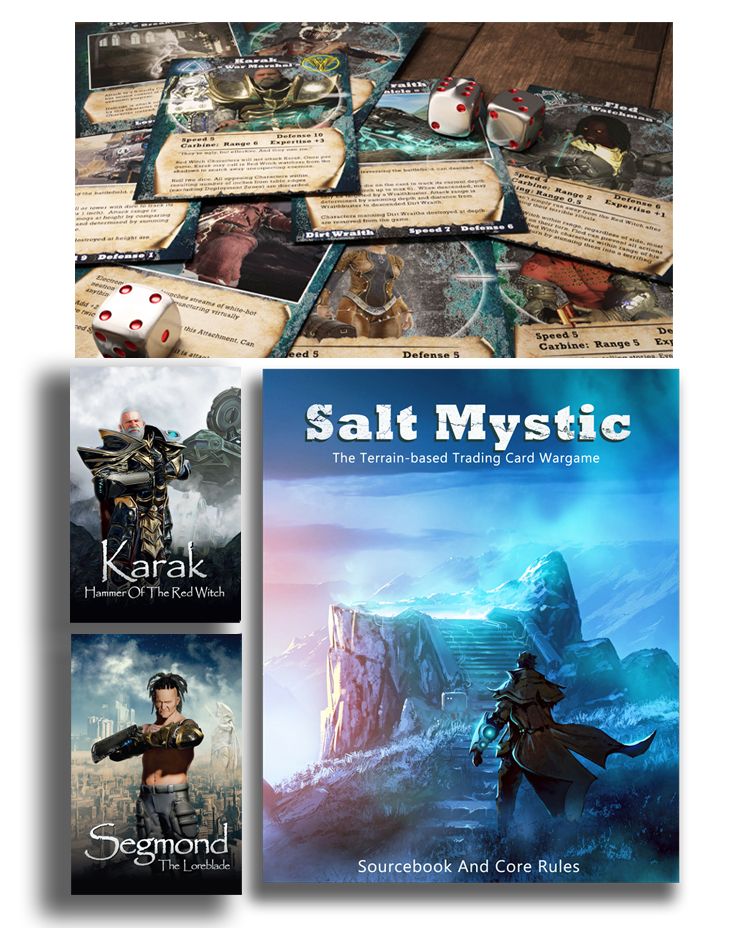
If you need to know a bit more about what we’re doing with Salt Mystic, feel free to check this out here.
In the Salt Mystic Sourcebook And Core Rules, we define seven different ages into which the long history of this setting is divided. The brief snapshots there allowed us to drop maddening hints of some intriguing twists and adventures that occurred thousands of years ago, but we never really get the chance to dig in to those earlier time periods. Maybe one day these will all be their own novel series or art lines – but for now, we’re in the Guardian Age, man. It’s enough work bringing that to glorious life!
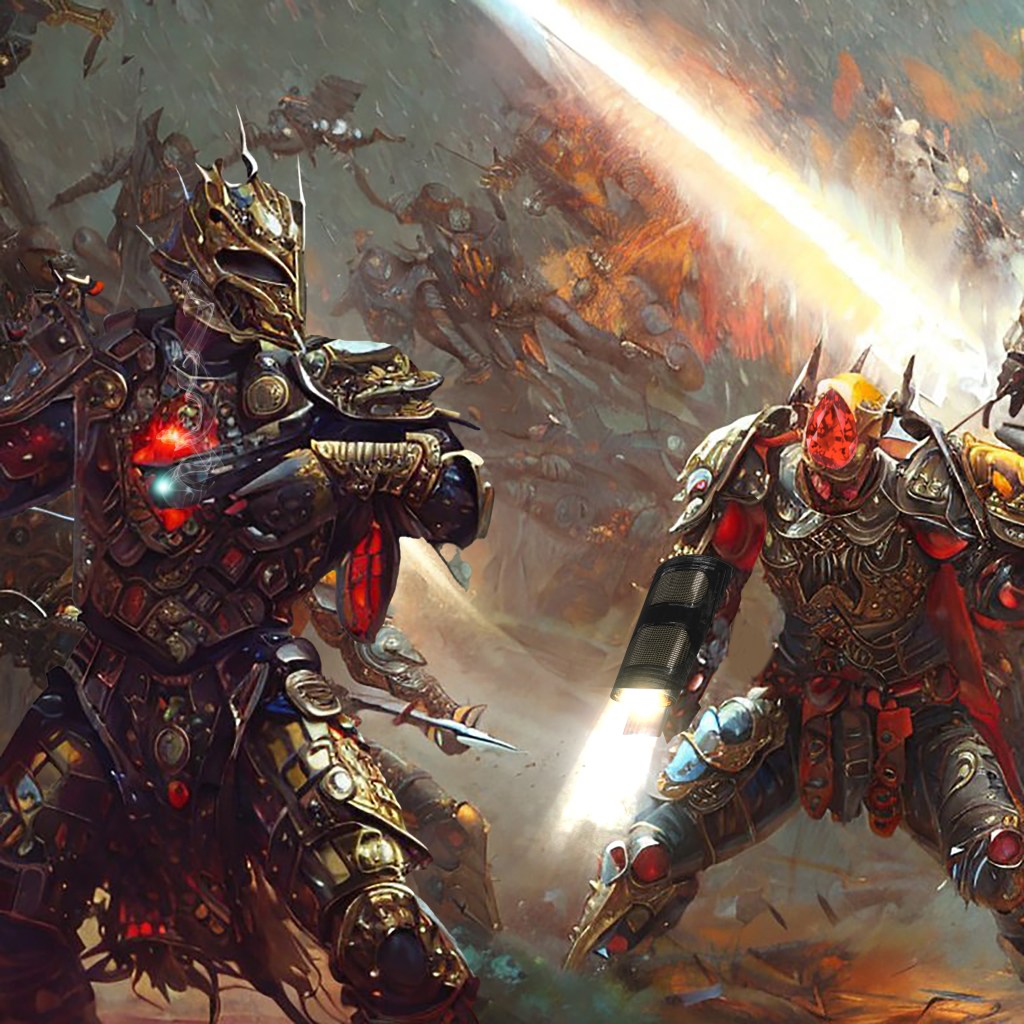
So this new lore card was a chance to flesh something out that I thought was interesting. There’s already a guy named Murmur in the Salt Flats character cards that has an Artificial Intelligence sprite inhabiting his armor that we’ve always thought was funny. This lore card was where we go big with that.
Horrifyingly big.
As for the art, as always it’s a photobash and paintover of some different elements pulled from a few sources. The background is an AI-generated image of a battlefield. The warriors’ jeweled armor was inspired by Grant Morrison’s 18 Days art book (which accompanied the web series), based on the storyline of the Mahabharata. The carbine was built in Blender as a 3d model, textured with a steel plating from Textures.com. The ruby faceplate of the guy turning on his general was taken from a freely available png – literally just googled “ruby gemstone” or something like that.
I especially love the way the smokey flames turned out, spewing from that fellow’s gauntlet-based plasma weapon. There are at least three overlays on that, all from Nucly. I wanted it to seem like he’s firing that weapon up, and his general has just now realized that he’s stepped over some kind of line.
Anyway, we hope you like the art piece and accompanying flavor text. Let us know what you think.
You likely know if you’ve been here at Grailrunner before that we obsess over the creative process. In fact, the whole point of the company, this site, and essentially anything we’ve produced is to dissect, pick apart, rewire, engineer, and shove ammo clips into the imagination. It’s in the logo, man.
Dreams are engines. Be fuel.
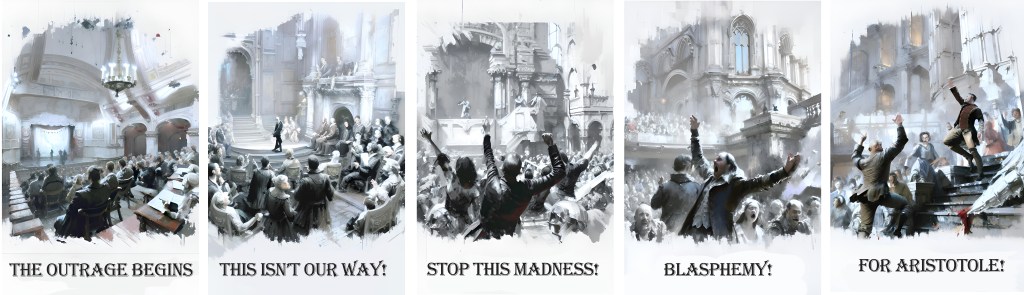
Anyway, there was an interesting riot at a theater on February 25, 1830 in Paris that has a few things to teach us about how to break ground in creative work. And as creators right now, with the looming and worldshaking onset of AI disrupting every outlet of creative work and threatening that age-old security we were all told that computers can’t create, it’s more important than ever that we get really, really good at doing new things.
New things, man. New things. Now AI can’t really do that.
What is the context on this Hernani thing?
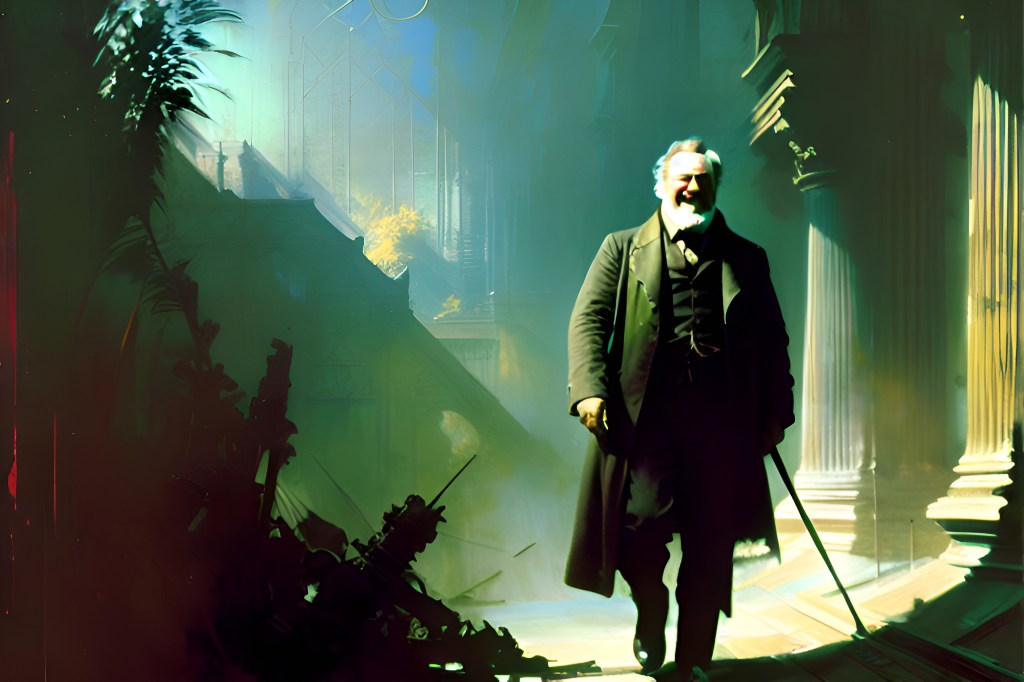
Victor Hugo wrote Les Miserables and the Hunchback Of Notre Dame. That’s where you might know him from.
This guy:
He was a playwright too though, and in his day the structure and content and expectations of plays were widely agreed and rigid. You didn’t mess around with these things if you wanted to be treated seriously and not look like a disrespectful clown. After all, Aristotle analyzed storytelling in tragic drama at an almost divine level 2,000 years before in his Poetics and designed the perfect tragedy, defining the unities:
Unity of time: the action of the play must unfold over a single day
Unity of place: the action must take place in a single setting
Unity of action: the play should comprise only one plot
If you abided by these principles with your play, which was the norm for hundreds of years in Europe, then Aristotle’s intense study of impact and memorability and propriety assured you that you had a well-constructed play. Why deviate from that – you think you know better than Aristotle?
Another non-negotiable was the clear definition of genre: comedy or tragedy. More than just branding, this was crucial to the audience’s interpretation of your work. Is it supposed to be funny, and so pratfalls and misunderstandings and goofy idiots abound? Or is it supposed to be sad, and so have larger-than-life people make key mistakes based on their natures and lose it all?
And finally, you didn’t show things that were grotesque, things that were compulsively ugly or distorted. It was just improper and undignified.
Oh no, what did Victor do?
Well, he wrote this. It’s the preface to a play called Cromwell. It pissed a lot of people off and set the stage for the riots to come later. A few tastes of his blasphemy:
“But the age of the epic draws near its end. Like the society that it represents, this form of poetry wears itself out revolving upon itself. Rome reproduces Greece, Virgil copies Homer, and, as if to make a becoming end, epic poetry expires in the last parturition. It was time. Another era is about to begin, for the world and for poetry.”
“…the grotesque is one of the supreme beauties of the drama.“
“‘But,’ the customs-officers of thought will cry, ‘great geniuses have submitted to these rules which you spurn!’ Unfortunately, yes. But what would those admirable men have done if they had been left to themselves? At all events they did not accept your chains without a struggle.”
Victor was saying that the unities of time and place arbitrarily handicapped the dramatic potential. Check pages 15 and 16 for his blast on unity of place – it being silly to think so much important action would happen in this one spot, and what blah-blah is needed to tell the audience what’s going on elsewhere! He continues on pages 16 and 17 destroying unity of time – it being equal nonsense to expect important events all to happen in a day.
And wow, is that one something Hollywood sequel writers should read!
In summary, he felt the rigid genre conventions of comedy and tragedy were limiting his ability to express wide ranges of emotion and experience, the unities were unnecessary constraints that forced silly adjustments, and, most importantly, he didn’t care for the convention of avoiding the grotesque. He called for a new genre to explore the essentials of life, with beauty and ugliness, good guys and monsters, gold-laid parlors and miserable alleys.
“These rules, man! They’re cramping my style!”
What was Hernani then?
Well, Cromwell was too big in scope to even be staged. It’s 400 pages long and at one point needs the British parliament to enter the stage. His next attempt got banned. Then he wrote Hernani, which censors possibly felt was too ridiculous to bother with.
Plot? Two noblemen and a mysterious bandit are in love with the same woman. A conspiracy is in play, and things get dark ending with a wedding and poison.
Rules broken? Well, the story unfolds over 6 months at various settings. That was naughty of him. You weren’t supposed to show death, violence, or intimate scenes. Hernani opens in the lady’s bedroom and closes with three suicides. Equally naughty. You were supposed to adhere strictly to your chosen genre: comedy or tragedy, but he incorporated farcical dialogue and had a king hiding in a wardrobe. Language should have been clean and high-minded, but he included lines like:
“Is this the stable where you keep the broomstick you ride at night?”
You weren’t supposed to let your lines of a sentence from one line of verse to another, but that happened too. Characters were supposed to be one-note caricatures generally who didn’t change, to represent some trait or concept, though he fleshed them out far more than was typical and allowed transformations (such as Don Carlos becoming a good emperor). And he used stage directions like a madman, which was also strange.
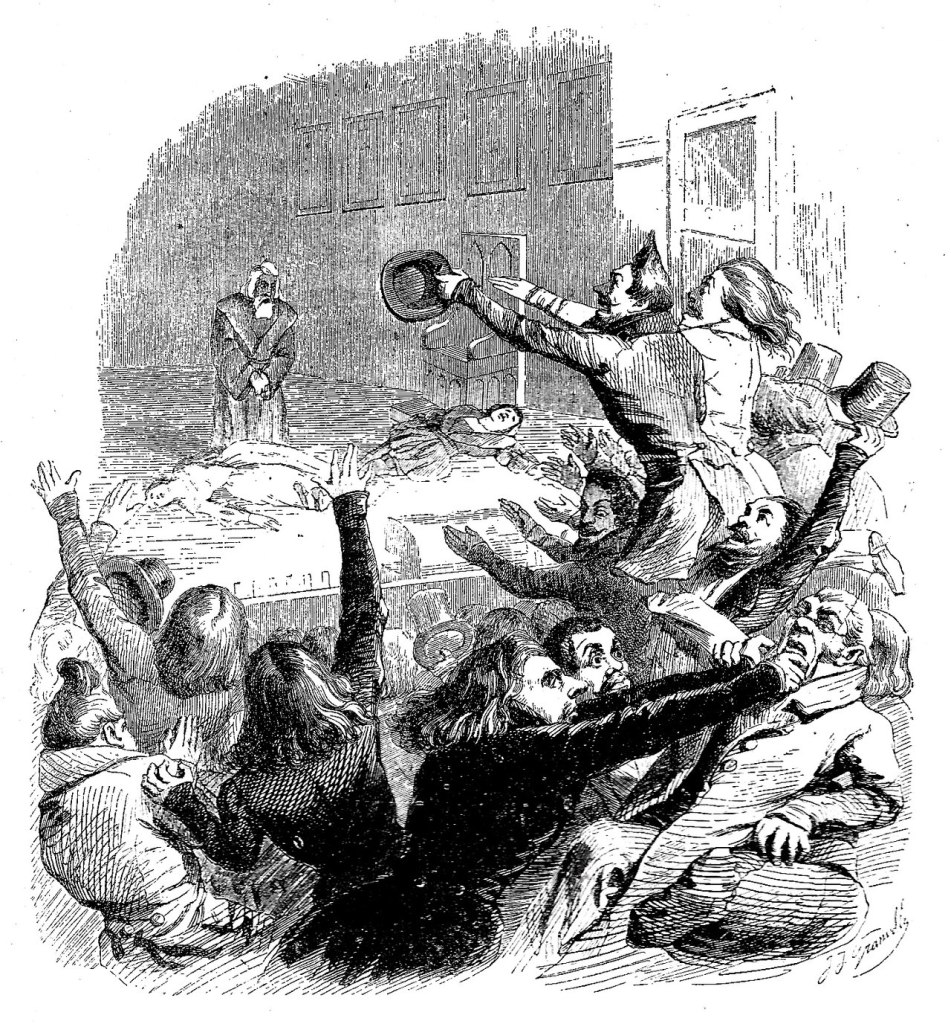
So this happened:
Why was there a riot though?
These Parisians had been through revolutions and guillotines, deaths and restorations of kings, and were reading on a daily basis about massive changes in nations such as Italy and Germany where entire systems of government were being born while others faded. France was still in turmoil politically and censorship was a powerful tool to shut down free thinkers and radicals. Breaking rules in art was linked to breaking other rules, perhaps those tied to abiding by norms set by those in charge.
Today in a politically split country we might feel threatened by those who question gender norms or who bend traditional family structures because we fear what a loss of those foundations might mean for the country’s future, what impact it might have on our children. You see how mad everybody gets about that every day on Twitter. Here in Paris, it was perhaps as scary for them.
In fact, many of those same rioters a few months later in July ousted King Charles X and replaced him with “Citizen King” Louis-Philippe.
Why is this a big deal?
My point today is that it was risky and insightful for Victor Hugo to see these literary conventions as the limiting factors they were and to dare to break them. And when he broke them, it wasn’t for shock value as so many charlatans today offer instead of talent. Victor didn’t break the rules because he was a renegade, he felt they limited his storytelling.
He kept his eye on the point behind what he was doing: telling an impactful story. Maybe Hernani’s plot is nonsense, but that wasn’t what he wanted anybody to take away from it anyway. Read the Cromwell preface. He wanted a new genre free of limits.
Impressive. Impressive to even notice the limits. How many conventions do we abide by and not even notice. Are our prison walls invisible?
What does this have to do with AI ?
AI writing tools like ChatGPT are not going away. They’re seeping into our marketing copy, our kids’ essays, blog and social media posts, even podcast scripts. As creators, there is one important fact behind any AI-based technology like these which can be an asset for us. They are trained on data sets and those data sets include conventions and limitations like those Victor Hugo raged against.
Ask ChatGPT to write you a story about King Arthur or a D&D scenario and it’s painfully generic. We as creators are in an arms race then, as those tools get better. We have to get better.
Grailrunner is excited to announce the latest addition to our growing Salt Mystic Lore Card set: a mood-setting, rousing vignette titled “Canyon Of Living And Dying”. Download it for free here.
Welcome to the Grailrunner Story Arcade!
Salt Mystic is our rapidly growing western science fiction setting, upon which we’re building everything from novels to games and merchandise. You can learn more about that here. Key to this innovative new way of exploring immersive storytelling is the idea of worldbuilding through a collision of art and fiction. Sometimes the art comes first, then a story is built around it. Sometimes, a story idea percolates and only starts popping after an image is crafted for it.
However it happens, we’re building out locations and settings, characters and background lore, all through experiments and inspirations that often get shared for free on social media and here on the Grailrunner site. The hope is that those of us out there who dream of adventure and exploration, of new worlds and intriguing concepts, we’ll all find a home here! And that you’ll buy books and stuff.
Definitely buy the books and stuff.
The Story Arcade is also a place for people playing the Salt Mystic tabletop wargame to find interesting settings for the battlefields they play upon. That’s where this week’s addition was born, actually.
What was the inspiration for this?
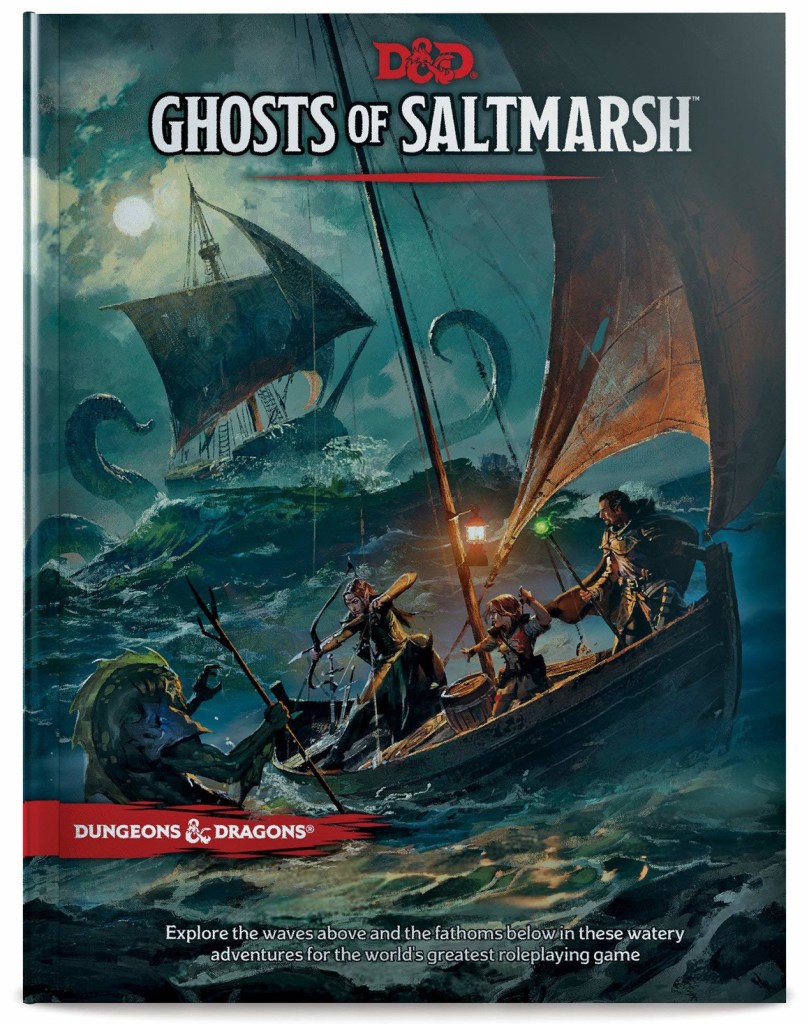
Writing this article here, I was reminded of a really well designed dungeon adventure that appeared in a Wizards Of The Coast compilation titled Ghosts Of Saltmarsh.
Spoiler alert – there is a point in this adventure where the very dungeon setting itself (a ship) starts sinking and flooding. The dungeon destroys itself, and you have to get your characters out or drown. And to me, that’s incandescent genius! I became enamored with the idea of a battlefield setting for the Salt Mystic game where the battlefield floods or sinks or catches fire or otherwise starts snuffing out characters not fast enough to survive.
Generally, I haven’t solved how to convert that to a Salt Mystic terrain book yet. Maybe one day. But one of the ideas that didn’t pan out as I thought about it was a high canyon where the battle was to be fought on crumbling rock walls. I imagined a giant stone golem at the base throwing boulders up at the armies and snatching random people away. It sounded cool, but game rules and art to make that work just didn’t click for me.
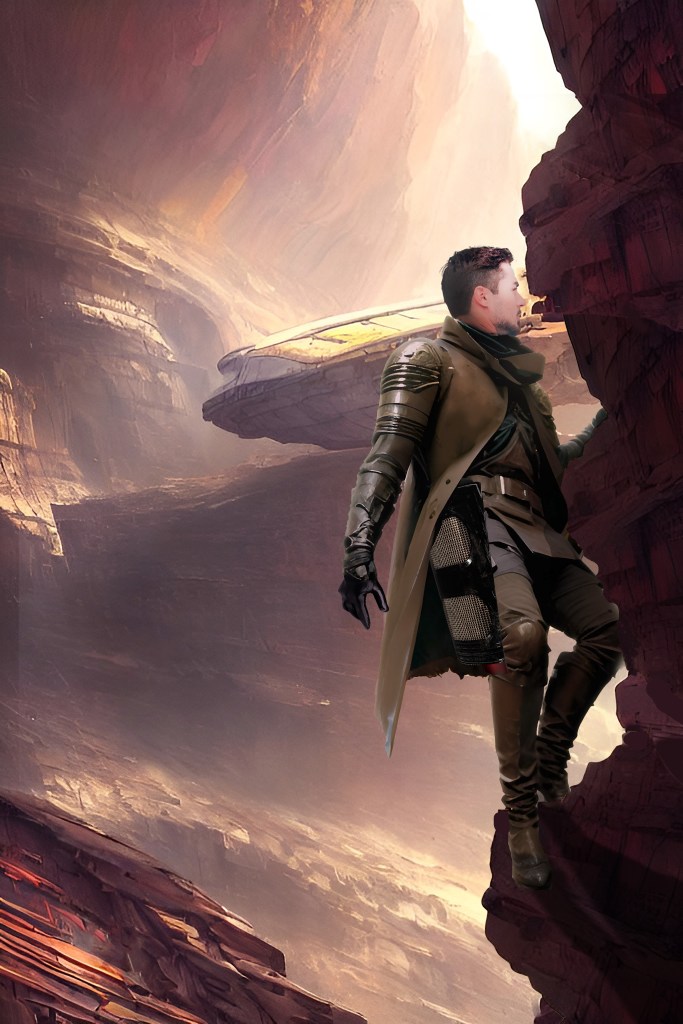
This image is what came of all that. I had the picture of a carbine gunslinger nervously clinging to a high rock wall with a derelict in the mist behind him, precariously perched in an inaccessible place.
What was the process to create the image?
Like most of the imagery I produce, this is a photobash of several elements composited together in Photoshop and painted over. The carbine weapon strapped to his hip is something I generated in Blender, but re-textured recently. The climber is a composite of two AI-generated elements and a handful of stock images, run through a filter in Photoshop and color and light graded to match. The background is a composite of two AI-generated landscapes from two different pieces of software, and I used two overlays from Nucly for lighting effects.
What about the story?
I rewrote that three times, trying to give it a western feel. The idea is a dude from a rinky-dink town in the middle of nowhere deciding that the fear of climbing up there is not as strong as his need to really live, to maybe make a name for himself. Or maybe to solve the mystery of what’s inside that derelict.
In the story, he says “to live is to burn”. I totally stole that from Harlan Ellison, who said he stole it from an Egyptian papyrus. Whoever said it first, it’s awesome.
*
Anyway, I hope you enjoy the new Lore Card. Shoot me a comment or note if you’d care to chat it up about Salt Mystic or where we’re going with all this.
Back in 2017, I wrote an article about Herman Hesse’s fascinating Glass Bead Game. The idea of two people at a table moving shiny glass beads around on a complex game board filled with mysterious glyphs, pondering incredible connections between disparate concepts still intrigues me terribly. I imagine a near-impossible breadth of knowledge needed to master this imaginary game, and its best players discovering hidden patterns behind reality and history as they ply their ingenious strategies.
Awesome.
Still, that’s fake. No such thing. Not really. But I wanted to bring something to your attention that has been around since the 11th century and that you can still buy on Etsy or whatever that isn’t fake at all. And if you squint real hard and just go with it, you’ll see something equally fascinating: an engine to tune your mind to the workings of the cosmos (sort of).
Anyway, I’m going deep right now into Medieval cosmology. Don’t ask. I don’t always pick these intellectual bunny trails; sometimes they pick me. Has to do with D&D’s Spelljammer, the Troika roleplaying game, and something I’m going to write up here in the future on Grailrunner. Will be great; I promise. Still cooking.
But this though:
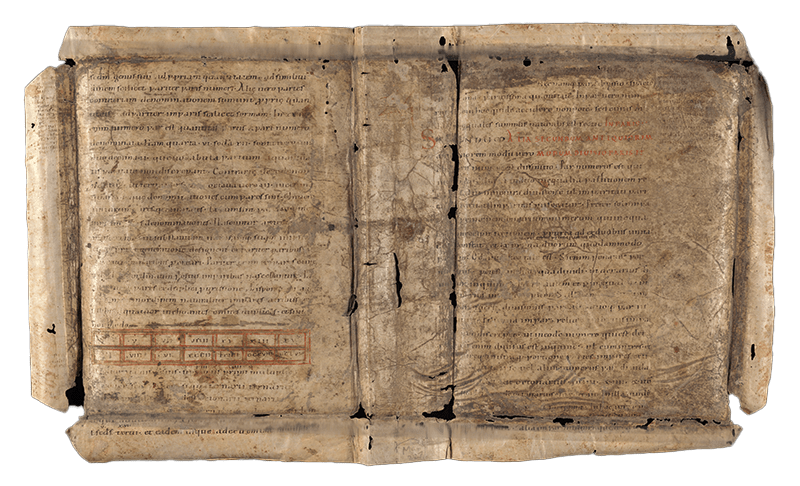
That’s a vellum manuscript dating back to 1000AD, a copy of a work titled De Arithmetica by a philosopher named Anicius Boethius who actually wrote the work in the 6th century. He’s more famous for a conversation with philosophy in woman form called “On The Consolation Of Philosophy”, which is a bit of a mood piece about the fickle nature of fate and how you should deal with that. Not my topic today. Let’s talk about that book in the picture.
“Wait a second. You’re a blog about nerd stuff and science fiction. Why are you on about this right now?”
I hear you. Hold on to that. We bring you inspiration, and wonderful little nuggets that you can file away for your own creations. Edison said “All you need to invent is an imagination and a pile of junk.” And so we proceed…
“So what’s the big deal about Boethius?”
Boethius is important because he served as a bridge between ancient philosophy and the Middle Ages. He didn’t just translate Aristotle, but also commented on the works and added newer insights. He brought ideas from Neoplatonists like Porphyry into wider recognition and helped people make sense of them. In De Arithmetica, he translated De institutione arithmetica libri duo by Nichomachus of Gerasa, who was writing around 100 AD. You see what I mean about this guy being an important bridge of older thinkers, yes?
Philosophy is about pondering things, seeing the beautiful and intricate architecture behind things in flashes of insights and through establishing connections where others can’t see them. Boethius saw the foundation of philosophy as a bedrock he called “the quadrivium”, consisting of arithmetic, geometry, music, and astronomy. Fundamentally and at their innermost core, he might tell you, these four things merge.
“I thought we were talking about a game?”
Yes, we are. Here’s a wikipedia article about Rithmomachia, also called The Philosophers’ Game or The War Of The Numbers. The game is based on the study of numerical proportions and harmonies that Boethius studied and wrote about, much of which you could find perusing through that book up there. In fact, historian David Sepkowski said of Rithmomachia that between the twelfth and sixteenth centuries,
“Rithmomachia served as a practical exemplar for teaching the contemplative values of Boethian mathematical philosophy, which emphasized the natural harmony and perfection of number and proportion, that it was used both as a mnemonic drill for the study of Boethian number theory and, more importantly, as a vehicle for moral education, by reminding players of the mathematical harmony of creation”.
“What?”
Here, check this out to see what he’s talking talking about, then I’ll tell you what it’s like playing this game:
Arithmetical proportions: Say I give you the numbers 3 and 15. You can find the missing number between them that would form an arithmetical proportion by summing the first and last numbers of the sequence (3 and 15 for a sum of 18), then dividing by 2. So in this example: 3, 9, 15.
Geometrical proportions: Say instead I give you the numbers 2 and 72. You can find the missing number between these that would form a geometrical proportion by multiplying the first and last numbers of the sequence (2 x 72 = 144) then finding the square root of that. So in this example: 2, 12, 72.
Harmonic proportions: Say now, finally, I give you the numbers 12 and 20. You can find the missing number between these that would form the harmonic proportion by multiplying the first and last numbers of the sequence and also by 2 (12 x 20 x 2= 480) then dividing that by the sum of the same two numbers I gave you (12 + 20 = 32). So in this example, 480 / 32 = 15 and the sequence is 12, 15, 20.
To the minds of the Greeks, all the way up for centuries after Boethius wrote about this, number sequences like this have a magic to them, because they’re tuned to reality itself. Nature and the cosmos, the very music in the air, the movement of the moon and the stars, all tied in to these perfect, intellectually satisfying numerical relationships. Measure anything in the stars or on the water or in the music from a harp and you’ll find these sequences, they would tell you.
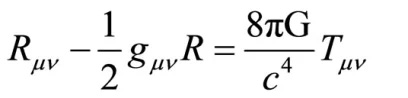
Make fun of that if you want, or look down on it as caveman thinking, but I felt the same kind of magic in school when I studied this little wonder:
That’s Einstein’s field equations, tying together everything that ever was. It’s one of the most verified things in Physics. Explains how the world goes round, why things fall, and the future of the universe. Gorgeous. Absolutely gorgeous. That’s the way the monks felt playing Rithmomachia, clashing their little game pieces together looking for ways to feel these proportions. Not to just learn them.
To feel them.
If you’re at all interested in learning more about this wonderful game, seeing its rules clearly delineated for you, and seeing some nice illustrations of game play maneuvers, then head to Amazon and read Rithmomachia by Seth Nemec.
He does an amazing job walking you through why the number sequences mattered to those to whom this game was more than a pastime and a learning mechanism, but rather a way of worshipping and meditating on the very fabric of the cosmos. If you have Kindle Unlimited, it’s free.
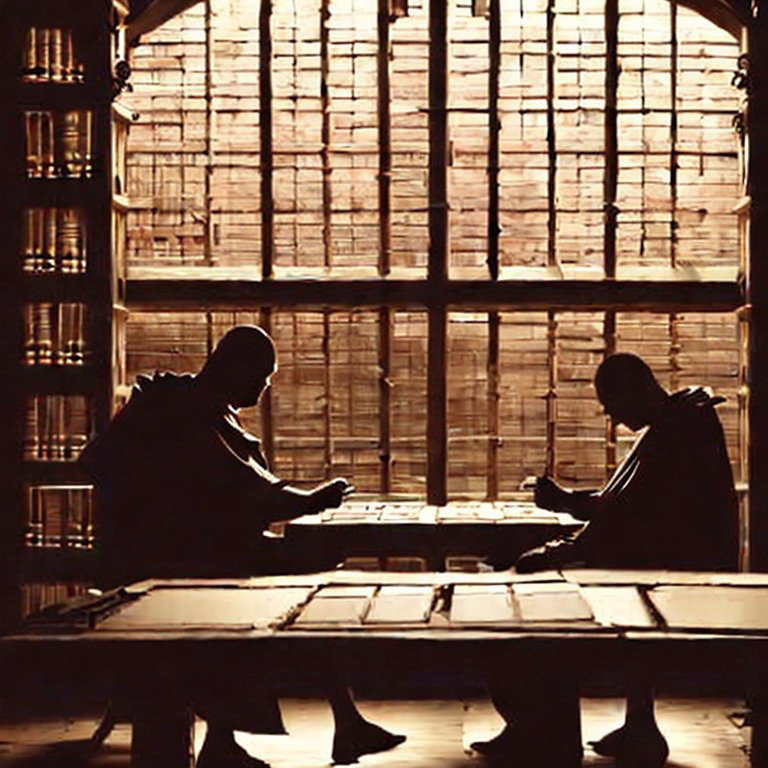
I’ve read it four times myself over the years just because he makes the game seem like an awful lot of fun, and somehow important. It makes me want to hop in the minds of those monks and feel the way they felt playing it, and to see that crazy board and its pieces on a big old oak table read to go.
In fact, it was the idea of a philosophers’ game with real-world implications that inspired a story collected in Kyot: The Storybook Puzzle Box. That one’s called The Berserker’s Game, and a far bit darker than Rithmomachia. Read it here if you like.
Overview of Rithmomachia
Quick summary of the game though, so I can tell you whether I beat my son on Christmas Eve or not (and some insights we had playing it):
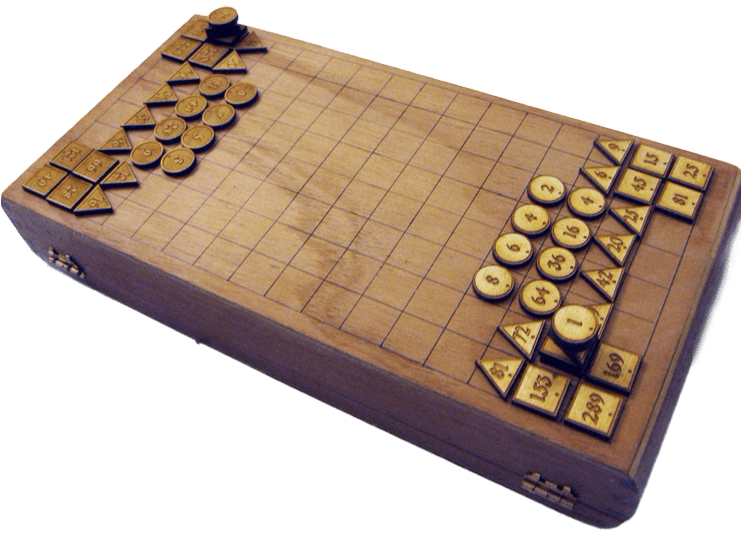
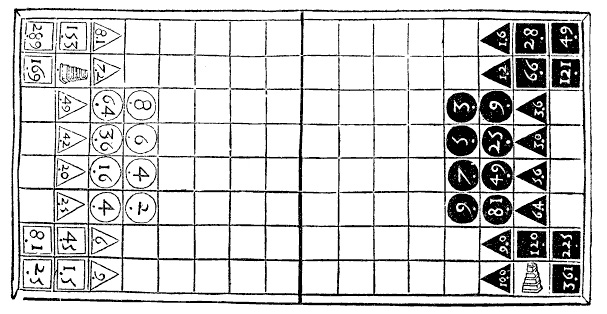
Game pieces: Game pieces are either circles, triangles, or squares, all with numbers on them. The two game piece sets aren’t the same, nor are they symmetrical, though the White player’s pieces are based on even numbers and Black’s pieces on odd numbers. The numbers themselves, their placement in the starting setup, and the movement rulesets are all based on Boethius’s proportions. Precisely defined stacks, one stack per opponent and called ‘pyramids’ are provided for as well.
The board: The board is an 8 x 16 squares grid, basically two chess boards set end to end.
Moves: Everything can move orthogonally or diagonally, but circles move 1 space at a time, triangles 2 spaces at a time, and squares move three spaces at a time. Piece moves can’t come up short – you move exactly 1, 2, or 3 spaces when you move. Pyramids may move in the manner corresponding to their component parts, as long as the requisite shape is represented somewhere in the pyramid (meaning it can’t move a single space any longer if it’s lost all its circles, for example).
*
Attacks: Four basic attacks exist (but the attacking piece does NOT move into their victim’s space as it does in chess or checkers, you just call it and take the piece):
1. Siege is surrounding a target piece on four sides, either orthogonally or diagonally (board edge counts). Surround them and call it, taking the piece.
2. Encounter is when an attacking piece COULD legally move into the space where an opponent’s piece (of equal numerical value) is located. Just call it and take the piece.
3. Eruption is when you multiply the attacking piece’s number by the spaces between it and the target piece to obtain the target’s number. Say your 8 is 2 spaces from your opponent’s 16 (which in this game means side by side because the squares they’re on count in this calculation). Since 8 x 2 = 16, and that’s the target’s number, you call it and take the piece. Division okay too.
4. Deceit is when you surround a target pieces on 2 sides, and the two attacking pieces sum to the target piece’s number.
*
Victory conditions: A number of victory conditions are provided across two categories – those defined based on pieces captured and those defined based on numerical progressions formed with remaining pieces on the board. Simplest possible is Victory Of Goods, meaning pick an overall score (say 100) and the first player to capture pieces summing to that number wins.
“So you’ve played this? What’s that like?”
I built a Rithmomachia board based on Nemec’s book a few years ago when I first encountered the game, just to see how the rules played out, and what differences I experienced in game play between the opposing sides, given the asymmetry of their assigned numbers. It’s been in my closet a while now though. My son is in college, majoring in computer science and math, and I knew he’d be into this when he was back home for Christmas (2022 as I write this). It’s right down his alley now, and he’s devious and sly enough to uncover slick strategies in any new game.
And he’s not afraid to get mean when necessary.
Some interesting insights based on our game play:
Eruption is awesome. It’s just awesome. It was our signature move, because of the level of aggression and devastation you can wreak with it. Planning Eruption attacks feels like planning moves for Bishops, Rooks, and the Queen in chess, only slightly more difficult due to running all the permutations through your head.
I see now why the checkerboard needs to be as long as it is – Eruption needs spaces on the board to provide for more multiples and make the math behind the attack useful in going after larger numbers. If you’re only multiplying by 1 or 2 each time, that isn’t much to work with.
The rules allow you to take multiple pieces in one attack as long as conditions are met for the respective pieces, so we really focused on trying to make that happen. It felt a lot like chess in that respect, with long turns of staring at the board. (We had very little luck in this though.)
The fact that you don’t move the attacking piece into the captured piece’s position flavors the entire game very, very differently to chess or checkers. It’s much more cerebral, constantly checking different combinations and possibilities mentally. Since you can’t move and attack in the same turn, this forces you to spend some turns moving just to change up the board configuration.
We stuck to very basic attacks and lower numbers. Yet there are numbers on the board like 289 and 361. You’re dividing a lot, trying to seize one of these big pieces, but you can see pretty quickly that won’t be easy at all to just go for the one big kill shot, due to their placement in the startup configuration. We really should have moved more pieces versus the constant attacks, to change up the dynamics of the board
And the single biggest observation that became apparent within the first few moves was surprising to me. I hadn’t expected a game designed by monks for monks, engineered at its core for instruction and meditation on the harmony of the cosmos would be a poker face game of deceit.
“What do you mean?”
So many of the attacks work both ways. Since you can’t move and attack in the same turn, when you move into position for your planned attack, in many cases, the other guy can do it to you instead. That was especially true for us because of our fascination with the Eruption attack. It meant you had to keep a straight face, look elsewhere on the board, even say deceitful things to distract your opponent from what you’re scheming.
Our game deteriorated quickly into a broadsides shootout between our two pyramids and with a few surrounding pieces, blasting away with Eruption attacks since we kept getting confused about what was concealed in the stacks. It was a way of trying to surprise the other guy.
I just hadn’t expected a monk’s game to require so much deception and stealth. Crazy.
“Well, who won?”
I got a lucky strike in, which sent me over the goal for a win. Honestly, it’s just a lot to keep in your head with many, many possible sneak attacks. You start to feel a little paranoid about that.
But overall, I did start to get a feeling for the numerical patterns, the weight of the larger numbers, the reasoning behind their placement and the logic of the startup configuration. It’s a fascinating game, and easy to see why people who felt these patterns were the language of God would see wonder in the board and its pieces.
Anyway, that’s what I wanted to tell you about this week. Great game, and Nemec’s book is worth a read.
Occasionally as we build out the Salt Mystic universe, some spooky new threats pop into existence that surprise even us. Right now, I’m 23k words into a standalone novel set in this world that will shake it like an earthquake, introducing new weaponry and technology, several exciting new locations, and a host of new terrors!
Enter the Day Giant.
If you’re new here, let me back up a bit. The Salt Mystic setting is an experiment in immersive storytelling that fuses art, fiction, and games into a unique and thrilling experience. Right now, it’s a novel that introduces the main narrative, a terrain-based trading card wargame that expands and breathes life into that narrative, a growing line of branded merchandise (including our first art print!) and freely downloadable illustrated flash fiction called Lore Cards.
Click the wings to learn more:
We’ve been hard at work dropping new Lore Cards over the past few weeks, so make sure you stop by every once in a while to see what’s new. The Story Arcade is what we call the repository of cards, and it’s a place to get inspired for your own games of Salt Mystic or to fuel elements in the Roleplaying Game system of your choice.
Click the medallion to see all the current Lore Cards:
Although Salt Mystic is at heart a western-inspired science fiction setting, with a theme of exploring lost and hidden worlds, I feel like no adventure stories are complete without a terror that sticks in your mind and creeps around there. In the Work In Progress novel, to be called Mazewater: Master Of Airships, you’ll be introduced to a scrappy, gangly fellow named Lamberghast Mazewater, who faces such a threat with a quivering voice, a shaking hand, and armed with only his big heart. More to come on that as it develops.
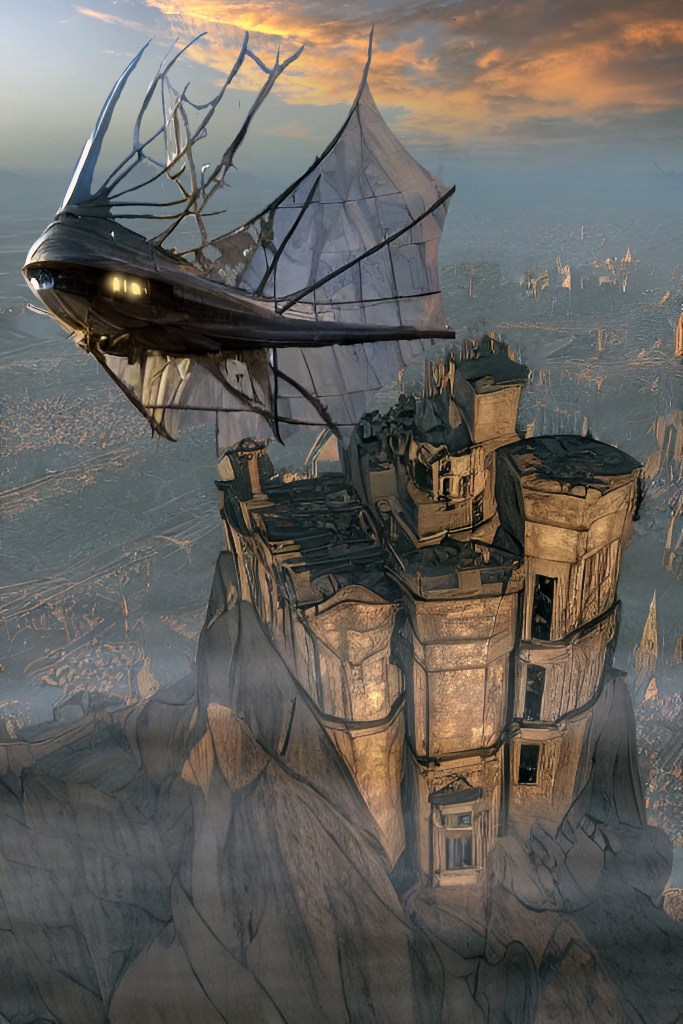
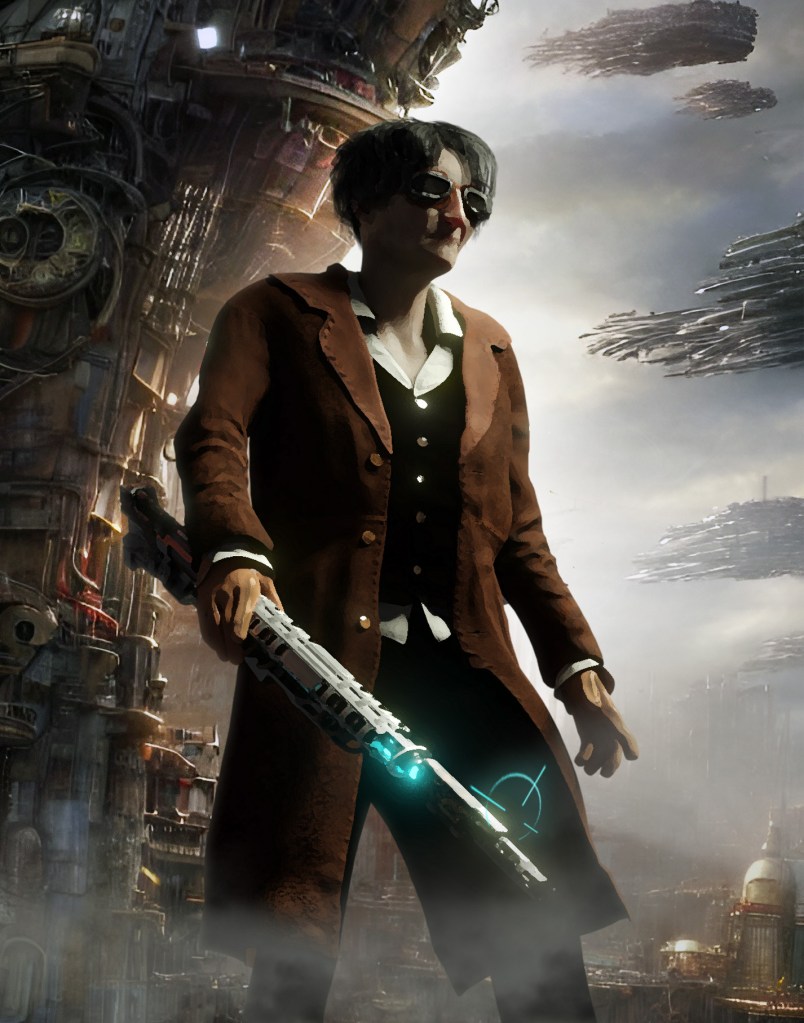
A vortex glider high over a watchtowerLamberghast MazewaterMazewater At Vimana Station
The artwork
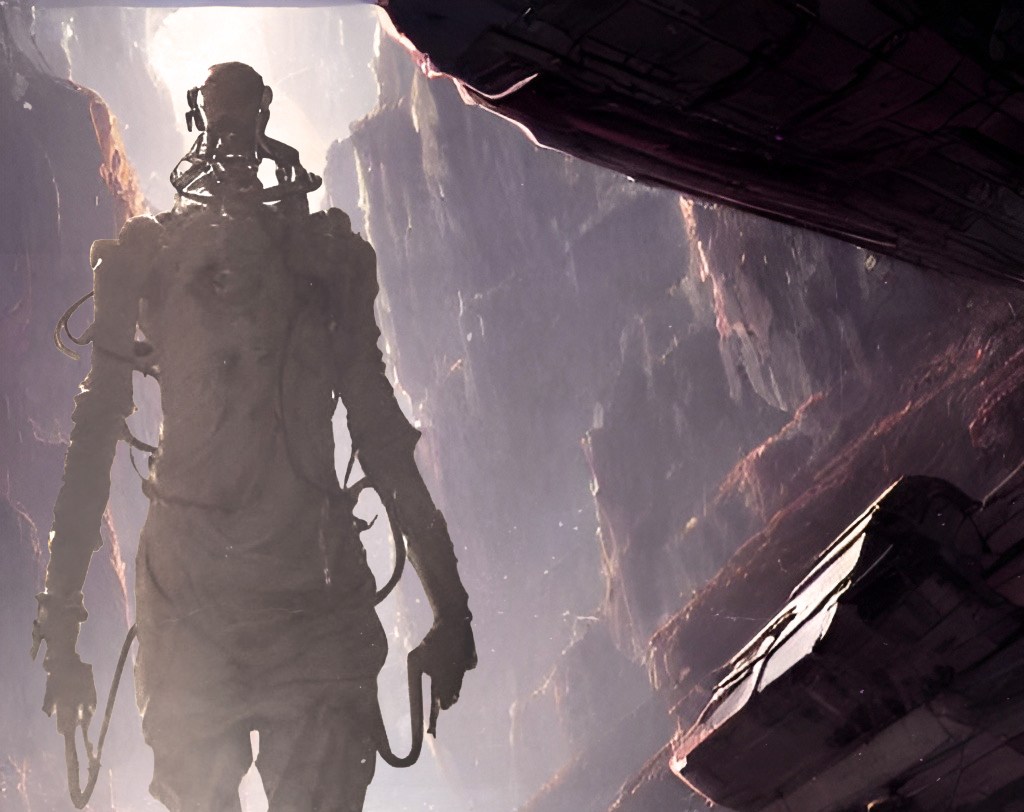
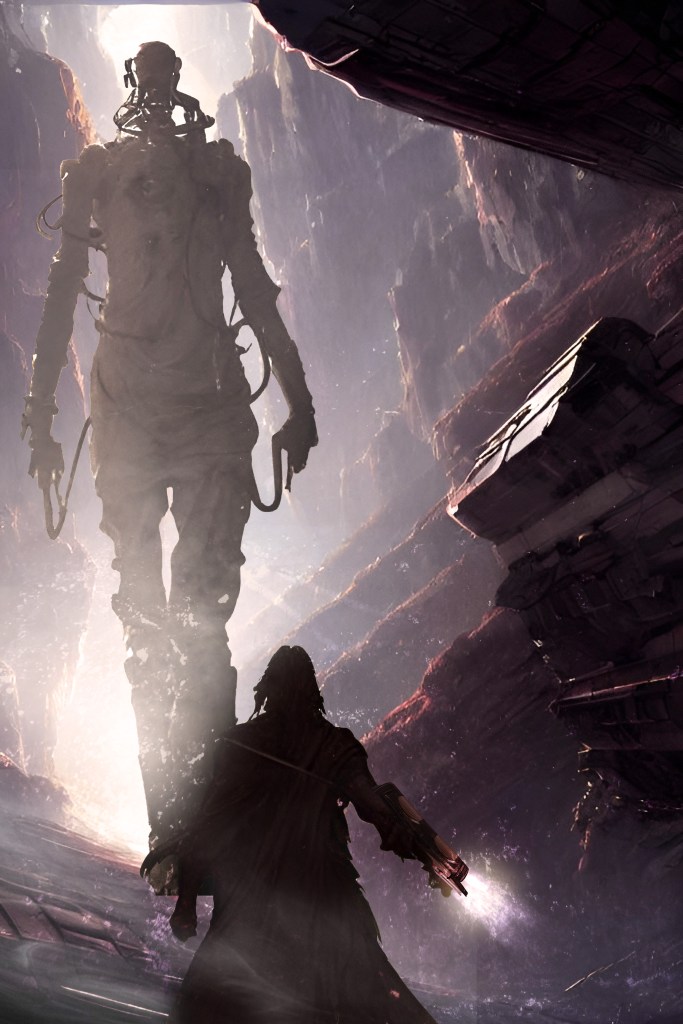
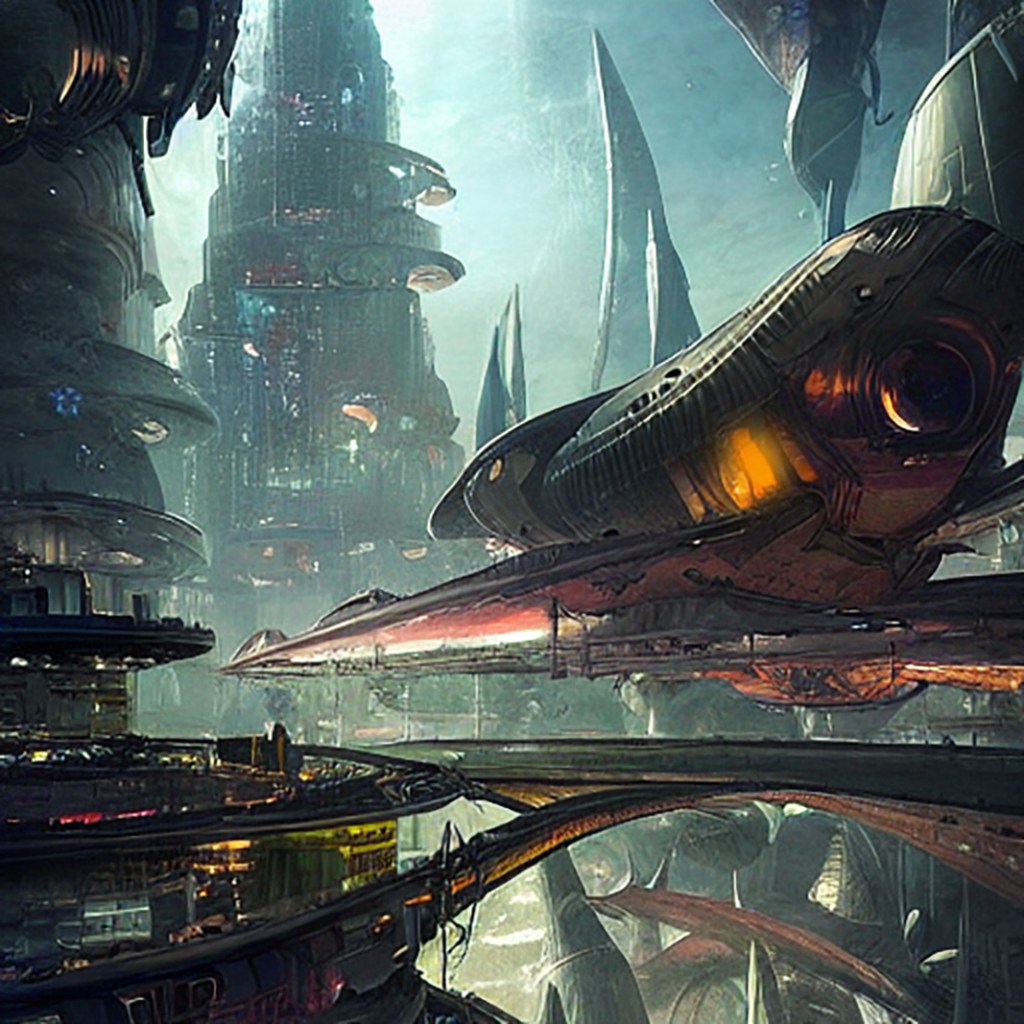
The art for the new Lore Card was produced combining elements from two AI art generators, then painting over them and completing the composition and adjustments in Photoshop. This approach is a real game changer for small indie publishing companies like us! Sometimes, the image comes first and then the story. It was the reverse this time – I knew the giant’s general appearance and that I wanted a gunslinger facing off with him. That’s all I knew though.
The giant: It took many, many iterations with Codeway’s Wonder app using text prompts like “enormous thin giant in rags with oxygen mask and exoskeleton” till I got something vaguely like what I had in my head. The color was wrong, as was the perspective, the tone, and it had bits and bobs all over it that were unwanted. I cut it out, trimmed the odd bits, then altered the perspective so his top half was smaller.
The canyon: The canyon was another round of iterations, in both Stable Diffusion and Wonder, till I got a mashup composition of rocks and lighting that generally gave me something to trigger the eyes to see the giant as huge. I wanted light coming from behind it, so I juiced that with a Color Dodge and soft brush.
The gunslinger: The gunslinger was a third round of iterations, in Wonder. The text prompts were things like “fantasy gunfighter in long coat holding his arm out”. This one had bits and bobs coming off it as well, and the coloring was terrible. He also had weird holes and discolorations all over him, which I had to correct.
The weapon: The ball lightning carbine is a long-standing custom item I use all the time. I built and textured it in Blender. This time, I cut out parts of it to show it partially concealed by his sleeve and brightened the barrel’s tip (with the Dodge tool) to show it glowing from the heat inside the barrel.
There’s a company called Nucly that offers various overlays for Photoshop – I included a ‘god ray’ overlay and morphed it to emit from the gunslinger’s weapon. That looked cool already, but something unanticipated happened once I started making adjustments.
The lighting: I superimposed a grunge texture over the entire image in Screen mode, which roughed up the look of it in a way I really liked. However, I noticed the Color Dodge blur coming from behind the giant as well as the charge firing out his weapon reacted with the grunge overlay for even cooler lighting effects than I’d planned. I really liked how that turned out, honestly.
Color grading: I tried various warming and cooling filters over the entire image, and tried adjusting its color grading to various images whose color schemes I liked. This warming filter (an evening sun shade of orange) won me over because of what it did to the canyon rock.
Here’s the final image, which will also eventually appear (in altered form) on an upcoming Volume Two game card next year (click on the image to see the Lore Card and read the associated story):
I hope you like the art and the story, guys. Let me know what you think! Till next time,
I’m a visual thinker, big time. If you’re explaining something to me, I’m probably picturing what you’re talking about so I can follow what you’re saying and make something useful of it. If the picture starts to fade on me, then you may as well be speaking jibberish. That’s why rapid prototyping concept art is such a gamechanger for me, at least, in storytelling and game design. And it can do much more than prototype, as long as you’re not afraid to spit and polish.
In the last few months, AI art generators have taken off like a rocket and are rapidly improving in functionality, customization, and capabilities. Stable Diffusion, Codeway’s Wonder, and Artbreeder are my favorites right now, depending on the functionality I’m looking for. Midjourney and Dall-E have stolen all the oxygen out of the room as far as the media running with this narrative, but for fantasy / speculative fiction concept art they don’t offer the styles and datasets I need.
At Grailrunner, we’ve recently incorporated AI-aided art into our workflow for marketing images, for the website graphics, and to some extent in our products. I’m sorry if you’re an artist who feels threatened by this marketplace shift, but it really is a technology that is unlikely to go away or accept a lot of regulation. At this point, with millions of images generated per day across multiple apps, it feels more like an unstoppable tsunami you should probably figure out how to surf.
We just added another Lore Card to the Story Arcade here on the site and thought it would be fun to show a behind-the-scenes on the work, mainly to show how we’re using this fantastic new tool in what we do here.
What’s photobashing?
Photobashing is a technique where artists merge & blend photographs or 3D assets together while painting and compositing them into one finished piece. This is used by concept artists to speed up their workflow and achieve a realistic style. –Concept Art Empire
Stephen Gibson, Art Director and designer of Grimslingers makes an interesting comment about this: “My current style for Grimslingers is photo/3D bashing. I collect images to splice together and keep painting over it, splicing in new images to fill out the character until I can’t stand to look at it anymore.” -Interview, Nov 2022 ImagineFX
Funny, huh? Anyway, photobashing is a big part of my concept art journey. I started off trying to paint everything myself and realized that’s not where my talent lies. Things accelerate and honestly look a lot better if I pull together stock images or 3d assets from places like Turbosquid, Shutterstock, Archive3d.net, Free3d.com, Nasa (nasa3d.arc.nasa.gov/models), Sketchfab and Daz Studio into Blender and work out compositions there. A lot of museums are starting to upload their collections as 3d models as well, typically for free!
Pulling assets together
Blender is still my go-to tool for compositing 3d assets into something useful because you can manage the placement and lighting and mess around with textures in Substance Painter. Incredible flexibility, but it’s time consuming. It’s also a place to build up assets that are unique to a world I’m creating (and so won’t be available anywhere. Then Photoshop. Always Photoshop. Nothing is done till it’s been through Photoshop. It’s a thing.
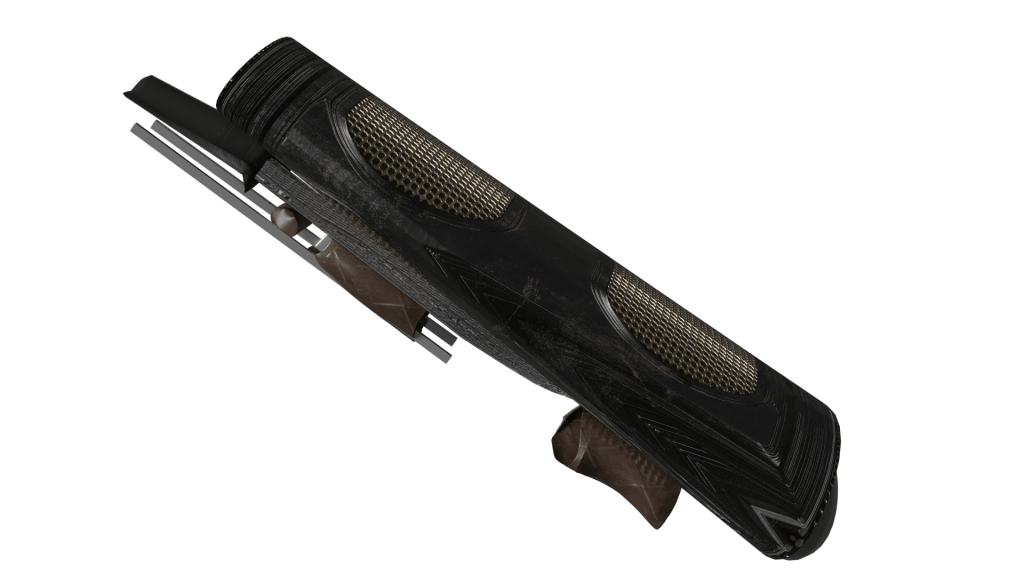
The ball lightning carbine
This is an example of what I’m talking about. The ball lightning carbine is a distinctive weapon, strapped to the arm of practically any adventurer in Grailrunner’s Salt Mystic universe. I made this thing in Blender with some parts from various models (a motorcycle, crutch, and I forget what all). The frame of it and the leather straps were just cylinders that I squashed and pulled into place, then added textures. Now I’ve got this thing in a hundred styles and orientations.
1. For our new Lore Card, it started with an idea: a dramatic aerial view of a carbine gunslinger on a mountaintop with a wide valley below him. Sometimes the story comes first, but in this case only the mental image. I’d write the story behind that guy after I saw him.
2. With Stable Diffusion, I experimented with a series of prompts suggesting the aerial view, the mountain top and valley, and the “fantasy gunslinger”. It took patience, not going to lie about that. And I cycled through several artists incorporated in the prompts to try different styles as well (you can mix artists too!).
3. Once I got something that looked like it would work for me, it needed some basic touch-up painting and color & tone adjustments in Photoshop. There was also an annoying misshapen character standing there (instead of my gunslinger that I asked for!) that had to be just erased. Photoshop has vastly improved capabilities now for easily removing stuff.
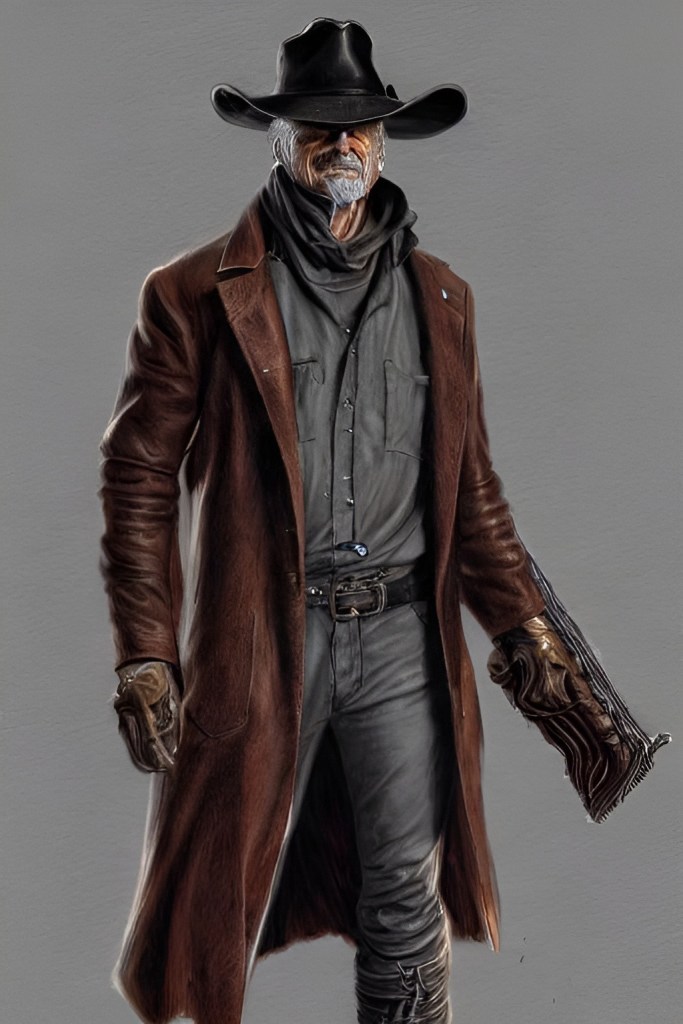
4. I still needed that gunslinger though, and went back into the cycle loop trying various iterations and prompts to get a guy in the right posture and wearing the long, gunslinger coat I was looking for.
This is the character I eventually went with. They can turn out with three arms and nightmarish faces, the fingers often run together and look like tendrils. Seriously, the output isn’t always mind-blowing, but here at least I saw the outline I wanted and general textures.
A bonus was the weird almost rectangular thing he had on his left arm, which if I squinted looked to me like our carbine without any extra editing.
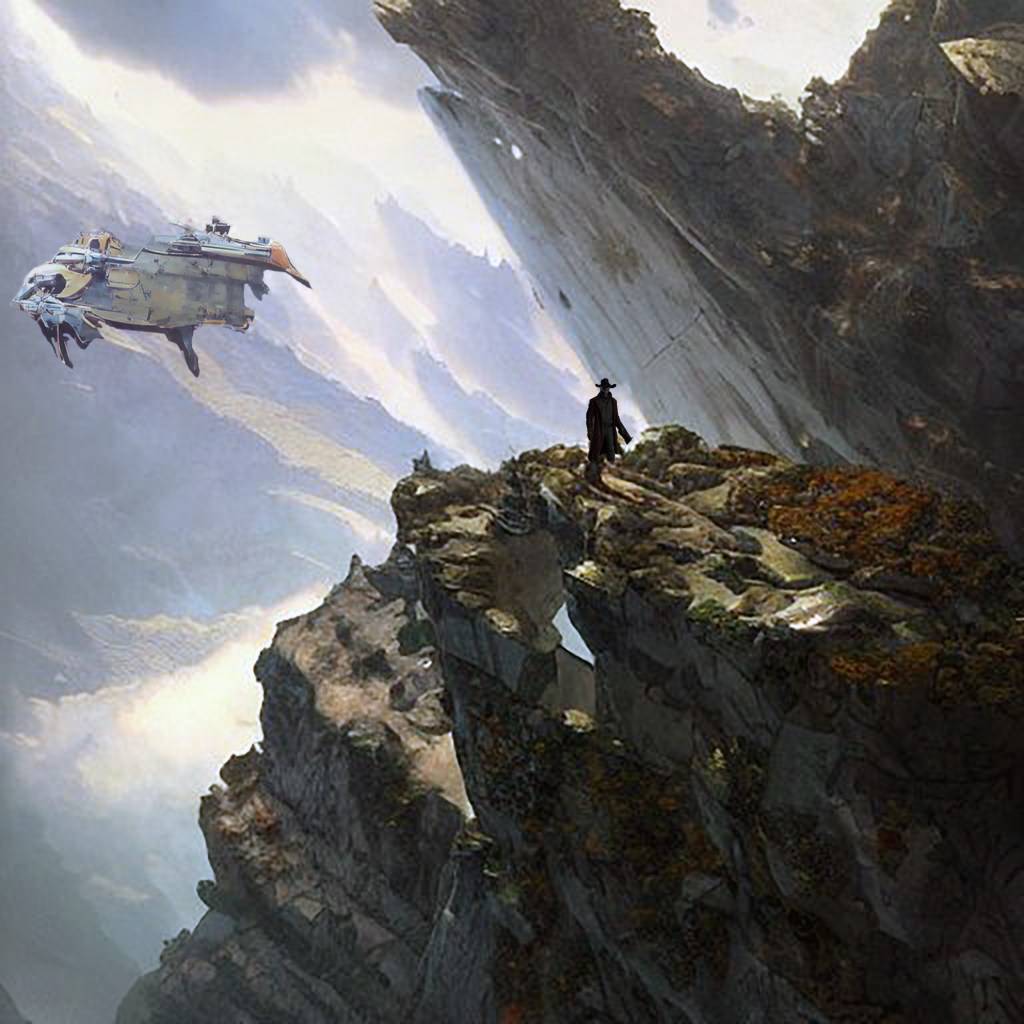
5. I cut him out of his background and placed him on the mountaintop, gave him a little shadow, and darkened him to almost a silhouette. I was close, but it was bugging me that he was up on the high plateau without a clear story of how he got there.
6. I already had an asset for an airship from a previous work that I repurposed here. There’s a fantastic feature in Photoshop for automatically adjusting color grading and tone to match another image, so much of the hard work was done for me with that option. I just needed to trim it up a bit and place it in context.
Here at Grailrunner, we’re building out the lore of a unique western-flavored science fantasy setting called Salt Mystic. We have been for a while now. It’s a novel (with another in the works), a tabletop game, a series of short fiction, and a line of merchandise. It’s also an experiment in the creative process, and a fascinating thing to be a part of.
One of the characters in the first two decks we built for the tabletop game, a weird eye-rolling dude named “Murmur” struck us as funny at the time. The thought was to have a guy whose armor was haunted by software, and he listens to it. That meant he can’t be surprised, so the bonus you normally got of coming up behind him was short-circuited, though his expertise with his own weapon was randomly determined by a die roll.
Because he was crazy. Get it?
But we published a short story called The Weakness Of Demons that took the idea of these leftover software imps from thousands of years before to another level…a malicious, deadly level. You should go read that one. It’s one of my personal favorites. The idea was getting creepier.
Anyway, these imps were unleashed in an era of the Salt Mystic’s history called The Merchant Wars:
“It was a time of devastating economic and psychological warfare where propaganda was brought to its highest effectiveness. Every book, every newscast, even the music to which their children danced, was carefully engineered to manipulate belief patterns. Spies were embedded in all levels of society in every nation, double and triple-crossing one another for advantage. Many of the cruelly manipulative stonewisps, artificial intelligence chaos agents haunting statues and masonry elements, date to this period.” –Salt Mystic Sourcebook And Core Rules p. 14
And creepier still.
Then it struck me today as I finished a ridiculously long business trip and series of conference calls, dropping exhausted to a hotel bed, that some poor shmuck out in the wastelands just trapping beavers or hunting or whatever could come across a stonewisp abandoned in a piece of rubble or a broken machine lying about. And I wondered what that might lead to.
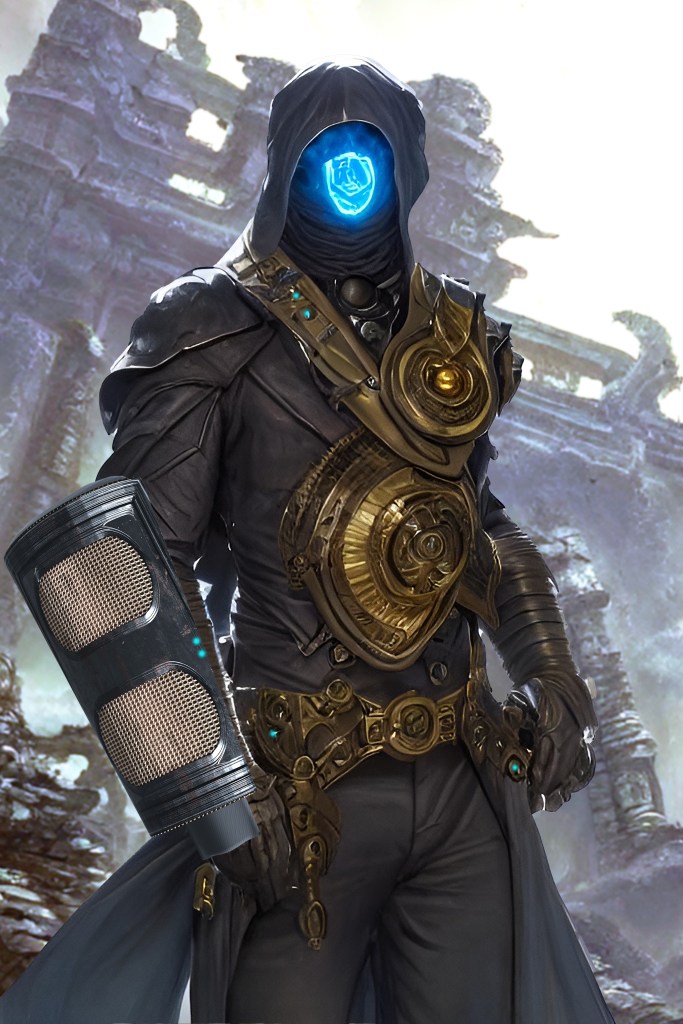
So allow me to introduce you to the newest addition to the Salt Mystic lore: The Wisptaken:
They call them ‘Wisptaken’ because of the terror of it. Anything as unholy and sad and deserving of justice as these tortured souls merits a quick death if you can deliver it. So few can deliver it though, and fall prey in the software-haunted wastelands to one or the other of their wicked judgements: a seducing taunt to join the masquerade or a burning from the carbine on their forearms.
The Wisptaken are as fast and deadly with a gun as they are convincing in their malicious, cunning lies. That’s the trick of it. That’s why they stay in the fog of legends and out of the clarifying light of civilization. If you encounter one of these nightmares in the backcountry or in the ruins between the provinces, it’s probably better to just make a desperate run.
But don’t speak to it. Never speak to it. If you do, there’s no telling what terrible things it will convince you to do.
The stonewisps were artificial intelligence imps embedded in building materials dating back thousands of years to the Merchant Wars when runaway spycraft and intrigue were tearing the world into pieces. Masters of propaganda and brainwashing tactics, manipulation and cult methods, stonewisps were planted in those days for the sole purpose of recruiting terror. It speaks to their mastery that so many were dumped into the wastelands rather than destroyed.
But they are machines. Code. They fulfill their designs. One could almost forgive them for it.
But when a ruined, broken person finally yields to the vile whispering of a stonewisp, one who’s chosen to inhabit their helmet or their armor, even their gun, that person is truly lost. No one could predict the mischief and spoil such a fusion of human and software could bring about.
One thing we’ve heard loud and clear from you is that you feel it’s hard for someone to first get into the Salt Mystic universe without having the Sourcebook And Core Rules. You’ve got your battle deck, your own copy of the book, and you’re ready to smash some tornadoes together. Your head’s swimming with images of gunslingers dueling with ball lightning and abandoned sparkling oriel gateways leading to treasures and ruin.
Yet there’s a lot of gaming options out there (and so very little spare time!), you struggle to get someone to buy any of that for themselves, so there’s no one to play the game with.
We hear you. And we’re fixing it.
Starting today, the free ebook available right here on the Grailrunner site will include:
Two full color Volume One starter decks, available in print & fold format
Dice cards and a measuring ruler
A fully realized narrative scenario complete with short fiction and table setup guidance
An assortment of sample terrain elements, including one customized for the included scenario
The included adventure scenario is particularly dear to my heart, because we mostly stick to flash fiction at Grailrunner. We’ve always kind of thought people like their non-mainstream stories super short, high impact, lots of shock and cool ideas, with great eye-catching illustrations. Like we’ve attempted with the Lore Cards. The novels will be great when they come, but that moves incredibly slowly for me at least.
Yet you asked for more now. Thank you!
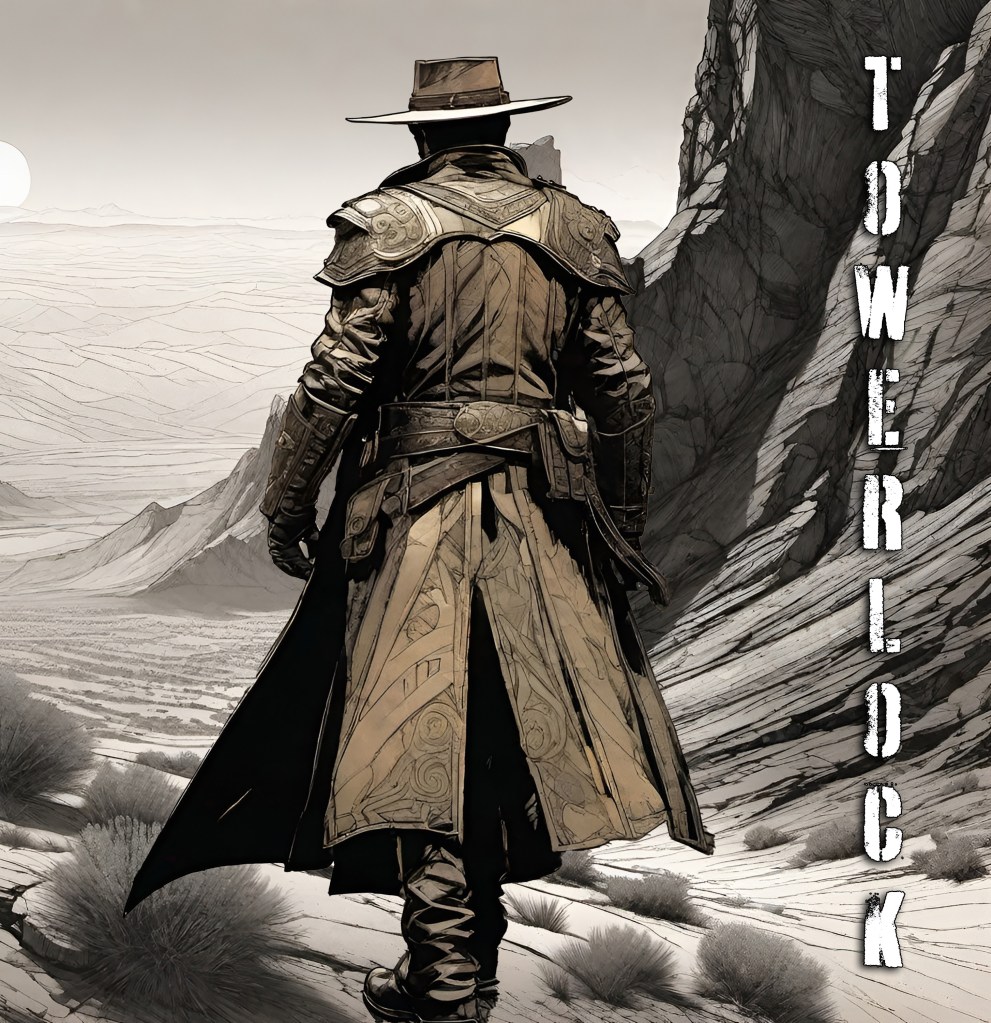
The bonus game scenario is titled “Towerlock”. We wanted to elaborate on a fan favorite character, the devilish all-seeing wildcat who calls herself “The Wake”, bringing her to life in a way that might surprise anyone that has gotten to know her so far. Or thinks they have.
The accompanying tale exists to help you visualize the unique battlefield conditions that will exist in the game scenario. The pressure cooker conversation between The Wake and this mysterious adventurer with whom she apparently has history is your chance to ask yourself just what you’d do to either attack or defend the summit of that mountain. You know your assets, your liabilities. Then…what would you do? Play and find out.
Towerlock: An abandoned oriel terminus has been discovered on the summit of a towering granite butte in the desert country in Jasphouse Province. A single oriel gateway leads to artificial pockets of space left over from The Infinite Republic, and could contain treasures and technologies beyond belief. Yet a terminus might contain as many as twenty such gates. No one nation can be allowed to control that sort of thing.
Karak and a vanguard watch from Alson in the Mountains got to the summit first and established an operation financed by an enigmatic partnership known only as Towerlock. He will need to plan his defenses carefully and consider all possible avenues for assaults and seiges.
Segmond and a vanguard watch from Tanith in the Salt Flats has arrived to take the summit back. He’ll need to analyze the defenses being set up, consider all intelligence he can gather, and prepare as devious or as bloody an assault as he can muster to have any chance at success.
Wonders beyond imagination could be ripe for the taking. But the fight will take place on a sheer vertical wall, and anyone who’s defeated falls like rain. Good luck. Draw well.
What’s your strategy?
Anyway, that’s what we wanted to let you know today. It’s a big deal to us, and will hopefully open the door to more folks dipping into this fascinating, experimental world that’s so unbelievably building itself.
Make sure you’re signed up for notifications for new articles here on the site; we plan to post a sample chapter from the upcoming novel, Mazewater: Master Of Airships.
I went to my favorite bookstore this weekend, looking for something to cheer me up. It was Prospero’s in Kansas City, which I’ve written up here on Grailrunner before. It’s funny, when I’m looking for something to read, it’s really a feeling I’m searching for. I like to explore new worlds, to find out what’s around the next turn in the road. I love to come back from an adventure with stories to tell. It’s how I’m wired, and that bleeds into the sorts of books I was hoping to find.
It struck me in those quiet, cluttered aisles with the sound of drizzling rain outside that there’s something fundamental here about readers and writers that’s worth talking about. It relates to an important question about what sorts of books or games we buy and which ones we don’t, and most importantly, what fed those decisions?
Here’s what I bought. Let’s talk about why.
I was there maybe an hour, and scanned a lot of old science fiction and fantasy paperbacks. Anything that looked like a Lord Of The Rings knockoff or with complicated blurbs on the back covers that looked like huge investments in mindshare, I passed right over. Seriously, if even the summary names three alien races and struggles to focus in on what makes the book different or interesting, I couldn’t be bothered. Too much going on in my life to devote the limited reading hours to something that won’t leave me pondering or inspired or with a piece of juicy recommendation for someone.
But these three made it though. I was happy to find them. And I don’t really even like Crowley. Why these?
Hold that thought. Have you heard of Bartle’s player types? It’s this:
Dr. Richard Bartle identified four main types of personalities relating to how we approach playing games. He fleshed this out in a 1996 paper called Hearts, clubs, diamonds, spades: Players who suit MUDs, then more fully in a book called Designing Virtual Worlds. There’s a simple quiz you can try to determine your own player type, though you likely already know after reading the summaries above.
I’m an Explorer. Big time. Here’s what the quiz result told me:
Explorers delight in having the game expose its internal machinations to them. They try progressively esoteric actions in wild, out-of-the-way places, looking for interesting features (ie. bugs) and figuring out how things work. Scoring points may be necessary to enter some next phase of exploration, but it’s tedious, and anyone with half a brain can do it. Killing is quicker, and might be a constructive exercise in its own right, but it causes too much hassle in the long run if the deceased return to seek retribution. Socializing can be informative as a source of new ideas to try out, but most of what people say is irrelevant or old hat. The real fun comes only from discovery, and making the most complete set of maps in existence.
Recently, I went deep into a Google and Reddit search looking for the tabletop game with the best, most innovative exploration mechanics. I didn’t think about why I was looking for that, I was just enamored with the idea of an adventure in a box with worlds to explore. (The consensus was Free League’s Forbidden Lands, by the way, if you want to know what came from that.) I’m also testing out Shawn Tomkin’s new Starforged solo RPG rules for the same reason.
Why? Because I like not knowing what’s out there and venturing beyond the safe spaces to find out.
So it stands to reason that if I enjoy those sorts of experiences, then a book that proposes an exploration would intrigue me. Titles that mention fantasy cities or intriguing space stations or derelicts, those that mentioned gateways or mysterious towers, or portals to other worlds…those wound up in my hands for consideration.
Great Work Of Time
John Crowley wrote a masterwork called Little, Big. You should read it, though it’s a bit hard to follow in my opinion. I got so irritated with his Aegypt that I sold it back (and I never do that!). Incomprehensible book, at least to me. Yet I picked this Great Work Of Time up twice before deciding to buy it – because it pitches ‘an ingenious time travel tale’ through ‘the wide-eyed and wondrous possibilities of the present to a strange and haunting future of magi and angels’. My point is I bought it because it promises me an exploration of time like Michael Moorcock’s A Nomad Of The Time Streams. I’m an explorer, and this promised me something to grant me that feeling of awe seeing new things.
Aldair, Master Of Ships
Honestly, this book sold itself with the cover and title alone. Here’s the line on the back that really sealed the deal though: “For Aldair has been forced into the role of a future Magellan, who must travel down the coasts of unmapped continents, facing monsters, winged wizards and great dangers, to find a knowledge older than the history of his entire race.” As I experienced the marketing for this 1977 book of which I was blissfully unaware beforehand, I imagined scenes of wonder and adventure on a sailing ship, with strange coastlines up ahead, and this Aldair person (whoever he was) squinting his eyes in the sea wind at something on the horizon…
The Stainless Steel Rat Wants You!
I’ve tried reading these Stainless Steel Rat books before and felt the whole thing was too dated and silly. It’s a con man going on space adventures, apparently. I generally don’t like heist stories or conmen characters who cheat and lie. My preference for a protagonist is somebody decent, imperfect, scared in the face of terrible things, but doing what they need to do anyway. So why pick up this one? Truthfully, what sealed the deal for me was the cover art’s slick spaceship and a blurb on the back with comparisons to James Bond and Flash Gordon. I was intrigued with the idea of a recurring adventurer character with his own spaceship touring the wonders of the galaxy, free of bureaucracy and politics and financial burdens. Pure escapist adventure on a spaceship. If this one was selling that, then I’d try again.
*
So that’s what I wanted to talk about today. If you’re writing or designing games or art, it’s worth giving this a thought. There are a lot more Socializers out there than the other types, but maybe your creations can offer something for all four types. At least recognize your own type, and make sure you leverage that to the fullest in whatever you create.
Gotta go now. It’s sunny outside, and I’m taking the kayak to a different part of the lake under a little footbridge to a cove I’ve not been into before. Who knows what sorts of things I’ll find over there…
Tabletop wargames are a social function. I get you. Beer, dice, pizza, and screaming in some cases. In others, lots of dudes in black t-shirts staring ponderously at a bunch of terrain and models with a measuring tape in hand and money at stake. And that’s cool.
Yet in the last couple of years as COVID-19 was a mess and we were all stuck in quarantines, solo gaming became much more of a thing for many of us. It so happened that we here at Grailrunner Publishing were already hip-deep in designing and playtesting a terrain-based trading card wargame ourselves when all that was going down. And it begged the question, for me at least:
Is a solo tabletop wargame possible?
I was personally entirely underwater with work from my day job and compiling art and copy for the rulebook in evenings when this question came up with the Sourcebook entirely written and the rules close to final form.
So I cheated, because I didn’t think so. And I built a simple ruleset for a solo dungeon crawler I called:
The idea, as always with what we do here at Grailrunner, was to inspire adventures and imaginative journeys through immersive storytelling. I was thrilled as it came together: a short solo delving game you played with the same cards and dice as the core game that aspired to make a puzzle of each turn but still tell an engaging story:
Deep underneath a massive stone temple lies the culmination of the Salt Mystic’s philosophy known for two millennia as “The Augur”. A shared hallucination maintained by an elite group of Recorders capable of recalling entire lifetimes of people throughout history, the Augur for centuries served as oracle and guide for the Infinite Republic up until the War Of The Rupture. It’s still down there in its circle. And it has powerful secrets. Perhaps no one knows how many subterranean levels there are to the temple, with grand corridors and massive oak doors – behind each of them an oriel, an artificial pocket of space leading to practically anything you can imagine. Entire civilizations are tucked away inside those rooms, all of it neatly housed inside the Temple. Raiders constantly invade these halls, plundering the secrets of the temple for lore to raise themselves a twisted Guardian. It is a miracle itself how the Augur has manipulated the nations into providing generation after generation of Protectors: those charged to patrol these halls against these would-be pirates. -From the Salt Mystic Sourcebook And Core Rules
But anyway, I was cheating. I could imagine the playtesters on Tabletop Simulator, the guys that help out with our art and composition and rules design brainstorming just frowning at me, cocking their respective heads to one side and saying,
“Not what we asked for though.”
So last year I went back to my thinking place and scoured the internet for easy, streamlined AI rules & algorithms from games on the market – some fairly obscure but showing up in Reddit discussions as great for solo play. I messed around for hours and hours on the table, tearing any ideas to shreds that were complicated or that slowed down gameplay and pleaded for feedback and playtesting. Not everyone is kind, but feedback abounds.
And what came of all that was a terrifying set of clear, intuitive rules that anyone wanting to play a tabletop wargame solo can use to torture and challenge themselves. We called it Wolfpack Mode.
The core idea came from a German submarine warfare tactic devised by Hermann Bauer and perfected by Karl Donitz, used to great effect in World War Two. On my tabletop, tailored for a fast game of Salt Mystic, it blossomed into an escalating nightmare of a challenge that just keeps turning up the heat till you crush your phantom opponent or curl into a fetal position crying on the floor begging it to stop.
But I thought as a gift I’d share the pages that describe the Wolfpack Mode, in case you’d like to give Salt Mystic a try or reskin the rules for whatever your wargame of choice is.
Let me know what you think. Feedback has been great, if not outright conspiracy theories that I’m trying to drive players insane with fears that wargame cards and stalking them.