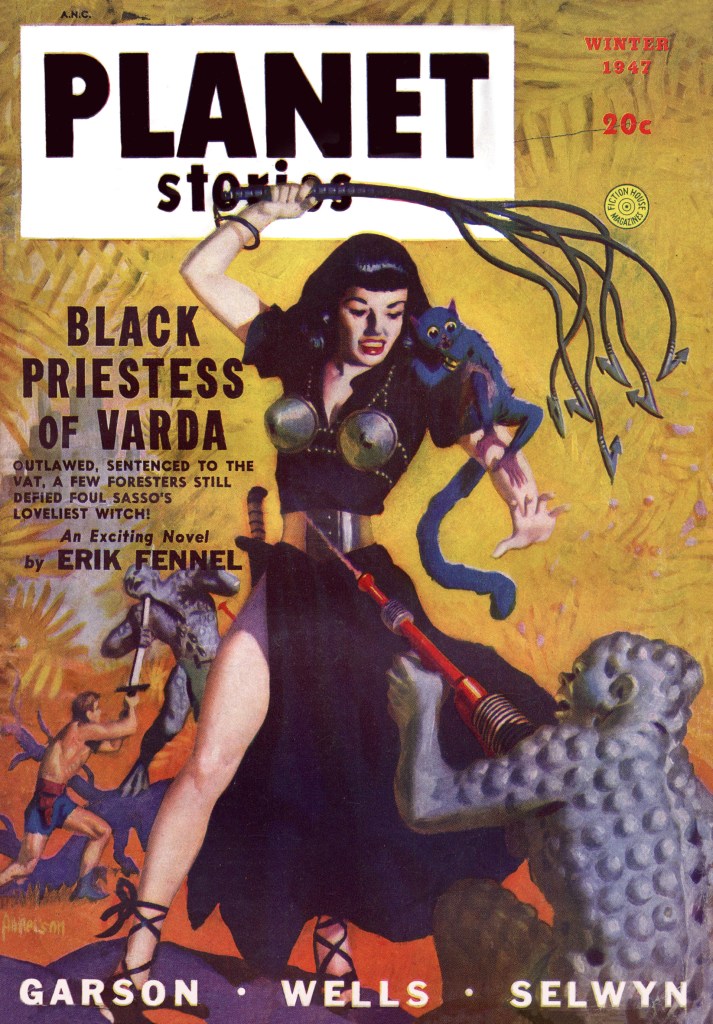
If you’re at all a bit tired of politics and agendas driving science fiction today, you might take a dip into the old 30’s and 40’s pulps sometime and take a breath of fresh air. Just set aside any ideas of scientific accuracy – this is all just high octane, adrenalin-infused imagination to keep your engines running clean! I honestly love it. Case in point: Erik Fennel’s Black Priestess Of Varda, from the Winter 1947 issue of Planet Stories.
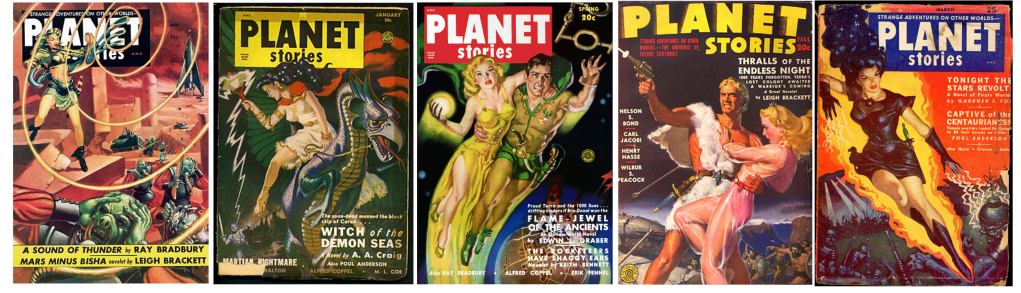
Planet Stories was an American pulp science fiction magazine published by Fiction House, based in New York. It ran between November 1939 to May 1955 for a total of 71 issues. This one’s among my go-to pulp fixes just because its covers almost always deliver – and by that, I mean they’re intriguing and striking and would practically all look great on a T-shirt. If you’re offended by mild sexism even despite a consideration of the times in which the works were published, then this article probably isn’t for you. I’m just in this for the fun of it, and how innovative and free of constraints these writers and artists were. I love the feeling of unbounded optimism and adventure these people brought to the table!
I would also add that, though the covers often show the ladies in these stories as helpless but pretty mops waiting on men to save them, it’s almost never that case in the stories themselves. Herein, you’ll find powerful, intelligent and courageous women. Thought I’d mention that, if it’s a reason you might stay away from these old gems.
For example, my wife and I are finally making our way through all 5 seasons of the HBO show, The Wire. It’s as good as I’ve always been told, and some of the finest writing I’ve ever seen. No doubt in my mind – this should be the standard for how to juggle multiple character arcs and portray in fiction how different agendas among even minor characters can drive the narrative. That isn’t my point today, but there you go.
Anyway, we started season 4 last night. I idly picked up my phone to just troll through some pulp covers for inspiration, thinking I might work up some art for the Salt Mystic marketing over the weekend. And I came across that bad boy at the header of this post. “The Black Priestess Of Varda”. What a nutty title. “Outlawed, sentenced to the vat”…”foul Sasso’s loveliest witch”. Crazy. It sends your mind reeling. At least mine. Totally lost track of the Wire episode and tracked down an electronic copy of the 1947 issue in which Erik Fennel’s story was originally published. The entire issue is linked above, or here it is in a combined pdf:
It’s the rollicking tale of a disfigured scientist, finding himself in a strange world and discovering the black heart of his once love. He finds redemption and a new love, and develops incredible new powers. Yet most of all, he finds the inner strength and courage to fight back against wickedness in all its forms, no matter how beautiful.
I worry that in our collective zeal among modern fiction to present social injustices, to drive activism and try to awaken social action among readers by unrefined and almost silly victimhood portrayed in caricature fashion – bad cops, racists, cruel landlords, selfish politicians, blah blah blah…that we’re losing the ability to make people dream and aspire. People like Erik Fennel, whoever he was, preciously crafted colorful worlds spun with action and heart to get his young readers to dream. That’s why the little guys slapped down their quarters at the newsstand as soon as they could to rush home or to the playground and blast through the latest Planet Stories, or magazines like it. They wanted to dream and feel powerful, to learn what it means to stand up to bullies and terrifying challenges like they were seeing in the real world and that many lost their fathers to. This was a place to see courage and to emulate it. And it was a place to be inspired.
Hey, go read this one or another in Planet Stories. Will take you maybe an hour after you download it. An easy read.
But maybe an important one.
I don’t know, guys. What do you think? Is there enough out there on the racks or Amazon to feed your own imagination? Send me your own thoughts on the most inspiring stuff you’re seeing. I’d appreciate it.
The wheels turn slowly, my friends. But they do turn. We’re making glacial headway on the tabletop game we’ve been talking about for a couple of years now – but in recent days, some exciting things have been happening!
If you’re a visitor, welcome! I’ve got a gift for you. Download the basic ruleset for an introduction and overview, to get some cool ideas on how this bad-boy will start cranking once it’s up and running to tell some gosh-a-mighty, romping, stomping tales of science fictiony goodness.
Proofs of the deluxe version of the Core Rules And Sourcebook have come in, and we weren’t happy with the color and print quality. The cover looked great, but some of the textured pages were a bit muddy. We’re also including two starter decks and some papercraft terrain you can pull out and play with immediately – those need to pop in clarity and brightness more than we were seeing with the proofs. So we’ve beefed up to a higher print quality standard and are waiting on the second round of proofs on that.
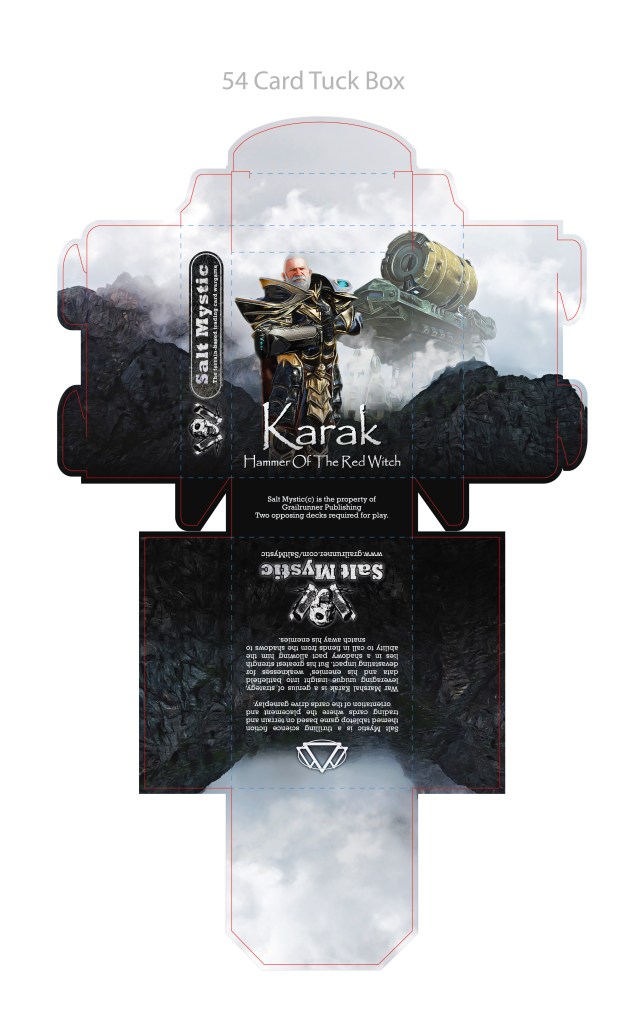
The game is played with tremendous flexibility, including different War Marshal decks you can begin with, and customize from there. Those guys needed their own tuck boxes. We approved the first design, and the proof arrives any day. This guy here:
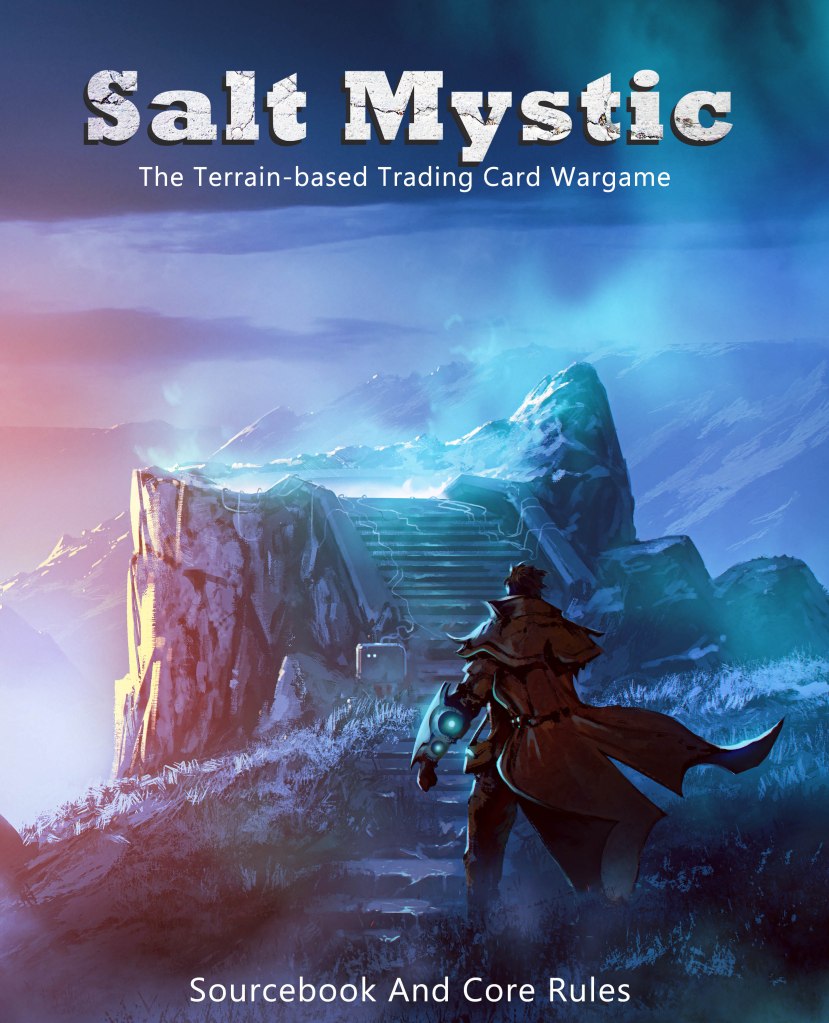
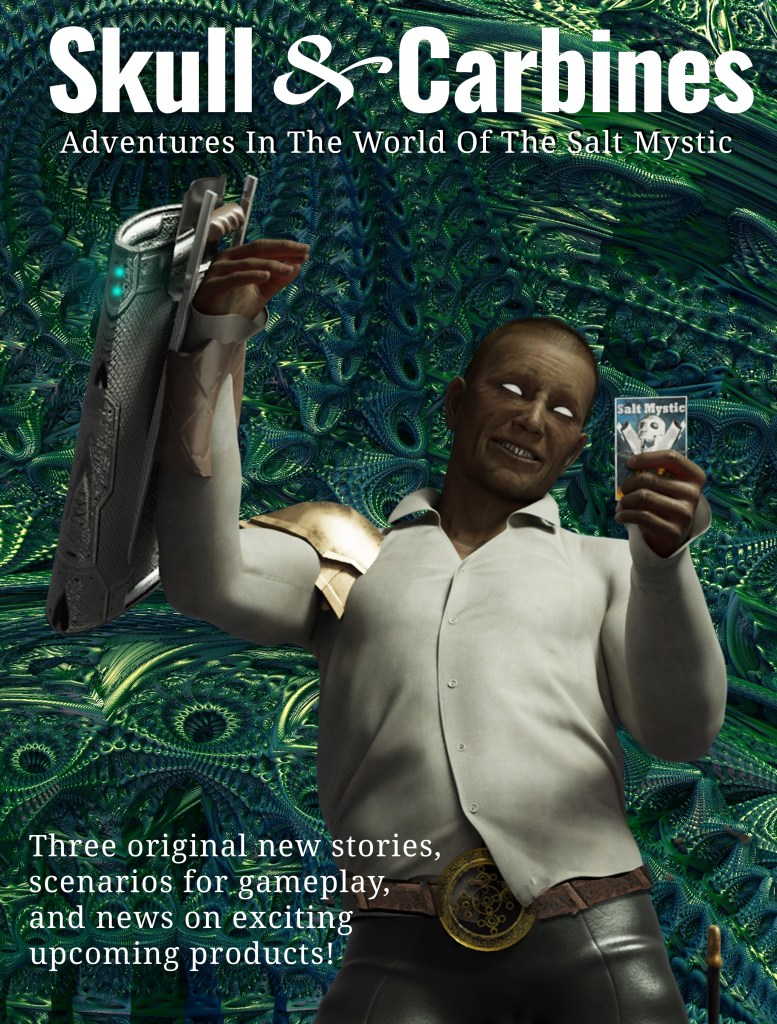
We also got a head start on the quarterly (hopefully quarterly!) digital magazine which will serve as sounding board and announcement central for upcoming products (like the terrain tile deck we started working on and can hopefully be ready before year-end). Here’s a draft for the potential cover of issue one – let us know what you think!
I started writing the feature story for the first ish, with a scheme of introducing some of the key characters and framing out a narrative scenario you could immediately set up and play after you read it…to see how you’d handle the situation. Could be in two-player mode or solo. We’ve gotten some great feedback on the playtesting for solo play, which we refer to as Wolfpack Mode. It seems even after quarantines have mostly lifted, people are super interested in solo play these days. That’s great, and hopefully we can make that as shifting and challenging as the regular one-on-one version.
Man, I wish this was a full time gig and we could just sit around writing stories and dreaming up worlds for a living! But bills to pay, and kids to raise, my friends. If you’d like to volunteer to help out, or submit any stories or art for consideration, feel free to reach out either here or emailing me directly (brian (at) grailrunner.com). We’d love to grow the family.
I hope you’re doing well, guys. Shoot me any questions or suggestions you have. Happy to connect. Till next time,
My dad told me once that if I ever see a book I think I might like in a bookstore, but that I’m waffling on, that I should probably just get it. That I’ll regret it otherwise and will be miserable. Generally, that’s about right. But I have a different point to make just now, about inspiration (with a little nostalgia to fire the magic). Hear me out on this.
There’s a cluttered, winding bookshop in Kansas City called Prospero’s…a place of winding stairs, creaking wooden floors chocked in every nook with old books on three floors. Here, this place:
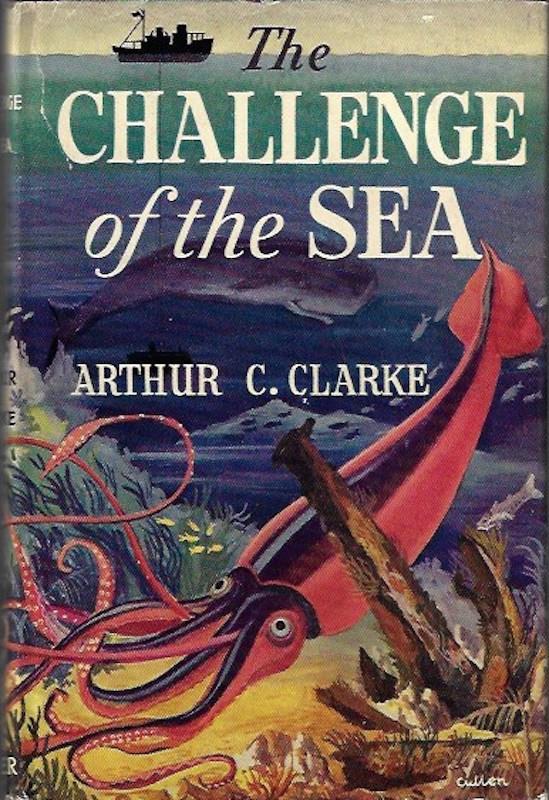
I was sitting in a small cranny perusing science fiction paperbacks from the 70’s and came across this little book from Arthur Clarke:
I shouldn’t have cared. I mean, there’s probably no writer who’s influenced me…who’s meant more to me…than Arthur Clarke. I adored this man. A marvel of imagination and curiosity! Seriously, he was incandescent. I wanted to hitch a ride on some kind of ship and just go hang out with him on Sri Lanka back in the day. But this was clearly a book aimed at young readers, with simple style and dated back to 1960. I flipped through it a few times, considered it too simple and not what I was looking for, with obsolete science and no fiction.
So I put it back on the shelf.
I went back to it before leaving, having found nothing else I wanted. Flipped through the faded pages again. There was a line at the register upstairs. I could hear the voices upstairs and the creaking floor, the busy commerce. I didn’t feel like waiting, so I left the book there on the shelf.
But it got me thinking about sparkling oceans and shining futures of busy aquanauts living under the sea. It reminded me of one of his great novels, The Deep Range where a broken astronaut finds redemption in a beautiful life harvesting bounty from the ocean, wrangling whales, and adventuring in his submersible. It reminded me of his other novel, Dolphin Island wherein a future lab is learning to speak the language of dolphins. It got me thinking about the beautiful people at Coral Restoration Foundation in Key Largo, FL where I stopped in recently to tell them I was a LinkedIn groupie from Kansas City eagerly following their critical work growing and replanting new coral to preserve our reefs for future generations…
…which led me to a fantastic documentary series on Discovery+ now called Oceans, where more beautiful people are studying the coral and other sea life to find the keys of preserving them. That’s one that’s worth your time, without all the preaching and guilt Attenborough throws at you these days, and a focus on the beauty and WHY we should care about this sort of thing. Then in one episode of that series, they pay a visit to an undersea habitat from the 1960’s where Jacques Cousteau apparently had people living on the seafloor.
What? Living on the seafloor? (That’s what I was thinking when I saw that one.)
And here’s the documentary that led me to, an Academy Award winner from 1964 called World Without Sun. Sure enough, there’s Jacques Cousteau, the guy who basically invented scuba diving, leading a group of dudes who inhabited an undersea complex for a month. I know it’s dated, but you really should skim through the documentary at that link. I mean, they’re darting down in a submersible to a garage, popping up into a little habitat where they’re having breakfast, hanging out, and freaking smoking pipes. One dude after breakfast just hops down quickly into a small pool in the floor and is immediately on the seafloor at 30 feet with no scuba gear….just to cool off and see what the fish were up to!
Seriously now, my head is just swimming with images of shining future sea-cities and seafloor complexes. I included glimpses of such things in last year’s short fiction collection, Kyot: The Storybook Puzzle Box but I’m firing up on all cylinders now at the possibilities. I even found a new spot to go kayaking from this, a little cove at Black Hoof Lake where I found a gorgeous cluster of mossy plants and waterlillies alive with little fish pecking off their lunches. It’s the kind of thing that Arthur Clarke always does to me – sends my imagination reeling into what could be. His head was full of stars, and it’s contagious.
And I didn’t even buy that old book.
I wonder if I had, would it have come off as just stale and naïve, as simplistic cartoon descriptions of obvious and outdated science? Would I still have this electric sense of possibilities of the future of the ocean if I was making my way through a youth-oriented science book from 1960? Likely not.
And I suppose that’s the magic of a delicious sauce of nostalgia and imagination. Arthur Clarke and Jacques Cousteau. Weird how those two wound up swimming around in my head today.
Hope that made you smile a bit. Till next time, guys.
“Edgar Rice Burroughs was, and is, the most influential writer, bar none, of our century.” –Ray Bradbury
If we could just stop letting cultural baggage ruin our science fiction, we’d have a lot more fun. And we could go back to being inspired by it, and building a better world and whatnot.
Unfortunately, we’re all activists now, and we get offended quite easily. We focus on a scavenger hunt to dredge all the things from older fiction and movies that are unacceptable now, but which were commonplace in the times in which those things were written – and we lose sight of ourselves in the process. We emphasize the divisions rather than the commonalities. Which brings me to Edgar Rice Burroughs’ Barsoom books, featuring John Carter Of Mars.
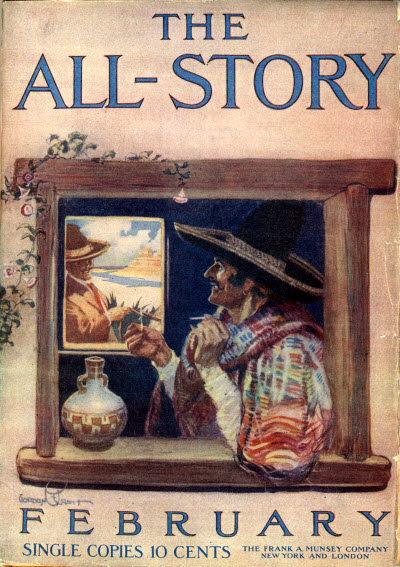
Let’s say it’s February 1912 and you stroll up to a magazine rack at a busy street corner somewhere, like this one…
…and pick up the latest All-Story Magazine. This one here:
There’s a quirky story in there called Under The Moons Of Mars by some guy named Norman Bean (a pseudonym; it’s said he typed ‘normal bean’ – as in ‘not insane’, but his typesetter messed it up). I don’t know how it wouldn’t command your attention if you were at all an explorer, a dreamer, an adventurer at heart born in the wrong time and place for your imaginings. It’s white-hot lightning on paper, and it changed the world. I like to think you’d have sensed that might happen after reading those six installments, finishing in the July issue.
Let’s just ignore the 2012 Disney film supposedly based on the first novel because it’s terrible. I’m sorry if you loved it. That’s just my opinion based on how convoluted and boring it was – not because it doesn’t follow the books. Though it doesn’t really. I’m talking about that mesmerizing set of pulp novels that came from the same mind that created Tarzan: Lord Of The Apes. These John Carter Of Mars books brought us airships and space princesses, swashbuckling space action, telepathy and psychic powers, evil green aliens and more. It’s crazy, reading them now, just how many people who came later were inspired by things they found in these books…people and tropes you’ve heard of but didn’t know their origin. I’m talking about even things like exotic sci-fi character names and settings like dried-up seabeds, dying cities with lost technology. He dreamed those things up and blazed an incandescent trail others followed – others like Arthur C. Clarke, Robert Heinlein, Ray Bradbury, Leigh Brackett, H.P. Lovecraft, Alan Moore, James Cameron, J. Michael Straczynski, and George Lucas. And others, man! Plenty of others.
“I knew nothing about the technique of story writing…I had never met an editor, or an author or a publisher. I had no idea of how to submit a story or what I could expect in payment. Had I known anything about it at all I would never have thought of submitting half a novel; but that is what I did.
Thomas Newell Metcalf, who was then editor of The All-Story magazine, published by Munsey, wrote me that he liked the first half of a story I had sent him, and if the second half was as good he thought he might use it. Had he not given me this encouragement, I would never have finished the story, and my writing career would have been at an end, since l was not writing because of any urge to write, nor for any particular love of writing. l was writing because I had a wife and two babies, a combination which does not work well without money.
I finished the second half of the story, and got $400 for the manuscript, which at that time included all serial rights. The check was the first big event in my life. No amount of money today could possibly give me the thrill that first $400 check gave me.
My first story was entitled, Dejah Thoris, Princess of Mars. Metcalf changed it to Under the Moons of Mars. It was later published in book form as A Princess of Mars.”
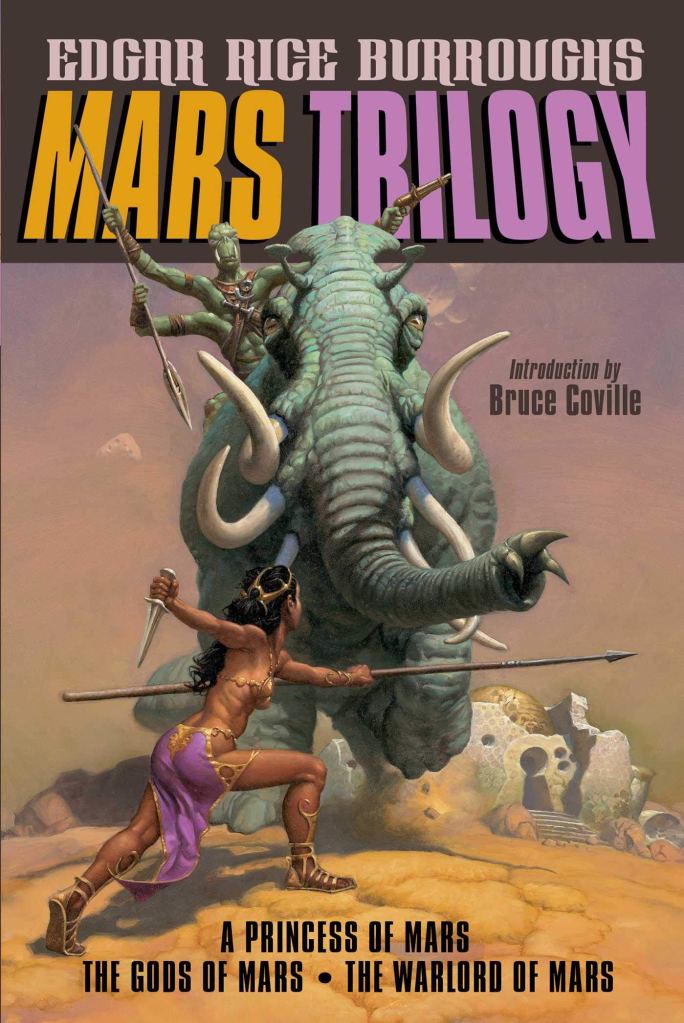
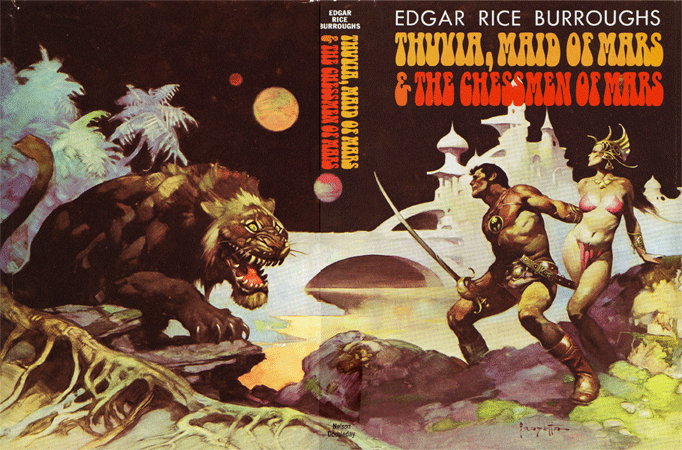
It may be in this cynical, political age that images like the ones below hang some people up. “There’s just another invincible white dude swinging a sword, treating his woman like property and being racist!” But that isn’t it at all. John Carter just tries to do the right thing – nothing is handed to him. He had a hard life and knows how to handle himself. Good things happen to him in the end because he never gives up, no matter how frightened he gets. He just follows a code of conduct and sticks to his word. We’re not allowed heroes as much these days – isn’t it okay to have a strong male lead who tries to do good things?
And Dejah Thoris, the original space princess, isn’t dumb or a piece of wallpaper. She’s noble and brilliant, a strong inspiration to her people and considered the finest of her race. There’s no need to try and make her a scientist or technological genius in a misguided attempt to update her character – the woman is nobility itself, and she shines like it. It’s okay for a woman to fall in love with a brave man who’s trying to help her. That doesn’t demean her or make less of her.
The John Carter Of Mars books are worthy of your time. They’re incredible inspirations and true works of genius. Why not pick up the first three books in the compilation by Gallery / Saga Press here on Amazon. My suggestion is just keep an open mind, remember that what you’re reading came long before almost any science fiction with which you’re familiar, and consider just what an outlandishly brilliant masterpiece these stories are considering so little came to pave the way beforehand.
Let us know what you think – we’d love to geek out with you on this.
I know, man. Anybody trying to figure out what Grailrunner Publishing is all about must get dizzy skimming through these eclectic articles ranging from wargames to popular fiction and movie reviews, and begging for graphic design advice. But check out the nametag – we simply seek to inspire.
Dreams are engines. Be fuel.
That’s the point of us…giving people building blocks and inspiration to escape everyday life and politics and digital propaganda and to just be happy and dream. So today it’s a psychological model analyzing how they make certain products addictive. Crazy, right? Our hope is you dig this book and its HOOKed model, see how it might help you design something you’re building or thinking about, and that you thrive in that. But use your new powers for good, not evil. Cool?
For us, we’re putting out science fiction books and a tabletop wargame line with a branded merchandise line. It will help to have something concrete to think about as we learn this model from Nir Eyal, as described in Hooked: How To Build Habit-Forming Products. What this model offers is a way of thinking about WHY we engage with products at all, what triggers us throughout our day or week to go back to those products, and why we keep going back…or frightfully, why we might NOT return to those products.
1 & 2: Internal & External Triggers
Check out the diagram at the top of this article. It’s a loop – hopefully you see that. Starts at 1, with an internal trigger. One clear example Eyal gives is a fitness app where the designers latched onto that awkward moment when you might step into a gym or workout room and not really know what to do…which machine to go to. If you’re uncomfortable enough, you might even connect that ‘dumb’ or ‘confused’ feeling with the act of going to the gym and just stop going. That’s an internal trigger – the feeling of wanting to know what to do.
A buddy of mine told me once the hardest part for him in quitting smoking wasn’t the nicotine or taste, it was the social aspect of going out to the smoke pad at the top of the hour and networking with people…hearing all the gossip from all levels of the company. For him, the internal trigger was the top of the hour and that itch to talk to some people.
When I think about the Salt Mystic wargame we’ve been designing for a few years now, the internal trigger we’re targeting is the desire to escape into a science fiction world…the itch to laugh and talk trash with friends over a tabletop without complicated rules and lore getting in the way. More simply – the desire to dream up a story.
The external trigger piece Eyal identifies, labeled as 2 in the diagram, is how the user actually gets to the product. With the fitness app, maybe it notes your GPS location as being in a gym and flags you with a suggestion. Maybe your GPS watch notes that you haven’t moved in a while and flags you to do so, or connects you with friends through a Garmin app who encourage you to go for a run because it’s been a while. The point to remember here is the product is trying to establish a link between that internal itch the potential user feels to do something, tied to a core drive or interest, and an access point to the product.
In our case, we have no intention of building a digital tool to intrude on your life. That actually drives me crazy when my iPhone puts up those irritating red notifications on various apps. It stresses me out, so all that noise is turned off and I’ll look at the phone when I feel like it. However we’ve been spending time thinking about how to connect a desire to escape from the daily grind and dip into fun sci-fi weirdness to our Salt Mystic offerings versus all your other options. We feel like unique and striking aesthetics, memorable and relatable characters, and certain easily understood anchor points in the main storyline will help. I’m specifically thinking about the difference in lore between what you might see with Magic: The Gathering and Warmachine (complicated, confusing, not terribly relatable) and the wild success of Game Workshop’s Warhammer 40k Black Library where every single book begins with the one-page synopsis explaining the world of 40k, the Emperor Of Mankind, and the key point all of this pivots around. It gives you an easy anchor to orient yourself in the world of the game.
In fact, this very point decided it for us that there HAD to be a sourcebook and not just a rulebook to illustrate the key building blocks of the Salt Mystic world. That stuff was designed to be memorable and different, immediately recognizable as a science fiction backdrop with a western feel. We also leveraged this idea of an external trigger to decide there HAD to be a digital version of Salt Mystic available in Steam’s Tabletop Simulator, to make the game as accessible as possible. External triggers in Steam, social media, or on sites like Drivethru RPG when you’re trolling for something to do with your friends would hopefully catch you with the aesthetics and cool technology, if not the description of the game mechanics.
3: Action
I’m talking high level now about just getting someone to play the game, though there are applications within the game mechanics where we’ve also considered this point Eyal makes in step 3 – taking the simplest possible action expecting a reward. As an explanation of what this is driving at, consider the fitness app example we talked about before. The simplest action the user might take is to just click on the recommended workout the app suggested, much like you might click on a recommended video in Youtube. Doesn’t take a lot of thought or consideration, and there isn’t much at stake here given that you either ignore the workout suggestion or skip to another video. Still, it’s a simple action the user can take in hopes of getting something in return.
What are they hoping to get in return?
It’s to scratch the itch from step 1 of this model: the internal trigger. But it can’t be annoying with tons of setup and fiddly bits and long complicated rulebooks, twenty different tie-in stories you need to know, and a bookshelf full of expensive codex books needed to really play properly. A simple action, man….trying to scratch the itch.
4: Variable Reward
I’m fascinated right now with a show called Gold Rush: Whitewater that does an amazing job illustrating Eyal’s overall point behind step 4 – the variable reward. Think of the creepy old lady at the casino tied up to a slot machine looking for that adrenalin rush of the blinky lights and tink-tink of the coins dropping. Think of an exciting poker game where sometimes you draw a great hand and run the table, and sometimes it’s just a losing hand. In the Gold Rush show, those poor guys have terrible days where they get absolutely nothing done but jerry-rig some redneck equipment they should have planned and purchased beforehand, and some days they draw gold out of the water like it’s M&M’s. It’s a dopamine rush, hoping to see what comes up.
Social media has entirely nailed this, haven’t they? You troll through a feed on your favorite app, and you might be bored for a few posts, but quickly scroll to something striking that the almighty algorithm has decided you’ll love. They’re lighting off your dopamine every time you see something interesting or sexy or funny or that scares you or that pisses you off. It’s a variable reward because you never know what you’re going to get.
In the game environment, we knew we needed to have the players draw their characters rather than set them up like traditional wargames for this very reason. Drawing a card each hand is exciting. It’s variable. Sometimes you draw well. Often you don’t. And it matters to some extent how well you play, but there’s also a luck component. In that event, you’d better think on your feet! We went nuts with this variable reward element in designing the solo version of the game and the solo dungeon crawler we included in the Sourcebook.
5: Investment
This step 5 in Eyal’s model is the buildup of something the user can own that gets them to be invested, to add some switching costs so they’ll feel kind of bad if they leave. In the fitness app example, maybe you’ve added your workout data or your run times and pulse information. If you stop using that app, it’s gone and you’re starting over. With a game like Gloomhaven, you’re working through a campaign so there’s loot and additional abilities you’re picking up along the way that make it crazy to stop. Gamification researcher and speaker, Yu Kai Chou identifies something called “The Ikea Effect” whereby you value something because you’ve spent time on it. Gabe Zichermann identifies “The Endowment Effect” whereby you value something simply because it’s been given to YOU and no one else.
Quick anecdote on that Zichermann example:
Took my wife and kids to a Medieval Times restaurant and show once (reluctantly) and noticed how genius it was at the jousting tournament for them to randomly group the crowd into two sides and assign us our knights – one guy was blue and one green, or something like that. They called our knight “our guy” constantly. Some random dude whose face I couldn’t even see was assigned to me. And within moments, we were cheering like crazy for him to win. Because he was ours. That’s the Endowment Effect.
Anyway, the idea Eyal is presenting in this final step is pretty key. If the user isn’t invested, they’ll move on to other channels whereby they can scratch their itches. And that’s the reason we study this kind of thing. And to be honest, we’re still stuck on this point with our work. This is an opening for us in Salt Mystic – we know that. Maybe campaign books make sense, where you take your characters through scripted adventures and level up along the way. Maybe a sideboard mechanic makes sense, where a mystery deck is laid out alongside the battlefield with which you can level up. Maybe you have secret packages inside the War Marshal decks you only open up after you achieve certain milestones.
I don’t know, man. There’s a lot of ways to take that one. What do you think?
Anyway, that’s the model and some thoughts on application. Hopefully you find it interesting enough to go pick up Eyal’s book and read it for yourself. Fascinating stuff. If not, then just go watch Gold Rush: Whitewater. That’s entertainment.
Look, I try and keep it positive and optimistic around here. I do. Mostly, as anyone who stops by to visit any of the Grailrunner waystations on the internet or social media will tell you, I focus on things that inspire us. I especially (and incessantly) harp on inspirational engines within speculative fiction. It’s my jam.
But sometimes I need to vent. And I need to warn you away from some potentially very irritating literary experiences. Since this is all subjective, you probably love at least one of these books and think I’m a Neanderthal for feeling otherwise. That’s cool, man. That’s cool. But these suck. Really.
Let me tell you how the highlighted suck gallery went for me, in reverse order of my irritation level.
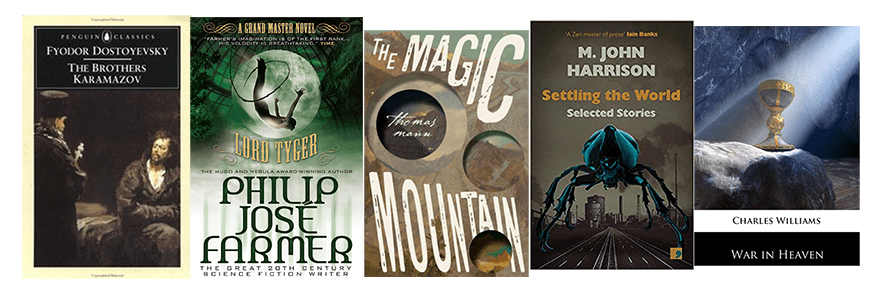
5. Brothers Karamazov by Dostoevsky.
I periodically dip into heavier literature (and outside of science fiction or fantasy, my usual haunts) to sharpen my writing, to expose myself to the towering figures of literature and scientifically dissect what makes those books tick. It’s a great exercise, as it has been with Moby Dick, with Hemingway (all of it, man…I’ve read all of it), Dickens and Faulkner. I picked Dostoevsky as an experiment because of how highly Harlan Ellison spoke of him. This one, I went with because it seemed to offer me some nuanced character studies, piledriving into a supposedly blowout climactic event (patricide by four brothers) that resulted from those character traits, and the fallout of that event. Now, it strikes me that this setup, should that be the case as I’ve outlined in the preceding description, then I could learn quite a bit about crafting plots driven by character flaws or quirks, and possibly about how to foreshadow and set ominous thundercloud mood to lead to the blowout.
That was the thought, at least. But what a cheese fart this one was! Sorry if you’re a professor who’s dedicated your life to it or whatever. But this book is super tedious, flat and uninspiring.
I admired the early chapters, with alternating introductions of the individuals and clear characterization. But it went on and on. It just went on and on and on, with nothing seeming to have any consequence. The big event wasn’t clearly foreshadowed (at least for me). There was no ominous mood as I’d expected. Not even the supposed angelic and innocent brother meant a thing in the world to me. I hated all of them. It was a chore to keep going, till I eventually wondered if they’d ever get around to knocking the old man off. So I bailed.
4. Lord Tyger by Philip Jose Farmer
If I told you there’s a book, written by the guy who dreamed up the masterwork Riverworld series, that conducts a thought experiment speculating what would actually happen should someone be raised by gorillas like Tarzan in the jungle….would you think that sounds awesome?
The idea is a British millionaire hires a couple of dwarves to raise a British aristocratic boy in the jungle like Tarzan, simulating some of the key events of Burroughs’ Tarzan books because of his love for them. And things go differently than he’d planned.
It struck me as a fascinating idea for a book, and I had some wild ideas of what might play out like the books and what would obviously go south. More curiosity than anything, I tried it. To be honest, I didn’t bail and actually finished the book. It was painful, but I made it through. What kept me going was the same curiosity of what would be done with the idea, and definitely NOT any skilled storytelling or characterization.
The lead character is overly obsessed with his penis, and it gets really monotonous and cartoon-like how many times we have to see that play out. I get it, monkeys touch themselves and maybe sleep around. I get it. But can’t we move on to something else?! It drives the plot sometimes. It’s entirely ridiculous sometimes. And it keeps coming up (no pun intended). Nobody is interesting, nothing makes sense, and I yawned through the climax. Avoid this one.
3. Magic Mountain by Thomas Mann
Not sure why, but I have a deep fascination with the psychology that led up to World War One, that kept it escalating and stagnating, and that resulted from its fallout in the couple of decades afterwards. It’s incredibly rich, picking all that apart – at large scales, understanding trends and behaviors of large groups, and also at small scales reading the biographies and journals of key figures that fought in the war. Magic Mountain by Thomas Mann struck me as a great option because it’s so highly praised, and supposedly was going to offer me a hotbed of the different moods and psychologies of people of that time, but in the setting of a health salon high in the mountains.
Reading this book feels very much like talking to a sickly aunt who won’t stop going on about the parts of her that hurt. And her cough, do I think that’s serious. And her swollen toe, should she get that looked at. And she’s so tired…
The lead figure isn’t sickly, but visits his cousin who is recuperating at a sanitarium in the Alps. And he meets people and stays, and he has breakfast and he has lunch. And he has dinner. And he tells you in detail what he ate. And no one is interesting, at least in the first fourth of the book I managed to read. You can see how little patience I have for stories that lead nowhere, for characterizations without some sizzle, and for aimlessness. This book seemed to go absolutely nowhere, and at the very point I threw it physically to the floor was at least the fifth time he was explaining what they were serving for the next meal. Avoid this one.
2. Settling The World by M. John Harrison
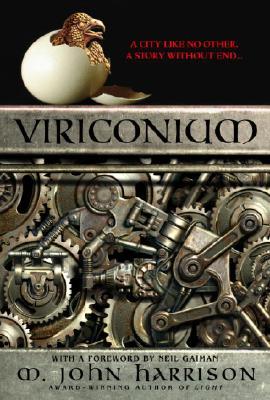
Nobody loves Harrison’s Viriconium series like I do! His mother wouldn’t love it like I do. It’s genius. Read that one. Please, God, read that one instead of Settling The World. In Viriconium, you get a true masterwork of mood-setting, of fascinating ideas to inspire, of interesting people, of a world you’d care to visit, and of the most maddeningly genius wording and phrasing you’ll encounter. Anybody who writes should treat Viriconium like nitroglycerine. A true brilliant white-hot piece of literature.
Much of everything else he’s written comes off as comparatively weak and confusing to me. Light is an exception, but its sequels are muddled streams of consciousness. Settling The World is a set of speculative fiction short stories. I don’t even know how to summarize it, because I can’t tell at all what’s happening in some of these tales. It’s seriously bad. Pages in, I had to ask myself if there was anything at all that was clear to me. I read a summary of a story I’d finished on the internet to see what it was about. Isn’t that funny? There are people in this world that can read jumbles of words like some of the tales in this collection and tell you what happened, even though you read the same story and saw none of that. And I saw none of the brilliant word-slinging which draws me so much to Viriconium and Light. With those books, there are moments when I’ve had to set the book down and just marvel and ponder at what I’d just read…descriptions and phrasing that pop with a life of their own and send your mind reeling.
I honestly have enough grief in my life than to read stories that I have to research afterwards to understand what happened and come off as bland as these. I set it as number two because I know what Harrison can accomplish and he fell short here.
1. War In Heaven by Charles Williams
This one made the top of the list because it presented itself as a story about the Holy Grail. I’m literally ALWAYS in for a story about the grail. I mean, this is “grailrunner”. That’s kind of…for a reason, you know? Here, we have the description from Amazon:
“Williams gives a contemporary setting to the traditional story of the Search for the Holy Grail. Examining the distinction between magic and religion, War in Heaven is an eerily disturbing book, one that graphically portrays a metaphysical journey through the shadowy crevices of the human mind.”
Williams was one of the Inklings, that little Oxford literary club that gave us J.R.R. Tolkien (Lord Of The Rings) and C.S. Lewis (Chronicles Of Narnia). If this guy hung around with those two, who could produce towering mythic works such as those, then he would potentially speak and think along the same mythic lines. I’ve written here about the power of mythic storytelling. That can change your life! And here, I’m told he’s going to potentially apply such mythic storytelling techniques to the eternal grail myth, in a contemporary setting. What on earth is NOT to like about that?!
Unfortunately, this reads like a boring, slice-of-life trip to the general store to buy a pound of flour. Even a dead body found in the opening pages is portrayed with the weight and significance of a paperweight. I got possibly a fourth of the way in before bailing. Where was my updating of mythic figures like Arthur or Merlin? Where was my ominous doomsaying warning of consequences? Where was that curious, inspirational sense of questing and seeking perfection in body and spirit that I get from classic Eschenbach or De Troyes? Where was the mystery from those original grail tales, that leave you breathlessly marveling over what the bleeding lance means, and who the maidens are in the processional carrying the mystical platter?
Nope. Just nope. Maybe it got better. I’ll never know. Pass on this one.
*
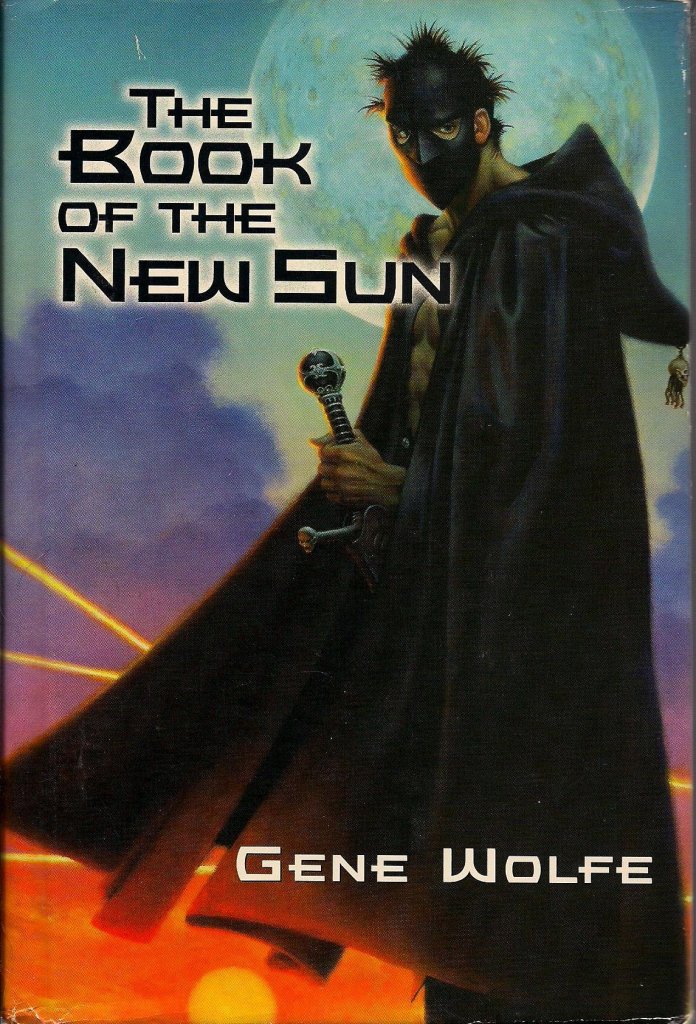
And that’s the roundup for this little venting session. I hope it wasn’t overly negative. I finished Gene Wolfe’s Book Of The New Sun, all four parts, for those who’d asked what I thought. Definitely worth the experience, though not one of my favorites. There’s a distinct sense of importance as you read those books, like the early seasons of Game Of Thrones, wherein every word people speak seems to have weight and grant some vague insights. Events here make far more sense after the fact, in reflection, and often what you thought happened actually played out differently than you’d thought. Yeah, there’s a place to spend your money.
Anyway, let me know what you think. And if I poo-poo’ed on one of your faves, maybe drop me a note on what you liked about these books I consider stinkers. Maybe I could feel differently and try again if you make sense.
If you’re a science fiction & fantasy person, you’ve maybe heard of Gene Wolfe’s Book Of The New Sun. It’s a four-part series, tracking the story of a dude from a guild of torturers in a future world, but one degraded into a fantasy-style medieval setting. Armor and swords and whatnot. The reason I bring it up is kind of interesting.
Give me a second here. There’s a larger point about why we stop reading books after a page or two, and why we keep going.
Anyway, people in the know brag about this series like it’s Tolkien or the Bible or Dickens. They go on and on, writers whom I respect very much and who should know dregs from riches. If they say it’s worth the read, even though it’s dense and uses esoteric words that look made-up but are actually in the dictionary (when you bother to look and don’t just skim past hoping they’ll make sense in context), you figure you should give it a shot. Well I did. Four times.
Four separate times, I tried to start reading the first book, Shadow Of The Torturer. “It’s mind-blowing”, they said. “A masterpiece”. I had not found it to be so. In fact, I tried some other Gene Wolfe books (in the library so I wasn’t blowing money on things I expected to hate) trying to see the big deal. I couldn’t do those either. So I figured this dude just isn’t the beans for my java and moved on.
Let me put just a little flesh on the bone before we move on here: The opening scene seemed to me to have some typical fantasy-trope band of misfits at a gate of some kind, whispering about how to get inside. Or something. The word choices were exotic, the descriptions dense, and I hate plain-vanilla bands of misfits doing fantasy thieving stuff. It’s. Been. Done. I honestly never got anywhere with that first book because it seemed like tired content, done in an unnecessarily obtuse style.
I listen to a lot of disparate things when I go running at the lake. Seriously, it’s all over the place. Here’s a good one, if you’re into Harlan Ellison, a collection of all his Sci Fi Buzz appearances called ‘Harlan Ellison’s Watching‘. It’s great to hear him rant or get excited about something, then have the ability to fast forward with a Google search to see what became of it.
But I came across these two intelligent, informed gentlemen, discussing at length one of my favorites…a set of pieces collectively called Viriconium by M. John Harrison.
I’d never heard of ‘Books Of Some Substance’, nor have I listened to anything from a doom metal band from Arkansas (and likely never will), but Viriconium‘s one of the great ones. That’s a life changer, at least for me. It gets in my head. I can’t read it without it changing how I think, how I choose my words. Harrison’s a genius at mood-setting, at impressionistic fiction, at sending your mind off to flights of fancy. Maybe not of telling a story – he’s not great at that. But otherwise, a true work of art there. These two gents had a fascinating chat about Viriconium, so I heard them out on that count. And towards the end, when these two had completely won me over with a rich, insightful conversation that encourages you to think maybe they’re not all Snapchat-addicted neanderthals out there, the doom metal guy mentioned Book Of The New Sun.
Well crap. He said if you really like Viriconium, you’ll like that one too. He said it’s set in the far future where the old technology is literally a toe-scratch below the dust and shards of decaying cities. He said it was amazing.
So I took a fifth go at Gene Wolfe’s supposed masterpiece. I kept an open mind, telling myself this isn’t a piece of Dungeons & Dragons fan fiction or a bajillionth clone of Tolkien, that the exotic words can be skipped or considered in context without constant jaunts to the dictionary, that this very intelligent, insightful doom metal person who held a series I cherish in such high regard was telling me to give it a chance because it holds some of the magic that Harrison’s work does. He earned my trust, so I dug in with as open a mind as possible.
And honestly, it’s pretty good. They weren’t D&D-style thieves at all, but apprentice torturers. That scene was short and not at all what I thought it had been. They were young trainees basically, and this was going to have elements of coming-of-age tales. It’s super easy for me to connect with coming-of-age tales, especially when they hint up front at the great heights to which this person will reach (as this book does). I like to examine their choices, to question whether I’d make them as well, to see where external factors advanced their cause and when they seized their own fortunes alone. I saw this after a few chapters, beyond where I’d stopped those previous times.
The word choices remain exotic and annoying, but they add flavor and atmosphere, which was his point I imagine. I understand there will be an element of the unreliable narrator as I proceed, so I’m on the lookout for nonsense he pitches at me. We’ll see how that goes.
My point today is just to hand you a few links you might find interesting, and to suggest that our preconceived notions of what a book is about can throw us off the rails, that our impatience and lack of attention span can cheat us of some great tales, and that when you find reviewers or podcasters or other folks whose opinions you trust, maybe listen to them with an open mind.
If you’re into Gene Wolfe’s works, shoot me a note and let me know what you think. I’m anxious that this series will fail me at some point, but so far so good.
When I read Stephen King’s Dark Towerseries or Isaac Asimov’s Foundation, anytime I read Dune, I get the same vibe as I’m planning to chat with you about in this post…that there’s something ominous and huge going on – a belief system or set of myths or larger than life history affecting events. I dig that tremendously; and I look for it in things I enjoy reading. In fact, when I was growing up, you were either a Luke Skywalker guy or a Han Solo guy – meaning you wanted to be the space cowboy or the brooding, mythic hero. I was a Luke Skywalker guy. The literary take on this is it’s much more interesting in your fiction should you plan to include some sort of belief system if you don’t just recreate the Greek Gods or rip off the American Indians with a ‘Great Spirit’ thing-a-ma-bob.
So I’m going to go deep with this one. Stick with me. I finished an interesting study recently that went way farther that I’d expected. I was googling and flipping through the original materials madly, chasing a huge idea that kept getting bigger. It was like pulling up one of those weeds where the roots keep popping up out of the ground and you finally just cut it when you can’t tell how far it’s really going to go. For me, it started with a random book on my shelf from years ago that had an article about the I Ching in it.
Anyway, another article in that book that caught my attention was about the Kabbala’s Sefirot. The idea of treating a deity like an engineered contraption, like a set of physics rules you just needed to respect to make jedi-mind-trick things happen tickled both the logic and artsy sides of my brain. So I went deep into the Kabbala – read several books and spent some time reading what its believers found attractive about it. No offense if that’s your thing; but I ultimately found it full of promise and marketing but a big fizzler when you try to pin it down to something useful. It did strike me as fascinating though, the nebulous descriptions of the highest realms of reality – a nameless and unapproachable perfect being so incredibly pregnant with the potential of creation it’s provoked by nothing more than a state of mind. The sefirot idea stuck with me, so I poked into where it came from.
Read the Sefer Yetzirah if you like; but it’s gibberish to me. That was where the sefirot were first described. I bought the Pritzker Edition of The Zohar though, because that’s the big daddy of Kabbala, the place where it really took off. Get far enough into The Zohar; and you’ll get the feeling that nobody’s saying what they really mean and you can stretch and pull to make anything mean what you want it to. Still though, the massive superstructure of the universe having a secret dimension to it, a direct line of sight to a divine machinery, kept things popping. So I went deeper to see what influenced Moses DeLeon (the 13th century Spanish author or the channeler, whichever you dig).
I’ll speed up to make my point, though this took a while to trace. What I found was a pattern of about every two or three hundred years, a very similar theoretical apparatus was showing up in some famous writings. The themes are these:
There’s an indescribable, unapproachable entity way up in some higher dimension ready to burst with creative potential
This entity is either intelligent or just a principle of the universe, depending on who you’re reading; but it can be influenced either way
Since this thing’s perfect, it can’t produce things that aren’t perfect, yet here we are with cancer and weeds and birth defects
So this thing has levels beneath it, where things get progressively farther from the top and so are less perfect till you get to us
That means there are perfect versions of things somewhere, like flawless templates from which all matter is descended
I had discovered what they call Neo-Platonism. If you already knew that, good for you. I didn’t. It made me think of Object Oriented Programming, because it’s exactly the same idea where you have ‘classes’ defined as templates, then make ‘instances’ of them to tweak for where you use them. Going successively back in time…
John Scottus Eriugena (800-877AD) said the entity at the top was God; and He was creating stuff so that He could understand Himself. He said the primary Forms I was talking about above were the patterns of all things located in God’s mind. Eriugena was probably influenced by…
Pseudo-Dionysius The Areopagite (late 5th, early 6th century AD) who shared the view of a procession of realms from God but said a rock or a worm was a window upon the entire universe if you only knew how to look at it. He was intrigued by finding his place within that procession and seeing himself inside it, focusing on the sacraments as a way to engage with the apparatus. This guy was probably influenced by…
Proclus (412-485AD) who was head of the Athenian school and thought Plato was divinely inspired. This guy wasn’t Christian, so his view of the thing at the top was more of a nameless ‘One’ you could influence with magic rituals. He was influenced by…
Plotinus (205-270AD) who studied Plato religiously. This guy had an inherent distrust of material things because they were a poor image of something higher. He said the supreme dealie-o at the top was a transcendent ball of potentiality, without which nothing could exist. He also said because of its nature of perfection, it couldn’t have a will of its own and couldn’t engage in any activity without becoming imperfect. So he had a procession downwards as well, culminating in matter.
The Gnostics were around this same time period, thinking the same sort of thing about matter being wicked and only a pale reflection of the perfect templates up there somewhere.
You see how big this is getting, right?
Plato (4th century BC) developed in The Phaedo and in The Republic what’s called his Theory Of Forms . He likened us to people who’ve spent their lives watching shadows on a cave wall, thinking the shadows were what’s real when in fact there’s something making the shadows. Plato extrapolated from this idea that the soul was also a Form, and therefore perfect and unchanging, so..you know…reincarnation. He may very well have been influenced by…
Parmenides (5th century BC) who revolted against the sciency philosophers by suggesting there was actually a difference between true, objective reality and the stuff we can see. I’m not sure he started all this though because of…
Heraclitus (535 – 475BC) which is where my story ends. I read Remembering Heraclitus by Richard Geldard. Here’s a deep well like you wouldn’t believe. Heraclitus may have written a book and just dropped it off in the famous temple at Ephesus, and soundly changed the world. He described ‘the logos’ as a fiery, invisible rational principle that embedded the universe (like the Force, surrounding us, binding the galaxy together). It’s the wisdom of all of creation. Entirely possible it’s this guy that kicked the whole thing off that led to the same theoretical apparatus inspiring people for millennia.
My point is that this nebulous, vague description of a cosmic apparatus appeals to the logical side of your brain because it sounds like machinery; and you want to figure out how to make it work. It appeals to the creative side of your brain because it leaves so much for you to interpret and add to it. In fact, ,that’s just the way the I Ching appeals as well, presenting itself as reflecting the universe in a little microcosm so you can leverage what it’s up to as it changes.
Since the I Ching has been around in some form for 3,000 years; and the ideas the Kabbala built its palace on for not much less than that, those systems have something to say about how to make your manufactured belief systems resonate with people. Appeal to both the right brain and the left. Show how it could make people’s lives better in some way.
I took a real stab at this myself in Tearing Down The Statues, focusing on the idea that history repeats itself at different scales.
Now you go try and let me know how it turns out for you!
“The cosmos was not made by immortal or mortal beings, but always was, is and will be an eternal fire, arising and subsiding in measure.” -Heraclitus
Let’s talk about being stuck in paradigms and not even knowing it. The reason you should care – if you’re an aspiring writer or somebody interested in the craft of storytelling, then you probably want to break some kind of new ground. At least for me, I like to think I’m an original, coming up with cool stuff that inspires other people. When somebody tells me I wrote something that really made them think or that gave them the shivers…or best of all, that made them want to know more…that’s fireworks to me! So paradigms are cancer. Off with their head – if you know what I mean!
Here’s an example, for the science fiction nerds out there like myself. Maybe it was Star Trek that started this, not sure; but have you noticed when you’re watching basically any show or movie set on a spaceship that the doors swish open and closed automatically? That would require motion sensors and motors. The doors always look like heavy industrial steel. In fact, everything looks like industrial steel and huge! Just huge. But stop and think about it for just a second – space has precious little resources; and every bit of mass you take along with you takes up more energy to move the ship at all. Massive freaking spaceships made of heavy steel with silly, unnecessary things like automatic doors are a bit unlikely. “Hold on, genius”, you might say. “These aren’t science text books. Energy is free in my story. If I want doors to swish shut automatically, maybe I’m thinking about emergency containment!” Blah blah. Maybe – and you have to ask yourself this – maybe you’re just coasting on paradigms Gene Roddenberry set up decades ago.
Why are spaceships always gray metal? Is it because that’s most likely, or because Navy ships have been battleship gray; and that was the paradigm folks like George Lucas just carried on from the trailblazing pulp cover artists of the 1930s? When you’re at the airport, are the planes gray? You can disagree; but my guess is the economics of space travel either in our future or in whatever alternative universe you’re dreaming up, say commercial enterprises will be building ships for space travel. They won’t have to worry about obscuring visibility in ocean environments like the Navy does. I’m saying spaceships probably won’t be battleship gray with all sorts of squiggly machinery and useless lights blinking all over their hulls. Think about it. Isn’t it more likely they’ll be smaller, probably modular vessels with logos and smooth shielded hulls, light on mass and with relatively small hallways and workspaces, maybe capable of linking up into larger structures?
Gravity? Every show you’ll watch has their folks walking around and nothing floating. That means you’re assuming the ship spins or you should at least hand-wave something about ‘gravity generators’ or something. Why not just make it spin? How hard is that?
Don’t get me started on robots. The pulps set the stage for human-looking robotics; and we’re still living with that. We’ll probably get there, no doubt. But what’s the point of all that design if the job you’re giving it is to clean the floor or pilot the ship or load cargo or to repair things? Why make it look human with all the expense and complications and liabilities, to do mundane things like that? Form will follow function, right? That’s actually how the world really works when manufacturing plants have to actually spend money on R&D and machinery and raw materials and labor to make something real. Those slick little Roomba vacuum cleaners are a fantastic example of this. They look nothing like C3PO; but they can suck up dog hair like nobody’s business.
I’m going to end with my least favorite paradigm of all because your argument should build to a climax, shouldn’t it? I mean, this one really…really needs to go. If you’re guilty of it, please stop and question yourself. I purposely avoid the heck out of this one because it’s so tired and lazy and ridiculous by now. Yet it’s hard to stay away from it. I’ve veered very close and hated myself afterwards, like when you eat the whole bag of those little chocolate doughnuts. Stop. Stay away. Go back.
‘The chosen one’. Oh my God, how many times have you heard somebody say this? Look, I understand that to set up a mythology, some sort of over-arching roller coaster you want your characters to get swept up in, this is a handy little trick. Just make the main guy the chosen one; and all sorts of mysterious things can happen. Then you can show all the whiz-bang stuff they can do and didn’t know, so replicate the ‘coming of age’ motif which everybody loves so much. Me too. But isn’t it getting old? We’re pretty sophisticated in our appreciation of narrative structure and themes by now, so isn’t it time to put this one to bed? It almost never makes sense anyway, when you poke on who chose them and why.
Anyway, I should really practice what I’m preaching here. When you agree to move beyond some of these deeply entrenched themes or backdrop devices, it gets challenging. There’s maybe even an argument to be made that things like I’m talking about here are the common vocabulary now, so to change them up too much makes the reader confused or uncomfortable and distracts from what you’re really trying to say. Honestly, if we’ve thought about it that much, then we probably did our due diligence and should have the big, freaking steel doors swish open and closed if we feel like it.
Back in the day, pre-internet and when the only way to hit it big was to get signed by a big publishing house, you hounded magazines to sell short stories as much as you could. You got in print. All the names you’d recognize from those days offered that advice; and I sadly admit to listening to my dot matrix printer bweh-bweh-bweh in the corner of my desk while I bent those little metal clips on the manila envelope time and time again patiently sending off stories so I could make a name for myself to finally see the way clear before me. The only cool story I have from those days is a terribly cruel rejection letter from the guy who ran Asimov’s magazine accusing me of stealing the story idea (naming some obscure piece I’d never heard of and saying the other guy did it better). Now that I think about it – there was a guy named Vampire Dan who ran something called The Story Emporium at one point, who said nice things about what I sent him and always said I was ‘close’. He was awesome; but that’s beside my point.
Where I’m going with this is – you sold everything. Nothing was free. Guys like Harlan Ellison were brutal about it, chasing every dime for reprints and mentions and ripoffs. Basic economic common sense says you don’t give your hard work away because it has value. Giving it away means it’s crap and you couldn’t sell it. Right? Hold onto that for a minute.
My brain builds up steam. What I mean by that is my job can be technical; and if I’m not careful, I’ll be exclusively reading science journals and history books, learning statistical programming, building robotic arms, or whatever my left brain decides to chase with precious little stretching of my imagination. It can make my writing a little dodgy and stiff, and the ideas a little plain-Jane and cardboard because I’m not exercising that part that mishears things on purpose, that plugs and unplugs things I see around me to rewire them into something else. Everybody says you’re supposed to write every day; and they’re of course right about that. It matters. Our brains are neuroplastic, meaning you can rewire them yourself just by what you think about. It would be incredibly helpful for a writer to be able to dredge up an inspiring idea to stretch on like taffy any time he needs it. Confidentially, it helps me tremendously at work too because I’m always being presented something people are stuck on. Different ways of thinking break out of that kind of rut.
When I recently started in earnest to build a platform for future book launches, I finally got the light bulb to spark on – that old school thinking about not giving things away for free doesn’t hold true in the internet age. Nothing gets attention on-line like FREE. It’s amazing. Book giveaways are critical because of how you get reviews; and no book sells without reviews. Twitter, Facebook and Goodreads or whatever media you want to talk about, they’re all swamped and crowded with authors pumping books. Nonsense. Sales are about trust; and somebody who’s looking for an author needs to trust them. It is an incredibly intimate relationship between author and reader…a joining of the minds that must be honored and treated as precious. What this all means is it’s not only okay to give your work away for free, it’s important to do so. Setting up a place on Facebook where you can share a piece of flash fiction or a story idea you never intend to build a book around – that gives you a fantastic place for people to get to know your style, to trust you, and also forces you to sit down once a day and do it!
Go see what I mean here and let me know which ones you like best. I’ve come to notice already that people seem to appreciate most the ones with images attached. Give it a shot yourself and see if it doesn’t stretch you to look for slick story ideas around you more often.












 Grailrunner Publishing