I’m swimming with stuff I need to get down in the lore for the Salt Mystic universe. There should be more time in the day and less need to pay bills.
Anyway, here’s the background if you aren’t familiar with the original IP we’re building here at Grailrunner called Salt Mystic.
A unique blend of western grit and fantastical science! Step into a far future world where artificial pocket dimensions hide untold mysteries, gunslingers duel with ball lightning, and colossal armies fight for their very survival. Get ready to embark on a boneshaking adventure that will test your courage and set fire to your imagination!
Salt Mystic is an immersive experience that seamlessly weaves together the rugged allure of a wild western tale but with the boundless wonders of science fantasy.
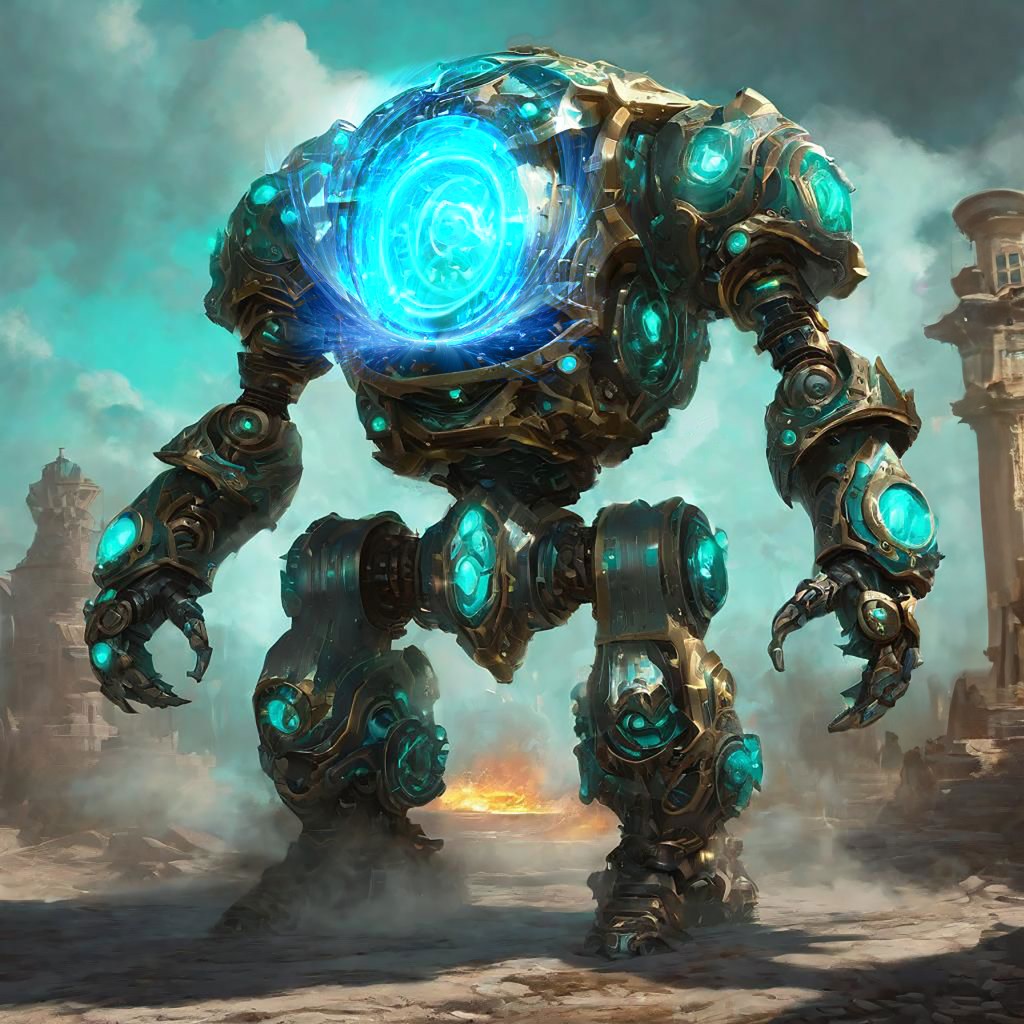
Today, we’re introducing a new threat to this rapidly growing world called the Justice Engine, and we’re doing it with an exciting new lore card, available for download free now!
What is a Salt Mystic lore card?
Smash the Story Arcade button below to see a description and to access all of them, but basically it’s a distinct fusion of art and flash fiction on a single page to build (brick by brick) this expansive new world.
Oh, Grailrunner, what have you done now?
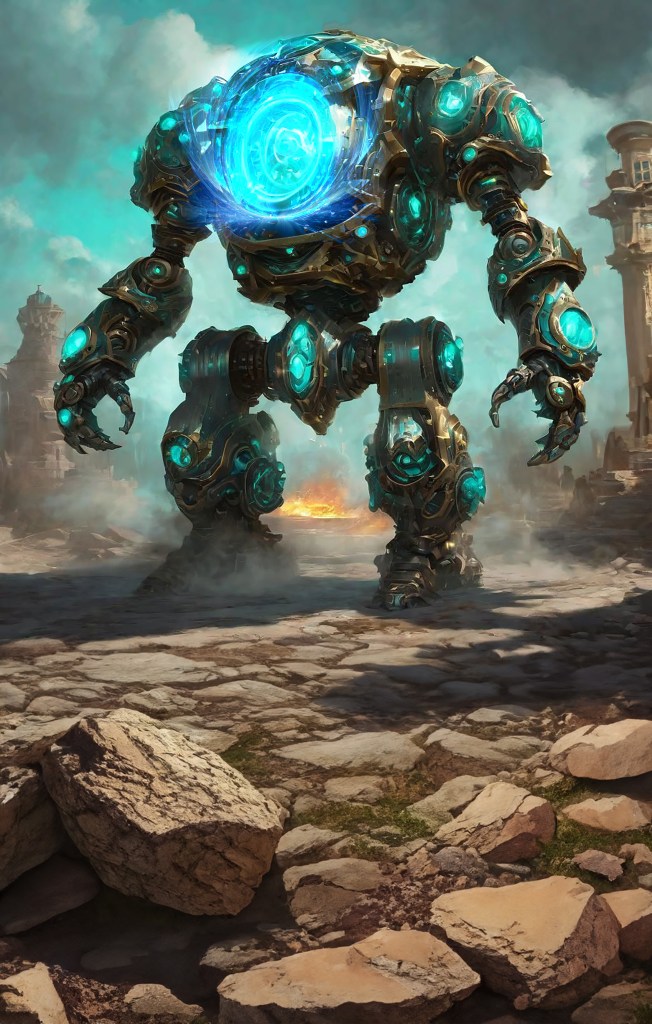
Oh, today’s a whopper! A doozie. A slam-fest to your noggin. It started with the art this time, and the vague idea of a wandering mechanical judge with a dimensional gate in its chest. You can see some of the image in the header and the full image below, though if you’re at all interested, why not just take a peek at the pdf in the Story Arcade?
The art is a photobash paintover, with the golem body itself AI-generated. I altered the background, mainly the tower on the right, and corrected some artifacts that came with it as well as added some clouds and sky. Then I added the rocky ground in the foreground to heighten the image for the card. The dimensional gate swirling was a handful of sparkly and lightning overlays in Color Dodge mode. The idea here is this thingie can just pluck you up and drop you into a pocket dimension should you be found guilty.
But it isn’t Robocop. I didn’t want some Hollywood-style robot going rogue with its own ideas of justice in a dystopian nightmare. There’s a twist to who’s doing the thinking with these and why they’re qualified to do so. There’s a reason they’re wandering these days, and it’s sad but maybe a little hopeful.
And all that is tied distinctly to the history of the Salt Mystic setting. I’m personally really proud of this one in particular, and I can’t wait to write it into something more ambitious.
Please take a peek at the lore card – shouldn’t take you more than a minute or two to read the text and get the flavor of this new beastie. And let me know what you think!
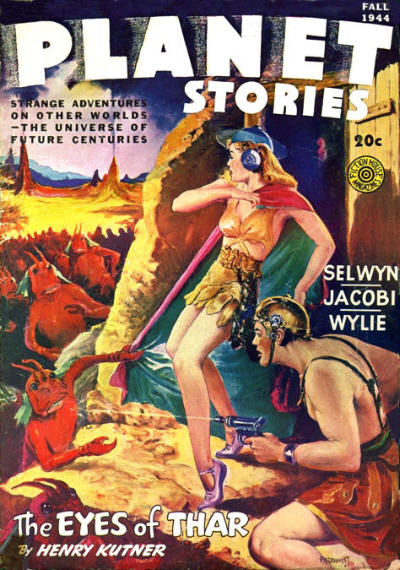
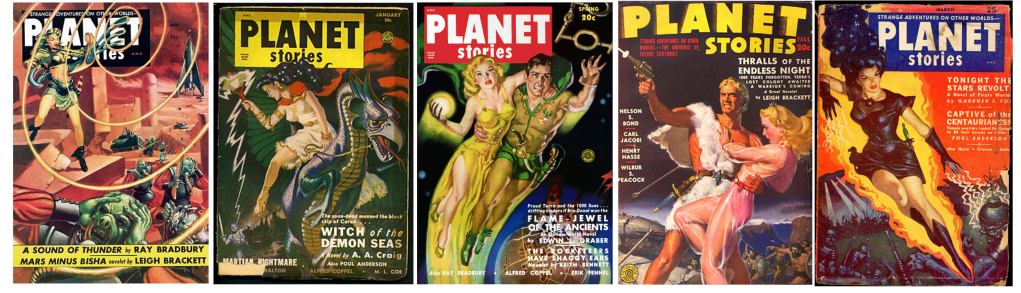
If life is a bit heavy these days, consider the starry-eyed wonder of the science fiction pulps of the 1930’s and 1940’s for a breath of clean air. One well I eternally find refreshing is Planet Stories, a pulp of substance that ran from 1939 to 1955 and which gave birth to many of the mainstream writers of the genre. Today, I want to bring you a low-key page turner of a short story from the Fall of 1944 that highlights the bold energy and high concept speculation typical of the time.
Welcome to Henry Kuttner’s The Eyes of Thar and our latest entry in the Pulp Gems series! (and yes, they misspelled his name on the cover)
Follow the link above to download the Fall 1944 Planet Stories (Kuttner’s story is on page 45), just to keep traffic flowing to the wonderful folks at the Internet Archive. Should you have any troubles with that, download it here.
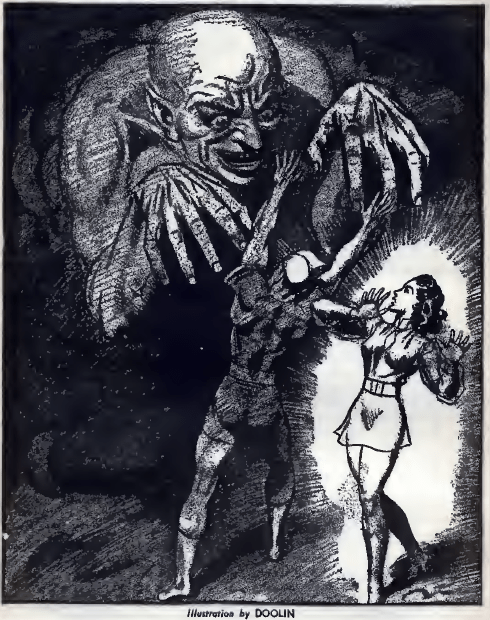
She spoke in a tongue dead a thousand years, and she had no memory for the man she faced. Yet he had held her tightly but a few short years before, had sworn eternal vengeance – when she died in his arms from an assassin’s wounds…
I really think some of those zingers from the tables of contents back in the day were wonderful! This one caught my eye with its dense and compelling mystery summed in those few lines: how was Kuttner going to explain a lady who was dead returning at all, much less one speaking a thousand-year old dead language? And this illustration by Joe Doolin that accompanied it – I was hooked before I started. If you’re unfamiliar with Doolin’s work, read up on him here.
Henry Kuttner co-wrote (with his extremely talented wife, C. L. Moore), one of the first science fiction novels I ever remember reading: Earth’s Last Citadel. I almost hate to re-read that one now, just because I have fond memories of it from then.
Anyway, our tale for today swings right into the action:
“He had come back, though he knew what to expect. He had always come back to Klanvahr since he had been hunted out of that ancient Martian fortress so many years ago. “
Samuel Dantan is a bloodthirsty terror to those on ancient Mars who had killed his lover years ago, returning to kill them mercilessly between bouts in the spacelanes.
“When Dantan came back to Klanvahr, men died, though if all the men of the Redhelm tribe were slain, even that could not satisfy the dull ache in Dantan’s heart.”
Unfortunately, the tables have turned on him this time, and he’s being hunted. In fact, it’s while he’s desperately on the run that he encounters a mysterious artifact in a canyon that has been exposed by a landslide. Climbing inside, he finds it to be an ancient laboratory, buried under the stream for maybe as many as ten thousand years. Then, locked inside and hiding from his pursuers, a familiar voice calls for someone named “Sanfel”…
At first, it’s just her voice speaking in the dead language of old Mars. Dantan knows it because his grandfather was a shaman and used it for ancient rituals. It’s the voice of his dead lover, for sure, though the mystery woman has no idea who he is. She, too is being hunted by nightmare beast-men of her own foreign universe. And she’s just as desperate.
There are different physics in her world, not only slower time passage but also things such as light and thought work very differently. The weapons and aid that Dantan promises her should they open the doorway between worlds would be useless to her. So she says, though he’s ready to die trying. Sanfel so many centuries ago was following her instructions to build a weapon able to help, but he was long turned to dust.
“No, Dantan, you speak in terms of your own universe. We have no common ground. It is a pity that time eddied between Sanfel and me, but eddy it did, and I am helpless now. And the enemy will be upon me soon. Very soon.”
So her beastly enemies are at her door in an unimaginably faraway universe even as the vicious thugs of Redhelm are at Dantan’s own. Somehow, it’s his lover, and she needs him. What can he do?
*
I’ll let you pick the story up from there, just to avoid spoilers. It’s maybe a half-hour read at most. Definitely worth it. Kuttner’s always great, and this one was a fresh take on Burroughs’ old Mars.
Planet Stories never disappoints.
I hope you liked the referral on this one. If you have your own gems from the pulps, feel free to let me know.
Assuming there is an afterlife, and that I get to hug three people of my choosing for just how wonderful they were and how much they impacted me, I’m thinking (today at least, the list changes):
Honorable mention to Nicholas of Myra since he was Santa Claus.
Let’s talk about Stan Lee for a minute, and the miraculous collaborative technique he popularized, in many ways pioneered in comics writing called “The Marvel Method”.
The stories Stan used to tell of the old days of Marvel are truly fascinating and inspiring. His mom got him the job with a cousin (it was Timely Comics then). Pretty much all the adults quit or didn’t care and were never around the office, leaving him as a teenager who knew nothing about the business pretending everything was fine.
All manner of folks apparently went on business as usual with the in’s and out’s of the office, never really knowing the kid that was always in was the one basically running everything. As he matured in the business, and couldn’t keep up with the many writing responsibilities, he relied on what came to be called “The Marvel Method”, meaning he would provide an outline or maybe just an idea to the artists, and they would go nuts from there, expanding the basic plot thread into intricate panels of story without words.
Stan would take what they sent, whatever they sent, and add the dialogue and narration, riffing off what they had provided since he only knew the basics of the story. With geniuses like Steve Ditko and Jack Kirby to work with, he made magic.
Here’s what you might have seen, for example, sent in by John Buscema:
We’ve stated our position on generative AI tools here at Grailrunner before. Bottom line, although many occupations are threatened by this rapidly evolving technology, it isn’t going away. In fact, it’s a new industrial revolution. We believe tools like Stable Diffusion and ChatGPT have a place in the world, but see them more like stock image websites or reference or idea books.
Like George Lucas did back in the day with Ralph McQuarrie’s mind-expanding images, the art and the ideas can dance together and make beautiful new worlds.
What’s that got to do with Stan Lee?
There’s a new experimental generative AI program called AI Comic Factory hosted on huggingface here. Looks like this:
You select the style and layout, then enter a prompt. When you hit the Generate button, it lays out a set of comic panels based on your choices and entry that are impressive.
While I have no intention of packaging these up for our Salt Mystic line, it really is fun to describe some of the elements of our IP and see what looks like a Humanoids comic illustrated by Phil Gemenez pop up in a few seconds with interesting graphic elements that inspire more ideas to pursue.
Look at these to see what I mean. My prompts were variations of cowboys entering dimensional portals, stone golems (glowing or otherwise), beautiful fantasy cities and majestic airships, that sort of thing. All very much in line with Salt Mystic adventuring.
I’m drooling at this. It’s incredible how inspiring this can be! When I’m looking for descriptions for a character now, or costumes (which I hate describing), or an interesting perspective for a city, I can go back to these and dream.
Recently, I started playing with Actions in Photoshop to turn images to pen & ink drawings with the click of a button. I have a very nice gallery of ball lightning carbines now to drop in to whatever I’m working on. For the header image, I grabbed one of those, color matched and graded it after compositing it in. I cut it off to fit the panel so it would look like it belonged.
Then I grabbed a cartoon dialogue bubble from a Google search and used Comic Sans font in Photoshop to add the gunslinger’s words. Not sure what he’s pissed about, or who in that city is going to pay for it, but it sends my mind reeling.
Anyway, that’s what I wanted to suggest to you today. If you’re going to try it out, don’t forget to be respectful of the artists who worked on the images that trained tools like these, but don’t be afraid to collaboratively build something new with them either.
One of the most exciting things we do around here at Grailrunner is introduce new bits of the lore of our Salt Mystic setting in the form of Lore Cards. A fusion of art and short fiction, it’s an important mechanism for us to introduce and test these mini-expansions of concepts that will wind up ultimately as game cards or in the books or stories.
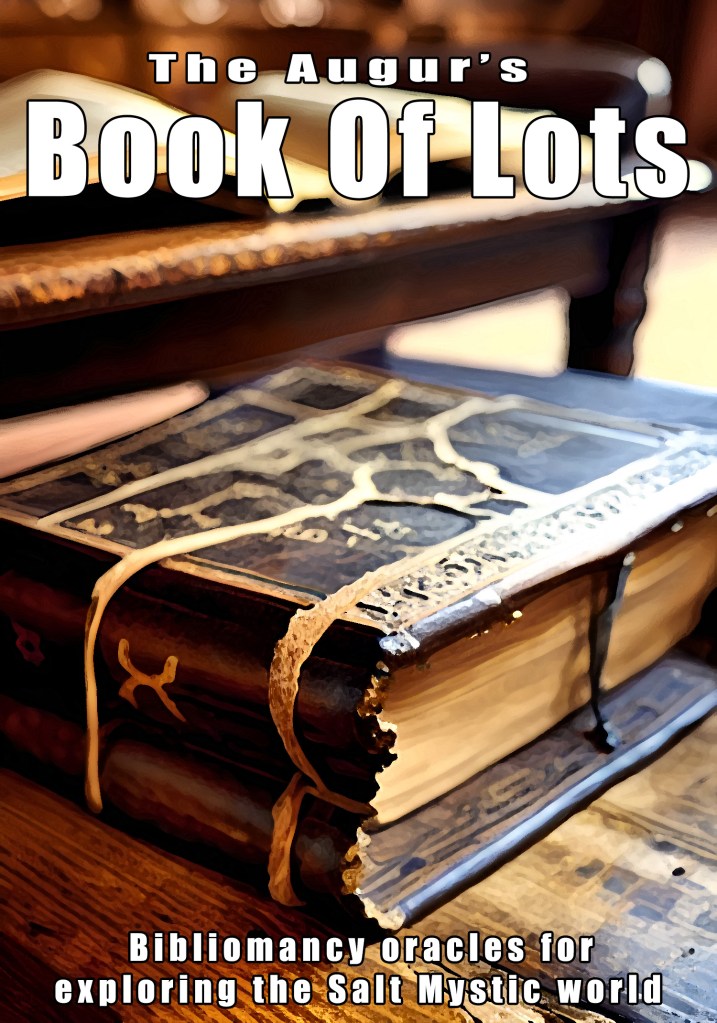
A product we have heavily active in development right now is a bibliomancy-based oracle book for roleplaying in the Salt Mystic universe to be called The Augur’s Book Of Lots.
In order to bring that to life, all manner of new encounter types, new places, and historical figures and their stories are needed. It’s an incredible, life-changing experience for me personally to explore all that and watch it unfold like a big, crazy flower, and I can’t wait for you to see it. Seriously, this whole world is building itself and waiting for you to slide a ball lightning carbine on your arm and take a cautious step through the gates…
Today, we thought we’d introduce you to a new exciting, and sometimes terrifying, addition to the world of the Salt Mystic: the chimera.
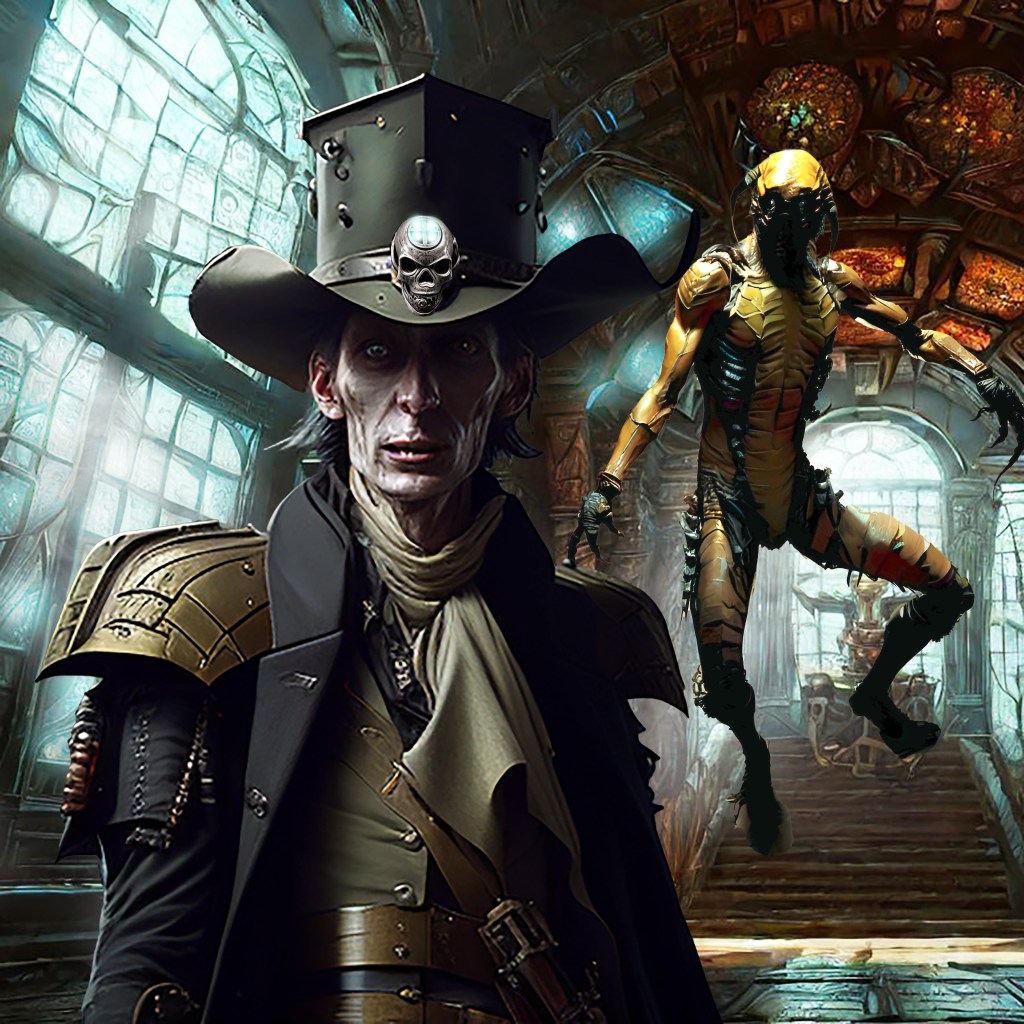
The sneaky fellow leaping on our hapless narrator today is part man / part scorpion. In the oracle book so far, we’ve met countless hybrids like this already, though this particular combination freaks me out the most.
As for the art, as always it’s a paintbash with the heavy lifting done in Photoshop. In this case, the bounty hunter, the skull on his hat, the backdrop, and the scorpion-man were all drawn from various iterations of Stable Diffusion or Wonder, with heavy correction and repair. I discovered the ‘puppet warp’ in Photoshop, which is my new favorite trick!
After compositing them together and color grading everything, I added some Stock nebulosity overlays from Nucly to make the diffuse smoke around the windows, blending them in Screen mode. The positioning of the scorpion-man was tricky – it made more sense for him to be creeping around behind our clueless bounty hunter, but the more I looked at him in mid-air, the creepier and more interesting I found it to be.
I wanted the skull on the bounty hunter’s hat to glow, so that along with the window glow was just some soft brush painting in Color Dodge blend mode.
Anyway, we hope you like the final product. Let us know what you think, and please check back periodically for updates on the stuff we’ve got cooking.
If you need to know a bit more about what we’re doing with Salt Mystic, feel free to check this out here.
In the Salt Mystic Sourcebook And Core Rules, we define seven different ages into which the long history of this setting is divided. The brief snapshots there allowed us to drop maddening hints of some intriguing twists and adventures that occurred thousands of years ago, but we never really get the chance to dig in to those earlier time periods. Maybe one day these will all be their own novel series or art lines – but for now, we’re in the Guardian Age, man. It’s enough work bringing that to glorious life!
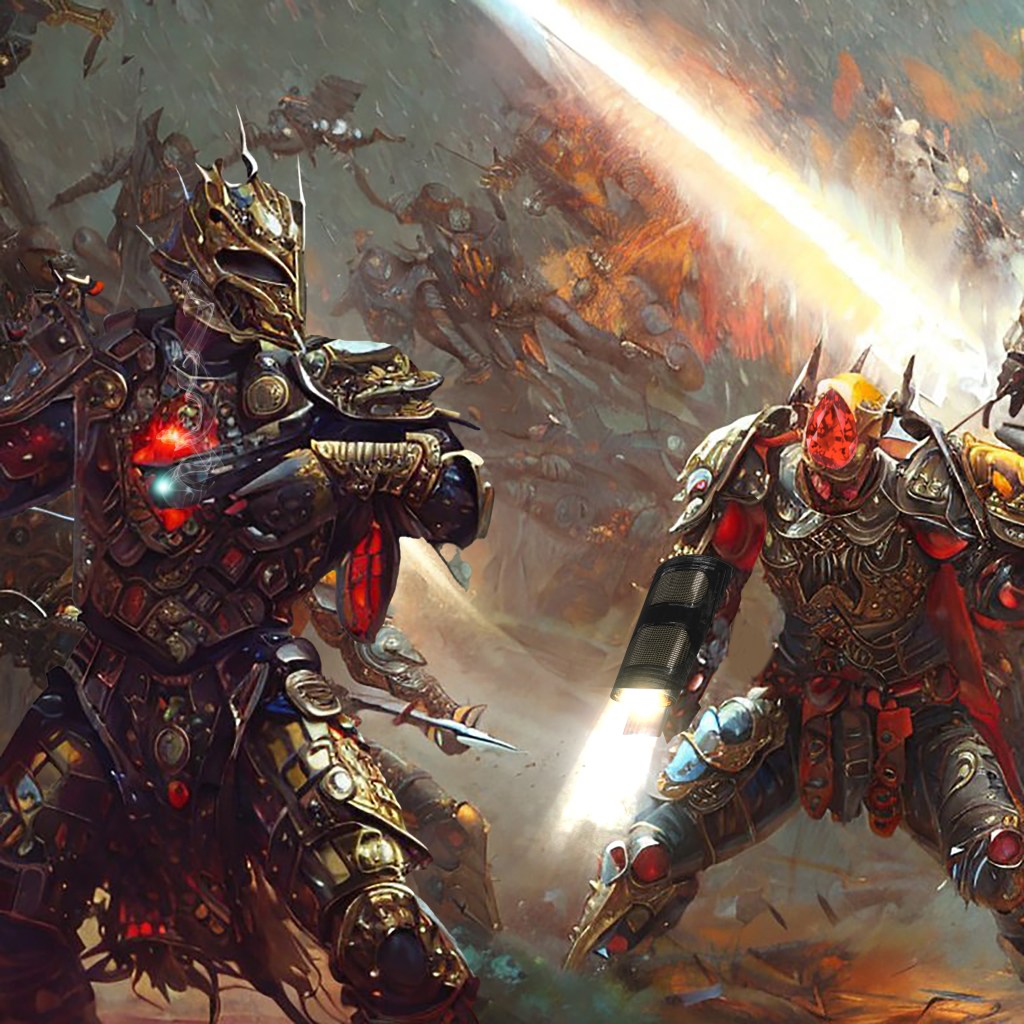
So this new lore card was a chance to flesh something out that I thought was interesting. There’s already a guy named Murmur in the Salt Flats character cards that has an Artificial Intelligence sprite inhabiting his armor that we’ve always thought was funny. This lore card was where we go big with that.
Horrifyingly big.
As for the art, as always it’s a photobash and paintover of some different elements pulled from a few sources. The background is an AI-generated image of a battlefield. The warriors’ jeweled armor was inspired by Grant Morrison’s 18 Days art book (which accompanied the web series), based on the storyline of the Mahabharata. The carbine was built in Blender as a 3d model, textured with a steel plating from Textures.com. The ruby faceplate of the guy turning on his general was taken from a freely available png – literally just googled “ruby gemstone” or something like that.
I especially love the way the smokey flames turned out, spewing from that fellow’s gauntlet-based plasma weapon. There are at least three overlays on that, all from Nucly. I wanted it to seem like he’s firing that weapon up, and his general has just now realized that he’s stepped over some kind of line.
Anyway, we hope you like the art piece and accompanying flavor text. Let us know what you think.
You likely know if you’ve been here at Grailrunner before that we obsess over the creative process. In fact, the whole point of the company, this site, and essentially anything we’ve produced is to dissect, pick apart, rewire, engineer, and shove ammo clips into the imagination. It’s in the logo, man.
Dreams are engines. Be fuel.
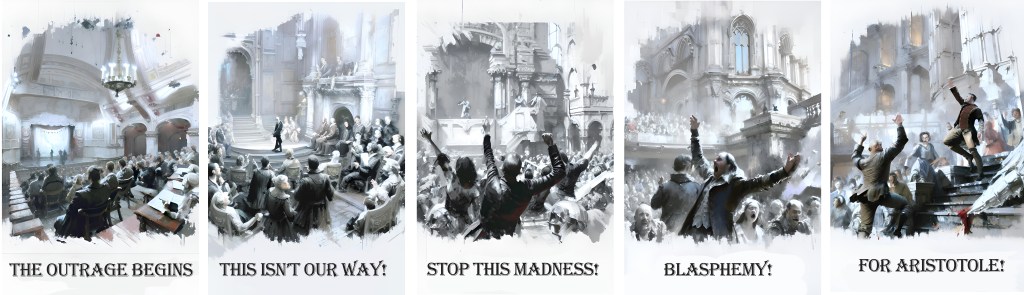
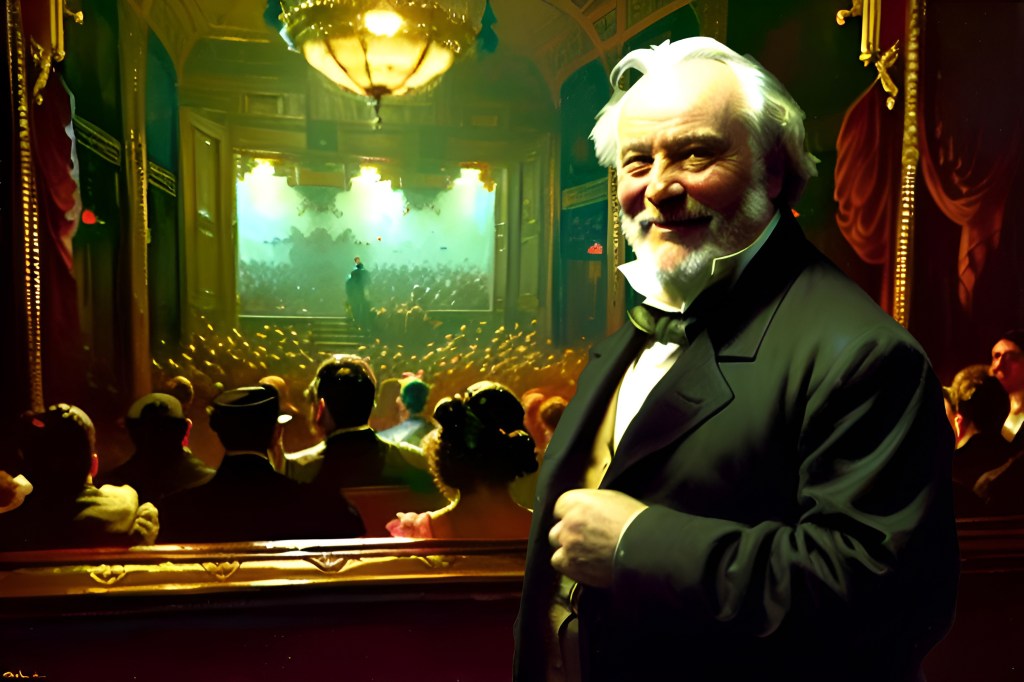
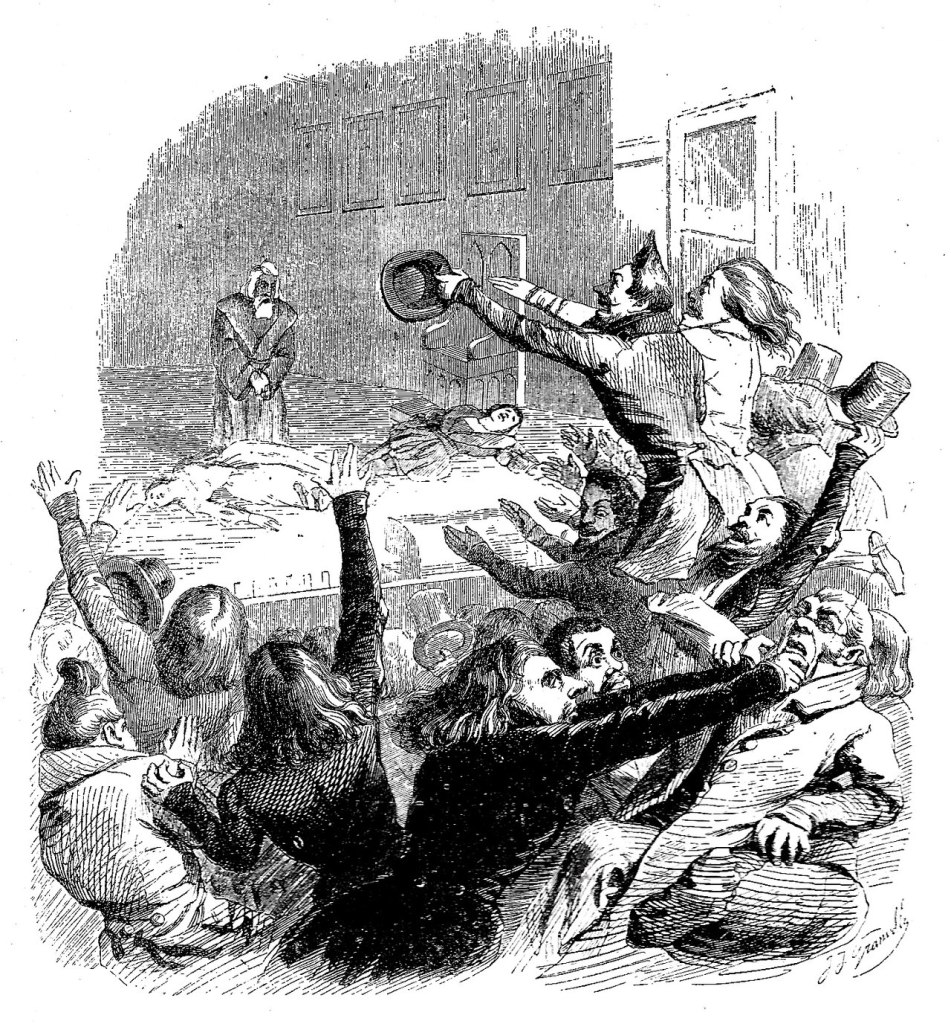
Anyway, there was an interesting riot at a theater on February 25, 1830 in Paris that has a few things to teach us about how to break ground in creative work. And as creators right now, with the looming and worldshaking onset of AI disrupting every outlet of creative work and threatening that age-old security we were all told that computers can’t create, it’s more important than ever that we get really, really good at doing new things.
New things, man. New things. Now AI can’t really do that.
What is the context on this Hernani thing?
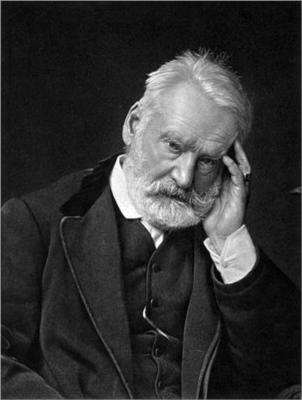
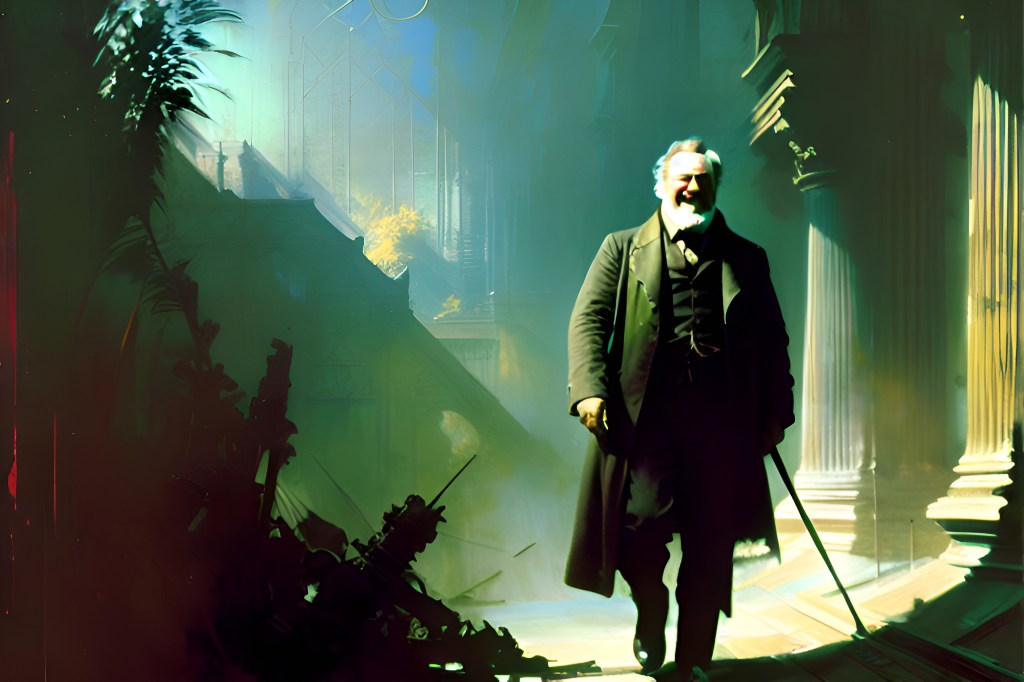
Victor Hugo wrote Les Miserables and the Hunchback Of Notre Dame. That’s where you might know him from.
This guy:
He was a playwright too though, and in his day the structure and content and expectations of plays were widely agreed and rigid. You didn’t mess around with these things if you wanted to be treated seriously and not look like a disrespectful clown. After all, Aristotle analyzed storytelling in tragic drama at an almost divine level 2,000 years before in his Poetics and designed the perfect tragedy, defining the unities:
Unity of time: the action of the play must unfold over a single day
Unity of place: the action must take place in a single setting
Unity of action: the play should comprise only one plot
If you abided by these principles with your play, which was the norm for hundreds of years in Europe, then Aristotle’s intense study of impact and memorability and propriety assured you that you had a well-constructed play. Why deviate from that – you think you know better than Aristotle?
Another non-negotiable was the clear definition of genre: comedy or tragedy. More than just branding, this was crucial to the audience’s interpretation of your work. Is it supposed to be funny, and so pratfalls and misunderstandings and goofy idiots abound? Or is it supposed to be sad, and so have larger-than-life people make key mistakes based on their natures and lose it all?
And finally, you didn’t show things that were grotesque, things that were compulsively ugly or distorted. It was just improper and undignified.
Oh no, what did Victor do?
Well, he wrote this. It’s the preface to a play called Cromwell. It pissed a lot of people off and set the stage for the riots to come later. A few tastes of his blasphemy:
“But the age of the epic draws near its end. Like the society that it represents, this form of poetry wears itself out revolving upon itself. Rome reproduces Greece, Virgil copies Homer, and, as if to make a becoming end, epic poetry expires in the last parturition. It was time. Another era is about to begin, for the world and for poetry.”
“…the grotesque is one of the supreme beauties of the drama.“
“‘But,’ the customs-officers of thought will cry, ‘great geniuses have submitted to these rules which you spurn!’ Unfortunately, yes. But what would those admirable men have done if they had been left to themselves? At all events they did not accept your chains without a struggle.”
Victor was saying that the unities of time and place arbitrarily handicapped the dramatic potential. Check pages 15 and 16 for his blast on unity of place – it being silly to think so much important action would happen in this one spot, and what blah-blah is needed to tell the audience what’s going on elsewhere! He continues on pages 16 and 17 destroying unity of time – it being equal nonsense to expect important events all to happen in a day.
And wow, is that one something Hollywood sequel writers should read!
In summary, he felt the rigid genre conventions of comedy and tragedy were limiting his ability to express wide ranges of emotion and experience, the unities were unnecessary constraints that forced silly adjustments, and, most importantly, he didn’t care for the convention of avoiding the grotesque. He called for a new genre to explore the essentials of life, with beauty and ugliness, good guys and monsters, gold-laid parlors and miserable alleys.
“These rules, man! They’re cramping my style!”
What was Hernani then?
Well, Cromwell was too big in scope to even be staged. It’s 400 pages long and at one point needs the British parliament to enter the stage. His next attempt got banned. Then he wrote Hernani, which censors possibly felt was too ridiculous to bother with.
Plot? Two noblemen and a mysterious bandit are in love with the same woman. A conspiracy is in play, and things get dark ending with a wedding and poison.
Rules broken? Well, the story unfolds over 6 months at various settings. That was naughty of him. You weren’t supposed to show death, violence, or intimate scenes. Hernani opens in the lady’s bedroom and closes with three suicides. Equally naughty. You were supposed to adhere strictly to your chosen genre: comedy or tragedy, but he incorporated farcical dialogue and had a king hiding in a wardrobe. Language should have been clean and high-minded, but he included lines like:
“Is this the stable where you keep the broomstick you ride at night?”
You weren’t supposed to let your lines of a sentence from one line of verse to another, but that happened too. Characters were supposed to be one-note caricatures generally who didn’t change, to represent some trait or concept, though he fleshed them out far more than was typical and allowed transformations (such as Don Carlos becoming a good emperor). And he used stage directions like a madman, which was also strange.
So this happened:
Why was there a riot though?
These Parisians had been through revolutions and guillotines, deaths and restorations of kings, and were reading on a daily basis about massive changes in nations such as Italy and Germany where entire systems of government were being born while others faded. France was still in turmoil politically and censorship was a powerful tool to shut down free thinkers and radicals. Breaking rules in art was linked to breaking other rules, perhaps those tied to abiding by norms set by those in charge.
Today in a politically split country we might feel threatened by those who question gender norms or who bend traditional family structures because we fear what a loss of those foundations might mean for the country’s future, what impact it might have on our children. You see how mad everybody gets about that every day on Twitter. Here in Paris, it was perhaps as scary for them.
In fact, many of those same rioters a few months later in July ousted King Charles X and replaced him with “Citizen King” Louis-Philippe.
Why is this a big deal?
My point today is that it was risky and insightful for Victor Hugo to see these literary conventions as the limiting factors they were and to dare to break them. And when he broke them, it wasn’t for shock value as so many charlatans today offer instead of talent. Victor didn’t break the rules because he was a renegade, he felt they limited his storytelling.
He kept his eye on the point behind what he was doing: telling an impactful story. Maybe Hernani’s plot is nonsense, but that wasn’t what he wanted anybody to take away from it anyway. Read the Cromwell preface. He wanted a new genre free of limits.
Impressive. Impressive to even notice the limits. How many conventions do we abide by and not even notice. Are our prison walls invisible?
What does this have to do with AI ?
AI writing tools like ChatGPT are not going away. They’re seeping into our marketing copy, our kids’ essays, blog and social media posts, even podcast scripts. As creators, there is one important fact behind any AI-based technology like these which can be an asset for us. They are trained on data sets and those data sets include conventions and limitations like those Victor Hugo raged against.
Ask ChatGPT to write you a story about King Arthur or a D&D scenario and it’s painfully generic. We as creators are in an arms race then, as those tools get better. We have to get better.
Grailrunner is excited to announce the latest addition to our growing Salt Mystic Lore Card set: a mood-setting, rousing vignette titled “Canyon Of Living And Dying”. Download it for free here.
Welcome to the Grailrunner Story Arcade!
Salt Mystic is our rapidly growing western science fiction setting, upon which we’re building everything from novels to games and merchandise. You can learn more about that here. Key to this innovative new way of exploring immersive storytelling is the idea of worldbuilding through a collision of art and fiction. Sometimes the art comes first, then a story is built around it. Sometimes, a story idea percolates and only starts popping after an image is crafted for it.
However it happens, we’re building out locations and settings, characters and background lore, all through experiments and inspirations that often get shared for free on social media and here on the Grailrunner site. The hope is that those of us out there who dream of adventure and exploration, of new worlds and intriguing concepts, we’ll all find a home here! And that you’ll buy books and stuff.
Definitely buy the books and stuff.
The Story Arcade is also a place for people playing the Salt Mystic tabletop wargame to find interesting settings for the battlefields they play upon. That’s where this week’s addition was born, actually.
What was the inspiration for this?
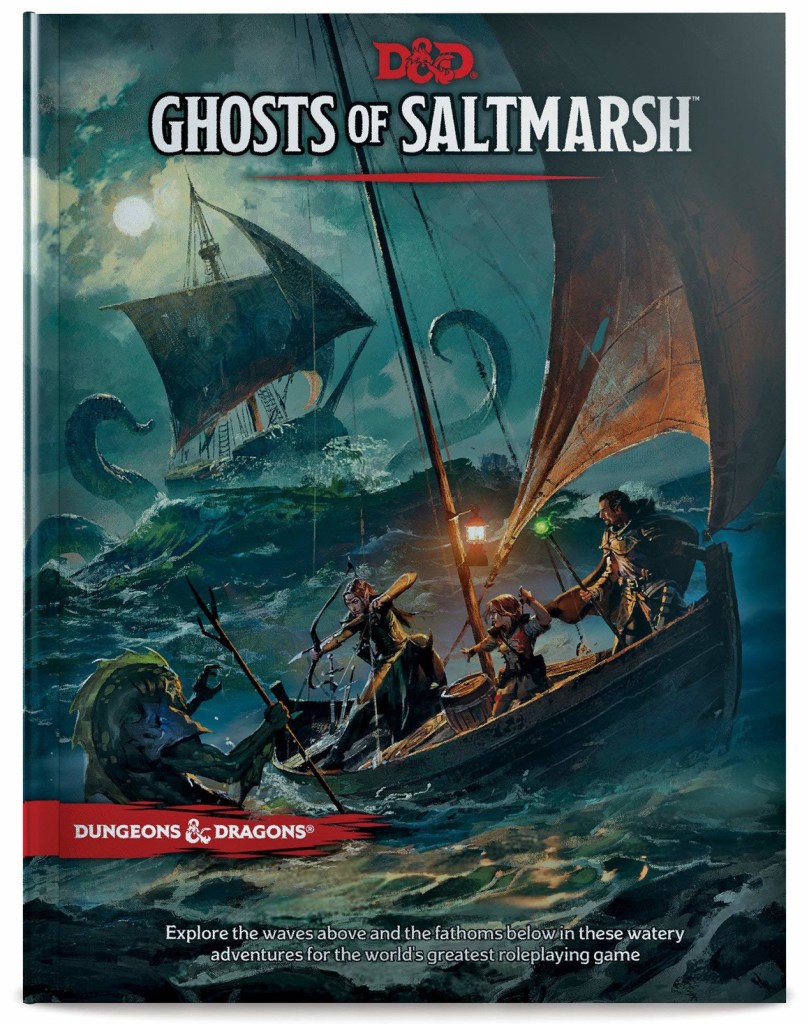
Writing this article here, I was reminded of a really well designed dungeon adventure that appeared in a Wizards Of The Coast compilation titled Ghosts Of Saltmarsh.
Spoiler alert – there is a point in this adventure where the very dungeon setting itself (a ship) starts sinking and flooding. The dungeon destroys itself, and you have to get your characters out or drown. And to me, that’s incandescent genius! I became enamored with the idea of a battlefield setting for the Salt Mystic game where the battlefield floods or sinks or catches fire or otherwise starts snuffing out characters not fast enough to survive.
Generally, I haven’t solved how to convert that to a Salt Mystic terrain book yet. Maybe one day. But one of the ideas that didn’t pan out as I thought about it was a high canyon where the battle was to be fought on crumbling rock walls. I imagined a giant stone golem at the base throwing boulders up at the armies and snatching random people away. It sounded cool, but game rules and art to make that work just didn’t click for me.
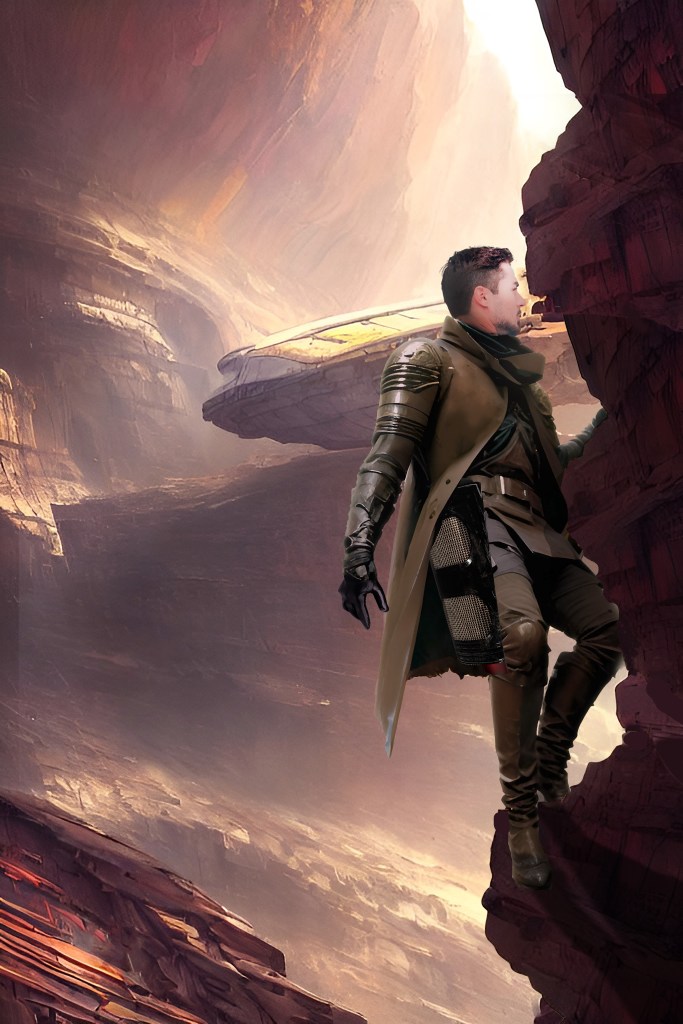
This image is what came of all that. I had the picture of a carbine gunslinger nervously clinging to a high rock wall with a derelict in the mist behind him, precariously perched in an inaccessible place.
What was the process to create the image?
Like most of the imagery I produce, this is a photobash of several elements composited together in Photoshop and painted over. The carbine weapon strapped to his hip is something I generated in Blender, but re-textured recently. The climber is a composite of two AI-generated elements and a handful of stock images, run through a filter in Photoshop and color and light graded to match. The background is a composite of two AI-generated landscapes from two different pieces of software, and I used two overlays from Nucly for lighting effects.
What about the story?
I rewrote that three times, trying to give it a western feel. The idea is a dude from a rinky-dink town in the middle of nowhere deciding that the fear of climbing up there is not as strong as his need to really live, to maybe make a name for himself. Or maybe to solve the mystery of what’s inside that derelict.
In the story, he says “to live is to burn”. I totally stole that from Harlan Ellison, who said he stole it from an Egyptian papyrus. Whoever said it first, it’s awesome.
*
Anyway, I hope you enjoy the new Lore Card. Shoot me a comment or note if you’d care to chat it up about Salt Mystic or where we’re going with all this.
Back in 2017, I wrote an article about Herman Hesse’s fascinating Glass Bead Game. The idea of two people at a table moving shiny glass beads around on a complex game board filled with mysterious glyphs, pondering incredible connections between disparate concepts still intrigues me terribly. I imagine a near-impossible breadth of knowledge needed to master this imaginary game, and its best players discovering hidden patterns behind reality and history as they ply their ingenious strategies.
Awesome.
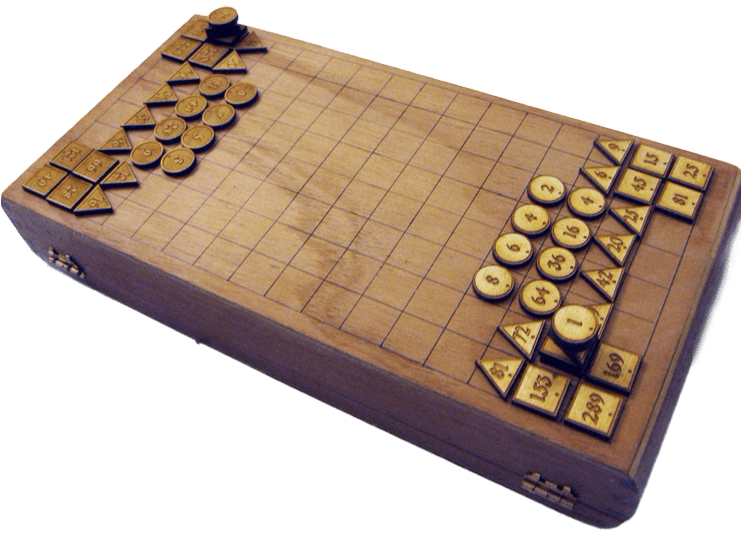
Still, that’s fake. No such thing. Not really. But I wanted to bring something to your attention that has been around since the 11th century and that you can still buy on Etsy or whatever that isn’t fake at all. And if you squint real hard and just go with it, you’ll see something equally fascinating: an engine to tune your mind to the workings of the cosmos (sort of).
Anyway, I’m going deep right now into Medieval cosmology. Don’t ask. I don’t always pick these intellectual bunny trails; sometimes they pick me. Has to do with D&D’s Spelljammer, the Troika roleplaying game, and something I’m going to write up here in the future on Grailrunner. Will be great; I promise. Still cooking.
But this though:
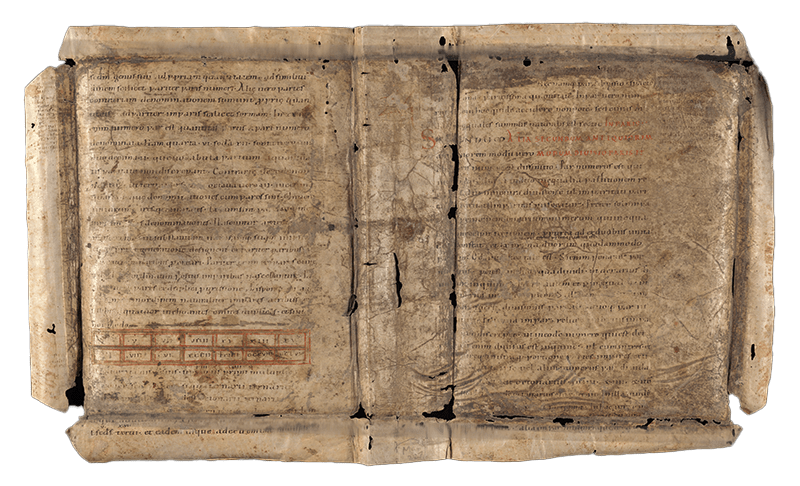
That’s a vellum manuscript dating back to 1000AD, a copy of a work titled De Arithmetica by a philosopher named Anicius Boethius who actually wrote the work in the 6th century. He’s more famous for a conversation with philosophy in woman form called “On The Consolation Of Philosophy”, which is a bit of a mood piece about the fickle nature of fate and how you should deal with that. Not my topic today. Let’s talk about that book in the picture.
“Wait a second. You’re a blog about nerd stuff and science fiction. Why are you on about this right now?”
I hear you. Hold on to that. We bring you inspiration, and wonderful little nuggets that you can file away for your own creations. Edison said “All you need to invent is an imagination and a pile of junk.” And so we proceed…
“So what’s the big deal about Boethius?”
Boethius is important because he served as a bridge between ancient philosophy and the Middle Ages. He didn’t just translate Aristotle, but also commented on the works and added newer insights. He brought ideas from Neoplatonists like Porphyry into wider recognition and helped people make sense of them. In De Arithmetica, he translated De institutione arithmetica libri duo by Nichomachus of Gerasa, who was writing around 100 AD. You see what I mean about this guy being an important bridge of older thinkers, yes?
Philosophy is about pondering things, seeing the beautiful and intricate architecture behind things in flashes of insights and through establishing connections where others can’t see them. Boethius saw the foundation of philosophy as a bedrock he called “the quadrivium”, consisting of arithmetic, geometry, music, and astronomy. Fundamentally and at their innermost core, he might tell you, these four things merge.
“I thought we were talking about a game?”
Yes, we are. Here’s a wikipedia article about Rithmomachia, also called The Philosophers’ Game or The War Of The Numbers. The game is based on the study of numerical proportions and harmonies that Boethius studied and wrote about, much of which you could find perusing through that book up there. In fact, historian David Sepkowski said of Rithmomachia that between the twelfth and sixteenth centuries,
“Rithmomachia served as a practical exemplar for teaching the contemplative values of Boethian mathematical philosophy, which emphasized the natural harmony and perfection of number and proportion, that it was used both as a mnemonic drill for the study of Boethian number theory and, more importantly, as a vehicle for moral education, by reminding players of the mathematical harmony of creation”.
“What?”
Here, check this out to see what he’s talking talking about, then I’ll tell you what it’s like playing this game:
Arithmetical proportions: Say I give you the numbers 3 and 15. You can find the missing number between them that would form an arithmetical proportion by summing the first and last numbers of the sequence (3 and 15 for a sum of 18), then dividing by 2. So in this example: 3, 9, 15.
Geometrical proportions: Say instead I give you the numbers 2 and 72. You can find the missing number between these that would form a geometrical proportion by multiplying the first and last numbers of the sequence (2 x 72 = 144) then finding the square root of that. So in this example: 2, 12, 72.
Harmonic proportions: Say now, finally, I give you the numbers 12 and 20. You can find the missing number between these that would form the harmonic proportion by multiplying the first and last numbers of the sequence and also by 2 (12 x 20 x 2= 480) then dividing that by the sum of the same two numbers I gave you (12 + 20 = 32). So in this example, 480 / 32 = 15 and the sequence is 12, 15, 20.
To the minds of the Greeks, all the way up for centuries after Boethius wrote about this, number sequences like this have a magic to them, because they’re tuned to reality itself. Nature and the cosmos, the very music in the air, the movement of the moon and the stars, all tied in to these perfect, intellectually satisfying numerical relationships. Measure anything in the stars or on the water or in the music from a harp and you’ll find these sequences, they would tell you.
Make fun of that if you want, or look down on it as caveman thinking, but I felt the same kind of magic in school when I studied this little wonder:
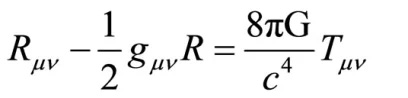
That’s Einstein’s field equations, tying together everything that ever was. It’s one of the most verified things in Physics. Explains how the world goes round, why things fall, and the future of the universe. Gorgeous. Absolutely gorgeous. That’s the way the monks felt playing Rithmomachia, clashing their little game pieces together looking for ways to feel these proportions. Not to just learn them.
To feel them.
If you’re at all interested in learning more about this wonderful game, seeing its rules clearly delineated for you, and seeing some nice illustrations of game play maneuvers, then head to Amazon and read Rithmomachia by Seth Nemec.
He does an amazing job walking you through why the number sequences mattered to those to whom this game was more than a pastime and a learning mechanism, but rather a way of worshipping and meditating on the very fabric of the cosmos. If you have Kindle Unlimited, it’s free.
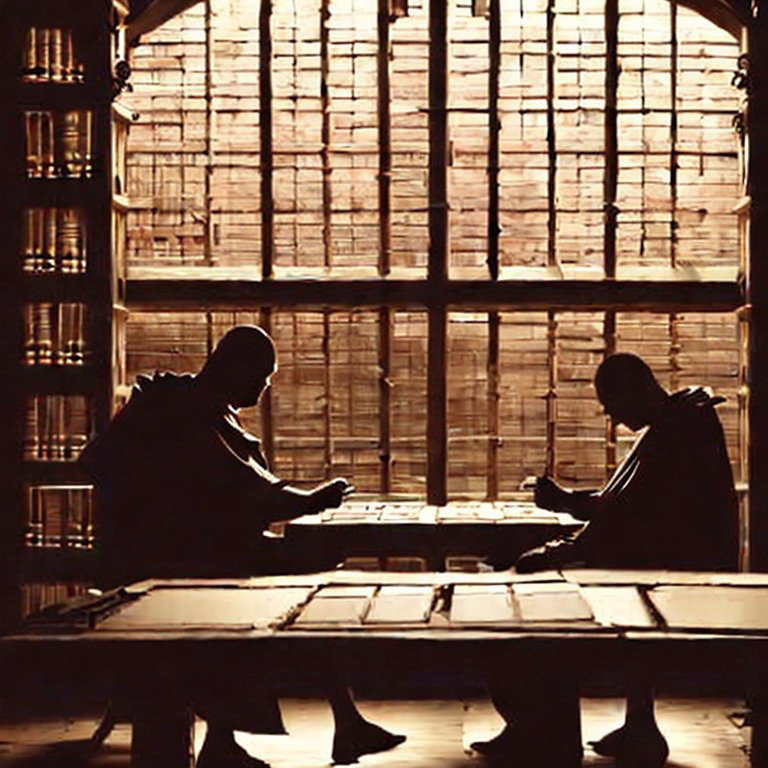
I’ve read it four times myself over the years just because he makes the game seem like an awful lot of fun, and somehow important. It makes me want to hop in the minds of those monks and feel the way they felt playing it, and to see that crazy board and its pieces on a big old oak table read to go.
In fact, it was the idea of a philosophers’ game with real-world implications that inspired a story collected in Kyot: The Storybook Puzzle Box. That one’s called The Berserker’s Game, and a far bit darker than Rithmomachia. Read it here if you like.
Overview of Rithmomachia
Quick summary of the game though, so I can tell you whether I beat my son on Christmas Eve or not (and some insights we had playing it):
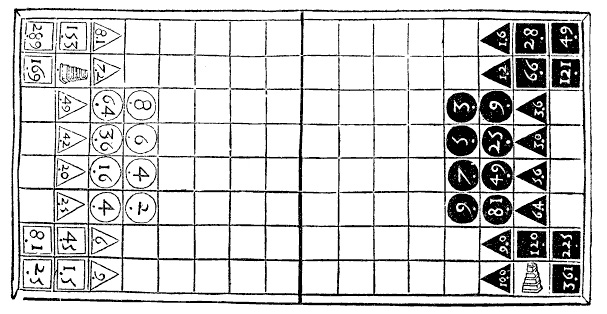
Game pieces: Game pieces are either circles, triangles, or squares, all with numbers on them. The two game piece sets aren’t the same, nor are they symmetrical, though the White player’s pieces are based on even numbers and Black’s pieces on odd numbers. The numbers themselves, their placement in the starting setup, and the movement rulesets are all based on Boethius’s proportions. Precisely defined stacks, one stack per opponent and called ‘pyramids’ are provided for as well.
The board: The board is an 8 x 16 squares grid, basically two chess boards set end to end.
Moves: Everything can move orthogonally or diagonally, but circles move 1 space at a time, triangles 2 spaces at a time, and squares move three spaces at a time. Piece moves can’t come up short – you move exactly 1, 2, or 3 spaces when you move. Pyramids may move in the manner corresponding to their component parts, as long as the requisite shape is represented somewhere in the pyramid (meaning it can’t move a single space any longer if it’s lost all its circles, for example).
*
Attacks: Four basic attacks exist (but the attacking piece does NOT move into their victim’s space as it does in chess or checkers, you just call it and take the piece):
1. Siege is surrounding a target piece on four sides, either orthogonally or diagonally (board edge counts). Surround them and call it, taking the piece.
2. Encounter is when an attacking piece COULD legally move into the space where an opponent’s piece (of equal numerical value) is located. Just call it and take the piece.
3. Eruption is when you multiply the attacking piece’s number by the spaces between it and the target piece to obtain the target’s number. Say your 8 is 2 spaces from your opponent’s 16 (which in this game means side by side because the squares they’re on count in this calculation). Since 8 x 2 = 16, and that’s the target’s number, you call it and take the piece. Division okay too.
4. Deceit is when you surround a target pieces on 2 sides, and the two attacking pieces sum to the target piece’s number.
*
Victory conditions: A number of victory conditions are provided across two categories – those defined based on pieces captured and those defined based on numerical progressions formed with remaining pieces on the board. Simplest possible is Victory Of Goods, meaning pick an overall score (say 100) and the first player to capture pieces summing to that number wins.
“So you’ve played this? What’s that like?”
I built a Rithmomachia board based on Nemec’s book a few years ago when I first encountered the game, just to see how the rules played out, and what differences I experienced in game play between the opposing sides, given the asymmetry of their assigned numbers. It’s been in my closet a while now though. My son is in college, majoring in computer science and math, and I knew he’d be into this when he was back home for Christmas (2022 as I write this). It’s right down his alley now, and he’s devious and sly enough to uncover slick strategies in any new game.
And he’s not afraid to get mean when necessary.
Some interesting insights based on our game play:
Eruption is awesome. It’s just awesome. It was our signature move, because of the level of aggression and devastation you can wreak with it. Planning Eruption attacks feels like planning moves for Bishops, Rooks, and the Queen in chess, only slightly more difficult due to running all the permutations through your head.
I see now why the checkerboard needs to be as long as it is – Eruption needs spaces on the board to provide for more multiples and make the math behind the attack useful in going after larger numbers. If you’re only multiplying by 1 or 2 each time, that isn’t much to work with.
The rules allow you to take multiple pieces in one attack as long as conditions are met for the respective pieces, so we really focused on trying to make that happen. It felt a lot like chess in that respect, with long turns of staring at the board. (We had very little luck in this though.)
The fact that you don’t move the attacking piece into the captured piece’s position flavors the entire game very, very differently to chess or checkers. It’s much more cerebral, constantly checking different combinations and possibilities mentally. Since you can’t move and attack in the same turn, this forces you to spend some turns moving just to change up the board configuration.
We stuck to very basic attacks and lower numbers. Yet there are numbers on the board like 289 and 361. You’re dividing a lot, trying to seize one of these big pieces, but you can see pretty quickly that won’t be easy at all to just go for the one big kill shot, due to their placement in the startup configuration. We really should have moved more pieces versus the constant attacks, to change up the dynamics of the board
And the single biggest observation that became apparent within the first few moves was surprising to me. I hadn’t expected a game designed by monks for monks, engineered at its core for instruction and meditation on the harmony of the cosmos would be a poker face game of deceit.
“What do you mean?”
So many of the attacks work both ways. Since you can’t move and attack in the same turn, when you move into position for your planned attack, in many cases, the other guy can do it to you instead. That was especially true for us because of our fascination with the Eruption attack. It meant you had to keep a straight face, look elsewhere on the board, even say deceitful things to distract your opponent from what you’re scheming.
Our game deteriorated quickly into a broadsides shootout between our two pyramids and with a few surrounding pieces, blasting away with Eruption attacks since we kept getting confused about what was concealed in the stacks. It was a way of trying to surprise the other guy.
I just hadn’t expected a monk’s game to require so much deception and stealth. Crazy.
“Well, who won?”
I got a lucky strike in, which sent me over the goal for a win. Honestly, it’s just a lot to keep in your head with many, many possible sneak attacks. You start to feel a little paranoid about that.
But overall, I did start to get a feeling for the numerical patterns, the weight of the larger numbers, the reasoning behind their placement and the logic of the startup configuration. It’s a fascinating game, and easy to see why people who felt these patterns were the language of God would see wonder in the board and its pieces.
Anyway, that’s what I wanted to tell you about this week. Great game, and Nemec’s book is worth a read.
Occasionally as we build out the Salt Mystic universe, some spooky new threats pop into existence that surprise even us. Right now, I’m 23k words into a standalone novel set in this world that will shake it like an earthquake, introducing new weaponry and technology, several exciting new locations, and a host of new terrors!
Enter the Day Giant.
If you’re new here, let me back up a bit. The Salt Mystic setting is an experiment in immersive storytelling that fuses art, fiction, and games into a unique and thrilling experience. Right now, it’s a novel that introduces the main narrative, a terrain-based trading card wargame that expands and breathes life into that narrative, a growing line of branded merchandise (including our first art print!) and freely downloadable illustrated flash fiction called Lore Cards.
Click the wings to learn more:
We’ve been hard at work dropping new Lore Cards over the past few weeks, so make sure you stop by every once in a while to see what’s new. The Story Arcade is what we call the repository of cards, and it’s a place to get inspired for your own games of Salt Mystic or to fuel elements in the Roleplaying Game system of your choice.
Click the medallion to see all the current Lore Cards:
Although Salt Mystic is at heart a western-inspired science fiction setting, with a theme of exploring lost and hidden worlds, I feel like no adventure stories are complete without a terror that sticks in your mind and creeps around there. In the Work In Progress novel, to be called Mazewater: Master Of Airships, you’ll be introduced to a scrappy, gangly fellow named Lamberghast Mazewater, who faces such a threat with a quivering voice, a shaking hand, and armed with only his big heart. More to come on that as it develops.
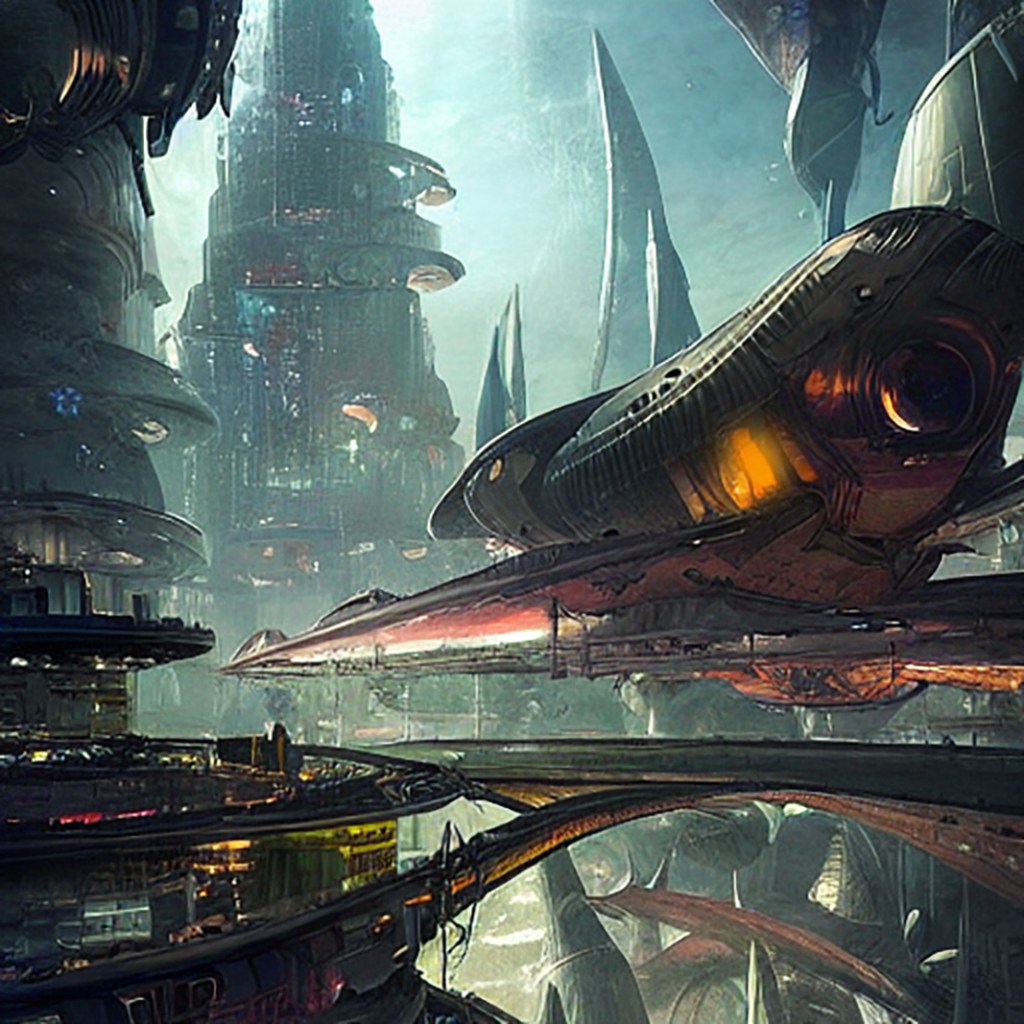
A vortex glider high over a watchtowerLamberghast MazewaterMazewater At Vimana Station
The artwork
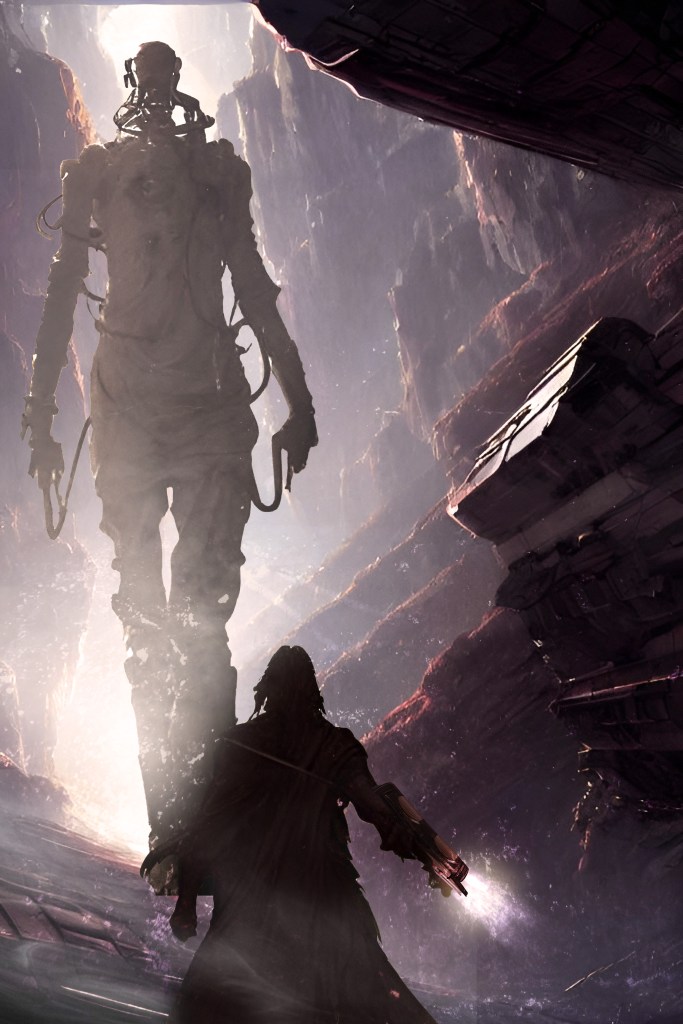
The art for the new Lore Card was produced combining elements from two AI art generators, then painting over them and completing the composition and adjustments in Photoshop. This approach is a real game changer for small indie publishing companies like us! Sometimes, the image comes first and then the story. It was the reverse this time – I knew the giant’s general appearance and that I wanted a gunslinger facing off with him. That’s all I knew though.
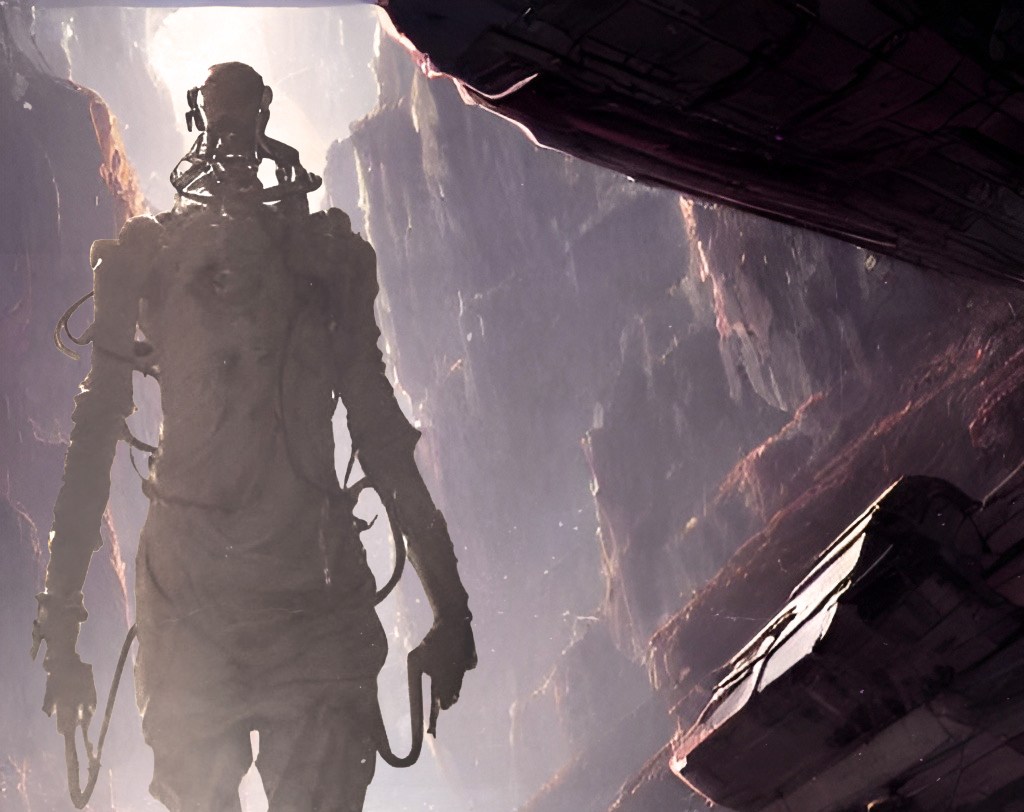
The giant: It took many, many iterations with Codeway’s Wonder app using text prompts like “enormous thin giant in rags with oxygen mask and exoskeleton” till I got something vaguely like what I had in my head. The color was wrong, as was the perspective, the tone, and it had bits and bobs all over it that were unwanted. I cut it out, trimmed the odd bits, then altered the perspective so his top half was smaller.
The canyon: The canyon was another round of iterations, in both Stable Diffusion and Wonder, till I got a mashup composition of rocks and lighting that generally gave me something to trigger the eyes to see the giant as huge. I wanted light coming from behind it, so I juiced that with a Color Dodge and soft brush.
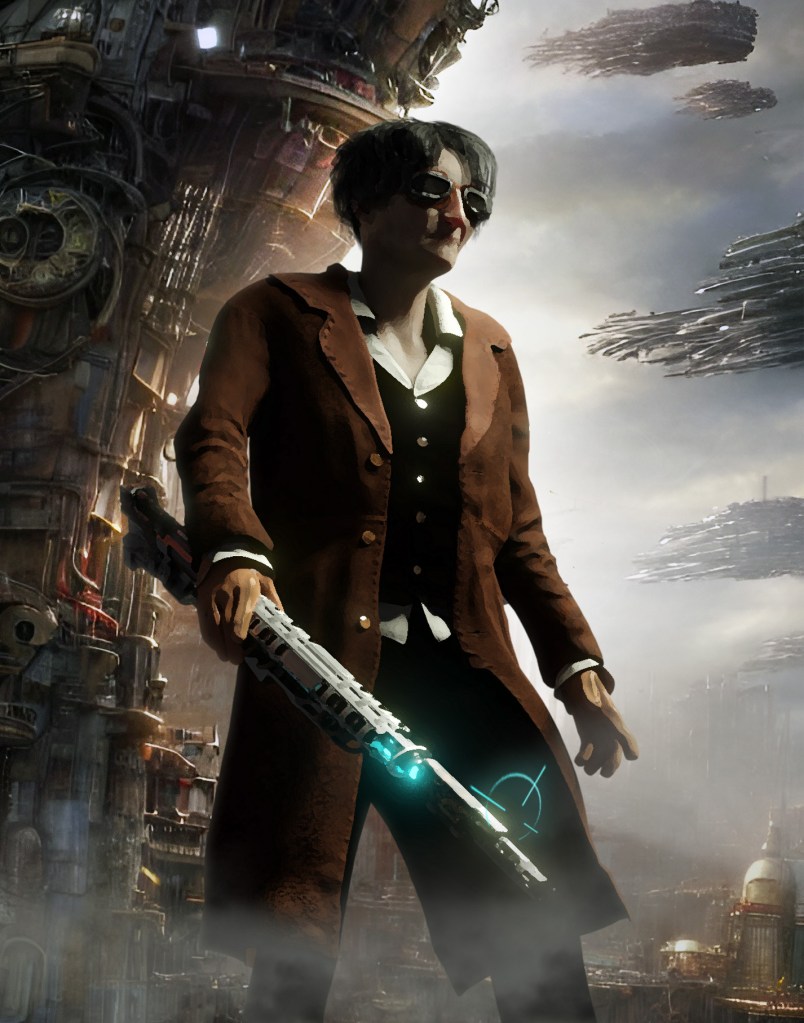
The gunslinger: The gunslinger was a third round of iterations, in Wonder. The text prompts were things like “fantasy gunfighter in long coat holding his arm out”. This one had bits and bobs coming off it as well, and the coloring was terrible. He also had weird holes and discolorations all over him, which I had to correct.
The weapon: The ball lightning carbine is a long-standing custom item I use all the time. I built and textured it in Blender. This time, I cut out parts of it to show it partially concealed by his sleeve and brightened the barrel’s tip (with the Dodge tool) to show it glowing from the heat inside the barrel.
There’s a company called Nucly that offers various overlays for Photoshop – I included a ‘god ray’ overlay and morphed it to emit from the gunslinger’s weapon. That looked cool already, but something unanticipated happened once I started making adjustments.
The lighting: I superimposed a grunge texture over the entire image in Screen mode, which roughed up the look of it in a way I really liked. However, I noticed the Color Dodge blur coming from behind the giant as well as the charge firing out his weapon reacted with the grunge overlay for even cooler lighting effects than I’d planned. I really liked how that turned out, honestly.
Color grading: I tried various warming and cooling filters over the entire image, and tried adjusting its color grading to various images whose color schemes I liked. This warming filter (an evening sun shade of orange) won me over because of what it did to the canyon rock.
Here’s the final image, which will also eventually appear (in altered form) on an upcoming Volume Two game card next year (click on the image to see the Lore Card and read the associated story):
I hope you like the art and the story, guys. Let me know what you think! Till next time,
I’m a visual thinker, big time. If you’re explaining something to me, I’m probably picturing what you’re talking about so I can follow what you’re saying and make something useful of it. If the picture starts to fade on me, then you may as well be speaking jibberish. That’s why rapid prototyping concept art is such a gamechanger for me, at least, in storytelling and game design. And it can do much more than prototype, as long as you’re not afraid to spit and polish.
In the last few months, AI art generators have taken off like a rocket and are rapidly improving in functionality, customization, and capabilities. Stable Diffusion, Codeway’s Wonder, and Artbreeder are my favorites right now, depending on the functionality I’m looking for. Midjourney and Dall-E have stolen all the oxygen out of the room as far as the media running with this narrative, but for fantasy / speculative fiction concept art they don’t offer the styles and datasets I need.
At Grailrunner, we’ve recently incorporated AI-aided art into our workflow for marketing images, for the website graphics, and to some extent in our products. I’m sorry if you’re an artist who feels threatened by this marketplace shift, but it really is a technology that is unlikely to go away or accept a lot of regulation. At this point, with millions of images generated per day across multiple apps, it feels more like an unstoppable tsunami you should probably figure out how to surf.
We just added another Lore Card to the Story Arcade here on the site and thought it would be fun to show a behind-the-scenes on the work, mainly to show how we’re using this fantastic new tool in what we do here.
What’s photobashing?
Photobashing is a technique where artists merge & blend photographs or 3D assets together while painting and compositing them into one finished piece. This is used by concept artists to speed up their workflow and achieve a realistic style. –Concept Art Empire
Stephen Gibson, Art Director and designer of Grimslingers makes an interesting comment about this: “My current style for Grimslingers is photo/3D bashing. I collect images to splice together and keep painting over it, splicing in new images to fill out the character until I can’t stand to look at it anymore.” -Interview, Nov 2022 ImagineFX
Funny, huh? Anyway, photobashing is a big part of my concept art journey. I started off trying to paint everything myself and realized that’s not where my talent lies. Things accelerate and honestly look a lot better if I pull together stock images or 3d assets from places like Turbosquid, Shutterstock, Archive3d.net, Free3d.com, Nasa (nasa3d.arc.nasa.gov/models), Sketchfab and Daz Studio into Blender and work out compositions there. A lot of museums are starting to upload their collections as 3d models as well, typically for free!
Pulling assets together
Blender is still my go-to tool for compositing 3d assets into something useful because you can manage the placement and lighting and mess around with textures in Substance Painter. Incredible flexibility, but it’s time consuming. It’s also a place to build up assets that are unique to a world I’m creating (and so won’t be available anywhere. Then Photoshop. Always Photoshop. Nothing is done till it’s been through Photoshop. It’s a thing.
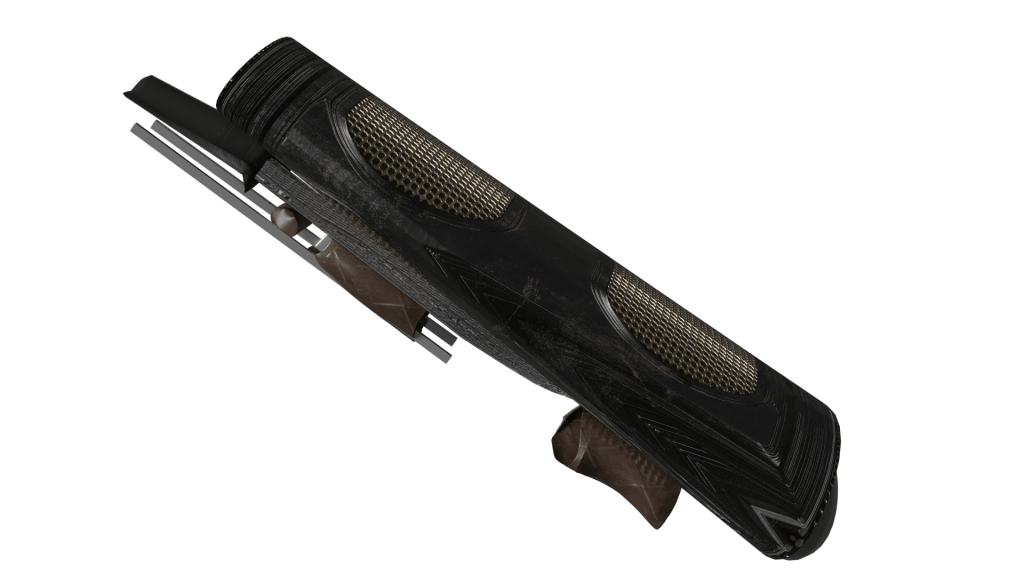
The ball lightning carbine
This is an example of what I’m talking about. The ball lightning carbine is a distinctive weapon, strapped to the arm of practically any adventurer in Grailrunner’s Salt Mystic universe. I made this thing in Blender with some parts from various models (a motorcycle, crutch, and I forget what all). The frame of it and the leather straps were just cylinders that I squashed and pulled into place, then added textures. Now I’ve got this thing in a hundred styles and orientations.
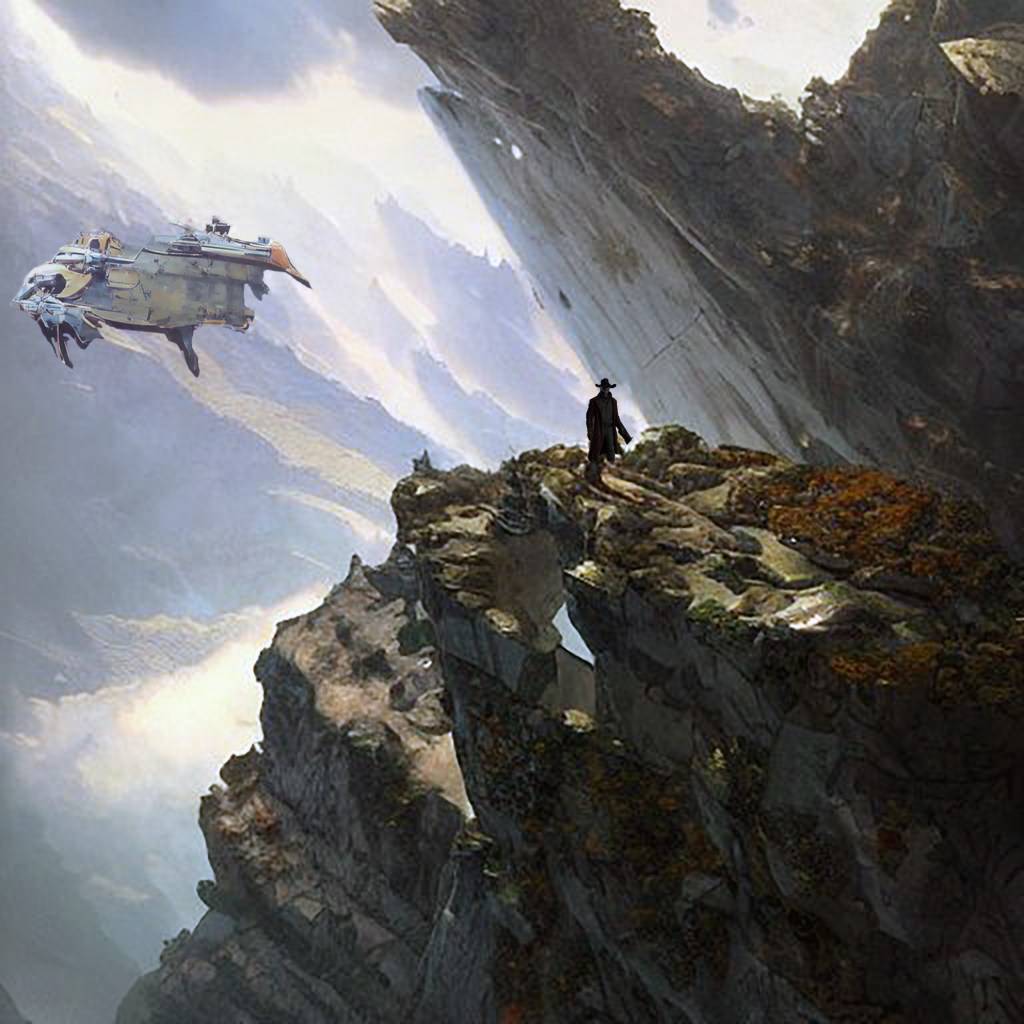
1. For our new Lore Card, it started with an idea: a dramatic aerial view of a carbine gunslinger on a mountaintop with a wide valley below him. Sometimes the story comes first, but in this case only the mental image. I’d write the story behind that guy after I saw him.
2. With Stable Diffusion, I experimented with a series of prompts suggesting the aerial view, the mountain top and valley, and the “fantasy gunslinger”. It took patience, not going to lie about that. And I cycled through several artists incorporated in the prompts to try different styles as well (you can mix artists too!).
3. Once I got something that looked like it would work for me, it needed some basic touch-up painting and color & tone adjustments in Photoshop. There was also an annoying misshapen character standing there (instead of my gunslinger that I asked for!) that had to be just erased. Photoshop has vastly improved capabilities now for easily removing stuff.
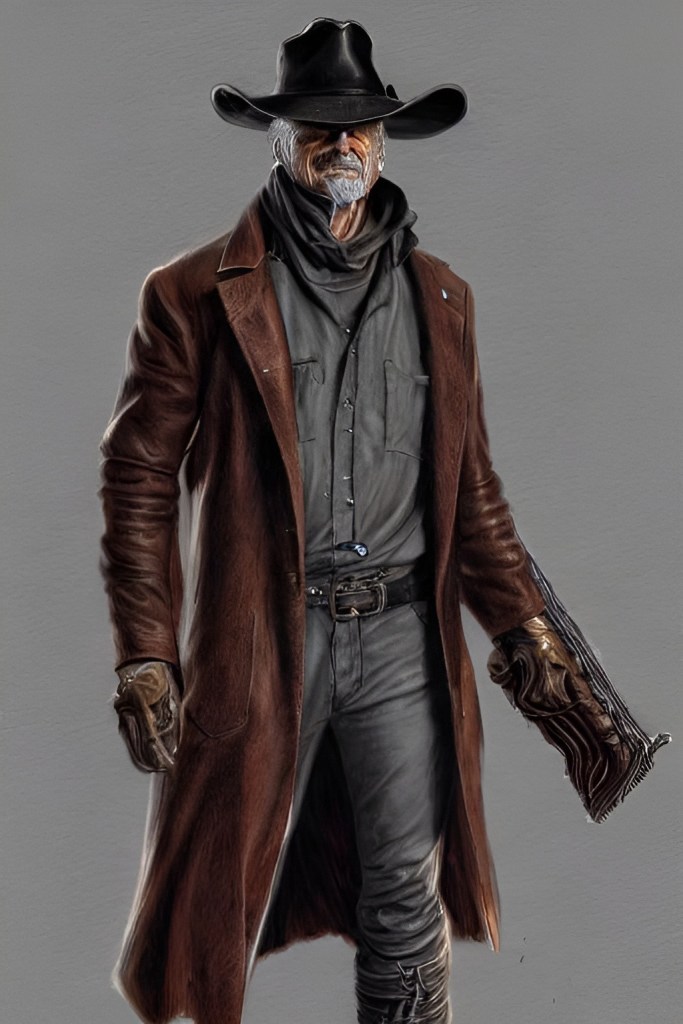
4. I still needed that gunslinger though, and went back into the cycle loop trying various iterations and prompts to get a guy in the right posture and wearing the long, gunslinger coat I was looking for.
This is the character I eventually went with. They can turn out with three arms and nightmarish faces, the fingers often run together and look like tendrils. Seriously, the output isn’t always mind-blowing, but here at least I saw the outline I wanted and general textures.
A bonus was the weird almost rectangular thing he had on his left arm, which if I squinted looked to me like our carbine without any extra editing.
5. I cut him out of his background and placed him on the mountaintop, gave him a little shadow, and darkened him to almost a silhouette. I was close, but it was bugging me that he was up on the high plateau without a clear story of how he got there.
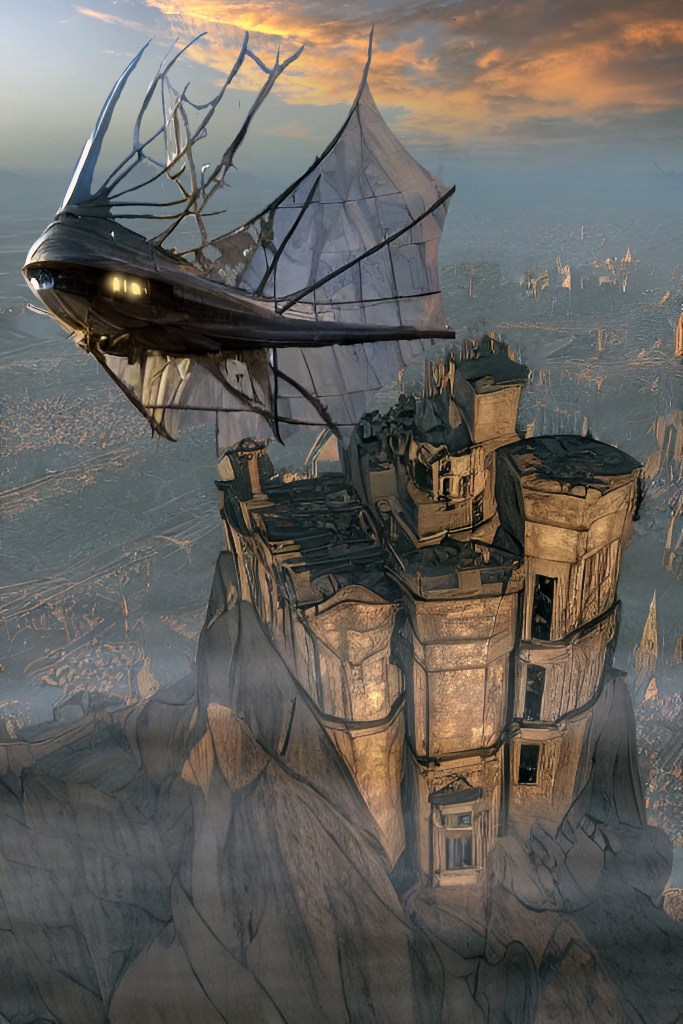
6. I already had an asset for an airship from a previous work that I repurposed here. There’s a fantastic feature in Photoshop for automatically adjusting color grading and tone to match another image, so much of the hard work was done for me with that option. I just needed to trim it up a bit and place it in context.














 Grailrunner Publishing