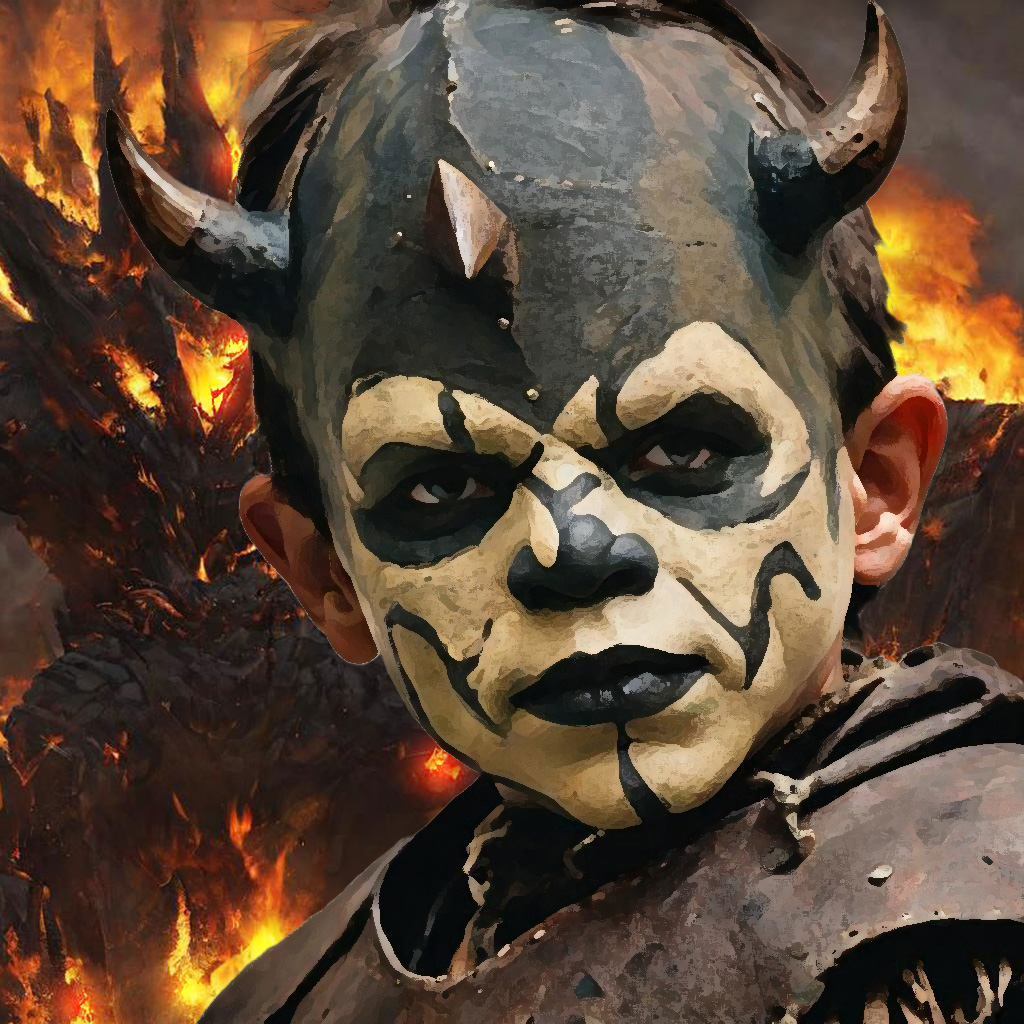
Interesting Shapes: Altered Perceptions Through The Arts

“Interesting shapes” What in the world does that mean? (I’ll come back to that)

Our passion at Grailrunner is the imaginative process, any and every thing that can unlock new ways of creating mind-melting concepts and experiences with a bent towards speculative and fantasy fiction and images. We experiment with immersive storytelling in wargames, in roleplaying games, through a fusion of art and flash fiction, in novels, and in art prints.

On a personal level, as the guy generating practically all of that, I have to spend a ridiculous amount of time developing new skills. Recently, I’ve broken out the old sketchbook and Faber Castell pencils, bought a Pigma brush pen, and started going deep on Youtube with some modern day masters of the arts to get to a point where I’m not just painting in Photoshop over photobashed composites or renders from Daz Studio or Blender.

What’s the dream?

Because I love the awe and surprise of exploration, of not knowing what lies beyond a turn in the road, I’m hoping to get to a point where I can crack open a sketchbook and not just draw what I see, but generate something in simulated three-dimensional glory dredged from my imagination without knowing what I was going to draw when I sat down. Ideas from there would feed the hopper of more purposeful art images and concepts in the fiction and games. (I did this as a child and filled countless sketchbooks, but it was all 2-dimensional super heroes, heavy outlines, terrible shading, and nothing I’d be excited to show anybody).

Is that dream possible?

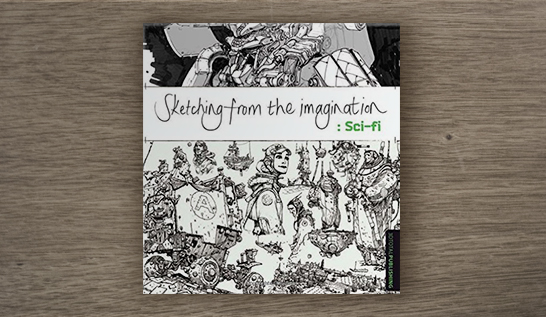
This little gem is called Sketching from the Imagination: Sci-Fi, by 3dTotal Publishing, and though it’s a few years old by this point, it will melt your face off if you’re at all into what I’m talking about here. There is some incredible talent in here. They’re doing it.

Also, these guys at ImagineFX (which is free on Kindle Unlimited now, if that works for you). One thing I especially appreciate about this magazine is the artists explain their desk setups, their materials and software, and their thought processes as they create.

What does all this have to do with “altered perceptions”?

It started with Leonardo Da Vinci’s notebooks, actually. I bought a compilation of them in a used book store in Florida and perusing them, noticing he spent a lot of time talking about the importance of an artist developing their “mental library”. I forget what he called it, but the idea was to look at the world differently and actually notice things like how light falls on an object, how light reflects off the table, where exactly shadows fall. File all that away so you can draw on it in different contexts when you need it.

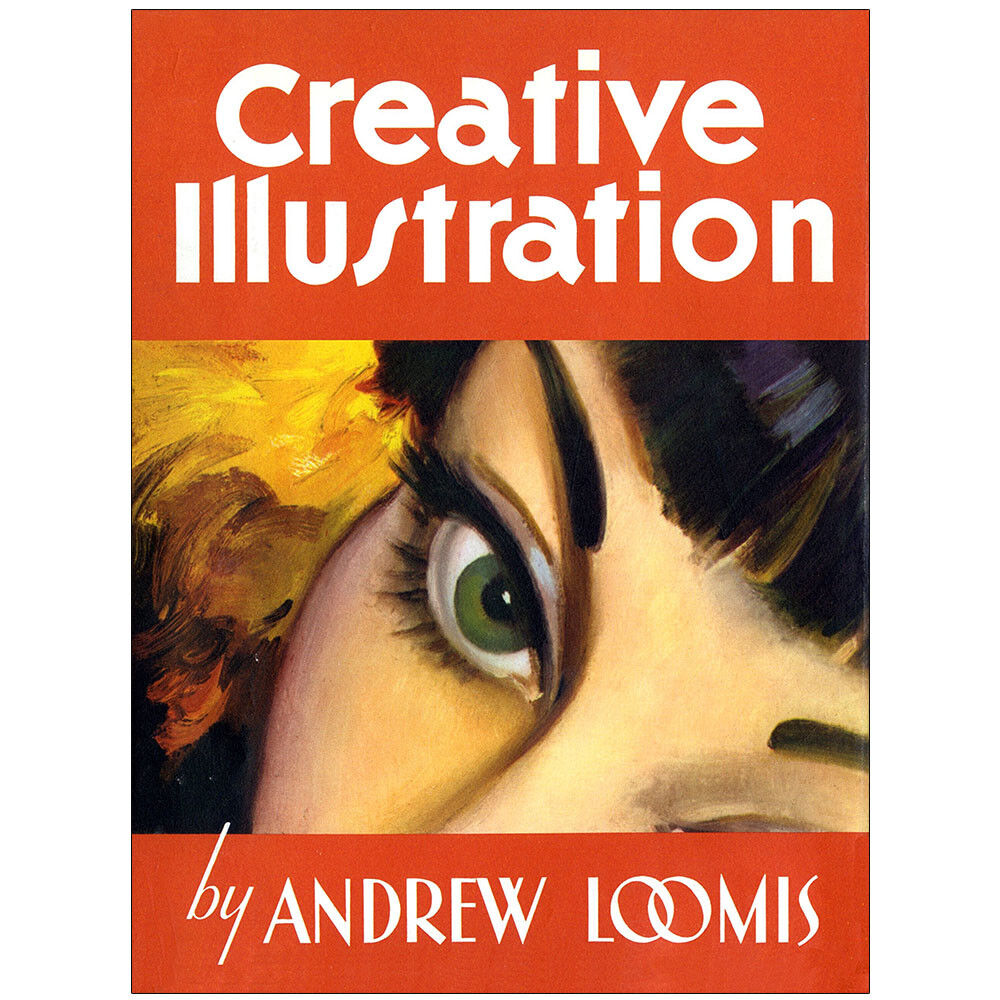
And there in one of the most influential art instruction books ever written, Creative Illustration by Andrew Loomis, he made the same sort of point. One of the first exercises he suggests is to simplify multiple scenes at random and find the “flow” in them. He saw things in terms of basic curves, ovals, and swirls and something like a person just standing there, to Loomis, was a flowing curved line. It made it easier for him to represent it simply and beautifully on the page. Yet, it’s an entirely different way to see the world, which is my point today.

I’ve written here before about the visual power and intellectual punch of haiku. My hero in that world is an astounding 17th century genius named Matsuo Basho. This guy:

I’m reading (again) his poetry, this time in some translations by Andrew Fitzsimons, finding all kinds of new and striking illuminations there. One particular comment by Andrew caught my eye: he referred to Basho as one of the greatest “noticers” of literature.

“Noticers”

That struck me. Basho noticed things. Here:

The old pond

A frog leaps in

The sound of water

That’s his most famous one. For me, it’s not something I would pay a lot of attention to on my own, but just having him point this out – a little frog plopping in to a murky little pond, making that pleasant BLOP noise on a quiet morning – that’s just a relaxing and pretty thing now that I think about it. Basho points things like that out. He notices them and files them away for future contexts, including how it made him feel to see or experience it.

This past weekend, I was in the Smokey Mountains in Tennessee with my wife and stared longer than I should have at a little mossy tree root that had made its way out into the brook, just thinking about this sort of thing. Today, I noticed the way the sunrise light filtered through a bright orange autumn leaf, making it almost glow. Crazy.

And then I found this guy, Kim Jung Gi. Please google him and watch and listen to a freakishly talented and wonderful human being! There are countless Youtube videos. Enjoy yourself watching him go nuts with a brush pen. Sadly, he passed away last year (and the world has lost something truly amazing).

He talked at length about how he looked at the world, things he noticed and filed away about how they look, how shapes curve, what geometries caught his eye, and the textures. Again, not things I’d pay attention to otherwise without someone pointing at it. We make mental shortcuts all day long – in fact, it’s how our minds work – and artists just focus their attention on things you and I might not because they know they’ll need those things later.

In my day job as a consultant focused on management behaviors and people interactions, that sort of thing plays into our daily lives practically every waking moment. One thing I do to explain that is ask an audience the color of the walls behind them or the pattern of the carpet. Nobody knows, and that’s my point. We’re shortcutting and letting information pass by us that doesn’t matter. We have to.

But what that means is there is untapped capacity to see things differently, to alter our perceptions.

And that leads us to Peter Han. This fellow, you need to meet.

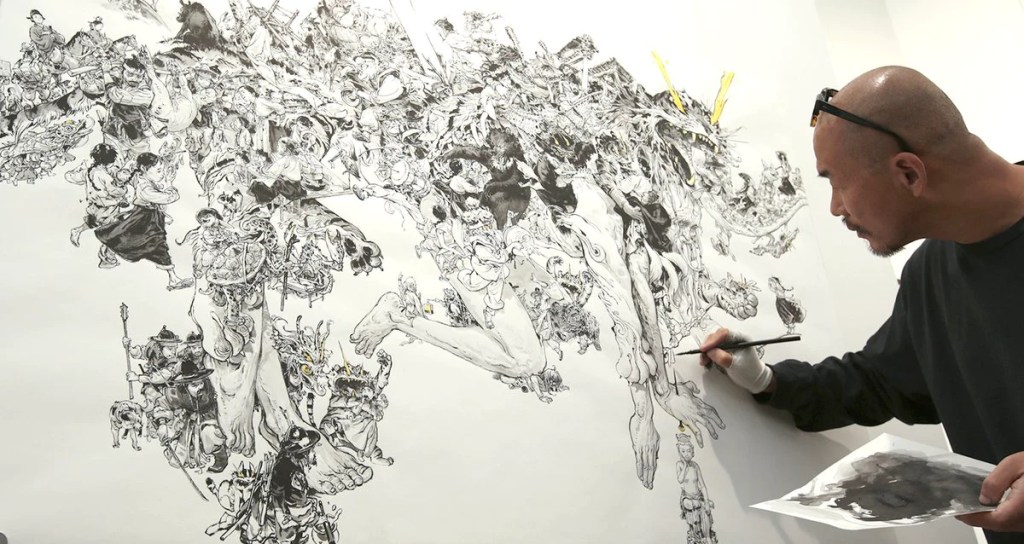
Here’s his Instagram. Here’s his website. Here’s a demonstration of him just riffing on the paper. That’s him, grinning at you in the header image for this article, surrounded by some of his work.

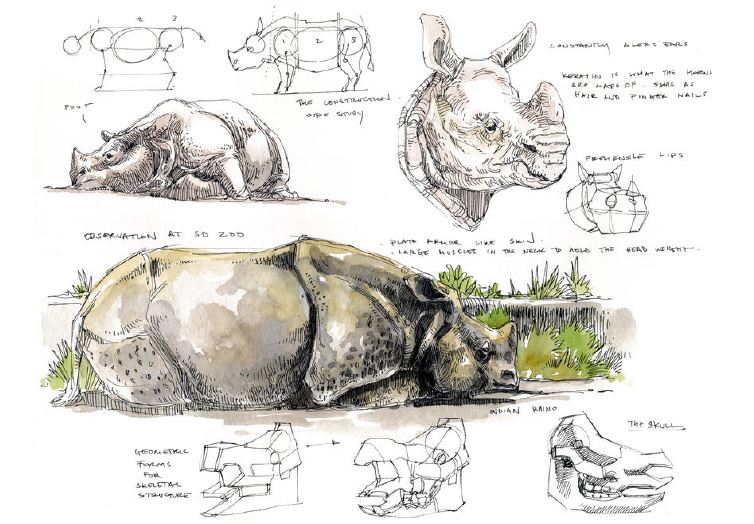
He sees the world like this:

Peter has an inspiring story. He’s been drawing since he was 5, and had an extremely influential teacher when he was studying art (Norm Schureman). Norm apparently impacted him so much that, even with Norm gone now (shot in a senseless and tragic act), Peter has based his life’s work on some of the approaches he learned back then. He’s built a little empire of teaching people like you and me to model any scene at all in terms of basic shapes to get the structure and proportions and silhouettes correct. After that, it’s just shading and texturing, if not also color.

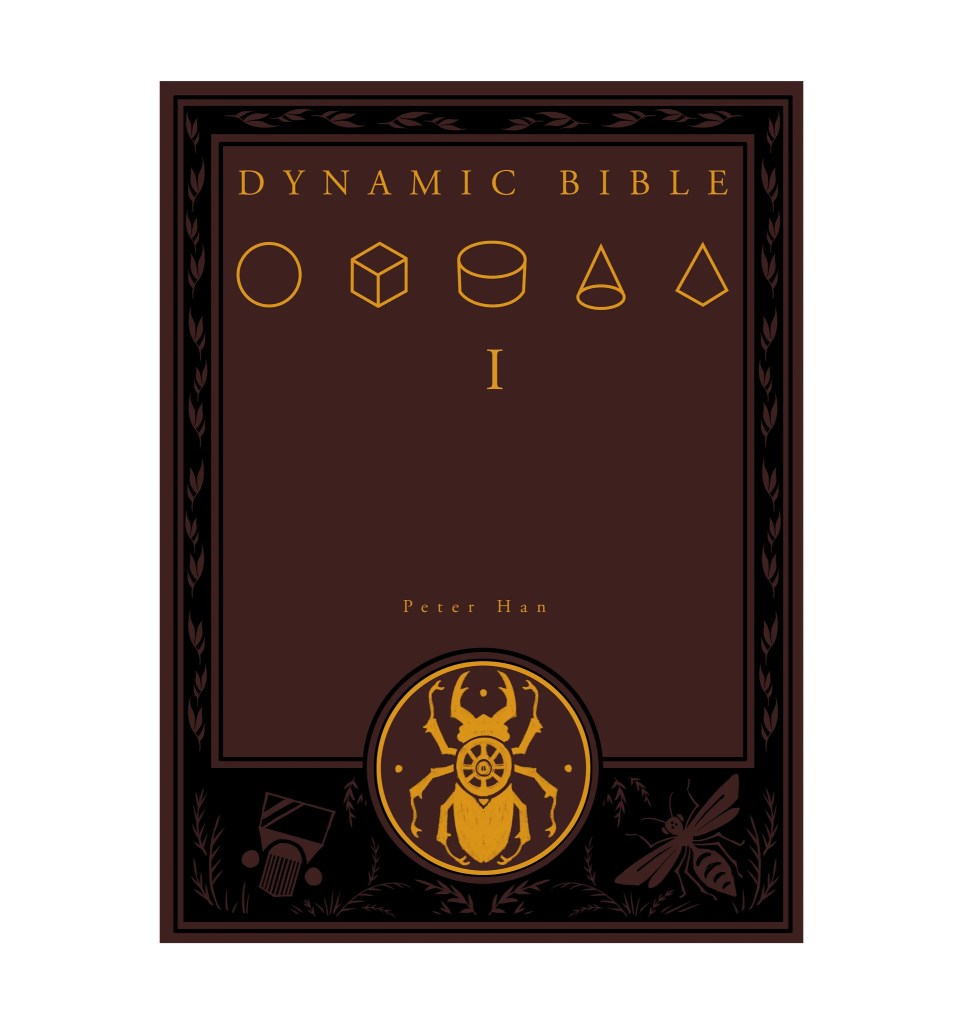
Here’s a sample of a wildly interesting book he’s written and illustrated he calls The Dynamic Bible. But you should really buy yourself the full copy available here.

What are we supposed to take away from all this?

Watch and listen enough to people like those guys highlighted in ImagineFX and Kim Jung Gi and Peter Han, and you’ll hear them talk about “interesting shapes” they encounter in their daily lives. They don’t just see a cricket, they see some fascinating geometry in its belly or legs that has something they appreciate about it. They don’t just see a sunbeam trickling through a dusty window onto a stairway landing, they see its fabric-like ripples and where it fades to one side but gets brighter on the other.

They may not just hear the frog jumping, but experience it more deeply and with more meaning than others.

My point is that’s the sort of untapped perception capacity we can all unleash, with a little focus and determination to do so.

A whole new way to experience the world! That’s what I’m getting at here. Something different and exciting to adventure with.

Cool, huh?

Till next time,

A Gem From The Pulps: The Eyes Of Thar

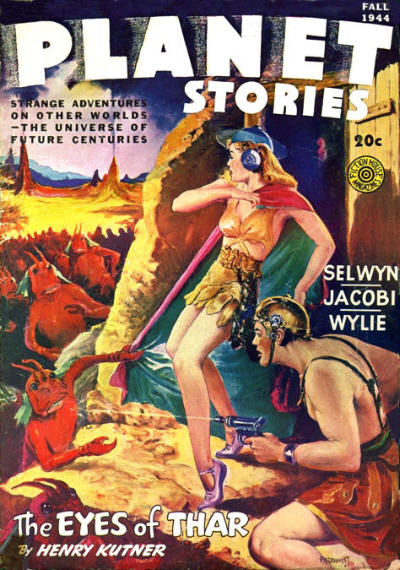
If life is a bit heavy these days, consider the starry-eyed wonder of the science fiction pulps of the 1930’s and 1940’s for a breath of clean air. One well I eternally find refreshing is Planet Stories, a pulp of substance that ran from 1939 to 1955 and which gave birth to many of the mainstream writers of the genre. Today, I want to bring you a low-key page turner of a short story from the Fall of 1944 that highlights the bold energy and high concept speculation typical of the time.

Welcome to Henry Kuttner’s The Eyes of Thar and our latest entry in the Pulp Gems series! (and yes, they misspelled his name on the cover)

Follow the link above to download the Fall 1944 Planet Stories (Kuttner’s story is on page 45), just to keep traffic flowing to the wonderful folks at the Internet Archive. Should you have any troubles with that, download it here.

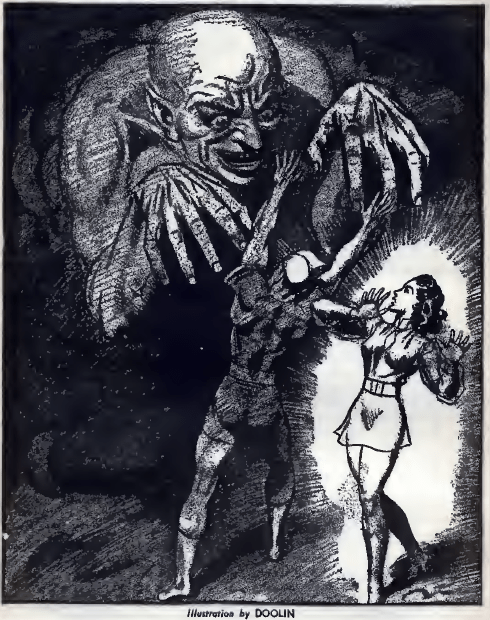
She spoke in a tongue dead a thousand years, and she had no memory for the man she faced. Yet he had held her tightly but a few short years before, had sworn eternal vengeance – when she died in his arms from an assassin’s wounds…

I really think some of those zingers from the tables of contents back in the day were wonderful! This one caught my eye with its dense and compelling mystery summed in those few lines: how was Kuttner going to explain a lady who was dead returning at all, much less one speaking a thousand-year old dead language? And this illustration by Joe Doolin that accompanied it – I was hooked before I started. If you’re unfamiliar with Doolin’s work, read up on him here.

Henry Kuttner co-wrote (with his extremely talented wife, C. L. Moore), one of the first science fiction novels I ever remember reading: Earth’s Last Citadel. I almost hate to re-read that one now, just because I have fond memories of it from then.

Anyway, our tale for today swings right into the action:

He had come back, though he knew what to expect. He had always come back to Klanvahr since he had been hunted out of that ancient Martian fortress so many years ago.

Samuel Dantan is a bloodthirsty terror to those on ancient Mars who had killed his lover years ago, returning to kill them mercilessly between bouts in the spacelanes.

“When Dantan came back to Klanvahr, men died, though if all the men of the Redhelm tribe were slain, even that could not satisfy the dull ache in Dantan’s heart.”

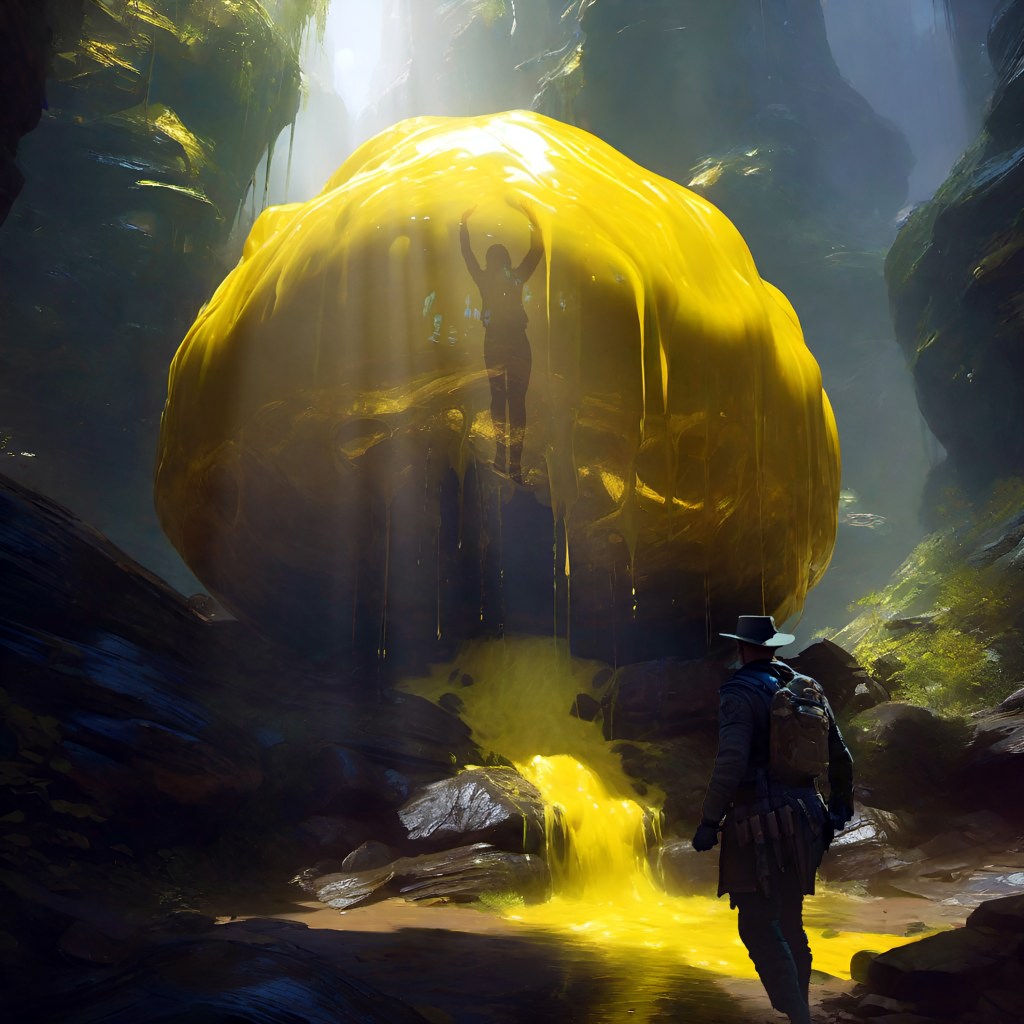
Unfortunately, the tables have turned on him this time, and he’s being hunted. In fact, it’s while he’s desperately on the run that he encounters a mysterious artifact in a canyon that has been exposed by a landslide. Climbing inside, he finds it to be an ancient laboratory, buried under the stream for maybe as many as ten thousand years. Then, locked inside and hiding from his pursuers, a familiar voice calls for someone named “Sanfel”…

At first, it’s just her voice speaking in the dead language of old Mars. Dantan knows it because his grandfather was a shaman and used it for ancient rituals. It’s the voice of his dead lover, for sure, though the mystery woman has no idea who he is. She, too is being hunted by nightmare beast-men of her own foreign universe. And she’s just as desperate.

There are different physics in her world, not only slower time passage but also things such as light and thought work very differently. The weapons and aid that Dantan promises her should they open the doorway between worlds would be useless to her. So she says, though he’s ready to die trying. Sanfel so many centuries ago was following her instructions to build a weapon able to help, but he was long turned to dust.

“No, Dantan, you speak in terms of your own universe. We have no common ground. It is a pity that time eddied between Sanfel and me, but eddy it did, and I am helpless now. And the enemy will be upon me soon. Very soon.”

So her beastly enemies are at her door in an unimaginably faraway universe even as the vicious thugs of Redhelm are at Dantan’s own. Somehow, it’s his lover, and she needs him. What can he do?

*

I’ll let you pick the story up from there, just to avoid spoilers. It’s maybe a half-hour read at most. Definitely worth it. Kuttner’s always great, and this one was a fresh take on Burroughs’ old Mars.

Planet Stories never disappoints.

I hope you liked the referral on this one. If you have your own gems from the pulps, feel free to let me know.

Till next time,

A Celebration! We’ve Hit The Halfway Mark!

Oh boy, has this been harder and infinitely more rewarding than I’d thought it would be!

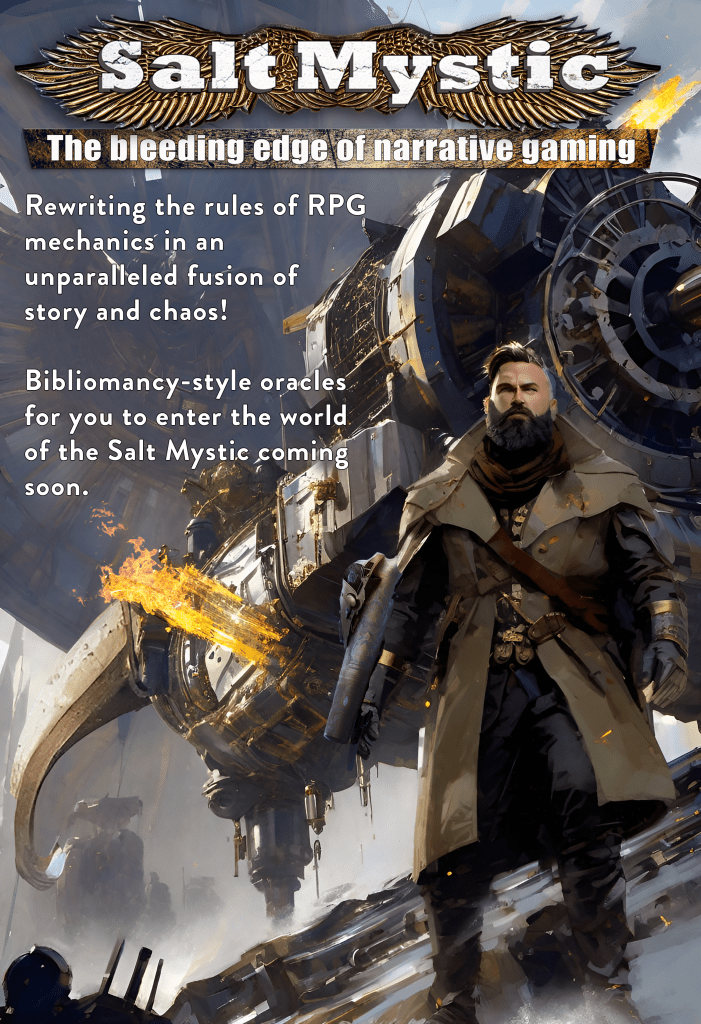
A few months ago, we announced an exciting new project we’re working on at Grailrunner, expanding our Salt Mystic setting into tabletop roleplaying through a bibliomancy-style oracles book. The core idea is to provide a simple engine for exploring a fully realized science fantasy world with its rich history, colorful people and cultures, and the quirks and dangers of exploration contained in the covers of a book. The innovative twist on standard roleplaying oracles, which typically take the form of dice tables, is it will be constructed in a bibliomancy format.

We’re calling it:

I’m the guy writing it and it’s been life-changing. Seriously. I’ve had to stretch my imagination till it hurts to build out a realistic but fantastical world interesting enough to merit exploring and complex enough to come to glorious life for a solo player as well as for groups with a game master…all while avoiding contradictions with stories and materials we’ve already published.

What is bibliomancy?

It means foretelling the future by interpreting a random passage from a book.

How does that relate to roleplaying games?

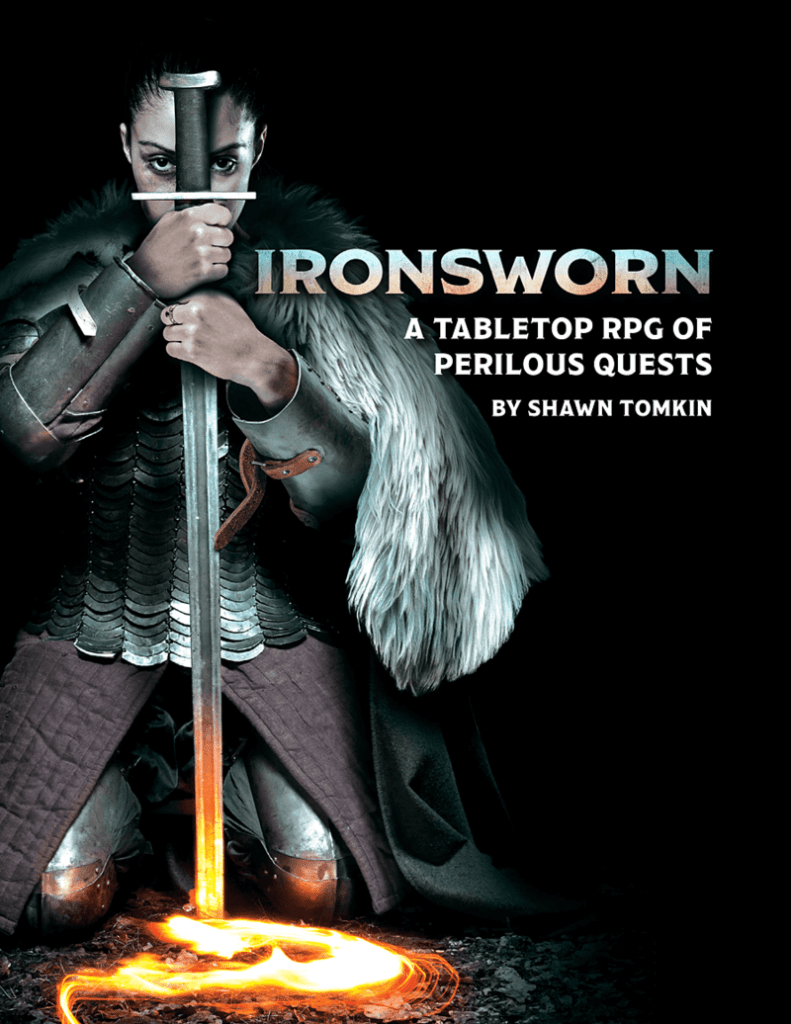
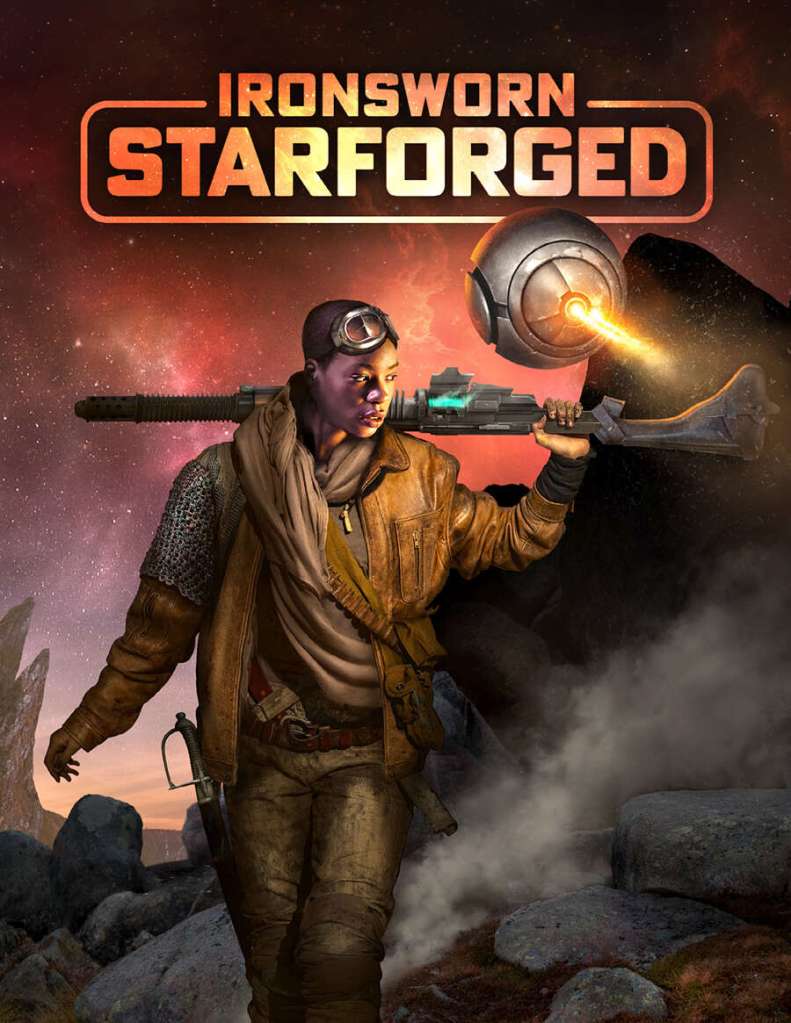
In well-constructed roleplaying games like Shawn Tomkin’s Ironsworn or Starforged, there are layers of dice tables you consult to surprise and throw new encounters and situations at a player. Shawn is a master of this, providing a first impression of a person, then a name, then a more revealed aspect of their character as you get to know them. In Starforged, he provides similar layering for a star system, a planet seen from orbit, then more revealed aspects of settlements as you land your space ship and learn more. This randomness and immersion makes magic happen when you’re trying to avoid a blank page staring back at you (if you’re playing solo) or, worse, a table of players waiting on you to be creative.

More to my point today, he also provides “Action” and “Theme” tables intended to set the scene for a new area you’re exploring or some new situation your player is entering. They’re a bit vague but Shawn has described the marvelous imaginative process we follow in consulting tables like this as “creative interpretation”. What he means is you bring your own thoughts and ideas and filters to bear when you roll for these random descriptive words and make sense of them to drive the story forward.

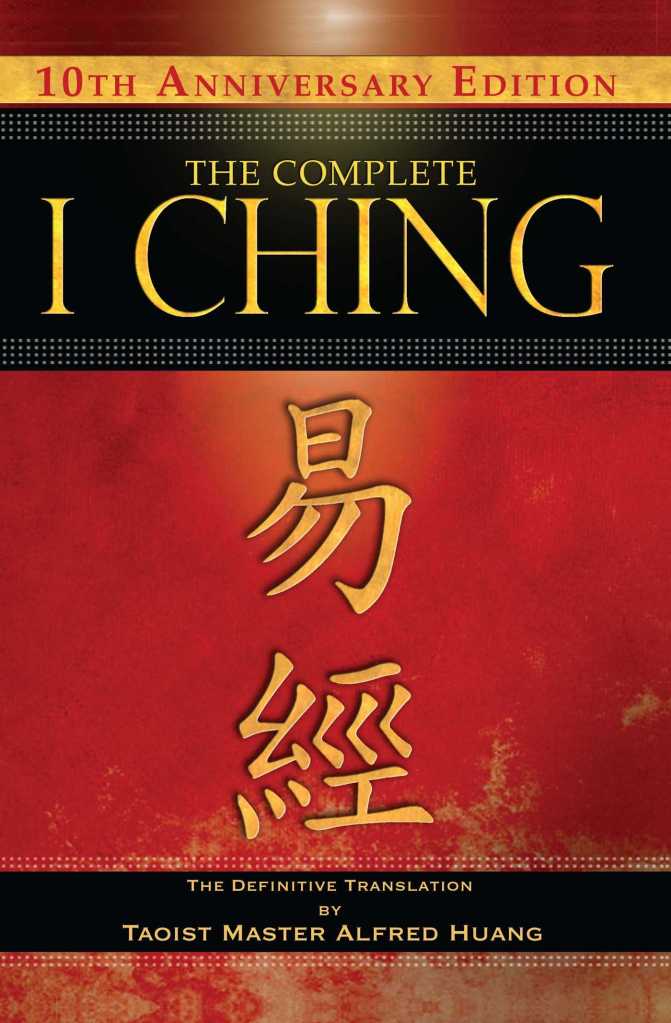
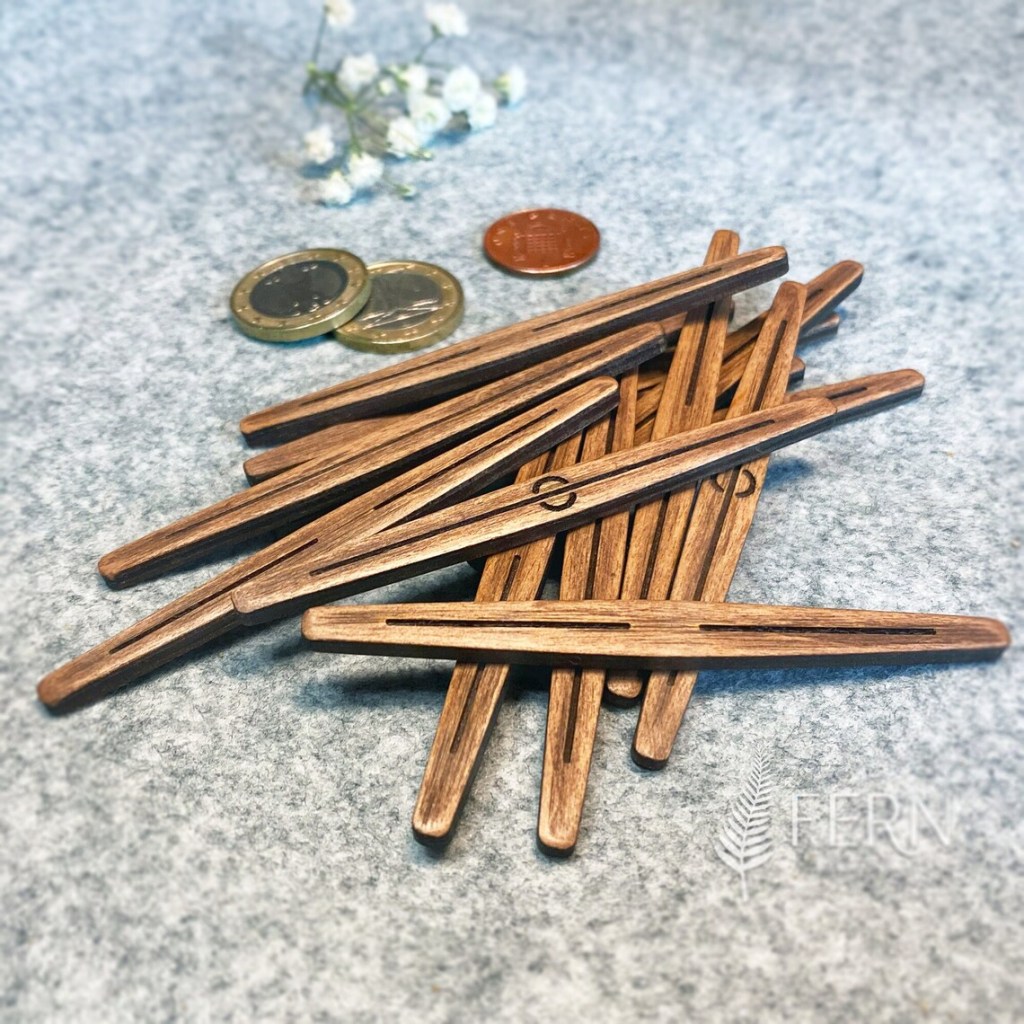
Apologies if you see the I Ching as reflecting a deep reality but I do not and view the creative interpretation process as similarly at work figuring out what a hexagram has to do with a given situation.

So this new book will be a one-stop shop for a roleplaying adventure then?

Yes. I’m being careful to design for use with any roleplaying system (as people are a bit judgey about this) so it can just be an oracles supplement for other systems. However, there are some intriguing things you can only do with bibliomancy mechanics which make it necessary to provide very streamlined rules a solo player or game master can use without any other system (or even dice) at all!

What sorts of new things in the Salt Mystic setting will we see in this?

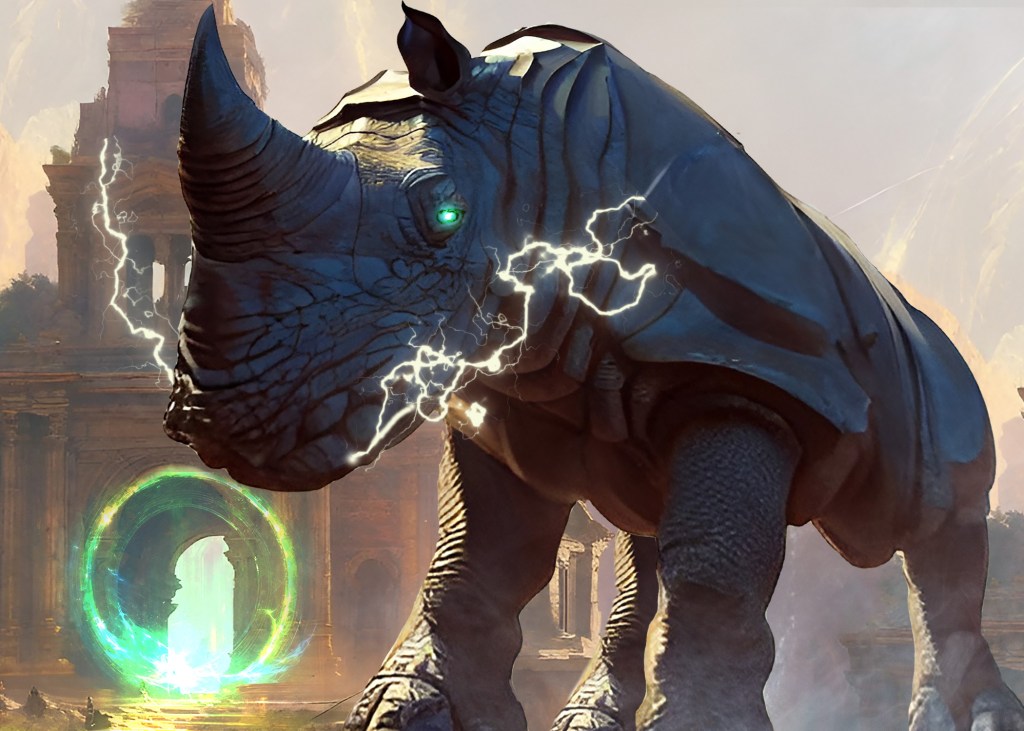
Wow, it surprises me every week! In another project (called Ruinwalker), we already had designed these massive naturally armored rhinos called “towerbeasts”, bio-engineered for ancient wars but still lingering about. Here, as towerbeasts pop up in various places it struck me that they didn’t have the kind of personality dragons do, jealously guarding piles of treasure and breathing white-hot flames.

So…

In Salt Mystic, we have all these abandoned gates to pocket dimensions of artificial space, inside which can be all manner of wonders. Suddenly, towerbeasts got taller in my imagination, and curious, fond of idly poking at and lingering about these gates. They might even jealously protect them, creating ugly encounters for adventurers looking to take a peek inside.

And I had them hiss lightning too, just to make it more interesting.

Fantastic! What else?

Oh, it’s something cool every week or so. My background imagination is always running on this. Let’s leave it for now.

OK, what is the creative process for this? What are your influences?

I wanted this to be on an epic scale, with shimmering cities in the distance and a long, rich history that gets glimpsed but maybe not exhaustively explained, giving the feeling of a world that’s existed a very long time and in which terribly and mighty things have happened. I’ve been rotating at random through several classic epics and transforming a randomly selected phrase into something that makes sense in this setting.

These, so far:

  • The Iliad
  • The Odyssey
  • The Ramayana
  • The Mahabharata
  • Greek mythology
  • Metamorphoses
  • Lucian’s True History
  • Calvino’s Invisible Cities
  • Dante’s Inferno
  • La Morte D’Arthur
  • The Aeneid
  • Beowulf
  • Gilgamesh
  • The Kalevela
  • Lugulbanda
  • Louis L’Amour books
  • The Persian Book of Kings
  • Arabian Nights
  • Parzival
  • Ring of the Nibelung
  • The Raghuvamsa
  • The Song of Roland
  • Pigafetta’s diary
  • The Lives of Saints

For example, if a phrase or encounter from a King Arthur story has a betrayal and a virtuous knight, I’ll keep the betrayal and turn the knight into a famous carbine gunslinger. Magical objects become abandoned & mysterious machines.

I’ve also recently started flipping to random pages in ImagineFX magazines and to interesting images on Artstation for inspiration.

What about the game mechanics?

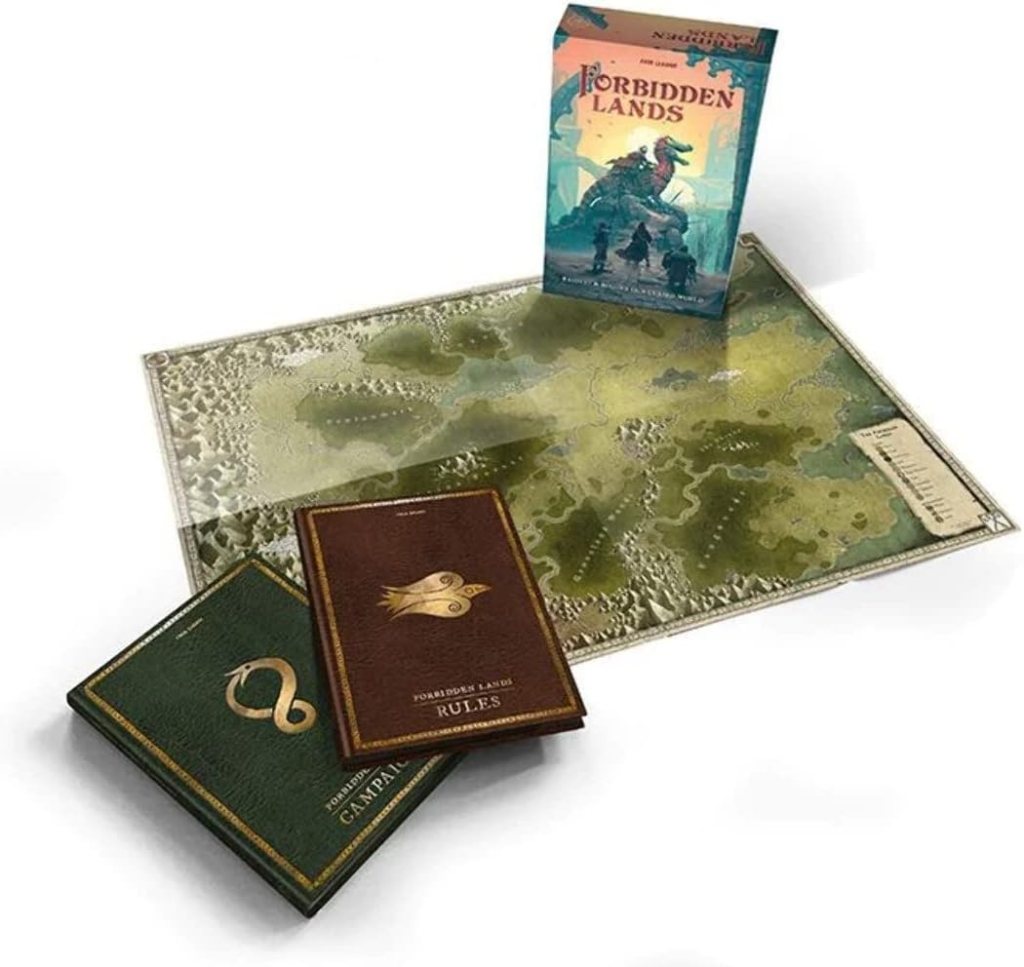
I’ve spent a lot of time researching the best mechanics of various games to translate into a bibliomancy implementation. For exploration, there isn’t a game system better than Free League Publishing’s Forbidden Lands. I’ve taken a spark from them and eliminated dice and the map but tried to keep the general feel of how they treat encounters, story fragments, inventories, and experiences while exploring.

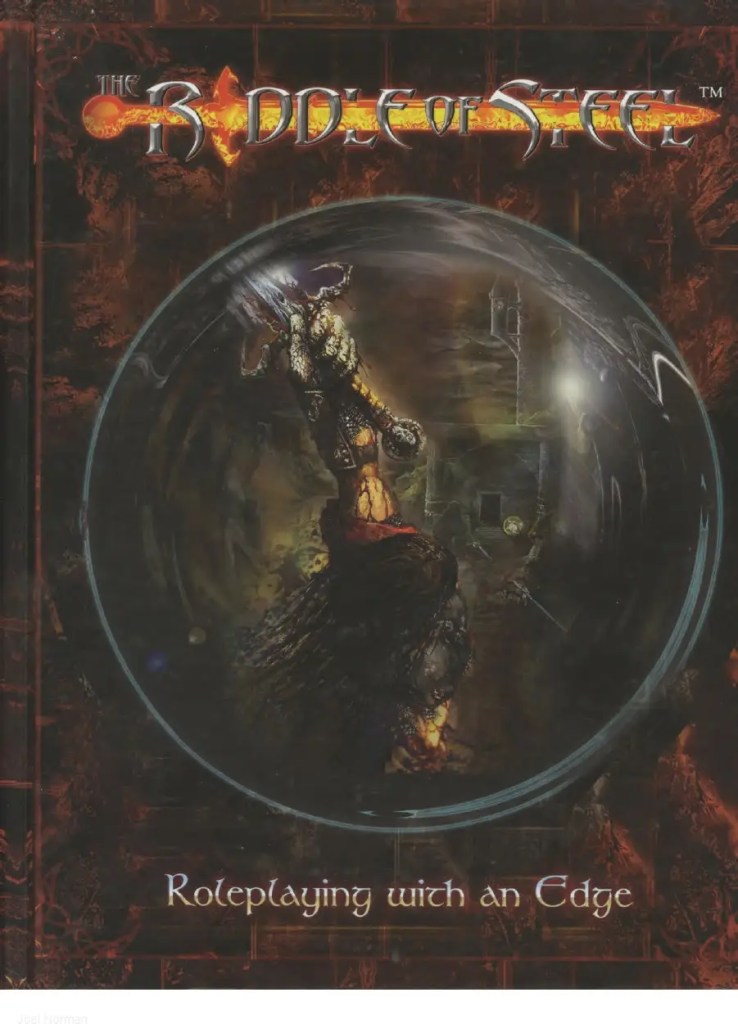
Right now, I’m trying to crack the code on a combat mechanic that doesn’t involve clueless bashing and smashing to grind down hit points. I’m super intrigued by an old, out-of-print game called Riddle of Steel, which contains an innovative and brutal set of rules for realistic combat simulation.

I’ve recently gotten touch with the designer of the game, a fantastic guy named Jake Norwood. We’ll be chatting later this month (I’ll write up the interview for our Inspirational Creator series). Hopefully, I can streamline from the spark of what he has there into something easy but with similar tactics and feel that leverages my format.

Anyway, I just wanted to celebrate a bit and catch everyone up on what’s happening here. I’m targeting 60k words for the text of this, a middling sized novel word count. When I crossed 30k words this week, I felt like cheering. It’s fun, but a real stretch.

I hope this intrigues you, and that you’re okay getting the occasional update as things evolve. Till next time,
New Salt Mystic Lore Card Available For Free Now!

It’s always exciting when we can bring you another lore card: those new bits of the expanding Salt Mystic setting delivered in a unique fusion of flash fiction and original artwork! And they’re free!

You can download any or all of the Lore Cards at the Story Arcade by smashing the button below:

One thing we’re hammering home with the Salt Mystic line, and which will always remain core to it, is this:

In the Salt Mystic universe, cowboy-clad adventurers with ball lightning carbines slung to their arms bravely delve terrifying and thrilling pocket dimensions. The backstory of the Infinite Republic and its collapse, and the unlimited range of possibilities lying in wait out there behind sparkling dimensional gates is the (intentional) engine behind the adventures we’re trying to create.

Read all about the setting here.

So this lore card, called “Newb”, began with the image. I was touring an art museum in Kansas City. And I came across Claude-Joseph Vernet’s “Coastal Harbor with a Pyramid: Evening”, an oil on canvas from 1751.

Here, let me zoom in to the part that struck me:

I just kind of stopped and stared at that part. I mean, what was a pyramid with Roman columns doing on a seashore? And a functional one, at that? It sent my mind reeling, and of course ultimately (as always with me), made me think of sparkling and sizzling gates to artificial pocket dimensions where boundless adventures awaited.

Doesn’t that happen to you?

The artwork for this lore card was based on this, then. I wanted ruins beside a seashore with dudes working their gear along the lines of an exploration party, and I imagined the oriel gate as a shimmering window to another world up on the ruins.

The piece that heads this article is the end result: a paintbash of numerous elements, some of which were drawn from an AI art generator using prompts relating to what I had in mind. Once I composited all the pieces and bits together in Photoshop and color graded everything to match, I tried another trick.

Take a look at this work by Milan concept artist, Edvige Faini:

I am not great with color palettes. In Photoshop, you can match an image to another image’s color palette fairly readily. What I had produced so far in my process was too brown, too plain. It didn’t stand out like I’d hoped, and my adjustments to color and vibrance and hue weren’t giving me the result I wanted.

So I used Edvige’s piece here for the color scheme, matching my art to her color palette. I don’t know what you think, but to me, it’s wonderful. I’m a little overly attached to turquoise, so I’m biased. But still, I like the final product quite a bit.

This was the first lore card where I added the text over the image magazine-style. I’ve been reading a lot of graphic design books so wanted to experiment a bit.

Download the new lore card here.

Till next time, guys:
I Read A Book Because Of Its Cover, So Let Me Tell You How That Went

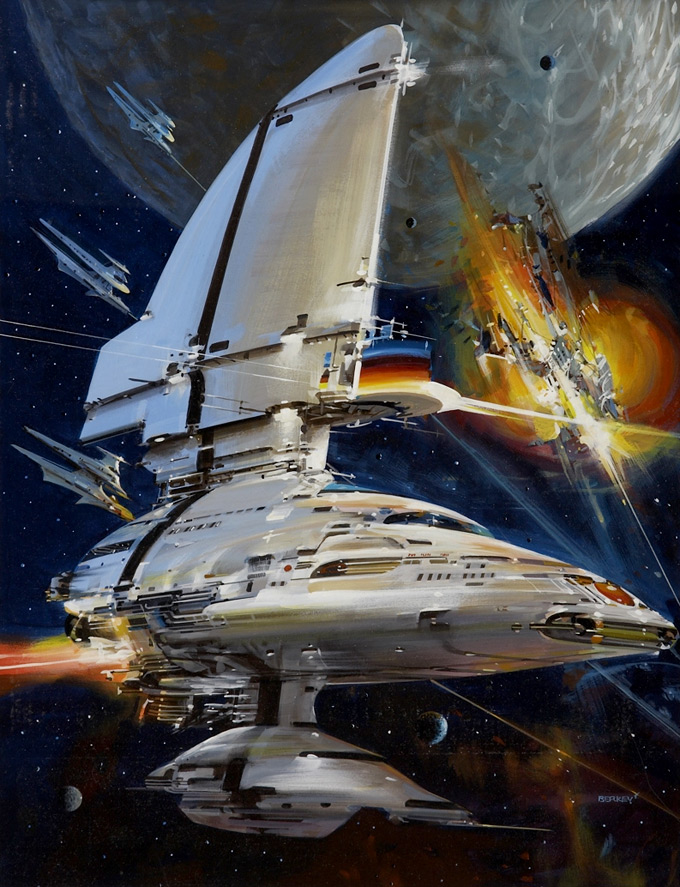
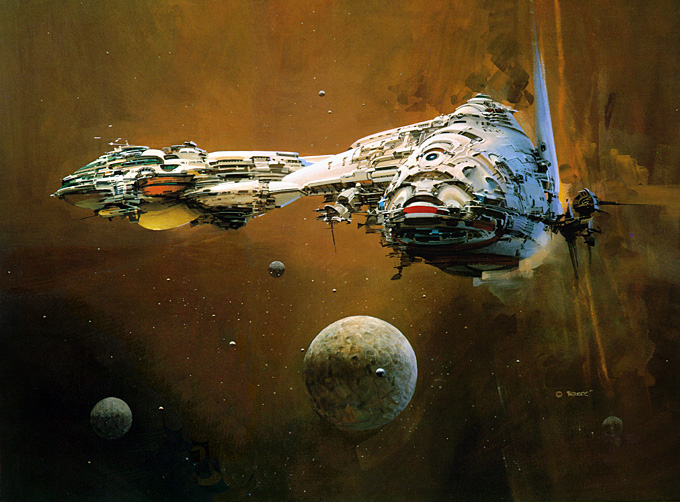
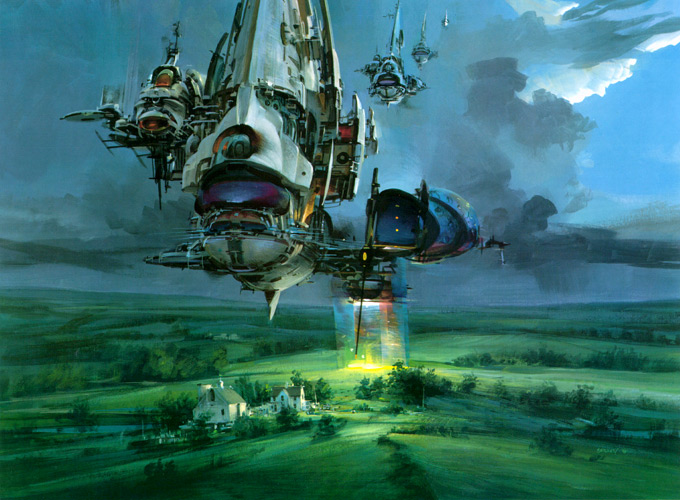
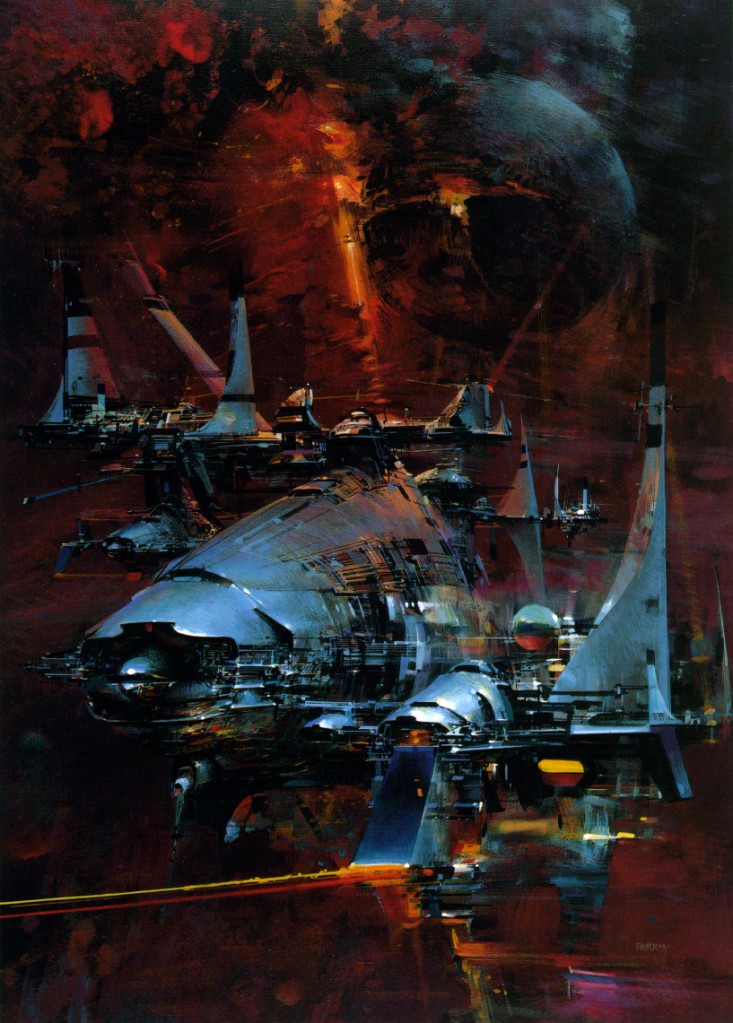
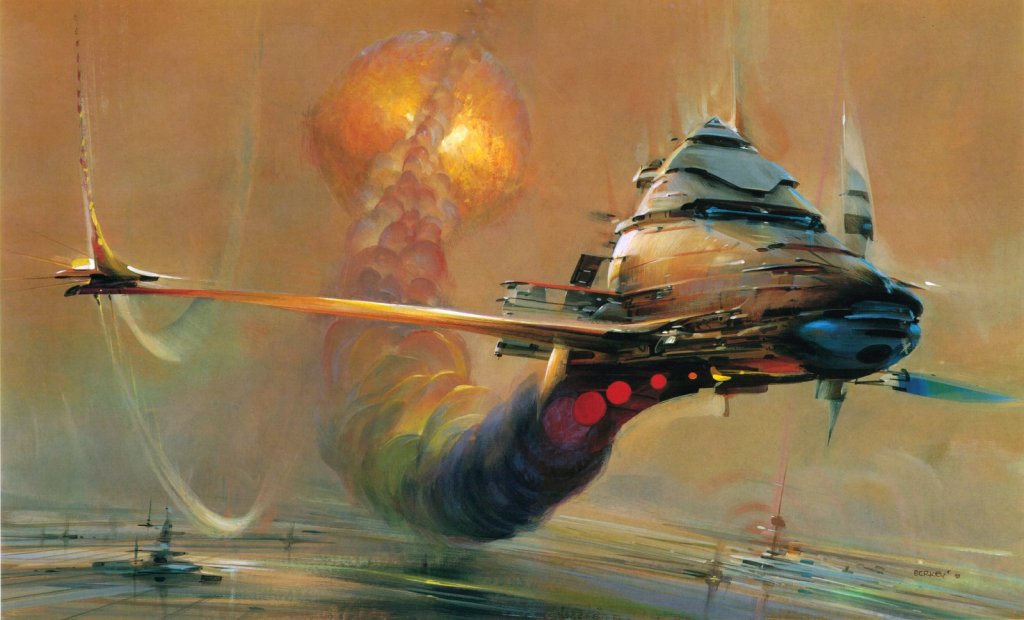
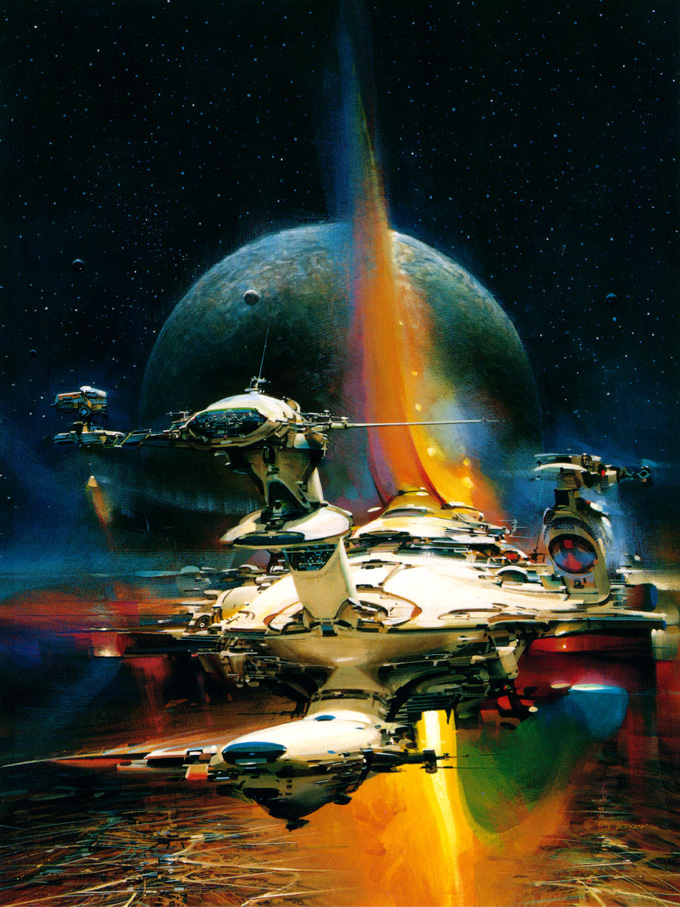
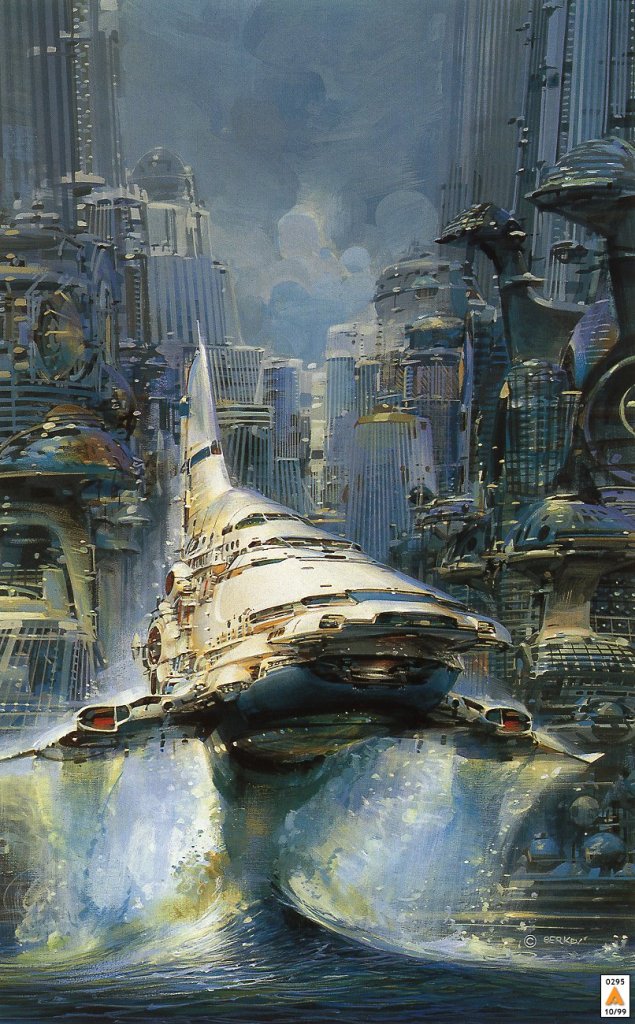
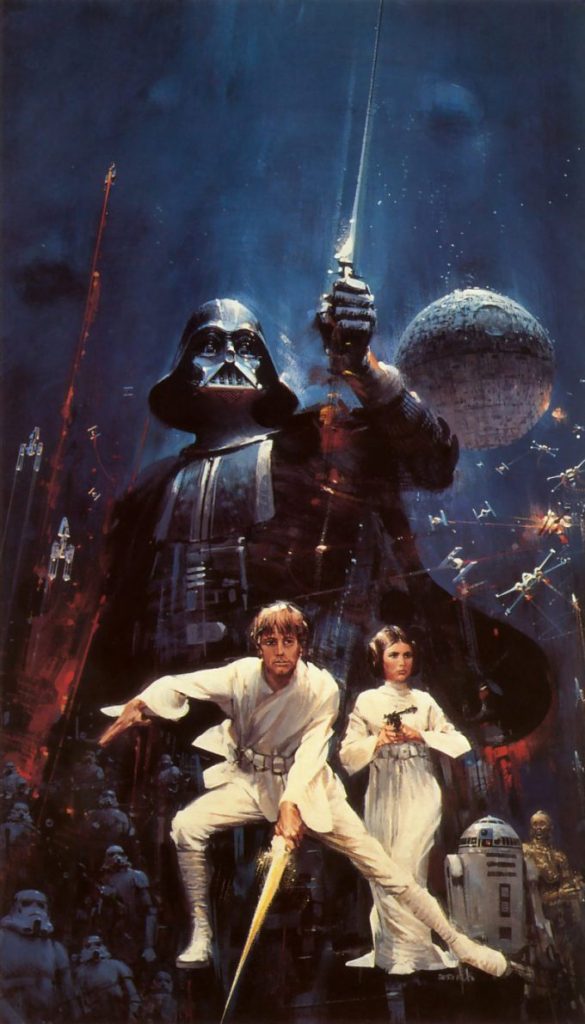
John Berkey was an earth-shattering genius painter of science fiction images. I love everything I’ve ever seen from him. And it isn’t stretching the truth to say that if you view space ships as sleek, aerodynamic vehicles with white plating, that can be traced in many ways right back to him.

Seriously.

He did these, for example:

My first introduction to him way back in the day was this masterwork below, which inspired the mile-high vortex cruiser hydrofoils in the Salt Mystic universe. Just look at this beast:

And, of course, he did this one too, which some of you may remember:

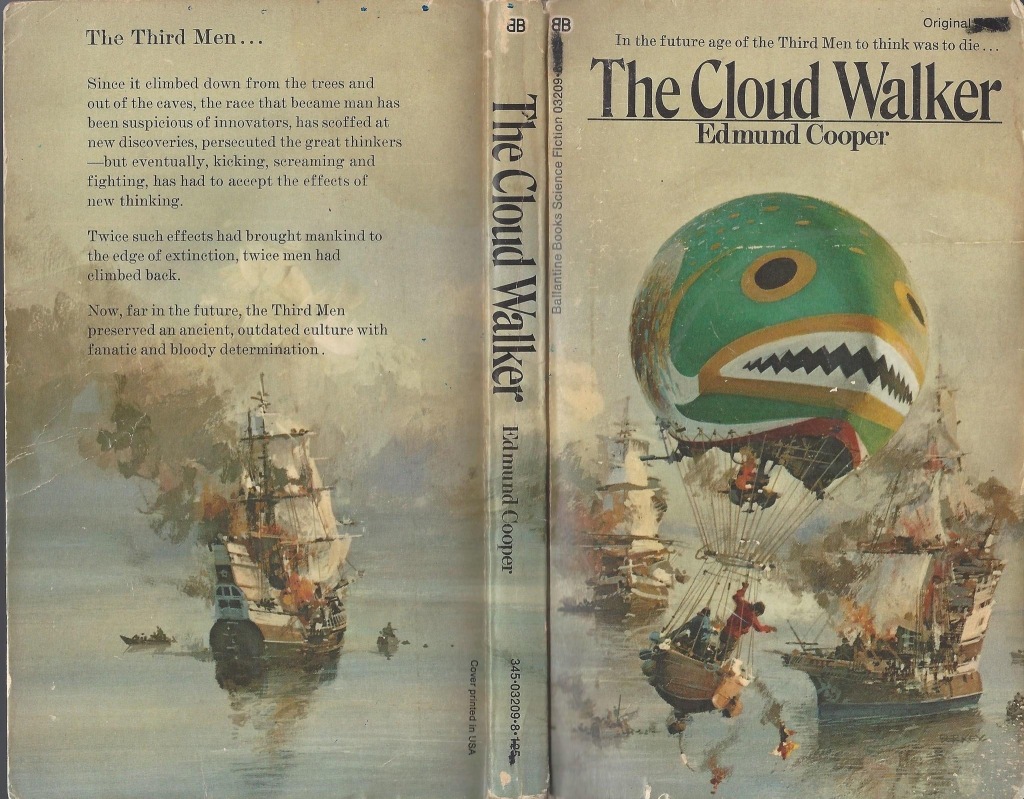
So why am I on again about John Berkey? Well, more than once I’ve seen this haunting, fascinating book cover drift across my social media feed or appear on a used bookstore shelf:

I’d never heard of Edmund Cooper, and it didn’t have space ships or a hook in the back cover text that sealed the deal, so I passed it by multiple times. I’m not that much into humanity turning away from machines because of some uprising or difficulties, like Dune’s Butlerian Jihad or Walter Miller’s A Canticle For Leibowitz. I didn’t really care who the “third men” were, or to read what I imagined would be monotonous pages with religious torch-bearing zealots yammering on in mobs to some plucky machine-builder about how evil computers could be or whatever.

Apologies if that’s your thing, I’m just a bit worn out on those tropes and don’t find them interesting. So I moved on.

But that image though.

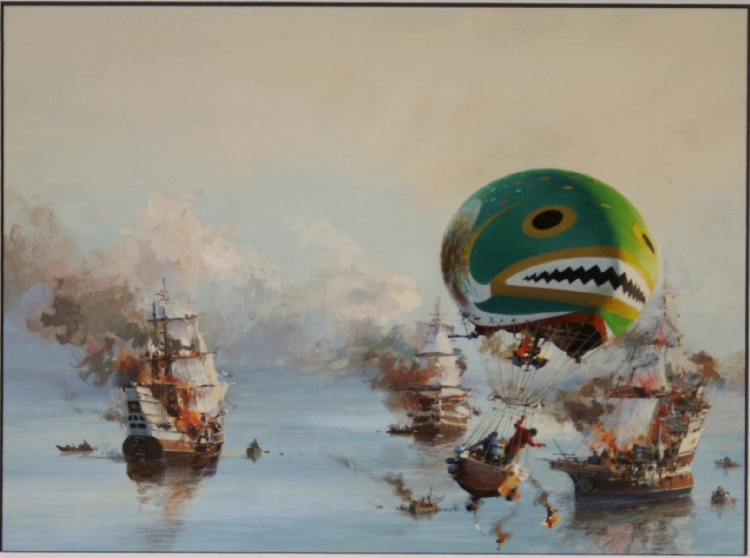
What in the world was the deal with that crazy face emblazoned on the balloon?! I love a naval battle too. Maybe, I thought, after considering Berkey’s fascinating cover art so many times, I should read this book just to settle some questions about what he was painting.

And I’ll cut to the bottom line for you: The Cloud Walker is an easy read, with some mild, pleasant twists on the story you expect to play out here based on the cover description:

The setting is mostly the small town of Arundel in what had once been the county of West Sussex in England after two world wars have decimated the population and turned society against technology in all its forms. The protagonist, Kieron, dreams of building a flying machine, even though he knows what the Luddite priests can do to him if he’s caught. There’s an interesting love triangle, with some mild surprises in how that turns out, and a massive shift in the plot at one point – relating to a pirate invasion, and which ultimately leads to the battle portrayed in Berkey’s marvelous image.

I imagine if you’re a regular reader, you can knock this one out in a couple of days. It was a great experience for me, primarily for one key reason which honestly inspired me to write this article in the first place:

Cooper’s writing style.

There is a style of storytelling often used in fables and myths that is charming, easily relatable, and that focuses on things common to us all like family, fear of the unknown, betrayal, and friendship. Read any of the Narnia books by C. S. Lewis or the Oz books by L. Frank Baum and enjoy a master class in what I’m talking about here. It’s in the word choice, the easy manner of painting images with words, and the awe and wonder of fantastic beasts and places like you’re sitting by a fire listening to it. Lewis and Baum knew what they were doing.

Cooper isn’t in their league; it just struck me that I was several chapters in before I knew it and sinking wonderfully deeper into his rural landscape, getting to know Kieron and his family, the two ladies, and just why he wanted to take to the air in the first place.

I won’t spoil anything here, but I feel Cooper stuck the landing on the ending (pun intended, you’re welcome).

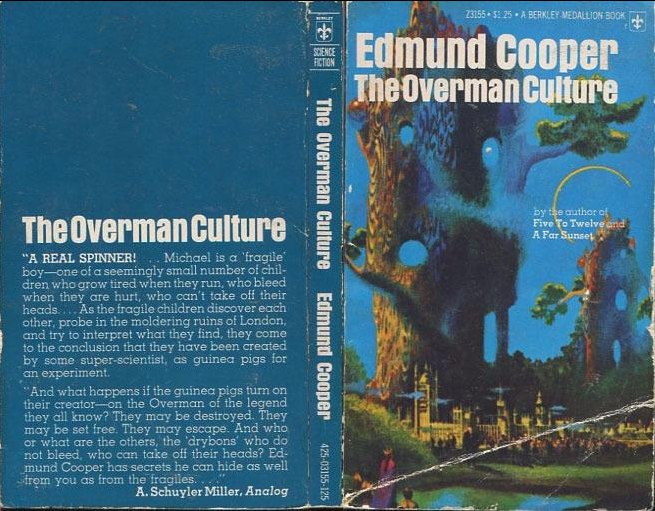
Anyway, I liked it so much I tried another one by Cooper, called The Overman Culture.

Honestly, I hated it. It was the same narrative style, just a meandering and plain mystery box story with some juvenile personal interactions and nowhere near enough happening to keep your interest. I doubt I’ll try Cooper again, though The Cloud Walker will remain with me.

Pick it up sometime if you get the chance. It feels like a comforting fable, and maybe we need more stories like that.

Till next time,
Riffing Ideas Like Stan Lee: The Marvel Method With AI

Assuming there is an afterlife, and that I get to hug three people of my choosing for just how wonderful they were and how much they impacted me, I’m thinking (today at least, the list changes):

  1. Robin Williams
  2. Pausanius (explained here)
  3. Stan Lee

Honorable mention to Nicholas of Myra since he was Santa Claus.

Let’s talk about Stan Lee for a minute, and the miraculous collaborative technique he popularized, in many ways pioneered in comics writing called “The Marvel Method”.

Listen to him explain it here.

The stories Stan used to tell of the old days of Marvel are truly fascinating and inspiring. His mom got him the job with a cousin (it was Timely Comics then). Pretty much all the adults quit or didn’t care and were never around the office, leaving him as a teenager who knew nothing about the business pretending everything was fine.

All manner of folks apparently went on business as usual with the in’s and out’s of the office, never really knowing the kid that was always in was the one basically running everything. As he matured in the business, and couldn’t keep up with the many writing responsibilities, he relied on what came to be called “The Marvel Method”, meaning he would provide an outline or maybe just an idea to the artists, and they would go nuts from there, expanding the basic plot thread into intricate panels of story without words.

Stan would take what they sent, whatever they sent, and add the dialogue and narration, riffing off what they had provided since he only knew the basics of the story. With geniuses like Steve Ditko and Jack Kirby to work with, he made magic.

Here’s what you might have seen, for example, sent in by John Buscema:

We’ve stated our position on generative AI tools here at Grailrunner before. Bottom line, although many occupations are threatened by this rapidly evolving technology, it isn’t going away. In fact, it’s a new industrial revolution. We believe tools like Stable Diffusion and ChatGPT have a place in the world, but see them more like stock image websites or reference or idea books.

Like George Lucas did back in the day with Ralph McQuarrie’s mind-expanding images, the art and the ideas can dance together and make beautiful new worlds.

What’s that got to do with Stan Lee?

There’s a new experimental generative AI program called AI Comic Factory hosted on huggingface here. Looks like this:

You select the style and layout, then enter a prompt. When you hit the Generate button, it lays out a set of comic panels based on your choices and entry that are impressive.

While I have no intention of packaging these up for our Salt Mystic line, it really is fun to describe some of the elements of our IP and see what looks like a Humanoids comic illustrated by Phil Gemenez pop up in a few seconds with interesting graphic elements that inspire more ideas to pursue.

Look at these to see what I mean. My prompts were variations of cowboys entering dimensional portals, stone golems (glowing or otherwise), beautiful fantasy cities and majestic airships, that sort of thing. All very much in line with Salt Mystic adventuring.

I’m drooling at this. It’s incredible how inspiring this can be! When I’m looking for descriptions for a character now, or costumes (which I hate describing), or an interesting perspective for a city, I can go back to these and dream.

Recently, I started playing with Actions in Photoshop to turn images to pen & ink drawings with the click of a button. I have a very nice gallery of ball lightning carbines now to drop in to whatever I’m working on. For the header image, I grabbed one of those, color matched and graded it after compositing it in. I cut it off to fit the panel so it would look like it belonged.

Then I grabbed a cartoon dialogue bubble from a Google search and used Comic Sans font in Photoshop to add the gunslinger’s words. Not sure what he’s pissed about, or who in that city is going to pay for it, but it sends my mind reeling.

Anyway, that’s what I wanted to suggest to you today. If you’re going to try it out, don’t forget to be respectful of the artists who worked on the images that trained tools like these, but don’t be afraid to collaboratively build something new with them either.

Let us know what you think.

Till next time,
New Salt Mystic Lore Card Available For Free Now: “Chimera”

One of the most exciting things we do around here at Grailrunner is introduce new bits of the lore of our Salt Mystic setting in the form of Lore Cards. A fusion of art and short fiction, it’s an important mechanism for us to introduce and test these mini-expansions of concepts that will wind up ultimately as game cards or in the books or stories.

You can download any or all of the Lore Cards here at the Story Arcade.

A product we have heavily active in development right now is a bibliomancy-based oracle book for roleplaying in the Salt Mystic universe to be called The Augur’s Book Of Lots.

In order to bring that to life, all manner of new encounter types, new places, and historical figures and their stories are needed. It’s an incredible, life-changing experience for me personally to explore all that and watch it unfold like a big, crazy flower, and I can’t wait for you to see it. Seriously, this whole world is building itself and waiting for you to slide a ball lightning carbine on your arm and take a cautious step through the gates…

Today, we thought we’d introduce you to a new exciting, and sometimes terrifying, addition to the world of the Salt Mystic: the chimera.

The sneaky fellow leaping on our hapless narrator today is part man / part scorpion. In the oracle book so far, we’ve met countless hybrids like this already, though this particular combination freaks me out the most.

Download the new card here

As for the art, as always it’s a paintbash with the heavy lifting done in Photoshop. In this case, the bounty hunter, the skull on his hat, the backdrop, and the scorpion-man were all drawn from various iterations of Stable Diffusion or Wonder, with heavy correction and repair. I discovered the ‘puppet warp’ in Photoshop, which is my new favorite trick!

After compositing them together and color grading everything, I added some Stock nebulosity overlays from Nucly to make the diffuse smoke around the windows, blending them in Screen mode. The positioning of the scorpion-man was tricky – it made more sense for him to be creeping around behind our clueless bounty hunter, but the more I looked at him in mid-air, the creepier and more interesting I found it to be.

I wanted the skull on the bounty hunter’s hat to glow, so that along with the window glow was just some soft brush painting in Color Dodge blend mode.

Anyway, we hope you like the final product. Let us know what you think, and please check back periodically for updates on the stuff we’ve got cooking.

Till next time,
Aesthetic Puzzles: When Bach Met Shakespeare

Bach never met Shakespeare. Sorry about the clickbait title. Stick around though, because as always with this site we’re probing the creative process and what inspires it. In the past few weeks I’ve personally been going down a deep well with Johann Sebastian Bach, father of western music, and how his mind worked. I’m finding useful lessons there that I thought you might find helpful if you’re a creator yourself. Special focus here is on writing, hence the Shakespeare reference.

And you don’t have to know a thing in the world about music.

Join me?

(There are loads of Youtube videos about what makes Bach great, but two excellent books from which I’ve drawn heavily here are Bach: Music in the Castle of Heaven by John Eliot Gardiner and Why Bach? An Audiovisual Presentation by Daniel Brown.)

Bach composed music primarily for Sunday church services and often wrote the music for existing hymns or verses written by someone else. It was an aesthetic puzzle for him to solve, and sometimes a difficult one. Certain notes clash with one another and can sound harsh. We (somehow) almost universally feel kind of sad with certain notes and sequences and kind of happy with others. We (again, somehow) expect certain notes to show up after others or else it feels weird and lacking closure. For whatever reason, western ears generally agree on quite a bit about how musical notes should string together into music. Strange, but true.

Bach knew his craft well, understood these basic principles and expectations, and steered his listeners like a sailing ship by leveraging them in his works. He didn’t settle for just solving these aesthetic puzzles but broke every rule and went to places with his imagination that suited his own dazzling, soaring intellect in the process. That helped lay the foundations for western music as we know it today.

I noticed the more I read about Bach’s compositional tactics that those who were analyzing the music would very often say things along the lines of “you expect this, but he does that”. Once you get your head around these fundamental expectations I’m talking about above, it gets a bit clearer what Bach was doing, and what it can mean for a writer or creator in different fields than his.

Here’s an example: Jesu, Joy of Man’s Desiring. This (in my opinion) is one of the most beautiful pieces of music ever written. Bach fit this masterpiece on top of some stanzas written over 60 years earlier by a minister and musician named Martin Janus in 1661. It opens with Bach’s melody, followed by the first phrase of Janus’ chorale, then shortly thereafter the 2nd phrases of both works coincide flawlessly. The freedom with which he went gonzo with his own melody yet managed to fit without seams over the hymn is my point.

Bach was dancing.

Another example is particularly moving and gets to the heart of the spirituality and emotions that moved him when he was composing.

Sleepers Awake, a Voice Is Calling: An obscure 16th century pastor named Philipp Nicolai had just taken the job in the town of Unna when plague struck and killed half its people. His parsonage overlooked the cemetery. Suffering deeply, yet wishing to record his meditations to encourage the survivors, Nicolai wrote a collection he called “Mirror of Joy” which emphasized shining your own light in expectation of great things, not terrible ones. Bach built his own work on top of Nicolai’s hymn in a masterclass of weaving musical compositions.

In his piece, Bach presents his new melody entirely, then repeats the first three phrases (with 2nd and 3rd swapped) but with Nicolai’s melody in the choral part underneath. Again, separately they sound nothing alike, yet together they are flawless. At one point, Bach’s melody repeats its first phrase over Nicolai’s phrase that does not.

Did you catch that?

Bach wrote something that can repeat its melody and match perfectly in two different places on another melody. In this perfect weave, he was also weaving Nicolai’s times and his own – for Bach’s audience too was being encouraged to shine their own lights into a world that needed hope.

Last example, and another gorgeous one:

Air from the 2nd movement of Bach’s Orchestral Suite No. 3 in D Major. Click the link and listen to the incredibly talented Evangelina Mascardi (who has said she spent up to 6 months at a time learning Bach’s songs). You can stop after the first half when she pauses and moves on to ‘Gavotte’ to see my point here.

Listen closely for the melody – you’ll catch it right away. It’s really beautiful and poignant. People tend to describe this as, not sad…not happy…but something rather that reminds them of happy times, good memories, good friends. Keep listening though. You want him to repeat it. He doesn’t, not exactly. He adds all manner of embellishments and hesitations and dances around the melody he knows you want to hear again.

He gives you what you want, but embroiders it.

So what’s all this got to do with writing?

Recently, I came across a thorough article describing 49 effects possible in literature. At the time I first read it, I was just starting to examine Bach’s approach to composition and his freedom to innovate with tuning, different instruments, and other elements. I was seeing him play with his listener’s expectations, creating tension and dissonance and delaying resolution till it suited his dramatic purposes.

And I was seeing the same possibilities in this list of literary effects, such as pathos, irony, comedy, and others. Readers most certainly have common expectations and tropes, which can be similarly placed in opposition to each other. Bach mastered the elements of his craft and innovated wildly, though always staying in close view of what he knew were his listener’s expectations of resolution.

Maybe some principles apply here:

  1. Consider your characters and their dynamics. Anticipate the readers’ expectations and play with that. Don’t shortcut and focus on “subverting”, which is obnoxious and unpleasant.
  2. Innovate, but stay in view of the compelling engine driving the story…the central character dynamics. Don’t mess that up in your desire to make the plot happen.
  3. Break the attention barrier with something energetic and wild. Bach’s church audience was rude, reading papers, talking loudly, ogling women, endlessly walking in late and leaving early. He demanded their attention with his craft. We should do the same.
  4. Know the elements of your own craft. Be a professional – no obvious mistakes with grammar or plot holes, terrible dialogue or vague character motivations. It breaks the magic.
  5. Feel it. Bach felt it in his soul. He was talking to God. If we’re going to try and make something new for the world, at least we could try and feel it as we do so.

Anyway, I hoped you enjoyed a layman’s take on Bach. Impressive genius, even if you don’t really understand all the nuances of what he was doing.

Till next time,
“Jeweled Warriors In The Merchant Wars” – Free New Salt Mystic Lore Card!

Grailrunner is excited to announce the latest addition to our growing Salt Mystic Lore Card set: “Jeweled Warriors In The Merchant Wars”. Download it for free here!

Welcome to the Grailrunner Story Arcade!

If you need to know a bit more about what we’re doing with Salt Mystic, feel free to check this out here.

In the Salt Mystic Sourcebook And Core Rules, we define seven different ages into which the long history of this setting is divided. The brief snapshots there allowed us to drop maddening hints of some intriguing twists and adventures that occurred thousands of years ago, but we never really get the chance to dig in to those earlier time periods. Maybe one day these will all be their own novel series or art lines – but for now, we’re in the Guardian Age, man. It’s enough work bringing that to glorious life!

So this new lore card was a chance to flesh something out that I thought was interesting. There’s already a guy named Murmur in the Salt Flats character cards that has an Artificial Intelligence sprite inhabiting his armor that we’ve always thought was funny. This lore card was where we go big with that.

Horrifyingly big.

As for the art, as always it’s a photobash and paintover of some different elements pulled from a few sources. The background is an AI-generated image of a battlefield. The warriors’ jeweled armor was inspired by Grant Morrison’s 18 Days art book (which accompanied the web series), based on the storyline of the Mahabharata. The carbine was built in Blender as a 3d model, textured with a steel plating from Textures.com. The ruby faceplate of the guy turning on his general was taken from a freely available png – literally just googled “ruby gemstone” or something like that.

I especially love the way the smokey flames turned out, spewing from that fellow’s gauntlet-based plasma weapon. There are at least three overlays on that, all from Nucly. I wanted it to seem like he’s firing that weapon up, and his general has just now realized that he’s stepped over some kind of line.

Anyway, we hope you like the art piece and accompanying flavor text. Let us know what you think.

Till next time,
The Battle Of Hernani And The Creative Arms Race With AI

You likely know if you’ve been here at Grailrunner before that we obsess over the creative process. In fact, the whole point of the company, this site, and essentially anything we’ve produced is to dissect, pick apart, rewire, engineer, and shove ammo clips into the imagination. It’s in the logo, man.
Dreams are engines. Be fuel.

Anyway, there was an interesting riot at a theater on February 25, 1830 in Paris that has a few things to teach us about how to break ground in creative work. And as creators right now, with the looming and worldshaking onset of AI disrupting every outlet of creative work and threatening that age-old security we were all told that computers can’t create, it’s more important than ever that we get really, really good at doing new things.

New things, man. New things. Now AI can’t really do that.

What is the context on this Hernani thing?

Victor Hugo wrote Les Miserables and the Hunchback Of Notre Dame. That’s where you might know him from.

This guy:

He was a playwright too though, and in his day the structure and content and expectations of plays were widely agreed and rigid. You didn’t mess around with these things if you wanted to be treated seriously and not look like a disrespectful clown. After all, Aristotle analyzed storytelling in tragic drama at an almost divine level 2,000 years before in his Poetics and designed the perfect tragedy, defining the unities:

  1. Unity of time: the action of the play must unfold over a single day
  2. Unity of place: the action must take place in a single setting
  3. Unity of action: the play should comprise only one plot

If you abided by these principles with your play, which was the norm for hundreds of years in Europe, then Aristotle’s intense study of impact and memorability and propriety assured you that you had a well-constructed play. Why deviate from that – you think you know better than Aristotle?

Another non-negotiable was the clear definition of genre: comedy or tragedy. More than just branding, this was crucial to the audience’s interpretation of your work. Is it supposed to be funny, and so pratfalls and misunderstandings and goofy idiots abound? Or is it supposed to be sad, and so have larger-than-life people make key mistakes based on their natures and lose it all?

And finally, you didn’t show things that were grotesque, things that were compulsively ugly or distorted. It was just improper and undignified.

Oh no, what did Victor do?

Well, he wrote this. It’s the preface to a play called Cromwell. It pissed a lot of people off and set the stage for the riots to come later. A few tastes of his blasphemy:

“But the age of the epic draws near its end. Like the society that it represents, this form of poetry wears itself out revolving upon itself. Rome reproduces Greece, Virgil copies Homer, and, as if to make a becoming end, epic poetry expires in the last parturition. It was time. Another era is about to begin, for the world and for poetry.”

“…the grotesque is one of the supreme beauties of the drama.

“‘But,’ the customs-officers of thought will cry, ‘great geniuses have submitted to these rules which you spurn!’ Unfortunately, yes. But what would those admirable men have done if they had been left to themselves? At all events they did not accept your chains without a struggle.”

Victor was saying that the unities of time and place arbitrarily handicapped the dramatic potential. Check pages 15 and 16 for his blast on unity of place – it being silly to think so much important action would happen in this one spot, and what blah-blah is needed to tell the audience what’s going on elsewhere! He continues on pages 16 and 17 destroying unity of time – it being equal nonsense to expect important events all to happen in a day.

And wow, is that one something Hollywood sequel writers should read!

In summary, he felt the rigid genre conventions of comedy and tragedy were limiting his ability to express wide ranges of emotion and experience, the unities were unnecessary constraints that forced silly adjustments, and, most importantly, he didn’t care for the convention of avoiding the grotesque. He called for a new genre to explore the essentials of life, with beauty and ugliness, good guys and monsters, gold-laid parlors and miserable alleys.

“These rules, man! They’re cramping my style!”

What was Hernani then?

Well, Cromwell was too big in scope to even be staged. It’s 400 pages long and at one point needs the British parliament to enter the stage. His next attempt got banned. Then he wrote Hernani, which censors possibly felt was too ridiculous to bother with.

Plot? Two noblemen and a mysterious bandit are in love with the same woman. A conspiracy is in play, and things get dark ending with a wedding and poison.

Rules broken? Well, the story unfolds over 6 months at various settings. That was naughty of him. You weren’t supposed to show death, violence, or intimate scenes. Hernani opens in the lady’s bedroom and closes with three suicides. Equally naughty. You were supposed to adhere strictly to your chosen genre: comedy or tragedy, but he incorporated farcical dialogue and had a king hiding in a wardrobe. Language should have been clean and high-minded, but he included lines like:

“Is this the stable where you keep the broomstick you ride at night?”

You weren’t supposed to let your lines of a sentence from one line of verse to another, but that happened too. Characters were supposed to be one-note caricatures generally who didn’t change, to represent some trait or concept, though he fleshed them out far more than was typical and allowed transformations (such as Don Carlos becoming a good emperor). And he used stage directions like a madman, which was also strange.

So this happened:

Why was there a riot though?

These Parisians had been through revolutions and guillotines, deaths and restorations of kings, and were reading on a daily basis about massive changes in nations such as Italy and Germany where entire systems of government were being born while others faded. France was still in turmoil politically and censorship was a powerful tool to shut down free thinkers and radicals. Breaking rules in art was linked to breaking other rules, perhaps those tied to abiding by norms set by those in charge.

Today in a politically split country we might feel threatened by those who question gender norms or who bend traditional family structures because we fear what a loss of those foundations might mean for the country’s future, what impact it might have on our children. You see how mad everybody gets about that every day on Twitter. Here in Paris, it was perhaps as scary for them.

In fact, many of those same rioters a few months later in July ousted King Charles X and replaced him with  “Citizen King” Louis-Philippe.

Why is this a big deal?

My point today is that it was risky and insightful for Victor Hugo to see these literary conventions as the limiting factors they were and to dare to break them. And when he broke them, it wasn’t for shock value as so many charlatans today offer instead of talent. Victor didn’t break the rules because he was a renegade, he felt they limited his storytelling.

He kept his eye on the point behind what he was doing: telling an impactful story. Maybe Hernani’s plot is nonsense, but that wasn’t what he wanted anybody to take away from it anyway. Read the Cromwell preface. He wanted a new genre free of limits.

Impressive. Impressive to even notice the limits. How many conventions do we abide by and not even notice. Are our prison walls invisible?

What does this have to do with AI ?

AI writing tools like ChatGPT are not going away. They’re seeping into our marketing copy, our kids’ essays, blog and social media posts, even podcast scripts. As creators, there is one important fact behind any AI-based technology like these which can be an asset for us. They are trained on data sets and those data sets include conventions and limitations like those Victor Hugo raged against.

Ask ChatGPT to write you a story about King Arthur or a D&D scenario and it’s painfully generic. We as creators are in an arms race then, as those tools get better. We have to get better.

Let’s go fight our own Hernani then.

Till next time,